Archive for the ‘China’ Category

DPRK – PRC trade up 18% in January

Friday, March 2nd, 2012

According to Yonhap:

North Korea’s trade volume with China jumped nearly 20 percent in January, compared to the same period last year [January 2011], a report said Friday, indicating sustained bilateral economic relations.

Citing data released by China’s Ministry of Commerce, U.S. broadcaster Voice of America said trade between China and North Korea reached US$418 million in the cited month, up 18 percent from a year ago.

The North’s January exports to China reached $139 million, an on-year increase of 7 percent, while imports expanded 24 percent to $278 million, according to the report.

Coal was the North’s biggest export item for the Chinese market, totaling $70 million, it added.

Here is a link to the original VOA article.  Hat tip to a friend.

Read the full story here:
N. Korea-China trade jumps 18 pct in Jan.: report
Yonhap
2012-3-2

Share

DPRK’s Air Koryo to open Pyongyang, Harbin charter flight

Friday, February 24th, 2012

According to Xinhua:

Air Koryo of the Democratic People’s Republic of Korea will launch a charter flight route between Pyongyang and the northeastern Chinese city of Harbin on April 27, local Chinese airport authorities said Friday.

The airline will offer a round-trip flight between the cities every Monday and Friday, a spokesman with the Heilongjiang Provincial Airport Group Management Co. Ltd. said.

The new service will meet the travel demands of nationals from both countries, the spokesman said.

Harbin, known as China’s “Ice City,” is the capital of Heilongjiang Province, which borders Russia.

Read the full story here:
DPRK’s Air Koryo to open Pyongyang, Harbin charter flight
Xinhua
2012-2-24

Share

China does [not?] commit to new infrastructure investment in Rason

Wednesday, February 15th, 2012

UPDATE 2 (2012-4-12): North Korea and China attracting investors for Rajin Port development (IFES):

China is currently actively recruiting investors to build additional wharfs in Rajin Port.

China’s Dandong City Industrial and Information Association (丹东市信息协会) announced that it is seeking investments for the construction of tanker wharf under 10,000 ton and affiliated facilities. This organization has received 45 year usage rights from the Rason City People’s Committee and stated that it needed 330 million CNY (52 million USD) to cover the construction cost. According to the association, the investment is attractive because of its geographic location, reduced transit time and costs, and tax-free benefits, for which a special permit was obtained from the North Korean authorities granting trade goods coming from Jilin Province at the Hunchun Port to be allowed entry tax-free. In addition, cargo will be permitted to be sent from Rajin Port to other ports in China.

Meanwhile, North Korea is also planning to build a new port in the Rajin-Sonbong area with a state-of-the-art container distribution capacity. According to the “Rajin New Port Development Plan,” Rajin port development will undergo major transformation as an international hub port, similar to Busan Harbor, unlike the previous small-scale renovations of Piers 1, 2, and 3. This new port is expected to be built across from the current Rajin Port.

Rajin Port development was initially considered as a remodeling project to update the existing wharfs. In 2003, China began to implement construction of Piers 1, 2, and 3. However, the piers began to deteriorate and for the lack of railway and road infrastructure in the area, it delayed the transportation and distribution and could not perform its full function. As a solution, in 2008, North Korea transferred the usage right of Pier 1 to China and Pier 3 to Russia. At that time, Pier 1 was developed to primarily transport chemical fertilizers but it was recently updated as a transportation dock for coal. Russia, in addition to the port, also carried out a modernization project of the Rajin-Hassan railway system to improve the transport of containers.

The new port development plan as suggested by North Korea indicates Jian Group of China as the responsible party for developing the new port into a container port. However, considering that North Korea’s industry does not call for container ports, it is more likely that North Korea is expanding the port to make it a hub port to ship cargo to China, Russia, and Europe. Considering Rajin Port’s geographical advantage, it is likely that North Korea is striving to make it into an international hub port that connects the Pacific with Northeast Asia.

China’s recent advertisement of investment is also considered to be linked with the new port development in Rajin Port.

UPDATE 1 (2012-3-1): Accoridng to Stratfor, the Chinese have denied they plan to make this investment.

The Chinese Foreign Ministry denied allegations made in a Feb. 16 South Korean media report regarding its agreement with North Korea to jointly develop the Rajin-Sonbong Special Economic Zone (SEZ), a port area in northeast North Korea commonly referred to as the Rason Special Economic Zone.

According to the Yonhap news agency, Beijing agreed in late 2011 to invest about 19 billion yuan ($3 billion) into Rason, for which it would receive the lease of three piers for 50 years. Under the agreement, Beijing would also build an airfield, a thermal power plant and a 55-kilometer (34-mile) railway track connecting Rason to Tumen, China. The Chinese Foreign Ministry claimed that the specific details of the report are untrue and that China and North Korea had agreed only in principle to develop the zone.

China has long exerted its economic influence in North Korea and has an interest in the strategically important Rason Special Economic Zone. Chinese involvement in Rason dates back to the 1990s, though Beijing increased its involvement considerably in 2005 when it secured the rights to one of the port’s piers. Beijing has been particularly involved over the past few years. While the details of the deal remain unknown, it is clear that Beijing has arranged to help Pyongyang develop Rason, possibly by connecting the remote port to northwest China. Such a development would revitalize the zone — to the benefit of both countries.

ORIGINAL POST (2012-2-15): China has committed to infrastructure projects in Rason. According to Yonhap:

China has secured the rights to build three new piers in a special economic zone in North Korea’s northeast and use them for 50 years, sources said Wednesday.

China will also build an airfield and a thermal power plant in the special economic zone known as Rason, as well as a 55-kilometer railway track between China’s northeastern city of Tumen and Rason.

North Korea and China reached an agreement late last year to build infrastructure in Rason with Chinese investment of about US$3 billion, according to the sources in Seoul and Beijing.

The Daily NK offers some more data:

China has agreed to dig out dock 4 at Rasun to make it possible for 70,000 ton vessels to dock and to construct a runway long enough to accommodate passenger and cargo aircraft within the SEZ; the railroad is due to be complete by 2020, while the development of dock 5 and 6 will follow that of dock 4, Yonhap sources claim.

This agreement was reportedly signed quietly by North Korea’s Joint Ventures Committee and the Chinese government shortly before Kim Jong Il’s death.

The North Koreans have sought the construction of an airport and expansion of the port  for some time.

KITC published the image above in 1995 (Source here).  If you look carefully on the right side of the picture you will see the site of a proposed airport.

Above is a more recent map of Rason published by the DPRK. In the middle of the above map you can see a small airplane which represents the desired location of a future airfield. It is in the same location as shown on the KITC map.

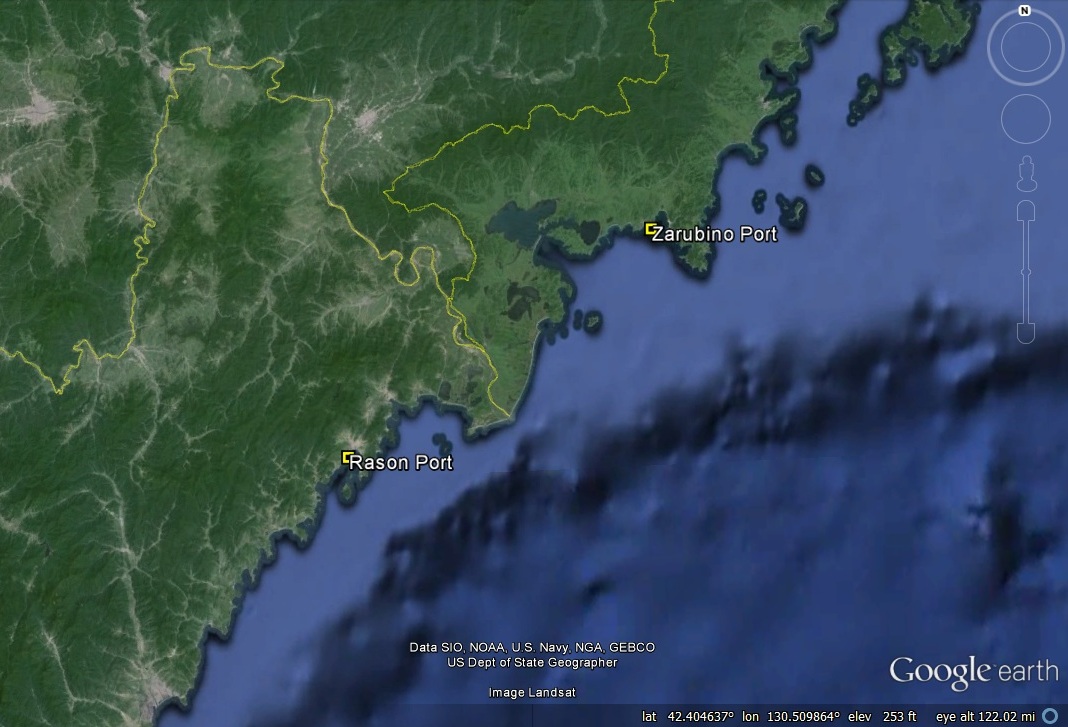
Here is the approximate location on Google Earth (42.397884°, 130.592084°):

If you look at the left side of the KITC photo you can also see that there are many piers, however today there are only three.  I suspect that the new piers will be constructed south of the current piers and will look something like this:

The railway and power plant projects are intereting as well.  There is already a thermal power plant in Sonbong, so I expect that the Chinese are simply renovating it so that it generates more power or is simply more reliable (Google Earth:  42.327275°, 130.382585°):

At a presentation at the Korea Economic Institute in Washington, DC, Andray Abrahamian reported that increased electricity supplies for the Rason Zone could come from China.

As for the Tumen (China) – Rason railway line…this already exists as well.  The DPRK’s Hambuk Line (함북선) runs from Chongjin to Namyang (border with Tumen) to Rason:

The Tumen to Rason leg of this railway line, however, is approximately 156km (according to Google Earth) and likely runs pretty slowly.  The proposed new Chinese-built Tumen-Rason line is intended to be just 1/3 the distance!

Additional Information:

1. The Russians built a railway line from their border to the Rajin Port. Learn more here.

2. The Chinese and Russians have already rented two of Rajin’s three ports.

Read the full stories here:
China secures right to use 3 piers to be built on N. Korean port for 50 years
Yonhap
2012-2-15

China Reportedly Grabs 3 Docks and More
Daily NK
2012-2-15

Share

DPRK visitors to China in 2011

Friday, February 10th, 2012

The PR of China published official data on the number of North Koreans that visited the country in 2011. The numbers were originally reported in this Voice of America report (in Korean). The VOA story was covered in English by two Korean news sources, and I have posted them below.

It is important to remember that these are official Chinese numbers, therefore they represent a lower bound of the actual numbers of North Koreans crossing the border.

According to the Daily NK:

China’s National Tourism Administration has revealed that the number of North Koreans legally visiting the country reached a new high in 2011.

According to a report carried by Voice of America yesterday, the 152,300 North Koreans who visited China last year exceeded the 2010 figure of 116,400 by more than 30%, and comfortably beat the previous high of 125,800 recorded in 2005.

Approximately half (75,266) the total number of visitors apparently went for work, while a further 39,042 went for business purposes or to attend meetings. 4,589 were tourists. However, the statistics show that just 99 of the visits were for the purpose of visiting relatives.

72,885 of the visitors were age 45 through 64, while a further 64,823 fell into the 25 to 44 bracket. Women were heavily outnumbered by men; 21,828 against 130,472.

Yonhap reported an additional point:

Ferries were the most popular means of transport for the North Koreans at 62,160 passengers, followed by 33,933 who arrived by plane, 31,829 by car, 19,132 by train and 5,246 by foot.

Although the majority of official North Koreans border crossers are men, it is reasonable to assume that the majority of unofficial North Korean border crossers are women.

Read the full stories here:
Largest-ever number of N. Koreans visited China in 2011: report
Yonhap
2012-2-10

Official Visitor Numbers Hit New High
Daily NK
Park Seong Guk
2012-2-10

Share

DPRK – PRC economic integration

Thursday, February 9th, 2012

According to the Choson Ilbo, China-N.Korea trade has reached a historically high level (as it does nearly every quarter).

China’s trade with North Korea has tripled since 2005. According to the Korea Trade-Investment Promotion Agency (KOTRA), Chinese customs statistics show that China has been bumping up its trade with the North by US$1 billion every three years since the middle of the last decade.

After first breaking past the $1-billion trade barrier in 2005, China posted $2 billion in 2008 and over $3 billion last year. Minerals, machinery and cars topped the list of exports, and two-way trade last year reached its all-time peak of $5 billion.

Additional Information:
Read the full story here:
China-N.Korea Trade Reaches All-time High
Choson Ilbo
2012-2-9

Share

DPRK fruit imports

Monday, February 6th, 2012

According ot the Donga Ilbo:

About 10,000 tons of fruit have been exported every year to North Korea via the Chinese city of Dandong in Liaoning Province, which borders the North at the estuary of the Yalu River.

Fruit imports for the North`s elite have reportedly posted double-digit growth over the past five years despite severe food shortages in the Stalinist country.

An informed source in Dandong said Monday, “About 10,000 tons of fruit were exported to North Korea via Dandong Marine Center last year,” adding, “They were worth 100 million yuan (16 million dollars).”

Shipments to North Korea have grown about 15 percent per year on average over the past five years, the source said.

Fruits exported to the North include the different varieties available in China, including subtropical and tropical types such as bananas, pineapples, litchis, dragon fruit and durians as well as apples, tangerines and watermelons.

The source said fruit exports surge just before major North Korean holidays, including Feb. 16 (the birthday of the late North Korean leader Kim Jong Il) and April 15 (the birthday of North Korea founder Kim Il Sung).

“Fruit exports significantly increased ahead of Christmas Day in the past, but there was no notable change in exports last year due to the death of Kim Jong Il,“ the source said.

North Korea does not celebrate Christmas but fruit exports usually increased because Dec. 24 marks the birthday of Kim Jong Il’s biological mother Kim Jong Suk. The shipments are sent to Pyongyang for use at events or consumed by the power elite. Payment is made mostly with U.S. dollars, but the yuan is often used to settle accounts.

The Dandong city government also established an agency in charge of fruit exports to the North. Liaoning Province announced on its website Thursday that a center for market purchase of exported fruits for border area trading was set up in Dandong.

The purpose of the market is for Dandong to supply fruit to meet growing demand in North Korea, and assure the quality and safety of them.

Furthermore, the agency aims to manage chaotic fruit export markets for North Korea. In Dandong, a number of fruit stores targeting trade with the North rather than sale to residents are reportedly operating.

One fruit vendor said, “We`re shipping fruit via vehicles that regularly travel back and forth to and from Shinuiju and Dandong.”

The center is designed to control and manage the overall fruit export market to the North, including fruit exports by such small merchants. From now on, all fruit exports to North Korea will be reportedly be sent through this center.

The center is a subsidiary of Dandong Guopin Co. Ltd., a state-run company established by Dandong. It has a system worth 10 million yuan (16.4 million dollars) designed to enhance capacity in sorting, refrigeration, packaging, inspection and transport of fruits.

The center has taken charge of about half of fruit shipments from Dandong to North Korea every year, and its office is in Dandung Marine Center.

Read the full story here:
Chinese city exports $16 mln worth of fruit to N.Korea yearly
Donga Ilbo
2012-2-6

Share

Some DPRK – PRC economic cooperation stats

Wednesday, February 1st, 2012

According to the Korea Herald:

The trade volume between China and North Korea jumped from $1.97 billion in 2007 to $5.62 billion in 2011 with the North suffering a deficit of about $700 million, according to figures compiled by the Korea Trade-Investment Promotion Agency. In contrast, the volume of South-North commerce showed a slight decrease from $1.79 billion to $1.71 billion over the cited period, with the North recording a surplus of about $114 million.

China’s share in North Korea’s total trade rose from 42.7 percent in 2007 to 56.9 percent in 2010, while South Korea’s proportion declined to 31.4 percent from 38.9 percent.

Excluding inter-Korean commerce, China accounted for a whopping 83 percent of North Korea’s external trade in 2010, up from 67.1 percent in 2007. China’s investment in the North rose from a mere $1.1 million in 2003 to $41 million, or 94.1 percent of the total foreign investment, in 2008 before decreasing to $12.1 million in 2010, according to figures from the Chinese Commerce Ministry.

Experts here are concerned that the North Korean economy will be further absorbed into the circle of China’s economic influence to the point of making it difficult for the South to expand its economic presence in the North after shifting its policy toward inter-Korean businesses.

“North Korea has imported most of machinery and other industrial equipment from China, which may lead to cementing the structure of its long-term economic dependence on China,” said Cho.

Observers say it goes too far to say North Korea will become a Chinese province, but China has been pushing the North toward reform and openness as part of a larger scheme to develop its three northeastern provinces, which lag behind the east coastal zones.

Some North Korea watchers say Kim Jong-il might have been pressed by Beijing to visit China four times in the last two years before his death.

China has been the main developer of the Raseon special economic zone, the combined towns of Rajin and Seonbong, in the northeastern coast of North Korea, which also provides it with access to an ice-free port for shipping abroad manufactured goods and other products from its northeastern provinces.

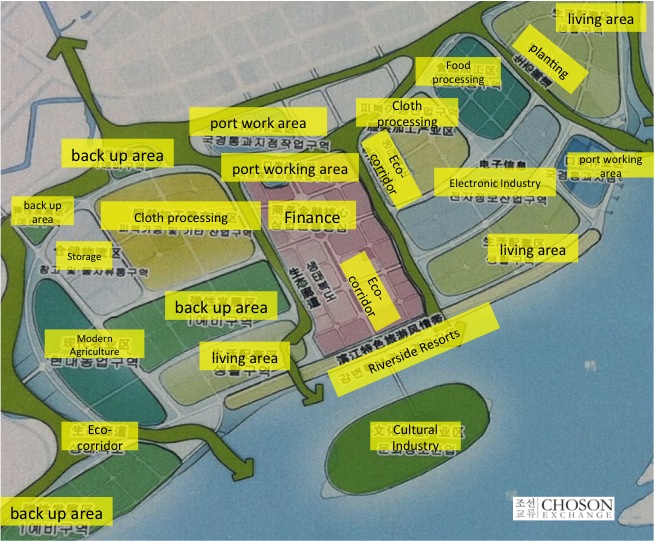
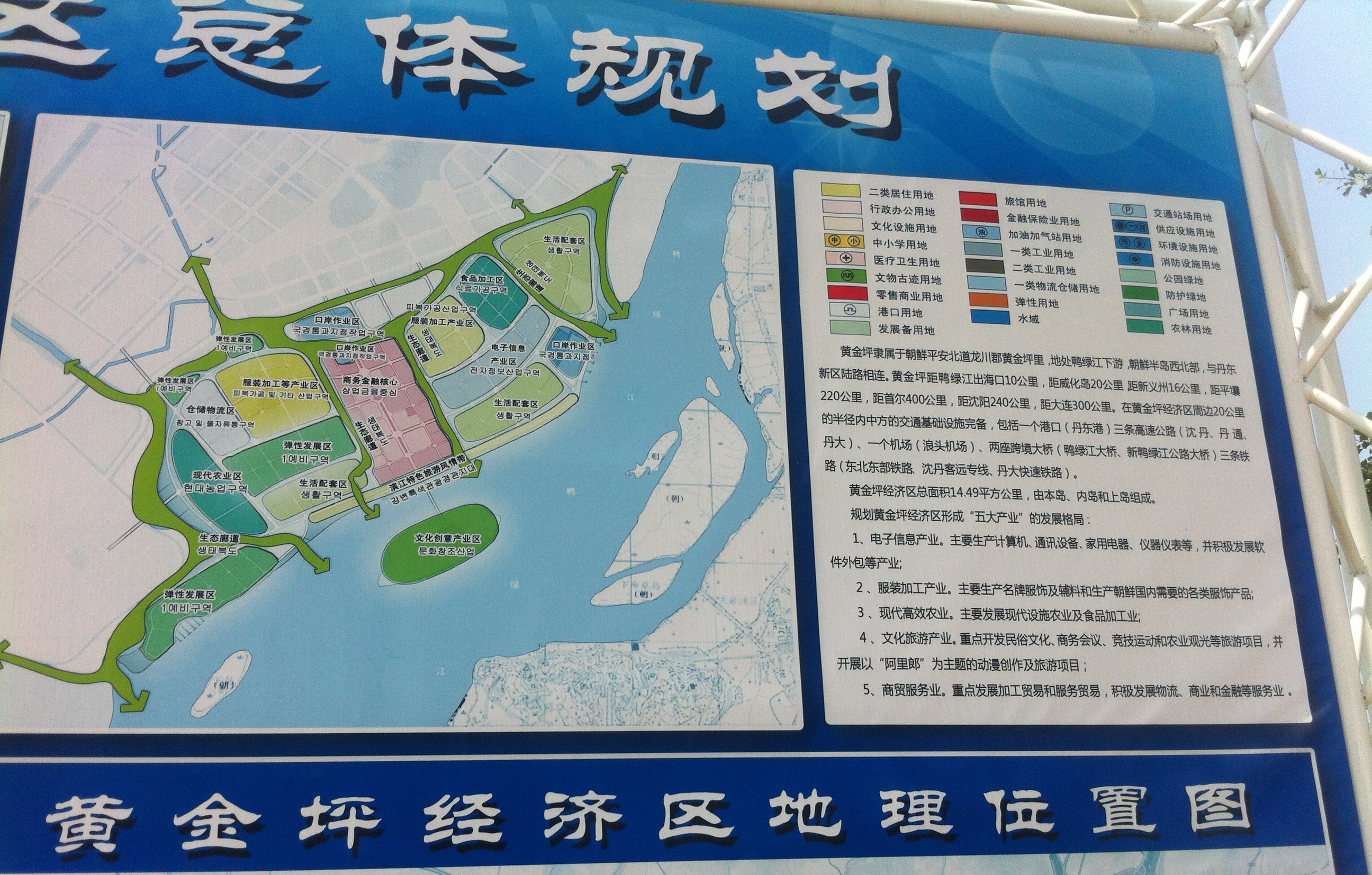
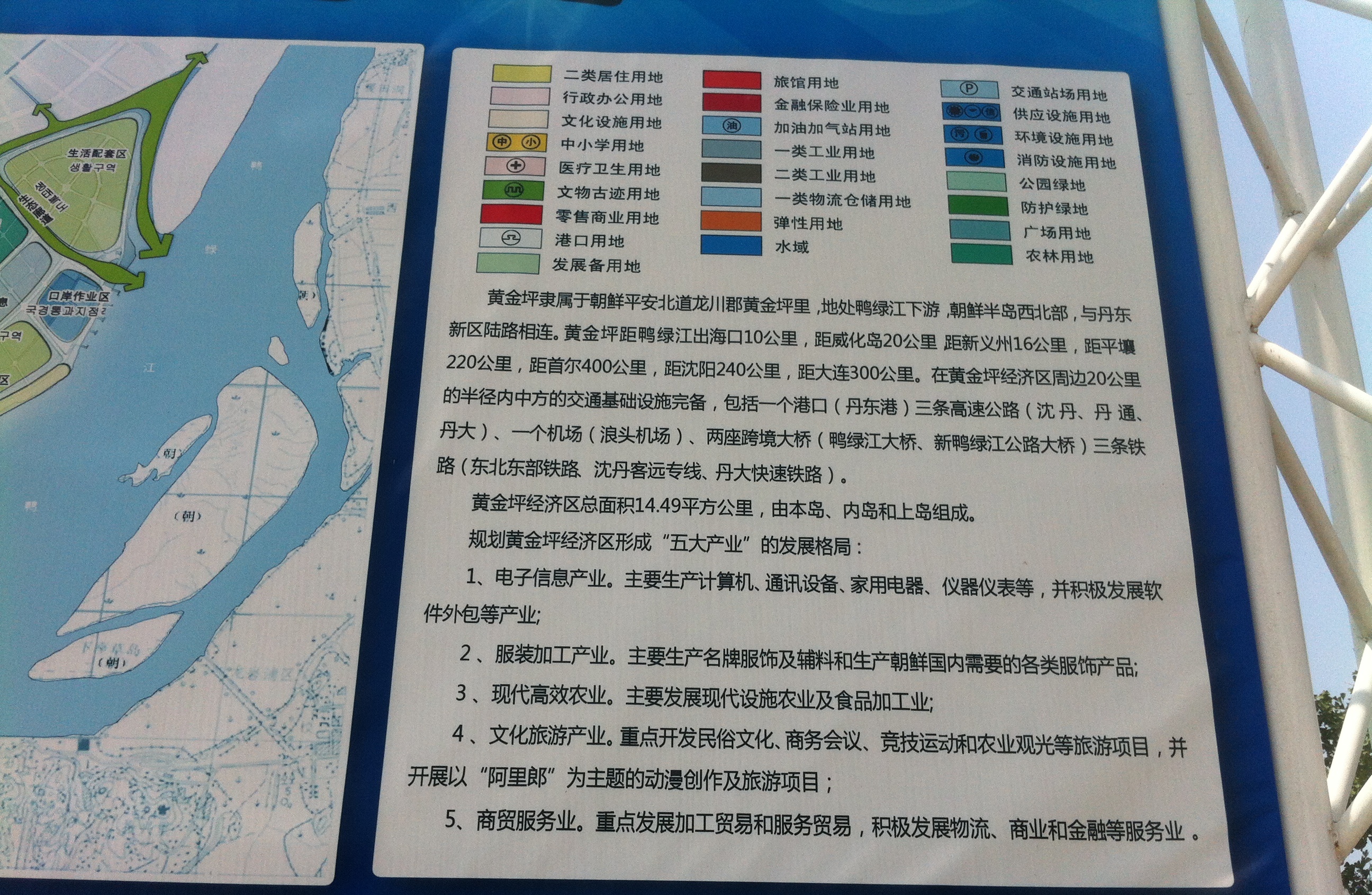
China also agreed with North Korea to jointly develop another special economic zone on the border islands across the Yalu River from the city of Dandong, its main gate into the North.

Jang Song-thaek, the uncle and key mentor of the young Kim, has been in charge of the economic projects with China.

You can see a picture of some of the data here.

Read the full story here:
Concerns mount over China’s grip on N.K. economy
Korea Herald
Kim Kyung-ho
2012-2-1

Share

DPRK phone imports in 2010

Thursday, January 19th, 2012

Radio Free Asia posted the following information:

The latest UN statistics showed that in 2010, North Korea imported 430,000 mobile phones from China, its primary ally and biggest trading partner, a six-fold jump from imports the previous year.

North Koreans forked out U.S. $35 million to buy these mobile phones, six times more than the money spent in 2009, according to the UN figures.

At the same time, Koryolink, North Korea’s only 3G mobile phone network operator, saw a rapid increase in subscribers—from about 90,000 at the end of 2009 to 430,000 a year later and more than 800,000 in the third quarter of 2011, according to majority owner Egypt’s Orascom Telecom.

While the rapid increase in mobile phone users is allowing greater communications within and outside the country, there are various restrictions in usage and it does not signal any major opening up of North Korea, experts told RFA.

Read the full story here:
Cellphones No Signal Of Reforms
RFA
2012-1-19

Share

North Korean trade and aid statistics update

Tuesday, January 17th, 2012

According to Business Week:

North Korea’s trade expanded more than 20 percent in 2010 to $6.1 billion on growing business with China even as the economy shrank for a second year, South Korea’s national statistics office said.

Trade volume increased 22.3 percent in 2010 after a 10.5 percent decline in 2009, Statistics Korea said in its annual report today in Seoul. Commerce with China accounted for 57 percent, or $3.5 billion, of North Korea’s foreign trade, up from 53 percent in the previous year. The totalitarian state doesn’t report economic statistics.

North Korea’s gross domestic product contracted 0.5 percent to 30 trillion won ($26.1 billion) in 2010, compared with South Korea’s 1,173 trillion won, the Bank of Korea said in November. Per capita income was 1.24 million won compared with South Korea’s 24 million won.

Kim Jong Un took over as leader of North Korea in December after the death of his father, Kim Jong Il. The regime has relied on economic handouts since the mid-1990s and an estimated 2 million people have died from famine, according to South Korea’s central bank. The United Nations and the U.S. increased sanctions on the country aimed at curtailing its nuclear weapons program after 2010 attacks that killed 50 South Koreans.

Chinese aid to the stricken country will probably increase as the government in Beijing seeks to avoid a flood of refugees from crossing the 880-mile (1,416 kilometer) border it shares with North Korea, analyst Dong Yong Sueng said. While food shortages have contributed to rising defections, North Korea has shown no willingness to ease sanctions by abandoning its nuclear weapons program.

Economic Dependence

“North Korea’s economic dependence on China will inevitably increase for the time being unless there’s some resolution to the nuclear situation,” said Dong, a senior fellow at the Samsung Economic Research Institute in Seoul. “China wants a stable North Korean regime and succession to avoid a potential influx of refugees.”

North Korea had a shortfall of as much as 700,000 metric tons of food last year, which could affect a quarter of the population, according to the United Nations Food & Agriculture Organization. China provides almost 90 percent of energy imports and 45 percent of the country’s food, according to a 2009 report from the New York-based Council on Foreign Relations.

China is preparing to consent to a North Korean request to provide 1 million tons of food in time for the April 5 anniversary of the birth of the country’s founder, Kim Il Sung, Japan’s Fuji Television said on its website. The report didn’t say where it obtained the information.

Providing Assistance

Chinese Foreign Ministry spokesman Liu Weimin today told reporters in Beijing that while he wasn’t aware of the report, “we have always been providing assistance to the DPRK within our capacity which we think will be conducive to the stability and development of the country.” DPRK is an acronym of North Korea’s formal name, the Democratic People’s Republic of Korea.

Kim’s military had over one million soldiers in active duty and 7.7 million reserve troops as of November 2010, today’s report said, citing South Korean Defense Ministry figures. The North operates under a military-first policy and has remained on combat alert since the Korean War ended in 1953 with a truce and not a peace treaty.

North Korea’s population rose to 24.2 million in 2010 from 24.1 million in 2009, about half of South Korea. Inter-Korean trade rose 13.9 percent from a year earlier to $1.9 billion last year, Statistics Korea said.

South Korea plans to set up a fund to raise as much as 55 trillion won to pay for eventual reunification with North Korea, Unification Minister Yu Woo Ik said in an interview with Bloomberg last October.

Read Sangwon Yoon’s full article in Business Week here.

The data in this article was pulled from a recent publication by Statistics Korea (Korean, English). You can read a press release of the publication here (in Korean). You can read the press release in English here (via Google Translate). It is not very good, so if a reader would care to take the time to translate this article, I would appreciate it. You can also download the press release as a .hwp file at the bottom of the article (download a .hwp reader here).

Statistics Korea did set up a North Korea Statistics page which you can see here. Unfortunately, it is only in Korean! I have, however, added it as a link on my North Korean Economic Statistics page.

UPDATE 1: The Daily NK also covered this story with the following report:

The income gap between North and South Korea is becoming ever wider, according to statistics released yesterday by Statistics Korea showing that South Korea’s per capita Gross National Income (GNI) in 2010 was $27,592, 19.3 times that of North Korea at $1,074. Last year the gap was 18.4 times.

In the (legal) foreign trade sector, the two Koreas also lived very differently. South Korea’s 2012 trading volume was $891.6 billion, 212.3 times North Korea’s $4.2 billion. North Korea’s exports were worth just $15 billion, its imports $27 billion.

As expected, North Korea’s trade reliance on China was highly significant (56.9%), partly because as strained inter-Korean relations started to bite, so inter-Korean trade declined as well: from 33.0% in 2009 to 31.4% in 2010.

Meanwhile, 61.0% of adults in South Korea are economically active, a number which rises to 70.2% in North Korea. Conversely, there are 3,134,000 college students in South Korea, but only 510,000 in North Korea.

In the energy industry sector in 2010, South Korea imported 872,415,000 barrels of crude oil, 226.4 times more than North Korea’s 3,854,000. The electricity generating capacity of South Korea is 10.9 times more than that of North Korea, too, though the generated amount was actually around 20 times bigger, the statistics allege.

Automobile production was no better; in South Korea (4,272,000), 1,068 times more than North Korea (4,000). Steel production in South Korea was 46.1 times that of North Korea, cement was 7.6 times more, and fertilizer 6.1 times.

UPDATE 2: The Hankyoreh adds some critiques of the data:

“With inter-Korean relations so tense, it is no longer possible for us to do the kind of North Korean grain production estimates that were possible under the previous administration,” a government official explained on Tuesday.

2010 production figures for rice, corn, barley, beans, and other major grains were left blank in a Statistics Korea report on major statistical indicators in North Korea. The numbers were included in statistical data released in 2008, 2009, and other years.

A Statistics Korea official said, “We made several requests to the organization in charge, but they didn’t provide materials, so we couldn’t print them.” The Rural Development Administration is responsible for investigating North Korean grain production. Early every year, it has estimated and released North Korean grain production figures for the previous year. Since 2011, however, it has failed to release figures.

A government official explained, “Since inter-Korean relations were decent during the previous administration, it was possible to go to the North and get samples to use as a basis for estimates.”

“With inter-Korean exchange all but completely halted under the current administration, the basis for releasing estimates has disappeared,” the official added.

Some observers said the decision was motivated by concerns that South Korean public support for food aid to North Korea could grow if low figures are presented. The argument is that there is no reason the kind of grain production estimates that were possible in 2008 and 2009, while the Lee administration was in office, would not be so for 2010 alone. Observers are also expressing bafflement at the fact that only agricultural products were omitted from estimates at a time when even the number of cars is being estimated in the area of industrial products.

Kim Yong-hyun, a professor of North Korean studies at Dongguk University, said, “Recently, food aid negotiations have been taking place between North Korea and the US, and I suspect the government may have decided not to announce [the estimates] because it was too concerned about public sentiment in South Korea.”

The North Korea figures released Tuesday also showed South Korea‘s per capita gross national income of $20,759 to be 19.3 times North Korea’s $174 for 2010.

Share

Chinese student experiences in the DPRK

Tuesday, January 17th, 2012

A reader sent me a link to this Chinese-language story about Chinese student experiences in the DPRK. You can read the article in Google Translate with decent results here.

Below are several facts I pulled from the article:

1. The Chinese ambassador held meeting at the embassy to calm Chinese students after the DPRK’s nuke test, but told them to prepare for contingencies by stocking up on water and instant noodles.

2. The Chinese can go to two DPRK universities: Kim Il-sung University and Kim Hyong-jik University of Education. NOTE: Although the article does not mention it, I personally also know a Chinese person who attended the DPRK’s University of Light Industry a few years ago.

3. It is not not easy for the Chinese to make NK friends

4. Chinese students have free reign of the city.

5. Chinese students share rooms with party member families.

6. Korean students envy Chinese student posessions: computers, e-books, etc.

7. Holding hands common at North Korean universities now, however, bith control is not visibly for sale anywhere…

8. North Korean studends enjoy “adult content”

9. The story mentions a relationship between a Chinese student and a North Korean.

More information is apparently available here (in Chinese).

Source:
在朝鲜留学的日子
作者:南方周末记者 张哲 雷磊 实习生 师小涵 沈茜蓉
2012-01-12 12:11:39

Share

An affiliate of 38 North