Archive for the ‘Civil society’ Category

Freedom House: Freedom in the World 2008

Thursday, January 31st, 2008

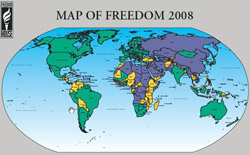
mof.jpg

On January 16, Freedom House released the findings from the latest edition of Freedom in the World, the annual survey of global political rights and civil liberties.

The report surveyed 193 countries, 90 of which were rated “free,” 60 were labeled “partly free,” and the remaining 43 were labeled “not free.”

North Korea, rated “not free,” received the lowest rating of 7 in both political rights and civil liberties and remains one of the eight lowest rated countries along with Cuba, Turkmenistan, Uzbekistan, Libya, Sudan, Burma and Somalia.

Click here for the full report.

Share

N. Korea: Last cold warrior standing

Thursday, January 31st, 2008

Joong Ang Daily
1/18/2008

North Korean athletes will enter the 2008 Beijing Olympics in August with a completely different concept of international sport to the one embraced by former Cold War allies.

Eastern Bloc states used to spend heavily on sports systems that turned out Goliaths, whose wins at the Olympics were used to validate what they argued was a superior political system.

The impoverished North, however, is happier playing the role of David, where its rare wins are attributed to the teachings of pudgy leader Kim Jong-il and its losses are blamed on a playing field made unfair by its foes.

“North Korea’s paranoid nationalism can use defeat just as well as it can use victory,” said Brian Myers, an associate professor at Dongseo University in Seoul, South Korea. He specializes in analyzing the North’s ideology. The reclusive North spends its limited resources to inspire its masses and not to impress the outside world on the playing field.

“North Korean nationalism does not boast that North Koreans are physically superior to other races,” Myers explained. The North’s propaganda spreads the message of being morally superior.

North Korea is likely to grab a handful of medals in Beijing in sports such as judo, weightlifting or wrestling. It has shunned overtures from the South to compete as a joint team in Beijing, which could bring it greater sports glory, because its neighbor wants to field a squad with the best athletes on the Korean Peninsula. The North wants equal representation. At the 2004 Athens Olympics, South Korea won 30 medals while the North took five. Their combined 35 would have been seventh highest, just below the 37 of their mutual arch-rival Japan.

“North Korea has realized at this stage that no number of victories on the sports stage could change the country’s reputation as an economic basket case,” Myers said.

North Korea’s athletes may be better at providing entertainment for the opening ceremony than at competing. The North’s biggest sports spectacle is its Arirang Mass Games, a circus-like extravaganza that includes legions of teenage girl gymnasts, goose-stepping soldiers flashing taekwondo kicks and a massive flip-card animation section.

The message of the event, in which some 100,000 play a role, is that the group is North Korea’s strength, and the group reveres and protects the leaders of the destitute state.

Sports are often associated with the ruling communist party, featuring competitions with farming collectives, factory workers and soldiers. Its best athletes are celebrated for upholding “the dignity of the nation”.

“Sports constitute a powerful driving force in firmly preparing the entire people for national defense and labor,” its official media said, citing the teachings of state founder Kim Il Sung.

The North relishes the role of underdog. When one of its athletes or teams achieves even moderate success, it makes the most of the victory, proclaiming it a result of the state’s military-first policy and its self-reliance ideal called “juche.” And of course, Dear Leader Kim Jong-il, who is celebrated in state propaganda for penning operas, piloting jet fighters and shooting 11 holes-in-one the first time he played golf, also turns out to be a remarkable motivator for athletes.

After Jong Song-ok won the women’s marathon gold at the 1999 World Athletic Championships in Seville, state media quoted her as saying: “I ran the race picturing the great leader of our people Kim Jong-il. This greatly encouraged me and was the source of my strength.”

Kye Sun-hui, North Korean Olympic gold medalist in women’s judo, said Kim “gave her strength, courage, matchless guts and pluck.”

Share

North Korea dragged back to the past

Tuesday, January 29th, 2008

In the article below, Dr. Lankov makes a compelling argument that the North Korean government is now attempting to to re-stalinize the economy because the system cannot survive liberal economic reforms.

Altough the trend seems depressing, optimists should take note that Pyongyang’s efforts to reassert control over the economy parallel a decline in belief in the official ideology.  With a deterioration of this ideology, people’s acquiescence to the DPRK’s political leaders declines, and power dynamics are all that hold the system together.  Efforts to control the general population are increasingly seen by the people as self-interested behavior on the part of their leaders, calling their legitimacy into question.

Additionally, efforts to reassert control over the economy are bound to fail because the system has already collapsed, their capital has been stripped, and there are insufficient funds to rescue the system.

In other words, efforts to re-stalinize the economy are bound to fail from both an economic and ideological perspective.

North Korea dragged back to the past
Asia Times

Andrei Lankov
1/24/2008

When people talk about North Korea these days, they tend to focus on the never-ending saga of the six-party talks and the country’s supposed de-nuclearization. Domestic changes in the North, often ignored or overlooked, should attract more attention.

These changes are considerable and should not encourage those optimists who spent years predicting that given favorable circumstances the North Korean regime would mend its ways and follow the beneficial development line of China and Vietnam. Alas, the recent trend is clear: the North Korean regime is maintaining its counter-offensive against market forces.

Merely five years ago things looked differently. The decade that followed Kim Il-sung’s death in 1994 was the time of unprecedented social disruption and economic disaster culminating in the Great Famine of 1996-99, with its 1 million dead. The old Stalinist economy of steel mills and coal mines collapsed once the Soviets discontinued the aid that alone kept it afloat in earlier decades.

All meaningful economic activity moved to the booming private markets. The food rationing system, once unique in its thoroughness and ubiquity, collapsed, and populace survived through market activities as well as the “second”, or non-official, economy. The explosive growth of official corruption meant that many old restrictions, including a ban on unauthorized domestic travel, were not enforced any more. Border control collapsed and a few hundred thousand refugees fled to China. In other words, the old Stalinist system imploded, and a new grassroots capitalism took over.

The regime, however, did not approve the changes – obviously on assumption that these trends would eventually undermine the government’s control. Authorities staged occasional crackdowns on market activities, though those crackdowns seldom had any lasting impact: people had to survive somehow, and officials were only too willing to ignore the deviations if they were paid sufficient bribes.

By 2002 it seemed as if the government itself decided to bow to the pressure. In July that year, the Industrial Management Improvement Measures (never called “reforms”, since the word has always been a term of abuse in Pyongyang’s official vocabulary) decriminalized much market activity and introduced some changes in the industrial management system – very moderate and somewhat akin to the half-hearted Soviet “reforms” of the 1960s and 1970s.

The 2002 measures were widely hailed overseas as a sign of welcome changes: many Pyongyang sympathizers, especially from among the South Korean Left, still believe that only pressure from the “US imperialists” prevents Kim Jong-il and his entourage from embracing Chinese-style reforms. In fact, the 2002 measures were not that revolutionary: with few exceptions, the government simply gave belated approval to activities that had been going on for years and which the regime could not eradicate (even though it had tried a number of times). Nonetheless, this was clearly a sign of government’s willingness to accept what it could not redo.

However, around 2004 observers began to notice signs of policy reversal: the regime began to crack down on the new, dangerously liberal, activities of its subjects. By 2005, it became clear: the government wanted to turn the clock back, restoring the system that existed before the collapse of the 1990s. In other words, Kim Jong-il’s government spent the recent three of four years attempting to re-Stalinize the country.

This policy might be ruinous economically, but politically it makes perfect sense. It seems that North Korean leaders believe that their system cannot survive major liberalization. They might be correct in their pessimism. The country faces a choice that is unknown to China or Vietnam, two model nations of the post-Communist reform. It is the existence of South Korea that creates the major difference.

Unlike China or Vietnam, North Korea borders a rich and free country that speaks the same language and shares the same culture. The people of China and Vietnam, though well aware of the West’s affluence, do not see it as directly relevant to their problems: the United States and Japan surely are rich, but they are also foreign so their experiences are not directly relevant. But for the North Koreans, the comparison with South Korea hurts. Even according conservative estimates, per capita gross national income in the South is 17 times the level it is in the North; to put things in comparison, just before the Germany’s unification, per capita GNI in West Germany was roughly double that in East Germany.

Were North Korea to reform, the disparities with South Korea would become only starker to its population. This might produce a grave political crisis, so the North Korean government seemingly believes that in order to stay in control it should avoid any tampering with the system. Maintaining the information blockade is of special importance, since access to the overseas information might easily show the North Koreans both the backwardness of their country and the ineptitude of their government.

At the same time, from around 2002 the amount of foreign aid began to increase. The South Korean government, following the so-called Sunshine policy, began to provide generous and essentially unmonitored aid to Pyongyang. China did this as well. Both countries cited humanitarian concerns, even though it seems that the major driving force was the desire to avoid a dramatic and perhaps violent collapse of the North Korean state.

Whatever the reasons, North Korea’s leaders came to assume that their neighbors’ aid would save the country from the worst of famine. They also assumed that this aid, being delivered more or less unconditionally, could be quietly diverted for distribution among the politically valuable parts of the population – such as the military or the police, and this would further increase regime’s internal security.

So, backward movement began. In October 2005, Pyongyang stated that the Public Distribution System would be fully re-started, and it outlawed the sale of grain on the market (the ban has not been thoroughly enforced, thanks to endemic police corruption). Soon afterwards, came regulations prohibited males from trading at markets: the activities should be left only to the women or handicapped. The message was clear: able-bodied people should now go back to where they belong, to the factories of the old-style Stalinist economy.

There have been crackdowns on mobiles phones, and the border control was stepped up. There have been efforts to re-enforce the old prohibition of unauthorized travel. In short, using newly available resources, North Korea’s leaders do not rush to reform themselves, but rather try to turn clock back, restoring the social structure of the 1980s.

The recent changes indicate that this policy continues. From December only sufficiently old ladies are allowed to trade: in order to sell goods at the market a woman has to be at least 50 years old. This means that young and middle-aged women are pushed back to the government factories. Unlike earlier ban on commercial activity on men, this might have grave social consequences: since the revival of the markets in the mid-1990s, women constituted the vast number of vendors, and in most cases it was their earnings that made a family’s survival possible while men still chose to attend the idle factories and other official workplaces.

Other measures aim at reducing opportunities for market trade. In December, the amount of grain that can be moved by an individual was limited to ten kilograms. To facilitate control, some markets were ordered to close all but one gate and make sure that fences are high enough to prevent scaling.

Vendors do what they can to counter these measures. One trick is to use a sufficiently old woman as a figurehead for a family business. The real work is done by a younger woman, usually daughter or daughter-in-law of the nominal vendor, but in case of a police check the actual vendor can always argue that she is merely helping her old mother. Another trick is to trade outside the marketplace, on the streets. This uncontrolled trade often attracts police crackdowns, so vendors avoid times when they can be seen by officials going to their offices.

This autumn in Pyongyang there was an attempt, the first of this kind in years, to prescribe maximum prices of items sold in markets. Large price tables were displayed, and vendors were forbidden to sell goods (largely fish) at an “excessive price”. It was also reported that new regulations limit to 15 the number of items to be sold at one stall.

The government does not forget about other kinds of commercial activities. In recent years, private inns, eateries, and even bus companies began to appear in large numbers. In many cases these companies are thinly disguised as “government enterprises” or, more frequently, as “joint ventures” (many North Korean entrepreneurs have relatives in China and can easily persuade them to pose as investors and sign necessary papers).

Recently a number of such businesses were closed down by police. People were told that the roots of evil capitalism had to be destroyed, so every North Korean can enjoy a happy life working at a proper factory for the common good.

Yet even as the government pushes people back to the state sector of the economy, These new restrictions have little to do with attempts to revive production. A majority of North Korean factories have effectively died and in many cases cannot be re-started without massive investment – which is unlikely to arrive; investors are not much interested in factories where technology and equipment has sometimes remained unchanged since the 1930s.

However, in North Korea the surveillance and indoctrination system has always been centered around work units. Society used to operate on the assumption that every adult Korean male (and most females as well) had a “proper” job with some state-run facility. So, people are now sent back not so much to the production lines than to indoctrination sessions and the watchful eyes of police informers, and away from subversive rumors and dangerous temptations of the marketplace.

At the same time, border security has been stepped up. This has led to a dramatic decline in numbers of North Korean refugees crossing to China (from some 200,000 in 2000 to merely 30,000-40,000 at present). The authorities have said they will treat the border-crossers with greater severity, reviving the harsh approach that was quietly abandoned around 1996. In the 1970s and 1980s under Kim Il-sung, any North Korean trying to cross to China or who was extradited by the Chinese police would be sent to prison for few years.

More recently, the majority of caught border-crossers spent only few weeks in detention. The government says such leniency will soon end. Obviously, this combination of threats, improved surveillance and tighter border control has been effective.

The government is also trying to restore its control of information. Police recently raided and closed a number of video shops and karaoke clubs. Authorities are worried that these outlets can be used to propagate foreign (especially South Korean) pop culture. Selling, copying and watching South Korean video tapes or DVDs remain a serious crime, even though such “subversive materials” still can be obtained easily.

It is clear that North Korean leaders, seeking to resume control that slipped from them in the 1990s and early 2000s, are not concerned if the new measures damage the economy or people’s living standards when set against the threat to their own political domination and perhaps even their own physical survival.

Manifold obstacles nevertheless stand in the way of a revival of North Korean Stalinism.

First, large investment is needed to restart the economy and also – an important if underestimated factor – a sufficient number of true believers ready to make a sacrifice for the ideal. When the North Korean regime was developed in the 1940s and 1950s it had Soviet grants, an economic base left from the days of Japanese investment and a number of devoted zealots. The regime now has none of these. Foreign aid is barely enough to feed the population, and the country’s bureaucrats are extremely cynical about the official ideology.

Second, North Korea society is much changed. Common people have learned that they can survive without relying on rations and giveaways from the government. It will be a gross oversimplification to believe that all North Koreans prefer the relative freedoms of recent years to the grotesquely regimented but stable and predictable existence of the bygone era, but it seems that socially active people do feel that way and do not want to go back. Endemic corruption also constitutes a major obstacle: officials will be willing to ignore all regulations if they see a chance to enrich themselves.

It is telling that government could not carry out its 2005 promise to fully restart the public distribution (rationing) system. Now full rations are given only to residents of major cities while others receive reduced rations that are below the survival level. A related attempt to ban trade in grain at markets also failed: both popular pressure and police inclination to take bribes undermined the policy, so that grain is still traded openly at markets.

Even so, whether the government will succeed in re-Stalinizing society, its true intent remains the revival of the old system. North Korean leaders do not want reforms, assuming that these reforms will undermine their power. They are probably correct in this assumption.

Share

N.K. orchestra to perform in Britain: report

Tuesday, January 29th, 2008

Back story: It looks like Suzanne Clark’s efforts are finally paying off…

Yonhap
1/29/2008

North Korea’s national symphony orchestra will perform in Britain as part of its planned concert tour to Europe in early September, a U.S. radio station reported Friday.

The North’s 120-member State Symphony Orchestra will hold three concerts in London and Middlesbrough Sept. 2 to 14, Radio Free Asia said, quoting a British businessman who arranged the tour.

Share

North frees Canadian aid worker held 2 months

Tuesday, January 29th, 2008

Joong Ang Daily
1/29/2008

A Canadian citizen detained for more than two months in North Korea has been released, the Canadian Embassy in Seoul said yesterday.

Kim Je-Yell was deported to China on Saturday and was met at the border by Canadian consular officials, said Shauna Hemingway, head of public affairs at the embassy.

“Canadian officials are facilitating his reunion with his family,” she said, without saying where he is now.

“We are grateful to North Korean authorities for providing us with consular access to Mr. Kim.”

She declined to give further details, saying Kim’s family had asked for privacy.

Kim, a Korean-born Canadian in his 50s, appeared to have fallen afoul of the state due to his religious connections, according to media reports.

He was detained in the remote northeast part of the country on Nov. 3, the Toronto Star reported last week.

The news had not been announced earlier pending diplomatic efforts to have him freed, the newspaper said. The Star cited the humanitarian group he worked for, Christian Aid, as saying Kim was held on charges related to “national security.”

Kim had been bringing in dental supplies and setting up clinics in northeastern North Korea for nearly a decade with official approval, the report said.

A Voice of America radio report said Kim had written in a statement during interrogation that he had criticized the North Korean regime and tried to establish a church in the North.

Canada’s ambassador to South Korea, Ted Lipman, visited Pyongyang last week in an apparent effort to secure his release.

The North’s constitution provides for freedom of religious belief. “However, in practice the government severely restricts religious freedom, including organized religious activity, except that which is supervised tightly by officially recognized groups linked to the government,” the U.S. State Department said in its 2007 report on religious freedom.

“Genuine religious freedom does not exist.”

Share

Pyongyang launches a cultural wave

Tuesday, January 29th, 2008

Joong Ang Daily
1/29/2008

While dragging its feet again on its pledge to denuclearize, North Korea is expanding its cultural outreach to the West.

The move is drawing a mixed response from North Korea watchers. Some hail it as a prelude to a long-awaited opening of the isolated nation, recalling China’s “ping-pong diplomacy” that served as a catalyst for a thaw in its relations with the United States in the 1970s.

Others, however, caution against expecting too much, citing the communist nation’s track record of using arts for propaganda.

Regardless, Pyongyang looks set to provide a rare chance for Europeans to see its elite orchestra perform.

The North’s State Symphony Orchestra is scheduled to hold performances in London and Middlesbrough in September in what would be its largest-ever shows abroad, according to Radio Free Asia. The concerts will be telecast live, added the U.S.-government funded station.

The orchestra is said to have been nurtured by the North’s all-powerful leader Kim Jong-il, reportedly a big fan of film, music and other arts.

In the North’s latest cultural diplomatic activity, five North Korean movies were screened over the weekend in San Diego, California during the first inter-Korean film festival organized by a university in the United States. North Korean authorities selected the films. Pyongyang’s No. 2 two diplomat in the North’s United Nations mission, Kim Myong-gil, attended the event after receiving U.S. government approval. Members of North Korea’s UN mission are required to stay within a small radius of New York and need Washington’s approval for trips outside the city.

The film festival came two weeks after a North Korean movie, titled “Schoolgirl’s Diary,” was screened in Paris. It marked the first-ever commercial distribution of a North Korean movie in the West.

One of the most awaited shows in coming weeks is a concert by the New York Philharmonic in Pyongyang. During the performance, the orchestra will perform the U.S. and North Korean national anthems as well as classical music. The historic concert, backed by the U.S. State Department, will be broadcast live via satellite on Feb. 26.

“This journey is a manifestation of the power of music to unite people,” said Zarin Mehta, the orchestra’s executive director, reiterating remarks he made last month.

Assistant Secretary of State Christopher Hill, Washington’s point man on Pyongyang, said earlier the performance bodes well for their bilateral relationship.

“We haven’t even had ping-pong diplomacy with these people,” he said. “It would signal that North Korea is beginning to come out of its shell, which everyone understands is a long-term process. It does represent a shift in how they view us.”

Hill expressed hope that the cultural exchange will help resolve the North Korean nuclear crisis.

Many experts here agree cultural diplomacy can be an effective way of dealing with the North. They view the North’s move as reflecting its cultural pride and determination to break its isolation. “It also appears to be aimed at diluting the North’s negative image as a repressive nation and silencing criticism from hard-line U.S. officials,” said Yang Moo-jin, a professor at the University of North Korean Studies in Seoul.

But skepticism lingers with the nuclear crisis still unresolved.

“Even if the orchestra plays music from heaven, it will have nothing to do with most North Koreans outside of the venue,” said Joo Sung-ha, who defected from North Korea in 2001 and now works as a journalist in Seoul. “We need to think about for whom such one-time shows should continue.”

Share

Travel to Kaesong Restricted to Prevent Awareness of South Korea

Friday, January 25th, 2008

Daily NK
Yang Jung A
1/25/2008
 
A job in a factory at the Kaesong Industrial Complex is fast becoming the ideal job for North Korean citizens, and positive feelings toward the South are continuing to grow.

Good Friends reported on the 23rd that most North Koreans are aware that economic cooperation at Kaesong is thriving as South Korean enterprises supply advanced materials and management, and North Korea supplies labor.

“South Korean advisory managers supervise workers. If workers do not come to work on time in the morning or they do not work diligently, the managers simply say, ‘You don’t need to come here tomorrow’” reported one North Korean citizen through Good Friends.

The citizen added, “Workers try to complete their appointed tasks under all conditions, while monitoring the South Korean supervisors’ attitudes.”

As the Kaesong Complex grows, the internal customs procedures into Kaesong become more complicated.

Good Friends reported, “Kaesong was originally a strictly controlled zone because of its location just north of the 38th parallel. If a North Korean wanted to visit Kaesong, they had to register, undergo an investigation and get a pass. Now, If they try to go to Kaesong, the process is much more complicated.”

A cadre working at the Kaesong Complex said that this is because people have growing positive feelings toward South Korea. The authorities worry about the great gap between the North and the South and worry about growing public disillusionment.”

He added, “The only place people can talk about South Korea is at Kaesong. They have a yearning for South Korea, especially after they’ve encountered South Korean products.” 

Share

Hoiryeong Trains for War

Tuesday, January 22nd, 2008

Daily NK
Lee Sung Jin
1/22/2008

The citizens of Hoiryeong are worried about ongoing evacuation training they must undergo as part of a joint winter military drill with the army that began on January 17, said a source.

The winter military drill used to be held in December each year but this year it was delayed.

“People feel uneasy because of the sudden beginning of the drill and the strict regulations on the jangmadang in the cold winter,” one source reported on the 21st.

At 3 am on January 17th, in Hoiryeong, North Hamkyung Province, the North Korean army announced an emergency summons, modified the Worker and Peasant Red Guards, Local Reserve Forces and Youth Red Guard, declared a state of national preparation for war and started inspection of emergency supplies. The Local Reserve Forces rushed to occupy strategic positions and the Worker and Peasant Red Guard started a scouting drill.

During the winter military drill, ordinary citizens must leave their residential districts, taking one day’s worth of food with them, and live in an encampment for Local Reserve Forces around 8-12 km away from their homes.

The average temperature in Hoiryeong drops to around minus 10 degree Celsius in January. As defectors in Seoul testified, it is terribly hard to put up with the lack of heat at the encampments.

This drill is limited only to Hoiryeong. The source said: “It is actually a type of civil defense training. It was ordered by the People’s Safety Agency, but the army participated as well.”

This year’s drill was more intense than previous year’s. Vehicles without camouflage netting were prohibited from the streets and all citizens were forced to wear camouflage while outdoors.

The source said the drill was so similar to actual warfare that Local Reserve Forces and Worker and Peasant Red Guards wore their real rank badges.

When the drill started, factories and People’s Units in Hoiryeong began holding lectures entitled, “Let’s complete preparation for war against the American imperialists’ constant war maneuvers!”

Share

Expansion of Electrical Infrastructure in Samjiyeon for Mt. Baekdu Tours?

Friday, January 11th, 2008

Daily NK
Moon Sung Hwee
1/11/2008

Rodong Sinmun, the official mouthpiece of the Chosun (North Korea) Workers Party, discussed the construction of new electrical infrastructure in Samjiyeon in a feature titled, “The New Legend from the Night-less City, Samjiyeon,” on December 26.

Rodong Sinmun praised Samjiyeon’s current condition, saying that “It is literally a night-less city where countless lights from houses and streetlights along the beltway shine like stars.”

The newspaper implied that providing electricity to hotels and other lodging for visitors was the reason for setting up the electrical infrastructure, noting that “Visitors who have completed long distance marches would want to take a rest, sing songs, and play accordions in the heated rooms of lodgings by the lake of Samjiyeon.”

The newspaper revealed, “The electricity produced by the Samsoo Power Plant, which was completed in May 2007, is now flowing to Samjiyeon.”

It added, “The June 18 Shock Brigade and workers form the Ministry of Electric Power pursued the lofty goals of the great General to expand the electrical infrastructure of the Mt. Baekdu region. They provided materials and equipment for the construction of power-transmission wires and towers and built them.”

To accomplish the goal of the North Korean authorities, in there words: “to improve the hometown of the General to meet global standards” – the Propaganda and Agitation Department organized the “Shock Brigade for the Propagation of the Party Ideology” (June 18 Shock Brigade) and made the brigade tear down houses and start reconstructing the city.

Although North Korean authorities said that they redeveloped the Samjiyeon district for the purpose of restoring Kim Jong Il’s hometown, a rumor is spreading among cadres that this reconstruction project was actually carried out in preparation for the commencement of Mt. Baekdu tours for South Koreans, according to inside sources.

In 1998, when the North and Hyundai Asan started Mt. Geumgang’s tour business, they agreed that Hyundai would offer 942 million dollars to the North in return for the right to use the tour site and to run the tour business for 30 years. Similar preparations to the ones being made in Samyijeon were completed prior to the opening of the Geumgang site.

It appears that North Korea has been carrying out construction work in Samjiyeon since 2001. Experts point out that reconstruction of the houses in the area was inevitable because these sites would soon be revealed to South Korean tourists.

North Korean authorities stressed that the newly-built houses are on par with international standards but residents complain of insufficient electrical supplies, according to the inside sources.

Sources said that the power situation was so dire that residents are forced to cook outdoors and bring heated stones in their houses for heating.

Share

Customs Director of Hoiryeong Arrested for Assisting in Drug Trades

Thursday, January 10th, 2008

Daily NK
Yang Jung A
1/10/2008

It was confirmed that the customs director of the city of Hoiryeong in North Hamkyung province was arrested last December for alleged corruption.

Multiple sources in Hoiryeong reported on the 8th that “The customs director of Hoiryeong was arrested at the end of last December on suspicion of assisting in the drug trade with China. It is known that a large sum of U.S. dollars was found in the customs director’s house.”

A source in North Korea reported through a phone call that, “The arrested customs director regulated small-scale merchants heavily and gave benefits to a couple of merchants who regularly gave bribes. Ultimately, the result was that access to commercial licenses in Hoiryeong was limited to the merchants who dominated the jangmadang.

Hoiryeong is one of the major crossing points along the North Korea-China border. Recently, cases of extortion in which the customs director demanded bribes in exchange for not confiscating goods were on the rise. Criticism had been rising.

The outcry from Korean-Chinese who regularly visit relatives in North Korea has been especially loud. Customs officers have required bribes from the Korean-Chinese who visit North Korea to deliver food, clothing, medicine, and daily necessities claiming them as customs fees. Such actions have become commonplace. (more…)

Share
