Archive for the ‘Civil society’ Category

DPRK tries to increase “taxes” on bus (coach) market

Monday, February 18th, 2008

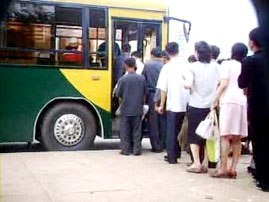
bus.jpgDuring the late 1990s, North Korea suffered a terrible economic collapse which resulted in famine and massive social dislocation.  During this time, most ministries and state-owned companies  were cash-strapped and unable to maintain their operations.  Out of desperation they turned to private investment for much needed revenues by outsourcing many basic services. (Individuals who were capable of taking up such opportunities were probably small in number at the time, but apparently now compose a healthy sub-section of the population.)

Outsourcing has benefited both the government and private entrepreneurs.  Outsourcing allows state-owned companies to receive capital financing from private individuals as well as a share of joint-venture revenues (tax revenues).  Private entrepreneurs need a legal business environment where they know they will not be subject to ex-post expropriation of profits.  Leasing the name of a government body gives them some of this legal cover.  This system is no doubt tolerated because it allows the government create space for entrepreneurship (and tax revenue) within the existing state structure while still maintaining de jure control of the means of production.   

According to the story in the Daily NK, the regulations for establishing a legitimate passenger bus company under this system (or “coach” company for readers in Her Majesty’s Commonwealth) are fairly strict.  Once an individual acquires a bus (appx US$6,000-10,000), he has to register it with the government body for whom he is working.  Revenues are then split 70/30 (the government taking 30%) for three years, after which the individual is required to “donate” the privately acquired bus to the state-owned enterprise.  This policy literally gives North Korean entrepreneurs just three years to recoup their investments!

The response of the North Korean business community was predictable:  investors sell the buses before the three years are up or they forge registration papers.  This is not hard to do in the DPRK.  In fact if you have just one other associate who owns a bus in similar condition, all you need to do is trade with him every three years and re-register the new vehicle. 

Word of this game has finally reached the top and they have responded by increasing their share to 70% of passenger bus revenues–leaving just 30% for the purchaser of the vehicle.  It is unclear from the story if investors are still required to “donate” their busses after three years, but realizing that the confiscation of buses was not enforceable, the North Korean government probably just opted for a larger share of the revenue over time.

The good news is that it is not likely that many people pay 70% of revenues either.  After-all, someone has to collect these taxes and he has needs too.  Sounds like some kind of arrangement could be reached…

You can read the full story here:
North Korea Regulates Operation of “Service Car”
Daily NK
2/18/2008

Share

“Crossing the Line” now out on DVD

Saturday, February 16th, 2008

crossing.jpgThe third film by Dan Gordon and Nick Bonner is now out on DVD.  

The film’s official web site is here.

Order the film on Amazon.com here.

Nick and Dan, what’s next?

Share

North Korea Now: Will the Clock Be Turned Back?

Friday, February 15th, 2008

This morning I received an email from a reader at the Brookings Institution who shared an article by one of their visiting fellows.  Much of it was about US/DPRK foreign policy, but I thought the following excerpt was interesting from a social change perspective:

On a recent visit to Pyongyang, this author was impressed by the sheer scale of new economic phenomena in DPRK. In terms of variety of goods, activity, and scale, markets in North Korea’s central areas (less in the provinces) remind of Chinese provincial markets. Numerous restaurants serve good—and very cheap, by Western standards—food to customers flocking to them. New “service centers” (eundokwon), combining shops, saunas, and restaurants under one roof, have sprung up and are run by highly placed entities such as Party departments and “offices.” Every branch of the Party, military, and local authorities now operates trading companies. Real business managers have appeared, some engaged not only in the “shuttle” trade with China but in bigger projects (in construction, for example), and some corporations have amassed a considerable volume of business. Judging by the author’s experiences in the 1980s and 1990s, these “new Koreans” are much more realistic and open to contact with outsiders than was the case before. There are changes in the official line as well: North Korean economists explained that now, out of several hundred thousand products manufactured in the country, only several hundred are now centrally planned. For the vast majority of manufactured products, managers of the state-owned enterprises are given a free hand to determine their production targets and to get what they need through the “socialist wholesale market.”

Having witnessed the processes eventually leading to the denunciation of the command economy in the USSR, and the transition to a market-based economy, this author can testify that there are striking resemblances in certain aspects of contemporary daily life in the DPRK to the USSR in the 1970s and 1980s (the Chinese experience in the1980s, with private enterprise officially sanctioned, is less similar). At that time in the Soviet Union, a vast black market of goods and services began to form in major cities. Many of its dealers became (often after a prison term) the leading businessmen of the post-Soviet era.

For example, at that time there was no private property for apartments in Moscow or elsewhere, and no real estate market officially existed. But at the same time almost any Soviet in the course of his life would “change” one apartment for a better one, paying considerable sums of money to the former “owner.” Some shadowy dealers would buy apartments outright, bribing officials to get a “registration” (propiska), and many made a profession of acting as a “go-between.” Similar activities are sprouting like mushrooms around North Korea. A one-room apartment in Pyongyang is said to cost about US$5000, less in local areas. However, real estate in some small cities close to Pyongyang boast the same high prices, as various kinds of dealers and traders, who are not permitted to settle in Pyongyang, buy apartments there. Foreign currency flows freely and, like in the USSR, most things can be obtained for money. A Russian joke said: “if it is illegal, but very much desirable, it is not prohibited.”

The ground for developing market relations is well prepared. The “royal economy” serving the ruling class (Kim Jong-il’s immediate retinue and the top nomenklatura or kanbu), and a large part of the internationalized sector (joint ventures and free economic zones) operate on market principles. The next step, should the country’s leaders admit the need for developing the country and sustaining their power, should be “setting the rules of the game” by providing a legal framework for what already exists. For that, however, external security should be guaranteed to the regime—irreversibly and comprehensively. Only then will the hard-liners, who fear—with good reason—that reforms would invite subversion of the regime, be confident enough for real progress to take place. Nevertheless the words “reform” and “openness” (especially because of their “Chinese connotations”) are unacceptable to Pyongyang, and Kim Jong-il himself stated as much during his talks with Roh Moo-hyun in October 2007. Under the present leadership Pyongyang, any economic reforms would most likely never be called such and would take place in an unpublicized manner without discussion, which is not helpful in terms of public relations with the West and negative international sentiment about the regime.

The full article can be found here:
North Korea Now: Will the Clock Be Turned Back?
logo_sm.bmp

Georgy Toloraya, Visiting Fellow, Center for Northeast Asian Policy Studies
2/11/2008

Share

Reporters Without Borders 2008 Report

Thursday, February 14th, 2008

rwb.JPG

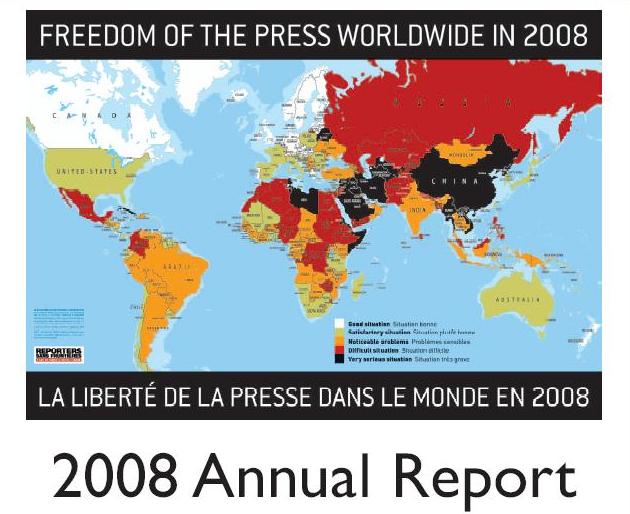
The Reporters Without Borders 2008 Annual Report has been published.  It is not an index (with rankings assigned to each country) but rather a survey that groups nations into one of five quintiles based on the publisher’s perceptions of press freedom: (1. Good situation, 2. Satisfactory situation, 3. Noticeable problems, 4. Difficult situation, 5. Very noticeable problems.

If you read the report (here), it is mostly a qualitative analysis and there does not seem to be any objective methodology for grouping countries into a particular quintile. (Disclaimer: I have note read the whole thing, but usually the methodology is spelled out in its own section for these types of publications, but I have not been able to find it). This worries me because if there is no standard methodology, with relative weights, then the results are vulnerable to questions of subjectivity.

North korea is ranked a “Very Noticeable Problem.”  To read just the North Korea section of the report click: rwb-dprk.pdf

Share

The crying game…

Monday, February 11th, 2008

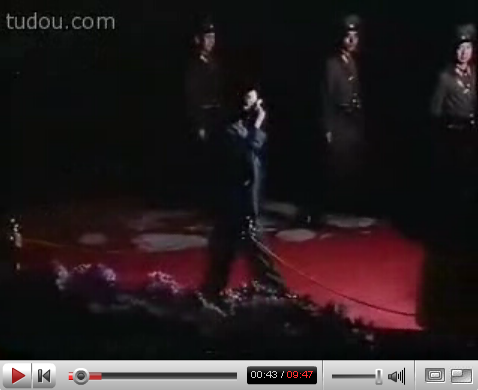
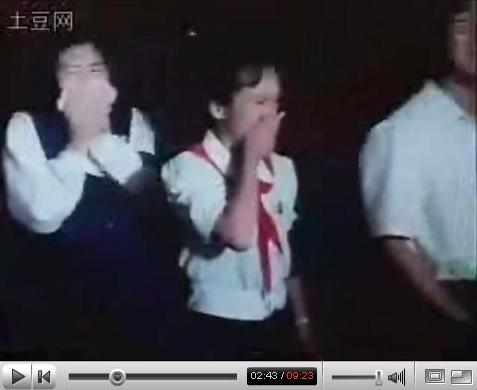
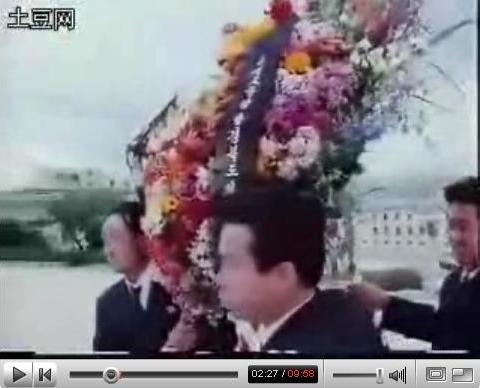
Below are three video’s recently posted on YouTube which portray North Korea’s national mourning in 1994 when Kim Il Sung passed away.  Although we do not know what people really think of the deceased leader, we do know that the public displays of sadness and eternal loyalty were scripted for television (and probably planned out in advance): Large crowds were mobilized at politically symbolic locations throughout the country, people were lined up in formations, given black arm bands, and placed in front of well-positioned television cameras to make sure they gave their best performances (which were strangely identical). 

The cameramen were also composed enough to carry out their tasks: Not only would they have to be dispatchted from Pyogyang to record the mass sadness, but they would have to arrive early to the scene, plan out their shots, record each scene several times, conduct multiple interviews, travel back to Pyongyang, and finally edit the footage into the final product.  This would all take a fair amount of time because travel conditions between the different locations would have been less than stellar.

Click on the images below to see the three part video:

Part 1. crying.bmp 

Part 2. crying2.JPG

Part 3. crying3.JPG

Share

Esquire Magazine recognizes Ryugyong Hotel

Sunday, February 10th, 2008

…as “The Worst Building in the History of Mankind.”  (h/t Marginal Revolution) Excerpts below:

It’s the Ryugyong Hotel in North Korea, where the world’s 22nd largest skyscraper has been vacant for two decades and is likely to stay that way … forever.

Even by Communist standards, the 3,000-room hotel is hideously ugly, a series of three gray 328-foot long concrete wings shaped into a steep pyramid. With 75 degree sides that rise to an apex of 1,083 feet, the Hotel of Doom (also known as the Phantom Hotel and the Phantom Pyramid) isn’t the just the worst designed building in the world — it’s the worst-built building, too. In 1987, Baikdoosan Architects and Engineers put its first shovel into the ground and more than twenty years later, after North Korea poured more than two percent of its gross domestic product to building this monster, the hotel remains unoccupied, unopened, and unfinished.

Construction on the Hotel of Doom stopped in 1992 (rumors maintain that North Korea ran out of money, or that the building was engineered improperly and can never be occupied) and has never started back up, which shouldn’t come as a shock.

What is most interesting is that a group of German architechts is already speculating on projects to revitalize the site.

Richard Dank and Andreas Gruber, a pair of German architects and self-described “custodians of the pyramid’s diverse manifestations.” The duo run Ryugyong.org, which they describe as an “experimental collaborative online architecture site.” Sad you can’t visit the building in real life? Log on, view the detailed 3-D models, and “claim” a subsection for yourself.

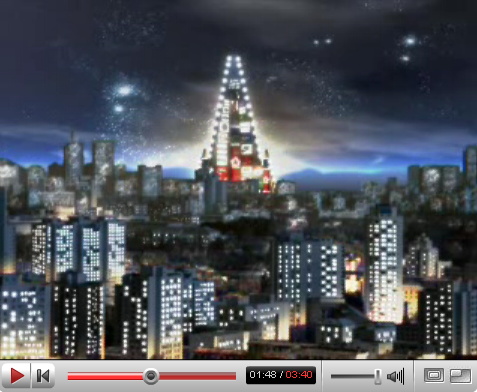
And of course, no story on the Ryugyong is complete without the “Demolitoin S How” video, which shows how the Ryugyong’s dominance of the Pyongyang skyline might make it valuable as a good bill board platform in the future:

ryugyongvideo.bmp

The video [which you can watch by clicking on the image above] was mounted as part of the exhibition Fiction Pyongyang, curated in part by Stefano Boeri, who also collected 120 speculative designs for the hotel in the June 2006 domus magazine (archives here). The designs, he says, “have forced it to reveal its icy nature, its irresistible fascination as a fragile alien meteorite.” The worst building in the world is also, we now know, “the only built piece of science fiction in the contemporary world.” And it’s true. Demolition S How is all Blade Runner-style flying ads and soaring concrete, and the video reminds us that the worst building in the world is the closest humans have come to building a Death Star.

Other information:
Ryugyong Wikipedia page
Ryugyong photo (showing the base)

Full Article:
The Worst Building in the History of Mankind
Esquire Magazine
Eva Hagberg
1/28/2008

Share

North Korea named No. 1 persecutor of Christians

Thursday, February 7th, 2008

Open Doors International, a Christian group based in California, released their list of the national top ten violators of religious freedom.  As with most other indexes, North Korea does not come out looking too good:

For the fifth year in a row, North Korea heads the World Watch List as the worst violator of religious rights for Christians. Media attention was focused on the country in 2006 but nothing has changed for the North Korean people. The North Korean regime launched missiles and tested nuclear weapons in 2006, which meant a further increase of pressure in the country. We were able to trace more information, which indicated that more Christians were arrested in 2006 than in 2005. There are still many people in labor camps, and everyday life in North Korea is inhuman. Between 50,000 and 70,000 Christians are currently suffering in prison camps. Many of them are tortured. People are still putting their lives at stake by trying to flee to China. After crossing the border, several people have converted after coming into contact with Christians. The newborn Christians are very brave and return to North Korea to tell others about Jesus. Considering Christianity to be a tremendous threat to stability in the country, the North Korean government hunts Christians all over the country, especially those who try to return from China. Many of them were arrested, tortured and even killed. But amidst all the harshness in the country, the local Christians are dedicated to serving the local Body of Christ and are firmly standing strong during this period of relentless persecution.

Rounding out the other nine slots: 2. Saudi Arabia, 3. Iran, 4. Somalia, 5. Maldives, 6. Yemen, 7. Bhutan, 8. vietnam, 9. Laos, 10. Afghanistan.

More on Religion in North Korea can be found here.

Share

North Korean run restaurants diversify product lines

Thursday, February 7th, 2008

Writing today for the Asia Times, Sunny Lee gives an update on the North Korean-run restaurants in China and South East Asia.  Much has already been published on these restaurants: how they channel money back to North Korea and how the waitresses tend to defect.  (As mentioned in the Kaesong post yesterday, they probably also pay hefty bribes for their overseas posts and have well-connected relatives.)

Sunny Lee points out that these restaurants (see YouTube video here) are now diversifying their product lines to boost profits, and like other successful capitalists across Asia, they are doing it by leveraging their most unique asset–attractive North Korean women.  How?  By transforming into karaoke bars after dinner hours.

North Korea has some 100 restaurants overseas, mostly in China and Southeast Asia, including Laos, Vietnam and Cambodia. These restaurants serve as an important revenue pipeline for earning foreign currencies for Pyongyang. Each overseas North Korean restaurant is said to be allotted a revenue quota to fill, ranging from US$100,000 to $300,000 a year to send to Pyongyang, which makes the total revenue estimation some tens of millions of dollars.

The business formula – restaurant by day and karaoke bar by night – is also seen as an effort for these restaurants to meet the assigned financial quota. Currently, there are scores of North Korean restaurants in China, including in cities such as Beijing, Tianjin, Tsingdao, Dandong and Yanji. Beijing has 11 North Korean restaurants. All of these employ North Koreans whose total employment number in China is estimated to be several hundred. (Asia Times)

Despite the higher cost, business is brisk…

The reason that North Korean restaurants are expensive yet remain popular among customers is their immaculate service from beautiful employees. In China, where service quality at restaurants is often unsatisfactory, North Korean restaurants are becoming a favorite alternative among members of the businesses community. (Asia Times)

However, if you want to enjoy an authentic North Korean dining experience but have moral qualms about supporting the regime, then you can patronize similar resturants managed by North Korean defectors in South Korea–though the experience is quite different.  Whereas the Chinese pay extra for premium restaurant service in Beijing, the South Koreans pay for the genuine socialist restaurant experience.  In other words, they pay to be treated like an annoyance to the staff.

[At the Pyongyang Moran Bar (located in South Korea), the] North Korean waitresses wore traditional dresses in the bright colors that were fashionable in the South some years back. The singer’s interpretation of “Whistle,” a North Korean standard of the 1980’s, was shaky and off-key. Service was bad and included at least one mild threat. Drinks were spilled, beer bottles left unopened and unpoured.

But the South Korean customers could not get enough of the Pyongyang Moran Bar. (New York Times)

So you have your choice of North Korean themed restaurants:  The propaganda ideal or the  socialist reality.

The full articles can be found here:
Chillin’ at a North Korean karaoke bar
Asia Times
Sunny Lee
2/8/2008

In Deep South, North Koreans Find a Hot Market
New York Times
Norimitsu Onishi
5/25/2006

Share

IFES DPRK monthly recap: January 2008

Tuesday, February 5th, 2008

Institute for Far Eastern Studies (IFES)
NK Brief No. 08-2-5-1
2/5/2008

Kim Jong Il’s first visit of the year was reported on January 6 to have been to the Ryesonggnang hydro-electric power plant. Generally, the leader’s visits in the first months of the year, along with the New Year’s Joint Editorial, which focused on economic recovery, set the tone for the coming year’s policies. His second inspection of the year was to a military unit.

Defectors claim that prostitution is on the rise in North Korea, and on January 9, the aid group ‘Good Friends’ reported that the DPRK has begun to close massage parlors as part of a crackdown on prostitution. The agency reported that in the DPRK there was a “steady campaign to weed out decadent foreign culture,” and that in September, DPRK soldiers were ordered to avoid alcohol, sex, and money.

On January 16, it was reported that Kim Jong Il had instructed all DPRK institutions to reduce their bureaucracies, including senior staff, by thirty percent.

Figures released by North Korea’s Korean Central News Agency indicate that the DPRK’s population had increased to 23.6 million in 2004, the latest available figures. According to DPRK figures, the population has grown from 22.1 million in 1996.

North Korea announced the closure of its Australian embassy on January 22. While the DPRK will continue to maintain diplomatic relations with Australia, it apparently can no longer afford to maintain an embassy in Canberra.

According to a report released by the International Red Cross, North Korea has the largest number of people in the world killed by natural disasters over the past decade. The report states that 458 thousand North Koreans have died from natural disaster, 38 percent of the disaster-caused deaths in 220 countries from 1997-2006.

A U.S. Senate investigation reported that the DPRK funneled as much as 2.7 million USD through a bank account set up from UN development projects. The report stated that North Korea used the UN account due to fears that the United States would block its ability to transfer money internationally.

DPRK Nuclear Negotiations

2008 opened with the United States and Japan releasing statements expressing their disappointment at North Korea’s failure to meet its December 31 deadline to fully disclose the extent of its nuclear programs, while North Korea’s New Year’s Joint Editorial called for “stability on the Korean Peninsula and peace in the world” as well as an end to hostile U.S. policies. A U.S. White House spokesman stressed that there was still opportunity to move forward with negotiations, stating, “the important thing is that we get a declaration that…needs to be full and complete,” not whether the declaration is made by the deadline.

On January 4, North Korea claimed it had met its obligations to come clean on its nuclear programs, and that it had provided Washington with a list of its nuclear programs in November. Pyongyang also threatened to bolster its “war deterrent” because Washington had failed to provide promised aid following the declaration. Washington denied that any complete declaration had been made.

A senior Russian diplomat was quoted on January 11 as saying that while Russia regrets the slowed state of progress in talks on DPRK nuclear issues, Russia will fulfill its promise to provide the North with fuel oil. 50,000 tons of fuel oil were delivered on January 20~21.

According to a book of figures recently published by the National Statistical Office, ”Comparison of North and South Korean Socio-economic Circumstances”, the DPRK”s crude imports over the past several years bottomed out at 2,325,000 barrels in 1999, then rose to 4,244,000 barrels by 2001. Since 2001, imports have steadily fallen until only 3,841,000 barrels were imported in 2006, recording the least imports in the last five years.

North Korea opened its first online shopping mall in January. The site offers items from fourteen categories ranging from machinery and building materials to stamps and artworks. The site, www.dprk-economy.com/en/shop/index.php, is based in China.

Orascom Telecom, a Cairo-based phone operator, has been granted the first commercial license for provision of mobile phone services in North Korea. The license was granted to CHEO Technology, a subsidiary that is 25 percent-owned by the state-run Korea Post and Telecommunications Corporation.

DPRK Abduction Issue

The Cambodian Foreign Minister announced on January 16 that his country had been working behind the scenes to find a resolution to the DPRK-Japan abduction issue. The minister stated, “Cambodia is in a position where it can hold high-level meetings with North Korea, and it has the ability to persuade North Korea.”

Inter-Korean Affairs

The incoming Lee Myung-bak administration announced on January 4 a plan to develop an international cooperative fund to support North Korea’s economy. The plan is said to call for World Bank and the Asia Development Bank to help, and for South Korea to provide 40 billion USD.

On January 7, it was reported that Lee Myung-bak’s presidential transition team had asked the ROK Unification Ministry to slow the pace of inter-Korean economic projects and to link them to progress in the six-party talks. The incoming administration has promised not to link humanitarian projects such as rice and fertilizer aid to nuclear negotiations.

The Lee Myung-bak administration announced plans for downsizing the South Korean government, including disbanding of the Ministry of Unification. Opposition to the plan points out the role played by the ministry in improving inter-Korean relations, while proponents to the plan of relegating the ministry’s duties to the Ministry of Foreign Affairs and Trade applaud the move to align North Korea policy with standing foreign policy directives.

On January 14, it was reported that Lee Myung-bak had asked the United States to further engage in talks with DPRK military leaders, while presenting a balanced approach, stating that “our people don’t support the idea of giving lavish aid to the North nor do they want to irritate it too much, I believe.” He went on to add that the United States holds the key to easing DPRK fears of opening up.

The net worth of inter-Korean exchanges totaled 1,797,890,000 USD in 2007, up 33% from the 1.35 billion USD in the previous year. The almost 1.8 billion dollars in trade recorded in 2007 is the highest to date, and is equal to 65 percent of the DPRK”s non-Korean trade volume of 2.996 billion USD in 2006.

The Seoul-based International Vaccine Institute announced on January 14 that it will soon begin inoculating approximately six thousand North Korean children against bacterial meningitis and Japanese encephalitis.

The two Koreas began working-level military talks on January 25, marking the first talks of the year. During talks, the North proposed reducing the frequency of the inter-Korean rail services, citing a lack of cargo. The Southern delegation felt that the frequency was an important indication of inter-Korean cooperation. The two sides agreed to continue daily runs, but to reduce the number of empty carriages in the future.

North Korea is still not as attractive to businesses as other Asian neighbors. A survey released by the (South) Korea Chamber of Commerce and Industry on January 28 indicated that China and Vietnam are more attractive to ROK businesses. According to the survey, 80 percent of businesses have difficulties starting or operating businesses in North Korea.

An ROK special envoy returned on January 23 from Moscow after proposing a joint ROK-DPRK-Russian cooperative project in eastern Siberia. President-elect Lee Myung-bak sent a letter to Russian President Vladimir Putin pushing for cooperation of “North Korea’s workforce, Russia’s resources and capital, and [South] Korean technology.”

U.S.-DPRK Relations

On January 9, amidst reports concerning possible DPRK-Syria nuclear connections, it was reported that in 1991 Israel was posed to strike a ship suspected of delivering missiles from the DPRK to Syria, but was dissuaded by Washington.

A U.S. State Department official stated on January 22 that North Korea had met the legal criteria to be removed from the U.S. list of state sponsors of terrorism. This came just after reports of conflicting opinions within the Bush administration, with Secretary of State Condoleezza Rice sharply rebuking Special Envoy on North Korean Human Rights Lefkowitz, who stated that North Korea is not serious about nuclear disarmament. Rice went so far as to say that Lefkowitz “certainly has no say on what American policy will be in the six-party talks,” dismissing his negative position on the failure of North Korea to meet its obligations. The White House later stated that North Korea must make a full declaration of its nuclear activities before being removed from the list.

Five officials from the DPRK recently visited the United States in order to learn how to treat and prevent tuberculosis, a serious concern for the North that is “practically non-existent in most developed countries.” The officials were invited by The Korea Society, which is based in New York.

DPRK-PRC Relations

According to the PRC General Administration of Customs, China’s oil exports to North Korea were the same in 2007 as they were in 2006. China sent 523,160 tons of oil to North Korea in 2007.

A senior PRC Communist Party official traveled to Pyongyang for a meeting with Kim Jong Il on January 30. Wang Jiarui, director of the International Liaison Department of the Chinese communist party, was to convey a message to Kim, inviting him to the opening ceremony of the Beijing Olympics. While Kim reportedly told Wang that there would be no change in the DPRK stance on nuclear negotiations, he also assured the Chinese envoy that North Korea had no intention of harming DPRK-PRC relations.
Share

Koreas to send joint cheering squad to Olympics

Monday, February 4th, 2008

Yonhap
2/4/2008

South and North Korea agreed Monday to send a 300-strong joint cheering squad to the Beijing Olympic Games in early August, the Unification Ministry said.

One hundred and fifty people from each side will travel across the heavily armed border by train to Beijing, it said.

The agreement was made by working-level officials at a one-day meeting in Kaesong, a North Korean border city.

The two sides agreed to hold another round of talks to discuss the details of sending the joint cheering squad, the ministry said in a news release.

Hailed as a symbol of inter-Korean peace and reconciliation, the cross-border railway was reconnected in May last year for the first time in 56 years. It was severed in the early stage of the 1950-53 Korean War.

The two Koreas agreed during the second summit of their leaders in October to transport the joint cheering contingent to the Aug. 8-24 Olympics using the Gyeongui railway, which is linked to the Chinese railway system.

South Korea also hopes to connect the railway to the Trans Siberian and Trans Chinese railways so products from the world’s 13th biggest economy can be transported to Europe at lower costs and in less time.

Yoo Sang-il, a member of the Korean Olympic Committee, led the three-member South Korean delegation to the talks. Yoo’s North Korean counterpart was Hwang Chol, a department director of the North’s Council for National Reconciliation.

Share