Supreme People’s Assembly’s 2007 Budget… Financial Estimate $3.1bn

April 13th, 2007

Daily NK
4/14/2007
Park Hyun Min

Changes to the North Korean Cabinet Ministry, Kim Young Il elected as the new Prime Minister, Kim Young Choon as Vice-Chairman of the National Defense Commission

At the 5th round of the 11th Supreme People’s Assembly announced on the 5th, the change in economic policies that would in future concentrate on the people’s livelihood and suspend the advancement of technological skills.

In the report, the deputy Prime Minister revealed that the major economic task for the upcoming year included light industries and agriculture, which had already been completed, and the improvement of the people’s livelihood. He said that the issue of social economic management had been discussed and that it would be resolved “our way.”

The 2007 report by the Supreme People’s Assembly proposed to, i) improve the basic standards of living in relation to agriculture and light industries, ii) enhance the manufacture of potential energy starting with the prioritizing the department into 4 divisions, iii) modernization of public economy and iv) manage sosicalistic economy through the our own.

Furthermore, foreign collaboration was proposed to further investments into advanced technology. In relation, the third phase proposal was made over a 5 year period (`08~`12) to improve technological skills such as the advancement of basic skills, high technology and software.

In contrast to last year, North Korea estimated an increase in revenue at 433.2bn won ($30.9bn, $1=141won). Last year, 5.9% were considered the public revenue, whereas this year, this figure was raised to 7.1%.

As for tax resources, national business gains tax was increased to 6.4%, cooperative organizations fund set at 4.5%, depreciation amount 9.6%, real estate fees 15.4%, and social welfare tax at 15.1%

Regarding expenses, science-technological skills among people’s economic expense increased to 60.3%, net business income is estimated to be 2% which will aid new measures to develop enterprise skills. In addition, proposals were made to increase agricultural expenses to 8.5%, light industries to 16.8%, energy, coal, metalwork and railroad to 11.9%

In relation to this, a South Korean governmental official revealed, “At this Supreme People’s Assembly, economic improvement proposal was mainly revealed without any announcement on foreign policies or sort of legislation of reform or openness.

Since last year, there have been rumors that a change in government would occur amidst the North Korean Supreme People’s Assembly. While Park Bong Joo stepped down from his position, Kim Young Il, formally in charge of transportation was elected as the new prime minister. It has been three and half years since Park Bong Joo first took his prime ministerial post at the first round of the 11th Supreme People’s Assembly in September 2003.

Former Prime Minister Park is known to have ceased his duties since last year June. He has been suspected of transferring money from the agriculture’s oil funds. At the 20th High Level Cabinet Talks in Pyongyang in February, a South Korean representative did mention that Prime Minister Park had made a welcoming speech. However, it seems that he has been ousted from his position.

Additionally, with the death of Yeon Hyung Mook in October 2005, Kim Young Choon is known to have succeeded the position of Vice Chairman as well as taking on the role of military counselor.

Regarding, the new appointments, a governmental official said that the Cabinet’s Prime Minster, Kim Young Il would aim to solve the economic issue while Kim Young Choon as the new Vice Chairman would aim to organize the structure of the ministry and strengthen the military.

While Kim Jong Il did not attend the last round of meetings, the fact that he participated in the recent meeting has also gathered much interest.

Share

China Investing Heavily in N.Korean Resources – Report

April 12th, 2007

Choson Ilbo
4/12/2007

Last year a Chinese company took a 51-percent stake in Hyesan Youth Cooper Mine in Yanggang Province, North Korea. Hebei-based Luanhe Industrial Group now has the right to develop the mine for the next 15 years.

North Korea also sold a 50-year development claim to the Musan iron mines, Asia’s largest open-air mine, to China’s Tonghua Iron & Steel Group. Since 2006, North Korea has sold the rights to develop more than 10 mines to Chinese firms.

KDB Research Institute, an affiliate of Korea Development Bank, has raised concerns with a report released Wednesday that details China’s intensive investment in North Korean natural resources. According to the report, since 2002 China has invested US$13 million (US$1=W932), more than 70 percent of its total investment in North Korea, in iron, copper and molybdenum mines.

The major investors come from the three northeast provinces of Heilongjiang, Jilin and Liaoning. They have moved the focus of their investment from small-scale, commercial opportunities to strategic deals to secure energy resources, the report said.

According to the report, China’s Wukang Group bought the rights to dig the Yongdeung mine, North Korea’s largest hard coal mine, and another Chinese company invested in a North Korean project to develop an oil field in the West Sea. The North has also allowed Chinese fishermen to fish off the coast of Wonsan, a North Korean port city on the east coast, in return for 25 percent of the catch.

Since North Korea lacks funds while China suffers from a shortage of natural resources the two are forming joint development projects, said KDB Research Institute researcher Chung Eui-jun, the writer of the report.

Andrei Lankov, a North Korea expert at Kookmin University in Seoul, said in the Wall Street Journal last July that the Chinese government seems to have made a strategic decision to encourage Chinese firms to invest in North Korea as a way to maintain its influence with its long-time ally in the post-Kim Jong-il era.

Share

Kim Yong-il Elected North Korean Premier

April 12th, 2007

Korea Times
Lee Jin-woo
4/12/2007
 
North Korea’s legislature on Wednesday elected Transport Minister Kim Yong-il as the country’s new premier, the North’s state-controlled news agency reported.

He replaces Pak Pong-ju who has been accused of embezzling some of the national budget, the report said.

According to the Korean Central News Agency (KCNA), Kim was elected as the new premier in a plenary session of the North’s Supreme People’s Assembly (SPA), a rubber-stamp legislature of the Stalinist state.

Kim, 62, rose to his position after starting his bureaucratic career as a rank-and-filer in the Ministry of Land and Marine Transport. He is known to have expert knowledge in economic affairs.

He accompanied North Korean leader Kim Jong-il twice in 2005 on trips to government facilities, and led a delegation of ministry officials to China, Cuba and Syria over the last seven years. He visited Syria in 2005 to conclude a maritime transport agreement.

After graduating from Rajin University of Marine Transport, he served in the military for nine years beginning in 1961. He has served in the minister post for more than 10 years since the early 1990s.

The SPA also tapped Kim Yong-chun, chief of general staff of the Korean People’s Army, as the vice chairman of the National Defense Commission (NDC), a position that has been vacant since the death of Yon Hyong-muk in October 2005.

The SPA, which convenes once or twice a year at irregular intervals, is headed by Kim Yong-nam, the official president of the Presidium of the SPA. He also serves as the titular head of the communist state.

Share

N. Korea to focus on improving livelihoods this year

April 12th, 2007

Yonhap
4/12/2007

Saddled with a severe food shortage problem, North Korea is poised to raise people’s standard of living this year by concentrating on agriculture and light industry.

In a session of its parliament held on Wednesday, North Korea said its major economic goal is “to improve the living standards of people on the basis of the existing foundations of agriculture and light industry.”

In a related move, the North replaced Prime Minister Pak Pong-ju, the control tower of its economy. It named Transport Minister Kim Yong-il as its new premier. Pak is believed to have been in conflict with senior North Korean officials over electricity supplies.

“Kim is in his early 60s, relatively young for North Korean cabinet members, and he has no prestigious political or educational background. He seems to be credited by his track record of economic expertise and achievement,” a senior Unification Ministry said, asking to remain anonymous.

The impoverished country has depended on international handouts to feed a large number of its 23 million people.

In a recent meeting with U.N. World Food Program officials, a North Korean vice agriculture minister acknowledged that the communist country has a shortfall of about 1 million tons of food and called for aid from the outside world.

“The cabinet will concentrate state efforts on agriculture this year, too, considering it as a mainstay, to thoroughly implement the WPK’s policy of agricultural revolution and make a signal advance in the efforts to settle the people’s problem of food,” Vice Premier Kwak Pom-gi said in a report to the delegates at the session. WPK is the acronym for the North’s ruling Workers’ Party of Korea.

To that end, North Korea plans to raise spending on agriculture by 8.5 percent and on light industry by 16.8 percent compared with last year.

North Korean leader Kim Jong-il also attended the meeting of the parliament, the Korean Central News Agency (KCNA) reported.

The North is officially headed by its titular leader Kim Yong-nam, the president of the Presidium of the Supreme People’s Assembly, the country’s parliament.

But Kim Jong-il rules the country with an iron grip. He is officially the chairman of the National Defense Commission and general secretary of the ruling Workers’ Party. He reserves the office of president for his late father as a way of showing filial piety.

The North also said it will kick off a drive to modernize major light industrial factories and reinforce the production of daily necessities, while state efforts will be channeled into the construction of houses in major cities, the KCNA said.

The North earmarked 40.8 percent of the total budget expenditure for the national economy this year, and in particular, spending on the development of science and technology will rise as much as 60.3 percent compared with last year.

Based on the report from the North’s parliament, South Korea’s Unification Ministry estimated the North’s 2007 budget at US$3.09 billion, up 5.9 percent from a year earlier.

Share

North Korea elected new premier

April 12th, 2007

Korea Herald
4/12/2007

The Supreme People’s Assembly, North Korea’s legislature, elected Transport Minister Kim Yong-il as the country’s new premier, replacing Pak Pong-ju, at its fifth plenary session held on Wednesday, Yonhap News Agency quoted a state-run North Korean news agency as reporting.

The SPA also elected Kim Yong-chun, chief of general staff of the Korean People’s Army, as the vice chairman of the National Defense Commission, a position which has been vacant since death of Yon Hyong-muk in October 2005, the Korean Central News Agency said. Kim Jong-il is the NSC chairman, and the NDC has two vice chairmen.

The 62-year-old new premier has served as the land and maritime transport minister since 1994. He visited Syria in 2005 to conclude a maritime transport agreement.

The SPA convenes once or twice a year at irregular intervals. The SPA is headed by Kim Yong-nam, the official president of the Presidium of the SPA. He also serves as the titular head of the communist state.

Share

North Korea sacks prime minister

April 12th, 2007

BBC
4/12/2007

North Korea’s parliament has sacked the country’s prime minister, reports say.

Pak Pong Ju, who had been prime minister since 2003, was replaced during a session of the Supreme People’s Assembly.

No reason was given for the decision to hand the position to former army and navy minister Kim Yong-Il.

North Korean leader Kim Jong-Il was present during the session of the Supreme People’s Assembly but did not comment on the decision.

Limited powers

Kim Yong-Chun was elected vice-chairman of the country’s National Defence Commission during the session, the state-run Korean Central News Agency reported.

The parliament meets once or twice a year to approve budgets or discuss policy but its power is limited. All power in the secretive state rests with the country’s reclusive leader, Kim Jong Il.

While the prime minister is the leader of North Korea’s government and cabinet, it is not the number two position.

That belongs to Kim Yong Nam, chairman of the Presidium of the Supreme People’s Assembly.

Share

40 Trillion Won Needed for North Korea Reform & Development

April 11th, 2007

Yonhap
Park Hyun Min
4/11/2007

An report estimated that it would cost North Korea 39.7 trillion won (approx. US$ 42.7 billions) during the first 14 years of reform and development.

A report released on the 9th by Managing Director Kim Won Bae and fellow associates of the Northeast Asian Regional Development Center for the Korea Research Institute for Human Settlements, analyzed the costs required by North Korea to commence essential reform based on agreements made to the resolution of North Korea’s nuclear issues.

On an optimistic premise that North Korea and foreign diplomatic relations normalize and that proactive reform and development policies are implemented, the report forecasted that the North Korean economy would rapidly grow similar to China and Vietnam. Contrastingly, if reform policies remained passive and the normalization of foreign relations delayed, the report predicted that the country would be unable to escape from the adverse state.

The report estimated that a minimum of 23.7 trillion won and maximum 39.7 trillion won would be needed for investments, if active reform were to take place. Retrospectively, if reform were to take a slow stance, then approximately 11.5~26.4 trillion won would be needed.

For every 1 trillion won North Korea invested in construction, the report claimed that it would gain approximately 2.7 trillion won. If South Korea were to invest 1 trillion won in North Korea, then the affect would be a little less with a profit of 2.5 trillion won.

Furthermore, if North Korea development was based on South-North cooperation, then South Korea would have the burden of supporting North Korea 319~698 billion won annually during the first phase (2007~2011), and then an additional 1.29~1.95 trillion won during the second phase (2012~2020).

If the international community became involved, South Korea would only need to support 336~515 billion won annually in the first phase and 651 billion won to 1.11 trillion won during the second.

The report also claimed that the direction of the development on the Korean Peninsula should be based on cooperation between South and North Korea with the possibility of transferring this support to neighboring countries.

Further, basic facilities managed by South-North Korea cooperation would be supervised into three industries and development around the border locations currently separating South and North Korea would be managed by North Korea. This would extend to raw materials and production also.

Mr. Kim who was in charge of the research project said, “Already, cooperation between the South and the North is accurately and effectively taking precedence over the North Korea issue within the international community” and added, “North Korea, the Korean Peninsula, nations interested in understanding North Korea and the international community must join to destroy North Korea’s nuclear development, support the North Korean economy and help solve its issues.”

Share

Hoiryeong Market Price of Rice Wanes from 1000 to 800 North Korean Won

April 10th, 2007

Daily NK
Kwon Jeong Hyun
4/10/2007

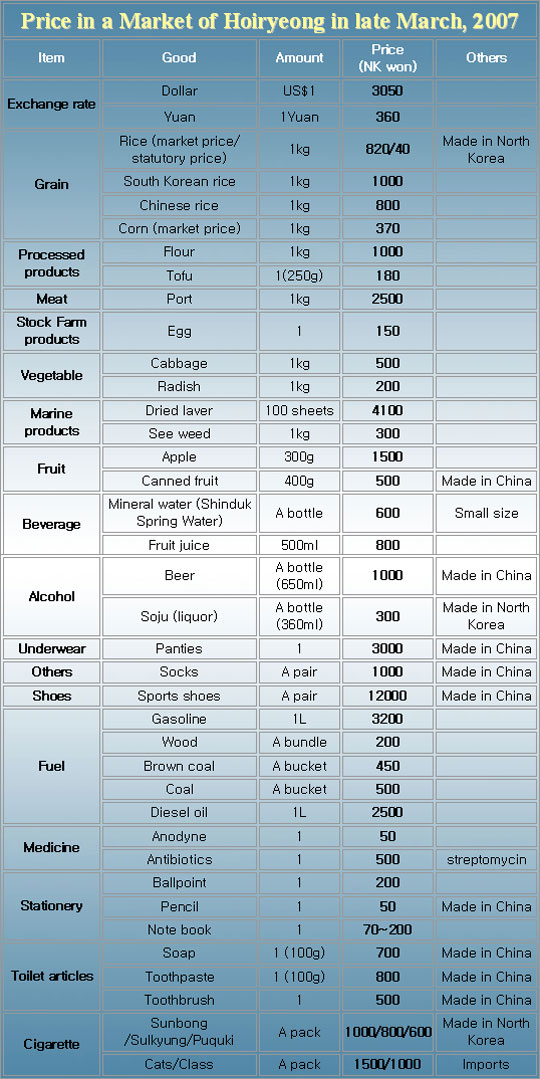
riceprices.jpgAt the end of March, the price of North Korean rice in Hoiryeong City’s jangmadang (market) fell to 820 won per 1kg, around 200 won lower than early January of this year. At a 100 won less value, the price of rice is in a falling state.

The result of Daily NK’s survey of three cities – Shineju, Hoiryeong, Kwaksan – in North Korea’s southern and northern regions at the end of March revealed that the declining price of rice will remain a reality through all regions of North Korea. In Shineju, North Korean rice costs 800 won per kg, 850 won for South-Korean rice, and 700 won for Chinese rice. The price of rice in Shineju is not much different than in January.

The price of corn, which is the staple among North Korea’s low-income, fluctuated narrowly from 340 won at the beginning of the year to 370 won at the end of March. Compared to the decline in the price of rice, the price of corn remaining at the current level can be said to reflect the demand for corn which has been transferred from the demand for rice on a small-scale.

As a whole, the stability of North Korea jangmadang’s price of rice indicates that food supply for North Korean citizens is relatively stable, compared to before. Since the North Korean authorities have not fulfilled the nationwide rations, a large majority of the citizens are purchasing their food at the jang.

In spite of North Korea entering the spring shortage season where the difficulty of obtaining food becomes more severe, the stability of the current price of rice is significant contrary evidence from the position upheld by world’s food organizations or domestic aid organizations of “100,000 tons of food deficit” in North Korea.

The value of the North Korean currency has been in a recession since March. In the Northern region, the currency declined from 3200 won per dollar early this year to 3050 won by the end of March. The Chinese yuan has also declined from 418 won to 360 won. North Korea’s inflation is falling back daily.

The price of North Korean pork at 2500 won per kg does not differ much from early this year. The price of flour, which is rare in North Korea, is 1000 won per kg; it always exceeds the price of rice. The price of North Korean sea foods is still astronomical. The bidding price for one frozen Pollack is 4000 won. That is enough to buy 5kg of rice.

A local source who conducted the price investigation of markets inside North Korea said, “The results of this investigation revealed that the price difference among the North Korean regions is very significant” and “besides medicinal or daily products, the price level in Hamkyungdo is higher than the price level in Pyongando.”


Share

To Be Legal or to Be Humanitarian?: Logic of Rescuing Defectors

April 10th, 2007

[NKeconWatch: Exit the government, enter the mafia?]

Daily NK
Han Young Jin
4/10/2007

South Korean court recently ruled to nullify any contract between defectors and brokers. Brokers help North Korean defectors to sneak into South Korea and get paid in return.

On Sunday, Seoul Metropolitan West District Court ruled against plaintiff, a broker, who sued former defector, a forty-five year old female A. In a ruling, the court stated “H (the broker) exploited A’s inexperience and hastiness to profit exorbitant amount.”

H made a complaint against A to pay five million won (roughly 5,400 US dollars), the amount A made a contract to do so in China for helping her to defect to Seoul.

Such controversy between brokers and defectors have been ongoing problem for a long time. And many have argued the contracts between defectors in China and brokers to be illegal.

The court ruling is based on South Korean civil code article number 104, in which ‘any legal activity lack of fairness due to one’s inexperience or hastiness is nullified.’ However, as the district court ruled, is brokerage of defection really an ‘act of exploiting defectors to profit exorbitant amount?’

There are many different types of brokers; somebody who profit from helping defectors, and others who receive minimal amount of compensation, barely enough to take defectors to Seoul, with somewhat humanitarian intention.

The decision by court on Sunday, however, might cause all those “contracts” between brokers and defectors invalid, which would definitely reduce the number of brokers and extent of their rescuing activity.

As of now, most of defectors who entered South Korea are helped by those brokers. Defectors, who lack information and legal status, often find it extremely hard to find safe area or a route via a third country to South Korea. Until they are in safe area or Seoul, brokers provide them protection and ways to escape.

South Korean government no longer offers protection for defectors at first hand for various reasons. Whatever the reasons may be, North Korean defectors are willing to pay a certain amount of money, which most of them do not have, in exchange of their freedom to go to Seoul. So defectors sign a contract with brokers to promise to take some of the government subsidy for settlement to reimburse.

An Inchon-based broker J said in an interview “Brokers are taking high risks because there’s no collateral but a piece of signed contract.” According to J it costs two million won to get a defector out of China safely. The cost includes food, transportation from northeast China to a country in Southeast Asia and bribe.

Since defectors do not have any money beforehand, brokers usually borrow money from bank with high interest. Thus, total cost could rise up to three million won to even five million.

Another broker K called the price “completely market price.” “This is not a risk-free business. If court nullify contract between defector and broker, there will be no more brokers, the only ones that defectors could ask for help.”

A broker from Busan, Y, told his experience. Y also went to court with a “contract” on his hand. In this case, the judge decided to let defectors pay at least some of the money.

Even defectors view the cash for entering Seoul as fair and legitimate.
Another K, a defector, said “I didn’t think even ten million won was too much to go to South Korea when I was in China. If there was no broker, I could’ve never escaped to South Korea.”

The district court’s decision might make in sense on the code. However, given harsh condition of defectors in China and South Korean government’s indifference toward them, brokers are necessary in rescue of wandering defectors.

Share

Ten-day Film Show Opens

April 10th, 2007

KCNA
4/10/2007

A ten-day film show opened Tuesday on the occasion of the Day of the Sun. 

Films dealing with the immortal revolutionary exploits of President Kim Il Sung and personality of Kim Jong Il as a great man will be screened at cinemas and cultural houses in Pyongyang and other parts of the country during the period. 

Among them are documentaries “Honor of Our People Holding the Great Leader in High Esteem”, “They Are Together in the Course of the Great Songun Leadership” and “Under the Guidance of the Great Brilliant Commander” and feature films “Star of Korea” and “Mt. Paektu”.

An opening ceremony took place at the Pyongyang International Cinema House.

Kang Nung Su, minister of Culture, made an opening speech.

At the end of the ceremony the participants watched newly-released documentary “Finding Himself among the People All His Life” (Part 1). 

Similar ceremonies were held in provinces on the same day.

Share
