N. Korea checks cross-border railways ahead of scheduled test: official

May 4th, 2007

Yonhap
5/4/2007

North Korea Saturday examined its side of railways that run across the heavily-fortified inter-Korean border as the divided Koreas are set to test them on May 17, a Defense Ministry official said.

“As North Korea notified our side Friday, (its officials) inspected the tracks inside the Demilitarized Zone (DMZ) early Saturday and returned,” the official said, adding a one-carriage North Korean train came to within a “few hundred meters” from the Military Demarcation Line (MDL) after departing from a station located some 2 kilometers north of the border and returned after the test run. The DMZ stretches two kilometers each to the north and south from the MDL.

The North told the South Friday that it will “check the tracks in the northern section” of a railroad connecting Seoul to the North’s northwestern city of Sinuiju for two hours from 10 a.m. Saturday.

The Seoul-Sinuiju railway was reconnected two years ago for the first time since the end of 1950-53 Korean War. Another railway connecting South Korea’s eastern Kangwon Province and North Korea’s Mount Geumgang is new.

The Koreas had agreed to conduct trial runs of passenger trains on the railways last year, but no train from either side has crossed the border amid opposition from the North Korean military, which fears possible exposure of its sensitive military installations along the tracks.

The sides have agreed to conduct a test run on the railways on May 17 following high-level military talks next week to discuss security guarantees and other issues related to the test.

Share

Ready to Run

May 4th, 2007

Joong Ang Daily
5/4/2007

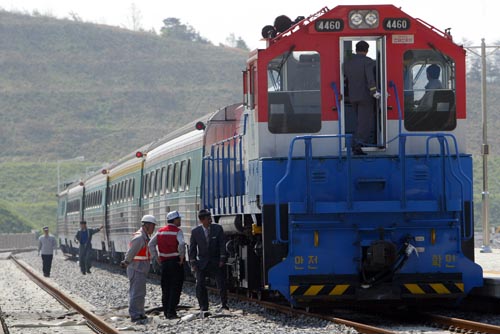
train.jpgAt Jejin Station on the east coast of South Korea, railroad officials yesterday checked a train to be used in the scheduled test of the restored inter-Korean railroads on May 17. In the pilot operation to reconnect the East Coast Line and the Gyeongui Line, trains from both sides will cross the demilitarized zone. North Korea has broken a promise to hold similar trial runs three times in the past.

Share

North Korean bird flu stamp

May 3rd, 2007

Joong Ang Daily
5/3/2007

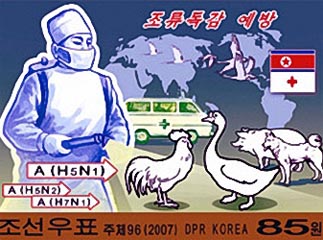
satmp.jpgNorth Korea recently issued a new postage stamp on the prevention of bird flu, Choson Sinbo, a pro-Pyongyang newspaper published in Japan, reported yesterday.

“North Korea’s Stamp Company has been creating new stamps with world topics and urgent international issues. Among those is the avian influenza prevention stamp,” the newspaper said. “In North Korea, bird flu prevention measures have been conducted continuously as a national project.”

The newspaper quoted a North Korea Stamp Company official as saying, “This stamp was created to promote North Korea’s health policy and to warn the public about the need to be careful about the disease.”

The price of the stamp is 85 North Korean won.

In February 2005, bird flu outbreaks were reported in poultry farms near Pyongyang. Sources close to North Korea’s affairs have said more than 210,000 chickens have been slaughtered to contain the disease.

Share

Is Seoul-Moscow Railway Linkage Feasible?

May 3rd, 2007

Korea Times
Kim Yon-se
5/3/2007

President Roh Moo-hyun has expressed his willingness for economic cooperation with Russia, including linking the Trans-Korean Railway (TKR) and the Trans-Siberian Railway (TSR), by sending a letter to Russian President Vladimir Putin, a Chong Wa Dae official said.

But cooperation with North Korea would be required for the railway connection between Seoul and Moscow, government officials said.

Though experts from South Korea, North Korea and Russia have held a series of meetings to discuss the railway project over the past several years, it has lingered on due to a series of politically negatives surrounding the Korean Peninsula.

According to government officials, North Korea has won Russian pledges of economic aid by agreeing on the project, which will generate huge profits for Russia.

During the Kim Dae-jung administration, many hoped the railway project would provide a momentum for the reunification of the two Koreas.  Since 2001 when North Korean leader Kim Jong-il and Russian President Vladimir Putin agreed on the reconnection of the TKR and TSR, the project to restore the Gyeongui line which links Seoul to Pyongyang and Shinuiju in the North, was expected to recommence.

Reconnection of the Gyeongui railway was agreed upon during the inter-Korean summit talks in June 2000.

But the North withdrew its workforce and equipment from the area in 2001, while the South has completed more than 70 percent of the Southern part of the line.

When the TKR and TSR are connected, transportation costs will be cut and the time taken to ship cargo to Europe will be reduced to 20 days from 45 days, bringing a significant change to the logistics system in Northeast Asia.

In addition, the connection of the railways is expected to increase both countries’ revenues, as North Korea and Russia are likely to collect $100 million and $400 million in tolls, respectively.

“The letter to Putin did not contain anything new on the railway project, though the issue was included in suggestions for economic cooperation,” said Cheong Wa Dae spokesman Cheon Ho-seon.

He added that there has been no reply from Putin to Roh.

In the letter delivered by former Prime Minister Han Myeong-sook, Roh also proposed to hold a summit with Putin. Han traveled to Moscow on April 25 to attend the state funeral of former Russian President Boris Yeltsin.

Share

Koreas fail to agree on details for swapping of raw materials, resources

May 3rd, 2007

Yonhap
5/23/2007
Koreas fail to agree on details for swapping of raw materials, resources

South and North Korea on Wednesday failed to settle remaining differences over how to boost cooperation in light industry and natural resource development, the Unification Ministry said.

“The two sides just agreed to continue to discuss details regarding the issue,” the ministry said in a statement. The ministry did not provide details about when they will meet again.

Working-level officials could not agree on the list and price of raw materials the South is to provide the North in exchange for the right to develop natural resources in the communist country.

The North called for more than the South has earmarked for the shipment on the last day of the two-day talks held in the North Korean border city of Kaesong, according to South Korean officials.

Last month, South Korea agreed that it will provide raw materials to the North in June to help revive its threadbare light industry in return for the North’s natural resources. The two Koreas reached a similar swapping agreement in 2005, but it has not been implemented due mainly to the North Korean nuclear dispute.

In the agreement, the rice shipment, which will consist of 150,000 tons of domestic rice and 250,000 tons of imported rice, will be sent to the North late this month in the form of a loan to be paid back over the next 30 years with a 10-year grace period. Seoul hopes to link it with Pyongyang’s promise to take initial steps toward nuclear disarmament.

Last Tuesday, the South Korean government endorsed the spending of funds needed to provide rice and raw materials for light industry to North Korea. The South’s planned shipment of 400,000 tons of rice is worth US$170 million, while the provision of raw materials for light industry is worth $80 million.

In 2005, South Korea agreed to offer raw materials to the North to help it produce clothing, footwear and soap starting in 2006. In return, the North was to provide the South with minerals, such as zinc and magnesite, after mines were developed with South Korean investments guaranteed by Pyongyang.

But the economic accord was not implemented, as North Korea abruptly cancelled the scheduled test runs of inter-Korean railways in May last year, apparently under pressure from its powerful military.

Last Thursday, two trains crossed the Military Demarcation Line for the first time since the end of the 1950-53 Korean War. But critics said the test run of two railways, one in the east and the other in the west, is not likely to lead to the formal opening of the railways or to rail services for a joint industrial complex in Kaesong or for tours of the North’s Mount Geumgang.

As part of efforts to accelerate the formal opening of the inter-Korean rail service, the South plans to sound out the possibility of providing raw materials via reconnected railways during the working-level dialogue or the upcoming ministerial talks.

Koreas hold talks on swapping of raw materials for light industry
Yonhap
5/22/2007

South and North Korea on Tuesday held talks to work out details for boosting cooperation in light industry and natural resource development, the Unification Ministry said.

The aim of the working-level dialogue, being held in the North Korean border city of Kaesong for two days until Wednesday, is to focus on procedures for the South’s shipment of raw materials to the North in exchange for the right to develop North Korea’s natural resources.

During the talks, South and North Korea are scheduled to exchange agreement documents, which will then take effect immediately since the two sides successfully conducted test runs of cross-border railways, a precondition for the implementation of the accord, government officials said.

The South also plans to sound out the possibility of providing the materials via reconnected railways in a prelude to the formal opening of the inter-Korean rail service, according to sources.

“We are studying various ways of speeding up the formal opening of the Gyeongui (Seoul-Sinuiju) and Donghae (East Coast) tracks. The use of the tracks for the promised shipment of light industry raw materials could be an option,” a government source said, asking to remain anonymous because of the sensitivity of the issue.

On Thursday, trains crossed the Military Demarcation Line for the first time since the end of the 1950-53 Korean War. But critics said the test run of two railways, one in the east and the other in the west, is not likely to lead to the formal opening of the railways or to rail services for a joint industrial complex in Kaesong and tours of the North’s Mount Geumgang.

Earlier this month, South Korea said it will ship the first batch of light industry materials to the North via ship on the Incheon-Nampo route, but the mode of transportation for the rest has yet to be decided.

Last month, South Korea agreed that it will provide raw materials to the North in June to help revive its threadbare light industry in return for its natural resources. The two Koreas reached a similar swapping agreement in 2005, but it has not been implemented due mainly to the North Korean nuclear dispute.

In the agreement, the rice shipment, which will consist of 150,000 tons of domestic rice and 250,000 tons of imported rice, will be sent to the North late this month in the form of a loan to be paid back over the next 30 years with a 10-year grace period. Seoul hopes to link it with Pyongyang’s promise to take initial steps toward nuclear disarmament.

Last Tuesday, the South Korean government endorsed the spending of funds needed to provide rice and raw materials for light industry to North Korea. The South’s planned shipment of 400,000 tons of rice is worth US$170 million, while the provision of raw materials for light industry is worth $80 million. The approval will be promulgated on Tuesday.

In 2005, South Korea agreed to offer raw materials to the North to help it produce clothing, footwear and soap starting in 2006. In return, the North was to provide the South with minerals, such as zinc and magnesite, after mines were developed with South Korean investments guaranteed by Pyongyang.

But the economic accord was not implemented, as North Korea abruptly cancelled the scheduled test runs of the railways in May last year, apparently under pressure from its powerful military.

Share

North Korea Time

May 3rd, 2007

Wall Street Journal Editorial
5/3/2007
Page A16

It’s been two and a half weeks since the 60-day deadline passed on April 14 for North Korea to comply with the first part of the nuclear accord reached in February. That includes shutting down the Yongbyong nuclear reactor, letting in U.N. inspectors and providing a list of all nuclear programs. But so far no word from Pyongyang, and nothing from Beijing or Washington either. President Bush and Secretary of State Condoleezza Rice both recently claimed their “patience” is not “endless,” contrary to all available evidence.

Meanwhile, another North Korean deadline has been allowed to lapse. On January 19, United Nations Secretary-General Ban Ki Moon ordered an “external inquiry” into all U.N. programs in North Korea, including the United Nations Development Fund, Unicef, the World Food Program and the U.N. Population Fund. Mr. Ban’s announcement followed our report on irregularities in UNDP programs in North Korea and U.S. concerns that tens of millions of dollars in hard currency were funneled to dictator Kim Jong Il.

Mr. Ban imposed a 90-day deadline for the audit, but it appears to be lost somewhere in the U.N. bureaucracy. The auditors spent two weeks in March at UNDP headquarters in New York interviewing staff and looking at the books, but they have yet to set foot in North Korea, much less file a report. Oh — and the “independent” and “external” audit Mr. Ban ordered is being conducted by the U.N.’s own Board of Auditors, consisting of a team from South Africa, France and the Philippines.

We had a challenge gathering even these details. The Board of Auditors refuses to talk to the press. The UNDP understandably feels it lacks standing to comment on an investigation of itself. And Mr. Ban’s press office can’t seem to get the facts straight, first telling us the auditors were in Korea and then informing us they weren’t. You’d think someone at the U.N. would show more interest in explaining one of the boss’s priorities to the public.

It will be interesting to see how Kim Jong Il responds if the auditors get around to asking for visas. The dictator recently told the last two UNDP officials left in Pyongyang to get out. The UNDP suspended operations there in March, after our reports and after the Kim government refused to let aid officials visit the projects they fund.

Mr. Ban is staying mum on the missed U.N. deadline. But on the evidence so far, Kim can be forgiven if he concludes that the world isn’t serious about enforcing any of its deadlines concerning North Korea.

Share

The North Korean Economy: Between Crisis and Catastrophe

May 3rd, 2007

American Enterprise Institute Book forum
4/17/2007

A couple of weeks ago, I had the opportunity to attend a book forum at the American Enterprise Institute on Nicholas Eberstadt’s new book, The North Korean Economy: Between Crisis and Catastrophe.  It was very informative to hear three different perspectives on the direction of North Korea’s economic reform.

Panelists included:

Nicholas Eberstadt, AEI
Andrei Lankov, Kookmin University
Deok-Ryong Yoon, Korea Institute for International Economic Policy

In summary, Mr. Eberstadt and Mr. Lankov are pessimistic about the North Korean leadership’s desire to enact reforms–knowing that information leakages will undermine their political authority.  As Mr. Lankov pointed out, the North Korean nomenklatura are all children and grandchildren of the founders of the country who are highly vested in the current system.  They have no way out politically, and as such, cannot reform.

They argue that the economic reforms enacted in 2002 were primarily efforts to reassert control over the de facto institutions that had emerged in the collapse of the state-run Public Distribition System, not primarily intended to revive the economy.  Lankov does admit, however, that North Korea is more open and market-oriented than it has ever been, and  Mr. Yoon was by far the most optomistic on the prospects of North Korean reform.

Personally, I think it makes sense to think about North Korean politics as one would in any other country–as composed of political factions that each seek their own goals.  Although the range of policy options is limited by current political realities, there are North Koreans who are interested in reform and opening up–even if only to earn more money.  In this light, even if the new market institutions recognized in the 2002 reforms were acknowledged only grudgingly, they were still acknowledged, and their legal-social-economic positions in society are now de jure, not just de facto.  The North Korean leadership might be opposed to wholesale reform, but that is economically and strategically different than a controlled opening up on an ad hoc basis–which is what I believe we are currently seeing. Anyway, dont take my word for it, check out the full commentary posted below the fold:

Read the rest of this entry »

Share

Foreign NGOs in N.Korea try to counter culture of dependence

May 2nd, 2007

doctor.jpg

 AFP
 Philippe Agret
 5/2/2007


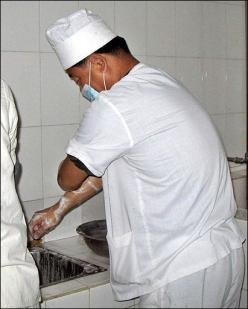
SARIWON, North Korea (AFP) – To cope with the pouring rain, the hospital tossed sawdust down the stairway leading to the operating theatre.

Two surgeons washed their hands in a sink, but sometimes they lack soap.

Much like the rest of North Korea, a political pariah and economic black hole, the nation’s hospitals subsist with whatever they can get their hands on, making ends meet with obsolete equipment, short-cut procedures and a smattering of foreign assistance.

Even by the standards of the developing world, the facilities here in Sariwon, a 45-minute drive south of the capital Pyongyang, leave much to be desired.

The medical equipment is largely German or Soviet, reused as long as possible, but spare parts are desperately lacking.

“As we lack sufficient or working equipment, we use local anaesthesia and acupuncture for operations,” said the director of the Sariwon hospital, Dr Choe Chol, a surgeon.

In winter, surgeons operate in rooms where the temperature is lower than five degrees Celsius (41 Fahrenheit).

To improve conditions, the doctors and nurses pitch in themselves to make the hospital work, sometimes even laying down the tiling in the operating theatres.

“We do our best here. There’s no bleach, no soap, no disinfectant. We cleanse with distilled water. It’s the volunteers — the doctors and nurses — who regularly do the cleaning up,” said Veronique Mondon, the North Korea head of the French charity Premiere Urgence.

Premiere Urgence is one of only six foreign non-governmental organisations allowed to work in the Democratic People’s Republic of Korea.

Like others NGOs, the group has set a goal of bringing the most basic treatment to the population — but also to encourage North Koreans to develop their own medical infrastructure.

Premiere Urgence’s primary effort has been producing intravenous drips — one of the only medical supplies made in North Korea — for the 12 hospitals where it works.

With 70 to 80 percent of the medicine in North Korea coming from overseas donations, the IV drip — in the form of a packet with a solution of distilled water, glucose and sodium — serves to ease the impact of the lack of supplies.

“These packets can be used for a great number of the medical problems in North Korea such as accidents, malnutrition, dehydration, diarrhea, typhus and hepatitis. They save lives,” said Mondon, a biologist who opened Premiere Urgence’s branch in North Korea in April 2002.

If IV drips are effective, their production is a daily challenge. The packets must be sterilised on site in the most sanitary conditions possible, a process that takes about three and a half hours.

In light of the instability of the electricity and frequent short power cuts, Premiere Urgence has brought in specially made transformers from China.

“The people in the laboratories work during the night to produce the packets so as to save the electricity for the sick people and operations during the day,” Mondon said.

“It was tough at first. It seemed to be an insurmountable task. But now, the North Koreans know that this is needed,” she said.

After the April 2004 disaster in the northern city of Ryongchon, when a cargo train blew up, killing more than 160 people and wounding a thousand others, Premiere Urgence worked round the clock to produce IV drips and distributed 40,000 of them to two hospitals that were treating victims.

Today, the laboratory in Sariwon produces 300 IV drips a day — enough to treat more than 200 patients in this 750-bed hospital.

Across North Korea, Premiere Urgence produces 500,000 packets a year, each one worth around 50 US cents.

The French group has also set up a central laboratory in Pyongyang for quality control over injectable solutions.

North Korea’s communist leadership adheres to the homegrown ideology of “Juche” — self-reliance and self-sufficiency.

But at least hundreds of thousands of people died in a famine in the 1990s and North Korea has since relied heavily on foreign assistance — notably for food — despite continued political defiance, including its test of an atomic device in October.

From the International Committee of the Red Cross (ICRC) to the few NGOs in North Korea, all encourage local initiatives in an effort to prevent a culture of dependence.

Premiere Urgence plans eventually to hand over the maintenance of equipment and training of technical staff to the North Korean ministry of public health.

As for the ICRC, as well as helping produce 1,200 prosthetic limbs in 2006, it has focused efforts on training local people, including orthopaedic specialists and surgeons.

“North Korea’s pharmaceutical industry will never be able to develop if humanitarian groups flood North Korea with foreign medicine. It will continue to vegetate and manufacturer substandard products if foreigners do not buy local medicine,” said Felix Abt, a Swiss businessman who heads PyongSu Pharma JV. Co Ltd., one of the first foreign joint ventures in North Korea.

Pyongsu has set up a “model” pharmacy in Pyongyang and since September 2004 has run a factory with 30 employees manufacturing paracetamol, the pain relief drug sold under name brands such as Tylenol, along with aspirin and antibiotics.

Abt hopes one day to be able to export medicine from North Korea.

“For now, we are giving the North Koreans fish. It would be better to give them nets so they can catch fish,” Abt said.

Share

Korean-Polish Joint Venture

May 2nd, 2007

Via the Eurpoean Business Association:

The Korean-Polish Shipping Co., Ltd. is a joint venture company established in 1967 in accordance with the agreement between the governments of the DPRK and Poland.

The company has head offices in Pyongyang, the DPRK and branch offices in Gdynia, Poland, where well-experienced officials appointed by the two governments respectively are employed.

In close cooperation with shipping agents and brokers of foreign countries in Asia, Europe and other parts of the world, it conducts mainly such businesses as cargo transportation and chartering of vessels. It also engages in brokerage and agency in marine transport, as well as invitation of investment.

The company will, in future, put the management of marine transport on a modern basis and further promote cooperation and exchange in shipping with different countries around the world.

Korean-Polish Shipping Co., Ltd.
Head office
Add: Moranbong District, Pyongyang, DPRK
Tel: 850-2-18111-3814384
Fax: 850-2-3814607
E-mail: [email protected]

Branch office
Gorczycowa Str.4F, 
81-591 Gdynia
Poland
Tel. ++48 (0) 58 629 90 54-55
Fax. ++48 (0) 58 629 90 53
eMail: [email protected]

Share

All Japanese Goods to be removed from North Korea in 3 Years

May 2nd, 2007

Daily NK
Kim Yong Hun
4/30/2007

North Korean high authority has issued domestic instructions to “remove all Japanese products from Pyongyang and every other city within 3 years.” A source in North Korea reported that the prohibition includes the trade and circulation of Japanese cars, bicycles, electronic goods, and groceries. The Kim Jong Il regime seeks to punish Japan for the attitude it displayed in the recent six party talks and for its decision to continue sanctions against North Korea for an additional 6 months.

As a result, reliance on Chinese and South Korean products such as refrigerated vans and trucks is increasing according to a custom house officer in the Chinese border city Dandung. There, “10 Yuan stores” offer South Korean goods whose main consumers are North Korean traders, according to the source. Hot items include plates, lunch boxes, shoes and clothes, and a South Korean electronic rice-cooker, the “Cuckoo.” The cooker is one of the most popular devices among North Korea’s elite who have spurred the import boom.

Share