North Korea Now: Will the Clock Be Turned Back?

February 15th, 2008

This morning I received an email from a reader at the Brookings Institution who shared an article by one of their visiting fellows.  Much of it was about US/DPRK foreign policy, but I thought the following excerpt was interesting from a social change perspective:

On a recent visit to Pyongyang, this author was impressed by the sheer scale of new economic phenomena in DPRK. In terms of variety of goods, activity, and scale, markets in North Korea’s central areas (less in the provinces) remind of Chinese provincial markets. Numerous restaurants serve good—and very cheap, by Western standards—food to customers flocking to them. New “service centers” (eundokwon), combining shops, saunas, and restaurants under one roof, have sprung up and are run by highly placed entities such as Party departments and “offices.” Every branch of the Party, military, and local authorities now operates trading companies. Real business managers have appeared, some engaged not only in the “shuttle” trade with China but in bigger projects (in construction, for example), and some corporations have amassed a considerable volume of business. Judging by the author’s experiences in the 1980s and 1990s, these “new Koreans” are much more realistic and open to contact with outsiders than was the case before. There are changes in the official line as well: North Korean economists explained that now, out of several hundred thousand products manufactured in the country, only several hundred are now centrally planned. For the vast majority of manufactured products, managers of the state-owned enterprises are given a free hand to determine their production targets and to get what they need through the “socialist wholesale market.”

Having witnessed the processes eventually leading to the denunciation of the command economy in the USSR, and the transition to a market-based economy, this author can testify that there are striking resemblances in certain aspects of contemporary daily life in the DPRK to the USSR in the 1970s and 1980s (the Chinese experience in the1980s, with private enterprise officially sanctioned, is less similar). At that time in the Soviet Union, a vast black market of goods and services began to form in major cities. Many of its dealers became (often after a prison term) the leading businessmen of the post-Soviet era.

For example, at that time there was no private property for apartments in Moscow or elsewhere, and no real estate market officially existed. But at the same time almost any Soviet in the course of his life would “change” one apartment for a better one, paying considerable sums of money to the former “owner.” Some shadowy dealers would buy apartments outright, bribing officials to get a “registration” (propiska), and many made a profession of acting as a “go-between.” Similar activities are sprouting like mushrooms around North Korea. A one-room apartment in Pyongyang is said to cost about US$5000, less in local areas. However, real estate in some small cities close to Pyongyang boast the same high prices, as various kinds of dealers and traders, who are not permitted to settle in Pyongyang, buy apartments there. Foreign currency flows freely and, like in the USSR, most things can be obtained for money. A Russian joke said: “if it is illegal, but very much desirable, it is not prohibited.”

The ground for developing market relations is well prepared. The “royal economy” serving the ruling class (Kim Jong-il’s immediate retinue and the top nomenklatura or kanbu), and a large part of the internationalized sector (joint ventures and free economic zones) operate on market principles. The next step, should the country’s leaders admit the need for developing the country and sustaining their power, should be “setting the rules of the game” by providing a legal framework for what already exists. For that, however, external security should be guaranteed to the regime—irreversibly and comprehensively. Only then will the hard-liners, who fear—with good reason—that reforms would invite subversion of the regime, be confident enough for real progress to take place. Nevertheless the words “reform” and “openness” (especially because of their “Chinese connotations”) are unacceptable to Pyongyang, and Kim Jong-il himself stated as much during his talks with Roh Moo-hyun in October 2007. Under the present leadership Pyongyang, any economic reforms would most likely never be called such and would take place in an unpublicized manner without discussion, which is not helpful in terms of public relations with the West and negative international sentiment about the regime.

The full article can be found here:
North Korea Now: Will the Clock Be Turned Back?

logo_sm.bmp

Georgy Toloraya, Visiting Fellow, Center for Northeast Asian Policy Studies
2/11/2008

Share

The gratuitous game theory of official support

February 15th, 2008

Yesterday’s post on accountability and South Korean aid to the North got me thinking about game theory again.

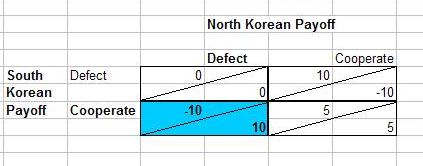
gametheorys.JPG

The South Korean Ministry of Unification has a dominant strategy to lend/give/invest in North Korea for ostensibly two reasons: 1. If the MoU does not, their raison d’etre goes away.  2. South Korea will ultimately see a payoff if a development strategy works in the DPRK.

Contracting with North Korea, however, is essentially a prisoner’s dilemma (see chart above), and North Korea has the ability to cooperate or defect.  However, the North Koreans have rational expectations, so they know the Ministry of Unification has a dominant strategy to cooperate.

Therefore the Nash equilibrium is for the South to keep cooperating and for the North to keep defecting.  In a repeated game, cooperation evolves over time as trust develops and defection decreases.  Because of South Korea’s dominant strategy,however, the North never has an incentive to cooperate–so we end up with an “anti-folk theorum” where defection is the only incentive compatible outcome over time.

Addendum: The game could be radically different for private investors, however, who are in a more credible position to say “no”–leading to defect/defect moves (because South Korean investors are not as politically constrained and can recognize sunk costs).  These moves result in neither gains nor losses for either side, however, because both sides have the ability to bargain, cooperation that is mutually beneficial can evolve over time as it should.

Share

DPRK military on Google Earth

February 14th, 2008

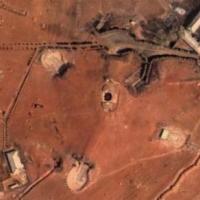
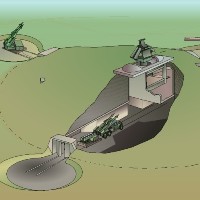
underground1.jpgunderground2.jpg

As many readers know, I have been mapping out North Korea’s military facilities (along with many other things) on Google Earth for some time.  Having never served in the military, I am not qualified to speculate on what many military locations are, but I discovered a web page that has a phenomenal explication of specific locations, even including 3-D overlay images (two  of the may comparisons are at the top of this post).

Anyone who is interested in Google Earth, or North Korea’s military infrastructure, needs to check out the full offerings at “Fortress North Korea” on “militaryphotos.net”.

And if you have not done so, download “North Korea Uncovered v.8” on Google Earth here.  Sorry Google Maps users, the file is too large.

Share

Miniunific: Show me the money!

February 14th, 2008

On February 8, it was announced that the South Korean Ministry of Unification, the agency responsible for official interactions with the North, would not be merged with the Foreign Ministry (full story)–dealing an early policy blow to the newly elected South Korean President’s efforts to reduce the size of the South Korean government.

However, just three days later, on February 11,  the Chosun Ilbo reported that a South Korean government cash donation to North Korea (cash donations are apparently unlawful) has [surprisingly] gone missing:

In March last year South Korea gave US$3.8 million worth of aid, including $400,000 in cash and building materials, to North Korea to build a center for inter-Korean video-link family reunions in Pyongyang. But North Korea has not even started construction on the site, it was known on Sunday.

The donation violated a ban on cash aid to North Korea, but South Korea’s Ministry of Unification said at the time that there would be no room for suspicious dealings because the North agreed to inform the South where the money was spent and the South agreed to visit the construction site to find out whether the money and materials were used properly.

It has been almost a year since the aid was delivered, but it is not clear what the North has done with the cash and building materials. The South Korean government has demanded that it be allowed to visit the construction site, but the North has brushed off the requests, saying it will show the site “next time” or after the center is dedicated.

[and…] 

On eight occasions from early April to late August last year, South Korea delivered to the North building materials such as cement, iron bars, electric cable, tiles, drills, adhesive glue, interior furnishings, elevators, and air-conditioning and heating equipment. It also sent 10 buses and six Rexton SUVs.

When sending the materials, Seoul demanded five times that the North allow South Korean officials to visit the construction site and provide details on where the materials were used. All such demands were rejected. (Chosun Ilbo)

Today, February 14, South Korean military authorities admitted to knowing (since 2003, when the previous Roh Moo-hyun administration was inaugurated), that North Korea has transported rice supplied by the South for humanitarian purposes to front-line units of the Korean People’s Army.

The South Korean military has admitted it found no fewer than 200 South Korean rice sacks transported to North Korean Army units on about 10 occasions to the demilitarized zone including Gangwon Province between 2003 and recently.

This is the first corroboration by the South Korean military of testimony by North Korean refugees that the food aid provided by South Korea is being diverted for military purposes. But despite their knowledge of this fact, neither the South Korean government nor military authorities protested to North Korea or asked it for an explanation, apparently for fear of provoking Pyongyang. (Chosun Ilbo)

Updated: 2/21/2008: North Korea denies it diverted food aid to military

Now, I personally favor some kind of engagement policy with the North, but implementing an effective strategy is difficult.  Strict transparency and accountability are absolutely necessary to avoid mismanagement of public funds.  This is admittedly difficult, even in the OECD, much less in a secretive communist state.  Under the current circumstances, however, the North is treating the South like an unwanted lover, and this is not a healthy outcome. 

Handing out public funds with weak- or no-strings attached (as the South has done for years) creates markets in political corruption in the North.  The North Koreans know that the Ministry of Unification has a bureaucratic incentive to spent the money on aid.  If they don’t, it will not be appropriated in the next fiscal cycle.  This is why government budgets almost never go down, and agency heads go on a spending spree just before the fiscal year ends–use it or lose it.  The North Koreans have simply learned how to say the right things, etc., so the Ministry of Unification can check the box and pay up, because they know there will be no consequences when they fail to deliver.

So what is the solution?  If the South Korean government demonstrated some desire to monitor development aid, and reduce it if necessary (say “no” once in a while), they might encourage the North Koreans to do with the money as they claim (at least more so).

Another option available to the South Korean government is to stop using public funds to develop North Korea and instead free the South Korean business community, and other individuals, to take their chances contracting with North Korean entities themselves.  Putting their own Won on the line will definitely encourage private investors and venders to keep an eye on their balance sheets, and will help depoliticize the development of a country with a poor reputation.  

See the gratuitous game theory here.

You can read the referenced articles below:
S.Korea Knew Its Rice Feeds N.Korean Military
Choson Ilbo
2/14/2008

N.Korea May Have Diverted Cash Aid
Chosun Olbo
2/11/2008

Share

Reporters Without Borders 2008 Report

February 14th, 2008

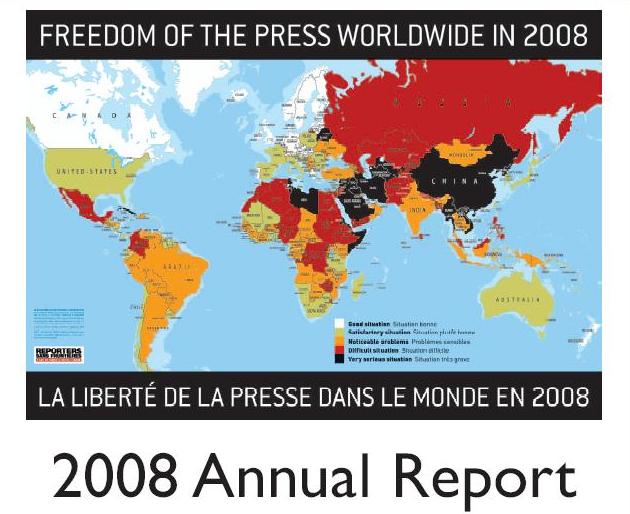
rwb.JPG

The Reporters Without Borders 2008 Annual Report has been published.  It is not an index (with rankings assigned to each country) but rather a survey that groups nations into one of five quintiles based on the publisher’s perceptions of press freedom: (1. Good situation, 2. Satisfactory situation, 3. Noticeable problems, 4. Difficult situation, 5. Very noticeable problems.

If you read the report (here), it is mostly a qualitative analysis and there does not seem to be any objective methodology for grouping countries into a particular quintile. (Disclaimer: I have note read the whole thing, but usually the methodology is spelled out in its own section for these types of publications, but I have not been able to find it). This worries me because if there is no standard methodology, with relative weights, then the results are vulnerable to questions of subjectivity.

North korea is ranked a “Very Noticeable Problem.”  To read just the North Korea section of the report click: rwb-dprk.pdf

Share

DPRK light industrial production grows with ROK material aid

February 13th, 2008

Institute for Far Eastern Studies (IFES)
NK Brief No. 08-2-13-1

2/13/2008

As South Korean materials used in light industry make their way to the North, some DPRK factories appear to returning to normal manufacturing operations. A source in North Korea recently reported, “Raw rubber, talcum (used for soap), perfumes, textiles, and other ROK raw materials made their way to a Sinuiju shoe factory and cosmetics factory, and production has returned to normal.”

South Korea is providing raw materials for light industry worth 80 million USD in return for mined goods from the Danchun and Kumduk areas of North Korea. According to the source, “9 containers of soap powder came to the soap department of the Sinuiju cosmetics factory. The factory is in full operation and most workers are reporting for work…Workers are receiving monthly wages and food rations, and [they] almost never come out to the traditional market.”

The workers at the Sinuiju cosmetics factory are mostly women, and up until now there were no materials or power, so there could be no production and business was off. However, since the middle of last November, as materials began to flow in, this factory was identified as a ‘special’ factory, power was turned back on, and the manufactured goods began to roll out. An inside source also reported that the goods have already begun to turn up on Sinuiju markets. “Sneakers began appearing in Sinuiju’s Chaeya and Chinsun Markets; The quality is good, and the residents have received them well … The response seen is that it is thanks to the South Korean shoe materials that the quality is good. Chinese shoes are not able to compete, and are not selling well.”

The source went on to report that the scent of laundry detergent was nice, and that it was only being used to wash undergarments. “Everyone knows that the light industrial raw materials are from South Korea …Everyone already knows that South Korea has flourished, so they publicly praise ROK goods.”

As production normalizes at the Sinuiju shoe factory, cosmetics factory, and other light industrial factories, factory workers are becoming objects of envy. Among residents, some worry about not being able to enter the factories, because in the factory, monthly wages and rations are received, and some products can be stolen and privately sold.

Goods now found in Sinuiju markets include some given to factory workers based on their piece rates, and some that are snuck out and find their way to vendors. However, in this first stage of production normalization, the North is not yet at a level at which large-scale rationing to the people is possible.

Share

North Korea can produce instant noodles again

February 12th, 2008

The Chosun-Shinbo reports (via the Daily NK) “North Korea can produce instant noodles again” because construction has been completed on Pyongyang’s newest (and largest) noodle factory, the Pyongyang Wheat Flour Factory.

“Starting this year, domestically produced instant noodles will likely be supplied to people on a large scale.”(Daily NK)

…signaling that the DPRK government still seems intent on re-launcing the collapsed Public Distribution System (which has floundered many times).

[The] Pyongyang Wheat Flour Factory is located in Samheong-dong of Mankyungdae District, in Pyongyang, and mainly produces wheat flour, cookie, noodle, and yeast. North Korea built its first noodle factory, Daedong River Instant Noodle Factory, with foreign capital in August 2000 along the Daedong River in Pyongyang.(Daily NK)

Last October Yonhap, reported that Hyundai’s 44,000-strong union donated US$553,800,  appx. $13 per worker, to help finance a corn noodle factory in Pyongyang.  This is likely the “older” Daedong River Instant Noodle Factory.  If this is the case, then Pyongyang has two noodle factories coming on line at about the same time.

The rest of the story:
Although the DPRK government is a newcomer to the noodle business, noodle production and consumption have been burgeoning in North Korea’s private economy, and there is supportive journalistic evidence that the business now suports those on the lower rungs of the  economic ladder (see here, here, here, and here).  Small scale noodle production requires little capital, so it is a natural fit for those who have nothing but have taken to supporting themselves. 

The opening of new government-operated food processing plants is tantamount to a “re-nationalization” of a “privatized” industry in the DPRK.  Past reports claim that noodle sales earned private vendors between 900 to 1,600 won.  Now these vendors, who operate at the fringes of North Korea’s semi-legal private economy, will at a minimum, be forced to compete with “free” or heavily subsidized government operators. 

What will be the result?  On the pessimistic side, we could claim that the DPRK government is attempting to monopolize the food supply to control the population (as it has in the past).  On the other hand, their ambitions might be more modest and they are only looking to establish some form of carrot they can point to as legitimization of the government’s leadership.

From an economic reform perspective, however, North Korea needs fewer government-run noodle factories and a better business environment for noodle entrepreneurs. 

The full stories can be found here:
North Korea Can Produce Instant Noodles Again
Daily NK
Park Hyun Min
2/12/2008

Hyundai Motor union leaders visit N. Korea for noodle project
Yonhap
10/31/2007

Share

David Kang on North Korean trade potential

February 12th, 2008

Kang: North Korean Trade Potential
Council on Foreign Relations
12/17/2007

Last December, David C. Kang, a professor of government at Dartmouth College and an adjunct professor at Tuck Business School, discussed the North Korean economy for the Council on Foreign Relations. I have excerpted some of his comments below.

His view on the new North-South cargo train service:

It doesn’t have huge economic significance in the overall GDP of North Korea. But it does have major economic significance in the fact that what North Korea had to do in order to let a train go through was an awful lot of adjustment[…]in terms of linking up the railroad, all the ministries had to prepare.  The old [Korean Energy Development Organization] had this problem as well. [W]hen they wanted Americans and South Koreans working in North Korea to build this light-water reactor, [they] had to set up protocols [Post offices, phone calls, where they were going to stay, etc]. It is pretty significant in terms of how much they had to adjust.

He quoted the following figures on North – South trade:

From $200 million in 1998, to now exceeding $1.7 billion in 2007.   South Korea’s total trade volume is $250 billion.

His opinion on the direction of the North Korean economy:

At this point what we’re seeing is very initial steps on the part of North Korea as they try to open up reform and yet maintain control. At the same time, they are being forced into a number of institutional changes and mind-set changes that are the first step forward in this process.

His view of North Korea’s comparative advantage:

Most of the companies that have gone in—the South Korean companies that have gone in—are assembly and light manufactures, such as or textiles and light consumer goods. This is the sort of obvious point of departure. It’s not hugely capital intensive in terms of building factories, and can take advantage of North Korean cheap labor and South Korean technological advantages.

There are a lot of potential mineral resources in North Korea, which would require a whole infrastructure of legal reforms to happen before anyone would take care of them. But at this point the safest bets are the ones that are on the order of assembly and light manufactures in the North and then exporting them out.

His view of South Korea’s long term goals:

If there’s unification, or even better relations, and South Korean companies can use cheap North Korean labor, instead of having to send those factories to China or Vietnam—not only do they speak Korean, they’re culturally similar, and the labor would be cheaper.

[I]f you could reconnect the railroads, from Japan, through Pusan [South Korea], up through North Korea, then out to China and Russia, you would be linking up all these economies in a much more efficient way than they are now. So everybody wants that. But obviously there’s the political problem. And even on the infrastructure side, the North Korean rail system is so old and so decrepit, that basically it would have to be rebuilt from zero. But the potential upsides are massive, in the long run.

His view of China’s engagement:

China has been essentially as deeply involved in economic engagement with North Korea as has South Korea—and by some measures, actually more so. Whereas South Koreans just do this assembling, some Chinese companies are moving in and building full factories in the North. There’s a lot of interest in Chinese-North Korean economic relations on both sides.

Share

Pyongyang to start using buses with air conditioning

February 12th, 2008

Yonhap
2/12/2008

North Korea will begin using more than a hundred new buses with air conditioning for the convenience of a growing number of foreigners visiting Pyongyang, a U.S. government-funded radio station reported Tuesday.

Pyongyang’s municipal people’s committee recently requested a Chinese bus manufacturer to install air conditioning in 110 new buses to be used in the capital city, Radio Free Asia said.

The North already paid the cost in cash and 52 of the buses were already sent to Pyongyang, it said.

The communist state depends heavily on foreign aid to overcome its chronic energy shortage.

“North Korea is introducing buses with air conditioning to make Pyongyang look more advanced and urban in the eyes of foreign tourists whose number is on the rise,” the radio report said, quoting an unidentified source in China. “North Korean people have realized by watching TV dramas and other programs from South Korea that their living standards are not good enough.”

Share

ROK business optomistic about inter-Korean cooperation after nuke resolution

February 12th, 2008

Institute for Far Eastern Studies (IFES)
NK Brief No. 08-2-12-1

2/12/2008

South Korean businesses currently involved in inter-Korean economic cooperation are facing many difficulties, both due to and in spite of the system in place, so that at the moment, investment in North Korea does not look much more appealing than in Vietnam or China.

The Korea Chamber of Commerce carried out a survey, titled “Business Perspective on the Direction of South-North Economic Cooperation Policy”, targeting 300 successful businesses (170 companies responded) and 200 companies currently involved in inter-Korean economic cooperation (132 companies responded). According to the results of the survey, 79.4 percent of companies involved in inter-Korean cooperation responded that they are “currently facing systemic and procedural difficulties.”

More specifically, 44.7 percent pointed to the “3-C” (commute, communication, and customs) issues, 22.4 percent pointed to “claim resolution procedures,” 14.3 percent highlighted “difficulties with financial transactions,” 11.8 percent chose the “ban on the import of strategic materials,” and 5 percent indicated that “limited markets” were the main issue.

In addition, 58 percent of responding companies noted issues not related to the system set up for inter-Korean cooperation. 36.6 percent pointed to difficulties resulting from the “lack of understanding of market economics,” 28.7 percent noted a “lack of supervision by managers,” 24.8 percent chose “uncooperative, highly tense attitudes,” and 8.9 percent pointed out “demands for quick production.”

When asked about the relative attractiveness of investment in North Korea if the current situation were maintained, as compared to Vietnam and China, only 27 percent responded, “more attractive”, while 53.7 percent, or twice as many companies, responded that investment was “impossible.”

However, 58 percent responded that, in the event the North’s nuclear issues were resolved, investment in North Korea would be “more attractive than China and Vietnam”, while only 21.7 percent responded that investment in the North would still be “impossible.”

The overall impression of these companies regarding inter-Korean cooperation is that “improvement of inter-Korean relations offers opportunities for new enterprises and is a positive influence on the South Korean economy” (65.3 percent), and 19 percent felt that cooperation would “in the future, serve as a springboard for the relaunch of the South Korean economy.” 15.7 percent of responding companies felt, however, that “there would be no substantial positive influence on the economy.”

Currently, a resolution to the North Korean nuclear issues is the most important factor, but it is imperative that pledges of the incoming ROK administration such as strengthening investment security, preparing claim resolution measures and other issues to placate business interests, and nurturing North Korean exporters, are institutionalized.

Share