POSCO looks north

June 26th, 2008

Kim Dong-Jin, head of South Korean steel company POSCO‘s China branch, visited Pyongyang Tuesday for talks on purchasing more of the DPRK’s coal, iron ore, and other raw materials.

According to the AFP

POSCO, the world’s fourth largest steelmaker, has imported 200,000 tons of coal from North Korea every year.

South Korea’s investment in the North’s rich mineral resources has been sluggish due to the standoff over the North’s nuclear programme and mixed views on whether such investment can be profitable.

North Korea has promoted raw material exports as a means of generating much needed hard currency for some time.  Unfortunately, this development strategy will bring the fewest benefits to the North Korea people. Look at any oil-exporting country for comparison.  Raw materials exports generally enrich the politically connected—and workers, who in North Korea are unable to leave their jobs or negotiate their wages, generally (pun alert) get the shaft.

South Korean firms operating in the North, however, do tend to offer better working conditions than North Korean or Chinese firms.  If POSCO launches operations in North Korea, hopefully public pressure and the profit motive will see an increase in productivity, wages, and working conditions for the DPRK’s miners.

South Korea apparently also operates a graphite mine in North Korea.  If anyone has any information on this, please send it my way.

Read the full story here:
POSCO eyes NKorea raw materials
AFP
6/25/2008

Share

Inter-Korean trade up this year

June 25th, 2008

Although political tensions have risen between North and South Korea (list here), Yonhap reports trade between the two countries has increased this year!

According to Yonhap:

South Korea’s trade with North Korea in the first five months of this year surged 30 percent on-year thanks to brisk industrial exchanges that offset a sharp drop in humanitarian aid, the Unification Ministry said Tuesday.

Inter-Korean trade volume increased to US$734.25 million in the January-May period, up from US$562.92 million during the same period last year, according to ministry data. The increase was notable in the commercial sector, which posted US$685 million worth of trade over the months, up 52 percent year-on-year.

However, exchanges in non-commercial areas significantly contracted due to strained inter-Korean political ties. Non-commercial trade dropped by 56 percent to US$49.2 million.

I have been unable to locate this information on the MoU website.  Perhaps it is not listed in English.  If you find it, please send me the link. 

Read the Yonhap article, see below:
Inter-Korean trade rises despite political chills
Yonhap
6/25/2008

Share

Sejong Society event: Bradley Babson

June 25th, 2008

Sejong Society Event Details:
Perspectives on North Korea’s Financial System
Wednesday, June 25, 2008
6:45 – 8:00 pm
 
Location:
Johns Hopkins University SAIS
Kenney Auditorium (ground floor)     
1740 Massachusetts Ave., NW
Washington, DC  20036  
(Closest Metro: Dupont Circle) 
 
Bradley O. Babson is a consultant on Asian affairs with a concentration on North Korea and Northeast Asia economic cooperation. He presently is consultant for the Stanley Foundation Project on Future Multilateral Economic Engagement with the DPRK and chair of the DPRK Economic Forum at the John’s Hopkins School for Advanced International Studies. He worked for the World Bank for 26 years before retiring in 2000, serving as a Senior Loan Officer on Indonesia from 1983-87, Division Chief for Education and Health for eight Asian countries from 1997-92, Regional Representative in Bangkok, Thailand from 1993-94, and the first Resident Representative to Hanoi, Vietnam from 1994-97. From 1997-2000 he served as Senior Advisor in the office of the Regional Vice President for East Asia and the Pacific where he began his studies of the North Korean economy.

He has participated in projects on North Korea sponsored by the Center for Strategic International Studies, U.S. Institute for Peace, National Bureau for Asian Research, and the Stanley Foundation. He serves on the Advisory Council of the Korea Economic Institute of America and Executive Committee of the National Committee on North Korea, and is Vice President of the World Affairs Council of Maine. Mr. Babson received his BA degree from Williams College in 1972, and MPA degree from the Woodrow Wilson School of International and Public Affairs at Princeton University in 1974. He lives in Brunswick, Maine.

This Sejong Society event is free and will begin at 6:45 pm, and light Korean food will be served. Please RSVP here.

Share

DPRK sends ambassador to Turkmenistan

June 24th, 2008

This is interesting on so many levels…

Turkmenistan.ru
6/24/2008

Turkmen Mejlis speaker Akja Nurberdiyeva received letters of credence of Ambassador Extraordinary and Plenipotentiary of the Korean People’s Democratic Republic to Turkmenistan Kim Yon Chje on June 23.

During the talks, the sides agreed on the need to boost interstate relations, in particular the cultural dialogue. The sides also supported the idea of establishing inter-parliamentary relations, the Turkmen State News Agency (TDH) reports.

On the same day, the North Korean ambassador held talks at the ministry of foreign affairs of Turkmenistan. The diplomat also visited the village of Kipchak to pay homage to the first president of Turkmenistan, Saparmurat Niyazov.

Share

Failed state index

June 24th, 2008

Foreign Policy has published the 2008 Failed State Index.  North Korea comes in 15th place.  Ahead of it:

1. Somalia
2. Sudan
3. Zimbabwe
4. Chad
5. Iraq
6. Congo
7. Afghanistan
8. Cote d’Ivoire
9. Pakistan
10. Central African Republic
11. Guinea
12. Bangladesh 
12. Burma
14. Haiti

North Korea’s score was based on the following rankings (out of 10):

Domestic Pressures 8.2
Refugees and displaced persons 6.0
Group Grievance 7.2
Human Flight 5.0
Uneven Development 8.8
Economy 9.6
Deligitimization of state 9.8
Public services 9.6
Human rights 9.7
Security apparatus 8.3
Factionalized elites 7.6
External intervention 7.9

Share

North Korea’s non-profit education fund

June 24th, 2008

Yonhap reports on the DPRK’s efforts to create an education endowment:

North Korea, which is marking the 60th anniversary of its foundation this year, has stepped up efforts to improve educational facilities across the country with help from foreign countries and overseas Koreans, a pro-Pyongyang Korean-language daily in Japan said Monday.

The program is being actively supported by Australian, Swiss, Vietnamese and Finish charitable funds as well as Korean residents in Canada, said the daily of Chongryon, or the pro-Pyongyang Association of Korean Residents in Japan.

Much of the funding is being used to construct a new building for Koryo Songgyungwan, a university of light industry in Kaesong, south of Pyongyang, and modernize educational facilities at Kimchaek University of Technology with a history of 60 years in Pyongyang, according to the report.

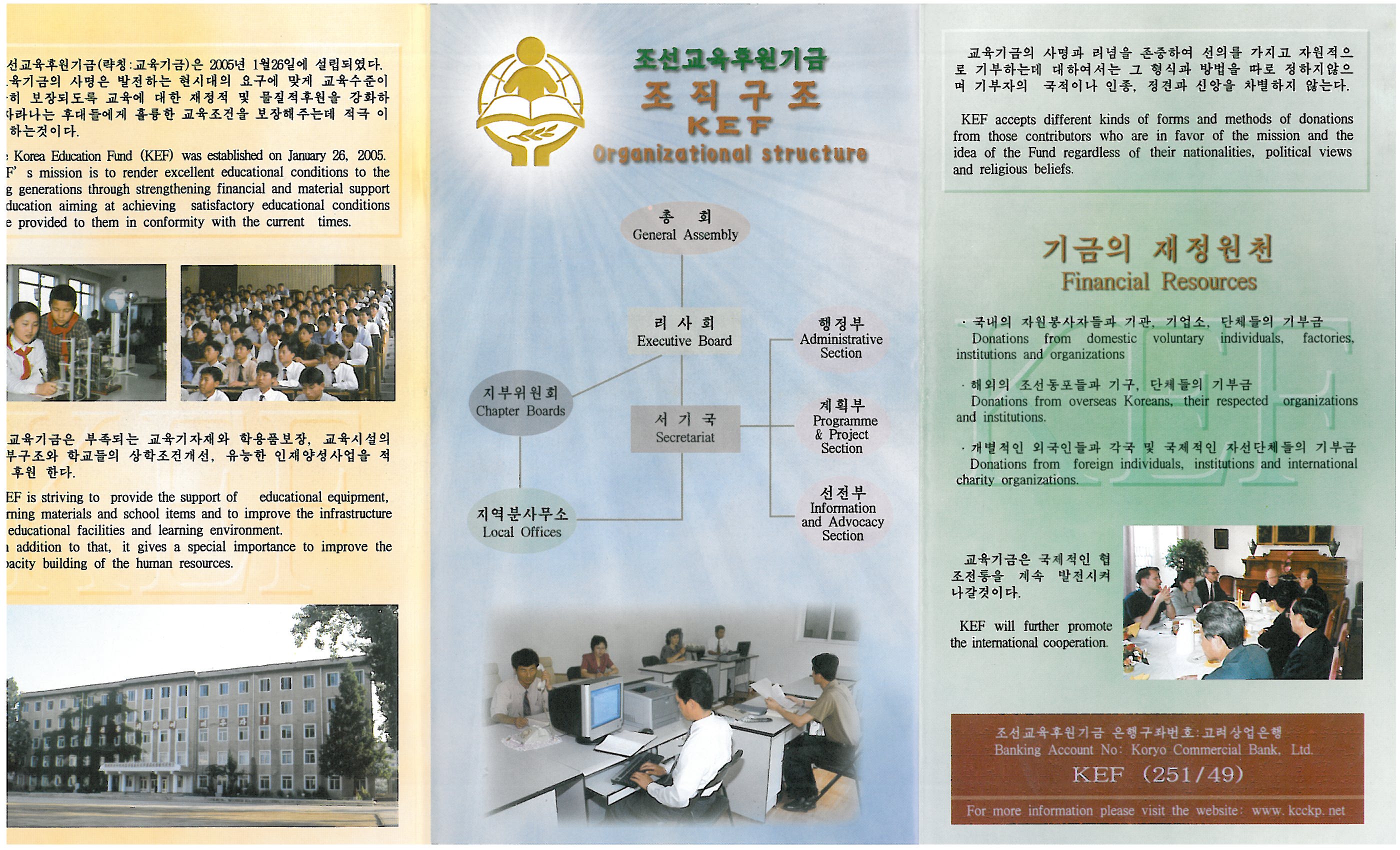
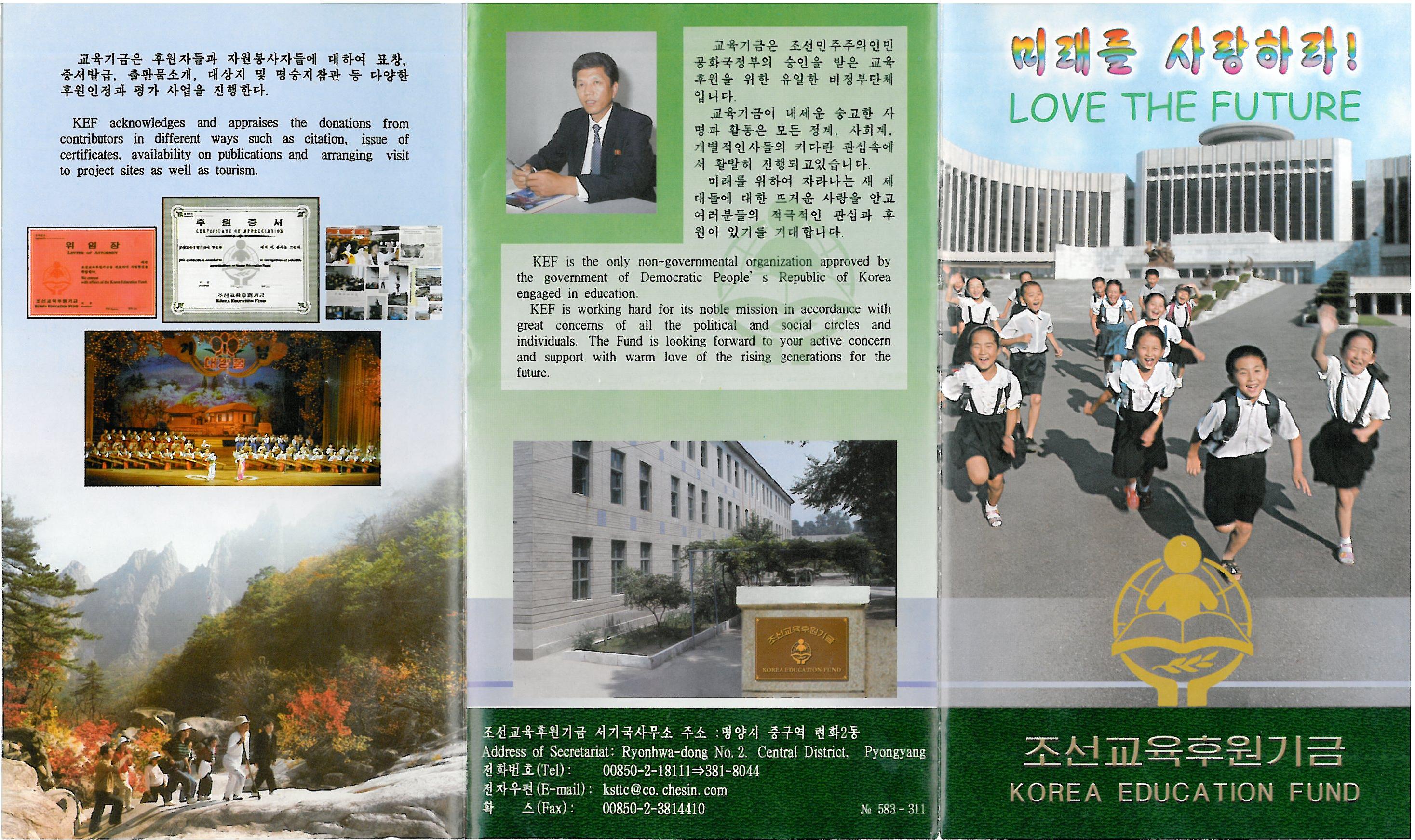
When I visited the DPRK in 2005 for the “60th anniversary of the end of Japanese colonialism (aka the end of WWII),” I picked up a brochure from this foundation—scans below:

kefsmall.JPG kef2small.JPG

(Click on images to view)

It is interesting to notice just how much they have learned from the Western non-profit world, including how to reward donors:

“KEF acknowledges and appraises the donations from contributors in different ways such as citation, issue of certificates, availability on publications, and arranging visit to project sites as well as tourism.”

Contributions are not tax deductible.

UPDATE: I have not had a chance to review all this material yet, but here are some more links:

KEF official web site

Information from Naenara

From KCNA:

Korea Education Fund Set Up

Pyongyang, June 7 [2005] (KCNA) — The Korea Education Fund (KEF) has been established. It is a legal non-governmental organization for public interests. Its mission is to regulate and strengthen financial and material support necessary to develop education in accordance with the requirement of the times.

Many Koreans at home and abroad and famous political, public and educational figures and organizations have rendered a lot of material and financial backing to the DPRK in its educational work, proceeding from the lofty humanitarianism of loving peace and valuing the future.

It has made a contribution to the improvement of educational conditions and the balanced development of education.

And many figures have advanced a proposal to establish an organization in the form of humanitarian fund for the purpose of strengthening the support to the educational work and have exerted efforts to realize it. Their efforts have resulted in founding the Fund in January last through an agreement and working procedure with parties concerned.

The Fund does not fix the regional limit in general activities such as raising fund and performing support. And it decides personnel selection according to relevant program and the agreed plan on specific objects, transcending the differences in political view, religious belief, race, nationality and sex.

The KEF welcomes all donators at home and abroad who are based on good intentions and voluntary principle.

Its support will be given mainly to the insufficient educational apparatuses and school things, improvement of infrastructure of educational establishments and studying conditions at schools and to training of personnel.

The KEF regards it as a supreme principle of its work to ensure trust in donators, receivers and volunteers. And it respects all those at home and abroad that join the assistance directly or indirectly and positively cooperates with them.

It organizes the work of recognizing and appreciating the donators and volunteers in accordance with the will of receivers and the principle of the Fund’s activity. Such activities include citation, issue of certificate, hanging of board, introduction through publications and organization of tour of the objects and scenic spots.

The KEF has its accounts in the Koryo Commercial Bank and overseas agent banks.

The KEF will be conducive to developing education in the country and rearing well the rising generation, the future of the humankind. (Fax: 0085-02-3814410, E-mail: [email protected])

Read the Yonhap story here:
N.K. renovating schools with foreign donations
Yonhap
Shim Sun-ah
6/23/2008

Share

Daily NK reports rice prices falling

June 23rd, 2008

According to the Daily NK, the price of rice in North Korea is falling faster than the purchasing power of the Won.  My congratulations to the few individuals who no doubt figured out how to short North Korean rice (borrow it, sell it, then buy some more at the new lower price to pay back the loan). For the poor North Koreans who bought into the bubble at its peak, as many North Koreans of modest means might have, they now know what it feels like to own real estate in the US. Unfortunately, there is no insurance, options, or other hedges available for North Korean entrepreneurs to diversify their holdings, so asset bubbles probably hurt much more than in developed economies.

From the Daily NK:

An inside source from North Hamkyung Province said in a phone conversation with Daily NK on June 19, “Some people started hoarding huge volume of rice after hearing the rumor that the price of rice would go up as high as 5,000 won/kg. However, these people are now suffering heavy losses as the price has plunged dramatically lately. ”

The source said that around mid-late March this year, the price of rice started rising and a rumor began to circulate in the market that the price of rice would rise as high as four to five thousand won per kilogram. It was about that time when people with big fortunes started stockpiling rice, which further contributed to the increase of rice price, the source said.
 
“Around the end of May, rice price started falling dramatically because another rumor began to circulate that rice aid from foreign countries would arrive at Nampo Port and merchants, upon hearing the rumor, rushed to bring out their rice for sale,” the source said. “Right now, those who borrowed money from family and relatives to hoard rice are going crazy over the situation,” the source added.

As of June 17, the price of rice in major border cities of North Korea ranges between 2,100 won/kg and 2,500 won/kg. In fact, the price of rice dropped almost by half in the last one month.

This is not to suggest that food is now plentiful in North Korea and we are seeing a necessary downward adjustment in prices, but rather a demonstration of the volatility of North Korea’s markets.  Prices disproportionately rise and fall on rumors because there is no way to easily verify information.  North Korea has neither a mercantile exchange, futures contracts, nor an effective communications or transportation system.  Simply dealing with these initial problems would go a long way towards stabilizing and rationalizing food prices. 

UPDATE: On June 9, a Good Freinds report was published in Yonhap which indicated China increased its quota on food exports to the DPRK.

To read the full article, click below:
Rice Price Falls by Half, Bringing Misfortune to Traders Hoarding Rice
Daily NK
Lee Sung Jin
6/23/2008

Share

North Korean film update

June 22nd, 2008

The Korean Film Council in Seoul analyzed North Korean films and TV dramas recorded between 2000 – 2006.  As discussed in an earlier post on this topic, initial findings indicate North Korean films made during this period differed tremedously over earlier years in that they portrayed real-life situations including husband-wife conflicts and generational differences (see A School Girl’s Diary).  

In the 1970s, films depicted the achievements of the two leaders. In the 1980s, works portrayed the happiness of citizens living in ‘our socialist society’.  The first kiss appeared in the 1980’s film, Snow Melting in the Springtime (봄날의 눈석이).  After Kim Il Sung’s death, films began to reemphasize the revolutionary tradition. The works focusing on the Kim Il Sung and Kim Jong Il revolutionary achievements were produced in order to strengthen the spiritual training of citizens.   

Read more here:
No Love Scenes or Love Triangles in NK Dramas
Daily NK
Yang Jung A
6/19/2008

Share

Kim invited to attend Olympics

June 22nd, 2008

Acording to the Korea Times, China invited Kim Jong il to attend the opening ceremony of the 2008 Olympics.  President Bush and Japan’s Prime Minister, Yasuo Fukuda, are still mulling their invitations.

Read the full article here:
‘North Korean Leader Invited to Beijing Olympics’
Korea Times
Kim Sue-young
6/22/2008

Share

The Way to Survive for Farmers

June 21st, 2008

Daily NK
Jung Kwon Ho
6/21/2008

The price of rice in the jangmadang has been on the decline since June. The rice price which had risen to 3,000 won at one point is now at 2,400 won per unit (1kg in North Korea), which was the standard in the beginning of April. With the upcoming potato harvest season and spreading the news that U.S.’ food aid will come, the forecast has also been proposed that the food crisis will be mitigated from a climax in mid-June. However, even though it is not at a life and death situation, the hunger of citizens still continues. The Daily NK, through the testimonies of three witnesses who came out of North Korea between May and June, got a glimpse into the lives of North Korean citizens.

Mr. B is a farmer in a county, Hwanghae Province. He met with a reporter while visiting relatives in China early last month, when the food shortage was severe in North Korea.

B said that food in Hwanghae Province, traditionally a granary area, is absolutely insufficient. Since the mid-90s, food has not been adequately distributed and a vicious cycle of food crisis and a lack of an effort by farmers have been occurring.

Regarding the cause of the reduction in the volume of food production, B noted, “You could possibly name several reasons, but the most important factor is the lack of earnestness by farmers. It is difficult to find people who work with consciousness. There is no reason to work, because even if people work hard, there is no food provision. In the 80s, before Kim Il Sung’s death, the estimated corn yield per unit of an area (approx. 2.45 acres) was even up to 10 tons. After his death, the yield has been about 3 tons per unit area.”

In June in Hwanghae Province, the reaping of wheat and flour begins. Accordingly, the food crisis can temporarily recover. If wheat and flour are produced, around 20 kilograms are distributed. However, these are excluded from the total distribution from the autumn harvest.

He stated that North Korean farmers have been finding a way to get by on their own for last 10 years after the March of Tribulation in late 1990s, due to the unstable food provisions. He cited three methods of survival for farmers in Hwanghae Province: “private farming, pilfering grains of farms, and doing business.”

Furrows are allocated to farmers for private farming

Because distributed food for individuals has not been enough, he said that land has been allocated according to the number of family members so that private farming could be carried out. This means, the authorities distribute no filed of the farm, but furrows and footpaths in the farm, so that farmers could plant peas or potatoes between crops.

“The state was supposed to provide 280kg of unpolished grain after a year of farming by the farmers, but only 120~130 kg are provided, which is not sufficient for the year. So all kinds of other crops are planted in the furrows and shared among the people. Furrows do not have to be registered with the state, so they can be operated independently. In Jaeryong County, Hwanghae Province, such methods have first been adopted. Half of the Province has started to employ this method.”

In actuality, the production volume of potatoes planted among corn furrows exceeds that of state potato farms. Mr. B said, “Farmers are zealous about planting potatoes in the furrows, because it has to do with private profits. They share over 50kg amongst each other. This helps get over the difficult month of June.”

Mr. B said that 150kg of food was produced from private field cultivated on an inclined plane of a mountain and in his home site. He said, “After discussions with the mountain surveillance directors, they have agreed to give a 30% of their production, even plant some trees, and engage in farming. If the deal is not kept, however, the steep land on mountains is not given to them for the subsequent year.”

B explained that besides private farming, another critical method of survival for the citizens in Hwanghae Province is pilfering grain under the control of the state. For several years, national provision has not been carried out properly, so coping methods by farmers have also become more aggressive.

He said, “Before harvesting officially the farm’s crops, farmers pilfer grains on fields every night. These stolen grains are actually their lifeline for the next year. Farmers are saving corn and rice for a year in this way.”

He said that the amount of food secured by farmers via such a method is different from person to person, but in the Jaeryong plain, people have been able to secure up to one ton of food. Through that rice, people are able to acquire daily necessities and send them to relatives in the cities.

During falls in North Korea, it is a well-known fact that the farmers and the state frequently scramble for grain. As a result, the North Korean authorities, since three years ago, have dispatched nation widely the People’s Safety Agency Political College students and have engaged in food recovery operations.

“Hide the food in a pigsty.”

B said, “Even a few years ago, there were a lot of people whose food were confiscated by the students, but the situation is different now. However, even last year, food was not preserved in the homes, but was hidden under the floor of pigsties or buried underground and covered with garlic fields. During last year’s harvesting season, the citizens benefitted this way and have been able to get by until now.”

However, he said that people who are who is honest and forthright or the elderly inevitably have a difficult time in the battle for pilfering grain.

Mr. B added, “Going out to the fields at night and gathering enough food before the harvesting period is a life and death matter. Without stealing, one ends up starving, so who would just sit there?.”

He additionally introduced a different style of persons belonging to a farm besides farmers. He said “There are about five traders in agricultural districts per work unit which consists of 50 households.” According to him, the managers of work units call them “8.3.” The name stuck after Kim Il Sung’s decree on August 3rd that necessities of daily life were to be independently produced in factories or work units. These people are often deployed by farms to be in charge of civilian projects ordered by the state. When the state demands necessary commodities, money or food from farmers under the pretext of support for the army or national construction, these traders take charge of the management.

They are the ones who go around to secluded villages and purchase 2~3 tons of corn and pea from the villagers in exchange for rice, oil, seasonings and flour, which usually produces a profit of 50 to 100 won per kg. But they have to sell over 15kg per day in order to buy a kilogram of corn.

B said, “Most of the people get by from private farming, theft, or doing business, but a minority do not even have any know-how to do that, so are in adversity. They have to endure the spring shortage period, skip meals, or eke out an existence on porridge. As a last resort, they borrow food at a high rate of interest and get by. Such a pattern is repeated the next year, so their debt only increases and they end up in even more desperate situations.”

Share