N.Korea’s Leading Apparatchiks

September 18th, 2008

Choson Ilbo
9/18/2008

Gen. Hyon Chol-hae, the 74-year-old deputy director of the general political department of the North Korean People’s Army (KPA) has been North Korean leader Kim Jong-il’s most frequent companion on official occasions. Hyon has accompanied Kim, who is said to be recovering from a stroke, on 32 occasions this year.

In analysis of senior North Korean officials who have accompanied Kim on his inspections of various facilities until Aug. 14, Hyon was followed by Gen. Ri Myong-su (71), director of the administrative department of the National Defense Commission (29 occasions); Kim Ki-nam (82), director of the propaganda department of the North Korean Workers’ Party (KWP) (22 occasions); Pak Nam-gi (74), director of the planning and fiscal affairs department of the KWP (10 occasions); Kim Jong-gak (62), first vice-director of the KPA’s general political department, Pak To-chun, chief secretary of the WPK Jagang Provincial Committee, Kim Kyok-sik, chief of the KPA general staff (seven occasions); Jang Song-taek (62), director of the administrative department of the KWP (five occasions); and North Korea’s first vice foreign minister Kang Sok-ju (67) (five occasions).

During these inspections, Kim has given instructions to military officers, government officials and plant managers. The more often these elderly men accompany Kim, the closer the Unification Ministry, which carried out the analysis, considers them to the North Korean leader. Hyon, Ri, Kim and Pak ranked first through fourth in 2007 as well

Song Dae-sung, a senior researcher at the Sejong Institute, said there is no big change in the ranking order of those closest aides to Kim Jong-il, who are assisting Kim on his sickbed or governing North Korea on his behalf.

Hyon Chol-hae
The KPA’s general political department, which Hyon controls as deputy director, is in charge of the entire KPA organization. A graduate of the Mangyongdae Revolutionary School, which families and descendants of the anti-Japanese partisans attend, he controls the school’s graduates, most of whom serve in the military. During the Korean War, he was Kim Il-sung’s bodyguard. He accompanied Kim junior on his visit to China in 2001.

Hyon stood on the platform alongside other North Korean leaders during a military parade on North Korea’s 60th anniversary on Sept. 9. According to analysts, normally only vice marshals or higher-ranking military officers are allowed to stand on the platform, and Hyon, a general, was an unprecedented exception.

Suh Jae-jean, director of the Korea Institute for National Unification, said, “It seems that Hyon Chol-hae is currently running North Korea behind the scenes. He is expected to play a leading role in laying the foundation for the post-Kim Jong-il era according to Kim’s wishes.” The institute says Hyon also has connections with Kim’s second son Jong-chol (27).

Ri Myong-su
Ri is director of the administrative department of the National Defense Commission, North Korea’s de facto supreme leadership. As the NDC’s administrative department director, he controls inspection and intelligence activities within the KPA. Until last year, he was under Kim Jong-il’s direct command as the director of the KPA’s operations department.

Ri emerged as a strongman in the process of Kim’s succession to power in the 1970s, by displaying loyalty to him. He has been Kim’s second most frequent companion since 2003.

Ryu Dong-ryeol, a researcher at the Police Science Institute, said, “Hyon and Ri directly report to Kim Jong-il.”

Kim Ki-nam
Kim is a well-known figure in South Korea since making an unannounced visit to the Seoul National Cemetery when he was in Seoul as the chief of a North Korean delegation to a “Unification Festival” marking Liberation Day on Aug. 15, 2005. He is Kim’s mouthpiece as secretary for propaganda for the KWP Central Committee. He was the editor-in-chief of the Rodong Shinmun, the organ of the KWP Central Committee, in 1976. In 1985, he was appointed director of the propaganda department of the KWP Central Committee.

Lee Ki-dong, a senior researcher at the Institute for National Security Strategy, said, “Kim Ki-nam will be in charge of publicizing at home and abroad Kim Jong-il’s decision about a successor.”

Pak Nam-gi
Pak is in charge of North Korea’s economy. Since 1976, he has worked as an economic expert as vice chairman of the State Planning Commission, the agency that controls North Korea’s planned economy.

As the first vice-director of the KPA’s general political department, Kim Jong-gak is in charge of propaganda within the military. Kim Kyok-sik assumed the post as the chief of KPA general staff in April last year, and Pak To-chun has served as the chief secretary of the KWP Jagang Provincial Committee since 2005.

Jang Song-taek, Kim Jong-il’s brother-in-law, fell out of favor with Kim in May 2004. But he came back in 2006 and has since controlled powerful agencies such as the Ministry of Public Security and the State Security Department, and prosecutors’ offices. He is reportedly close to Kim’s eldest son Jong-nam (37).

Kang Sok-ju played a major role in reaching the U.S.-North Korean Geneva Agreement in 1994.

Share

Chinese official confirms DPRK grain smuggling

September 17th, 2008

Markets work because price increases send entrepreners strong signals of relative scarcity and potential profit opporunities (unless these price increases are caused by inflation).  Entrepreneurs who pick up on these signals, then, have a strong incentive to move the desired resources from where they are valued less to where they are valued more.

A Chinese official in Jilin claims entrepreneurs in his province hear these signals loud and clear—and they respond the way humans have for thousands of years–they arbitrage:

The head of the grains bureau of Jilin, the Chinese province bordering North Korea, Zhu Yehui, says a drought in North Korea is very serious, and there is a lot of corn smuggling from China into North Korea.

He says the price in North Korea is more than 10 times the domestic price in China.

I am going to go out on a limb to suggest that these Chinese smugglers (entrepreneurs) are also delivering food more cheaply (on average) than the World Food Program, and I also am willing to wager that they have better access to “sensitive areas.” 

Addendum: According to Yonhap North Korea’s grain crop last year reportedly amounted to 4 million tons. The U.N. Food and Agricultural Organization told U.S.-based Radio Free Asia last month that the North will harvest a half million tons less than last year.

Read the full article here:
China reports grain smuggling business active into North Korea
Australian Broadacsting Corporation
9/17/2008

Share

New Chuseok Trends in North Korea

September 16th, 2008

Daily NK
Moon Sung Hwee
9/16/2008

Chuseok is considered one of the most important national holidays in South Korea, but this is not the case in North Korea.

North Korea’s most celebrated holidays are Kim Il Sung’s birthday (April 15th) and Kim Jong Il’s birthday (February 16th). Chuseok is no more meaningful than simply a day to groom one’s ancestral gravesites.

It was especially difficult to comfortably celebrate Chuseok this year because Chuseok fell on a Sunday, the day after the time when North Koreans are required to participate in regular evaluation meetings, lectures, and mass events.

In fact, North Korea completely neglected Seolnal (Lunar New Year’s Day) and Chuseok up until the mid-1980s, claiming that they originated from China.

However, Pyongyang began showing an interest in national holidays at the time of the “13th World Festival for Youth and Students,” held in Pyongyang in 1989. The North Korean authorities felt it necessary to propagate the excellence of its national history through national traditions on display for the foreigners attending the festival; including Seolnal and Chuseok.

As a consequence, some North Koreans began to perceive that Chuseok was a valuable national holiday, not a Chinese holiday. However, Chuseok still has a tendency to be considered a day off to take care of a forefather’s gravesite rather than a true national holiday.

The second reason why Chuseok is just considered a day off is because of North Korea’s poor infrastructure and North Koreans’ economic hardship.

The North Korean authorities grant a special break the day before Chuseok for those whose forefathers’ gravesites are far away in order to minimize any inconvenience. On the day off, the authorities even “guarantee” North Koreans’ convenience by increasing the numbers of trains and buses.

However due to the extremely poor infrastructure in North Korea and the complicated process of transit, it is almost impossible for families to gather together on Chuseok.

When the authorities speak of increasing the number of buses and trains for the convenience of North Koreans, they only increase the schedule by one or two. North Koreans cannot even consider visiting families because in order for them to travel to different provinces or districts, they need to be granted an official travel certificate.

Most North Koreans visiting their forefathers’ gravesites therefore have to walk approximately 39km (24 miles). If they want to visit gravesites in different districts, then they have to request a travel certificate, get a train ticket 10 days in advance and get ready to stand on a busy train for two or three days.

A third reason why it is difficult for North Koreans to comfortably celebrate Chuseok is related to the fact that Chuseok is in “autumn.” For North Koreans, autumn is an extremely busy season. Not only farmers but factory workers, housewives and even students are mobilized to harvest and transport crops. Furthermore, each household has to prepare and get ready to survive the long winter. Therefore, taking care of forefathers has to be put on the back burner.

Nevertheless, there are an increased number of so called bourgeoisie-high ranking officials or successful businessmen- visiting forefathers’ gravesites these days. But the reason for such visits is aberrant. They visit not to pay respects to deceased forefathers but to gain money, power and promotion by exercising superstitions.

Among Pyongyang citizens in the early 21st century, covertly visiting fortunetellers and paying exorbitant amounts of money to get one’s fortune told became popular. The trend has quickly spread not just among regular residents but among North Korean intelligentsia such as Party members, military personnel and educators.

Blaming forefathers for any negative fortune is a commonality found among North Korean fortunetellers. Therefore, in order to reverse such a fortune, forefather’s gravesites are often mentioned. The fortunetellers often advise taking better care of the ceremonial tables by forefathers’ gravesites. For this reason, many North Koreans spend time going to their forefathers’ gravesites despite their distance.

These people visit the forefathers’ gravesites to bury money near the gravesites (they bury 55 won or 555 won hoping for more money to come to them since the sound of number 5 in Korean means “to come”) or to burn red cloth to spread ashes in a certain direction following fortunetellers’ instructions. For them, Chuseok is a day to practice superstition for their survival in front of forefathers’ gravesites.

In South Korea, people spend money on Chuseok to share gifts or to prepare food for their families. However, North Koreans on this day spend money to exercise age-old superstitions. At least these people have money to spend. There is no extra public distribution at Chuseok in North Korea. Therefore, Chuseok means nothing to those poor North Koreans who have no money. It is just another day to worry about what they are going to eat.

Share

A look inside Pyongyang’s Central Market

September 16th, 2008

Jerry Guo, a Yale University economics student who recently traveled to Pyongyang, wrote some interesting articles this week detailing his illicit adventures into Pyongyang’s Central Market (pictures below).


jerryswalk.JPG

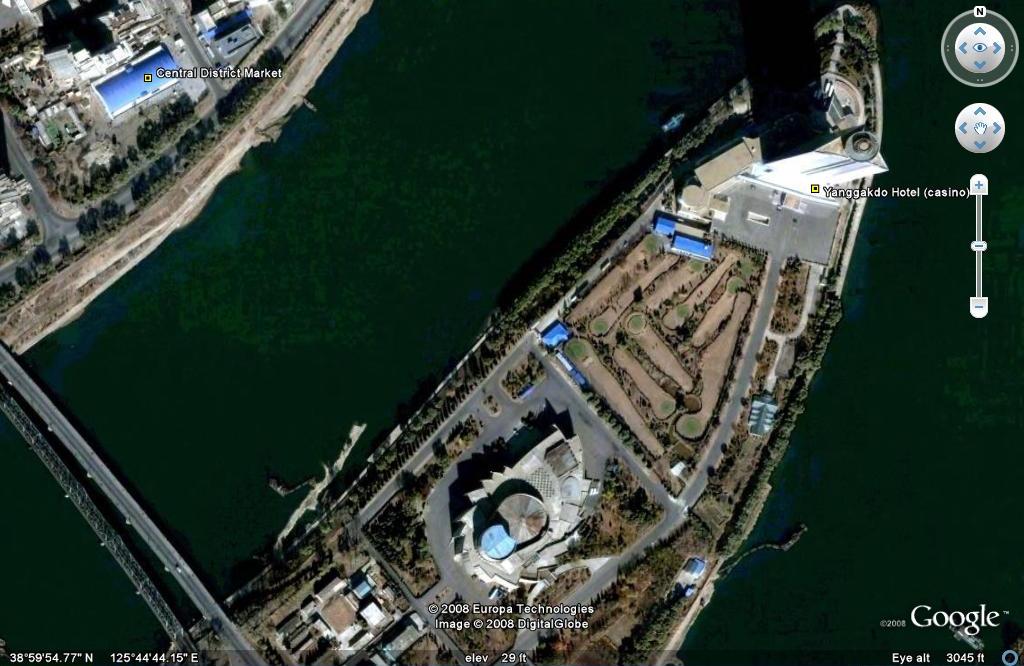
Pyongyang’s Central Market is located along the shore of the Taedong River and is visible from the Yanggakdo Hotel.  Unlike the larger Tongil Market located on the south side of town, the Central Market does not receive tourists or foreign visitors—and given the location, its customers would probably prefer to keep it that way.  So in a sense, an impromptu stroll to the Central Market offers every visitor to the DPRK exactly what they are looking for: a spontaneous glimpse at every-day life in Pyongyang.

According to Guo, that is exactly what he received:

But I wanted to catch a real glimpse of Pyongyang nightlife, so late one afternoon, I sneaked off unsupervised and hit the city streets. And much to my surprise, I didn’t see a single People’s Army cadet goose-step past me with those missile-launchers-on-wheels that appear on the nightly news. What I did witness: a mother buying a soda for her daughter from a sidewalk snack cart; two older women sitting on a bench, gossiping and eating pears; businessmen coming out of the subway, sans Bluetooth headsets; a grimacing teenage boy getting a haircut at a salon. (Washington Post)

Eventually he meandered into the Central District Market:

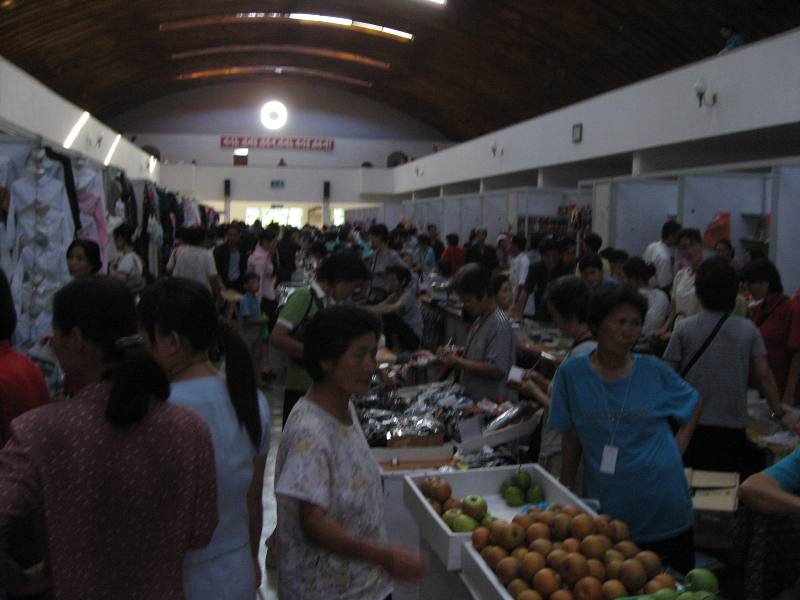
I had found myself in the North Korean version of Macy’s, but here, every day is the Friday after Thanksgiving. There were delicate blouses and dresses for around 15,000 won (roughly $4 at black market exchange rates), all sorts of fruit — thought to be nearly impossible to find in this mountainous hermit kingdom — and enough varieties of mystery meats to make my high school cafeteria green with envy.

…and he took some pictures (These pictures belong to Mr. Guo, and I thank him for letting me post them):

guo1small.JPG guo2small.JPG

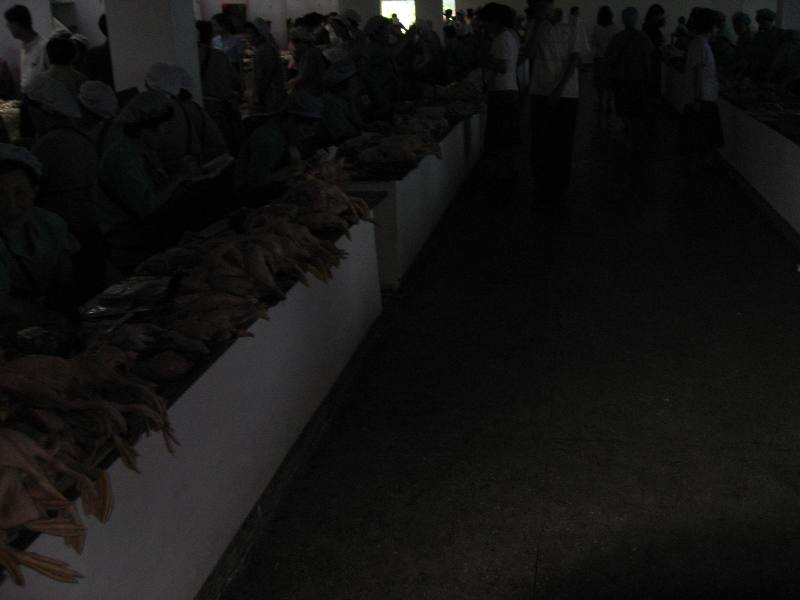
Above: Fruits and chickens for sale

guo3small.JPG guo4small.JPG

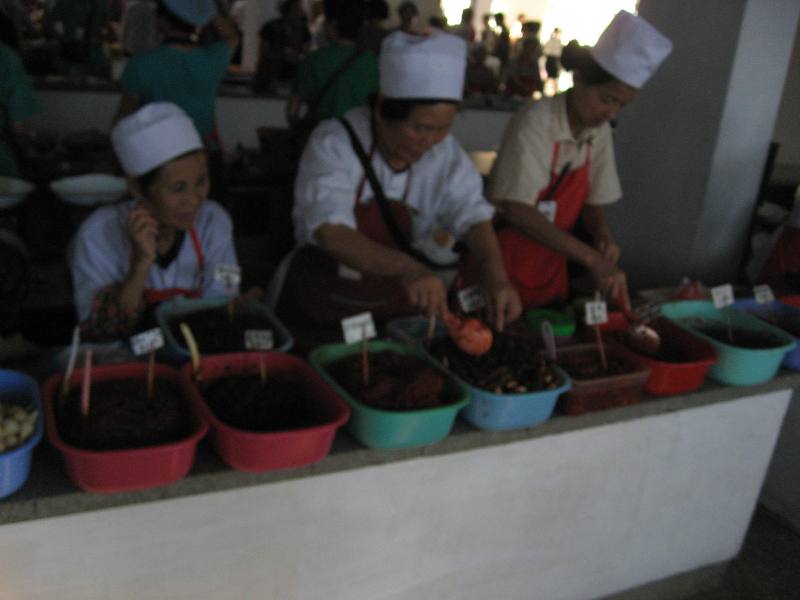
Above: Side dishes/Sauces and clothing for sale

guo5small.JPG

Above: View of the Central Market from the Yanggakdo Hotel

Taking these pictures, however, ushered in an unpleasant afternoon:

No one paid much attention to me, until I stopped to snap a few photos. Then a group of stocky women in pink dresses magically appeared. They half-wrestled me to a second-floor office while blowing fiercely on blue whistles, as if to announce, “Look at me! My first American spy!” For the next six hours, I was questioned and scrutinized by a procession of Public Safety Bureau officers, their rank identifiable by the quality of their outfits: the first wore an undershirt, the last what seemed to be a custom Italian suit.[…]

Eventually, they forced me to write a hyperbolic but harmless self-criticism, describing myself as “an American student,” “an incompetent trouble-maker” and “a genuine lover of the Korean people.” Then they booted me back to my five-star hotel.

Mr. Guo’s adventures have been chronicled in the following publications and they are well worth checking out:

My Excellent North Korean Adventure
Washington Post
Jerry Guo
9/14/2008; Page B02

A writer journeys into North Korea with Chinese tourists
Christian Science Monitor
Jerry Guo
9/16/2008

Yale Senior Enjoys Uncensored Day in N. Korea
National Public Radio
9/15/2008

And a caveat for future visitors: Although I personally appreciate knowing this type of information about the DPRK, I do not recommend other tourists take this course of action for numerous reasons!

Share

First NKHRA refugee gets green card

September 16th, 2008

Since passage of the North Korean Human Rights Act (NKHRA) the US government has admitted 63 North Korean defectors into the country.  I am no lawyer, but I believe these individuals are classified as refugees, meaning they have more restrictive visa conditions than permanent residents.

The first of this cohort, however, has just received a “green card” (US permanent resident status), which grants the holder most of the privileges of US citizenship with the major exceptions of the right to vote or having the State Department stick up for you if you are detained overseas.

If there are any immigration attorneys out there who can contribute some details, please add them to the comments.

As an aside, the NKHRA statute has a “sunset provision”—meaning it automatically expires this month unless it is again passed by the congress and signed by the president.    Joshua at One Free Korea is eager to see this statute renewed.  I do not have any strong feelings about the foreign policy implications of this legislation, but as an economist I am in favor of allowing most immingrants into the US for economic reasons alone.

Read the full article below
N. Korean Defector Gets Permanent US Residency
Korea Times
Kim Sue-young
9/16/2008

Share

Kaesong Industrial Zone output update

September 15th, 2008

The South Korean Ministry of Unification has reports on economic output at the Kaesong Industrial Zone.  Below are the highlights from Yonhap:

The total output by South Korean factories operating in North Korea has exceeded US$400 million, Seoul’s Unification Ministry said Monday.

Companies at the Kaesong industrial complex produced goods worth a total of US$410 million between January 2005, when the compound was opened, and July this year. One-fifth of all goods produced were exported, according to the ministry handling inter-Korean affairs.

The output in the first seven months of this year amounted to $140 million, up 51 percent from the same period last year.

As of August, 79 firms operated in the area, employing more than 32,000 North Korean workers, mostly women.

Read the full article here:
Production in inter-Korean business town tops $400 million
Yonhap
9/15/2008

Share

Tickle, hammer and caligraphy brush

September 14th, 2008

UPDATE:  Thanks to Mr. Kuslan for the additions in the comment section!

ORIGINAL POST: Humor was an important coping mechanism for people living in communist societies. Sadly, the expression of some humor could be interpreted as subversive behavior and land the joke-teller in serious trouble. 

This reality still exists for people in a number of current and former socialist republics, so they adopt practices that mitigate the risk of telling jokes.  For instance, in Turkmenistan people tell jokes about “Stalin” but implicitly understand they are (were) about Turkmenbashi.  

Last year, I received a copy of the documentary Tickle and Hammer, which is a collection of Soviet-era jokes. What a treasure. ( You can buy the book version hereHere is an interview with the project director. )  After seeing this film, I wondered how many of these jokes were popular in the DPRK. Well, this week Radio Free Asia reports on some North Korean jokes collected from defectors now living in the South:

Happy days
An Englishman, a Frenchman, and a North Korean are having a chat. The Englishman says: “I feel happiest when I’m at home, my wool pants on, sitting in front of the fireplace.”

The Frenchman, a ladies’ man, says: “You English people are so conventional. I feel happiest when I go to a Mediterranean beach with a beautiful blond-haired woman, and we do what we’ve got to do on the way back.”

The North Korean man says: “In the middle of the night, the secret police knock on the door, shouting: Kang Sung-Mee, you’re under arrest! And I say, Kang Sung-Mee doesn’t live here, but right next door! That’s when we’re happiest!”

Long Live Kim Jong Il!
Chang Man Yong works on a collective farm in North Korea. He goes fishing, gets lucky, and brings a fish home. Happy about his catch, he tells his wife: “Look what I’ve got. Shall we eat fried fish today?”
The wife says: “We’ve got no cooking oil!”
“Shall we stew it, then?”
“We’ve got no pot!”
“Shall we grill it?”
“We’ve got no firewood!”
Chang Man Yong gets angry, goes back to the river, and throws the fish back into the water. The fish, happy to have had such a narrow escape, sticks its head out of the water and cheerfully yells: “Long live General Kim Jong Il!”

Move over, comrade!
Two men are talking on a Pyongyang subway train:
“How are you, comrade?”
“Fine, how are you doing?”
“Comrade, by any chance, do you work for the Central Committee of the Workers’ Party?”
“No, I don’t.”
“Have you worked for the Central Committee before?”
“No, I haven’t.”
“Then, are any of your family members working for the Central Committee?”
“Nope.”
“Then, get away from me! You’re standing on my foot!”

Bear hug
Kim Jong Il and Vladimir Putin are having a summit meeting in Moscow. During a break, they’re bored, and they decide to take a bet to see whose bodyguards are more loyal.

Putin is on the 20th floor and calls on his bodyguard Ivan, opens the window, and says: “Ivan, jump!”

Sobbing, Ivan says: “Mr. President, how can you ask me to do that? I have a wife and child waiting for me at home…”

Putin sheds a tear himself, apologizes to Ivan, and sends him away.

Next, it’s Kim Jong Il’s turn. He calls his bodyguard Lee Myung Man and yells: “Lee Myung Man, jump!” Not hesitating for a split second, Lee Myung Man is just about to jump out the window. Putin hugs Lee Myung Man to prevent him from jumping and says: “Are you out of your mind? If you jump out this window, you’ll die! This is the 20th floor!” Nevertheless, Lee Myung Man is still struggling, trying to escape Putin’s embrace and jump out the window: “President Putin, please let me go! I have a wife and child at home!”

Out of the mouths…
At High School No. 1 in Pyongyang, a girl brags to her teacher about the cat she’s got at home: “Our cat has just given birth to seven kittens. All of them just stick close to their mother, they feel really comfortable, and sleep all the time. They’re all true communists.”

A few days later, the teacher asks the girl: “Are the communist kittens at home growing up nicely?”

The girl says: “Comrade teacher, big trouble! They’ve all opened their eyes, and they’ve all renounced communism!”

Looking at the sun and saying it is the moon
Child: “Mom, I’m hungry. I want rice.”
Mother: “I’m sorry, child. There’s no rice left.”
Child: “No rice! Why is there no rice? Our kindergarten teacher told us that if General Kim Jong Il points his finger to sand, it turns into rice. So, why is there no rice in our house?”
Mother: “Well, that’s a lie. No, what I actually meant to say was that’s a matter of deeply rooted belief.”
Child: “Mom, what’s deeply rooted belief?”
Mother: “Well, it’s a lie you’re supposed to believe.”

Another country
A woman living in North Hamgyong province comes back home after a hard day at the open market. While she was working hard, the husband spent the whole day at home, daydreaming. As soon as she returns home, they start talking, and the husband says: “Sweetheart, I’d love to go to some place I’ve never seen before, and do something I’ve never done before…”

The wife retorts: “That’s a great idea. Go to the kitchen and wash the dishes!”

Black cats, white cats, large mice
Chinese, Russian, Japanese, American, and North Korean police officers gather and decide to assess their investigative capacity. Under the watchful eye of their supervisors, each team gets a mouse, then lets it loose, and the mouse runs up a big mountain. The winning team is the one that manages to catch and bring back the mouse in the shortest time.

The Chinese police employ human wave tactics, combing every square inch on the mountain in their thousands.

They capture and return the mouse after only one day’s search.

The Japanese policemen use a smell detector, and after only half a day, they detect the mouse hole, search it, catch the mouse and bring it back.

The Russian cops send a robot equipped with a heat-seeking device up the mountain. The robot locates all the mammals on the mountain and after only three hours the Russians capture and bring back the mouse.

The only ones left now are the American and North Korean police officers. The Americans use a satellite signal device to locate the mouse, and then send in a mechanical gadget that looks like a snake gliding up the mountain.

The gadget gets into the mouse hole, catches the mouse and brings it back after only one hour.

The North Koreans are last. Although the supervisors are watching, none of them makes a move, there is no brainstorming, and no one comes up with a plan of action, nothing at all. After only about 10 minutes, a few North Korean police officers show up dragging a dog before the supervisors, saying they’ve found the mouse.

All the supervisors are puzzled: “What are you doing? It is not a dog you were supposed to catch! Weren’t you supposed to catch a mouse?” Instead of answering, the North Korean cops drag the dog through the dirt and repeatedly kick it in the ribs. The sobbing dog suddenly starts to talk: “Stop, stop, please stop! Yes, I confess, I’m a mouse! I’m a mouse, please concede that I’m a mouse, or else they’re going to kill me!”

Food for thought
Professor: “Comrade students, how many economic-political systems are there in the world?”

Student: “There are three such systems: The capitalist economic-political system, the North Korean socialist economic system, and the Chinese eclectic system.”

Professor: “Then, among these three systems, which one is the greatest?”

Student: “Well, it might be rather difficult to answer that question.”

Professor: “What kind of an answer is that? There is only one clear answer! Our style of socialist economic-political system is the greatest, as this is the system that’s destined to conquer the entire world and spur eternal economic development!”

Student: “Professor, that is great, indeed… But if our system takes over the world and all of the other countries and economic-political systems, then whom are we going to ask for food aid?”

Black and white
A member of the Chinese Communist Party goes to study in North Korea, where he gets to learn about juche, the official state ideology of North Korea and the political system based on it.

The Chinese Communist Party member wishes to let his friends back home know what life in North Korea is like.

However, he knows for sure that all the letters he sends are opened by the North Korean authorities, so he thinks of a way to bypass censorship.

The Chinese decides to write words meaning precisely what they say in blue ink, words conveying neutral meaning in black ink, and words intended to convey the very opposite meaning in green ink.

After a while, his friends back home in China receive a letter from North Korea. The letter was written entirely in black ink, meant for words carrying neutral meaning.

The conclusion they draw is that North Korea is not as good as the North Korean authorities’ propaganda says it is, and it is not as bad as the critics of the North Korean regime say it is. However, at the bottom of the letter, they come across a note from their friend: “My friends, I apologize. Green ink is unavailable here….”

The Workers’ Paradise
At an art museum in Europe, an Englishman, a Frenchman, and a North Korean stand before a painting of Adam and Eve holding an apple in the Garden of Eden.

The Englishman says: “The man has something tasty to eat and is eager to share it with the woman. Based on that, I would conclude that they’re rather obviously English…”

The Frenchman says: “I disagree. They’re walking around entirely naked, so they must be French…”

The North Korean says: “There is no doubt in my mind that they’re North Korean. They have no clothes to wear, barely anything to eat, and they still think they’re in heaven!” (Radio Free Asia)

If any readers from former/current socialist countries know any jokes they can contribute (especially jokes from the DPRK), please add them in the comments section. 

Share

DPRK: Interesting observations

September 14th, 2008

Iason Athanasiadis, an Istanbul-based writer and photographer, recently visited the DPRK to see the Arirang performance.  He wrote about his trip in The National.  Below are some highlights:

Tourism:

Often referred to as the world’s final frontier, North Korea accepts just under 2000 Western tourists every year and offers residency to a handful of foreign businessmen. Barely 100 Western foreigners live in Pyongyang, including diplomats and businessmen.

Doing Business in Pyongyang:

Waiting to have my bags X-rayed I bumped into a European permanent resident, a cheerful trader who imported computer parts from China into North Korea. Once a month, he said, he travels to Shenyang to stock up on monitors, laptops and motherboards. In North Korea, he “donates or sells them at no profit”. His hope is that, when North Korea opens up, he will be well-positioned to profit handsomely from the new economy. Since he didn’t come across as a staunch advocate of Communist ideals, I assumed he was reaping some additional profit from his sojourn in Pyongyang, about which he remained modest.

He described Pyongyang as like any other large city, but with cleaner air. Entry into North Koreans’ houses is banned, as is leaving the city for the countryside without permission and an escort. Romantic relations with North Korean women are similarly prohibited. The only locals who would come to his parties are business associates. Looking through the windows, he talked about the small, unmarked jet parked in the runway that he thought contained American nuclear inspectors.

“They’re very intelligent, thinking people,” the European businessman said of the North Koreans. “They are all independent thinkers. But they’re also split personalities, they compartmentalise their thoughts. Even I’ve brainwashed myself when I’m here. I self-censor.”

Later, he sent me an e-mail quoting a Cold War-era Sting song titled Russians whose refrain runs “We share the same biology; Regardless of ideology.” “You give a smile, they give a smile and the world is in peace,” he wrote. “And I can tell you: the Koreans do love their children.”

Perspective:

The lack of perspective in their cloistered lives became clearer at night, when the guides invited me into the hotel bar to review the pictures I had taken during the day. How were these men, who had never set foot in the West, supposed to judge what did or did not depict North Korea in a negative light? Innocuous pictures – like one of men squatting on the pavement with a portrait of the Great Leader in the distant background – were deleted, while photos that showed what any outsider would immediately recognise as rampant poverty and societal breakdown barely caught their eye.

Pyongyang:

The night before the opening performance of the Games, I sat in my room, listening to the sounds of Pyongyang slumbering. The DPRK is subject to a permanent curfew. A central switch turns off lights inside apartments shortly after the day’s last radio broadcast. That night, the only light came from the May Day stadium, where last-moment preparations continued for Arirang’s opening night. The only sounds coming through the open window were of bricks tumbling on some distant construction site. Some lights winked in the dark buildings. A parade ground drill rhythm wafted from the stadium. Then, all sounds stopped, aside from the breeze, an occasional ship’s horn, and the repetitive monotone of metal striking metal, as if some lone Stakhanovite worker was still out in the darkness and the silence, fulfilling another quota-surpassing day. At 3am, long after all sound had subsided, an amplified voice started up, slicing the night with slogans.

You can read the full article here:
The mass ornament
Iasson Athanasiadis
The Naitonal
9/5/2008

Share

Trouble again in the DPRK’s Chungjin market

September 11th, 2008

Institute for Far Eastern Studies (IFES)
NK Brief No. 08-9-11-1
9/11/2008

Police recently clashed with women who had worked as traders in the market in North Korea’s Chungjin, in North Hamyong Province, who were demanding that crackdowns in the market be less severe until city officials are able to supply food rations. This report was released on September 9 by ‘Good Friends’, a human rights group in South Korea focusing on aid for the North.

According to the report, on August 24, patrolmen carried out a drastic crackdown in the market, leading women claiming that they need to continue working there to occupy one area. Ultimately, fighting broke out between the two groups.

Women upset with the implementation of rules restricting market trading by women under the age of 50 also led an organized protest in the Chungjin Market last March, demanding that they be allowed to continue working.

According to local residents, this time, the families of the women who had traded in the markets were strongly resisting, causing authorities to become concerned. This has led Chungjin city authorities, after reporting the incident to local party authorities at an emergency session, to pass down an order to local police and market managers to “not crack down too hard until after the September rations are distributed.”

Share

Some DPRK citizens to receive special 60th anniversary rations

September 11th, 2008

According to Yonhap:

North Koreans received special rations of liquor, cookies, blankets and sports shoes earlier this week in honor of the communist country’s 60th founding anniversary, a mouthpiece for a pro-Pyongyang group in Japan reported Thursday.

“Holiday rations were distributed across the country to mark the 60th anniversary of the Democratic People’s Republic of Korea,” said Choson Sinbo, organ of Chongryon, or the pro-Pyongyang General Association of Korean Residents in Japan. “Concerned bodies had prepared for the distribution well before the holiday to ensure that all households enjoy the day,” it added.

Although the practice of giving out commemorative rations is pretty much a tradition in the DPRK, tastes have changed, and citizens do not hold them in the esteem they once did.

Share