DPRK shipping vessels ordered out of ROK waters 20 times

June 14th, 2010

According to Yonhap:

“Since the decision to block the passage of North Korean ships [May 24], we expelled 11 North Korean ships from our waters 20 times,” Kim was quoted by Rep. Hwang Jin-ha of the ruling Grand National Party as saying.

Kim told lawmakers that there was “no major trouble” in turning away the North Korean ships.

Read the full sotry here:
11 N.K. ships expelled from South’s waters since passage ban: minister
Yonhap
6/11/2010

Share

RoK further restricts trade with DPRK

June 14th, 2010

According to Joong Ang Daily:

South Korean goods and services going in or out of North Korea will now have to be approved by the unification minister, according to the ministry yesterday. Trade with the Kaesong Industrial Complex will be the only exception to the rule, which takes effect Monday, the ministry said.

This is a follow-up to South Korea’s decision on May 24 to halt all inter-Korean trade, except that at Kaesong, as punishment for the sinking of the South Korean corvette Cheonan in March, which the South has blamed on the North.

“To effectively implement the government’s decision to halt inter-Korean trade, we revised the rules regarding the approval processes regarding goods and services crossing the inter-Korean border,” said Chun Hae-sung, spokesman for the ministry, in a media briefing.

Until yesterday, items traded with North Korea didn’t need to be individually approved. The report by the Korea Development Institute said the suspension of trade will cost North Korea about $280 million annually.

Read the full article here:
Ministry further restricts trade with North Korea
Joong Ang Daily
6/12/2010

Share

Most nations not inplementing DPRK sanctions

June 14th, 2010

According ot the Reuters (via Straits Times):

More than 100 countries may not be doing enough to implement punitive actions against North Korea, said a report from a United Nations panel that monitors compliance with sanctions on the North.

The latest report to the UN Security Council from the Panel of Experts on North Korea, obtained by Reuters, said 111 of the 192 UN member states, or 58 per cent – mostly developing nations – had not submitted reports on their implementation of the council’s two sanction resolutions.

Those resolutions – adopted in 2006 and last year in response to Pyongyang’s two nuclear tests – restricted arms deals, banned trade in technology usable in nuclear and other weapons of mass destruction, called for travel bans and asset freezes, and banned North Korean imports of luxury goods.

Some 30 countries submitted reports on their implementation of the first sanction resolution, No. 1718, but not the second, No. 1874.

‘Basically, what this tells us is there’s a lot more work that needs to be done to implement the North Korea sanctions,’ a Security Council diplomat said, on condition of anonymity.

Another envoy agreed: ‘Often, developing countries simply don’t have the resources to implement the sanctions properly.’ He added this created potential weak spots and openings for countries such as North Korea and Iran to skirt UN sanctions.

Read the full story here:
6 in 10 didn’t report sanctions
Reuters (via Straits Times)
6/14/2010

Share

The DPRK’s internet, business, and radio wars

June 11th, 2010

Martyn Williams releases three DPRK stories this week all covering interesting issues…


North Korea Moves Quietly onto the Internet

North Korea, one of the world’s few remaining information black holes, has taken the first step toward a fully fledged connection to the Internet. But a connection, if it comes, is unlikely to mean freedom of information for North Korea’s citizens.

In the past few months, a block of 1,024 Internet addresses, reserved for many years for North Korea but never touched, has been registered to a company with links to the government in Pyongyang.

The numeric IP addresses lie at the heart of communication on the Internet. Every computer connected to the network needs its own address so that data can be sent and received by the correct servers and computers. Without them, communication would fall apart.

It is unclear how the country’s secretive leadership plans to make use of the addresses. It seems likely they will be assigned for military or government use, but experts say it is impossible to know for sure.

North Korea’s move toward the Internet comes as it finds itself increasingly isolated on the world stage. The recent sinking of a South Korean warship has been blamed on the insular country. As a result, there are calls for tougher sanctions that would isolate North Korea further.

“There is no place for the Internet in contemporary DPRK,” said Leonid A. Petrov, a lecturer in Korean studies at The University of Sydney, referring to the Democratic People’s Republic of Korea. “If the people of North Korea were to have open access to the World Wide Web, they would start learning the truth that has been concealed from them for the last six decades.”

“Unless Kim Jong-Il or his successors feel suicidal, the Internet, like any other free media, will never be allowed in North Korea,” he said.

The North Korean addresses were recently put under the control of Star Joint Venture, a Pyongyang-based company that is partly controlled by Thailand’s Loxley Pacific. The Thai company has experience working with North Korea on high-tech projects, having built North Korea’s first cellular telephone network, Sunnet, in 2002.

Loxley acknowledged that it is working on a project with Pyongyang, but Sahayod Chiradejsakulwong, a manager at the company, wouldn’t elaborate on plans for the addresses.

“This is a part of our business that we do no want to provide information about at the moment,” he said.

A connection to the Internet would represent a significant upgrade of the North’s place in cyberspace, but it’s starting from a very low base.

At present the country relies on servers in other countries to disseminate information. The Web site of the Korea Central News Agency, the North’s official mouthpiece, runs on a server in Japan, while Uriminzokkiri, the closest thing the country has to an official Web site, runs from a server in China.

North Korean citizens have access to a nationwide intranet system called Kwangmyong, which was established around 2000 by the Pyongyang-based Korea Computer Center. It connects universities, libraries, cybercafes and other institutions with Web sites and e-mail, but offers no links to the outside world.

Connections to the actual Internet are severely limited to the most elite members of society. Estimates suggest no more than a few thousand North Koreans have access to the Internet, via a cross-border hook-up to China Netcom. A second connection exists, via satellite to Germany, and is used by diplomats and companies.

For normal citizens of North Korea, the idea of an Internet hook-up is unimaginable, Petrov said.

Kim Jong-Il, the de-facto leader of the country, appears all too aware of the destructive power that freedom of information would have to his regime.

While boasting of his own prowess online at an inter-Korean summit meeting in 2007, he reportedly rejected an Internet connection to the Kaesong Industrial Park, the jointly run complex that sits just north of the border, and said that “many problems would arise if the Internet at the Kaesong Park is connected to other parts of North Korea.”

Kim himself has made no secret of the Internet access that he enjoys, and famously asked then-U.S. Secretary of State Madeleine Albright for her e-mail address during a meeting in 2000.

The government’s total control over information extends even as far as requiring radios be fixed on domestic stations so foreign voices cannot be heard.

The policy shows no signs of changing, so any expansion of the Internet into North Korea would likely be used by the government, military or major corporations.

The World’s Most Unusual Outsourcing Destination

Think of North Korea, and repression, starvation and military provocation are probably the first things that come to mind. But beyond the geopolitical posturing, North Korea has also been quietly building up its IT industry.

Universities have been graduating computer engineers and scientists for several years, and companies have recently sprung up to pair the local talent with foreign needs, making the country perhaps the world’s most unusual place for IT outsourcing.

With a few exceptions, such as in India, outsourcing companies in developing nations tend to be small, with fewer than 100 employees, said Paul Tija, a Rotterdam-based consultant on offshoring and outsourcing. But North Korea already has several outsourcers with more then 1,000 employees.

“The government is putting an emphasis on building the IT industry,” he said. “The availability of staff is quite large.”

At present, the country’s outsourcers appear to be targeting several niche areas, including computer animation, data input and software design for mobile phones. U.S. government restrictions prevent American companies from working with North Korean companies, but most other nations don’t have such restrictions.

The path to IT modernization began in the 1990s but was cemented in the early 2000s when Kim Jong Il, the de-facto leader of the country, declared people who couldn’t use computers to be one of the three fools of the 21st century. (The others, he said, are smokers and those ignorant of music.)

But outsourcing in North Korea isn’t always easy.

Language can be a problem, and a lack of experience dealing with foreign companies can sometimes slow business dealings, said Tija. But the country has one big advantage.

“It is one of the most competitive places in the world. There are not many other countries where you can find the same level of knowledge for the price,” said Tija.

The outsourcer with the highest profile is probably Nosotek. The company, established in 2007, is also one of the few Western IT ventures in Pyongyang, the North Korean capital.

“I understood that the North Korean IT industry had good potential because of their skilled software engineers, but due to the lack of communication it was almost impossible to work with them productively from outside,” said Volker Eloesser, president of Nosotek. “So I took the next logical step and started a company here.”

Nosotek uses foreign expats as project managers to provide an interface between customers and local workers. In doing so it can deliver the level of communication and service its customers expect, Eloesser said.

On its Web site the company boasts access to the best programmers in Pyongyang.

“You find experts in all major programming languages, 3D software development, 3D modelling and design, various kind of server technologies, Linux, Windows and Mac,” he said.

Nosotek’s main work revolves around development of Flash games and games for mobile phones. It’s had some success and claims that one iPhone title made the Apple Store Germany’s top 10 for at least a week, though it wouldn’t say which one.

Several Nosotek-developed games are distributed by Germany’s Exonet Games, including one block-based game called “Bobby’s Blocks.”

“They did a great job with their latest games and the communication was always smooth,” said Marc Busse, manager of digital distribution at the Leipzig-based company. “There’s no doubt I would recommend Nosotek if someone wants to outsource their game development to them.”

Eloesser admits there are some challenges to doing business from North Korea.

“The normal engineer has no direct access to the Internet due to government restrictions. This is one of the main obstacles when doing IT business here,” he said. Development work that requires an Internet connection is transferred across the border to China.

But perhaps the biggest problem faced by North Korea’s nascent outsourcing industry is politics.

Sanctions imposed on the country by the United States make it all but impossible for American companies to trade with North Korea.

“I know several American companies that would love to start doing IT outsourcing in North Korea, but because of political reasons and trade embargoes they can’t,” Tija said.

Things aren’t so strict for companies based elsewhere, including those in the European Union, but the possible stigma of being linked to North Korea and its ruling regime is enough to make some companies think twice.

The North Korean government routinely practices arbitrary arrest, detention, torture and ill treatment of detainees, and allows no political opposition, free media or religious freedom, according to the most recent annual report from Human Rights Watch. Hundreds of thousands of citizens are kept in political prison camps, and the country carries out public executions, the organization said.

With this reputation some companies might shy away from doing business with the country, but Exonet Games didn’t have any such qualms, said Busse.

“It’s not like we worked with the government,” he said. “We just worked with great people who have nothing to do with the dictatorship.”

Radio Wars Between North and South Korea (YouTube Video)

Share

The effects of the DPRK’s currency revaluation

June 10th, 2010

The New York Times published a lengthy article on the DPRK’s currency reform effort launched last year.  Excerpts below:

Like many North Koreans, the construction worker lived in penury. His state employer had not paid him for so long that he had forgotten his salary. Indeed, he paid his boss to be listed as a dummy worker so that he could leave his work site. Then he and his wife could scrape out a living selling small bags of detergent on the black market.

It hardly seemed that life could get worse. And then, one Saturday afternoon last November, his sister burst into his apartment in Chongjin with shocking news: the North Korean government had decided to drastically devalue the nation’s currency. The family’s life savings, about $1,560, had been reduced to about $30.

Last month the construction worker sat in a safe house in this bustling northern Chinese city, lamenting years of useless sacrifice. Vegetables for his parents, his wife’s asthma medicine, the navy track suit his 15-year-old daughter craved — all were forsworn on the theory that, even in North Korea, the future was worth saving for.

“Ai!” he exclaimed, cursing between sobs. “How we worked to save that money! Thinking about it makes me go crazy.”

North Koreans are used to struggle and heartbreak. But the Nov. 30 currency devaluation, apparently an attempt to prop up a foundering state-run economy, was for some the worst disaster since a famine that killed hundreds of thousands in the mid-1990s.

Read the rest of this entry »

Share

DPRK market price of grains stabilizing

June 10th, 2010

According to the Daily NK:

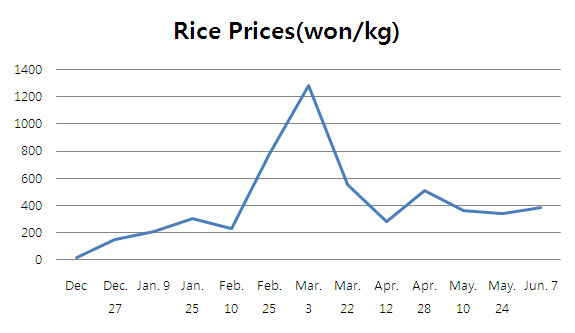
rice-price-6-7-2010.jpg

Today, the North Korean markets seem to have returned to the days before the currency redenomination. The price of rice appears to be rather stable, especially when compared with that of February or March. Especially, following Kim Jong Il’s trip to China, rumors indicating that food would be imported began to circulate, and this has made declining prices even more marked.

According to inside sources, the price of rice in Hoiryeong, North Hamkyung Province is now 480 won per kilo (June 4th), 420 won in Sinuiju (June 7th), 360 won in Sunam-district of Pyongyang (June 2nd), and 380 won in Sariwon (June 7th). The price of corn is approximately 50% that of rice, although recently in Hwanghae Province, households using corn as feed for pigs drove an unusual situation where the corn price reached almost 70% that of rice.

The exact nature of Chinese support for North Korea cannot be confirmed officially, however, the North Korean regime’s encouraging foreign currency earning enterprises to import food from China since March seems to have contributed to rice price stabilization.

One inside source added that the “reactivation of food smuggling on the border between North Korea and China” has also helped.

However, the main overall reason for the failure of the initial prediction, “When the farm hardship period comes in May and June, food prices will skyrocket” appears to have been the normalization of the market.

The source commented, “Compared with the situation prior to the currency redenomination, trading in industrial goods has decreased slightly, however, it is close to its previous condition. Since buyers and sellers can access that market any time, price volatility is not that great anymore.”

That being said, the opening hours of the market have been reduced since the authorities handed down a “rice planting battle order” in early May which stated, “Everyone must participate in the rice planting battle. The market should only be used for the purchase of food, side dishes and those necessities required for the day.”

The source explained, “Markets everywhere now open between 2 and 4 P.M. and close at sunset,” adding that there are small differences depending on the particular market. In North Hamkyung Province, the market normally closes at sunset; however, markets in Hwanghae Province and Pyongan Province, which are under heavier pressure due to the rice planting, close earlier, at around 6 P.M.

But concerns about food will not be solved even if the price of rice remains stable. Merchants are still watching prices with a concerned look since rumors constantly assert that food prices will increase again in July. The North Hamkyung Provincial Party Committee held a cadres meeting last May in which it released news that food distribution for the months from July to October must be prepared by each unit individually, meaning that the central authorities have no plans to assist.

The agricultural situation is one concern. North Korea has been suffering from a severe fertilizer crisis since the beginning of spring farm preparations. After Kim Jong Il’s visit to China, Chinese fertilizer was imported which temporarily alleviated the situation, but the rumor is that fertilizer for the summer has yet to arrive.

Recently, Kim Jong Il visited a domestic fertilizer production facility, Namheung Youth Chemical Works in Anju City, South Pyongan Province. There, he complimented factory management, saying, “It is a relief to know that fertilizer is being produced in Namheung.” The incident displays North Korea’s concerns about fertilizer.

Other factors which destabilize food prices are the icy inter-Korean relationship and international community sanctions.

Recently, around the North Korean market, the number of street vendors, so-called ‘grasshoppers’ has greatly increased. One source explained, “This situation has been caused by the middle class being demoted to the lower classes due to the big damage they incurred during the currency redenomination.”

Sharply decreasing trade in higher priced goods like home appliances and furniture is derived from the same source.

The tumbling credibility of the North Korean currency is another ongoing worry, as is a lack of small denomination bills. One source explained, “If you purchase a 30,000 won jumper from Sungyo Market in Pyongyang, the cost is $30 (market exchange rate, the equivalent of 27,000 won on the day), but it is 30,000 won if you pay in North Korean currency.” That’s a ten percent mark-up for people using local currency, the material representation of a lack of trust in the won.

In areas of Pyongyang, Wonsan, Sariwon, and Haeju, dollars and then Euros are preferred over won, but in Jagang Province, Yangkang Province, and North Hamkyung Province, Yuan are preferable to dollars. Places where all four; U.S. dollars, Yuan, Euros and won are being used are Sinujiu and the port city of Nampo on the west coast. One source explained that due to this situation, high-priced products like televisions, DVD players and refrigerators are being sold only for U.S. dollars or Yuan.

Also, he added, “There is a shortage of small bills which is causing some inconveniences in market trading.”

At the time of the currency redenomination, North Korea displayed 7 kinds of small bills and coins; 1 chon, 5 chon, 10 chon, 50 chon, 1 won, 5 won, and 10 won. The source explained that demand for the ‘chon’ unit coins is practically non-existent; the problem is that 1 won, 5 won, and 10 won are frequently used in market trading but a shortage of bills is causing inconvenience. Merchants are setting the price of goods mostly in increments of 10 won and 50 won as a result.

Read the full story here:
Everything Is Stable, But for How Long?
Daily NK
Park In-ho
6-9-2010

Share

South Korea to send aid, ban travel for 6.15 events in DPRK

June 10th, 2010

According to AFP:

The unification ministry, which must authorise all cross-border exchanges, said the shipments from private groups of milk and other items totalling 320,000 dollars would be sent late this month.

The South cut off most trade with the North after accusing its neighbour of firing a torpedo to sink the ship in March with the loss of 46 lives. It exempted humanitarian aid.

The impoverished North suffers severe food shortages. The UN Children’s Fund says one in three of its children is stunted by malnutrition.

And according to KBS:

The Unification Ministry is prohibiting South Koreans from going to North Korea to celebrate the tenth anniversary of the signing of the June 15th Joint Declaration.

The ministry recently rejected a South Korean group’s request to travel to the North to attend the ceremony marking the signing in Pyongyang.

The ministry said it could now allow the trip due to heightened inter-Korean tensions over the sinking of the Cheonan.

Representatives from South and North Korea and overseas Korean communities had planned to hold a joint ceremony in Pyongyang after holding working-level contacts in the North Korean border city of Gaeseong in May. 

Read the full stories here:
S.Korea to ship aid to North despite tensions
AFP
6/9/2010

S.Koreans Banned From Attending 6.15 Event in NK
KBS
6/9/2010

Share

The DPRK Missile Show: A Comedy in (Currently) Eight Acts

June 8th, 2010

Draft paper by Robert Schmucker and Markus Schiller
May 5, 2010

Download the PDF here

Summary
Today, there are at least seven different missile types of longer range available in North Korea – Scud B, Scud C, Scud D, Nodong, R-27/BM-25, Taepodong 1 and Taepodong 2/Unha-2. All were developed during the last three decades, each of them within a few years, and six are subject to the INF treaty. Some of the missiles have common roots, but their diameters vary significantly, ranging from 0.88 m over roughly 1.3 m and 1.5 m to about 2.5 m. This means that North Korea managed to develop at least four completely different lines of missiles to perfection and serial production, all of them with a negligible number of test launches. A total of roughly a dozen missile tests was actually observed before 2009, a number that is even today insufficient for only one military missile development in the USA, Russia, China or France. The repeating reports of North Korean “short range missile tests” are irrelevant – at those tests, the DPRK launches small anti ship missiles that were purchased in China or Russia. This has nothing to do with ballistic missiles.

It is often argued that the North Korean missiles are tested in other countries, namely Syria, Pakistan and Iran. This argument is insufficient. Combining all Scud B, C, D and Nodong launches in these countries, they are still not enough for a respective indigenous development, and the other missile types were never launched outside the DPRK. The choice of launch sites in the respective countries also is a clear indication: Pakistan tests its missiles close to Cashmere at the border to India, and as previously mentioned, Syria launched Scud D at the Israeli border. If the missiles head in the wrong direction – what is not uncommon at development tests –, this would have catastrophic consequences. Therefore, it must be assumed that these missiles had already had finished their development programs.

Aside of their small number, the sequence of North Korean tests is also noteworthy. There were only sporadic launches from 1984 to 2006, with a total of roughly ten. This was followed in 2006 and 2009 with an event of about a half dozen missile launches within a few hours, respectively, both including a large satellite launch vehicle. There might be a link to Iran’s and Pakistan’s orientation towards modern solid rocket technology. Russia can offer nothing on this market because of the imposed restrictions of the INF treaty – there are no old Soviet solid fueled missiles of this performance class, and new developments in this class are not allowed by INF – the required tests might be observed by the USA. Iran also increases its indigenous activities, resulting in a foreseeable loss of this source of funding. No wonder that the DPRK now has to demonstrate larger systems to stay in the proliferation game.

Conclusion
This is the visible North Korean situation: A country that has absolutely no other technical and economic merits offers a variety of quickly reverse engineered and indigenously developed high tech weapons, all of them with typical Soviet characteristics.

Every other country in the World had to rely on outside help of experienced institutions for their missile programs: China on Russia, India on the US and France, Pakistan on China and France, and so on. Even the US and the Soviets acquired German expertise after World War 2. Every country had foreign support for their missiles – except the DPRK.

It should be noted here that the common view of North Korea’s reverse engineering capabilities seems to come from one single source in the late 1980s, without any further proof. Today, this source is reported to see these claims with different eyes.

To get back to the analysis method that was introduced at the beginning: The three aspects country, program and missile are not compatible. The DPRK has no capabilities on any other area than rocketry, the programs are invisible or nonexistent, but a selection of operational missiles is offered that should even have countries like France, for example, go green with envy.

It is also strange that Russia silently watches the DPRK cloning and selling Soviet products, thus earning hundreds of millions of dollars, and doing this without any financial compensation for the Russians.

These antagonisms can be explained on several ways. Some claim that in the age of computer simulations, a single test is enough to proof functionality of highly complex machines such as missiles. After that, the missile goes straight into serial production. But this obviously only works in the DPRK: The new Russian submarine missile Bulava, for example, seems to have failed in 7 of its 12 flight tests so far – operational deployment is far from any discussion.

There is a different explanation that is much simpler – a connection to Russian institutions. All of the North Korean missiles were procured from Russia or at least realized with foreign support. Some, as Scud B, might come from old stocks, single remainders of old Soviet prototypes certainly were among them, and others might still be in production. A guided North Korean licensed production of simpler components can also not be excluded. In any case, the indigenous contributions of the DPRK are small at best. It is not said, though, that the Russian government or the leadership of the institutions in question know of this: Much happens in dark alleys, as was illustrated by the example of the Gharbiya gyros for Iraq.

The DPRK will of course try to reverse engineer parts and components, and it will try to acquire the capabilities for indigenous development and production. Due to this, single engine tests should be observable, not only to demonstrate indigenous activities, but also to learn and to slowly increase the DPRK’s competence on the missile sector.

But in the public opinion, this explanation is wrong, because – well, because it cannot be right. Because there is a well established view of North Korea that is also confirmed by defectors: The rockets are secretly designed, tested and produced in huge underground facilities, and these efforts are directed by an evil and megalomaniac villain who threatens the free world with his missiles.

How to best counter this type of threat should be known from the movies – just call James Bond.

More from CxI and NPR.

Share

Political Life Launched by Chosun Children’s Union

June 8th, 2010

Daily NK
Min Cho Hee
6/7/2010

On June 6, 1946, the Chosun Children’s Union was founded. The Children’s Union, an organization for all children between seven and fourteen, is guided politically by the Science Education Department of the Central Committee of the Party.

Its hierarchical structure consists of a number of levels populated by students, including section committees of class and school, provincial and local school committees, and the national coalition of the Children’s Union. Within the structure, there is one head and two vice-heads of the Union in each school, one school committee member from each classroom, one head and two vice-heads of a section committee which exists within each class, and three to five committee members of each section committee.

The teacher who takes responsibility for the Children’s Union in a school is known as the Children’s Union Instructor, while the homeroom teacher of each class is generally also the section committee instructor. Based on the notion that a student’s political and organization life should be divided from his or her general school life, the teacher undertakes homeroom tasks and Children’s Union tasks under two different official positions.

Members of the Children’s Union must act according to the “regulations and obligations of the Chosun Children’s Union.” In order to “do good works,” part of the social activities of the Union, Union members make a “Kid’s Plan,” which specifies the kind and scale of the activities the member intends to carry out, be it collecting scrap iron, copper or paper, raising rabbits, participating in propaganda choirs or being a children’s watch guard (someone who monitors the activities of other students).

The symbols of the Children’s Union are the red scarf, like that of Young Pioneer organizations in other communist states, a badge showing a torch, and the greeting and slogan of the Union, “Let’s always be ready to become workers in the construction of socialism!” in long form, or, more pithily, “Always ready!”

Every student has to take part in one of three Union entrance ceremonies during their second year of elementary school.

The first entrance ceremony is held on Kim Jong Il’s birthday, February 16, the second on Kim Il Sung’s birthday on April 15, and the last one on June 6, the date of the organization’s founding. Model students who have a good family background can join the Union on Kim Jong Il’s birthday with his or her homeroom teacher’s recommendation, the next political class of students enter it on April 15 and the rest of students joint en masse on June 6th.

Entrance ceremonies are held regionally. First on the agenda at the ceremony is to recite the entrance oath; next, Union officials give badges and ties to new members; then the children shout the Union slogan with right arm aloft in salute.

The main concern of parents is the day of their child’s entrance ceremony. Students who are permitted to join on Kim Jong Il’s birthday have the best prospects, with a high possibility of becoming Union leaders of one kind or another. Activities within the Union are, of course, noted, so it is important to be successful from the beginning.

Therefore, the position of homeroom teacher of a second-year elementary class is desirable, since it allows the teacher access to bribes of money, clothes, rice and more from parents keen to see their child enter the Union on February 16.

Until the early 1990s, when the authorities stopped provided students with school uniforms, the red scarf was also provided by the state, but now, as with so much, it is the duty of parents.

Therefore, from February to June demand for the ubiquitous red scarf of the Children’s Union increases in North Korean markets. In the Sunam market in Chonjin, the red scarf of the Union sells for between 500 and 1200 won.

Yet even in the simple red scarf there is a symbol of inequality. Children from the upper classes have silk scarves manufactured in China, while the other students use cheap nylon versions or receive them from siblings.

Share

North Korea Looking to Makkoli Business

June 8th, 2010

Daily NK
Hwang Ju Hee
6/7/2010

Showing Pyongyang’s desire to reach new markets, Uriminzokkiri (Being amongst Our Nation), a website managed by the North Korean Committee for the Peaceful Reunification of the Fatherland, recently covered “Rakbaek Makkoli,” taking its lead from an article published in the latest issue of monthly domestic publication “Deungdae” (Lighthouse).

Makkoli is a traditional Korean drink made from fermented rice which has its roots in agricultural areas. Recently it has experienced a resurgence of popularity in South Korea.

The Uriminzokkiri report explained of the North Korean makkoli, “The makkoli produced by Rakwon Department Store in Pyongyang is a healthy beverage and good to drink. It is consumed internationally as well as domestically.”

Given that Uriminzokkiri is targeted at South Koreans, the appearance of “Rakbaek Makkoli” looks like an attempt to profit from the thriving South Korean makkoli business.

Although North Korea has exported “Pyongyang Soju” to the U.S., Japan and China in the past, consumers didn’t take to it due to its expensive price and strong taste. Therefore, North Korea may be looking to makkoli.

One defector, who used to be involved in trade in North Korea, explained in an interview with The Daily NK, “Bottled makkoli is thought of as a luxury beverage, but the general populace can drink it only on holidays when the state distributes it.”

He added, “But the common people, especially those who live in agricultural areas, brew their own with spoiled rice or bread and yeast. Cadres don’t usually drink this.”

The South Korean makkoli industry is thriving under the influence of a South Korean cultural wave which is in evidence in Japan, China, Taiwan and even as far away as the U.S. The most famous traditional makkoli, which is made in the southwest provinces of South Korea, has recently begun to be produced for export, while marketing men in Seoul recently hit upon calling makkoli “Drunken Rice” in an attempt to forge an international makkoli brand image.

To that end, makkoli has been promoted several times at summits and other international events by South Korean President Lee Myung Bak.

Share