Kim Jong-il statue erected on Mansu Hill

March 1st, 2012

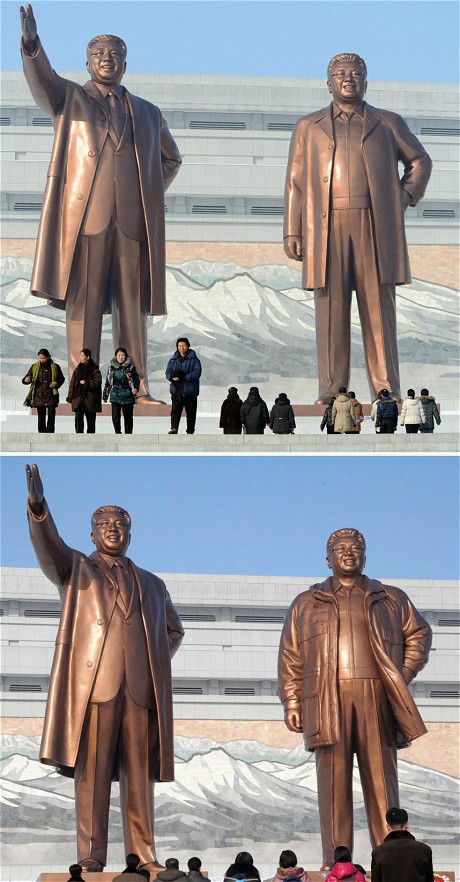
UPDATE 4 (2013-1-10): Kyodo (via The Telegraph) solves the riddle of just why the Kim statues on Mansu Hill were covered up in October 2012 (See below)–a new version of the Kim Jong-il statue was put up. It replaced a statue that was erected in April 2012.

Below is a before/after comparison.

NKOREA_STATUE_COMP_2476186c

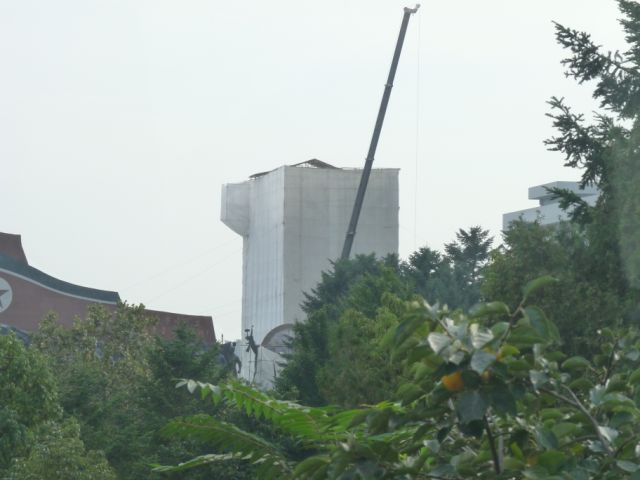
UPDATE 3 (2012-10-3): A reader sends in this image of the statues covered up.

Ruedeger Frank also publishes an image at 38 North.

UPDATE 2 (2012-4-14):


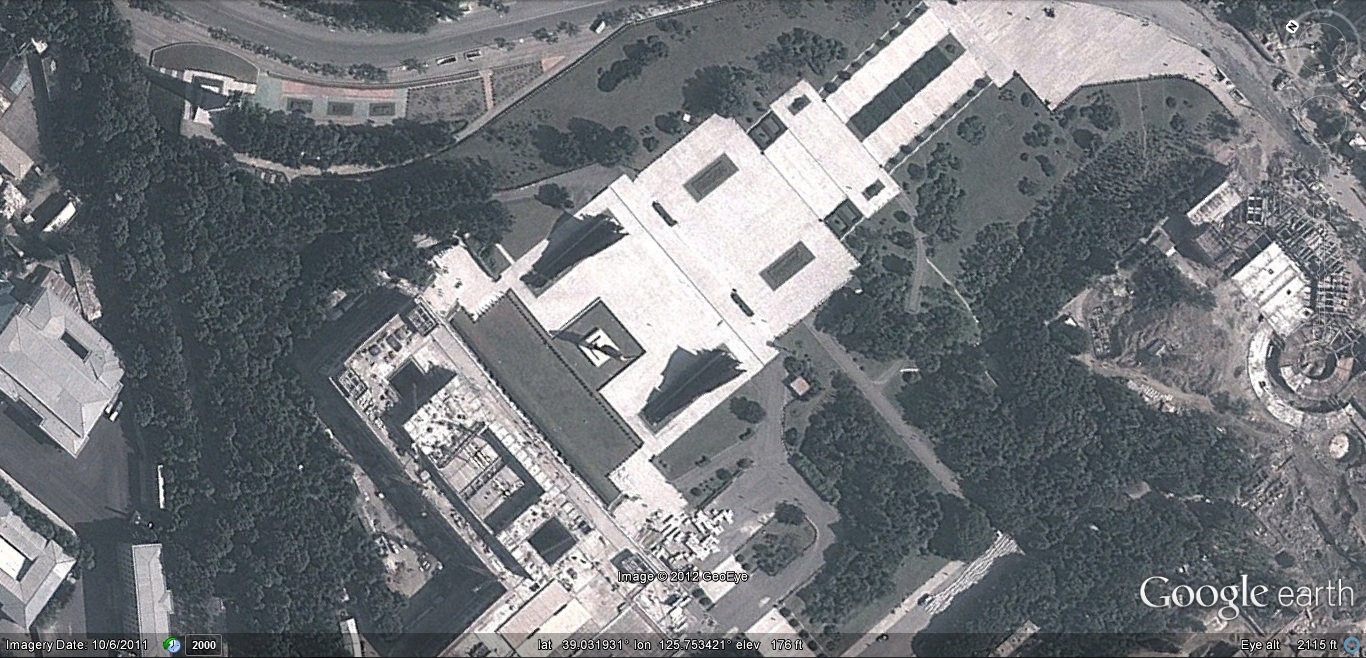
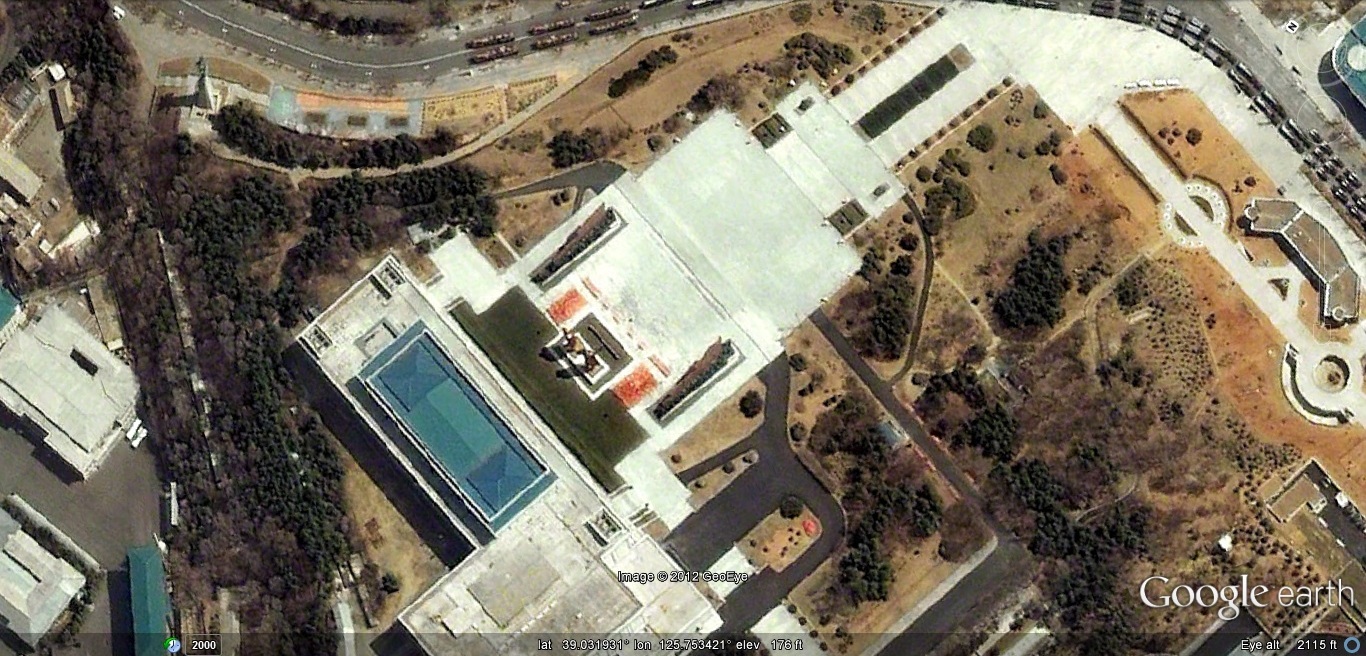
Pictured Above: Mansudae Grand monument.  (L) Google Earth, (R) Digital Globe

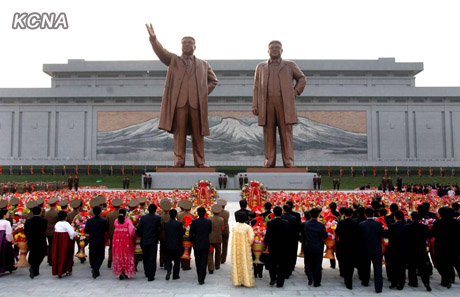
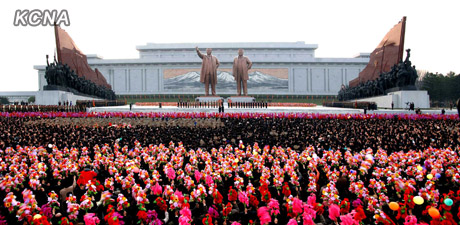
UPDATE 1 (2012-4-13): The Kim Jong-il statue and Kim Il-sung statues were unveiled today to much “fan fair”:


Above pictures via KCNA. Compare these with the photo I took of the Kim Il-sung statue in 2004.

Video of the unveiling can be found here (YouTube).

According to KCNA:

Statues of President Kim Il Sung and leader Kim Jong Il were successfully built on Mansu Hill.

The statues portray smiling Kim Il Sung who indicates the way ahead with his hand held forward and smiling Kim Jong Il blessing Songun Korea prosperous morrow while looking far into its bright future in the new century.

Large sculptures on both sides of the statues have been renovated on the highest level.

The unveiling ceremony took place with splendor Friday.

There were huge crowds of people from all walks of life, servicepersons, youth and students, 300 000 in all, on Mansu Hill and nearby streets. They were holding bouquets and balloons.

Supreme leader of the Workers’ Party of Korea and the people of the DPRK Kim Jong Un, first secretary of the WPK, first chairman of the National Defence Commission of the DPRK and supreme commander of the Korean People’s Army, was present at the opening ceremony.

Present there were senior party, state and army officials, chairpersons of friendly parties.

Also on hand were delegates to the celebrations of the centenary of the birth of the President, creators, officials and employees of the Mansudae Art Studio, officials of the party, armed forces and power bodies, social organizations, ministries and national institutions, anti-Japanese revolutionary fighters, anti-Japanese patriotic martyrs, servicepersons of the Korean People’s Army and the Korean People’s Internal Security Forces (KPISF), officials in the fields of science, education, literature and arts, public health and media, heroes, bereaved families of revolutionary martyrs, men of merits and working people in the city.

Also present there were a delegation of the Koreans in Japan and delegations of overseas compatriots and overseas Koreans, the chief of the Pyongyang mission of the Anti-Imperialist National Democratic Front, diplomatic envoys of different countries and representatives of international organizations here and foreign guests who are participating in the World Congress on the Juche Idea, the international festival and the April spring friendship art festival.

The statues were unveiled by senior party, state and army officials.

The moment thunderous cheers of “Hurrah!” resounded forth, fireworks were displayed and balloons were released.

Laid before the statues were large floral baskets in the joint name of the Central Committee of the WPK, the Central Military Commission of the WPK, the National Defence Commission of the DPRK, the Presidium of the Supreme People’s Assembly, Cabinet and in the name of all the Korean people.

Laid were floral baskets in the name of ministries, national institutions, armed forces organs, provinces, cities, counties, important units which were visited by the President and Kim Jong Il, units of the KPA and the KPISF, party and power bodies and factories, enterprises, co-op farms, universities, colleges and schools in Pyongyang and local areas.

Floral baskets were also laid by the diplomatic corps and the military attaches corps here and foreign guests and overseas compatriots.

All the participants bowed to the statues.

Kim Yong Nam, member of the Presidium of the Political Bureau of the WPK Central Committee who is president of the Presidium of the Supreme People’s Assembly of the DPRK, made a speech.

He said that Kim Jong Un instructed to build the statue of Kim Jong Il on Mansu Hill together with that of Kim Il Sung and energetically led the work to build them on the highest level in the shortest time possible.

It was possible to erect the statues on the highest level in a matter of some 100 days thanks to the yearning and devotion made by all the soldiers and people, overseas Koreans and the world progressives.

This great auspicious event is a precious fruition of the noble moral obligation of Kim Jong Un and his energetic leadership. It is also a striking manifestation of the unshakable will of the army and people of the DPRK to hold Kim Il Sung and Kim Jong Il in high esteem for all ages.

ORIGINAL POST (2012-3-1): Hannah Barraclough (Koryo Tours) reports on the CanKor web page:

A new statue of Kim Jong Il on a horse was unveiled at Mansudae Art Studio on the 15th Feb. It has been placed alongside the one already existing there of Kim Il Sung on a horse. It also appears that they are making a new large statue of Kim Jong Il which will go on Mansu Hill next to the one of Kim Il Sung there which is currently covered up. This is expected to be completed by April.

Additional Information:

1. The Kim Il-sung statue on Mansu Hill was recently covered up for renovations of the Korean Revolution Museum located directly behind it.

2. Here, here, and here are recent posts on different construction projects in Pyongyang.

3. A memorial to Kim Jong-il has recently been carved into Mt. Sokda and a memorial to Kim Jong-il is reportedly under construction in Hoeryong.

4. Here and here are additional stories on efforts to venerate Kim Jong-il.

Share

38 North highlights

March 1st, 2012

I have been pretty busy lately so blog posts have taken a hit.  I am mostly caught up now, but there were several 38 North publications released in February that I wanted to highlight:

Is North Korea Opening? What Might That Mean?
Aidan Foster-Carter
38 North
2012-2-29

Dealing with the Kims
38 North
Joel Witt and Jenny Town
2012-2-24

China’s Embrace of North Korea: The Curious Case of the Hwanggumpyong Island Economic Zone
38 North
2012-2-19

Share

US – DPRK “leap day deal” announced

February 29th, 2012

UPDATE 7 (2012-4-18): The IAEA now states that it is not likely to send an inspection team to the DPRK. According to the Voice of America:

The International Atomic Energy Agency says it is now unlikely to send a delegation to North Korea, after Pyongyang stated it is no longer bound by an agreement with the United States not to test missiles and nuclear devices.

Spokeswoman Gill Tudor made the announcement late Tuesday, ending hopes for the visit for which IAEA officials began negotiating with North Korea in March.

Earlier in the day, Pyongyang said it was breaking off a bilateral agreement to halt its nuclear activities and allow IAEA inspectors to enter the country after the U.S. suspended much needed food aid. Washington said North Korea did not keep its end of the bargain when it carried out its failed missile launch on Friday.

North Korea’s Foreign Ministry vowed to continue trying to fire a long-range rocket into space to place what it said was a weather satellite into orbit. It also vowed unspecified retaliation now that the agreement with the U.S. is no longer in place.

State Department spokesperson Mark Toner said Tuesday that Pyongyang’s statement was “not surprising, given their recent behavior.” He said he could not predict whether North Korea is laying the ground work for a future nuclear test, as some fear.

UPDATE 6 (2012-4-17): North Korea announced that it has scrapped the “Leap day deal“. According to KCNA (2012-4-17):

Thirdly, as the U.S. violated the Feb. 29 DPRK-U.S. agreement through its undisguised hostile acts, we will no longer be bound to it.

UPDATE 5 (2012-4-17): Following the launch of the Unha-3 rocket in April of 2012, the US has scrapped the “Leap Day Deal” to provide food aid for a suspension of the DPRK’s nuclear program. According to the Los Angeles Times:

The Obama administration announced shortly after the launch Friday that it was scrapping a Feb. 29 agreement to send 240,000 metric tons of food to North Korea, a promise made as inducement for Pyongyang to abide by previous U.N. resolutions and suspend its nuclear programs.

UPDATE 4 (2012-3-31): The DPRK attacks the US decision to suspend food assistance. According to Bloomberg:

North Korea criticized a U.S. announcement that it would suspend food aid if the Asian country carries out a planned “peaceful” satellite launch, calling it an overreaction “beyond the limit.”

Suspending food aid “would be a regrettable act” scrapping the entire Feb. 29 agreement between the two nations, North Korea’s state-run Korean Central News Agency said, quoting a foreign ministry spokesman it didn’t name.

North Korea drew rebukes from nations including the U.S. earlier this month when it revealed plans to launch an “earth observation satellite” in April to mark the 100th anniversary of the birth of state founder Kim Il Sung.

U.S. President Barack Obama, who visited Seoul for a Nuclear Security Summit this week, warned North Korea that its plan to fire a long-range rocket undermined prospects for future negotiations, while South Korea’s military said Kim Jong Un’s forces had moved the missile to a launch site.

North Korea’s announcement of a mid-April launch will make it difficult to move forward with the aid deal and broader efforts to get the regime back to negotiations on its nuclear weapons program, Obama said.

UPDATE 3 (2012-3-28): Food aid deal will be suspended if DPRK goes through with April rocket launch.  According to the American Forces Press Service:

Concerns that North Korea would resume provocative behavior on the international stage in 2012 have proven true, so the United States has suspended plans to provide nutrition aid to the impoverished nation, senior defense officials told Congress today.

“Our suspicions … were confirmed when North Korea announced on March 16 that it plans to conduct a missile launch between April 12th and 16,” Peter R. Lavoy, acting assistant secretary of defense for Asian and Pacific security affairs, told members of the House Armed Services Committee. “This grand launch is highly provocative, because it manifests North Korea’s desire to test and expand its long-range missile capability.”

Army Gen. James D. Thurman, commander of U.S. Forces Korea, testified alongside Lavoy in a hearing examining the security situation on the Korean Peninsula.

After a series of U.S.-North Korean discussions in late February, the North Korean government agreed to implement a moratorium on long-range missile launches — then announced plans for the launch just two weeks later, Lavoy explained.

The United States had agreed during the February talks to provide nutritional aid to North Korea. The World Food Program in November 2011 recommended targeted high-nutrition aid as critical to 3 million North Koreans most at risk for starvation.

Lavoy and Thurman both confirmed the United States will not deliver the planned nutrition aid.

“During those discussions, the United States made it very clear that a satellite launch would be a deal-breaker,” Lavoy told the panel.

Both men said U.S. officials have worked to “delink” humanitarian aid and political concerns, but defended the decision to suspend nutritional aid.

“The fact that North Korea so brazenly violated commitments that it just so recently agreed to … indicates that they’re not reliable,” Lavoy said. “We cannot expect them to meet … the commitments that they’ve agreed to that are associated with the provision of nutritional assistance to the needy population in their country.

“It’s regrettable that the food aid is not moving forward,” he added. “The North Korean population really needs nutritional assistance. And we’re prepared to provide that to North Korea.”

Thurman said officials are working closely with allies and other partners in the region to try to discourage North Korea from launching the missile. Meanwhile, the general added, “we have been forced to suspend our activities to provide nutritional assistance to North Korea.”

Lavoy said the threatened launch would be in direct violation of U.N. Security Council resolutions 1718 and 1874, which prohibit North Korea from conducting any launches that use ballistic missile technology.

The launch would involve a North Korean-made Kwangmyongsong-3 polar-orbiting Earth observation satellite to mark the 100th birthday of late President Kim Il Sung, a spokesman for the Korean Committee for Space Technology said in a statement.

The late president’s birthday is April 15.

Lavoy said North Korea’s authoritarian government, founded by Kim Il Sung and subsequently led by Kim Jong Il and Kim Jong Un — his son and grandson, respectively — seeks to provoke other nations militarily as a means of demonstrating power to its people.

“Political successions are extraordinarily difficult when you don’t have a representative government, which is the case there, of course,” he noted. Kim Jong Un took power after his father’s death in December.

“What we’re seeing now and what we anticipate is provocative behavior, because, unfortunately, this seems to be the only way that the North Korean regime can try to demonstrate its bona fides to a population that is suffering terribly,” Lavoy added.

Thurman said North Korea’s “military first” policy diverts national resources away from food and essential services to the people.

“They maintain the fourth-largest conventional military force in the world, the world’s largest special operating force, and significant long-range artillery capabilities,” the general said. “Over 70 percent of their combat powers are arrayed within 90 miles of the demilitarized zone.”

South Korea, home to some 28,500 forward-based U.S. troops, is “a vibrant democracy, economic success and global security partner, currently serving beside us in Afghanistan and off the Horn of Africa,” Thurman said.

“In stark contrast, one of the world’s poorest, most closed and
most militarized countries, North Korea, lies less than 20 miles from the northern districts of Seoul, a city of over 24 million people,” he added.

The United States and South Korea have for 60 years maintained a close partnership aimed at deterring North Korean aggression and maintaining stability on the peninsula, Thurman noted.

“We are prepared to defend the peninsula and can do that,” the general said. “And we can repel any type of attack should the North Koreans decide to do that.”

UPDATE 2 (2012-3-23): North Korea has announced it will conduct another “Satellite” Launch (aka ICBM test).  Jeffrey Lewis writes about the unwinding of the “Leap-day deal” at Arms Control Wonk.

UPDATE 1 (2012-3-15):  The Choson Ilbo reports that the DPRK has agreed to allow more monitoring of food aid distribution:

The North apparently agreed during the latest meeting with U.S. officials in Beijing to increase the number of monitors to 70. Their task will be to check that the food reaches civilians who need it and is not diverted to the military. A diplomatic source in Seoul said the U.S. has decided to send monitors who are fluent in Korean to the North when it takes delivery of 20,000 tons of food aid per month over a year, as agreed.

Robert King, the U.S. special envoy for North Korean human rights, met on March 7 and 8 with An Myong-hun of the North Korean Foreign Ministry and agreed the terms, the source said.

North Korea accepted most U.S. demands, the source added. Washington apparently insisted that Pyongyang must accept U.S. requests to dispatch monitors to a particular regions at 24 hours’ notice.

After the talks, King said he was “very satisfied” with the results. The U.S. will brief the World Food Programme in Rome on the outcome on Thursday. The WFP then handles the provision of food aid along with five other aid groups based in the U.S. The aid, which takes the form of nutritional supplements rather than rice, will go to North Korean children between the ages of five and seven as well as pregnant women.

ORIGINAL POST (2012-2-29): According to the Associated Press (Via Washingotn Post):

The United States says North Korea has agreed to suspend uranium enrichment and agree to a moratorium on nuclear and long-range missile tests.

State Department spokeswoman Victoria Nuland also said Wednesday the North has agreed to allow International Atomic Energy Inspectors to verify and monitor the moratorium on uranium enrichment and confirm disablement of its nuclear reactor at Yongbyon.

Her statement says the U.S. will meet with North Korea to finalize details for a proposed package of 240,000 metric tons of food aid.

The Washington Post provides additional information:

The agreement is the result of talks between U.S. and North Korean negotiators late last week in Beijing — the first such negotiations since the death of North Korean leader Kim Jong Il and the elevation of his son Kim Jong Eun.

While U.S. leaders have insisted that the food aid for the impoverished country and nuclear disarmament are separate issues, North Korean officials have tied the two in past negotiation

Here is the official statement by the State Department:

U.S.-DPRK Bilateral Discussions

Press Statement
Victoria Nuland
Department Spokesperson, Office of the Spokesperson
Washington, DC
February 29, 2012

A U.S. delegation has just returned from Beijing following a third exploratory round of U.S.-DPRK bilateral talks. To improve the atmosphere for dialogue and demonstrate its commitment to denuclearization, the DPRK has agreed to implement a moratorium on long-range missile launches, nuclear tests and nuclear activities at Yongbyon, including uranium enrichment activities. The DPRK has also agreed to the return of IAEA inspectors to verify and monitor the moratorium on uranium enrichment activities at Yongbyon and confirm the disablement of the 5-MW reactor and associated facilities.

The United States still has profound concerns regarding North Korean behavior across a wide range of areas, but today’s announcement reflects important, if limited, progress in addressing some of these. We have agreed to meet with the DPRK to finalize administrative details necessary to move forward with our proposed package of 240,000 metric tons of nutritional assistance along with the intensive monitoring required for the delivery of such assistance.

The following points flow from the February 23-24 discussions in Beijing:

The United States reaffirms that it does not have hostile intent toward the DPRK and is prepared to take steps to improve our bilateral relationship in the spirit of mutual respect for sovereignty and equality.

The United States reaffirms its commitment to the September 19, 2005 Joint Statement.

The United States recognizes the 1953 Armistice Agreement as the cornerstone of peace and stability on the Korean Peninsula.

U.S. and DPRK nutritional assistance teams will meet in the immediate future to finalize administrative details on a targeted U.S. program consisting of an initial 240,000 metric tons of nutritional assistance with the prospect of additional assistance based on continued need.

The United States is prepared to take steps to increase people-to-people exchanges, including in the areas of culture, education, and sports.

U.S. sanctions against the DPRK are not targeted against the livelihood of the DPRK people.

Here is the statement in KCNA:

DPRK Foreign Ministry Spokesman on Result of DPRK-U.S. Talks

Pyongyang, February 29 (KCNA) — The spokesman of the Ministry of Foreign Affairs of the Democratic People’s Republic of Korea on Wednesday gave the following answer as regards questions raised by KCNA concerning the result of the latest DPRK-U.S. high-level talks:

Delegations of the Democratic People’s Republic of Korea (DPRK) and the United States of America (U.S.) met in Beijing, China on 23rd and 24th of February for the third round of the high-level talks between the DPRK and the U.S.

Present at the talks were the delegation of the DPRK headed by Kim Kye Gwan, the First Vice Minister of Foreign Affairs, and the delegation of the U.S. headed by Glyn Davies, the Special Representative of the State Department for the DPRK Policy.

The talks, continuation of the two previous DPRK-U.S. high-level talks held respectively in July and October, 2011, offered a venue for sincere and in-depth discussion of issues concerning the measures aimed at building confidence for the improvement of relations between the DPRK and the U.S. as well as issues related with ensuring peace and stability on the Korean Peninsula and resumption of the six-party talks.

Both the DPRK and the U.S. reaffirmed their commitments to the September 19 Joint Statement and recognized that the 1953 Armistice Agreement is the cornerstone of peace and stability on the Korean Peninsula until the conclusion of a peace treaty.

Both the DPRK and the U.S. agreed to make a number of simultaneous moves aimed at building confidence as part of the efforts to improve the relations between the DPRK and the U.S.

The U.S. reaffirmed that it no longer has hostile intent toward the DPRK and that it is prepared to take steps to improve the bilateral relations in the spirit of mutual respect for sovereignty and equality.

The U.S. also agreed to take steps to increase people-to-people exchanges, including in the areas of culture, education, and sports.

The U.S. promised to offer 240,000 metric tons of nutritional assistance with the prospect of additional food assistance, for which both the DPRK and the U.S. would finalize the administrative details in the immediate future.

The U.S. made it clear that sanctions against the DPRK are not targeting the civilian sector, including the livelihood of people.

Once the six-party talks are resumed, priority will be given to the discussion of issues concerning the lifting of sanctions on the DPRK and provision of light water reactors.

Both the DPRK and the U.S. affirmed that it is in mutual interest to ensure peace and stability on the Korean Peninsula, improve the relations between the DPRK and the U.S., and push ahead with the denuclearization through dialogue and negotiations.

Both sides agreed to continue the talks.

The DPRK, upon request by the U.S. and with a view to maintaining positive atmosphere for the DPRK-U.S. high-level talks, agreed to a moratorium on nuclear tests, long-range missile launches, and uranium enrichment activity at Nyongbyon and allow the IAEA to monitor the moratorium on uranium enrichment while productive dialogues continue.

Evan Ramstad analyses the differences be3tween the DPRK and US State Department statements in this Wall Street Journal article.

The New York Times offers some caveats:

North Korea has agreed in the past to halt its nuclear program only to back out, demanding more concessions or accusing the United States of reneging on its obligations. And the statement Tuesday from the North’s official Korean Central News Agency appeared to give the country’s leaders wiggle room again this time, saying that Pyongyang would carry out the agreement “as long as talks proceed fruitfully.”

Still, North Korea’s agreement to allow inspectors from the International Atomic Energy Agency to return to the country appeared to be a significant concession. After years of negotiations, North Korea expelled inspectors and went on to test nuclear devices in 2006 and 2009. American intelligence officials believe the country has enough fuel already for six to eight weapons.

If the North lives up to its agreement to stop uranium enrichment, it could help ease some anxieties in Washington over the program at a time when the administration, in an election year, is consumed with halting Iran’s nuclear program before Israel decides to stage an attack.

For the relatively young and inexperienced Mr. Kim, the agreement could be crucial to solidifying his hold on power and the backing of the powerful military, analysts in South Korea said. He needs to show in the early months of his rule that he is improving people’s lives after years of food shortages and a devastating famine. Bringing in 240,000 metric tons of food aid from the United States will surely help.

CNN reports (sorry, no link) that the details of this agreement were largely negotiated before Kim Jong-il passed away.

Additional Information:

1. Here are Scott Snyder’s thoughts on the agreement. Here are Joel Wit’s comments. Here are Gordon Flake’s.

2. Here is coverage in the Wall Street Journal, Los Angeles Times, The Guardian, and Stratfor.

3. Joshua Stanton (OFK) posted a transcript of the entire State Department briefing. Here is the State Department Briefing transcript from State.

4. I have kept a collection of significant news and satellite imagery of the DPRK’s nuclear facilities.  You can see the information here.

5. The DPRK lobbied very hard for food aid from the international community throughout 2011.

6. Here is a list of US – DPRK engagement in 2011Fox News also reports that an American ship has arrived in North Korea to assist in the search for the remains of Korean War MIAs.

7. More on the talks that preceded the announcement of the deal here

Read the full stories here:
U.S. says N. Korea has agreed to suspend uranium enrichment, moratorium on nuclear, missile tests
Associated Press (Via Washingotn Post)
2012-2-29

N. Korea agrees to suspend uranium enrichment, nuclear tests
Washington Post
William Wan
2012-2-29
Share

Kangnam moved into Pyongyang

February 29th, 2012

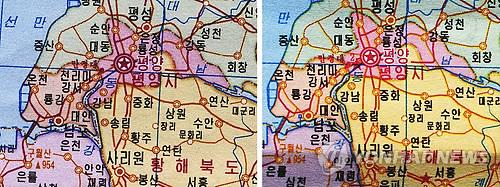
Pictured Above (Yonhap): A comparison of atlas photos showing the inclusion of Kangnam in Pyongyang.

According to Yonhap:

North Korea has incorporated a key farming county into Pyongyang in what could be an attempt to provide a stable food supply for loyal residents in the capital.

The North had reduced the size of Pyongyang by relinquishing most of the capital’s south and a portion of its west to neighboring North Hwanghae Province, South Korea’s Unification Ministry said last year.

The move reduced the city’s population by about 500,000 to 2.5 million.

However, the North has now incorporated Kangnam County in North Hwanghae Province back into Pyongyang, according to a 2011 almanac map from North Korea, a copy of which was obtained by Yonhap News Agency.

“The move appears to be aimed at using Kangnam County as a supplier of food to Pyongyang residents as the rural area is a major agricultural producer,” said Kwon Tae-jin, an expert on North Korea at the Korea Rural Economic Institute in Seoul.

The North has relied on international handouts since the late 1990s when it suffered a massive famine that was estimated to have killed 2 million people.

Pyongyang is home to the ruling elite that governs the country through rations and a military-first policy. It is located in the southwest region of the country, which is believed to have a total population of 24 million.

Here is my post from last year about the removal of Kangnam, Junghwa, Sangwon, and Sungho from Pyongyang.

Read the full story here:
N. Korea incorporates key farming county into Pyongyang
Yonhap
2012-2-29

Share

US – DPRK joint Korean War MIA search

February 28th, 2012

UPDATE 1 (2012-3-20): The DPRK’s announced launch of the Kwangmyongsong-3  has brought an end to the program. According to the Associated Press:

The United States said Wednesday it is suspending efforts to recover remains of thousands of fallen service members in North Korea, the latest sign that a recent thaw in relations is over.

The U.S. was in the process of resuming the hunt for remains missing from the 1950-53 Korean War that had been on hold since 2005, the only form of cooperation between the two militaries.

But North Korea announced plans last week to launch a satellite into space by rocket — a step the U.S. says would violate a U.N. ban. That knocked back recent progress in negotiations on the North’s nuclear program, and has jeopardized a Feb. 29 agreement in which the U.S. was to provide food aid in exchange for a nuclear freeze.

The U.S. left open the door to resuming remains recovery if the situation improves.

North Korea says the rocket launch, intended to mark the centennial of the nation’s founder in mid-April, has peaceful aims. The U.S. and other countries suspect it would serve to test capabilities of a long-range missile. Pyongyang has also threatened a “sacred war” against rival South Korea, in response to recent U.S.-South Korean military drills.

The agreement on resuming the troop recovery operations was made last October, and the program was beginning this month. The U.S. had already sent equipment by ship, and an advance team had been due in the country this month. North Korea would have received millions in compensation this year for its support of the operations.

Pentagon press secretary George Little told reporters that North Korea has not acted appropriately in recent days and weeks and “it’s important for them to return to the standards of behavior that the international community has called for.”

“When there are suggestions that they might launch ballistic missiles, when they make bellicose statements about South Korea, and engage in actions that could be construed as provocative, we think that it’s not the right time to undertake this effort,” he said.

He said at some point the U.S. hopes to restart the recovery effort.

More than 7,960 U.S. servicemen are unaccounted for from the Korean War, which ended without a formal peace treaty, leaving the adversaries in a state of war. Some 5,300 of the missing are believed to be in North Korea.

Pentagon spokeswoman Tara Rigler said North Korea had refused to take agreed steps, including permitting the U.S. advance team into the country, and had politicized the remains recovery operations by linking them to the recent U.S.-South Korean military exercises.

She said no U.S. personnel are currently on the ground in North Korea.

The announcement is the latest setback for family members of veterans of the conflict who have lobbied hard for a resumption of the recovery operations. Of the nearly 8,000 missing service members, the remains of just 192 have been recovered and identified so far, based on remains handed over by North Korea or retrieved between 1996-2005.

“It’s heartbreaking to have such a humanitarian, positive mission be continually caught up in political storms,” said Richard Downes, who leads a volunteer group representing families of Korean War MIAs.

See also this story in the Washington Post and this in the Herald Tribune.

ORIGINAL POST (2012-2-28): According to Fox News:

The U.S. military says an American ship has arrived in North Korea to support the hunt for the remains of soldiers missing-in-action from the Korean War.

Chief of the U.S. Pacific Command, Adm. Robert Willard, said Tuesday the ship is offloading equipment at Nampho, a port city west of the capital, Pyongyang.

The U.S. and North Korea agreed in October to restart the search for thousands of American service members, a sign of easing tensions between the wartime enemies.

The program is due to begin formally on March 1, with a U.S. advance team arriving in Pyongyang later in the month.

The search was suspended in 2005 during tensions over North Korea’s nuclear program. The U.S. cited misgivings about the security of its personnel.

Read more about the origins of this project here.

Read the full story here:
US ship in North Korea to prepare for remains hunt
Fox News
2012-2-28

Share

DPRK issuing exit permits for food importers

February 28th, 2012

According to the Daily NK:

The North Korean authorities are expediting the issuance of exit permits for people wishing to visit relatives in China but who agree to return to the country with one ton of food within 40 days. A considerable number of people have obtained permits on this basis in the last week, according to a source who spoke with Daily NK yesterday.

The source, from North Hamkyung Province, told Daily NK, “At the start of last week, my people’s unit head advised us, ‘Anyone able to return to the country with a ton of rice before April 5th should apply for a short-term exit permit to the National Security Agency now.’”

The source added, “More than 20 people per day are crossing over into China via Namyang Customs House after getting prior approval this way in Chongjin, Myongchon and Kilju. Others are finding lodgings in Onsung to wait their turn.”

The permit issuance policy is being implemented nationwide, according to information received by Daily NK. Many people are said to be departing via customs facilities both in Hyesan and further west in Shinuiju under the same deal.

Provincial branches of the Party are keen to issue the permits because they are under pressure to provide special food distribution for the 100th anniversary of Kim Il Sung’s birthday on April 15th, a responsibility Pyongyang is said to have passed on to the provinces in its entirety.

According to the source, the NSA’s provincial anti-espionage head has been telling travelers attending a briefing at the border control office there that their trips “have been made possible by the compassion of Kim Jong Eun,” and threatening that anybody minded to overstay their permit or who is unable to meet their food quota upon their return will be barred from leaving the country indefinitely.

Usually, exit permits are granted on the following basis: ▲ a maximum of 5 degrees of separation between inviter and applicant; ▲ a maximum stay of 3 months; ▲ a minimum of one year between permits. However, this time the authorities are reportedly allowing travelers who have already visited China within the last year to reapply.

Though rare, the policy shift is not unprecedented. For example, a similar pact with would-be permit recipients was offered by the authorities immediately after Kim Jong Il’s trip to China in May, 2011.

Such a loosening of border controls comes with a number of side-effects, not least that it brings down prices in the jangmadang, offering a valuable boost to individual purchasing power.

As such, kilo of decent rice was selling for 3,200 North Korean won early last week in Chongjin, a source from the city told Daily NK yesterday, but as of Monday this had fallen to 3,000 won, with 1 Chinese Yuan dropping from 605 to 600 North Korean Won.

“Given the situation, ordinary people are happy that the price of rice has fallen,” the source commented. However, he added, there is a high degree of skepticism in the market about how many of the travelers will actually return when the time comes.

Read the full story here:
NK Trading Exit Permits for Rice
Daily NK
Lee Seok Young
2012-2-28

Share

DPRK per capita GDP grows 4.7% in 2011

February 26th, 2012

UPDATE 2: Here is a translation of part of the paper:

2011 North Korea GDP per Capita 720 dollars

HRI Speculation Model of North Korea GDP: Hyndai Research Institute developed ‘HRI North Korea GDP Speculation Model’ to speculate North Korea’s GDP per Capita using the ‘Child Mortality Rate Report’ of 2011 August. In order to enhance the explicability of the original ‘HRI North Korea GDP Speculation Model’, in this report, the model has been modified adding annual agricultural production rate into consideration.

Speculating 2011 North Korea‘s GDP per Capita: According to the calculations of the modified ‘HRI North Korea GDP speculation model’, North Korea’s GDP per capita of 2011 was 720 dollars, 32 dollars increased from the previous year’s 688 dollars. North Korea’s GDP per capita is less than 3% that of South Korea which is $23,749. Even compared to other Communist nations such as China($5,194), Laos($1,204), Vietnam(1,362), North Korea’s economy is significantly deficient. Nations holding similar average income with North Korea is Bangladesh($690) and Nepal($644) of Asia, and Zimbabwe($735) of Africa.

Background on 2011 North Korean Economy’s growth

Domestic background: North Korean Economy is analyzed to have experienced a concentrated growth due to government’s planning and showering of its resources. According to FAO(Food and Agriculture Organization), North Korea’s agricultural production total has increased 7.2% from 4420 thousand tons in 2011 to 4740 thousand tons in 2012. Also, North Korean government focused their resources on food preservation, building 100 thousand households, and resolving electricity problem.

International Background: Internationally, DPRK-China trade expansion, Gawesung Factory, International Society’s aids were the three main backgrounds. DPRK-China trade total experienced a steep increase of 62.4% from 34.7 billion dollars in 2010 to 56.3 billion dollars in 2011. Gawesung Factory’s trade was 17 billon dollars which is a 17.7 % increase from 2010’s 14.4 billion dollars. International Society’s aid towards DPRK spiked the highest of 9, 7710 thousand dollars since 2007, which is more than three times that of 2, 1780 dollars from the pervious year.

UPDATE 1 (2012-3-13): Marcus Noland weighs in on the report’s findings here.

ORIGINAL POST (2012-2-26): According to Yonhap:

North Korea’s per-capita gross domestic product probably expanded more than 4 percent in 2011 from a year earlier on an improved grain harvest and intensified state efforts, a report said Sunday.

The North’s per-capita GDP for last year is estimated at US$720, up 4.7 percent from $688 a year earlier, Hyundai Research Institute said in the report based on the communist country’s infant mortality rate and grain production.

The North’s 2011 per-capita GDP amounts to a mere 3 percent of that for archrival South Korea.

“The increase stemmed from better grain crops,” the think tank said. “Pyongyang also stepped up its efforts to meet its goal of building a strong and prosperous nation in 2012.”

According to data by the U.N. Food and Agriculture Organization, North Korea’s grain production reached 4.74 million tons last year, up 7.2 percent from a year earlier.

Other positive factors were North Korea’s expanded trade with China, its staunchest ally and largest benefactor, the existence of an inter-Korean industrial complex in the border city of Kaesong and aid from the international community, according to the report.

Pyongyang’s trade with China surged 62.4 percent on-year to $5.63 billion last year, the report said.

I have been unable to locate an original copy of this report.  If you have a copy please send it to me.

Read the full story here:
N. Korea’s per-capita GDP grows 4.7 pct in 2011: report
Yonhap
2012-2-26

Share

Private US aid to the DPRK

February 24th, 2012

According to the Baptist Standard:

A Korean Texas Baptist with a 17-year track record of relief ministry in North Korea made two trips there in recent months to deliver 50 tons of flour and 1,100 pairs of warm socks and other supplies for orphans.

Yoo Jong Yoon’s most-recent trip to North Korea ended just two weeks before the death of the nation’s supreme leader, Kim Jong-il.

Yoon—former Korean mission field consultant with the Cooperative Baptist Fellowship —delivered $28,000 worth of flour and supplies provided by CBF, Texas Baptist Men , the Korean American Sharing Movement of Dallas and several individual donors.

At their recent board of directors meeting and annual convention, TBM agreed to provide another $10,000 in 2012 to meet needs in light of North Korea’s longstanding food shortage. TBM’s ongoing involvement in hunger relief, humanitarian aid and development projects in North Korea dates back to the mid-1990s.

Yoon anticipates delivering 60 tons of corn in May and another 60 tons in September. One ton of corn provides for about 2,200 meals, he explained.

Yoon also secured memoranda of understanding from the government that could open the doors to providing support for an English-language teaching institute and medicine, supplies and equipment for a hospital in Wonsan City in Kwangwon Province.

Read the full quote here:
Baptist food deliveries continue in North Korea
Baptist Standard
20120-2-24

Share

DPRK’s Air Koryo to open Pyongyang, Harbin charter flight

February 24th, 2012

According to Xinhua:

Air Koryo of the Democratic People’s Republic of Korea will launch a charter flight route between Pyongyang and the northeastern Chinese city of Harbin on April 27, local Chinese airport authorities said Friday.

The airline will offer a round-trip flight between the cities every Monday and Friday, a spokesman with the Heilongjiang Provincial Airport Group Management Co. Ltd. said.

The new service will meet the travel demands of nationals from both countries, the spokesman said.

Harbin, known as China’s “Ice City,” is the capital of Heilongjiang Province, which borders Russia.

Read the full story here:
DPRK’s Air Koryo to open Pyongyang, Harbin charter flight
Xinhua
2012-2-24

Share

S. Korea approves medical aid to DPRK by civic groups

February 23rd, 2012

According to Xinhua:

South Korea has approved humanitarian aid to the Democratic People’s Republic of Korea ( DPRK) by civic groups here, the latest in the flow of private aid to the estranged neighbor, local media reported Thursday.

With the approval, two South Korean aid groups, Nanum International and the Eugene Bell Foundation, plan to send medical equipment including X-ray machines and diagnostic reagents for tuberculosis, according to Yonhap News Agency.

South Korea suspended almost all exchanges with the DPRK following their border incidents in 2010, but has occasionally allowed humanitarian assistance to the impoverished neighbor.

Civic groups need government permission for DPRK-bound aid.

The original Yonhap story is here.

Read the full story here:
S. Korea approves medical aid to DPRK by civic groups
Xinhua
2012-2-23

Share