You can learn about which specific Kaesong sites have been named at the UNESCO web page.
Back in 2004, several Koguryo tombs were named to the list.

You can learn about which specific Kaesong sites have been named at the UNESCO web page.
Back in 2004, several Koguryo tombs were named to the list.
According to Yonhap (via Global Post):
Trade between South and North Korea came to virtually zero in May after inter-Korean tensions led to the shutdown of the Kaesong Industrial Complex seen as the last symbol of bilateral economic cooperation, the government said Monday.
The volume of inter-Korean trade reached only US$320,000 last month, which accounts for just over 1 percent of the $23.4 million recorded in April, according to the Unification Ministry, which handles inter-Korean affairs.
The majority of the May trade represents electricity costs the South spent to maintain the plant facilities in the factory park in the North Korean border city of Kaesong, according to the ministry. The South exported about $260,000 worth of electricity while importing $60,000 worth of periodicals from the North last month, the ministry said.
Inter-Korean exchange came to an abrupt halt in mid-April as the North withdrew North Korean workers employed by South Korean firms in the Kaesong industrial zone in protest against South Korea’s joint military drills with the U.S. in March.
The joint factory park made up almost all of the inter-Korean trade as chilly relations cut off other exchanges.
The number of cross-border trips permitted during May came to only seven, the ministry said, adding that they were the last batch of the seven South Korean workers who returned to the South after the closing of the Kaesong complex.
As inter-Korean relations remain frosty, the hiatus in inter-Korean trade is expected to continue, analysts said.
Read the full story here:
Inter-Korean trade comes to almost naught in May
Yonhap (via Global Post)
2013-6-24
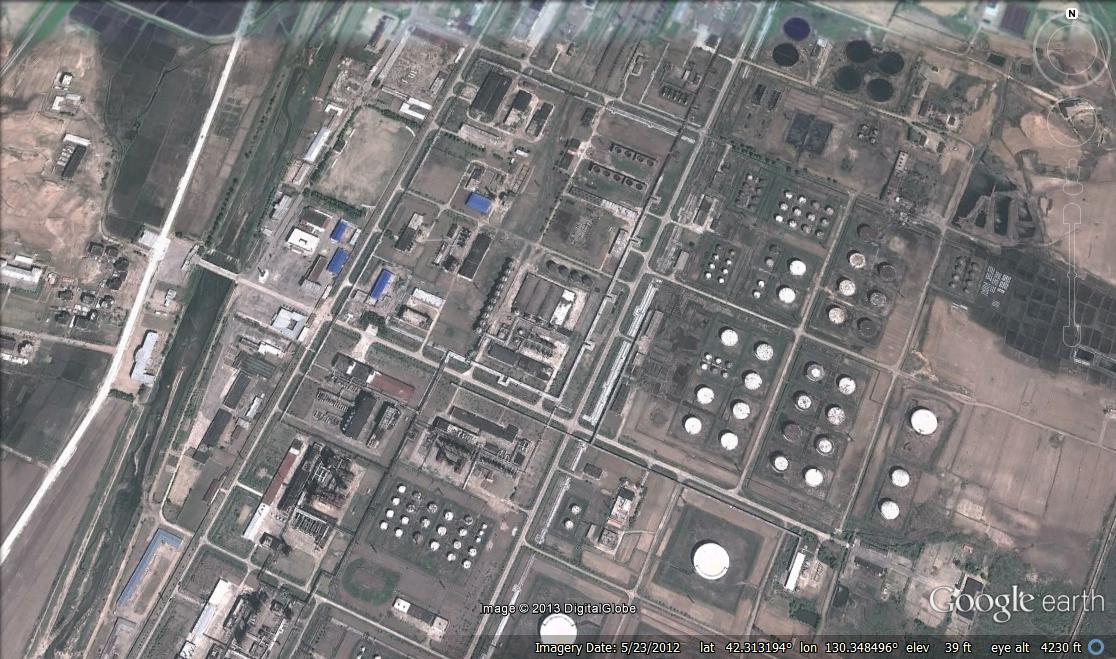
Pictured above (Google Earth): The Victory (Sungri) Refinery in Rason, North Korea.
UPDATE 2 (2016-3-25): NK News reports that HBOil refutes the claim in the Joong Ang Daily:
“HBOil JSC … hereby refutes the South Korean publication known as ‘KOREA JOONGANG DAILY’, for irresponsible reporting and dissemination of erroneous news on 23 March 2016; asserting that HBOil JSC has withdrawn from its joint venture in the Democratic People’s Republic of Korea,” the statement read.
HBOil also confirmed, “that it remains fully committed to its joint venture with Korea Oil Exploration Corporation (“KOEC”) of the DPRK, and continues its tenacious efforts to progress the joint venture’s ambition for exploration and development of hydrocarbon resources onshore North Korea.”
HBOil entered into a joint venture with North Korea in 2013 and has attempted to make inroads into North Korea’s undeveloped oil and gas sector.
The company has since invested in projects that could give it access to upstream oil and gas production and downstream refinery capacity in the coming years. However there has not been much reported movement on their North Korean project, and the outlook will not have been improved by a 70 percent drop in oil prices since last year.
While the statement affirmed HBOil’s belief that North Korea represents an “exceptional business opportunity” it also stated that the company are reviewing the implications of the recently adopted UN Security Council resolution against the country.
UPDATE 1 (2016-3-23): The Joong Ang Daily reports that HBoil is pulling out of North Korea:
A Mongolian oil company recently decided to withdraw from North Korea, a South Korean government source said, amid growing pressure from the international community after North Korea recently conducted nuclear tests and long-range missile launches.
HBOil JSC, an oil trading and refinery company based in Ulaanbaatar, Mongolia, acquired 20 percent of the North Korean entity Sungri refinery in June 2013, valued at roughly $10 million. In May 2014, the company opened a joint venture in Pyongyang.
The ex-communist country established bilateral ties with the North in 1948, but after this recent decision, the already impoverished North Korea will be further isolated from the international community.
“Mongolia is sending a message to North Korea: don’t fall down the wrong path,” said Nam Sung-wook, professor at Korea University’s Department of North Korean Studies.
North Korea formerly attracted foreign investment to resume operations of the Sungri refinery, which stopped running in 2009, in order to push for economic development. The deal with Mongolia, begun almost three years ago, was taken as evidence that North Korea wass seeking further investment partners-in addition to China.
However, the North Korean government continually delayed the inland oil development project, failing to provide reasonable explanations. Mongolia may therefore have concluded that there was no practical benefit to continuing the project.
Bilateral ties between the two countries recently turned bitter when Mongolian president Tsakhiagiin Elbegdorj said Mongolia could not endure the North’s tyranny forever, a remark made during his speech at Kim Il-sung University in Pyongyang at the end of October 2013.
“No tyranny lasts forever. It is the desire of the people to live free, that is the eternal power,” the president said in his speech. After his remarks, North Korean leader Kim Jong-un expressed disappointment and refused to hold meetings with the Mongolian president.
ORIGINAL POST (2013-6-13): Clarification: “HBOil has 20% of a state-dominated joint venture called Korean Oil Exploration Corp. International, and a formal commitment with Sungri has yet to be made. Another option is to invest in a refinery on the west coast of the DPRK.”
According to Bloomberg:
HBOil JSC, an oil trading and refining company based in Ulaanbaatar, Mongolia, said it acquired 20 percent of the state-run entity operating North Korea’s Sungri refinery, according to an e-mailed statement yesterday. It intends to supply crude to Sungri, which won’t be fully operational for up to a year, and export the refined products to Mongolia.
“Mongolia has had diplomatic relations with North Korea for many years,” Ulziisaikhan Khudree, HBOil’s chief executive officer, said in a June 12 interview in Ulaanbaatar. “There are certain risks, but other countries do business with North Korea so I am quite optimistic the project will be successful.”
The investment comes as ex-communist Mongolia seeks to power its mining-led boom while offering sanctions-hit North Korea a bridge to economic reforms. Since Swiss-educated Kim Jong Un took over the leadership of the totalitarian regime in December 2011, Mongolia has pledged to help its Soviet-era ally implement an economic transition similar to its own of the 1990s.
…
Under the transaction, worth as much as $10 million, the Mongolian Stock Exchange-listed HBOil would swap shares for full ownership of Ninox Hydrocarbons (L) Berhad, a private Malaysian company that owns 20 percent of KOEC International Inc., and issue convertible notes to fund investment at Sungri.
The rest of KOEC International is held by North Korea’s national oil company, Korea Oil Exploration Corp., which also has oil production and exploration rights in North Korea.
“This is a chance to take an equity holding in a foreign entity, and will allow us to import petroleum products, which could be lower than the current price,” said HBOil’s Khudree.
HBOil jumped by the daily limit of 15 percent to close at 253 tugrik (18 cents) on the Mongolian stock exchange today.
The deal will be the first purchase by a Mongolian-listed company of a foreign asset, according to Joseph Naemi, chief executive officer of the Ninox parent, Ninox Energy Ltd. The company is in compliance with international sanctions levied against North Korea, he said.
“If the sanctions change, and if they target the oil and gas industry, that would put us out of business, and we will have to comply,” Naemi said. “That is a risk one takes.”
Naemi said he had briefed his North Korean partners on the transaction and that “they are supportive.” No one was available to speak about the deal at North Korea’s embassy in Ulaanbaatar, which is in the middle of a renovation.
North Korea has three onshore oil basins with “proven working petroleum systems” and the country is conducting exploration for new fields, BDSec brokerage, Mongolia’s largest and the underwriter of the bonds HBOil plans to offer, said in a note to investors yesterday.
The Sungri refinery, located in the Special Economic Zone of Rason City in North Korea’s northeast, has a refining capacity of 2 million tons a year and is connected to the Russian railways system, HBOil said in its release.
Read the full story here:
Mongolia Taps North Korea Oil Potential to Ease Russian Grip
Bloomberg
Michael Kohn and Yuriy Humber
2013-6-18
According to Yonhap (via Global Post):
North Korea plans to import about 100,000 smartphones from China this year, a report said Tuesday.
China is planning to export a total of 500,000 mobile phones to the North and 100,000 of them will be smartphones, the Washington-based Radio Free Asia report said, referring to a Chinese government official’s posting on Weibo, a Chinese microblogging website.
Chinese smartphones sell for about 1,000 Chinese yuan (US$163.27) per unit in China, but the price tag comes to 2,800 yuan per unit in North Korea, the report said, adding profits from the price difference will go into the pocket of the North Korean regime.
Read the full story here:
N. Korea to import 100,000 smartphones from China this year
Yonhap (via Global Post)
2013-6-18
38 North has published new satellite imagery of Hwanggumphyong that shows new construction taking place on the island.
We can now identify the groundbreaking ceremony stone, management committee building, electricity infrastructure, and construction equipment.
Previous posts on Hwanggumphyong and Sinuiju SEZ here.
My article in the BBC is up. You can see it here.
Naenara offers news of a rare DPRK international public tender:
Invitation for International Public Tender
The Ministry of Land and Environment Protection of the Democratic People’s Republic of Korea plans to build a new road between Pyongyang and Phyongsong in order to facilitate public transportation in the western region of the country, including Pyongyang.
To this end, the ministry is going to purchase equipment and materials necessary for the project through international public tender. It also intends to employ international consultation services for technical assistance.
The international consultancy services will include road design, building operations and technical supervision (land fill, sand and gravel bedding, cement stability, paving, bridge construction, construction of small structures and protective guard and installation of road signs) and use of equipment and machines for road construction.
The equipment and materials to be purchased are as follows:
Hydraulic excavator, cement truck, self-propelled road liner, measuring equipment, bus, bulldozer, fuel truck, concrete cutter, geological testing equipment, cement, grader, trailer, voltage regulator, examination equipment, round steel, loader, sprinkler, water pumping equipment, drilling equipment, angle iron, Macadam roller, crane truck, dredger, printer, steel pipe, Dandem roller, stone crushing plant, horizontal vehicle for bridge construction, plotter, iron sheet, composite roller, mobile compressor, guniting machine, laptops, timber, tired roller, hammer drill, welder, laser surveyor’s rod (LEICA TCA 2003), asphalt, concrete paver (with the framed rails), rock-driller, electric generator, digital theodolite (SOKKIA DT 610S), fuel, concrete mixing station, asphaltic emulsion truck, pressure pump, automatic leveling instrument (SOKKIA C32II), aluminum sheet, asphalt mixing station, automatic truck, vibratory pile hammer, fork-lifter, luminous paper, mixture truck, asphalt paver, pressure pump, light reflection sign, and car.
Letters of tender invitation will be issued early in July 2013.
For more details, please contact:
International Implementing Office for Road Construction Project
Add: Pothonggang-dong No.1, Pothonggang District, Pyongyang, DPR Korea
Fax: 850-2-381-4416/4410
UPDATE 1 (2013-6-22): The Institute for Far Eastern Studies wrote about this tender:
North Korea to Acquire Road Equipment and Materials via International Auction
2013-6-22
North Korea has revealed plans to acquire equipment and materials for new road construction through an international auction.
In the May 29 economic news section of ‘Naenara,’ a website run by North Korea, it was reported that a new road is being built between Pyongyang and Pyungsung, South Pyongan Province. It announced that “with regards to the construction, the Ministry of Land and Environment Protection will purchase the necessary equipment and material through an internationally competitive auction.”
Naenara speculates that the ministry will purchase hydraulic excavators, buses, cement, and transformers, among fifty other items, with the auction invitation to be issued this July. Naenara also announced that the construction and technological management of the roads will receive voluntary international consulting.
It is uncommon for North Korean media to publicize plans for receiving goods via an international auction. Whereas North Korea has usually made direct contact with foreign companies based in China, it has recently diversified its reception of foreign capital.
As the international society’s trust in North Korea is low, North Korea is pursuing changes in its methods of acquiring capital through avenues like international auctions. This can be interpreted as an intentional effort to show that North Korean liberalization and development policies are following international norms. Furthermore, in addition to adopting the law on economic development zones, North Korea is starting to focus more on developing a ‘special zone’, with construction of the ‘Sinuiju Special Zone’ scheduled to start soon.
At first, the ‘Sinuiju Special Zone’ was intended to develop by sections, receiving capital from not only Chinese companies but also Korean companies. However, due to faltering relations between the North and South, China has emerged as the sole partner of North Korea to co-develop the special zone.
Also, following the 12.1 Policy from last year, an umbrella organization will be set up to comprehensively manage the economic development zones pursued by the thirteen cities and provinces, and the two hundred twenty districts. While the North Korean Joint Venture Committee (Chaired by Lee Kwang-keun) was in charge of securing foreign investments for the development of the special zones, the new organization will manage not only all the specialized zones but also all the development zones.
Furthermore, there are plans to link Sinuiju, Pyongyang, and Kaesong via highway and high speed rail, an investment which is expected to cost 14.1 trillion KRW. The highway is expected to cost 4.7 trillion won and the high speed rail carries an anticipated price tag of 9.4 trillion won. In order to secure funding, North Korea plans to sell underground resources and secure sources of private investment. In terms of financing procurement methods, North Korea is considering BOT (build-own-transfer), BTL (build-transfer-lease), resources development rights as collateral, etc.
The English language PDF is here.
Translation courtesy of Lee Kyungmin, currently working at Hanns-Seidel-Foundation Korea.
UPDATE 4 (2014-10-2): North Korea reveals Wonsan-Mt. Kumgang International Tourism Zone development blueprints (IFES):
North Korea recently released blueprints for a new tourism zone in the Kangwon area, which is designated as the location for the national goal of developing a global tourist attraction. This area has been officially named as the “Wonsan-Mt. Kumgang International Tourism Zone.” The Wonsan District Development Company, an affiliate of North Korea’s Ministry of External Economic Affairs, introduced large-scale development plans for the Wonsan-Tongchon-Mt. Kumgang “tourism belt” to a crowd of over 200 members of the World Federation of Overseas Korean Traders Association (World-OKTA) at an investment forum held in Dalian, China on September 20, 2014.
At the investment forum, North Korean representatives emphasized that the focus city of this project, Wonsan (population 360,000), is merely 1 to 2 hours away from neighbors China and Japan, and is within a three-hour plane ride from over 40 other cities each with populations of over 1 million. The nation anticipates that, provided tourism infrastructure developments are completed according to plan, the Wonsan-Mt. Kumgang International Tourism Zone could potentially attract up to 1 million visitors annually.
North Korea marked the fourth quarter of 2013 with the opening of the Masikryong Ski Resort and the remodeling of the Songdowon International Children’s Union Camp as iconic projects leading the development of the Wonsan-Mt. Kumgang area. Representatives were quoted as saying, “The Masikryong Ski Resort enjoyed incredible popularity during its opening season last winter, attracting more tourists than hotel facilities could accommodate. . . . The Masikryong Ski Resort has become a huge asset to our nation’s tourism industry, capable of entertaining tourists even during the winter off-season.” Increasing hotel and lodging facilities were emphasized as the next most urgent task.
The Masikryong Ski Resort, located 25 kilometers from the city of Wonsan, was introduced as a resort capable of competing in the international market with its 49.6 kilometers of slopes, outdoor ice rink and swimming pools, and hotel accommodations for up to 360 guests. In addition to accommodation facilities for 12,000 people in Wonsan, 7,000 in Tongchon, and 14,000 people in the Mt. Kumgang area, North Korea also revealed plans for new and additional construction of infrastructure facilities in the Wonsan area—including airports, ports, railroads, roads and electricity—and for expansion of recreational facilities such as golf courses and casinos.
More specifically, construction is planned for a large-scale airport in the Kalma (Galma) Peninsula area of Wonsan which will be able to accommodate thousands of passengers per day [Learn more here and here]. Once completed, foreign tourists will be able to visit the Wonsan-Mt. Kumgang zone directly, with no need to pass through Pyongyang. While the most important project is to repair and expand the roadways connecting inner Wonsan with the Masikryong Ski Resort, Ullim Waterfall, Sokwangsa and Mt. Kumgang areas, North Korea also plans to construct or remodel service facilities within inner Wonsan such as hotels, exhibition centers, athletic facilities, and other business and commerce services necessary to satisfying the needs of tourists.
Overseas investors’ requests to visit the Wonsan-Mt. Kumgang International Tourism Zone for inspection and consulting can be processed within ten days, and North Korea is planning to invite potential investors to an on-site investment briefing to be held in April 2015.
UPDATE 3 (2014-7-29): According to the Pyongyang Times:
Thongchon to be developed as tourist zone
A project is to be launched to develop an international tourist zone in Thongchon County, Kangwon Province, which has lots of tourist resources.
The project is part of the development plan for the Wonsan-Mt. Kumgang International Tourist Zone, according to a decree released on June 11 by the Presidium of the Supreme People’s Assembly.
Thongchon County is situated 52 km south of Wonsan, the capital city of Kangwon Province.
The county boasts Chongsokjong—a group of basaltic stone columns which is known as one of the eight scenic beauties in the northeastern part of Korea, four picturesque lakesides, six sand beaches, nine scenic sites and a treatment mud resource of over 3 280 000 cubic metres.
The tourist zone area covers well over 9 000 hectares.
Tourist facilities for sea bathing and boating will be added to Chongsokjong so that visitors could enjoy sightseeing day and night.
Accommodation facilities with a capacity of over 5 600 people are to be built in the area of Lake Tongjong while the Lake Sijung area will turn into a health and treatment hub with an accommodation capacity of over 1 000 people and a sanatorium equipped with health and fitness facilities.
Detailed plans are being mapped up.
UPDATE 2 (2014-6-12): KCNA has formally announced the Wonsan-Mt. Kumgang International Tourist Zone:
Pyongyang, June 12 (KCNA) — The world-class Masikryong Ski Resort and Songdowon International Children’s Camp were successfully built and areas of Wonsan, Ullim Falls, Sokwang Temple and Thongchon are being peculiarly spruced up as cultural recreation grounds for people in Wonsan-Mt. Kumgang area under the wise guidance of the Workers’ Party of Korea. Koreans and world people are showing ever-growing expectation and interest in world famous Mt. Kumgang and other scenic spots.
The DPRK decided to set up Wonsan-Mt. Kumgang International Tourist Zone in Wonsan-Mt. Kumgang area in Kangwon Province to reenergize the international tour of scenic spots in the area of Wonsan and scenic spots on the east coast now in the process of turning into world famous tourist destinations.
The international tourist zone includes areas of Wonsan, Masikryong Ski Resort, Ullim Falls, Sokwang Temple, Thongchon and Mt. Kumgang.
The Wonsan area comprises some parts of Wonsan City and Anbyon County, the ski resort area includes some parts of Wonsan City and Popdong County, the area of Ullim Falls comprises some parts of Munchon City and Chonnae County, the area of Sokwang Temple includes some parts of Kosan County, the Thongchon area comprises some parts of Thongchon County and the area of Mt. Kumgang includes the international tourist special zone and some parts of Kosong County and Kumgang County.
The DPRK law on Mt. Kumgang International Tourist Special Zone, the law on economic development zone and the laws related to foreign investment are applied to the relevant areas and objects in the Wonsan-Mt. Kumgang International Tourist Zone.
The DPRK decided to increase new tourist destinations, depending on the progress made in the development of the Wonsan-Mt. Kumgang International Tourist Zone and tour.
The Presidium of the DPRK Supreme People’s Assembly promulgated a relevant decree on June 11.
UPDATE 1 (2013-6-27): The JoongAng Ilbo claims to have a North Korean document called “General blueprint for the Wonsan District”. This document has not been made public, so I cannot vouch for its authenticity or content. However, as reported in the paper, the contents seem fairly congruent with established facts.
According to the article:
According to a document entitled “General blueprint for the Wonsan District” obtained exclusively by the JoongAng Ilbo on Tuesday, North Korea is in the process of constructing three special districts in Wonsan: a financial district, an entertainment and sports area and a tourist destination.
The report says Kim is planning to develop Songdowon Beach in Wonsan into a holiday destination for summers and a ski resort on Mount Masik for winters. Mount Masik is about 20 kilometers (12.4 miles) from Wonsan.
…
Sources in Seoul say the plan to develop the eastern naval city was actually his father’s.
In fact, in the transcript of the 2007 inter-Korean summit that was declassified Monday, Kim told former South Korean President Roh Moo-hyun that “Wonsan is a holiday destination,” rejecting Roh’s proposal to develop the city into an industrial park like the Kaesong Industrial Complex.
“Wonsan is a bay,” Kim said. “Waste comes into the bay and it can’t be properly managed because of Masik Mountain behind the city. So we will shut down all of the factories and shipyards in Wonsan right away.”
Sources said Jong-un might have decided to turn the city into a tourist resort based on the Kumgang resort, which was jointly run with the South but has been closed since July 2008.
“In Wonsan, there are a series of heavy industry factories, such as automobile plants and shipyards,” a source said. “But North Korea has a plan to close the aging factories and turn the city into a resort.”
Sources told the JoongAng Ilbo in March that North Korea appeared to have moved their MiG jet fighters from an airfield in Wonsan to a frontline unit in Kuup. They also reportedly shut down some factories in the city.
Still, the plan obtained by the JoongAng Ilbo didn’t elaborate on the length of construction or the cost.
“North Korea is hoping to lure investment of more than $1 million from a company in Singapore [for the project],” the source said. “Completion of the project relies on whether they attract foreign investment.”
North Korea has already started construction at Mount Masik, starting with a ski slope, three lifts, an office for ski rentals and a hotel. In phase two, it will build a larger slope, a gas station and a golf course.
ORIGINAL POST (2012-2-24): North Korea planning special economic zone in Wonsan and Mt. Kumgang regions
Institute for Far Eastern Studies (IFES)
North Korea announced plans to develop a special tourism zone in the Mount Kumgang region and recently established detailed plans to connect five countries in the Northeast Asian region by land, sea and air routes. In particular, it specified construction plans for the Tongchon Special Economic Zone (SEZ) in Tongchon County of Kangwon (Gangwon) Province.
Currently, there are four SEZs in North Korea: Rajin-Sonbong (Rason) SEZ, Hwanggumpyong SEZ, the Kaesong Industrial Complex, and Mt. Kumgang Tourism Zone. Tongchon will be a special case where a free economic trade zone will be located within the Mt. Kumgang Tourism Zone linking the areas of Wonsan and Mt. Kumgang.
Growing attention is being paid to the “Tongchon Special Economic Zone in the Mt. Kumgang Tourism Zone.” Industrial service facilities will be built in the Tongchon SEZ along the coastline including, “comprehensive industrial, merchandise, and communication service center zone,” “international multipurpose building zone,” “international finance, trade, and business center,” and a golf course.
Construction inland is currently underway for regular and high-tech industrial complexes in the following areas: IT, LCD, and electronics; home electronics; automobile; new energy and environmental protection; and biomedical and breeding.
Tongchon Port is equipped to accommodate 100,000-ton vessels and there are plans of constructing beaches, a marine park, hot springs, and luxury hotels, and vacation homes in the vicinity.
According to a five-page blueprint for the “Choson Wonsan-Mt. Kumgang Development Plan” (in Chinese), North Korea has set 10 million tourists per year as its goal and is preparing to attract large investment of over 10 billion USD over the next ten years.
Although it is unclear who has prepared the blueprint, it is most likely that North Korea has prepared the plan in Chinese to promote the SEZ internationally. North Korea recently distributed briefing materials in Chinese at the 7th China Jilin-Northeast Asia Investment and Trade Expo (JNIT), which was held last September.
The report included plans of constructing Wonsan International Airport at an estimated cost of 150 million USD.
The ten-year development plan is further divided into three periods: October 2011 to December 2013 (short-term); 2014 to 2016 (mid-term); and 2017 to 2020 (long-term).
In addition, the report included the detailed plans of road and facility renovations. The Pyongyang-Wonsan-Mt. Kumgang highway that stretches 310 km will be renovated with investments worth around 150 million USD. A four-lane highway will also be added. The seaside areas of Wonsan and Mt. Kumgang and the tourism zone will be reconstructed with major facilities and electricity worth 10 billion USD and a new town is also being designed to accommodate a population between 800,000 and 1 million people.
The report “Establishment of International Travel between Mt. Kumgang and Five Countries in Northeast Asia” included details of 18 air routes from Beijing, Changchun, and Shenyang to Wonsan International Airport; 8 sea routes to Nampo Port and the routes from South Korea, Japan, Russia, and the Northern Pacific rim using the port in Mt. Kumgang. In addition, a land route connecting Dandong of China to Mt. Kumgang is also included in the plan, via Shinuiju.
It is designed to develop Mt. Kumgang into an international tourism zone making it accessible by land, sea, and air transportation to South Korea, China, Russia, and Japan.
Specifically, Niigata Port of Japan, Vladivostok Port of Russia, and Jeju, Busan, and Sokcho Ports of South Korea were mentioned as the major ports for the sea travel to North Korea.
Travelers from China will be connected to Mt. Kumgang by rail (from Wonsan to Mt. Kumgang) and by sea (from Rajin-Sonbong Port to Mt. Kumgang Port).
Interestingly, no land route was designated for travel from South Korea. The previously used Donghae Line to travel from Kosung to Mt. Kumgang by road and railroad was omitted from the plan.
Additional information:
1. Check out previous posts on the DPRK’s “Law on Economic Development Zones“.
2. You can read about the DPRK’s plans for a new Wonsan International Airport in this article and in this article with James Pearson.
Read the full story here:
North is building ski, beach resorts in Wonsan
JoongAng Daily
2013-6-27
According to Agence France-Presse:
The UN food body on Saturday said it had approved $200 million of food aid for North Korea, targeting the country’s most vulnerable people who remain dependent on external assistance.
The World Food Programme (WFP) executive board has this week approved a new two-year operation for North Korea starting on July 1, WFP spokesman Marcus Prior said.
“It will target about 2.4 million people – almost all children, and pregnant and nursing women – with about 207,000 [206,800] metric tons of food assistance at a cost of US$200 million,” he said in an email to AFP.
The WFP will continue to focus on the nutritional needs of young children and their mothers through food which will be manufactured in the North using ingredients imported by the food body, he said.
“WFP remains very concerned about the long-term intellectual and physical development of young children in particular who are malnourished due to a diet lacking in key proteins, fats and micronutrients,” added Prior.
In March, UN resident coordinator in North Korea Desiree Jongsma said timely imports from the WFP had contributed to avoiding a crisis this year but two thirds of the nation’s 24 million population were still chronically food insecure.
Nearly 28 percent of children under five in the North suffer from chronic malnutrition and four percent are acutely malnourished, according to a UN national nutrition survey last year.
Overall production for the main 2012 harvest and early season crops this year was expected to reach 5.8 million tonnes, up 10 percent on 2011-2012, UN agencies said in November.
But the poverty-stricken country is still struggling to eradicate malnutrition and provide its people with vital protein, the UN’s Food and Agriculture Organization and WFP said.
North Korea suffered regular chronic food shortages under the Kim dynasty, with the situation exacerbated by floods, droughts and mismanagement. During a famine in the mid to late-1990s, hundreds of thousands died.
International food aid, especially that from South Korea and the United States, has been drastically cut over the past several years amid tensions over the communist state’s nuclear and missile programmes.
The US last provided food aid to North Korea from late 2008 to March 2009. Some 170,000 tonnes out of an expected 500,000 tonnes was delivered, until Pyongyang expelled US workers monitoring the distribution.
Here is the official announcement.
Quarterly bulletin for WFP’s operation Nutrition Support to Women and Children in DPR Korea (Q1, 2013)
DPRK National Nutrition Survey (October 2012)
Read the full story here:
UN food body approves $200 mn food aid to N. Korea
Agence France-Presse
2013-6-8
