Archive for the ‘Transportation’ Category

Rain Death Toll in North Totals 900

Monday, August 28th, 2006

From the Korea Times:
Park Song-wu

The National Intelligence Service (NIS) said in a report to the National Assembly on Monday that the death toll from heavy rain and flooding in North Korea totaled around 900.

In addition the flooding destroyed 40,000 homes and left 24,000 families homeless, a lawmaker quoted the report as saying.

The report also noted that 105 kilometers of railways and 378 kilometers of roads were either inundated or washed away.

NGOs in Seoul have argued that the floods killed around 10,000 North Koreans.

Share

DPRK tightening up Chinese border or vice versa?

Monday, August 21st, 2006

From the Joon Ang Daily:

Ties sour at North’s China border

Signs of discontent between those two closest of allies, China and North Korea, have begun to appear. Last month, despite Chinese urging, North Korea fired off a test salvo of seven missiles. Although the tests were generally considered to be a bid for international attention, they provided Japan with more domestic ammunition to change its constitutional bar on warfare as an instrument of national policy, a development China does not see as in its interests.

Some suggestions of those cooling ties can be seen in this Chinese border city. Recently, about 40 North Korean women were waiting in front of the customs office in preparation for returning to North Korea. One of the women said Chinese authorities had order the women, who had worked at a stuffed-toy factory, out of the country.

“We received a three-year approval originally to work there, but after less than a year we are going back,” the woman said. Customs officials said the women were working illegally, but other people here were skeptical. One noted that many Russians have no problems because of a lack of work papers. “When relations between China and North Korea were good, there were no problems,” one said. “These incidents are in line with the cooling ties in light of the North Korean missile launch.”

In all, about 300 North Koreans have been told to leave Dandung for their homeland. The head of a trading company here, who has been dealing with North Korea for 10 years, said another 300 North Koreans will be sent home from Dandung within a month.

A source in Beijing said the Labor Ministry headquarters told its subordinate offices earlier this month not to issue work permits to North Koreans who carry passports and visas issued to government officials. “In the past, these people were allowed to work, and given the fact that they already have a visa, this measure is probably a retaliatory move by Beijing,” this source said.

A South Korean trader with ties to the North and China said that custom checks at the border have been increased, resulting in longer delays in shipping goods. The Dandung Customs Office said concerns about drug trafficking was the reason for stepped-up measures, an explanation that some residents here say has no precedent.  

From the Daily NK:
8/17/2006

National Defense Commission’s Inspection Task Force Dispatched to Sino-Korean Border
By Kim Young Jin, Yanji of China
 
An inspection task force under the National Defense Commission (NDC) is deployed on the Sino-Korean border in order to review border security and to check defection from North Korea to China.

Kim Choon Il (a false name), a 36-year-old defector living in South Korea since 2003, said on Wednesday that in a telephone conversation with his family in North Korea on Tuesday, he was told that NDC’s inspection team came to the border area since the end of last July and inspection became much tighter.

Kim also said that the inspection task force, cooperating with local Workers’ Party office, National Security Agency, and police, blocked the Sino-Korean border.

This inspection task force is under the control of the highest state organ NDC, which surpasses the power of other previous inspection squads organized under the lesser authority.

Since the task force is directly responsible to Kim Jong Il, it is expected that the task force is granted some specific inspection guideline.

The NDC inspection squad was deployed after the UN resolution on North Korean missile crisis was passed. Also it was immediately after a flood killed thousands and created hundreds of thousands victims who lost their homes.

Dispatch of the inspection team is a measure against infiltration of outside ideology and culture and also to prevent massive defection due to recent internal and external crises.

North Korean authority sent a party inspection team to the border area in 1992 after China and South Korea normalized diplomatic relationship. Also, as the number of defectors increased since then, another inspection team under the combined control of five departments (army, security agency, prosecutor’s office, police and party) was sent.

NDC’s dispatch of an inspection task force represents the highest authority’s distrust of previous inspection teams’ activities. It’s been pointed out that due to corruption and bribery previous inspection squads were unable to root out crimes.

According to inside sources, NDC inspection task force’s primary mission is to thwart defection, leak of documents, infiltration of outsiders, guns trafficking and any other anti-socialist activities. It is confirmed that in Sino-Korean border area not only drug and counterfeit dollar bills but also guns and ammunition are smuggled.

The informant also reported that it is ordered illegal defectors and their families to be deported, and infiltrators from outside and missionaries to be executed publicly.

According to Han, a defector living in Inchon, South Korea, who is aiding North Korean refugee in China, among those who suffered flood, an increased number of them wants to escape to China or South Korea.

Share

Air Koryou crash in August 2005!

Wednesday, August 16th, 2006

From the British Government:

A TU-154 operated by Air Koryo from Beijing to Pyongyang crash landed at Pyongyang airport on 15 August 2006.

Share

DPRK tightening domestic travel

Thursday, August 3rd, 2006

From the Daily NK:

“Regulation of People Due to Concern over Flooding”
Newspapers will not report the real conditions 

The North Korea support organization ‘Good Friends’ alleged that the aftereffects of the recent flood in North Korea seem more severe than the flood of the late 1990’s. However, North Korean authorities are attempting to regulate people so that the truth does not become public.

Good Friends recently reported that “Each town and province in North Korea is taking measures not to authorize travel certificates until further directions are given.”

The restrictions have not only suspended railway operations, but have affected flood victims as well. During the period of unrest due to the current quasi-war, these restrictions have been enacted in order to prohibit flood victims from spreading the news of damage as they go from place to place looking for food.

In addition, military bases in Yangduk, Maengsan, Shinyang, Yoduk and Gumkang were most severely affected. However, as the country remains in a state of tension, newspapers have not been reporting details of the damage, in an attempt to lessen feelings of anxiousness.

The newsletter also reported that North Korea does not seem to be taking any countermeasures against the flooding.

Following the flood in late July, many elderly citizens and children in areas of North Korea such as Kowon, Dancheon, and Wonsan have contracted diseases and more are dying everyday. As there is no medical support or preventative measures against such epidemics, the number of deaths continues to rise.

Moreover, as the North Korean regime has been thrust into a “situation of quasi-war”, it has neglected to support those in need.

Although action has been taken to begin reconstruction, there is little machinery and equipment, so people have resorted to manually rebuilding. In addition, as roads and railroads are disconnected it is difficult for emergency equipment to be delivered to disaster areas. Currency is also not circulating easily, and it is predicted that the cost of market supplies and the price of food will rise.

Good Friends reported that approximately 130,000~150,000 people have suffered damages due to the flood, and that at present, 4,000 people have been reported missing. The number of deaths and missing persons totals more than 10,000.

Share

DPRK, China agree on border river management

Tuesday, July 25th, 2006

From Xinhua via NKZone:

China and North Korea have signed an agreement to facilitate transportation through and environmental protection of a border river.

According to the agreement inked last Friday in Changchun, capital of northern China’s Jilin Province which neighbors North Korea, the two sides will cooperate on the management of navigation buoys and the dredging of part of the Yalu River.

During a nine-day meeting, traffic officials from both sides also discussed measures to prevent environmental damage caused by the dredging works.

The two sides also agreed to tighten management of cargo ships plying the river, according to sources who attended the meeting.

Share

Underground backup command center under Taesong

Friday, July 21st, 2006

Chosun
7/21/2006 (not sure of year)

Mammoth Underground Square and Road in Pyongyang

The Pyongyang subway has two generally-unknown facilities: a mammoth “underground square” in preparation against war, and an “underground road” between the subway stations, linking the Mount Kumsu Memorial Palace and the Sunan Airport in the suburbs of Pyongyang.

The underground square, built as a bunker command post for the Supreme Command of the People’s Armed Forces and a space for storing manpower and equipment during a war, is located in Anhak-dong, near the Nakwon Subway Station, famous for the Central Zoo at the foot of Mount Taesong. The square is said to be comparable in area to the Kim Il Sung Square, which can accommodate a rally of over 100,000 people.

The underground square is learned to have been constructed by the General Military Engineer Corps of the People’s Armed Forces in the 1970s when the second phase of the Pyongyang subway was built, linking the five stations of Hyoksin, Chonsung, Samhung, Kwangmyong and Nakwon. The command post in the underground square is said to be replete with state-of-the-art communications equipment and billeting facilities, and a host of 10-ton trucks including Soviet-made Zils and Japanese Isizus are kept in the square to transport troops and arms to be shipped by the subway under an emergency.

The underground road between subway stations connects the late national founder and president Kim Il Sung’s palace and the current Mount Kumsu Memorial Palace, with the Sunan Airport. It was said to have been built in case Kim Il Sung had to be evacuated by plane. The Mount Kumsu Memorial Palace is connected to the Kwangmyong Subway Station. The underground road is said to have been maintained even after the death of president Kim Il Sung in 1994 under the judgment that it can be of use in the event the North Korean military leadership, headed by Kim Jong Il, should need to move to Sunan Airport from the underground square in the case of a war.

Share

Missle test does not stop last shipment of ROK aid

Thursday, July 6th, 2006

from the Joong Ang Daily:

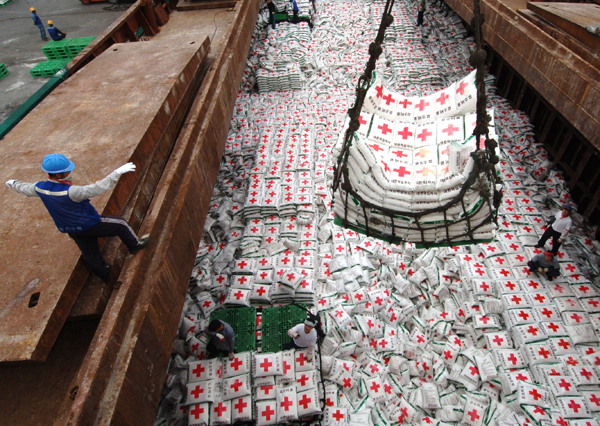
fertilizer aidSouth Korean workers loading fertilizer sacks yesterday at a dock in Ulsan. The ship and another ship from Yeosu, South Jeolla province, will head today to Haeju Port and Nampo Port to transport the last 20,000 tons of 200,000 tons of fertilizers South Korea promised to send to North Korea. Despite North Korea’s missile tests, the South Korean government decided to send the last fertilizers as a humanitrian aid.

Share

Can I have the train also?

Wednesday, July 5th, 2006

This is weird.  (Hat tip to Lost Nomad)

China sends the DPRK food aid via train.  The DPRK keeps the train and sends the crew back across the border  sans-train.

[F]ood and fuel supplies sent to North Korea have been halted, not to force North Korea to stop missile tests or participate in peace talks, but to return the Chinese trains the aid was carried in on. In the last few weeks, the North Koreans have just kept the trains, sending the Chinese crews back across the border. North Korea just ignores Chinese demands that the trains be returned, and insists that the trains are part of the aid program. It’s no secret that North Korean railroad stock is falling apart, after decades of poor maintenance and not much new equipment. Stealing Chinese trains is a typical North Korean solution to the problem. If the North Koreans appear to make no sense, that’s because they don’t. Put simply, when their unworkable economic policies don’t work, the North Koreans just conjure up new, and equally unworkable, plans. The Chinese have tried to talk the North Koreans out of these pointless fantasies, and for their trouble they have their trains stolen. How do you negotiate under these conditions? No one knows. The South Koreans believe that if they just keep the North Korean leaders from doing anything too destructive (especially to South Korea), eventually the tragicomic house of cards up north will just collapse. Not much of a plan, but so far, no one’s come up with anything better.

Share

Kim Jong Il Gives On-Site Guidance to New Pyongyang Taesong Tyre Factory

Tuesday, July 4th, 2006

KCNA
7/4/2006

General Secretary Kim Jong Il gave on-site guidance to the newly built Pyongyang Taesong Tyre Factory. The factory has a total floor space of more than 2,000 square meters and all its production processes are automated.

After being briefed on the factory in front of a huge painting showing a panoramic view of the factory, he went round various production processes to learn in detail about its construction and production there.

Watching tyres being manufactured through streamlined production processes and automated workshops, he expressed satisfaction over the successful construction of the factory. It is a great achievement that constructors have built the factory meeting the need of the new century in a short span of time, he said.

A rapid increase in the number of vehicles requires the increased production of different kinds of tyres, he said, underscoring the need to boost the production of tyres of diverse sizes.

Noting that an effective use of the existing production capacity would make it possible to increase the manufacture of tyres, he called on the factory to wage a vigorous drive to operate in full capacity so as to keep the production going at a high rate and, at the same time, raise the quality of products, while paying attention to the maintenance of equipment and technical management.

Praising the workers of the factory for keeping its inside and outside neat and tidy, he said that the working class in the DPRK should take the lead also in introducing the culture created by soldiers in the Songun era.

Share

Politics, blood ties trump trump profits in north

Thursday, June 22nd, 2006

Joong Ang Daily
6/22/2006

In the ground floor ballroom of the Yanggakdo Hotel annex in Pyongyang, the North Korean Chamber of Commerce hosted a trade information and investors’ relations conference on May 16. Senior North Korean trade ministry officials gave presentations on North Korea’s economic policy and investment climate. Rim Tae-dok, chief counselor of the trade ministry, said Pyongyang protected property rights of foreign investors and guaranteed the independence of their management. The North Korean official stressed that foreign investors would enjoy tax benefits and that the legal process of establishing companies in the North has been largely simplified.

Another senior North Korean official, Kim Ha-dong, also gave a presentation about Pyongyang’s export policy. Mr. Kim, a senior researcher at the trade ministry, said the communist country had been issuing permits for exports and imports after only a short review process. He encouraged investors to participate in trade.

The North Korean presentations were not very different from those given in any capitalist country, but the concept of “self-reliance” was prominent.

“We will build a self-reliant economy of Koreans and carry out trade on top of that,” Mr. Kim said. He added that North Korea’s self-reliance must not be damaged or controlled by foreign economies through trade.

During the JoongAng Ilbo’s 10-day survey of the reclusive communist country’s economic sites, Pyongyang’s dilemma ― self-reliant socialism versus economic development by attracting foreign investments ― was apparent. Some North Korean officials showed skepticism about China’s model of partially opening its economy, claiming that their country had to be run in a different manner.

“I have toured special economic zones in China several times,” said Ju Tong-chan, the North’s chairman of the National Economic Cooperation Committee. “But we have different ways of managing our economy than China, and I believe we should run our special economic zones in different ways. We are still researching our options, but we will not do it that [Chinese] way.”

China was able to expand its economy at high speed after the central government opened up the economy. It gave local governments enough independence to run business autonomously in their areas and attract foreign investment. But Mr. Ju was obviously unconvinced by the success of China’s model. The opening of the economy could boomerang, becoming a threat to the North’s system, he worried.

On factories and farms, North Koreans were still caught up – or at least gave the outward appearance of being caught up ― in a personality cult centered on the nation’s founding family. At cooperative farms and factories, the senior managers’ introductory briefings were always about the lessons taught by Kim Il Sung, North Korea’s first president, and Kim Jong-il, who succeeded him but did not assume the title of national president. These managers’ presentations began with the number of visits by the Kims to the site. There were always paeans to the communist regime’s “military first” policy and slogans to that effect were emblazoned everywhere, making it clear that the military and politics take priority over the economy.

North Korean officials were also reluctant to lay out all pertinent information to investors and journalists.

Kim Yong-il, 45, the manager of the port at Nampo on the country’s west coast, refused to cite specific numbers about the port’s freight-handling capacity. He said only that it could deal with “large amounts” of cargo.

Mr. Rim, the trade ministry chief counselor, said North Korean politics were extremely stable, which guaranteed the security of foreign investments. He gave no data or examples to support that claim of stability, however, and completely ignored the question of North Korea’s nuclear programs and how they might or might not affect stability.

Reacting to the journalists’ remarks that South Korean firms were reluctant to invest in the North because it has been difficult to make profits there, Mr. Ju, the chairman of the National Economic Cooperation Committee, said, “Why is money the priority? Inter-Korean business must be about something more than just monetary calculations.”

He was also visibly upset about Seoul’s policy on economic cooperation. “We made extremely sensitive military restricted areas at Mount Kumgang and Kaesong available to the South,” Mr. Ju said. “But the South has just given us a lot of excuses and failed to cooperate.”

He continued, “To nurture the Kaesong Industrial Complex into a world-class production facility, electronic and advanced technology industries are crucial. But labor-intensive industries are the majority in Kaesong. In this information era of the 21st century, the South has failed to bring in computers for administrative use in Kaesong.”

He also vented some spleen about the United States, asking the journalists why Seoul was so careful not to irritate Washington. He cited the U.S. restrictions on the re-export without prior approval of so-called “dual-use” goods, those with civilian and military applications, to countries it has blacklisted, including North Korea. Other international accords, such as the Wassenaar Agreement, also prevent South Korea from providing the North merchandise and commodities that have “strategic” applications.

But Mr. Ju sounded firm about continuing operations at Kaesong. “It is the nucleus of inter-Korean economic cooperation, and we must make it a success first. Then we can move on to other projects.”

He also dismissed the U.S. concerns that workers in Kaesong were laboring under harsh working conditions, but seemed to sidestep the basic question. “It is a matter that we should deal with,” Mr. Ju said. “Since we manage businesses differently, we are trying to come up with the best resolution to make direct [wage] payments to the workers.”

South Korean economists and businessmen who listened to similar presentations and looked at some of the North’s accounts were troubled by Pyongyang’s rigidity in opening up the economy. That, they said, coupled with the simmering nuclear weapons problem, is the most serious obstacle to attracting foreign investments. Unless U.S. diplomatic ties with North Korea are established, investing in facilities in North Korea and selling “made in North Korea” products on global markets would be difficult and risky, they agreed.

“If a foreign investor wants to visit a factory in the North that he has put money into, he has to obtain an invitation every time, and his schedule and movements in the North are strictly controlled,” said Kwon Yeong-wuk, the trade promotion director at the Korea International Trade Association of Seoul. “Under such circumstances, the North should not expect much in the way of foreign investments.” He said Pyongyang had a “my way or the highway” approach to the economy: If you’re here, follow our rules. The rigidity, he reiterated, is a serious obstacle to investors.

Other experts and businessmen in South Korea said Pyongyang’s attitude toward inter-Korean business in particular makes it hard to earn profit. They complain about the stress North Korean officials put on the concept that business between the two Koreas should be based on the maxim “blood is thicker than water” and not on market principles. An official at North Korea’s National Reconciliation Council argued that South Korean conglomerates should make large investments there based on that concept.

A South Korean businessman who has been looking for business opportunities in the North said he has run into a series of dead ends. “South Korean firms are doing businesses in the global market,” he said. “The largest market is the United States, and not many people would want to give that up to do business with the North.” He added that North Korea’s cheap but skilled manpower is an attractive point, but that poor infrastructure, extremely low purchasing power and the difficulty of obtaining raw materials make China and Vietnam much more attractive investment locales. Kim Yeon-chul, an academic at Korea University in Seoul, agreed with that assessment. “Large companies in South Korea have already automated their production facilities, so labor costs are not important in deciding on investments,” he said. “North Korea must improve other conditions instead of stressing the merits of its manpower or blaming outside causes.”

Share
