Archive for the ‘Transportation’ Category

Luxuries for North’s elite keep on flowing

Monday, December 18th, 2006

Joong Ang Daily
12/19/2006

Despite United Nations sanctions aimed at preventing the North Korean government from buying luxury goods for its ruling class, government sources here said a North Korean trading company is still busy providing Kim Jong-il loyalists with their perquisites.

Tian Ming Trading Company, in the center of this former Portuguese enclave now with the same China-affiliated status as Hong Kong, says its main business line is carpets, and little more. Three office workers said there were no North Koreans at the company and that it has never traded with North Korea. The company’s president was out of town on business, they said.

But a source with close ties to the trading economy here said that Park Su-dok, a 53-year-old North Korean, is in Macao and obtained a visa as an employee of the company.

Another source said, “Tian Ming is a joint venture by North Korean and Hong Kong investors, and its main business is buying luxury goods from Hong Kong for shipment to North Korea.” He added that Tian Ming’s president, a Hong Kong resident, is buying luxury watches, gold products and expensive liquor at North Korea’s request, using a Hong Kong branch office for the purpose.

Other Macao government officials said 18 North Korean firms were registered in Macao as of late November, and 115 North Koreans carry Macao visas as employees. Twenty have become Macao citizens, they added.

Since Washington threatened to impose sanctions on Banco Delta Asia here, allegedly for helping North Korea launder cash from its alleged dubious business lines, some of those companies have shut down. Ten are still in limited operation, however, these government sources said.

Separately, a South Korean banker in Hong Kong told the Joong-Ang Ilbo that a North Korean businessman had visited him in an attempt to sell gold bars through one of the South Korean bank branches in Hong Kong.

The banker reportedly spurned the overture, although the transaction would not have violated any South Korean laws or regulations on North-South dealings. He said he simply did not want to get involved in such a deal given the international attention being paid to commercial dealings with North Korea. The banker suggested that the offer may have been a sign of the foreign currency problems North Korea is facing because of the UN sanctions and U.S. pressure on financial dealings with North Korea.

Banco Delta Asia has said that between 2003 and 2005, it had sold 9.2 tons of gold bars that it had purchased from the North, where gold production is estimated to be about 25 tons per year, mostly for export.

Wall Street Journal
12/18/2006
Gordon Fairlcough, p.A1

Close-Out Sale: North Korea’s Elite Shop While They Can

A North Korean businesswoman with heavy makeup and a bouffant hairdo studied herself in a mirror as she modeled fur-lined leather coats at a small store in [Dandong, China] this frigid northeast border city.

During a three-day excursion late last month, the woman also tried on shoes and looked at large-screen television sets before buying furniture and fresh fruit and heading home to Pyongyang, North Korea’s capital city.

The United Nations has called for a crackdown on luxury-goods shipments to North Korea as a way of pressuring the country to drop its atomic-weapons programs, which came under new fire after an October nuclear test.

If anything, the uncertainty about the flow of fancy goods appears to have whetted the appetites of some privileged North Koreans — whose impoverished country cultivates a Spartan socialist image.

In Dandong, North Koreans, many wearing lapel pins with a picture of North Korea’s founding dictator, Kim Il Sung, stroll through hotels and department stores. Signs are often written in Korean, with storekeepers advertising computers, karaoke machines and the erectile-dysfunction drugs Viagra and Cialis.

A few North Koreans have bought new cars at a Toyota dealership near the Dandong customs checkpoint, according to a salesman. One man paid about $50,000 in cash for a luxury sedan.

Gold is also gaining a following. Wang Xiaoju, a saleswoman at the jewelry counter at Xin Yi Bai Department Store, says North Korean women come in nearly every day, mostly to buy gold chains and other gold jewelry.

Women from the North also are frequent visitors to a riverfront spa, favoring milk baths and massages, according to staff there. A saleswoman at the Xin Yi Bai L’Oreal counter says North Koreans are regular customers. Among the big sellers: body sculpting cream for women who want to look thinner.

In the first 10 months of this year, Chinese exports of fur coats and fake furs to North Korea soared more than sevenfold from the year-earlier period, according to Chinese Customs figures. Exports of televisions and other consumer electronics were up 77%, while perfumes and cosmetics were up 10%.

Some North Koreans are even buying real estate in Dandong. One high-rise building, where three bedroom apartments go for nearly $100,000 each, has sweeping views of a decrepit North Korean village with crumbling cinder-block houses across the border. A North Korean buyer recently purchased one of the units with cash, according to the building’s sales agent.

“Life is quite comfortable” for senior party members, military officers and traders, who have prospered despite widespread shortages of food, fuel and medicine in North Korea, says Pak Yong Ho, a former high-ranking North Korean official who defected to South Korea two years ago.

North Korea’s Communist Party has long had overseas agents in Macau, Switzerland and elsewhere dedicated to maintaining supplies of luxuries for top military and government personnel, according to former North Korean officials. Their jobs, in the wake of the U.N. sanctions, could get much harder.

The U.N. so far has let individual countries decide which high-end products to block. Washington has barred U.S. companies from selling everything from iPods to Harley-Davidson motorcycles. But that move was largely symbolic, as there is very little direct trade between the U.S. and North Korea.

Japan, which has for decades been a source of luxuries for the North Korean ruling class, has banned exports of 24 fancy products from caviar and gems to watches and art.

But the key to whether the sanctions will work is in the hands of China, North Korea’s largest trading partner.

A steel-girder bridge here spans the Yalu River, connecting Dandong to the city of Sinuiju in North Korea. That has helped Dandong, whose name means “Red East,” become a popular shopping destination for North Koreans with money. It is unclear how much that will change because of the sanctions.

So far, China hasn’t disclosed what specific kinds of high-end exports — TVs or luxury automobiles, for instance — it will block. A Chinese foreign-ministry spokeswoman, Jiang Yu, has said the list “should not be allowed to impact normal trade transactions” between the socialist neighbors.

North Korean leader Kim Jong Il, whose own taste for expensive French cognac and other imported luxuries is well known, uses money and goods liberally in an effort to buy the loyalty of the elite, according to U.S. and South Korean officials. Some of these officials say that depriving the ruling class of its creature comforts could alienate them from Mr. Kim, long known as “Dear Leader.”

But many North Korea watchers and North Korean defectors doubt that the elite would revolt against Mr. Kim’s government, because their fates are so closely tied to his now. “Under this regime, the privileged have had a very good life,” says Kim Dok Hong, the second-highest North Korean official to defect. “If the regime collapses, the people they’ve mistreated will be looking for revenge.”

At the peak of the famine that killed more than a million North Koreans in the mid-1990s, Mr. Pak, the former government official, says his parents weren’t short of food. Their home had three refrigerators regularly replenished with imported provisions by the Communist Party. Mr. Pak uses a pseudonym to protect family members still in the North from government retribution.

“The elites have had more freedom to do their own business” since economic overhauls in 2002, says Yang Chang Seok, a senior official at South Korea’s Unification Ministry, which oversees relations with the North. “People have earned a lot of money from trading.”

These days in Pyongyang, members of the ruling class are ferried around in imported cars and live in well-appointed — and well-guarded — apartment complexes. Their children race around city parks on in-line skates and play American computer games.

Says Mr. Pak: “If you can afford to pay, there’s nothing you can’t get.”

Share

Is scarlet fever on the rise?

Friday, December 15th, 2006

Daily NK
12/15/2006

“Spread of Scarlet Fever?… Yangkang in Isolation”

An inside North Korean source informed on the 13th that North Korea that has been suffering from “scarlet fever” has completely disconnected all trains to rural districts as well as closing schools in a great attempt to stop the spread of this infectious disease.

A defector Kim revealed a telephone conversation with his family in Musan “Since an infectious disease began to plague the country, all trains ceased have not yet been remobilized and lately due to the movements of the people’s units, regulations have become even stricter.”

Scarlet fever is a contagious disease that often spreads throughout late autumn and early spring. Symptoms include painful tonsils, high temperature and body rash. In South Korea, scarlet fever is merely a group 3 infectious disease and can easily be cured when treated, however in North Korea the disease is known to be spreading as a lack of resource and antibiotics.

The virus began to spread mid-October in the Northern border districts such as Hyesan, Bochoenbo, Baikam of Yangkang province and has began to spread towards rural inland areas of North Korea. Presently, the virus has spread to southern districts such as North Pyongan, Jagang province.

A defector Lee relayed his telephone conversation with his family “All trains that come from northern districts reach Kilju and then turn back. All trains scheduled from Pyongyang-Manpo-Hyesan only reach Manpo, Jagang province and then turn back.” On analyzing the two sources, it can be assumed that trains scheduled for the districts of North Hamkyung and Yangkang have been ceased and the regions in isolation.

Baikam, Hyesan, Bochoenbo elementary and middle school “winter vacation”

Actions taken by authorities to stop the spread of scarlet fever by ceasing train movements is decisively different to that of infectious viruses spreading in the past.

In the 80’s~90’s North Korea experienced an outbreak of a disease similar to “salmonella” and though there was a time when all adults (children and students were excluded) had to obtain a “health report card” for travel, never had trains been immobilized like this time.

Also, it has been confirmed that in the northern districts of Yangkang and Baikam, elementary and middle schools have been temporarily closed due to scarlet fever and the recommencement of study continues to be postponed.

A defector born of this district Kang relayed information “As ‘scarlet fever’ began to spread last November, schools began to close down” and “They ordered not to return to school until early-December but then this was postponed to mid-December.”

Winter vacation in North Korean elementary schools and middle schools roughly last a month beginning in January until early February. Whether or not this long break will replace the winter vacation in January has not yet been revealed by the Education authorities, Kang said.

Kang informed “Until students are told by schools to return, they must remain in isolation” and “It is unknown when this will end as there is no sign as to when the infectious virus will die out.”

He said “As there are no alternate immunization treatments for ‘scarlet fever’, North Korean authorities continue to exhort ‘drink boiled water.’ Even hospitals are short of drugs and medical facilities that they are insensitive to the growing number of patients.”

Share

ROK to join U.S.-led container security system

Wednesday, December 6th, 2006

Yonhap
12/6/2006

South Korea is set to announce its participation in a U.S.-led campaign to stop container-borne radioactive materials after refusing to help interdict North Korean ships suspected of carrying weapons of mass destruction.

A Foreign Ministry official confirmed Wednesday that Seoul decided to join the International Container Scanning Network, or ICSN.

“The government plans to formally announce the decision later this week,” the official said, asking not to be identified.

The ICSN calls for its members to install state-of-the-art radioactivity detectors at their major ports so customs officials can screen the contents of containers without opening them.

International efforts to curb the flow of nuclear materials have gained more urgency since North Korea conducted a nuclear test in October.

Seoul’s decision to join the ICSN was widely interpreted as designed to offset its limited participation in the Proliferation Security Initiative (PSI).

South Korea said last month that it would stay away from any PSI-related activity in the vicinity of the Korean Peninsula, citing its unique geopolitical situation. South Korea remains technically at war with the communist North and the two sides are vulnerable to military clashes especially in the poorly-demarcated West Sea.

South Korea described its position in the PSI as “special status,” as it kept the door open for PSI activities in remote areas.

Government officials, however, said the PSI was not considered when it made the decision to join the ICSN, a project still being tested.

Share

The Political Economy of Chinese Investment in North Korea

Wednesday, November 1st, 2006

Asian Survey
November/December 2006, Vol. 46, No. 6, Pages 898-916
Jae Cheol Kim
Professor of International Studies at the Catholic University of Korea, Seoul.

PDF here: chinainDPRK.pdf

Conclusion:
China’s investment efforts suggest that it has begun to engage North Korea economically. By investing, the Chinese leadership has attempted to push the North to embrace economic reforms, which in turn could improve the North Korean economy and reduce the country’s potential for political instability. In order to lead the North to embark on reform policies, Beijing has tried to provide it with seed money and technology by encouraging Chinese companies to invest. This suggests that despite expectations and allegations from the West that China might abandon its long-time ally, China is committed to supporting North Korea.

The Chinese investment, however, has increasingly been influenced by commercial considerations. Officials in Beijing have stressed that economic exchanges with the North must be mutually beneficial. Chinese companies, which have become responsible for the majority of the investment, have paid increasing attention to market share and natural resources. That China has increasingly tried to gain economic advantage in the North suggests that Sino-North Korean relations are being transformed from being ideology-motivated to interestmotivated.

Despite a stiff increase over the past couple of years, it is hard to say that Chinese investment is either full-fledged or irreversible. Because the instability of North Korea prevents Chinese entrepreneurs from fully embracing the country, Chinese investment must be seen as a pilot project, with Chinese companies and entrepreneurs testing the water. Looking to the future, Chinese investment in North Korea is likely to increase. Despite problems, the Chinese leadership will probably continue to encourage further investment in an effort to exploit developmental opportunities while simultaneously curtailing the flow of direct aid to the North. In addition, China’s dynamic economic growth will propel its overseas investment. As China’s capital account is gradually liberalized, cash-rich Chinese companies will look for markets and resources abroad to fuel their development. The potential appreciation of the yuan will further force firms to relocate factories producing low-end products to countries where the labor cost is lower. Seen from this perspective, North Korea is a good candidate for future Chinese investment—if there is no major turbulence in bilateral relations.

Highlights:
North Korea has been reluctant to follow China’s path of reform and opening because it worried that the policy may create political problems. In an apparent response to China’s recommendation in the late 1990s for reform, for instance, Kim asked Beijing to respect “Korean-style socialism.” But China’s support for reform is not unconditional. Although Chinese leaders have repeatedly urged the DPRK to embrace market-driven reforms (even taking Kim Jong Il is on tours to see the results of China’s economic reforms), when North Korea decided to set up a special economic zone in Sinuiju, apparently without prior consultation with Beijing, China aborted the project by arresting Yang Bin, whom North Korea had designated head of the zone, in October 2002.

China, however, does not want to see turbulence on the Korean Peninsula, which could not only lead to the economic and political collapse of a socialist regime on China’s border but could also threaten regional stability. China thus has tried to sustain the Pyongyang regime by providing economic assistance–believing that reform and opening would not only revive the North Korean economy but also reduce the need for regular aid to prop up the regime, Chinese Premier Wen Jiabao said that the Chinese government would encourage more of its companies to invest and establish their businesses in North Korea.

For Chinese firms, the prime minister’s statement amounted to a government directive, with some entrepreneurs understanding that Wen’s statement was a signal for Chinese companies to invest.  Organizations were formed to smooth such investment, including the Shenyang Municipal Association of Entrepreneurs (Shenyangshi Qiyejia Xiehui), Dandong Municipal Economic Consultation Center for the Korean Peninsula (Dandongshi Chaoxianbandao Jingji Zixun Zhongxin), and Beijing Sino-Korea Economic & Cultural Exchange Company (Beijing Chaohua Youlian). They organized explanatory meetings on investment, drawing numerous applicants.

Beijing attempted to boost investors’ confidence by signing an “Investment Encouragement and Protection Agreement” with Pyongyang in March 2005 when Premier Park Bongju visited Beijing. The framework for economic and technological cooperation was made clearer through the signing of an “Agreement on Economic and Technological Cooperation” that October. Chinese officials have given financial incentives and guarantees to firms that invest in North Korea. China’s state-run banks have not only provided companies with investment capital but also have underwritten Chinese investment for joint ventures. Beijing granted preferential treatment to products processed in the North, allowing them better access to the Chinese market. Products that were processed in the Rajin area with Chinese materials and then imported to China, for instance, were labeled domestic trade and were thus exempted from customs inspection.

The deputy CEO of Beijing Sino-Korea Economic & Cultural Exchange Company, a Beijing company that helps Chinese companies invest in the North, has been quoted as saying that whether a company is able to invest in North Korea depended not on the company’s will but on whether the North would accept it or not. Foreign investors, he added, needed to meet the criterion of “political reliability.” In practice, concerns about political contamination limit North Korea’s economic cooperation with South Korea, whose government has eagerly pushed economic integration with the North. North Korea’s opening therefore means an opening toward China, and this in turn gives Chinese companies very rare advantages.

Labor costs in the DPRK are low [compared to China], running only 70–80 yuan (about US$10) per month.  Building a factory is very cheap, up to one million yuan (about $120,000).  Chinese entrepreneurs see that what North Korea needs is largely light industrial products. Because brand consciousness there is weak, these investors believe that many Chinese companies, even small- and medium-sized ones, can compete in the North Korean market.  The scope for making profits is bigger in North Korea than in China because manufacturers can charge more for similar products in the North. For example, the price of a cigarette lighter is three to five yuan ($0.36 to $0.60) in Pyongyang but only 0.5 yuan ($0.06) in Wenzhou, China.

Although big state-owned companies account for the majority of Chinese outward investments, they rarely invest in North Korea, leaving this to small- to medium-sized companies. In the past, most Chinese investors were Korean-Chinese merchants from two areas in China: Liaoning Province and the Yanbian Korean Autonomous Prefecture. They do not expect that they can make profits in the North Korean market right away; rather, they plan to be ready for when the North opens to the world, by moving into the market early.

Chinese investment projects in North Korea are not only small in number but also weak in scale. There are no detailed data available on their average size, but they likely are no exception to the fact that China’s outward investment is generally characterized by its small scale and low level of technology.

Although North Korea wants capital in such sectors as home appliances, construction materials, electronic communications products, and machine building, Chinese investment is heavily concentrated in the sectors where China’s needs lie, such as resource extraction, or where its companies can make a profit, such as service sectors. The official Chinese guideline for outbound investment, noted above, recommended investment only in such manufacturing sectors as textiles, clothing, and food products, leaving aside other sectors for which North Korea wants investment.

The North lacks basic frameworks needed for drawing in foreign investment. Policies, laws, and regulations about tax, for instance, are not in place. There is no well established market mechanism for running the economy. The government is still heavily involved in economic management; therefore, potential investors need to have personal networks to open doors, a point that worries potential Chinese investors.  North Korea lacks a sound political environment for enticing foreign investment. The country’s economic policies, especially those related to reform, shift continuously, raising questions about the official commitment to reform.

Pyongyang Department Store No. 1
Zeng Changbiao, chief executive officer (CEO) of the Zhongxu Group, in a much publicized deal in 2004, signed a contract to run Pyongyang’s Department Store No.1 for 10 years. He said his main motive for investing was to take over the North Korean market. He wants to be dominant in the North Korean retail business by securing and expanding market share. But it is not clear whether the contract was put into practice.  An article in a journal published by the National Development and Reform Commission, a ministry-level organization of the Chinese government, suggested that little had changed at the department store by the middle of 2005. South Korean officials also say that the store is still run by North Korea. Zhongxu Group’s Zeng received the lowest tax rate—5% income and 5% import—in the North Korean tax system.

This is one of three big department stores that were being run either by the Chinese alone or jointly.  Shenyang Municipal Association for Trade Promotion opened Daesong Market in Pyongyang, the first wholly foreign-owned company in a non-science sector.

Musan
China has shown an interest in joint resources development projects. The best known case is the project to develop the Musan iron mines. It is not easy to draw an exact picture of Chinese investment in the mines because many press reports suggest different stories. According to a Korean report, a Chinese company from Jilin Province planned to invest about $500 million in the mines. Ta Kung Pao, a Hong Kong newspaper, reported that three companies from Jilin—Tonghua Iron & Steel Group (Tonggang), Yanbian Tianchi Company, and Sinosteel Corporation (Zhonggang)—contracted rights to exploit the Musan iron mines for 50 years. According to the report, the Chinese companies were going to invest 7 billion yuan (about $865 million) and planned to produce 10 million tons of iron ore each year.  In the case of the Musan mines, 2 billion yuan (about $240 million) out of the 7 billion China committed to invest was allocated to building roads and railways from Musan to Tonghua in China. Sizable investment levels might help Jilin secure access to seaports in North Korea.

Similarly, the Chinese press has reported that the Musan iron mines development project was canceled by officials in North Korea, embarrassed by publicity over the deal because it highlighted the degree of foreign investment, a subject that Pyongyang would prefer to handle quietly.

Raijin
Rason International Logistics Joint Company-Rason International secured the exclusive rights to run the No. 3 and No. 4 piers of Rajin port for 50 years. In order to secure the rights, China committed to investing 30 million euros ($36 million) to build an industrial park, tourism facilities, and a road from the trade district of Rason city to Rajin Port. North Korea in turn committed to providing China with 5 to 10 square kilometers of land to build the industrial park.

Share

US monitoring DPRK ships

Wednesday, October 25th, 2006

From the Donga:
U.S., All-Direction Pursuit on North Korean Ships
10/25/2006

It was [discovered] on October 24 that the U.S. is currently monitoring and tracking North Korean ships as a result of the resolution against North Korea and the Proliferation Security Initiative (PSI).

The South Korean government is known to have received intelligence from the U.S. government stating that it is tracking the route of North Korean ships which are suspected to be carrying either nuclear material or military equipment.

(more…)

Share

Railways damaged by nuclear blast

Thursday, October 19th, 2006

From the Daily NK:
Kang Jae Hyok
10/19/2006

An inside source in North Korea told the Daily NK that operation of the railroads near Kilju area, where the U.S. and South Korean authorities suspected the nuclear test was conducted, was stopped due to fractures on the tunnels after the test.

And it is also informed that the cement sent by South Korea as part of the economic aid package was used to repair the cracked tunnels, indirectly contributing the nuclear test.

The source told the Daily NK in a telephone interview on Wednesday that “Railroad from Kilju to Baekam stopped carrying trains. And repair operation in the tunnels on the line started.” He said the train operation was interrupted because of fractures inside of tunnels, created after the nuclear test.

North Korean railroad tunnels are constructed strong enough to sustain shocks from trains moving through and earthquakes. Also tunnels are designed to provide shelters for trains in case of emergency.

According to the source, currently there are many tunnels in the Kilju area under repair and the cement aided by South Korea for reconstruction of flood damage is being used to repair the tunnels.

Kilju is located in the southernmost part of North Hamkyung Province. In the north, it borders with Ryangkang Province along the Mt. Mantap, which is indicated to be the site of nuclear test this month.

Also, Kilju is a transportation center at which railroads and highways cross; railroads include Pyong-Ra line from Pyongyang to Rajin, the northernmost port city in NK, and the Youth Baekdu line from Kilju to Hyesan. Near the Kilju station, there are many tunnels. In each railroad tunnel, KPA Railroad Guard is on sentry 24/7, and strangers are forbidden to enter into tunnels. The Railroad Guard is part of KPA organization and under authority of the National Security Agency, because Kim Jong-Il habitually rides train when inspecting the provinces.

Share

Australia to ban N Korean ships

Monday, October 16th, 2006

BBC
10/16/2006

Australia is to ban North Korean ships from entering its ports in response to its claimed nuclear bomb test, the foreign minister has announced.

Alexander Downer told Parliament the move would help Australia make a “quite clear contribution” to other sanctions agreed by the UN on Saturday.

The UN resolution imposes both weapons and financial sanctions on the North, but despite the unanimous vote, disagreements have emerged between the members of the council.

Beijing has indicated that it still has reservations about carrying out the extensive cargo inspections that Washington says are called for in the resolution.

Ship inspections

Australia is one of the few countries to have diplomatic relations with North Korea, but its trade ties are limited. In 2005, imports amounted to A$16m ($12m).

“If we are to ban North Korean vessels from visiting Australian ports then I think that will help Australia make a quite clear contribution to the United Nations sanctions regime.”

Japan, which banned North Korean ships from its ports last week, is looking at whether it can provide logistical support for US vessels if they start trying to inspect cargo ships going to or from North Korea.

The restrictions imposed by Japan’s pacifist constitution may require the government to pass new laws to allow that to happen.

In a further diplomatic drive, US Secretary of State Condoleezza Rice is due to arrive in Japan on Wednesday.

She reportedly intends to reassure the country that Washington will provide adequate protection in the event that North Korea obtains a viable nuclear weapon – a message she will later take to South Korea.

‘Heavy responsibility’

The UN resolution against North Korea was agreed after lengthy negotiations.

It imposes tough weapons restrictions, targets luxury goods and imposes a travel ban on some North Korean officials.

It also allows the inspection of cargo vessels going in and out of North Korea for banned materials, although the resolution was weakened slightly at China and Russia’s insistence, to make this provision less mandatory.

Beijing’s UN envoy, Wang Guangya, said immediately after the vote that China urged countries to “refrain from taking any provocative steps that may intensify the tension”.

Both Russia and China are concerned that inspections could spark naval confrontations with North Korean boats.

But the US ambassador to the UN, John Bolton, told American television that China had voted for the sanctions and therefore “China itself now has an obligation to make sure that it complies.”

Share

On your bike, Dongjie

Saturday, October 14th, 2006

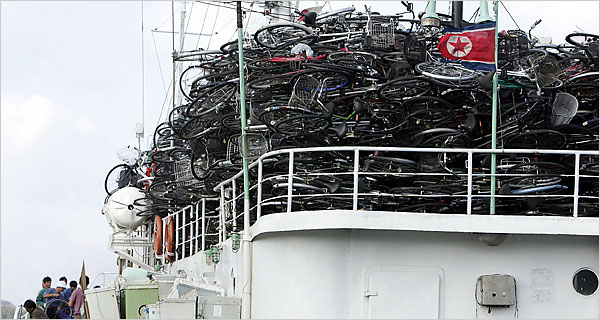
bikes.jpgThere was a great picture in the New York Times today.  The article was about the politics of a UN trade embargo in response to the nuclear test.  I was disappointed that the article was not about the story of the bikes being exported from Japan.  Who is importing them into the DPRK?  How are the funds transferred?  Is there a title? How are they being distributed in the DPRK?  Who is insuring them?  Who is buying them and where did they get the money?  This would have been a far more interesting article.  

Although stories of counterfitting currency and cigarattes, or exporting missles and drugs dominate news headlines, one story that never gets covered in the media, probably because it is so mundane, is how thousands of traders, motivated by nothing but self-interest and survival, are undertaking significant risks which are easing the hardships of the poor citizens of North Korea.  Will stopping this sort of trade make anyone better off? 

Image caption: Bicycles being loaded Friday onto a North Korean ship in Maizuru, west of Tokyo. A proposed Security Council resolution would restrict cargo. 10/14/2006

Share

40 year’s to obtain a DPRK passport?

Monday, September 25th, 2006

A Passport Worth 40 Years of Earning
9/25/2006
Choi Jeon Ho

On Sept. 15, in Bansi, Jilin Province of China, I was encountered by Mr. Choi, a 48-year old resident of Sariwon, North Hwanghae Province of NK. Mr. Choi had been visiting his relative in China for two months. As he was showing me his passport, Choi told me that the passport was worth what he earned for about 40 years.

According to Choi, ordinary residents have to save their earnings for 40 years to get passport; in other words, it is almost impossible for the North Korean people to travel abroad.

– What is the procedure to obtain a passport?

There are two required procedures; an unofficial one before submitting document and official document submission. Because we need permission of the security officer in charge to get out official documents passed, it is most important to have a ‘good relationship’ during the unofficial process.

Even during official process, it requires a ‘good relationship’ with local security office’s external affairs bureau official. Good relationship means bribery.

– How much does a security officer ask for bribery?

In my case, the officer in the National Security Agency suggested two terms of contract. One is to bring one million won (400 dollars) worth cash or home appliances. Another one is a letter of invitation from my relatives in China. In most cases, invitations to a wedding ceremony or 60th birthday banquet are acceptable.

Security officer in charge then submits the letter of invitation to the External Affairs Bureau (EAB) of local security office. Officials in the bureau would decide whether somebody is permitted to visit China or not.

The EAB official asked me one million one (400 dollars) worth bribe during decision process. If I don’t pay that, documents cannot be passed. So far is unofficial procedure.

Then, the official would give me an application form, in which I have to write about my relatives in China, my current job and family, specifically. EAB official verifies the form through People’s Safety Agency (NK police organization) registration office, and my company’s bosses and party secretary agree on, then local security chief permits my travel. To get permission, it requires vis-à-vis meeting with local security chief.

Afterward two visas, one from NK National Security Agency and the other one from Chinese embassy. Chinese embassy checks whether my relatives are currently living in China. After receiving the two visas, a passport is given.

Visa application fee is 30 euros, 240 thousands won (100 dollars). Since the average monthly wage for a (North) Korean worker is 2 thousands won, we have to save our wages for 12 years without spending a penny. And even the monthly wage is often delayed. 240 thousands won is obviously a huge amount of money. Moreover, security officers ask some bribes. Therefore, about 40 years earning is spent to get a passport.

– How long does it take to issue a passport?

At least 3 months to more than 6 months. And even this is impossible without bribery. (North) Korea is a Bribery Republic of Korea. Maybe that is why national elites don’t want the regime to be changed.

– What is the difference between the border area residents’ passports and the regular passports?

Border area residents don’t need their passports to be approved by the National Security Agency. The rest of the procedures are same. Personal bribery differs depending on the region, too. Residents of Pyongyang, South Pyongan Province, North and South Hwanghae and Kangwon provinces pay much more for bribery.
Also, although my passport is officially valid for 3 months, in reality, I have to come back in two months. However, border area residents can stay in China for full three months.

– Is there any instruction before visiting relatives in China?

Of course there is. At local party committee’s Propaganda Bureau.

– What kind of contents?

They educate the possible visitors that even though China is richer than (North) Korea, we must not be blinded by money. China is differed from us, they teach.

And, we are taught not to meet the South Koreans in China. If we meet them, we are instructed to boast about our country (NK) and be proud of. It is emphasized not to accept any of their (South Koreas’) offers. And if there is an encounter with a South Korean, we are required to report that fact to the National Security Agency.

Share

Travel more difficult

Wednesday, September 6th, 2006

From the Daily NK:
Transportation Chaos in N.K… “1 Train Operating Every 10 Days”
9/6/2006

A dire source from North Korea informed on the 5th that the main railway Pyong-ra line (Pyongyang-Rajin) connecting east North Korea with the inland was suspended leaving people in extreme transportation chaos.

In a phone conversation with a reporter, Kim Min Chul (pseudonym, 47) of Hoiryeong, North Hamkyung province said “It took me more than 1 month to travel from Pyongsung, Pyongan province to Hoiryeong, North Hamkyung province.” Kim who went to Pyongsung and Suncheon in Pyongan province at the end of last July for trade revealed “I returned barely alive and having spent all my money on the road.”

Kim said “The passenger train that connects Pyongan and Chongjin, North Hamkyung province only operates once every 10 days and so the majority of people ride trucks or buses.”

The Shinuiju-Chongjin train service that departs Chongjin, North Hamkyung province for Shinuiju can only operate unto Kowon, North Hamkyung province as restorations for the railroad at Yangduk is not yet complete. The train that arrives at Kowon is then returned back to Chongjin, however this seems to take 10 days.

According to Kim, this past April an accident occurred on the railroad between Yangduk, South Pyongan province and Kowon, North Hamkyung province. A train was overturned and before any restorations could be made, the flood that coincided blocked the tunnel and the rail roadbed was washed away. In some parts of the region, 50m of the rail is warped and in mid-air.

On April 23rd 2006, a 13 carriage train collided with a freight train between the regions of Yangduk-Kowon on its way from Pyongyang to Pyonggang, Gangwon province. It was a large-scale accident where 270 soldiers and 400 civilians were concealed on the train. Kim supposes that at the time, North Korean authorities feared the accident would become public, therefore ceased railway operations for a period of time.

Kim said “At present, traveling long distances is particularly inconvenient as trains are not operating properly. As a result the main services between Yangduk, Pyongyang province, and the east with the inland have become virtually nonexistent.”

Train ticket cost a minimum of 5,000won ($1.67)

As trains are suspended ‘paying to car-pool’ is increasing, as costs rise dramatically.

One North Korean source said “It is becoming a custom that you automatically show a 5,000won($1.67) the moment you board a car. In the case you are carrying luggage, each baggage costs an additional 5,000won.” The cost of traveling from Wonsan, Gangwon province to Kowon, South Hamkyung province is 5,000won, from Wonsan to Pyongyang 20,000won($6.67) and from Wonsan to Hamheung, North Hamkyung province 10,000won($3.33).

The source said “People using trains ride cars between Yangduk to Wonsan and then board trains like ‘a relay race’ only barely returning home.”

The source relayed, unfortunate people travel by walking for over 10 days from Yangduk to Sudonggu, North Hamkyung province through the Bukdaeryeong mountain paths renown for it’s rugged terrain. These people climb over mountains eating stolen potatoes and corn in nearby fields, which has led to a rise in complaints by the people.

Having a bad influence throughout the economy … Skyrocketing prices

As the belt between the east and inland is disconnected, adverse affects are impacting throughout North Korea’s economy and the lives of the people. Even North Hamkyung province which encountered little flood damages is facing restraints as goods cannot be delivered. The people in the majority live off trade are in a situation where they cannot even embezzle goods from each other as trains have been suspended.

The railroad is a critical means of transportation to the point it is called the ‘Economy’s Artery.’ As an important railroad such as this has been suspended, the whole economy has recoiled and signs of shortage in food prevalent.

Accordingly prices at Jangmadang are escalating. In a phone conversation with Kim Sun Mi(pseudonym, 35) of Onsung district, North Korea, confirmed this fact. Kim said “As roads and railways throughout the country are becoming immobilized, prices are skyrocketing.”

Kim said “The cost of rice has risen at Jangmadang at 1,300won ($0.43) per kilo, corn is 300won ($0.1), corn oil is 2,800won ($0.93) a bottle, bean oil is 3,200won ($1.07) and pork 3,300won ($1.1).”

Kim said “At present, Kotjebi (street children) are becoming more prevalent in the districts of Chongjin, North Hamkyung and Dancheon, South Hamkyung province. With an obscure thought that ‘You can only live if you go to the borders’ they are drawing to the districts near China and the border areas such as Hoiryeong, Musan and Onsung.”

In the mid-90’s, as the country faced difficulties due to lack of power and old equipment, trains operated once every 10~15 days. In those days, when a train stopped briefly, people would detach windows and chairs putting them to fire.

Share