Archive for the ‘Transportation’ Category

North Korea, China Will Start $10 Billion Fund, Yonhap Reports

Tuesday, November 13th, 2007

Bloomberg
Bomi Lim
11/13/2007

North Korea’s Daepung Investment Group will set up a $10 billion fund with China Development Bank to help Chinese firms operating in North Korea, Yonhap News reported, citing the company’s vice president.

The fund will be used to help Chinese companies build roads, railways and ports in North Korea, Daepung Vice President Bae Kyeong Hwan was quoted as saying. Bae didn’t say how much each country will contribute the fund.

Daepung also plans to set up a bank to attract investment from overseas, the report said.

China is North Korea’s biggest trading partner and an important provider of food and fuel. North Korea is isolated from most of the rest of the world and has received virtually no foreign investment.

Share

North Korea authorities “Stop Operating Chinese Motorcycles for Commercial Use”

Monday, November 12th, 2007

Daily NK
Kwon Jeong Hyun
11/12/2007

North Korean authorities recently started regulating motorcycle operation in order to control private market.

Motorcycle is most preferred means of transportation especially for North Korean salespersons. And in North Korea, everybody must get a license from the government to operate cars, motorcycles or even bicycles.

North Korean authorities now give license to only Made in DPRK “Bugang Motorcycle,” which is considerably more expensive than those imported from China.

Choi, a 33 years old resident of Sinuiju visiting his relative in Dandong, China, said on last Thursday “getting operator’s license for Made in China motorcycles has become ridiculously difficult.” According to Choi, only domestic motorcycle owners receive license and popular dissatisfaction increased.

It seems that North Korean authorities want to stop growing of private market by making it impossible to operate motorcycle, a vital part of transportation of goods.

Choi added “even before, someone had to bribe police officer to get a license, but now, bribery doesn’t work for Chinese-built motorcycles at all.”

Why people prefer Made in China? “Korean motorcycles manufactured in Pyongyang cost 1,500 US dollars and often break down. However, Chinese ones cost only 600 dollars while perform far better.”

Choi complained that “some people who operated Chinese motorcycle without license got their bikes confiscated.”

The loots were sent to the Army troops on DMZ.

Chinese motorcycle has become prevalent since 2002 when North Korean residents whose relatives lived in China received it as gift and operated for commercial purpose.

According to Choi, “Motorcycle can carry a certain amount of goods to inlands and it is so convenient. Even if motorcycle is expensive, everybody wants to own one. People buy seafood on the coast and bring them to the cities or sell small commodities.”

For alluvial gold, price differs among regions, so transporting it fast with motorcycle is lucrative business.

Lee, defected Pyongyang last year, said “In the past, a few rich people bought used Japanese motorcycles like Honda or Yamaha, but now many people operate Chinese ones for commercial purpose.”

Share

Google Earth North Korea (version 6)

Sunday, November 11th, 2007

The most authoritative map of North Korea on Google Earth
North Korea Uncovered: Version 6
Download it here

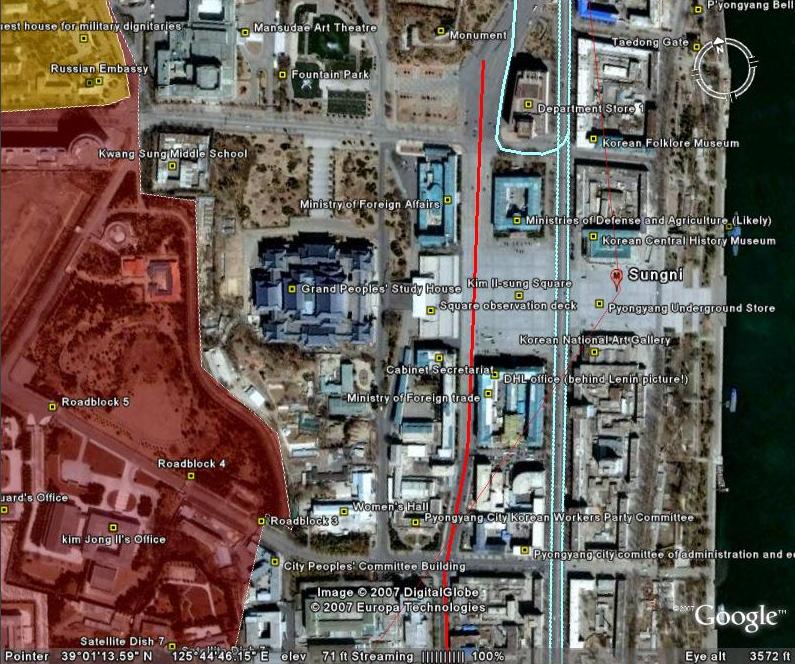
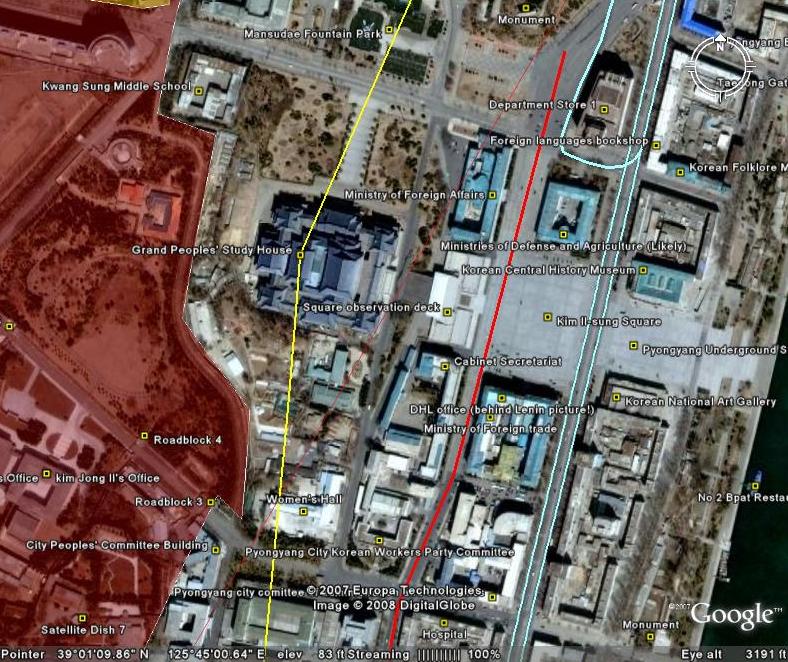
kissquare.JPGThis map covers North Korea’s agriculture, aviation, cultural locations, manufacturing facilities, railroad, energy infrastructure, politics, sports venues, military establishments, religious facilities, leisure destinations, and national parks. It is continually expanding and undergoing revisions. This is the sixth version.

Additions to the newest version of North Korea Uncovered include: Alleged Syrian nuclear site (before and after bombing), Majon beach resort, electricity grid expansion, Runga Island in Pyongyang, Mt. Ryongak, Yongbyon historical fort walls, Suyang Fort walls and waterfall in Haeju, Kaechon-Lake Taesong water project, Paekma-Cholsan waterway, Yachts (3), and Hyesan Youth Copper Mine.

Disclaimer: I cannot vouch for the authenticity of many locations since I have not seen or been to them, but great efforts have been made to check for authenticity. These efforts include pouring over books, maps, conducting interviews, and keeping up with other peoples’ discoveries. In many cases, I have posted sources, though not for all. This is a thorough compilation of lots of material, but I will leave it up to the reader to make up their own minds as to what they see. I cannot catch everything and I welcome contributions.

Share

It Costs about $300 for a Visa to China

Monday, November 5th, 2007

Daily NK
Yang Jung A
11/5/2007

Forty-year old Park Sung Jin (pseudonym), a cloth merchant in Chongjin lately went to Tumun in Jilin Province, China under the pretext that he would visit his relatives there. He looked for Chinese business partners and tried to find items he can sell.

It took guts for Mr. Park to venture a trip to China. However, his efforts might turn out to be fruitless.

Mr. Park needed to get a border pass to go to China, and it costs him a great fortune. The pass allowed Mr. Park to visit his pre-determined destination only once. He paid 1 million North Korean won (approx. US$340) for the pass which he applied for in February, 2006 and received in August, 2007. If he wanted to have it within six months, he had to pay about 4,000 Yuan (approx. USD560).

Applicants for the pass also need to bribe the officials of People’s Committee and Security Agency because they are in charge of issuing visas to China. In fact, Mr. Park had to spend extra money on bribery to go to China for business.

Since it was Mr. Park’s first time to apply for the visa, he went through a relatively simple visa procedure. As for those who apply for the visa more than once, more complicated procedure is waiting. They are asked to state what they had done during their first visit to China.

If Mr. Park is issued a passport by any chance, he can go to many places for long periods of time. Unfortunately those over the age of 45 are more likely to get a passport (Mr. Park is forty). Moreover, the eligibility for the issue of a passport is much more complicated and it costs big fortune to get one. For instance, those who apply for the issue of a passport are supposed to pay $40 for application fee. However, the applicants need to spend extra money on bribes and other things, and for the most time end up spending more than $500 to get a passport.

Mr. Park is now busy visiting relatives and business partners. He is determined to make money as much as possible during his stay in China so that he can get his money’s worth upon his return home.

There are more theft incidents in Hoiryeong than ever

Lately, 45-year old An Myong Sook, a resident in Hoiryeong city, never hangs out the wash to dry outside. She tells her 15-year daughter not to forget to lock the doors when she leaves home because there are so many thieves in her neighborhood.

Since last year, the construction of apartments and roads has been underway around her area in order to commemorate the 90th birthday of Kim Jong Suk (the late mother of Kim Jong Il). For the construction, many outside workers came to her area, and some of them have broken into neighboring houses.

After having repaired the road laid behind the statue of Kim Jong Suk, the workers have started building the road between Hoiryeong and Chongjin since June. Many workers came to Hoiryeong from Rajin, Chongjin, Kilju, and Hamheung.

However, ever since the outside workers came to Hoiryeong in June, the number of households which lost their belongings or livestock has increased. The local people of Hoiryeong are increasingly complaining that the increase in rice price and theft has to with the presence of the outside workers.

Accordingly, the North Korean authorities have strengthened the punishment for theft. In the past, stealing was considered as a petty misdemeanor. Nowadays, that guilt of theft is sent to labor training facilities. The authorities confiscate all stolen items sold to the third person.

However, it is difficult to get back basic supplies such as clothes once they are stolen, and therefore every household in Hoiryeong is on the alert for theft.

Share

Direct flights for tours of N. Korea’s Mount Paekdu to start in May: report

Saturday, November 3rd, 2007

Yonhap
11/3/2007

Direct flights that will allow tourists from South Korea to visit Mount Paekdu in North Korea will begin in May, Pyongyang’s official state-run news agency said Saturday.

The Korean Central News Agency (KCNA) said the deal was reached in talks between Hyundai Group chairwoman Hyun Jung-eun and representatives of the North’s National Economic Cooperation Federation.

The tours were agreed upon at the summit meeting between South Korean President Roh Moo-hyun and North Korean leader Kim Jong-il early last month. Seoul had previously provided materials to repair an airfield near the mountain.

Foreign visitors to Mount Paekdu, whose 2,744-meter peak is the highest on the Korean Peninsula, usually climb the mountain from the Chinese side, although the mountain is a popular tourist destination for foreign tourists in North Korea. Koreans traditionally consider Mount Paekdu a sacred mountain.

The KCNA report also said Hyundai will start tours of Kaesong, an ancient Korean capital, in early December.

Hyundai Asan, a affiliate of the the business group, runs the Kaesong industrial complex that is home to about 50 South Korean companies producing clothes, shoes, watches and kitchen appliances.

The inter-Korean complex 60 kilometers northeast of Seoul is hailed as the crowning achievement of the historic first-ever inter-Korean summit in 2000. It has played a key role in expanding two-way economic exchanges from just $300 million in 1999 to $1.35 billion last year.

The North Korean news agency said Hyun and Hyundai Asian president Yoon Man-joon met with Kim Jong-il.

The two senior executives are expected to return to South Korea later in the day.

Share

Freed N. Korean vessel opens new window for U.S.-N. Korea ties

Wednesday, October 31st, 2007

Yonhap
Byun Duk-kun
10/31/2007

A U.S. Navy destroyer helped a North Korean cargo ship escape a hijacking by pirates off the coast of Somalia on Tuesday, an incident which may bode well for the growing detente between the two nations, as sentiments remain upbeat over ongoing talks on the North’s denuclearization.

Officials here noted the incident will work positively in efforts to denuclearize the communist North, as it came just one day before the chief nuclear negotiators of the U.S. and North Korea were to meet for discussions on denuclearization, normalization of ties between the former Cold War foes and other issues.

It was early Tuesday when the USS James E. Williams, operating near Somalia, received a request from the International Maritime Bureau to investigate a North Korea-flagged ship reportedly hijacked by pirates.

The U.S. destroyer reacted with little hesitation, dispatching a helicopter to investigate the reported hijacking and then sailing at full speed to arrive at the site at midday to lend assistance, the U.S. Navy said in a press release.

The 22 crew members of the North Korean freighter eventually regained control of the ship after a firefight with the pirates, while the Williams demanded by radio that the pirates give up their weapons.

Two pirates were reportedly killed in the deadly gunfight, while five others were captured in the tense standoff.

After the hijacking situation was resolved, three injured crew members of the North Korean ship who may have received relatively serious wounds were brought onboard the U.S. destroyer for medical treatment, and were then sent back to their ship in stable condition, a message sent by the U.S. Navy to Yonhap News Agency said. It said the injuries sustained by the three merchant sailors were not life-threatening.

Besides giving first aid, the U.S. warship did not receive any further requests for assistance from the North Korean vessel, the message said.

Washington tried not to brag, saying piracy was a “scourge” in Somalia’s waters and that U.S. vessels were available to intercede when necessary.

“When we get a distress call, we help,” Lydia Robertson, commander of the U.S. Fifth Fleet, was quoted as saying by the AP.

South Korean officials agreed, saying the U.S. would have acted the same way had the incident taken place a year ago. They, however, noted the U.S. would not have acted so swiftly or as willingly had the incident happened before Feb. 13, when Pyongyang agreed to shut down and later disable its key nuclear facilities.

“Piracy is a crime that does not choose its victims by their nationality,” a ministry official said, asking that he remain unidentified.

“The U.S. and NATO forces have long operated missions in the (Somali) area to intercept pirates, so I don’t think the U.S. would have acted any differently had the incident happened a year ago,” said the official, whose job mainly deals with U.S. affairs.

Other officials said the incident demonstrates the changed mood between the former enemies as multilateral talks aimed at denuclearizing the communist North maintain an upbeat mood.

Washington and Pyongyang have held two rounds of working-level talks this year under a six-nation accord signed in February, which binds North Korea to shut down and disable its key nuclear facilities and declare all its nuclear programs.

In return, the communist nation will receive 1 million tons of heavy fuel oil or equivalent assistance, as well as other political benefits such as its removal from the U.S. list of terrorism sponsoring states and the normalization of its diplomatic relations with the U.S. and Japan.

North Korea has already shut down all its key nuclear facilities at Yongbyon and promised earlier this month to disable the Yongbyon complex and submit a full list of its nuclear programs by the end of the year.

Christopher Hill, the top U.S. envoy in six-way talks on ending North Korea’s nuclear ambition, was expected to hold bilateral talks with his North Korean counterpart Kim Kye-gwan in Beijing later Wednesday to discuss various issues including the normalization of ties between their nations, according to officials here.

“The incident will have a positive impact as a result of the efforts by both the U.S. and North Korea to normalize their diplomatic ties,” a ministry official said, asking to remain anonymous.

North Korea has yet to officially acknowledge the U.S. assistance in regaining the freedom of its vessel and treating the ship’s wounded North Korean crew members.

Crew wins deadly pirate battle off Somalia
CNN
10/30/2007

The crew members of a North Korean freighter regained control of their ship from pirates who hijacked the vessel off Somalia, but not without a deadly fight, the U.S. Navy reported Tuesday.

When the battle aboard the Dai Hong Dan was over, two pirates were dead and five were captured, the Navy said.

Three wounded crew members from the cargo ship were being treated aboard the guided-missile destroyer USS James E. Williams.

The captured pirates were being held aboard the North Korean vessel, the Navy said.

The bandits had seized the ship’s bridge, while the crew kept control of the steering gear and engines, the Navy said.

The Koreans moved against the attackers after the Williams — responding to reports of the hijacking — ordered the pirates to give up their weapons, according to the Navy.

When the crew members stormed the bridge, the deadly battle began. After the crew regained control, Navy sailors boarded the Dai Hong Dan to help with the injured.

North Korea and the United States have no diplomatic relations.

The incident took place about 70 miles northeast of the Somali capital, Mogadishu, the Navy said.

It is the second incident of piracy reported in recent days. A second U.S. Navy destroyer was searching waters off Somalia for pirates who hijacked a Japanese-owned ship, military officials said.

Over the weekend, gunmen aboard two skiffs hijacked the Panamanian-flagged Golden Nori off the Socotra archipelago near the Horn of Africa, said Andrew Mwangura, a spokesman for the Kenyan-based Seafarers’ Assistance Program.

The guided-missile destroyer USS Arleigh Burke has been pursuing the pirates after entering Somali waters with the permission of the troubled transitional government in Mogadishu, U.S. officials said Monday. In recent years, warships have stayed outside the 12-mile limit when chasing pirates.

Two military officials familiar with the details confirmed the ongoing operation.

The Navy’s pursuit of the pirates began Sunday night when the Golden Nori radioed for help. The Burke’s sister ship, the USS Porter, opened fire and sank the pirate skiffs tied to the Golden Nori’s stern before the Burke took over shadowing the hijacked vessel.

When the shots were fired, it was not known the ship was filled with highly flammable benzene. U.S. military officials indicate there is a great deal of concern about the cargo because it is so sensitive.

Benzene, which U.S. authorities have declared a known human carcinogen, is used as a solvent and to make plastics and synthetic fabrics.

Four other ships in the region remain in pirate hands, the Navy said.

U.S. and NATO warships have been patrolling off the Horn of Africa for years in an effort to crack down on piracy off Somalia, where a U.N.-backed transitional government is struggling to restore order after 15 years of near-anarchy.

On Monday, the head of the transitional government resigned as his administration — backed by Ethiopian troops — battled insurgents from the Islamic movement that seized control of Mogadishu in 2006.

Hospital officials reported 30 dead in three days of clashes on the city’s south side.

In June, the ship USS Carter Hall fired warning shots in an attempt to stop a hijacked Danish cargo ship off Somalia, but the American vessel turned away when the pirated ship entered Somali waters.

In May, a U.S. Navy advisory warned merchant ships to stay at least 200 miles off the Somali coast. But the U.S. Maritime Administration said pirates sometimes issue false distress calls to lure ships closer to shore.

The pirates often are armed with automatic rifles and shoulder-fired rockets, according to a recent warning from the agency.

“To date, vessels that increase speed and take evasive maneuvers avoid boarding, while those that slow down are boarded, taken to the Somali coastline and released after successful ransom payment, often after protracted negotiations of as much as 11 weeks,” the warning advised.

The agency issued a new warning to sailors in the Gulf of Aden, between Somalia and Yemen, after Sunday’s hijacking.

Share

Odd couple: The royal and the Red

Wednesday, October 31st, 2007

Asia Times
Bertil Lintner
10/31/2007

North Korean Premier Kim Yong-il is scheduled to pay a four-day visit to Cambodia in early November, underscoring the curious close relationship between one of the world’s last communist dictatorships and one of Asia’s most ancient monarchies.

Kim Yong-il, who should not be confused with the North Korean supremo, “Dear Leader” Kim Jong-il or any of his relatives, will hold talks with Cambodia’s retired king Norodom Sihanouk, the Cambodian Foreign Ministry said in a statement posted on its website.

The North Korean premier will also hold “official talks” with his Cambodian counterpart Hun Sen, and “pay courtesy calls” on Senate president Chea Sim, and the president of the National Assembly, Heng Samrin, according to the statement.

Cambodia has long served as a link between North Korea and Southeast Asia and beyond, so it is plausible to assume that trade and related issues will be on the agenda. For years the two countries ran a joint shipping company, and before the China-led six party talks, Cambodia had offered to mediate over Pyongyang’s contentious nuclear program.

Kim Yong-il’s visit to Cambodia is not the first by a North Korean dignitary in recent years. Kim Yong-nam, president of North Korea’s rubber-stamp parliament, the Supreme People’s Assembly, also visited the country in 2001 at the invitation of Sihanouk, who had then not yet abdicated in favor of his son, Norodom Sihamoni, the current serving monarch.

Kim Yong-nam now functions as de facto head of state, as Kim Jong-il’s father, “Great Leader” Kim Il-sung was elevated to the position of “eternal president” before his death in 1994, making North Korea not a monarchy, but rather the world’s only necrocracy.

As incongruous as it may seem, Cambodia is North Korea’s oldest ally in Southeast Asia. It all began when Sihanouk met Kim Il-sung in 1961 at a Non-Aligned Movement meeting in Belgrade and a personal friendship developed between the two leaders. When Sihanouk was ousted in a coup in 1970, Kim Il-sung not only offered him sanctuary in North Korea but also had a new home built for him about an hour’s drive north of Pyongyang.

A battalion of North Korean troops worked full-time on it for almost a year, and when it was finished, only specially selected guards were allowed anywhere near the 60-room palatial residence. Overlooking the scenic Chhang Sou On Lake and surrounded by mountains, the Korean-style building even had its own indoor movie theater. Like the Great Leader’s son, Kim Jong-il, Sihanouk loves movies.

Sihanouk has both directed and acted in his own romantic feature movies and a few more were made in North Korea, with Cambodian actors strutting their stuff against the backdrop of Korea’s snow-capped mountains.

French wines and gourmet food were flown in via China, and Sihanouk and his entourage were treated as royals would have been in any country that respects monarchy – as North Korea evidently does.

By contrast, North Korea has maintained less cordial relations with neighboring communist Vietnam, which still exerts behind-the-scenes pressure on Cambodia. Kim Yong-il will nonetheless also visit Hanoi during his diplomatic tour of Southeast Asia.

Throughout the Vietnamese occupation of Cambodia, North Korea refused to recognize the regime that Hanoi installed in Phnom Penh in January 1979 – and that despite immense pressure at the time put on Pyongyang from Moscow. During a meeting between Kim Il-sung and Sihanouk seven years later on April 10, 1986, in Pyongyang, the Great Leader reassured the then prince that North Korea would continue to regard him as Cambodia’s legitimate head of state.

When Sihanouk returned to Phnom Penh in September 1993, after United Nations-led mediation to end Cambodia’s civil conflict, he arrived with 35 North Korean bodyguards, commanded by a general from Kim Il-sung’s presidential guards. They are still there, now guarding Sihanouk as well as the new king, Sihanomi, who is not as close to North Korea as his father, but has paid at least one visit to Pyongyang.

Sailing buddies
Sihanouk and the Cambodian royals showed their gratitude to the North Koreans when in the late 1990s they set up a privately-owned shipping registry, the Cambodia Shipping Corporation (CSC). The flag of convenience was used by the North Koreans, and it enjoyed royal protection as it was headed by Khek Vandy, the husband of Sihanouk’s eldest daughter, Boupha Devi.

CSC was also partly owned by a Phnom Penh-based North Korean diplomat and for a few years aggressively marketed itself as a cheap and efficient “flag of convenience” service for international shippers. A series of embarrassing maritime incidents, including the interception in June 2002 of a Cambodian-registered – though not North Korean owned – ship by the French navy, in a joint operation with US, Greek and Spanish authorities, of a massive haul of cocaine off the West African coast prompted Hun Sen’s government to cancel CSC’s concession and reportedly give it to a South Korean company, the Cosmos Group.

At the time, International Transport Federation general secretary David Cockroft told the Cambodia-based fortnightly newspaper the Phnom Penh Post that “they’ll need to be able to walk on water, because nothing short of a miracle will clean up the name of Cambodian shipping”. Indeed, little appeared to change, including North Korea’s use of Cambodia’s flag of convenience for controversial shipments.

In December 2002, a Cambodian-registered, North Korean-owned ship named So San was intercepted by Spanish marines, working on a US tip, in the Arabian Sea. It was found to be carrying 15 Scud-type missiles, 15 conventional warheads, 23 tanks of nitric acid rocket propellant and 85 drums of unidentified chemicals under a cargo of cement bags.

The destination of the weaponry was said to be Yemen, and following protests from both Yemen and North Korea – and intervention by the US, which apparently did not want to antagonize Yemen, a supposed ally in Washington’s “war on terror” – the ship was allowed to continue to Yemen. Later revelations indicated that the cargo was ultimately delivered to Libya, which caused considerable embarrassment in Washington.

Premier Kim Yong-il is likely to be quite familiar with the CSC, as he served as minister for land and marine transport from 1994 until the Supreme People’s Assembly appointed him to the premiership in April this year. But since the scandal-ridden CSC was reorganized five years ago, Cambodia’s economic importance to Pyongyang would appear to have waned, and North Korea’s only known activity in the country today is in the restaurant business, including eateries in Phnom Penh and Siem Reap.

Yet as a diplomatic link to the wider region, Cambodia is still important to North Korea. In April 2003, the Cambodian government, at the urging of Sihanouk, had plans to send an envoy to Pyongyang in a bid to persuade the North Korean leadership to be more flexible about talks on its nuclear program, which at that time had stalled.

The mission never materialized, but North Korea no doubt remembers that its trusted ally Cambodia tried first to mediate – and that Phnom Penh in future could still serve as a gateway for improved contacts with the outside world. It remains to be seen what message Kim Yong-il will bring to Phnom Penh, but it is reasonable to assume that his visit will, despite the official announcements, be confined merely to “courtesy calls” and royal audiences.

Bertil Lintner is a former correspondent with the Far Eastern Economic Review and the author of Great Leader, Dear Leader: Demystifying North Korea under the Kim Clan. He is currently a writer with Asia-Pacific Media Services.

Share

Oil price ‘grounds’ N Korea fleet

Sunday, October 28th, 2007

BBC
10/28/2007

North Korea has been forced to ground a fleet of Soviet-era military planes because of the high oil price, South Korea’s Yonhap news agency reported.

Fuel is being diverted for other training flights, Yonhap quoted a military source as saying.

The Antonov An-2 biplanes – of which North Korea’s air force is thought to have about 300 – are able to drop special forces behind enemy lines.

The planes, which can cruise below radar, carry some 12 soldiers.

North Korea’s impoverished economy has suffered from energy shortages for years, and rising oil prices have made the situation worse.

Low speed

The Antonov, designed and built in the Soviet Union, first flew in 1947, and is still used by a number of military and civilian operators around the world.

The plane is useful in special forces operations because of its extremely low minimum speed – it can fly as slowly as 48km/h (30mph) without stalling, according to aviation experts.

North Korea’s air force fields hundreds of aircraft, but the vast majority are ageing Soviet models – such as the MiG 21 fighter – or Chinese copies outclassed by more modern aircraft fielded by the US, South Korea or Japan.

North and South Korea are still technically at war as a peace accord to bring an end to the 1950-53 conflict has never been signed.

Share

China halts rail freight to N Korea

Thursday, October 18th, 2007

Financial Times
Anna Fifield
Richard McGregor
10/18/2007

China suspended key rail freight services into North Korea last week after 1,800 wagons carrying food aid and tradeable goods crossed into Kim Jong-il’s hermit state but were never returned.

Absconding with Chinese wagons would be a strange move for North Korea because Beijing is Pyongyang’s closest political ally and biggest provider of food, goods and oil. Analysts monitoring North Korea said Chinese officials had privately complained to them that the North Koreans were dismantling Chinese wagons and selling them back as scrap metal.

The Chinese railway ministry suspended a number of rail freight services into North Korea on October 11, humanitarian agencies operating in North Korea told the Financial Times. The ministry told international aid agencies that it would not send any more wagons into North Korea until Pyongyang returned the 1,800 Chinese wagons.

Tony Banbury, Asia director for the UN World Food Programme, said that the curtailed service had held up the delivery of 8,000 tonnes of maize and wheat already stockpiled in Dandong, a Chinese border town. “We now have significant amounts of food but we can’t deliver it,” Mr Banbury said.

Reliefweb, a United Nations website for aid agencies, reported that the delivery of food stocks into North Korea had been “critically affected by the cessation of movement of railway wagons from China”.

An official with China’s railway ministry said yesterday that it was not aware of any suspension of freight services into North Korea.

But Fu Xue, of the Dandong Tianda International Freight and Forwarding Company, said there had been delays in the return of wagons but that North Korea had asked for permission from China.

North Korea has frequently failed to pay for goods or to pay back debt. It has also long been accused of relying on currency counterfeiting and drug smuggling to stay afloat.

But purloining Chinese wagons would be a brazen move. China is already thought to be disillusioned by Pyongyang’s refusal to embrace economic reform. It was also angered by North Korea’s decision last year to conduct a nuclear test despite Beijing’s objections.

North Korea has a history of not returning vehicles. In 1998, the late Chung Ju-yung, founder of South Korea’s Hyundai Group, donated 1,001 cows to North Korea to make amends for stealing a cow as he escaped from the north as a boy.

Pyongyang said the cows should be transported on Hyundai trucks. The trucks were never seen again.

Share

EBA Press Release: Pyongyang International Trade Fair

Wednesday, October 10th, 2007

Europen Business Association
October 2007

EBA.JPG18 European companies are participating at the European booth organized by the European Business Association (EBA) in Pyongyang. This has been the largest ever participation of European companies at a Trade Fair in Pyongyang. The 18 EBA-member companies come from 6 European countries and are engaged in banking, IT, pharmaceuticals, maritime transportation, railways, courier services, industry, mining, solar driven water pumps, energy saving technology, commodity inspection, cosmetics and other consumer goods and general trading. Some already operate in joint ventures with Korean partners or found other forms of close business cooperation, particularly in the fields of banking, mining, internet services, logistics, software development and pharmaceuticals.

The EBA will continue to make efforts to attract more European companies to invest and do business in the DPRK in the coming years and will share its experience to help make the endeavors of the newcomers and their Korean partners a success. The EBA closely cooperates with the DPRK Chamber of Commerce and the Korea International Exhibition Corporation to facilitate the participation at exhibitions, to intensify trade between European and DPRK-enterprises and to enhance the identification of suitable business and investment opportunities for European companies.

Pictures of the European booth will be published on http://www.eba-pyongyang.org/
Felix Abt, President
Dr. Barbara Unterbeck, PR-manager
European Business Association
President´s Office
Chang Gwang Foreign Residential and Office Building
10th Floor, No. 10-2
Central District
Pyongyang
The Democratic People’s Republic of Korea
http://www.eba-pyongyang.org/


Share