Archive for the ‘Transportation’ Category

Bicycle business growing in North Korea

Tuesday, November 4th, 2008

Institute for Far Eastern Studies (IFES)
NK Brief No. 08-11-3-1
11/3/2008

The Daily NK has reported that the use of bicycles for business and transportation around the city of Pyongyang is becoming more and more commonplace, with 7 out of 10 households owning a bike, despite the fact that the cost of a bicycle in the capital city has doubled in the last twelve months alone.

According to North Korean defectors, until the early part of the 21st century, bicycles were the most sought-after purchases, with only 30~40 percent of families able to buy them.

According to a source in Pyongyang, “If you go to a [market] these days, you’d see that people who sell or purchase goods mostly use bicycles,” adding, “With the exception of those houses with extremely difficult situations, most households have a bike.”

The source explained that the growing use of bicycles is not due to improvements in the lives of the people, but rather, due to a shift in mentality. In the past, someone wishing to purchase a bike would first have to save up money for it, while today they think they can borrow the money, even at high interest rates, and then repay the loan through business profits.

The Daily NK explains, “With the ubiquity of [market] trading and the increase in business competition, bicycles have become must-have items.”

In Sinuiju, as well, bicycles have become a necessity for traders. A source there reported, “In farmlands that are distant from the [market], bicycles are an important means of linking to city markets. The merchants can triple or quadruple their profit, compared with those that don’t own bicycles.”

Most traders with bicycles take orders from those living in farming villages, fill the orders in city markets, then barter the items in the villages for vegetables and grains which they then turn around and sell in markets for a profit. Competition is stiff as traders follow price differences between the markets in order to squeeze out even a 100 won profit.

Read two recent stories on North Korea’s bicycle culture here:
70% of Households Use Bikes
Daily NK
Jung Kwon Ho
10/30/2008

People’s Safety Agency Targeting Women Cyclists
Daily NK
Jung Kwon Ho
11/6/2008

Share

Pyonghwa Motors Update

Sunday, November 2nd, 2008

The Asia Sentinel offers an update on Pyonghwa Motors’ production and sales numbers:

Does it make economic sense to build or invest in a car factory for a country with 23 million people but fewer than 30,000 vehicles, a city where cars are so scarce that in the warmer months, traffic ladies swinging their stop signs act in place of electric lights, where hardly anybody knows how to drive? And why is Sun Mymung Moon, owner of an international business empire and a virulent anti-communist, investing in North Korea?

Pyeonghwa Motors invested around US$55 million to build the factory on a one-time rice paddy near the port city of Nampo, about 50 kilometers southwest of Pyongyang. In 2003, the JoongAng Daily quoted an executive from the Seoul-based Pyeonghwa, saying he expected the factory, with capacity to build 20,000 cars a year, to eventually turn a profit. However, a spokesman based in Seoul says Pyeonghwa has produced only 2,000 cars and pickup trucks in their first five years of operation.

How many cars have they actually sold? For North Korea, any statistics, much less accurate ones, are “very difficult to come by,” said Erik van Ingen Schenau, an Asian car analyst and author of the book “Automobiles Made in North Korea.” He quotes a French newspaper article that claims the factory sold around 400 vehicles, including SUVs, pickups, and sedans, in 2006.  He estimates the factory sold anyone from 400 to 1000 cars in 2007 and 2008, including the cars they exported to Mekong Auto, a Vietnam-based Moon company, and including the vehicles that they produced with the Shenyang-based China Brilliance. 

The Pyeonghwa factory produces cars with names such as Whistle, Cuckoo, and Three Thousand Li, which refers to the national territory of Korea, both North and South peppering the empty streets of Pyongyang, “You see these cars a lot, especially the Cuckoo,” said Simon Cockerell, general manager of Koryo Tours, one of the few western tour companies licensed to operate in North Korea. 

“It took drivers some getting used to because they were used to driving Japanese cars, with steering wheels on the right,” Cockerell said. 

Like most items produced in North Korea, the Pyeonghwa vehicles are not known for their quality. “They are probably nearly all hand-assembled, and based on a model from a factory in China that does not have a good reputation,” van Ingen Schenau said. “They make cars that no one is interested and in that they cannot export to Japan or South Korea. Maybe it is a prestige item to have a car factory in the country, but it does not seem to have worked out at the moment.”

The Whistle, based on the Fiat Siena, is one of the Pyeonghwa vehicles featured on billboards. It sits on a field next to a superimposed image of the Pyongyang Arch of Triumph. Built to commemorate Kim Il Sung and the Korean nation’s resistance to the Japanese occupation, the arch stands 60 meters tall, more than 10 meters taller than its model, the Arc de Triomphe in Paris. A boy stands next to the car one hand holding a trophy, while waving a hand, a smile on his face and a medal around his neck.  The billboard reads: “Whistle. A Strong and Beautiful Automobile.”

It is important to remember the target audience of the billboard. It is not only for the few thousand European tourists who visit the country for six days at a time, or the few hundred businessmen and embassy staff who live in one of the few foreigner hotels isolated from the city. The billboards also exist for the residents of Pyongyang, to show them that their country, despite the harm done to it by the entire capitalist world, is still able to go its own way and produce a strong and handsome car.

The full article can be found here:
North Korea in the Slow Lane
Asia Sentinel
Isaac Stone Fish  
10/31/2008

Share

(UPDATE) North Hamgyong by rail

Monday, October 27th, 2008

(UPDATE) These adventurers set up a couple of blogs to catalogue their trip.
1. Approaching Russia/Korea border
2. Entering North Korea at Tumangang
3. By train across North Korea (1/2)
4. By train across North Korea (2/2)
5. Pyongyang-Myohyangsan
 

railimage.jpg

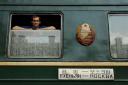
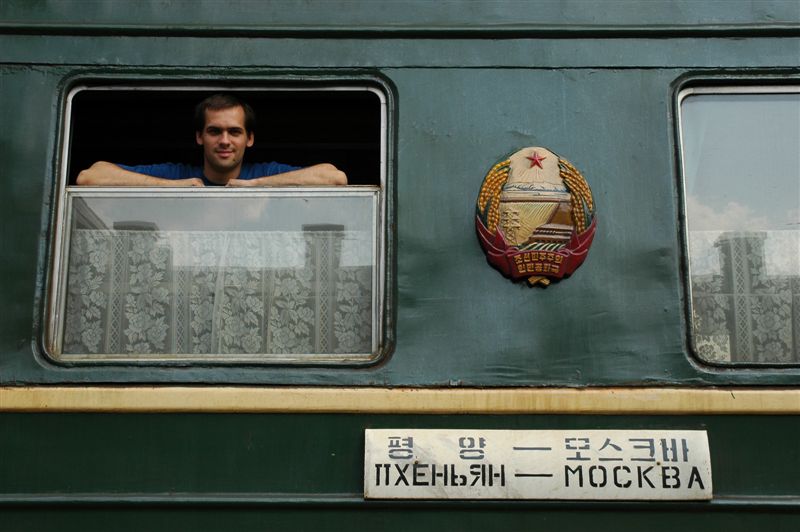
I just finished reading an incredibe DPRK travel account by two Swiss and Austrain rail enthusiasts who recently traveled the Trans-Siberian Railway from Europe to Pyongyang.  If you are interested in Russia and/or the DPRK you need to treat yourself to their pictures and travel journals as much of their material has not been published in the West.

I have included links to their trip from Ussuriyisk and Khasan to Pyongyang below, with some selected comments from their diary:

1. From Ussuriysk to Khasan (Russia):
http://www.railroadforums.com/forum/showthread.php?t=25908

Selected comments:

Trains over the border were not listed, but I knew that there is not only the twice-monthly sleeping car Moscow – Pyongyang, but also a twice-weekly cross-border passenger train Khasan – Tumangan.

I asked him [a Russian border agent], whether and how often he met foreigners here. He said, that he has been working here for about one year and that we were the 1st foreigners (except North Koreans, of course), he met.

The answer was that usually only Russian and Korean citizen cross the border, but that there have been a few third country citizen here, but they didn’t remember when that was the last time…

They also said, that among the passengers of the sleeping car to Pyongyang there are usually not even Russian citizen. Russian citizen crossing the border only go to the so called “Rajin-Sonbong Special Economic zone”, setup by the North Korean administration in cooperation with China and Russia

2. From Khasan to Tumangang Station (DPRK border)
http://www.railroadforums.com/forum/showthread.php?t=25971

3. From Tumangang Station to Pyongyang part 1:
http://www.railroadforums.com/forum/showthread.php?t=25993

Selected Comments:

(North Korea uses normal gauge – 1435mm)

We then talked about other things. They said that they had studied in Pyongyang and now have to serve at the army here in Tumangan. 

One of them told us, that he had seen the Hollywood-movie “Titanic” in the cinema in Pyongyang (I have also read before, that Titanic was shown in North Korean cinemas) and both said that they were glad to practice their language skills together with us. And one of them said, that he also wished to travel around the world like we did and see foreign countries… I hope in future it will be possible for him.

And of course the mobile-phones were of special interest, as they are forbidden in North Korea. The “translator” said, that they would be sealed and that we must open the envelope only when we leave the country. The sealing was quite simple: The customs official asked me for some of paper (obviously they didn’t have their own…) and I gave him two empty DIN-A4-sheets, in which he enwraped the mobile phones and which he closed with a yellow tape, which he then stamped several times…

They told us, that they now have to take the books, the laptop, the camera and the USB-sticks with them for some further inspection by a specialist, and that we would receive our belongings later.

They asked us to put all this items into the two smaller backpack (both of us had a big and a small backpack). Then they took the backpacks and left the sleeping-car.

They also provided the following information:

At http://www.logistics.ru/9/7/i77_6557p0.htm you can find a Russian article about the history of this border crossing point.

The line on the Russian side from Baranovskiy to Khasan was built between 1938 and 1951. The first bridge over the border was a wooden railway bridge opened in 1952. In 1954, when cross-border freight traffic offically started, 4400 tons of freight were transported over the border. That number rose to 12.000 tons in 1955.
In 1959 the new bridge, which still exists today, was opened.
The peak in freight traffic was in 1988 with 4.795.000 tons (USSR > DPRK: 4.070.000 tons, DPRK > USSR 725.000 tons). The numbers show, that the USSR ecenomically supported the DPRK and due to the political and economical changes in the former USSR the mostly unidirectional trade between the two countries decreased after 1988:

1988 – 4.795.000
1990 – 3.526.000
1993 – 2.306.000
1994 – 761.000
1999 – 230.000
2002 – 68.000

Only after 2002 a slight increase is noticeable, in 2004 106.000 tons were transported. However, the infrastrucuture was overdimensioned, and it has therefore been reduced: Several tracks at Khasan station were removed, as well as 3 of 14 passing-tracks between Baranovskiy and Khasan.

Passenger traffic was opened in 1958 and 10582 passengers crossed the border during the first year. Till 1988 this number rose to 21.000/42.000 passengers (I’m not sure, does “vozroslo na 200%” mean “rose to 200%” or “rose by 200%”?).

The new station building in Khasan was opened in 1989 and it was suitable to handle up to 500 international passengers per day. However, also passenger traffic is now lower than it was at it’s best times. During the 1st 6 months of 2005 5315 passengers crossed the border.

4. From Tumangang to Pyongyang part 2:
http://www.railroadforums.com/forum/showthread.php?t=25993
Selected comments:

Considering the number of other trains we met, one cannot say that railway traffic in North Korea is in total disorder and in it’s last throes. Trains are running and during our trip from Tumangan to Pyongyang there were obviously no problems with electricity supply for the catenary. Only once we stopped for 5 minutes in the middle of nowhere, but that might have been caused also by something else. However, the tracks are in bad condition, that causes the delay.

Freight trains where quite rare and relatively short (passing tracks at stations have usually a length of 400-500 meters according to Google Earth, so freight traffic inside North Korea might indeed be very low. And we saw less factories than expected considering our experiences in other former Socialist states. The main economic activity in North Korea seemed to be still agriculture.

Share

“Subsidized empty freight trains” or “How not to pursue economic development”

Friday, October 24th, 2008

After a 56 year hiatus, regular freight rail service between the two Koreas resumed on December 11, 2007.  According to reports at the time:

The new service is expected to slash the cost of transporting products to and from the [Kaesong Industrial Zone], just north of the border, considered a major achievement of Seoul’s “sunshine” policy of engaging the North over the past decade.

South Korean officials hope the cargo train service will lay the groundwork for a regular train service for passengers and the railway will be linked through North Korea to the Trans-China and Trans-Siberian railroads.

A 12-car train carrying curbstones and other construction materials left left South Korea’s Dorasan Station at 8:20 a.m. and arrived at North Korea’s Panmun Station 20 minutes later. A joint ceremony was held at the North Korean station around 11 a.m. with the attendance of some 180 officials from both Koreas.

The train returned to the South later in the day with goods including shoes, clothes and watches made at the industrial complex.

Trains will run daily on weekdays from Dorasan Station in Munsan to Panmun, carrying up to 10,000 tons of cargo on each run. The train service begins at 9 a.m. and returns from the North Korean station at 2 p.m. Trains are restricted to a maximum speed of 60 kilometers per hour when traversing the closely guarded frontier. (Korea Times)

However, the following January 29, a mere six weeks after launch, South Korea sought to scale back the rail service:

On the first day of working-level talks in North Korea on Tuesday, the two Koreas discussed scaling back their first regular inter-Korean railway service to run in more than a half century, as the trains are often empty, South Korean officials said. (Yonhap)

Since that time, though, things have not gotten much better:

A daily train service between South and North Korea that was opened as a symbol of reconciliation is nearly always completely empty, according to rail operators.

But in the first ten months, it carried only 340 tons of goods, the operators said in a report to the Seoul parliament. On 150 out of 163 return trips so far, it was a ghost train, carrying nothing at all.

“It may not make sense for cargo trains to run empty but this is too symbolic a project to stop now,” a Korail spokesman said. “It should be viewed in terms of the nation’s future economy.”

Officials said the firms working at the Kaesong park, the only customers for the service, found it easier and cheaper to use the road link previously opened to service it. (Telegraph of London)

Given the nature of political institutions and decision-making, it should not surprise anyone that this service is still in operation.  White elephants of this sort have been justified by any number of quasi-economic excuses: 1. The construction and operation of these projects creates jobs 2. Projects of this sort boost aggregate demand (Keynesian justification) 3. These projects provide some sort of political benefit to which a price cannot be easily attached 4. Capital markets are too short term to see value in these “long-term” projects (market failure argument). 

The dedicated public servant from Korail (qouted above) creatively combines cases 3 and 4 to justify the continued operation of an empty train.  Most of these claims, however, have been long debunked in the economics and political science literatures.  Sunk costs are sunk, so there is no need to fret about them now, but it is a waste to continue subsidizing an empty train.  Surely the South Koreans have a long list of investment projects they could attempt in the DPRK with these funds.  I am sure many in the DPRK would also prefer aid that actually helps as well.

Share

GPI consultancy report on DPRK trade mission

Sunday, October 19th, 2008

From GPI:

For many entrepreneurs, North-Korea is a relatively unknown trade destination. For this reason, from 28 September to 4 October 2008, a Dutch economic delegation investigated the business climate in this country. You may download a short report of this unique mission here.  Because of its success, another mission will be organised in 2009.
  
The participants noticed trade and investments in several fields, including textile and garments, shipbuilding, agribusiness, logistics, mining, animation and Information Technology. The findings of the mission will be presented at the seminar “Doing business with North-Korea”, which will take place in The Hague in spring 2009. A videofilm about the tour will be shown as well.
  
If you are interested in business opportunities in North-Korea, or in joining a seminar or trade mission, please contact us for further details. It is also possible for us to give presentations at business seminars abroad, in order to present the findings of the Dutch mission in more detail.
 
With best regards,
Paul Tjia (sr. consultant ‘offshore sourcing’)
GPI Consultancy, P.O. Box 26151, 3002
ED Rotterdam, The Netherlands
E-mail: [email protected]
tel: +31-10-4254172 
fax: +31-10-4254317
Website: www.gpic.nl
report_dutch_trade_mission_to_north_korea.pdf

Share

Korea Business Consultants Newsletter

Sunday, October 19th, 2008

Korea Business Consultants has published their latest newsletter.  You may download it here.

Topics covered include:
Six Party Talk progress
South Korea/Russia gas deal
More factories opening in the DPRK
UN survey of DPRK population
Summit pledges
Pyongynag hosts autumn trade fair
KEPCO to Abandon NK Reactor Gear
Trust Company Handling DPRK’s Overseas Business
DPRK-Russia Railway Work Begins
ROK Opposition Calls for Renewed Cooperation with DPRK
ROK Delegation Leaves for DPRK
ROK Aid Workers Leave for DPRK
“ROK Makes US$27.6 Billion from DPRK Trade”
“Kaesong Output Tops US$400 Million”
DPRK, Kenya Set Up Diplomatic Ties
Medvedev Hails DPRK Anniversary
Claim to North Korean rock fame
International Film Festival Opens
Ginseng

Share

North Korea on Google Earth

Thursday, October 2nd, 2008

North Korea Uncovered: Version 12
Download it here

mayday.JPGAbout this Project: This map covers North Korea’s agriculture, aviation, cultural locations, markets, manufacturing facilities, energy infrastructure, political facilities, sports venues, military establishments, religious facilities, leisure destinations, national parks, shipping, mining, and railway infrastructure. It is continually expanding and undergoing revisions. This is the 12th version.

Additions include: Tongch’ang-dong launch facility overlay (thanks to Mr. Bermudez), Yongbyon overlay with destroyed cooling tower (thanks to Jung Min Noh), “The Barn” (where the Pueblo crew were kept), Kim Chaek Taehung Fishing Enterprise, Hamhung University of education, Haeju Zoo, Pyongyang: Kim il Sung Institute of Politics, Polish Embassy, Munsu Diplomatic Store, Munsu Gas Station, Munsu Friendship Restaurant, Mongolian Embassy, Nigerian Embassy, UN World Food Program Building, CONCERN House, Czech Republic Embassy, Rungnang Cinema, Pyongyang University of Science and Technology, Pyongyang Number 3 Hospital, Electric Machines Facotry, Bonghuajinlyoso, Second National Academy of Sciences, Central Committee Building, Party Administration Building, Central Statistics Bureau, Willow Capital Food House, Thongounjong Pleasure Ground, Onpho spa, Phipa Resort Hotel, Sunoni Chemical Complex (east coast refinery), Ponghwa Chemical complex (west coast refinery), Songbon Port Revolutionary Monument, Hoeryong People’s Library, Pyongyang Monument to the anti Japanese martyrs, tideland reclamation project on Taegye Island. Additionally the electricity grid was expanded and the thermal power plants have been better organized. Additional thanks to Ryan for his pointers.

I hope this map will increase interest in North Korea. There is still plenty more to learn, and I look forward to receiving your contributions to this project.

Version 12 available: Download it here

Share

North Korean ship sinks in the Black Sea

Saturday, September 27th, 2008

So it seems the DPRK “was” involved in the Black Sea shipping industry…until their ship sank.  From RIA Novosty:

The Tolstoy cargo ship that has reportedly sunk in the Black Sea off the Bulgarian coast was not Russian, but North Korean, the Russian Transportation Ministry said on Saturday.

“We have nothing to report in relation to this tragedy because the ship that sank on Saturday near the Bulgarian coast belongs to North Korea…The crew was not Russian either,” the ministry said in a statement.

The Bulgarian Ministry of Transport earlier reported that the Russian Tolstoy cargo vessel with 13-member crew on board sank about 04.00 local time 10-15 miles off the Bulgarian coast.

Meanwhile, Bulgaria’s Darik Radio said sea search-and-rescue teams, including a Bulgarian military helicopter, are attempting to find the survivors, but the rescue operation is hampered by bad weather.

A Bulgarian Navy frigate is expected to join the rescue effort later on Sunday.

Darik Radio said the 138-meter-long cargo vessel was carrying scrap metal from Rostov-on-Don in Russia to Nemrut in Turkey.

The ship has reportedly been in service for 37 years and was recently cited for numerous technical problems.

Read the full story here:
Russia says ‘sunken ship in Black Sea was North Korean’
RIA Novosti
9/27/2008

Share

DPRK diverts aid….again.

Wednesday, August 27th, 2008

According to the Choson ilbo:

Following a request from the North in July 2005, the Unification Ministry and the Korea Tourism Organization bought 8,000 tons of asphalt pitch and subsidiary materials with about W4.9 billion from the Inter-Korean Cooperation Fund to repair Mt. Baekdu runway.

But inspection by the KTO in December 2005 showed construction to be shoddy because an insufficient amount of asphalt had been used. The Unification Ministry and the KTO bought another 8,000 tons of asphalt pitch and other materials with W4.4 billion from the fund in January 2006 and delivered them to the North.

But an inspection in 2007 by the Korea Expressway Corporation found that the paving was no different from that in December 2005, and that 3,497 tons of asphalt pitch had not been used to repair the runway, the BAI said.

The BAI presumes that W2 billion worth of aid materials were diverted illegally for other purposes.

And how did the South Korean’s respond?

The [Board of Audit and Inspection] said agencies including the Unification Ministry “made no preparations to deal with shoddy construction or illegal diversion of the fund.” They took “no action even when a senior North Korean cabinet counselor publicly said in 2006 the North would use a shipment to Nampo Port out of the aid materials to pave the runway of Sunan International Airport in Pyongyang” rather than Mt. Baekdu Airport.

As discussed before (here and here), South Korean development efforts (as conducted via the Ministry of Unification) have been poorly administered.   There is little transparency and less accountability for poor decision making and results.  Given this institutional environment, we can predict that resources will continue to be frequently diverted. 

An alternative, and I believe more effective, economic development strategy which South Korea could adopt towards the DPRK is simply to end MoU structural development programs and allow South Korean businessmen to directly negotiate business opportunities with North Korean counterparts (as the Chinese, European, and others currently undertake).  In this way, business persons risk their own capital and they are fully incentivized to make sure their efforts are properly administred.  Even if some graft is necessary to get things done, at least it does not come from the South Korean Treasury.

Comments welcome.

Read the full article here:
N.Korea Diverted W2 Billion in Aid: BAI
Choson ilbo
8/26/2008

Share

Gumball 3000 10th Anniversary stops in Pyongyang

Saturday, August 16th, 2008

UPDATE:  Looks like the show was drastically scaled down in P’ang.  According to the Associated Press:

Efforts shifted to trying to stage a rock concert in Pyongyang, and Cooper said possible artists included Eric Clapton or Roger Waters. But he said no corporate sponsor was found willing to pay the high production cost to bring such acts to the North.

It would have been the highest-profile performance in Pyongyang since the New York Philharmonic’s historic concert in February.

In the end, the rally ended up making the short stop in Pyongyang without the cars to watch the North Koreans’ “mass games” propaganda spectacle featuring 100,000 people performing synchronized gymnastics and acrobatics.

After the performance, the group had a banquet at the Koryo Hotel that a guide boasted was “one of the most luxurious hotels in our country.” Toasts were raised to the health of Kim Jong Il, and to Cooper.

Tattooed rally entrants wearing designer T-shirts and jeans mixed alongside North Korea’s vice culture minister clad in a dark suit.

And according to Simon (in the comments):

I was at Arirang the same night as these guys and went to the Koryo Hotel afterwards to see if they were having a party or anything like that – no party, no Hoff and the biggest star I saw was Carlton from the Fresh Prince of Bel Air. Don’t know who Travis Barker is so he may have been there. All in all I don’t know if they would consider the visit a success as they just flew in, went to the Games (spectacular as ever, a few changes as well this time so better than last years) and then flew out again – no concert, no party (unless it was hidden away or very small scale) but at least Carlton was there, and a guy carrying a skateboard who could conceivably have been a skater.

ORIGINAL POST: I had no idea what the Gumball 3000 was until I read the article below.  The story seems so surreal it has to be true. 

From the article:

This Saturday, August 9, superstars and super cars converge in San Francisco for the official kick-off of the 10th Anniversary Gumball 3000 Rally. More than 100 of the most amazing cars, driven by film stars, musicians, athletes and billionaires, will take an incredible eight-day journey from San Francisco to Los Angeles, San Diego, Las Vegas, North Korea and China. The “Gumballers,” driving by day and reveling at VIP parties by night, will witness the Mass Games celebration in North Korea as part of a “global friendship initiative” as well as attend the Olympic finals in Beijing.

“This year’s rally is our most historic and spectacular to date,” said Maximillion Cooper, Gumball Founder. “Fuelled by adrenaline, amusement and amity, the 2008 route from the West to the East, including the city of Pyongyang, North Korea, will be a real once in a lifetime adventure.”

The Gumball 3000 entrants include David Hasslehoff driving K.I.T.T., the Trans AM “Official Knight Rider,” Travis Barker and more in the world’s hottest cars from Ferrari Enzos to Bugatti Veyrons, low riders and electric cars.

Learn more about the Gumball 3000 here.

Read stories below:
Gumball 3000 10th Anniversary Rally Kicks Off Saturday, August 9 in San Francisco
Market Watch
08/08/08

Partytown Pyongyang? Global tour comes to NKorea
Associated Press
Burt Herman
8/15/2008

Share