Archive for the ‘Statistics’ Category

Food shortage worsens in N. Korea

Wednesday, February 10th, 2010

According to Yonhap:

North Korea’s food shortage is expected to further worsen this year, as the communist state’s grain output in 2009 is believed to have fallen from the previous year, a government official in Seoul said Wednesday.

The North is estimated to have produced 4.1 million tons of grain last year, a drop of about 200,000 tons compared to 2008, the Unification Ministry official said on condition of anonymity.

Read the full article here:
Food shortage worsens in N. Korea: official
Yonhap
2/10/2010

Share

North Korea’s Failed Currency Reform

Sunday, February 7th, 2010

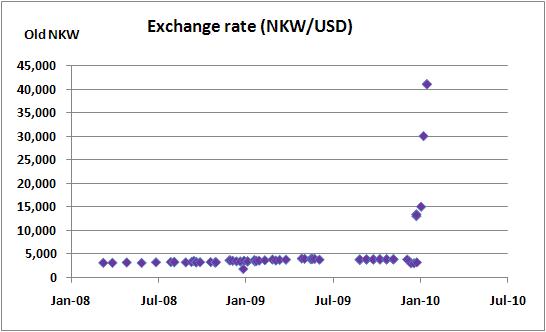
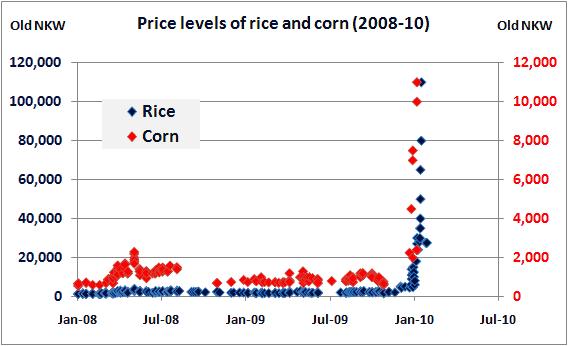
Marcus Noland wrote an op-ed for the BBC which is posted on the Peterson Institute web page.  There are some differences in the two (the BBC piece is shorter), so you can read whichever you prefer.  Below, however, I have posted the graphs from the Peterson Institute web page with some commentary:

noland-rice-corn-2008.JPG

This chart indicates the market for rice was surprisingly efficient before the currency conversion.  Over a two year window, the observed price seems remarkably stable (although the scale of the graph makes it hard to see the the actual level of price volatility).  Still, it seems fair to say that North Korean rice producers, vendors, and smugglers are quick to spot and eliminate regional price differentials through arbitrage. The supply of rice must also be highly highly elastic.  If the North Korean economy was experiencing inflationary pressures in this time, productivity gains and competition would have to have kept the nominal price essentially flat and caused the real price of rice to fall!

The price of corn is somewhat more volatile and I would be interested in hearing theories as to why this is. 

noland-dollar-2008.JPG

This chart is surprising as well. We see a highly stable US Dollar/DPRK won black market exchange rate (though again, the scale of the graph makes it difficult to determine just how stable).  Although the DPRK has not published its monetary policy goals (as far as I am aware), I think it is fair to say that the North Koreans practice exchange rate targeting. Most likely the target is not the US dollar, but the Chinese yuan–which trades at a nearly constant level with the US dollar.  Since China is the DPRK’s largest trading partner, it would make sense that the authorities would aim for exchange rate stability.  This would suggest, however, that the DPRK’s monetary authorities are well aware of the black market value of their currency and have the tools to  affect the exchange rate (i.e. lots of RMB reserves to sell on the black market).  I am not sure how plausible this is, but I am not sure how else we can explain this level of exchange rate stability.

Share

Canada admits 66 DPRK defectors in 2009

Wednesday, February 3rd, 2010

According to the Korea Times:

Canada granted 66 North Korean defectors refugee status in 2009, which is almost 10 times higher than in 2008, a report said Saturday.

Radio Free Asia, quoting a report from the Canadian Immigration and Refugee Board of Canada, said that more North Koreans are expected to receive the status as there are 59 defectors currently under review.

The North American country’s first case of granting refugee status to a North Korean was in 2000. In 2008, there were seven more cases.

According to the radio, a total of 93 North Koreans had also settled down in the United States as of last December.

Read the full article here:
66 North Koreans Given Refugee Status in Canada
Korea Times
Kim Sue-young
1/31/2010

Share

DPRK diplomat defects from Ethiopian embassy

Wednesday, January 27th, 2010

According to Yonhap:

A diplomat at the North Korean Embassy in Ethiopia defected to South Korea late last year after seeking asylum at the South Korean Embassy in the African country, an informed source said Tuesday.

The 40-year-old North Korean man, identified only by his surname of Kim, stormed into the South Korean embassy in October and spent several weeks there before arriving in Seoul in November, the source said, asking not to be identified.

The relationship between the DPRK and Ethiopia goes way back…to some dark days in Ethiopia’s history. 

Here are a few previous posts on the DPRK-Ethiopia relationship

Read the Yonhap story here:
N. Korean diplomat based in Ethiopia defects to S. Korea: source
Yonhap
1/26/2010

Share

2009 Inter-Korean trade tops US$1.6 billion

Monday, January 18th, 2010

Institute for Far Eastern Studies (IFES)
NK Brief No.10-01-19-1
2010-01-19

Last year, despite the impact of the economic recession, North Korea’s second nuclear test and other issues hindering inter-Korean exchanges, the previously sharply shrinking value of North-South Korean trade appeared to steady.

According to a report from the South Korean Customs Administration released on January 18, inter-Korean trade last year was down 8.5 percent from the previous year, amounting to 1.66608 billion USD. Exports to North Korea were worth 732.62 million USD, while 933.46 million USD worth of goods were brought into South Korea, giving Seoul a 200 million dollar trade deficit. Inter-Korean trade hit its lowest point last year in February (100.89 million USD), but since then showed slow-but-steady growth, hitting 173.18 in September.

In the aftermath of last year’s economic recession, together with the North Korean nuclear test, naval clashes in the West Sea in the area of the Northern Limit Line, etc., there were many difficult issues in 2009, but as inter-Korean trade numbers recovered in the fourth quarter, tensions eased slightly. Despite strained political tensions between the two Koreas, trade seemed not to be seriously affected, as DPRK goods were offloaded from a North Korean ship at Incheon Harbor and replaced with silica used for metal casting just six days after a clash between North and South Korean naval ships.

While growing trade is positive, this is the second year in a row South Korea has recorded a trade deficit with the North. In 2008, Seoul’s cross-border imports exceeded imports by 53.96 million USD. With Lehman Brothers’ collapse in September 2008 and the economic stagnation that followed, the South continued to record trade deficits for 15 straight months, until November of last year.

In December 2009, South Korean trade was back in the black (23.91 million USD) for the first time in 16 months. Looking back over time, it can be seen that inter-Korean trade has improved considerably over the years, recording a mere 705.68 million USD in 2004, 1.08872 billion USD in 2005, climbing to 1.3796 billion in 2006 and 1.79494 billion USD in 2007, and 1.82078 billion USD in 2008.

The import of North Korean sand, mushrooms, and smokeless charcoal briquettes in October 2009 required the permission of the South Korean government. This reflects Seoul’s more strict controls over management and oversight of inter-Korean trade following the sanctions and heightened concerns over cash deliveries to Pyongyang after its second nuclear test on May 25, 2009. Since the nuclear test, the South Korean government has limited the import of North Korean goods to only those that could ease losses being suffered by South Korean manufacturers.

According to the South Korean Ministry of Unification, among North Korean exports to the South in 2008, sand was the largest (according to value) export, with charcoal ranking ninth and (pine) mushrooms ranking eighteenth. 

Yonhap offered a short blurb: 

Trade between South and North Korea declined 8.5 percent on-year in 2009 due mainly to the worldwide economic slowdown that sapped demand and investments, a government report said Monday.

The Korea Customs Service (KCS) said inter-Korean trade reached US$1.66 billion last year, down from a record high of $1.82 billion tallied for 2008.

Read the full article here:
Inter-Korean trade falls off 8.5 pct in 2009
Yonhap
1/18/2009

Share

DPRK accepts RoK food offer

Friday, January 15th, 2010

According to Yonhap (1/15/2009):

North Korea told South Korea on Friday that it will accept the 10,000 tons of corn aid that South Korea offered in October, Seoul’s Unification Ministry said.

North Korea sent a fax message to the South, saying it “will receive the corn aid,” said ministry spokeswoman Lee Jong-joo.

Share

RoK’s Unification Ministry in 2010

Sunday, January 10th, 2010

According to the Daily NK:

The 2010 total budget for South Korea’s Ministry of Unification has risen to approximately $135.3 million overall, a year-on-year increase of 26.9%. This incorporates a project budget of $103 million. The project budget excludes personnel costs and other overheads.

The slice of the project budget earmarked for defector support is $73.07 million, some 70.9% of the total. Other budgeted items included unification education ($7.3 million, 7.1%), situation analysis ($4.7 million, 4.6%), unification policy ($3.6 million, 3.7%) and support for abductees ($3.9 million, 3.7%). In addition, the budget for inter-Korean meetings, information and economic cooperation was set at $10.2 million dollars.

The most significant increase is that for North Korea situation analysis projects, which has risen from just $0.35 million in 2009 to $4.8 million this year.

This steep budget increase comes as a direct result of a new situation analysis department, set up in May, 2009 for the purposes of systematic investigation and analysis of the North Korean situation. The size of the budget is similar to that for equivalent undertakings during the period up until the late 1990s when North Korea situation analysis was one of the primary tasks of the Ministry of Unification.

A strategic decision to try and take back the lead in information gathering seems to have been a factor in the decision to proceed with this project and allocate a substantial slice of the budget to it. The Ministry of Unification’s decision to proclaim 2010 a “key turning point” and forge ahead in inter-Korean relations requires the establishment of support systems to gather and analyze data.

Despite being technically in charge of inter-Korean relations, the Ministry of Unification has always relied heavily on intelligence agencies for information. This project appears to reflect the Ministry’s desire to understand inter-Korean relations independently and establish a system imbued with the Ministry’s own character.

The decision seems also to incorporate an implicit understanding that the Ministry of Unification should be able to demonstrate its information gathering capacity in various locations, not least inter-Korean economic cooperation locations like the Kaesong Industrial Complex.

In reality, the Ministry is also in a good position to systematically collect up-to-date information on North Korea from persons entering Hanawon, the education center for defectors, and from those South Koreans who visit North Korea with Ministry approval. Finally, the Ministry is also best-placed to interact with international organization officials who have information regarding the provision of aid and economic and agricultural conditions.

The major projects the Ministry of Unification is pursuing within the budget in order to strengthen its North Korea situation analysis capacity are; ▲ Development of a “North Korea situation index;” ▲ Establishment of a system to digitize North Korean broadcast data collection; and ▲ Establishment of infrastructure for the analysis of gathered data.

The Ministry is investing $1.62 million in its North Korea situation index development project. The aim is to develop an objective statistical index to evaluate situational changes in North Korean politics, diplomacy, military, economy, society and culture.

The digital data collection project is simply to facilitate the changeover from analog to digital data collection.

Infrastructure for the analysis of North Korea data simply means establishing a database on individuals during this year, extending the range of information into the fields of geography and industry in 2011.

In other areas of the budgetary allocation, unification education targeting the young is an interesting feature this year.

The Ministry has earmarked $0.53 million for a “Grand Youth Peaceful Reunification Rally” in commemoration of the 60th anniversary of the Korean War. The budget for school unification education has increased 8.2 times from $0.27 million in 2009 to $2.24 million this year.

The Ministry also plans to spend a further $4.5 million this year to acquire land and fund designs for the second Hanawon project, which is scheduled for completion by 2012 at a budget of $31.21 million. Currently, a number of possible sites in Gangwon Province are being considered.

Separate from the regular Ministry budget, inter-Korea cooperation funding levels are set in accordance with the state of inter-Korean relations. The South Korean government plans to prepare a budget for the ‘Grand Bargain’ using inter-Korean cooperation funds as and when progress is made in inter-Korean relations.

Read the full article here:
Unification Ministry Budgets for New Intelligence Role
Daily NK
Kim So Yeol
1/6/10

Share

Reunification costs

Sunday, January 3rd, 2010

According to Peter Beck in the Wall Street Journal:

The cost [of reunification] will depend in large part on how that transition unfolds. The best of the plausible scenarios would see Korea following the German path of sudden and bloodless reunification. The worst outcome would be violence akin to the unification of Vietnam or Yemen. A middle road would resemble the chaotic post-Communist transitions of Romania and Albania. This seems most likely given the similarities between Kim’s autocratic, autarkic rule and Nicolae Ceausescu’s and Enver Hoxha’s reigns in their countries.

Any of these outcomes is sure to be expensive because the North will require massive investments to build a modern economy. The economy collapsed in the 1990s amid a massive famine that likely killed hundreds of thousands. Infrastructure, starting with the power grid, railway lines and ports, will require tens of billions of dollars to build or upgrade. Few factories meet modern requirements and it will take years to rehabilitate agricultural lands. The biggest expense of all will be equalizing North Koreans’ incomes with their rich cousins in the South, whether through aid transfers or investments in human capital like education and health-care.

Even the best-case German model will cause heartburn in South Korean officials. Despite the $2 trillion price tag West Germany has paid over two decades, Bonn had it relatively easy in the beginning. East Germany’s population was only one-quarter of the West’s, and in 1989 East German per capita income was one-third of the West. The two Germanies also had extensive trade ties.

In contrast, North Korea’s per capita income is less than 5% of the South’s. Each year the dollar value of South Korea’s GDP expansion equals the entire North Korean economy. The Northern population is half the South’s and rising thanks to a high birth rate. North and South still barely trade with each other—China-Taiwan trade is 54 times greater in dollar terms than inter-Korean trade. That the North is starting from so far behind means even more resources will be needed than Germany required to achieve convergence in standards of living.

More than a dozen reports by governments, academics and investment banks in recent years have attempted to estimate the cost of Korean unification. At the low end, the Rand Corporation has figured on $50 billion. But that assumes only a doubling of Northern incomes from their current level, which would still leave incomes in the North at less than 10% of the South. At the high end of these projections, Credit Suisse estimated last year that unification would cost $1.5 trillion, but with North Korean incomes rising to only 60% of the South. I estimate that raising Northern incomes to 80% of Southern levels—which would likely be a political necessity—would cost anywhere from $2 trillion to $5 trillion, spread out over 30 years. That would work out to at least $40,000 per capita if distributed solely among South Koreans.

All of this leads to the question of who would foot the bill. China is the greatest supporter of the current regime in Pyongyang, with trade, investment and unconditional economic assistance worth $3 billion a year. Yet even if that flow continues to the Northern part of a reunified Korea (it most likely would not), it will be a fraction of the $67 billion a year that would be needed to equal $2 trillion over three decades. After South Korea, Japan would become the largest source of aid, but the $10 billion it is prepared to pay in reparations for having colonized the North would barely make a dent.

That leaves international institutions like the World Bank—and Seoul and the United States. It will be a wise investment to secure peace and prosperity in North Asia, but that money won’t grow on trees. Policy makers need to start considering now how they would spend it, to minimize the risk of wasting it in post-reunification confusion. And officials need to think about where they’ll secure the cash. Multinational corporations will rush in, but the bulk of the burden will fall on the shoulders of South Korea—requiring careful fiscal management, borrowing and tax increases.

Korean unification is unlikely to take place in the near future, but since it will most likely be sudden and cost trillions of dollars, the time to prepare is now.

I cannot find a copy of the Credit Suisse research on line this evening.  Here and here are a couple of media stories reporting on its findings.

Here is a link to the Rand Corporation study, “North Korean Paradoxes,”  mentioned above.

Here are some additional studies on this topic:

Global Economics Paper No. 188: A United Korea? Reassessing North Korea Risks
Goldman Sachs Slobal ECS Asia research
Goohoon Kwon, CFA
September 2009
(Post here)

Currency Conversion during Korean Unification
Brookings Institution
Yeongseop Rhee, Nonresident Fellow, Foreign Policy
January 2009
(Post here)

Prospects from Korean Unification
Colonel David Coghlan
Strategic Studies Institute, US Army

Share

RoK offers $22 million in aid to DPRK

Tuesday, December 29th, 2009

According to the AFP:

South Korea said Monday it would provide 26 billion won (22.2 million dollars) for humanitarian projects in North Korea, the second donation this month to its communist neighbour amid easing relations.

The unification ministry said it would donate 15.2 billion won to the World Health Organization’s programme for malnourished children and 4.7 billion won to the UN Children’s Fund UNICEF.

Spokesman Chun Hae-Sung said some six billion won has been allocated for a variety of other projects run by private groups.

“We decided to assist North Korean infants and children through private and international organisations, after considering the urgent situation in North Korea,” he told a briefing.

On December 18 the South shipped swine flu medication worth 15 million dollars to the North.

It was the first direct aid to Pyongyang from Seoul’s conservative government since it took office in February 2008.

Relations between the two Koreas have been interesting recently.   Official assistance from the South Korean government is at a near-term low, and the South Korean government spent little of the funds it appropriated for inter-Korean projects this year (See: here, here, and here).  South Korea has also tightened import rules for a number of North Korean goods (to protect local businesses), halted the export of luxury goods to the DPRK, and blacklisted DPRK businesses sanctioned by the UNSC. In addition, 2009 saw turmoil in the Kaesong Industrial Zone and a (predictable) naval clash along the NLL.

“Economic relations,” however, seem to have turned the corner recently.  Despite several months of decline, inter-Korean trade increased in the past two months.

Share

DPRK claims food output at 5 million tons

Sunday, December 27th, 2009

According to the Choson Ilbo:

North Korea in late October informed the UN its food output this year was 5.01 million tons, it emerged on Tuesday. The yield included 2.34 million tons of rice, 1.7 million tons of corn, 560,000 tons of potatoes, 240,000 tons of wheat and barley and 150,000 tons of beans.

The figure represents an increase of 330,000 tons over the 4.68 million tons the North claimed last year. The original estimate was about 4 million tons.

North Korea’s rice harvest increased this year thanks to little harm from floods and droughts, according to North Korea sources. Corn output was poor due to cold-weather damage in the border region with China and Kangwon Province. “Kim Jong-il appears to have carried out the shock currency reform out of confidence that the food situation next year won’t be worse than expected,” speculated a source.

If it is not in urgent need of food aid, the North can afford to be tougher in its dealings with the South and the U.S. for the time being. But there is a chance that the North exaggerated the food output in a bid to demonstrate the success of a “150-day struggle” and a “100-day struggle” where people were swept off urban streets and forced into labor on the collective farms.

With 5.01 million tons of staples, the North would face little problem in feeding its population of 24 million for a year. Its late leader Kim Il-sung once said, “Daily food consumption is about 10,000 tons. If we had 5 million tons of grains a year, we would be able not only to dole out food rations but feed the people with sugar and candy.”

But the food shortage in the North arises not only from a chronic quantitative shortfall but also from uneven distribution and supply. The authorities place priority in food supply on the party and the military. The burgeoning merchant class can also manage. But the old, the weak and the urban poor, estimated at 10 to 20 percent of the population, are marginalized. “Organizations aiding North Korea also need to improve monitoring of distribution,” said a South Korean government official.

Meanwhile, the UN Food and Agriculture Organization said the grain output North Korea informed it of in mid-November was 3.53 million tons. A source said this was because potatoes and beans, which are included in ordinary grain yield estimates, were omitted. “The aim may be to get the maximum possible food aid from the international community,” the source speculated.

Previous posts citing DPRK agriculture statistics can be found here.

Previous posts about the DPRK’s agriculture policies and outcomes can be found here.

Previous posts about the DPRK’s food situation can be found here.

Read the full article here:
N.Korea’s Claims Food Output of 5 Million Tons
Choson Ilbo
12/23/2009

Share