Archive for the ‘Statistics’ Category

Inter-Korean trade statistics update

Wednesday, August 24th, 2011

According to the Choson Ilbo:

According to the Unification Ministry, 123 firms were operating in the industrial park as of July, with combined production output amounting to US$34.87 million in May, up 25 percent from $27.79 million year-on-year.

The total volume of inter-Korean trade through the industrial park reached $825.88 million in the first half of this year, up 19.5 percent from last year and a whopping 135.8 percent from 2009.

South Korean staff dwindled from 1,461 in 2008, when inter-Korean trade was at its height, to 801 in May this year, but the number of North Korean workers rose from 36,650 to 47,172. And some 3,700 more North Korean workers were hired even since May last year when the South banned new investments there after the North sank the Navy corvette Cheonon in March.

At the moment, the regime is unlikely to shut down the industrial park, since nearly 50,000 North Koreans are working there. But experts stress that the government should take the seizure of the properties in the resort as a warning and be prepared for anything that the regime could do.

“There’s nothing we can be sure of in inter-Korean relations,” said Dong Yong-seung, a researcher at the Samsung Economic Research Institute. “Risk factors always exist because the government launched the Kaesong project without providing any safety net to protect its people and properties, as in the case of the Mt. Kumgang tour project.”

South Korean investments in the industrial park amount to W920 billion (US$1=W1,079) — W540 billion invested by the 123 firms, and W380 billion from the government and public corporations to lay the infrastructure, including electricity and communications facilities, and landscaping.

If the regime shuts down the industrial park, the South would suffer double the losses it incurred from the regime’s seizure of the properties in Mt. Kumgang, which are worth W484.1 billion.

Read the full story here:
Kaesong Firms Worry as N.Korea Seizes Mt. Kumgang Assets
Choson Ilbo
2011-8-24

Share

DPRK-China launch minerals – for – fertilizer program

Friday, August 19th, 2011

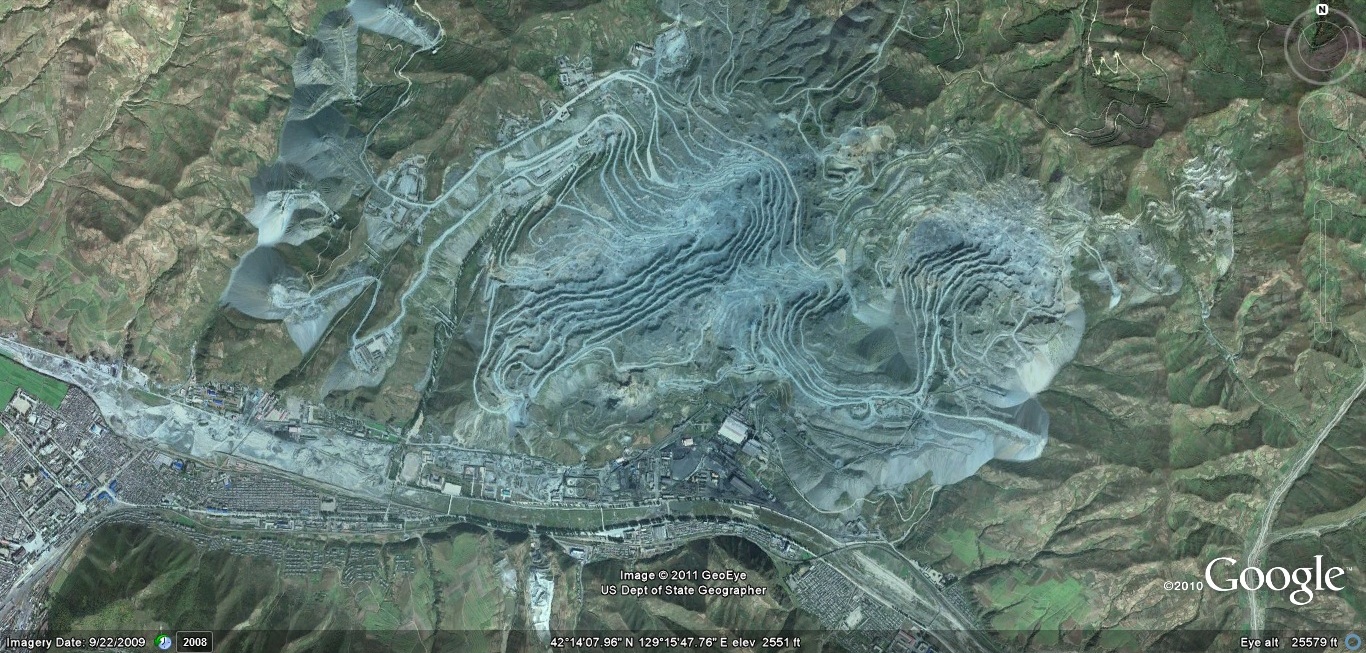
Pictured above (Google Earth): The Musan Mine, the DPRK’s largest.  See in Google Maps here.

According to the JoongAng Daily:

During his surprise May visit to China, North Korean leader Kim Jong-il secured free fertilizer and discounted food to help alleviate the impoverished country’s chronic food shortages.

A source in Beijing who monitors North Korea-China relations told the JoongAng Ilbo on Monday that Chinese officials agreed to provide 200,000 tons of fertilizer free of charge as well as 500,000 tons of corn at a discount in exchange for rights to North Korea’s abundant natural resources.

“When 200,000 tons of fertilizer is planted on North Korean soil, it can bring about a three-fold increase in the harvest,” the source said. “This can be the equivalent of giving 600,000 tons of food.”

The source added that China agreed to sell the 500,000 tons of corn for half of the international rate, which would be $30 per ton.

The corn, the source said, had already crossed the border into North Korea from northeastern China.

In exchange, Kim will allow China access to his country’s natural resources.

“The two parties agreed to participate in the extraction of buried rare earth minerals in Musan in Hamgyong Province,” the source said. “It’s quite a profit for China as it is thirsty for materials.”

North Korea is estimated to have around 20 million tons of rare earth minerals, which are vital in the production of high-tech goods.

The Beijing-based source said the agreement gives China the responsibility for the cost of building roads to transport the natural resources as well as lending equipment.

In exchange, North Korea will hand over 50 percent of the extracted rare earth minerals free of charge to China, with the rest to be sold to China at international market rates.

Meanwhile, other sources said that Kim also received a health checkup during his stay in China.

“When Kim Jong-il was visiting Yangzhou, he received a special examination from an oriental medicine doctor that the highest Chinese elite have gone to over the years,” a source familiar with North Korean issues said

The source added: “Kim Jong-il has never trusted China’s Western medicine. I heard from a Chinese official that Kim received an oriental medicine diagnosis by taking his pulse and that it did not involve drawing blood.”

Additional Information:

1. Here is a post linking to all the major DPRK food stories this year.

2. The media has reported on other DPRK food barter deals with Cambodia and Myanmar.

3. The role of the Musan Mine in DPRK-PRC relations has been quite interesting.  Here are previous posts on the mine.

Read the full story here:
North got fertilizer on Kim’s trip to China
JoongAng Daily
Chang Se-jeong
2011-8-19

Share

Inter-Korean trade volume for the first half of 2011 reached US$830 million

Wednesday, August 17th, 2011

Institute for Far Eastern Studies (IFES)
2011-8-11

Despite the current impasse in inter-Korean relations, the trade volume in the Kaesong Industrial Complex (KIC) continues to rise, up about 20 percent against last year.

According to the ROK Ministry of Unification, the inter-Korean trade via Kaesong totaled 825.88 million USD in the first six months of 2011. In comparison to last year’s 691.09 million USD, this is a 19.5 percent increase (134.795 million USD) and a whopping 135.8 percent climb (475.64 million USD) from 2009.

The total import reached 444.98 million USD, up 36.4 percent from last year. The total export recorded 389 million USD, a slight increase of 4.3 percent.

As of June 2011, there are about 123 companies reported to be in Kaesong. A total of 560 South Korean staffs work in the KIC, 155 of which joined since June of last year. There was also a boost in the number of North Korean workers; 3,161 new workers joined the complex from the year before, making the current number of North Korean employees 47,172.

In comparison, both commercial trade including general trade (mineral and agricultural products) and noncommercial trade such as humanitarian assistance and socio-cultural exchanges dwindled 16.2 percent (161.34 million USD) from the previous year.

The figure suggests the plunge was triggered by the sanctions imposed by the South Korean government on North Korea since May 24 of last year — a response to North Korea’s deadly provocation in March 2010 — cutting off most of the humanitarian assistance and exchanges. According to the ministry of unification, before the sanctions went into effect, general trade that comprised 30 percent fell below 1 percent and humanitarian assistance became nonexistent.

According to a recent survey conducted in the complex, economic loss engendered by the May 24 sanctions are estimated to be 3.875 billion USD. Out of the 154 total economic cooperation and trade firms in Kaesong, 104 claimed to have suffered economically, totaling over 430 million USD in losses.

The survey was conducted from January 24 to March 25 with 154 firms: 79.2 percent indicated the recent sanctions have significantly impacted their businesses; 3.2 percent answered “a little” effect; none answered “no effect at all.”

Moreover, 78.6 percent responded that the sanctions led to interruption in business operations and 12.3 percent replied that the sanctions resulted in complete shutdown.

In addition, reduction of staffs was also linked to the sanctions, in which 34.4 percent reported to have downsized by 20 percent, while 26.7 percent reported 30 to 40 percent cut backs in the number of staff.

Share

DPRK grain imports from China in first half of 2011

Sunday, August 14th, 2011

According to Yonhap:

North Korea imported more corn and less rice from China in the first half of this year than in the same period a year ago apparently due to a lack of foreign cash, a study showed Sunday.

North Korea’s grain imports from the neighboring country in the six-month period consisted of 38.2 percent corn, 37.5 percent flour, 16.9 percent rice and 7.2 percent beans, according to an analysis of the two countries’ trade by Kwon Tae-jin, vice president of the Korea Rural Economic Institute.

Last year, the figures stood at 34.2 percent flour, 28.8 percent corn, 19.3 percent rice and 16.4 percent beans, indicating an overall increase in imports of cheaper grains such as corn and flour this year, according to the study based on data from the Korea International Trade Association. Imports of rice and beans, meanwhile, fell from the same period last year.

This year, imports of beans cost $661 per ton on average, while a ton of rice, flour and corn sold for $538, $395 and $304, respectively.

The total amount of grain imports rose 5.5 percent to 149,173 tons, up from 141,395 tons in the first half of last year, apparently reflecting food shortages in the impoverished nation, the study said. Grain imports cost US$404 per ton on average, up 8.6 percent from $372 last year, bringing the total cost to $60.3 million, or 14.4 percent more than last year.

“The amount of grain imports last year was larger than in most years, but the fact that (North Korea) imported even more this year seems to indicate a shortage of food,” Kwon said in his study. “The larger imports of corn than beans or rice appears to be the result of a lack of foreign currency.”

Meanwhile, North Korea also boosted its imports of fertilizers by 91 percent in the first half of this year, buying a total of 190,396 tons compared with 99,588 tons in the same period last year. The country bought more than 164,000 tons of ammonium sulfate, which is sold at $188 per ton, while only importing some 25,000 tons of urea for $346 per ton.

“It seems like either fertilizer production in North Korea has dropped significantly, or they are aiming to boost their food production by a large amount,” Kwon said.

The Daily NK also published a story on these findings.

Read the full story here:
Lack of foreign cash forces N. Korea to buy more corn, less rice
Yonhap
2011-8-14

Share

CIA updates DPRK World Factbook statistics

Sunday, August 7th, 2011

According to Yonhap:

The life expectancy of an average North Korean stands at 68.9, placing it 149th among 222 countries checked, a U.S. media report said Saturday.

According to Voice of America (VOA), which cited the latest findings by the U.S. Central Intelligence Agency (CIA), the typical North Korean male born this year can expect to live 65 years, while the average female is expected to live 72.9 years.

The numbers are an estimation of how long babies who are born this year will live.

The VOA said that the original data did not elaborate on why there was a jump in the life expectancy of over four years. Last year, the CIA claimed North Korea’s life expectancy stood at 64.13 years.

The latest findings, meanwhile, said that as of July, there were over 24.45 million people in North Korea, with the U.S. Census Bureau predicting the population may grow by around 10 percent to 26.86 million by 2050.

The CIA periodically updates the data on its World Factbook (and changes the URLs), but because historical data is deleted and  the methodology for determining the findings is not publicly known, it is hard to know where exactly the numbers come from, why they have changed, or what it all means. With any change in data we could be looking at a new trend or we could be seeing corrections in previously flawed data.

The World Factbook’s “Guide to Country Comparisons” was the source for the statistics in this story.

Read the full story here:
N. Korea’s life expectancy ranks 149th in the world: report
Yonhap
2011-8-6

Share

Millions under threat as hunger stalks North Korea, says visitor

Thursday, August 4th, 2011

By Michael Rank

North Korea’s orphanages are full of malnourished children and food shortages in the isolated nation look set to get much worse, said a recent visitor who knows the country well.

Former member of the European Parliament Glyn Ford said shortages of food were affecting “tens of thousands of children, not just orphans, and there may be millions of people under threat of malnutrition” in North Korea.

Ford visited two orphanages in Hamhŭng (Hamheung), the country’s second largest city, where he was shown children who were extremely thin and clearly malnourished, and this had been confirmed by a European Union aid team. Each orphanage had about 300 children.

Ford said he had been encouraged by an EU pledge last month to provide emergency food aid worth 10 million euros ($14.3 million) to more than half a million people at risk of dying from serious malnutrition in North Korea, and that France and Germany had since added to this, making the assistance worth 14-16 million euros ($20-$22.8 million).

But at one of the orphanages he was told they had run out of EU food in June, and the children were suffering as a result.

The European Commission said the objective of the aid package was to lift around 650,000 people, mainly in northern and eastern provinces of the country, out of the hunger zone during the most difficult period of the worst year for food production in recent times. Food assistance will reach children under five who have already been hospitalised with severe acute malnutrition. Children in residential care will also be fed, as well as pregnant and breastfeeding women, hospital patients and the elderly.

An EU mission found in June that state-distributed food rations, upon which two thirds of the North Korean population depend, had been severely cut in recent months from 400g of cereals per person per day in early April to 150g in June: less than 400kCal – a fifth of the daily average nutritional requirement and equivalent to a small bowl of rice.

Ford told NKEW in a telephone interview that while there were clear signs of widespread hunger there was no sign, so far at least, of mass starvation, as happened in the 1990s, when hundreds of thousands, possibly millions, of people died.

He also said that despite the food shortages there were also signs that economic reforms of recent years were having a strong impact, and that in all populated areas roads were lined with rows of private stalls. “These blue plastic stalls are everywhere,” Ford said, adding that they were giving rise to

“kiosk capitalists” who were bucking the traditional, Stalinist economic system.

“This is a society where there are rich North Koreans. There are new cars and expensive consumer items in the shops. There is an economic elite rather than a Party elite,” he added.

Ford also visited the Kaesong (Gaeseong) Industrial Complex just north of the Demilitarised Zone, which he said consisted of large areas of waste land where plans for expansion had come to nought due to increased tension between North and South Korea.

The complex looked “a little bit sad”, he said, and the optimism that prevailed when he last visited it two or three years had dissipated. He said the zone continued to employ about 45,000 North Koreans, little changed from his previous visit, and hopes that it would employ 400,000 by 2015 now seemed highly unrealistic. “It was new then but the shining glow has gone off a bit,” he said, adding, “I noticed the gaps between the factories more than the factories themselves.” (Ford cited a goal of 400,000 workers eventually employed in the zone, but in 2006 a target of 700,000 was mentioned on the BBC’s Newsnight programme).

The complex, in operation since 2004, has around 120 factories, all South Korean-run, processing food and assembling clothing and machinery for export to the South.

Ford also said it seemed likely that the North Korea would open an embassy to the EU in Brussels before long, with a reciprocal EU embassy in Pyongyang. Although Pyongyang and the EU established diplomatic relations in 2001, embassies have not been opened due to French resistance, as France and Estonia are the only EU countries that do not have full diplomatic ties with North Korea.

France has cited human rights violations in its refusal to open an embassy in North Korea, but it has recently softened its line and has announced plans to open a “cooperation bureau” in Pyongyang. Ford said North Korea had long wanted to set up an embassy in Brussels and this now finally seemed likely, possibly by the middle of next year.

Ford, a British Labour Party MEP until 2009, spent about 12 days in North Korea, returning last Saturday. He has almost certainly visited North Korea more often than any other western politician, having been almost 20 times over the last 15-16 years. He was a member of the European Parliament’s Korean Peninsula delegation and in 2008 has published a book, North Korea on the Brink: Struggle for Survival.

Addendum: In January 2009 Ford hosted the first ever delegation from the Workers’ Party of Korea (WPK) delegation to visit Britain, when he pressed them to agree to reopen the dialogue that was  broken off in 2005.

Share

Cambodia and DPRK emigration

Wednesday, August 3rd, 2011

Sebastian Strangio points out a few interesting facts in the Asia Times about DPRK defection through Cambodia:

1. The Cambodian government has quietly worked to facilitate the processing of North Koreans as they move onto South Korea.

According to the US cables, the processing of North Korean arrivals is done in a quiet, ad hoc manner. In an October 2006 dispatch (06PHNOMPENH1927), Om Yentieng, one of Prime Minister Hun Sen’s advisors, was quoted as saying that the processing of North Koreans in Cambodia was “the result of an understanding reached between the prime minister and the South Korean ambassador to Cambodia”.

Secrecy was clearly a priority for the South Koreans. In a July 2007 cable (07PHNOMPENH925) documenting a meeting between South Korean and US officials to discuss the fate of five North Korean refugees in Cambodia who were seeking resettlement in the US, the South Koreans were “preoccupied with conveying their desire that the ROK [Republic of Korea – South Korea] pipeline for North Korean refugees not be publicly revealed”. They also demanded it remain separate from Washington’s own North Korean “refugee processing pipeline”.

A dispatch from April 2008 (08PHNOMPENH316) expressed gratitude to Cambodian officials for “expeditiously processing” the exit permits of two North Korean individuals who departed for the US on April 16. American officials were also “impressed” at Cambodian immigration officials’ “discreet handling” of the cases of another group of North Koreans who departed the previous November.

“During the quiet November departure, no one at the airport noticed the North Koreans’ comings and goings,” it stated. (According to figures released by the Office of Immigration Statistics at the Department of Homeland Security in May, the US resettled more than 100 North Korean refugees between 2006 and 2010 under legislation to help improve human rights conditions in the reclusive country.)

2. Cambodia is no longer a major hub in the underground railraod.  Thailand is now the prefered destination.

It appears, however, that Cambodia has since declined in importance as a conduit for North Korean defectors in favor of a route through Laos into northern Thailand. Pastor Chun Ki-won, head of the Seoul-based refugee aid group Durihana said that Cambodia – along with Mongolia – was one of the few Asian countries willing to aid North Koreans at the start of the 2000s when refugee flows were still relatively low.

Durihana has helped around 900 North Korean defectors reach South Korea over the years. Chun’s first aid mission, which he undertook in July 2001, involved the smuggling of a North Korean woman and her child from northeast China to Phnom Penh via Vietnam. Cambodia increased in importance after December 2001, Chun said, when he was arrested in a Chinese crackdown trying to smuggle a group of refugees across the Mongolian border.

Chun said that due to increased vigilance by Vietnamese authorities, most North Korean refugees now arrive in Southeast Asia via Laos and Thailand. The claim is mirrored in figures from the Thai Immigration Bureau which reveal a 50-fold increase in North Korean arrivals from Laos, from 46 in 2004 – around the time arrivals in Cambodia seem to have begun their decline – to 2,482 in 2010. 870 North Korean refugee arrivals have already been recorded between January and April of this year.

In a 2006 cable from the US consulate in Chiang Mai (06CHIANGMAI79), one official predicted that the increase in North Korean refugee arrivals – then still fairly contained – “may yet be the tip of the iceberg”. “[E]vidence suggests that the stream of refugees is unlikely to decrease, with a network of Christian missionary organizations in Thailand and southern China cooperating to bring in more refugees through Yunnan province, Burma [Myanmar], and Laos and into Thailand’s Chiang Rai province,” the cable stated.

Read the full story here:
All aboard North Korea’s refugee railroad
Asia Times
Sebastian Strangio
2011-8-3

Share

On the demand for DPRK-made missiles

Tuesday, July 26th, 2011

UPDATE 3 (2011-9-27): The Center for Nonproliferation Studies hosted a panel discussion on Mr. Pollack’s report.  You can see all the presentations here.

UPDATE 2: The Washington Post has recently covered this study.

UPDATE 1: 38 North has published an article by Mr. Pollack which provides an interesting narrative of the market for North Korean missiles.

ORIGINAL POST: The Choson Ilbo published the following:

Forty percent of ballistic missiles developing nations have imported since 1987 came from North Korea, VOA reported Thursday.

The claim comes in a report titled “The Evolution of North Korea’s Ballistic Missile Market” by Joshua Pollack, a nuclear proliferation expert at the U.S. Science Applications International Corporation, who says, “More than 40 percent of the roughly 1,200 theater ballistic missile systems supplied to the developing world between 1987 and 2009 came from North Korea.”

During this period Iran, Egypt, Syria, Libya, Yemen, the U.A.E., and Pakistan imported missiles from the North. The North topped the list of ballistic missile suppliers, followed by Russia (400) and China (270).

But the North’s missile export began declining rapidly in 1994.

North Korea’s time as supplier of “complete missile systems” to the Middle East at large ended because the Middle East no longer had the need for rapid arms buildup and missile stockpiles after the end of the Iran-Iraq War, Pollack said.

The North proved “adaptable to shifting market and security environments” by “turning instead to the export of missile components and materials.” But missile importers had less demand for North Korean missiles as they built their own production capabilities, he added.

Pollack’s report was carried in the July issue of The Nonproliferation Review published by James Martin Center for Nonproliferation Studies at Monterey Institute of International Studies.

Mr. Pollack’s full report can be found here (PDF). It is well worth reading. Mr. Pollack is also a blogger at ArmsControlWonk.com.

Share

DPRK’s import of luxury goods and estimated trade data

Wednesday, July 20th, 2011

UPDATE 2 (2011-7-20): The Daily NK offers some more statistics:

It has been confirmed the North Korean authorities were concentrating on importing luxury items for privileged people, while international humanitarian organizations were worrying about North Korea’s chronic food shortage and the damage to the vulnerable classes.

According to statistics from the South Korean government and Chinese customs, from January to May this year, the cost of food import is only about 4% out of the total amount of imports, which translates to about 46 million dollars out of 1.148 billion dollars.

The total amount of trade with China was doubled as compared with the corresponding period from last year: exports were increased by 217% and imports by 58%. The export amount is 812 million dollars while the import is 1.148 billion dollars.

In comparison, around 10 million dollars were used to purchase high quality liquor, cigarettes and others for privileged classes. The amount of cigarette imports, such as Marlboro, Mild Seven and others, is 7.5 million dollars. 2.4 million dollars were used to buy Cognac or whisky like Chivas Regal, Hennessy X.O. and other kinds of alcohol.

The amount of alcohol imported was increased by 94 % compared to the same period of last year.

It was reported that other items, such as international designer brands clothes, watches, and other items and electronic goods from SONY and Samsung were also imported.

It also showed that North Korean authorities sold wheat it had received from the international community to other countries. 200,000 tons of phosphate rock, which is materials for fertilizer, provided by Middle Eastern countries for free in 2010, were sold to some countries in Europe.

In addition, since South Korean markets have been blocked due to May 24 Measures, North Korea tried to download agricultural products, which are disguised as Chinese products, onto South Korean vessels in international waters by secretly working with Chinese traders. The South Korean government reported that there were four cases last year and 11 cases so far this year.

So apparently everyone has seen the data source but me.

UPDATE 1 (2011-7-22): The Los Angeles Times picked up on the report and offered a few more details:

North Korea’s importing of luxury goods from China nearly doubled in the first five months of this year, compared with the same time period for 2010, according to a report by Beijing customs officials obtained by the South Korean Unification Ministry.

The communist regime spent $46 million on imported corn, rice and other food staples, but it also spent $10 million on luxury items from January through May of this year. Imported through China, the items reportedly include Marlboro cigarettes, Hennessy cognac, whiskey and Japanese beer, South Korean officials said this week, quoting the Chinese customs report.

The imports included about $500,000 worth of high-grade beef, apparently for luxury meals, which North Korean leader Kim Jong Il uses to maintain the support of the power elite, Seoul officials said.

This year, the regime again requested food aid, citing reduced crop yields. Though the European Union plans to send $14.5 million in food aid, the United States and South Korea have been reticent to supply such aid.

Some scholars believe that North Korea has exaggerated its need for food, alleging that the aid is turned over to the military or stored for future use, such as a planned celebration next year to mark the anniversary of the regime.

“I do not believe these claims about mass starvation,” said Andrei N. Lankov, a professor at Kookmin University in Seoul and the author of several books on North Korean history and politics.

He called the move by Pyongyang “a deliberate campaign to get free food, which will then be distributed to the privileged groups as government gifts. This will allow them to increase their legitimacy and win some popular support at the expense of the Western and South Korean taxpayers.”

I still have not seen the original Chinese source.  If anyone has it, please send it my way.

ORIGINAL POST (2011-7-20): Yonhap cites an unnamed South Korean government official (anyone want to take credit for these statistics?) who claims that the DPRK is skirting UN sanctions and obtaining luxury goods.  According to the article:

Despite years of food shortages, North Korean leader Kim Jong-il has engaged in the gift politics of showering his top aides and other elites with luxury goods to win their loyalty.

Some ruling elites also enjoyed McDonald’s hamburgers delivered from China via Air Koryo, North Korea’s flagship airline, the official said, without elaborating.

The North also spent about US$7.5 million in buying cigarettes such as Marlboro and Mild Seven in the first five months, a rise of 117 percent compared to the same period last year, according to figures by South Korea and China. It also showed that the North imported $2.4 million worth of Hennessy Cognac, whiskey and Japanese beer, up 94 percent compared to the same period last year.

The trade volume between North Korea and China stood at US$1.96 billion in the first five months, twice as much as in the same period last year, according to Lee.

Since the article does not name a source or provide any way to track down the numbers, take them with a grain of salt.

Read the full story here:
N. Korea imports luxury goods for ruling elites despite food shortages
Yonhap
2011-7-20

Share

DPRK defection numbers / trends update

Wednesday, July 20th, 2011

(2011-7-14) The International Crisis Group published a report on DPRK defectors living in South Korea.  Here is the executive summary.  Here is the full report (PDF).  Below are some statistics that others might like to know for future reference (Footnotes can be found in the original document):

There were only 86 defectors from 1990 to 1994, and the numbers remained under 100 each year until 1999. North Korea’s deteriorating economy and a subsequent famine in the mid-1990s, along with an erosion of border controls that opened an escape route into China, began to push the numbers higher by 2000. In 2001, 583 North Koreans arrived in South Korea. The following year the figure nearly doubled to 1,138. By 2007, about 10,000 North Korean defectors had arrived in the South, and by December 2010, the number reached 20,360. The number is expected to remain steady at about 2,500-3,000 per year or even to increase, although slightly fewer defectors arrived in 2010 due to tightened restrictions in North Korea, including greater punishment for attempting to defect.

In 1998, only 12 per cent of the 947 defectors in the South were female. But they surpassed males in 2002, and in 2010 they accounted for 76 per cent of the 2,376 defectors who arrived in the South. By January 2011, the cumulative total of defectors nineteen years of age and younger was 3,174 – 15.4 per cent of all defectors in the South.

About 70 per cent of the defectors arriving recently have graduated from middle school or high school, about 9 per cent have graduated from junior colleges, and about 8 per cent are college graduates. About 50 per cent were unemployed or dependents before they left the North, and about 39 per cent were workers.

According to Pak Chŏn-ran [Park Jeon-ran], a specialist on defectors at Seoul National University’s Institute for Unification Studies, “the health status of defectors who left their families in the North is five times worse than that of defectors who escaped North Korea with relatives or friends”.107 She also found in a study that 20 per cent of ailments afflicting defectors were psychosomatic. The medical staff at a government reintegration centre reported that about 70 per cent of their patients exhibited symptoms of depression or other stress-related disorders.

In 2007, researchers from Seoul National University disclosed that in interviews conducted with over 200 defectors, 80 per cent indicated they had contracted at least one ailment since arriving in the South. In April of the same year, the Korea Institute for Health and Social Affairs released a study on the health of 6,500 defectors who had arrived in the South between 2000 and 2005. Some 1.8 per cent were infected with syphilis in 2004 and 2.1 per cent in 2005. About 20 per cent of 700 women aged twenty to 49 suffered from some type of gynaecological disorder.

The Korea Centre for Disease Control and Prevention (KCDC) reports that the average height and weight of defectors is much lower than their South Korean counterparts. The average North Korean male defector is 164.4cm tall and weighs 60.2kg, compared to the average South Korean man, who stands 171.4cm tall and weighs 72kg. The figures for North Korean female defectors and South Korean women are: 154.2cm and 158.4cm; 52.8kg and 57.1kg. The average teenage male defector’s height is 155.7cm, 13.5cm less than the average South Korean counterpart; the average weight is 47.3kg, 13.5kg less than that of the South Korean. The average heights and weights for teenage female defectors and South Korean teenage females are: 151.1cm and 159.4cm; 46.9kg and 52.3kg.

In January 2011, only 50 per cent of defectors were employed (10,248 of 20,539), and most of these were in unskilled manual labour jobs (7,901, or 77 per cent of those employed). Only 439 defectors (4 per cent) were working in skilled jobs, and 381 were working in administrative positions.

Those who do find work earn on average W1.27 million (about $1,170) per month, which is just above the minimum subsistence level for a family of three.

These levels of unemployment persist despite subsidies for employers who hire defectors; the government provides up to W500,000 of monthly salaries for the first year and up to W700,000 of monthly salaries for the second year.

Many defectors reach the South with the help of people known as brokers. The journey can cost anywhere from $2,500 to $15,000. Many brokers will defer payment until the government in Seoul has paid resettlement money. To prevent a developing business in bringing defectors to the South, in 2005 the government cut the payments from a W10 million (about $9,400) lump sum to W6 million (about $5,600) paid out over several years. This has left many defectors with considerable debts.

More posts on this topic below:

(more…)

Share