Archive for the ‘Statistics’ Category

DPRK imports of Chinese silver surge

Thursday, March 28th, 2013

According to Yonhap:

North Korea imported an unusually massive amount of silver from China in January, possibly in relation to leader Kim Jong-un’s birthday that month, sources and China’s customs office said Thursday.

Data from China’s customs office showed that North Korea imported 661.71 kilograms of Chinese silver for US$653,128 in January.

The monthly import is unusually enormous given that the North took in only $77,593 worth of precious metal and other jewels for the whole of 2012. The corresponding amount for 2011 was $57,000.

Before January this year, the North had hardly spent more than $10,000 on monthly imports of such goods, according to the data.

Given the leader’s birthday on Jan. 8, North Korea watchers said the massive amount of imported silver may have been used to produce silverware souvenirs to celebrate the leader’s birthday.

“It’s difficult to assume the exact purpose of the silver imports,” a source said. Given that late leader Kim Jong-il used to bring in foreign brand luxury sedans and expensive watches to treat the country’s top echelon on major holidays, the bulk of silver imported in January may have been used for similar purposes, the source said.

Backing this assumption, the customs data also showed that the North imported an unusually large amount of costume jewelry worth $10,447 in the same month.

A reader points out this Daily NK story hypothesizing that the silver could have been used in batteries:

As such, there are suspicions that the recent North Korean decision to import more than 600kg of silver through China was done to facilitate the production of batteries for submersible production.

A North Korean military source told Daily NK on the 4th, “The [North Korean] Navy has been producing submersibles at every shipyard on their east and west coasts ever since the attack on the Cheonan in 2010.”

According to the inside source, prior to the Cheonan sinking such vessels were produced at one shipyard, the disguised ‘Bongdae Boiler Factory’ in Sinpo, South Hamkyung Province, at a rate of five per year. However, following the sinking of the Cheonan that rate went up four times to 16 per year, as the vessels started being produced across multiple shipyards including Yongampo, Chongjin and Rajin.

The source explained, “The reason why the North Korean authorities are increasing production of this kind of submersible that can fire torpedoes is to maximize their underwater attack capacity. The subs can take 12 to 15 soldiers yet still sink destroyers weighing thousands of tons with their twin torpedoes.”

“The engines noise on the submersibles is very quiet, making them able to approach their targets underwater in secret, while it is impossible to trace crimes such as the Cheonan incident,” the source went on, adding that during North Korean military training exercises they also emphasize the essential nature of the subs.

The rising production is pushing up demand for batteries, the source then went on to add, saying that this required the bulk production of both silver and zinc. “All the silver produced in North Korea is supplied to the shipyards,” he claimed.

The source admitted to being confused, therefore, at North Korea’s recent decision to import 660kg of silver from China, declaring, “There is lots of silver being produced in North Korea, so it’s hard to say why they are importing it from China…I suppose it may have been just that more batteries were being produced so they needed more silver.”

Read the full stories here:
N. Korea imports massive amount of Chinese silver in Jan.: data
Yonhap
2013-3-28

NK Producing More Silvery Subs
Daily NK
2013-4-5

Share

DPRK National Nutrition Survey final report

Tuesday, March 19th, 2013

The official UN web page is here.

Here is the description:

Conducted in all provinces of DPRK from September 17th to October 17th, 2012, the National Nutrition Survey was a joint collaboration between DPRK Government, involving the Central Bureau of Statistics (CBS), the Child Nutrition Institute, the MOPH and the National Coordination Committee as well as WHO, WFP and UNICEF.

Amongst others, the results of the survey show that Stunting remains an area of great concern in DPRK. About 28% of Korean children are stunted (Chronic Malnutrition) with provincial disparities. Acute malnutrition (4%) is present and varies according to provinces but even if the prevalence is not alarming, support is still needed to treat these children because of the high mortality risk associated with acute malnutrition. The survey also provides detail on children’s and women’s feeding practices.

You can download a PDF of the report here.

I have added this report to my “DPRK Economics Statistics Page”.

Share

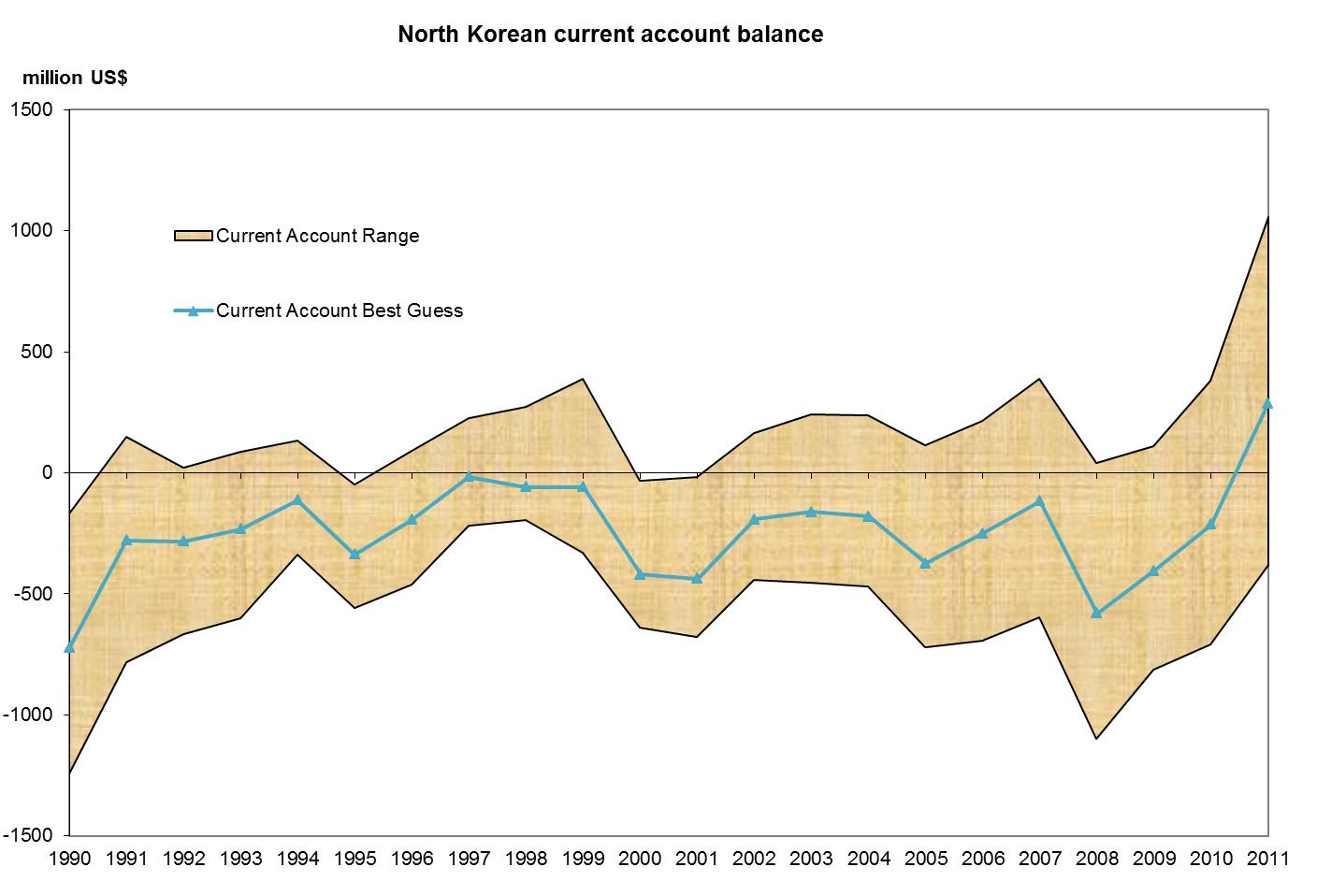
DPRK running a current account surplus

Monday, March 18th, 2013

The Bank of Korea has long reported that the DPRK has been running a current account deficit (see their summary report of the DPRK economy in 2011 here).

While working on their own statistics, however, Marcus Noland and Stephan Haggard assert that the DPRK may be running a current account surplus:

DPRK-trade-surplus-Noland

According to Noland:

[In all likelihood],  North Korea has run current account deficits for most of its history. That meant that the country was consuming more than it was producing, and the difference had to financed from abroad. However, on our calculation, largely on the back of expanding trade with China, the current account went into surplus in 2011. Our preliminary calculations suggest that the country probably also ran a surplus in 2012.

This is bad news, both for North Korea and the rest of us. It is bad news for North Korea because as a relatively poor country, they should be running a current account deficit, importing capital, and expanding productive capacity for future growth. Instead, our calculation suggests that they are exporting capital. Consumption at home is being needlessly compressed (the recent UNICEF survey documents continuing chronic food insecurity for some significant part of the populace) and instead, money is flowing abroad, presumably to finance the future consumption of the elite. Steph Haggard, in a post last week, pointed to evidence that this capital may be flowing into accounts in China.

It is also bad news for us. If North Korea is running current account surpluses, then they are less vulnerable to foreign pressure.

The Wall Street Journal offered additional information:

Messrs. Noland and Haggard said that taking a pulse on North Korea’s economy is inevitably speculative. Pyongyang doesn’t release trade figures, so estimates are made based on data provided by third parties.

According to South Korean estimates, North Korea’s total trade with its only major ally, China, nearly tripled to around $5.6 billion between 2007 and 2011, and in 2011 it showed a deficit of $700 million in goods trade—a major component of its current account. For there to be an overall surplus, as the research of Messrs. Noland and Haggard suggests, other components in the current account would have to be more than enough to offset that goods-trade shortfall.

“If there were massive dollar remittances back home by overseas North Koreans or a sharp increase in foreign tourists to the North, it would be possible for North Korea to run a current-account surplus despite a trade deficit,” said a Bank of Korea official in Seoul. “But you never know the exact reasons unless you see the full data.”

Share

Deforestation in the DPRK

Monday, March 18th, 2013

Yohnap reports on the UNDP’s 2013 Human Development Report. The report apparently mentions some statistics on the DPRK.  You can read the report here. The interface is awful.

Here is the report from Yonhap (via Global Post):

North Korea saw its forests shrink by nearly 31 percent in the past 20 years, a report by an international organization said Tuesday.

The size of forestlands in North Korea is down 30.9 percent as of 2010, compared to 1990, the 2013 Human Development Report by the United Nations Development Program said. The report ranked about 40 developing countries in terms of human development. It disclosed the North Korean data without including the country in its ranking.

The report also said that as of 2011, 8.6 percent of its animal and plant species are in danger of extinction.

The average life expectancy in North Korea is 69 while an average North Korean woman gives birth to two children in her lifetime as of last year, according to the report.

The average infant mortality rate — the number of babies who die within one year of their birth per 1,000 babies — reached 26 as of 2010 while the corresponding death rate for children under the age of five stood at 44, the report also noted.

A total of 6.6 North Koreans out of 100 used fixed-line or mobile telephone services as of 2010, according to the organization. Recent data from other sources have shown that the country with a population of about 25 million people had 660,000 mobile service subscribers in mid-2010. The number is believed to have soared to 1.5 million in late 2012.

Share

Grain imports from China fall in January

Monday, March 4th, 2013

According to Yonhap:

North Korea’s grain and fertilizer imports from China nosedived in January, Seoul’s Korea Rural Economic Institute said Sunday, citing data from the Korea International Trade Association.

North Korea imported 2,174 tons of grain and 2 tons of fertilizer from China in the first month of this year, the institute said. By product, flour imports totaled 1,172 tons and corn imports reached 540 tons.

The volume of imported grain marked a mere 9.2 percent of the North’s imports of Chinese grain in the previous month, while the corresponding figure for fertilizer amounted to 20 percent, the institute said.

Compared with the same month of last year, the figures reached 25.9 percent and 0.03 percent, respectively.

“The steep decline in the North’s grain imports from China is very unusual, even considering the past trend of grain imports decreasing every January,” said Kwon Tae-jin, a researcher at the institute.

Read the full story here:
N. Korea’s grain imports from China plunge in Jan.
Yonhap
2013-3-3

Share

DPRK life expectancy declines

Wednesday, February 20th, 2013

According to Yonhap:

North Korea’s life expectancy backtracked after 60 years of free medicare services, local analysts of the communist country said Wednesday.

The claims by Pyongyang observers comes as the latest United Nations Population Fund data showed the combined average life expectancy for men and women in the country stood at 69 in 2012, five years lower than a tally taken in the early 1980s. The average North Korean man is expected to live just 65.9 years according to last year’s findings, while the life expectancy for women reached 72.1. Both numbers placed the country in 117th place among countries checked.

Despite the regression, North Korean media such as the Rodong Sinmun, an organ of the ruling Workers’ Party of Korea, said in an article carried on Tuesday that the free universal medical care system has become the envy of countries around the world.

It added that the service reflects the will of the people and leadership to build an economically strong nation. The system was implemented in 1953.

The daily newspaper said because of the service, the size of country’s medical related spending surged 112 fold from 1940 to 1980.

The paper also said there was a 15.7 year rise in the country’s average life expectancy during the cited period. It claimed that the country’s life expectancy reached 74 in 1980, which is a different figure from the data provided by the U.N. organization for roughly the same time period. North Kore generally does not release life expectancy data, with the paper giving no numbers regarding life expectancy during the 1990-2000 period.

Related to Pyongyang’s insistence on maintaining the system and hailing it as a success, North Korean analysts said that the communist country’s free medicare is part of the political landscape that sets it apart from capitalist countries.

They said that despite what North Korean news outlets are saying, many defectors have argued that they paid money to be looked after by medical personnel while in the communist country.

Read the full story here:
N. Korea’s life expectancy backtracks after 60 years of free medicare
Yonhap
2013-2-20

Share

Inter-Korean trade hits record high in 2012

Saturday, February 9th, 2013

According to Yonhap:

Despite rising cross-border tension, the trade between South and North Korea reached a record high last year, government data showed Saturday.

The volume of trade between the two Koreas reached US$1.97 billion in 2012, inching up from the previous record of $1.91 billion in 2010, according to the data by the Korea Customs Service.

South Korean products worth $896.26 million were shipped to North Korea, up 13.4 percent from the previous year.

The amount of products that came here from the North jumped 19.3 percent on-year to $1.07 billion, according to the data.

A total of 99 percent of the volume was shipped through a land route linked to the inter-Korean industrial complex in the North’s border town of Kaesong.

Read the full story here:
Inter-Korean trade hits record high in 2012
Yonhap
2013-2-9

Share

Lee Myung-bak administration sets the lowest record for assistance to North Korea

Thursday, January 31st, 2013

Institute for Far Eastern studies (IFES)
2013-1-31

The total amount of assistance provided to North Korea by the South Korean government and private organizations in 2012 decreased by 28 percent against 2011, which marks six years of continuous decline.

The Ministry of Unification revealed on January 27 that the total amount of South Korean assistance to North Korea tallied 14.1 billion KRW (13 million USD), with 2.3 billion KRW (2.12 million USD) of government aid for vaccines and medical trainings and 11.8 billion KRW (10.89 million USD) from the private sector for medical supplies. This is a 28.1 percent drop from the previous year’s total of 1.96 billion KRW (18.09 million USD).

The South Korean government sent about 6.5 billion KRW (6 million USD) of medical supplies to North Korea via UNICEF and the private sector sent about 13.1 billion KRW (12.1 million USD) of malaria prevention supplies, powdered milk, soy milk, and flour.

Last year was the lowest record for humanitarian assistance to North Korea in sixteen years. Prior to this low was 1996, which recorded 3.6 billion KRW (3.3 million USD).

Lee Myung-bak administration’s aid to North Korea for the last five years reached a total of 257.5 billion KRW (236.2 million USD), with 102.4 billion KRW (93.94 million USD) in government funds and 155.1 billion KRW (142.3 million USD) from the private sector. This is equal to only 20 percent of the Roh Moo-hyun administration’s 1.275 trillion KRW (1.17 billion USD), and 44 percent of the Kim Dae-jung administration’s 582.9 billion KRW (534.8 million USD) of total aid to North Korea.

The highest record for South Korean humanitarian aid to North Korea was in 2006 at 298 billion KRW (273.4 million USD), in both government and private sector aid and continued to remain at a high level in 2007 with 289 billion KRW (265.1 million USD) in 2007. However, with the launch of the Lee Myung-bak government in 2008, it dropped to 116 billion KRW (106 million USD), and continued the downward slide recording 67.1 billion KRW (61.6 million USD) in 2009; 40.4 billion KRW (37.06 million USD) in 2010; 19.1 billion KRW in 2011 (17.5 million USD); and 14.1 billion KRW (12.9 million USD) in 2012.

The source of the drop in humanitarian assistance can be attributed to deadlocked inter-Korean relations followed by the shooting death of a Mount Kumgang tourist in 2008; long-range rocket launch and second nuclear test in 2009; and Cheonan and Yeonpyeong Island incidents in 2010.

From 1995 to 2012, the total amount of humanitarian aid to North Korea from the South Korean government was 1.48 trillion KRW (1.36 billion USD) and from the private sector was 871 billion KRW (799.1 million USD), equating to about 2.347 trillion KRW (2.15 billion USD) in total.

Meanwhile, international humanitarian aid to North Korea increased 30 percent in 2012 against the previous year. According to the United Nation’s Office for the Coordination of Humanitarian Affairs (OCHA), total aid to North Korea in 2012 was 113 million USD while the previous year reached 89.2 million USD. It quadrupled to the total amount, 24.4 million USD of 2010.

Nineteen countries joined in the effort to provide humanitarian aid to North Korea such as South Korea, Norway, Switzerland, Canada, Russia, Brazil, and Sweden. In 2010, there were only six countries, and it later increased to seventeen countries in 2011. The OCHA announced that the humanitarian aid provided in 2012 focused mainly on improving the food supply and nutrition, and provided agricultural support.

UPDATE: Here is a similar report in Yonhap (2013-1-27):

South Korea’s humanitarian aid to North Korea dropped 28 percent to a record 16-year low last year, the unification ministry said Sunday, as the cross-border relations remained chilled under Seoul’s outgoing government of President Lee Myung-bak.

Seoul’s humanitarian aid to the impoverished North totaled 14.1 billion won (US$13.1 million), compared with 19.6 billion won a year earlier. Last year’s amount is the lowest since 1996 when only 3.6 billion won was provided to the North in humanitarian aid.

The sharp drop came as relations between the two Koreas remained frozen since the North sank a South Korean warship near their Yellow Sea border in March 2010 and then shelled a border island in November that year. Pyongyang’s nuclear test and rocket launches also affected their ties.

The total amount of assistance the South provided the North during the five years of President Lee was 257.5 billion won, including 155.1 billion won of civilian aid. The total amount is only 20 percent of the aid sent during the presidency of Lee’s predecessor, the former late President Roh Moo-hyun.

Share

A review of the last five years of people-to-people exchanges and inter-Korean economic cooperation under the Lee Myung-bak government

Wednesday, January 23rd, 2013

Institute for Far Eastern Studies (IFES)
2013-1-23

The Ministry of Unification’s recent monthly report on ‘Trends on Inter-Korean Exchanges” included an examination of the last five years of the Lee Myung-bak administration’s (January 2008 to November 2012) people-to-people exchanges and economic cooperation between North and South Korea.

Over the past five years, total inter-Korean trade reached 8.94 billion USD, a growth of 58 percent against the previous Roh Moo-hyun administration’s 5.62 billion USD. This increase can be attributed to the steady growth of the Kaesong Industrial Complex (KIC). The KIC recorded a total trade volume of 6.695 billion USD under the incumbent administration, which is nearly a seven-fold increase compared to the previous Roh administration’s record of 957 million USD. Considering its importance, the KIC was exempt from South Korea’s May 24 (2010) sanctions imposed against the North.

During the Lee government, 108 companies were authorized for inter-Korean cooperation projects (including the Kaesong Industrial Complex). This represents a drastic drop from the previous government’s 370 companies. Under Lee, the number of cultural exchanges and related businesses that were approved were a mere 5, compared to the former administration’s record of 121.

Combined government and private sector assistance to North Korea totaled 256.3 billion KRW, only one fifth of what was recorded during the Roh administration (i.e., 1.27 trillion KRW). While the current government had more private sector support, the previous government showed more government support.

Over the 5 years of the Lee Myung-bak administration, 664,000 people traveled across the North-South border, which is significantly higher than the number (i.e., 390,002 people) recorded during the Roh administration. However, the majority were government officials, mainly those involved with the KIC.

The number of North Korean defectors that entered South Korea during the Lee administration’s term in office was 724 people, a significant drop from the 4,571 people during the 5-year term of the previous administration. Last year, no defectors entered South Korea — the first “zero-entry” in 14 years (that is, since 1998.

In terms of cross-border vehicle traffic, vehicles traveled across the border 840,009 times, an increase from the previous administration’s 490,000 visits. However, the quantity of goods transported dropped 40 percent from the previous, at 1.39 million tons.

In particular, after the ROKS Cheonan incident on March 2010, people-to-people exchanges and economic cooperation were completely halted due to the May 24 (2010) measures. The amount of goods transported was also largely reduced.

As far as cross-border rail is concerned, the Gyeongui Line (connecting South Korea to the KIC) and the Donghae Line (connecting the South to Mount Kumgang) were actively utilized during the Roh administration; but under the incumbent administration, only the Gyeongui Line was utilized.

During the Roh administration, the air traffic recorded 589 trips (42,495 people), but during the Lee government reached only 77 (3,812 people).

The number of separated families members reunited during the last five years was 1,774 (888 people in 2009 and 886 people in 2010). This is only a tenth of the 14,600 family members reunited during the former Roh Moo-hyun government.

Share

DPRK imports of grain / food from China drop

Tuesday, January 22nd, 2013

According to Yonhap:

North Korea imported significantly less grain and fertilizers from China last year, mainly due to improvements in overall food conditions in the country, local sources said Tuesday.

Kwon Tae-jin, a research fellow at the Seoul-based Korea Rural Community Corp., said data compiled from January through November showed North Korea’s grain imports from its neighboring country reaching 257,931 tons.

This represents a 26.8 percent decrease from 352,282 tons tallied for the same 11 month period in 2011.

“There was a noticeable drop in various grain imports last year,” the researcher said, adding that imports of corn and rice fell 19.2 percent and 16.7 percent vis-a-vis the year before, with wheat and bean purchases declining 56.2 percent and 7.4 percent, respectively.

The latest data also showed Pyongyang importing 252,780 tons of chemical fertilizers from China up till November, down 28.8 percent from 355,023 tons reported from the year before.

Experts in the South said the decrease reflected improvements in overall food supply in the communist country brought on by the new leadership paying more attention to the economy.

Read the full story here:
N. Korea’s grain, fertilizer imports from China fall sharply
Yonhap
2013-1-22

Share