Archive for the ‘Political economy’ Category

Kim Jong Il Gets the Gifts, and All North Korea Ends Up Paying

Wednesday, May 16th, 2007

Bloomberg
Bradley Martin
5/16/2007

For decades, tourists visiting North Korea have been brought to a 200-room, 70,000-square-meter palace completed in 1978 that displays presents to Kim Il Sung, the “Great Leader,” who died in 1994.

Starting with Joseph Stalin’s 1945 gift of a bulletproof railway carriage, the items include a stuffed bird from American evangelist Billy Graham and a piece of the Berlin Wall donated by a German writer.

These days most visiting foreign dignitaries bring gifts for Kim’s eldest son and successor, Kim Jong Il, 65. The junior Kim’s loot is housed in a 20,000-square-meter (215,278-square- foot) annex that was completed in 1996 — a time when a famine was starving tens of thousands of North Koreans.

Why would the country have spent vast sums on four-ton bronze doors and polished marble floors? “Our people couldn’t display all these precious gifts in a poor palace,” says tour guide Hong Myong Gun. “So we built this palace with our best.”

The gifts in the windowless “International Friendship Exhibition” at Mt. Myohyang, a two-hour drive north of the capital, Pyongyang, range from the trivial to the grandiose.

Cable News Network founder Ted Turner donated paperweights with the CNN logo. A tribal chief in Nigeria offered a throne featuring carved lions, with matching crown and walking stick. Romanian communist dictator Nicolae Ceausescu brought the stuffed head of a bear he had hunted and killed.

Giving and Receiving

In Asia, the protocol of gift-giving has been well established since Chinese emperors began expecting visitors to bear tribute. The Chinese know how to give as well as to receive: Pride of place in the exhibit goes to one of their presents, a life-sized wax figure of Kim Il Sung standing on a three-dimensional representation of a lake shore.

Reverent music, calculated to induce bowing, plays in the background of the posthumous gift, the final exhibit viewed by visitors to the hall.

The elder Kim’s title of President for Eternity makes him the world’s only dead head of state, and Hong says he continues to receive gifts. As of last year, his presents numbered 221,411.

“No other president could draw so many presents, so our people live in pride,” she says. “Except for this place, where can you see such a sight?”

The annex for Kim Jong Il, whose titles include secretary general of the Workers’ Party and chairman of the Military Commission, houses 55,423 additional presents, Hong says. As with his father’s gifts, most of them were never used but were immediately donated to the exhibition.

A Dynasty Sedan

Some highlights in the annex: a 1998 luxury sedan from the founder of South Korea’s Hyundai group — the model named, appropriately enough, Dynasty — and two roomfuls of carved, gilded furniture from South Korea’s Ace Bed Co.

From time to time, groups of uniformed soldiers troop past to see the gifts. A high percentage of them are five feet tall or shorter. In the 1990s, North Korea reduced the minimum height for military service to 148 centimeters (4 foot 9 inches) from 150 centimeters and the minimum weight to 43 kilograms (95 pounds) from 48 kilograms, according to South Korea’s National Intelligence Service.

A 2004 World Food Program nutritional survey found that 37 percent of North Korean children suffered chronic malnutrition. The state “bears central responsibility” for the shrinking of North Koreans, says Marcus Noland of Washington’s Peterson Institute for International Economics, co-author of a new book about the famine.

Freeing Up Foreign Exchange

“As aid began arriving, the North Koreans cut commercial food imports, freeing up foreign exchange,” Noland said in an e-mail exchange.

The saved money was used to purchase surplus military aircraft from Kazakhstan and to build monuments “to the recently departed Great Leader Kim Il Sung and his son,” Noland says. If the regime had maintained the rate of commercial food imports during the 1990s, using aid as a supplement instead of a substitute, he says, “the famine could have been avoided.”

Noland estimates the death toll at 600,000 to 1 million; others have said as many as 4 million people may have died.

Tour guide Hong, 27, places the blame elsewhere. “From 1993 to 2000 our people suffered from countless natural disasters and also from other pressure in the economic field owing to the U.S. aggressors,” she says, referring to sanctions. Even during such hardships, she says, constructing the annex with the best materials was “the greatest desire of our people.”

As she speaks, there is a brief power blackout, a frequent occurrence in the energy-short country. When the lights come back on, Hong continues.

“Our people are very grateful because the Great Leader Kim Jong Il sent all the gifts here for the people to look at freely,” she says. “It was our duty to preserve them and show them to the new generation.”

Share

North Korean Propaganda Festival May Signal Shift in Policy

Thursday, May 10th, 2007

Bloomberg
Bradley Martin
5/10/2007

Since 2002, North Korea has invited visitors every few years to a festival featuring 60,000 dancers, gymnasts, acrobats and musicians, along with card-flippers who create vast pictorial mosaics covering one entire side of the 150,000-seat May Day stadium in the capital, Pyongyang.

The previous performance, in 2005, included noisy and bloody tableaux of North Korean soldiers making mincemeat of enemy soldiers. Last week’s Arirang production — named for a famous Korean love song — was different. Battlefield carnage was replaced with scenes of people seeking higher living standards by rebuilding factories and growing crops.

While North Korea is hardly going pacifist seven months after testing an atomic device, the propaganda shift may signal a significant change in policy, according to expatriate businessmen living in the isolated country. Now that it is a nuclear power, North Korea appears to be directing more resources to improving an economy on its knees after decades of sanctions and isolation, they say.

Korean officials “are now confident they can defend their country,” said Felix Abt, the Swiss president of PyongSu Pharma Joint Venture Co. Ltd., which recently started manufacturing painkillers and antibiotics in Pyongyang. “Their next priority is economic development.”

Consumer Goods

The policy emphasizes light industry to produce consumer goods. It was formally expressed in a joint editorial that was run at the beginning of the year in three major newspapers published by the regime, Abt said.

Getting verifiable information about policies in North Korea is still almost impossible, especially on tightly organized trips for foreigners in which government guides keep visitors on a short leash.

And if the propaganda on display during one of these visits last week can be believed, the government continues to conceive any new economic policy along the lines of a traditional, planned economy, focused on state-owned enterprises where workers are inspired to redouble their efforts and produce miracles of socialist endeavor.

The Arirang show made this abundantly clear. In an act called “Power and Prosperity,” the audience was urged to emulate “youth shock brigade” members and other working people in North Pyongan Province who recently completed Thaechon Youth Power Station No. 4 in spite of catastrophic shortages of food, energy and most other materials that became evident in the early- to-mid-1990s.

`The Power’

The performance illustrated that North Korea needn’t depend on foreign donations, said Kim Song Ho, 32, one of the tour guides assigned to foreign visitors this month. “Our country has the power to live by ourselves,” said Kim, who worked for the World Food Program’s Pyongyang office until the government reintroduced rice rationing in 2005 and told foreign-aid organizations it could manage mainly on its own.

In Thaechon, Kim said, “workers constructed a power station despite the bad situation without any help. Now the slogan is, `We will work like Thaechon Power Station workers.’ We renovated factories, built new factories and now the economy is booming more and more.”

Evidence of such economic change wasn’t included on the tour Kim was guiding. Kim said he would happily show such sites to the foreign visitor another time.

Different Conditions

The development schemes aren’t directly modeled on those of China or Vietnam, locals stressed. “The conditions of the Chinese and Koreans are different,” said Kim Hyon Chol, the 32- year-old chief guide of the tour group. “The biggest difference is that our country is not united.”

The regime has kept its propaganda options open on its military direction.

Billboards in the capital city showed a U.S. and a Japanese soldier both skewered on the same bayonet. And while there was no sequence in the Arirang show celebrating the country’s nuclear explosion or missile tests, a military parade on April 25 to which foreign residents were invited showed off a missile said to be capable of hitting U.S. bases on Guam.

At the Demilitarized Zone, which has divided North from South Korea since the Korean War armistice agreement was signed in 1953, Korean People’s Army Captain Han Myong Gil was asked whether North Korea is safer since its nuclear test. He replied that U.S. and South Korean forces had held huge military exercises even as diplomats talked of trying to bring peace to the Korean peninsula.

`Hostile Attitude’

“The saying goes in Korea, `If there are many clouds, it will soon rain,”’ the 28-year-old career officer said. “We can’t feel safe until the U.S. gives up its hostile attitude.”

Han eventually responded to a question about what he thought of his government’s spending money on a huge military apparatus – – North Korea’s troop strength is the world’s fourth largest — while people don’t have enough food.

“We receive fright and oppression from the U.S., so I cannot hide that our living standard is not high,” Han said. “We were on an arduous march for a long time. Now we are very proud because we defended socialism with the military-first policy. A strong country can defend itself, but the weak will be beaten down.”

Share

Photos of Kim Jong Il’s Brother, Kim Pyong Il and Recent Visits

Wednesday, May 9th, 2007

Daily NK
Kim Song A
5/9/2007

KPI.jpg

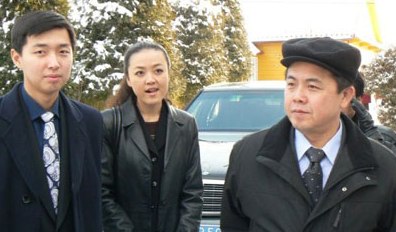
Photos of Kim Jong Il’s half-brother, Kim Pyong Il and the North Korean ambassador in Poland were recently made public.

Kim Pyong Il’s daughter, Eung Song and son, In Kang who have until now lived a sheltered and private life are also exposed in the photos. They are Kim Jong Il’s niece and nephew.

The photos were first released in March on Poland’s City of Narew homepage. The photos show Kim Pyong Il, his children and city officials making visitations to industrial sites, exhibitions, museums and participating recreational activities. In reference to the photos, it seems that these events took place on February 10.

Throughout the past, North Korea has maintained economic and cultural exchanges through the Korean Friendship Association with various countries in the East-European bloc. The events that took place on this day were organized by the association with North Koreans residing in Poland also participating in the occasion.

The homepage showed photos of Kim Il Pyong Il visiting NARMET Pty Ltd, his son, In Kang playing a game of table tennis and daughter Eun Song playing the piano.

Through the photos of Kim Pyong Il, you can see an exact resemblance of his father, though a “younger Kim Il Sung.” His two children are known to have completed a Masters degree in Poland and look healthy and well in appearance.

Kim Jong Il has one younger sister Kim Kyung Hee (married to Jang Sung Taek) as well as half-brothers (to different mothers) Kim Pyong Il, Kim Young Il (deceased 2000) and half-sister Kim Kyung Jin (51, married to Kim Kwang Sup, Ambassador to Austria). After being appointed as the successor in 1974, Kim Jong Il sent his brothers and sisters to work at alternative foreign departments so that they could not interfere with his power.

According to elite North Korean officials, there was a time where Kim Il Sung had considered appointing his succession to his three sons, “Jong Il, the Party, Pyong Il, the military and the government to Young Il.” However, after winning a power conflict with his uncle Kim Young Joo, Kim Jong Il ousted his uncle to Jagang province and sent his other siblings including Pyong Il to other departments where they could not come near of his power.

Kim Pyong Il was born on August 10 1954 and graduated from Kim Il Sung University with a major in economics. Following, he was appointed a high rank position and after passing the Kim Il Sung National War College, began working as a battalion commander at the guards headquarters. Once it was confirmed that Kim Jong Il would succeed his father, Kim Pyong Il left Pyongyang in 1979 to work at the North Korean Embassy in Yugoslavia. Around the same time, Kim Kyung Jin left with her husband for Czechoslovakia and Kim Young Il to East Germany.

In 1988, Kim Pyong Il was appointed Ambassador for Hungary but as soon as South Korea and Hungary developed amiable relations in December that year, he was re-appointed as the Ambassador to Bulgaria. Then in 1998, he became the official Ambassador to Poland where he has continued his services until now.

Kim Pyong Il’s wife is Kim Soon Geum. It is the first time that photos of their daughter Eun Song and son, In Kang, have been exposed to the public. When Kim Jong Il and his first wife Kim Young Sook had their first daughter, Kim Il Sung named the child “Sul Song.” When Kim Kyung Hee had her first daughter, she was named “Geum Song.” Similarly, it seems that Kim Il Sung named Kim Pyong Il’s first daughter, “Eun Song.” Kim Kyung Hee’s first daughter Jang Geum Song was known to have committed suicide last year in France as her parents opposed a marital proposal.

Of North Korea’s central committee under the Workers’ Party, the office 10 is known for regulating, controlling and being responsible for Kim Jong Il’s half-siblings.

Kim Pyong Il: North Korea’s Man in Poland
Daily NK
Nicolas Levi
5/17/2009

In February 2005, when I met Kim Pyong Il in Poland for the first time, he told me that he favored ameliorating the human consequences of the division of Korea.

Afterwards he started to talk to the other people present there in a room at the North Korean embassy; one of them later told me that Kim Pyong Il is usually very discrete, and is rarely present at receptions in other embassies in Warsaw. He generally only goes to the Chinese and Russian embassies, and sometimes to the Romanian and Algerian ones as well. North Korea was a model for both communist Romania under Ceaucescu and Algeria, that’s why the North Korean ambassador has special ties with those countries. In addition, Shaif Badr Abdullah Qaid, the last Yemeni ambassador in Warsaw studied in Pyongyang in the 70’s and became Kim’s good friend; their conversations dealt with life in North Korea, but never about the private life of half brother of Kim Jong Il.

In February 2006, I had occasion to talk with Kim Pyong Il again during a reception on Kim Jong Il’s birthday. During this meeting I saw a confident Kim Pyong Il, happy in Poland. However our conversation remained very diplomatic; Kim agreed that Korea should be reunified peacefully.

I never talked with Kim In Kang (26), Kim Pyong Il’s son, but I did have the chance to meet his daughter Kim Eung Song (28) some 10 times, both with her friends and face to face. She was a very open person. She was not only a nice girl; she also had impressive languages-skills (she is fluent in English, Polish, French and presumably Russian). She had a great social life in Poland with many friends. However, her father ordered her to return to Pyongyang in 2007, where she was supposed to marry the son of a North Korean General. She refused for a time, but finally went back to the North Korean capital.

Kim Sun Gum (56), the wife of Kim Pyong Il is a very discreet person, and rarely talks to others. Theirs was an arranged marriage. The wedding was personally organized by Kim Il Sung. It is said that she has a political background; her family apparently comes from the special services.

The last time I met Kim Pyong Il, in February 2009, I told him that I was preparing a doctoral thesis about his extended family (Kim Il Sung has two official wives: Kim Jong Suk, the mother of Kim Jong Il and Kim Sung Ae who is Kim Pyong Il’s mother). He reacted violently, telling me it was too dangerous.

That was my last contact with Kim Pyong Il; we haven’t met again since.

Kim Jong Il has a younger sister called Kim Kyung Hee (married to Jang Sung Taek) as well as half-brothers Kim Pyong Il (55) and Kim Yong Il (deceased in 2000), and half-sister Kim Kyung Jin (51), who is married to Kim Kwang Sop, Ambassador to Austria. After being appointed successor to his father in 1974, Kim Jong Il sent his half-brothers and sisters to work in overseas missions so that they could not interfere with his power. Kim Pyong Il started out in Yugoslavia, before moving to Hungary in 1988. However, he was swiftly relocated to Bulgaria as part of a protest over the opening of diplomatic relations between Hungary and South Korea. He then went on to work in Finland, but since January 1998 has resided in Warsaw.

Nicolas Levi is a Polish free publisher whose interests are mainly connected with the Korean Peninsula.

Share

Kim Jong Il’s Economic Investigation Propagandistic at Most…Military Is Ultimately the Best

Tuesday, May 8th, 2007

Daily NK
Han Young Jin
5/8/2007

Looking after the army back-to back rapidly changing to a “hard-line attitude towards the U.S.?” 

While observing the economic facilities for a while, Kim Jong Il, who has put on the gesture of emphasizing “economics,” has recently come forward to look after the army once again.

Last 5th and 6th, North Korea’s Workers Party-sponsored Rodung Shinmun reported that Kim Jong Il visited the 967th and the 977th army one after another.

According to this source, Kim Jong Il relayed, “The fate of our military-first revolution as our great revolutionary inheritance and our socialist enterprise depends on the military power.” At the 977th army, he revealed, “I am pleased that the soldiers have an awakened mind and are responsibly carrying out inspections work.”

This year, Kim Jong Il’s army inspections include seven visits, including the recent ones: 593rd army (January 15th), 398th joint army (January 16th), 105th army (March 19th), 350th army (March 19th), and the 75th anniversary parade of the establishment of the People’s Army.

Last year, when nuclear experiments were enforced, 66 army inspections and army-related events were achieved while raising a confrontational front to the United States. Immediately after the nuclear tests, it spared 16 events in the economic areas of Wonsan Farm and South Hankyung Province Industry Scene while putting forth a confident image under “improvement of civilian lives.”

North Korean advertising media have cast their spotlight as if to show their interest in economic issues while relaying the news of Kim Jong Il’s inspections of Chungjin in North Hamkyung last February, the 4th Taechun power plant, and Jakangdo industry scene.

Further, the North Korean media, through sound arguments via Rodung Shinmum, maintained, “The days when our people can live well are not too far off.” Accordingly, Kim Jong Il’s back-to-back industry inspection walks were portrayed as intentions to renew the impoverished civilian lives in contrast with the past that stressed army inspections.

Advertising “improvement of civilian lives” but people do not believe

However, the grandiose promise of “improving civilian lives” did not show much difference after the economy-related facility visits. Therefore, looking after the army by Kim Jong Il, who does not have a vision or will regarding opening and reforms, may be an inevitable course of action.

Even after entering the spring poverty season last March to April and the busy faming season in May, not having any possibility of resolving the problem of provisions is one of the reasons why civilians are having a difficult time purely accepting Kim Jong Il’s walks related to the public welfare and the national advertisements.

Kim Jong Il’s back-to-back army visits seem to be a gesture to arouse distrust in the wilted popular sentiment by rotating the policy towards the U.S. to a hard-line one. By turning the blame on the U.S. for the BDA asset problem, he seems to be stepping up the solidarity of the army and civilian mind around anti-American sentiment. 

Share

State Sponsors of Terrorism

Wednesday, May 2nd, 2007

Korea Times
5/2/2007

Despite Pyongyang’s ardent plea, Washington has recently decided to retain North Korea on the list of countries that sponsor terrorism. In its annual report called “Patterns of Global Terrorism,” the United States stipulated North Korea as a state sponsor of terrorism, along with Iran, Cuba, Syria and Sudan. However, the U.S. State Department has considerably reduced and revised the grounds for designating it as a terrorism-sponsoring state, opening the way for dropping Pyongyang from it.

In other words, Washington is hinting if the North shows sincerity in abiding by the Feb. 13 agreement on denuclearization, it could de-listing Pyongyang from the list. The latest U.S. decision to keep the North on the list appears to reflect Washington’s judgment that actual situations in the Stalinist country have not changed much, although Pyongyang has persistently called for its exclusion from the list since the landmark agreement.

Everyone knows now the frozen funds at the Banco Delta Asia have obstructed the implementation of the Feb. 13 agreement. Still it is clear what Pyongyang has to do to extricate itself out of the current doldrums and move further towards being dropped from the list: Put the Feb. 13 accord into action without delay. The reclusive regime should show visible actions, such as inviting back international inspectors to its Yongbyon reactor site, indicating Pyongyang thinks the BDA issue has all but been settled.

It is not hard to understand North Korea’s position, but doing nothing only citing the BDA funds would solve nothing. Pyongyang should explain its current circumstances to the international society and ask for its help. By keeping to its original stance of linking the initial steps to the funds issue, the isolationist regime will have little to gain, only deepening its isolation from the rest of the world.

Aside from North Korea, South Korea needs to take issue with the U.S. State Department’s annual report that erased the part that “the South Korean government estimates about 485 persons were kidnapped or detained by North Korea since the Korean War (1950-53).” Washington, which must be well aware of two Koreas being at odds over the POW and abductee issue, has all but raised the ire of Pyongyang by removing the part on South Korean abductees. This would have a negative effect on Seoul if and when the two Koreas retake this issue.

The U.S. action comes as all the more regrettable, considering it has retained the Japanese abductee issue in close linkage to excluding Pyongyang from the list. The government should ask for a proper explanation and call for its correction.

And from the US State Department:

North Korea
The Democratic People’s Republic of Korea (DPRK) was not known to have sponsored any terrorist acts since the bombing of a Korean Airlines flight in 1987. The DPRK continued to harbor four Japanese Red Army members who participated in a jet hijacking in 1970. The Japanese government continued to seek a full accounting of the fate of the 12 Japanese nationals believed to have been abducted by DPRK state entities; five such abductees have been repatriated to Japan since 2002. In the February 13, 2007 Initial Actions Agreement, the United States agreed to “begin the process of removing the designation of the DPRK as a state-sponsor of terrorism.”

(no mention of Myanmar, with which the DPRK just re-established diplomatic relations)

Share

Capitalism vs. Socialism, Crackdown at Shinuiju

Thursday, April 26th, 2007

Daily NK
Kwon Jeong Hyun
4/26/2007

Since February, the Party began inspections at Shinuiju customs in an attempt to punish and prosecute customs officers that were requesting irrational demands to the people. In particular, authorities conducted strict investigations over customs officers in charge of rail cargo.

A source in North Korea said, “Authorities identified that an employee of a trading company in Shinuiju, Kim Jung Man (pseudonym) had secretly transported about 1000 tons of copper to sell in China over the past 3 years” and added, “It seems that organized groups incorporating Chinese customs officers have been engaging in smuggling.”

He said, “He (Kim) disappeared instantly. He is probably sentenced with a serious punishment. The atmosphere is melancholic as 6 other customs officers were also caught.” In addition to this, bag inspections are conducted and at the end of every day, customs officers must report the total amount of goods that passed through as well as receive feedback.

“Not only is the central authorities conducting inspections, the National Safety Agency has sent 3 pair teams to run investigations on customs at the station, ports and bridges” he said.

Inspections were conducted until April 15th, Kim Il Song’s birthday. Though the most part of North Korea’s social regime is corrupt, customs officers have received the greatest complaints and have the worst reputation for bribery. It seems that North Korean authorities have used inspections at Shinuiju customs as an example to set public order over the city of Shinuiju.

The moment inspectors enforced control over customs, the reduction of cargo trucks entering North Korea was quite noticeable. On average about 50-60 trucks passed through customs daily. Today only 20 are in operation of which Chinese cargo trucks are transporting the goods. Overall, the amount of trade has returned to the days of the past.

Further, investigations are being held throughout all of Shinuiju city. Authorities, the Safety Agency and investigating teams have united to confiscate items such as foreign CD’s, capitalist-style clothing and computer programs. Also, any devices that could be used as a means of foreign communication such as TV’s, radios and mobile phone are also being strictly regulated.

The source said, “Authorities are enforcing strict control over Shinuiju city to use it as a confrontation with capitalism and socialism” and “An order was made to protect the border gateway and that the former guard post (Shinuiju) must not be shaken.” The source confirmed that the goods caught at customs included computer software, CD’s, and foreign books including the bible.

Share

Former N. Korean smuggler named ambassador to Italy

Tuesday, April 24th, 2007

Yonhap
4/24/2007

A senior North Korean diplomat who was deported from Zimbabwe a decade and a half ago for smuggling rhino horns out of the country has been named the country’s new ambassador to Italy, according to the North’s official media Tuesday.

In 1992, Han Tae-song, now a career diplomat in his mid-50s, was expelled from the southern African country on suspicion of being engaged in illicit trafficking in rhino horns.

Since then, Han has worked in the field of international organizations at the North’s Foreign Ministry, specializing in United Nations affairs, the Korean Central News Agency reported.

North Korea and Italy established diplomatic ties in January 2000.

Share

DPRK Ambassador to Equatorial Guinea Appointed

Friday, April 20th, 2007

KCNA
4/20/2007

Kim Chun Bong was appointed as the DPRK ambassador e.p. to the Republic of Equatorial Guinea, according to a decree of the Presidium of the DPRK Supreme People’s Assembly.

Share

Ranking NK Military Official in Critical Condition

Tuesday, April 17th, 2007

Korea Times
4/17/2007

A close aide to North Korean leader Kim Jong-il was in critical condition due to kidney failure, a civic aid group here said Wednesday.

Jo Myong-rok, first vice chairman of North Korea’s National Defense Commission (NDC), was in critical condition after his kidney was damaged, said Good Friends, a Seoul-based civic relief organization, in a monthly newsletter. Kim Jong-il is the NDC chairman.

Jo is widely known as a close confidant of Kim Jong-il, as he paid a visit to then U.S. President Bill Clinton in 2000 as Kim’s special envoy.

Doctors expect the 79-year-old vice marshal to live another month or two, as he already had one of his kidneys removed 10 years ago, and has gone through treatment for cancer in his intestines, the organization said.

“There were rumors of Jo’s illness,” a South Korean government official, asking not to be named, commented, adding that specifics of the illness were not known.

Share

Cash Bribes for North Korean Authorities By Chinese Merchants

Monday, April 16th, 2007

Daily NK
Kang Jae Hyok
4/16/2007

In commemoration of the anniversary of Kim Il Song’s 95th birthday (Apr. 15), North Korea has been preparing various spring festivities including the “Arirang” performance.

The number of foreigners visiting North Korea during this time is also expected to escalate.

Recently, the DailyNK confirmed through Chinese merchants that bribery and gifts had been exchanged between North Korean authorities. It is these during these seasons of Kim Il Song and Kim Jong Il’s birthday and the founding of the Workers Party and the Republic that bribes are most favorable.

For the past 4 years, Ma Il Su (pseudonym, 43) a Chinese merchant living in Jilian has been importing North Korean agricultural produce and herbal medicines to sell in China. In a telephone conversation with the DailyNK, he informed on the 12th, “I have prepared a special gift to give to North Korean authorities for when I enter the country on the 14th.”

He said, “On the whole, anyone trading with Chosun (North Korea) also offers gifts to them… The best offering is in the form of money.”

“Offering cash to the nation is the best but there are times when electronic goods are also given” he said.

Ma continued, “In order to trade in Chosun, you need the cooperation of authorities on your side” and said, “To charm the hearts of authorities, gifts must be given frequently. The best way to do this is by offering gifts at times of Kim Il Song and Kim Jong Il’s birthday.”

“You should go to the People’s Committee and offer the gifts to the chairman directly saying, ‘I sincerely pray for the Great Leader’s health and Chosun’s growth.’ Then they (the North Koreans) become ecstatically excited they do not know what to do” he said.

When asked whether or not gifts had to be offered to individual authorities Ma said, “You cannot trade if you do not offer bribes to authorities… Officials prefer cash as well as watches or electronic goods such as widescreen TV’s. In particular, they like watches made from South Korea.”

“I have already arranged for sheets of Chinese currency to give to individual authorities in timing with Kim Il Song’s birthday” he said and added, “Nowadays, offering bribes has become a norm in North Korea. There would be chaos if a gift was not offered.”

Ma said, “I am aware that my fellow tradesmen are offering gifts of similar nature” and estimated, “If we collect the amount of gifts offered by the Chinese, there should be quite a lot.”

Money given by Chinese merchants to the People’s Committee first reaches the respective local authorities of the Party → higher party authorities → central authorities in Pyongyang, and finally is offered as a bribe to Kim Jong Il. In the end, the money is donated into Kim Jong Il’s private fund and used for his personal pleasures.

Following the July 1st measures in 2002, North Korea-China trade has expanded significantly with hundreds of Chinese merchants filtering into North Korea everyday. In accordance with Ma, the number of people offering bribes to North Korean authorities seems to be considerably large.

Share
