Archive for the ‘Political economy’ Category

The crying game…

Monday, February 11th, 2008

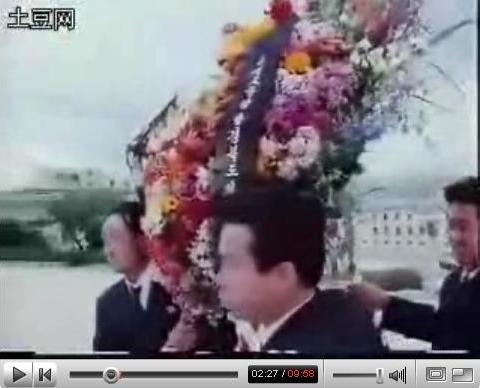
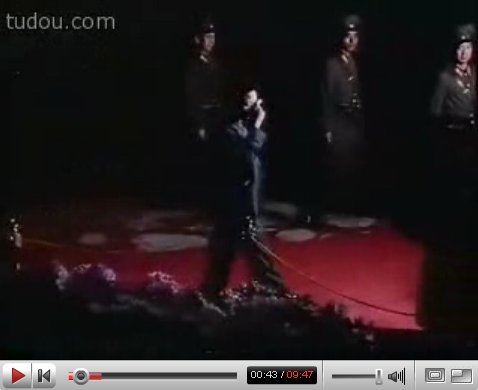
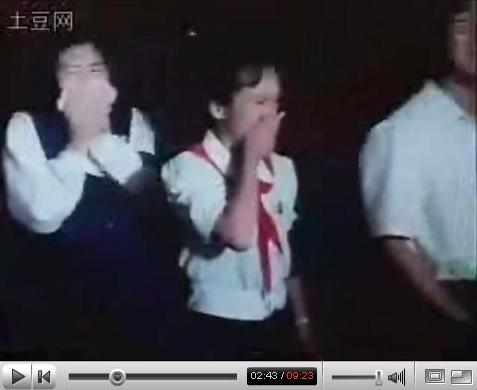
Below are three video’s recently posted on YouTube which portray North Korea’s national mourning in 1994 when Kim Il Sung passed away.  Although we do not know what people really think of the deceased leader, we do know that the public displays of sadness and eternal loyalty were scripted for television (and probably planned out in advance): Large crowds were mobilized at politically symbolic locations throughout the country, people were lined up in formations, given black arm bands, and placed in front of well-positioned television cameras to make sure they gave their best performances (which were strangely identical). 

The cameramen were also composed enough to carry out their tasks: Not only would they have to be dispatchted from Pyogyang to record the mass sadness, but they would have to arrive early to the scene, plan out their shots, record each scene several times, conduct multiple interviews, travel back to Pyongyang, and finally edit the footage into the final product.  This would all take a fair amount of time because travel conditions between the different locations would have been less than stellar.

Click on the images below to see the three part video:

Part 1. crying.bmp 

Part 2. crying2.JPG

Part 3. crying3.JPG

Share

Forced Expulsion of Six Households in Hyesan, with Charge of “Family Defection”

Friday, February 8th, 2008

Daily NK
Jung Kwon Ho
2/8/2008

On the 23rd of last month, six households were expelled from Haesan City in Yangang Province for the reason of “their families having fled to South Korea” and 25 households were simultaneously expelled under the charges of illicit trade along the North Korea-Chinese border, a North Korean inside source relayed on the 5th.

The source said, “6 of the 152 who were arrested at the inspection which was carried out from August to October of last year by the ‘5 divisions combined Anti-Socialist Inspection Group’ received a long-term prison labor camp sentence for the reason of ‘having secret communication with family members who defected to South Korea. When their sentence was confirmed, the expulsion of the rest of the family members ensued.”

The “5 divisions combined Anti-Socialist Inspection Group” carries out the duty of regulating the inspection of anti-socialist elements by temporarily transferring people and organizing groups from five organizations, such as the Party, the Central Procurator’s Office, the Central Court, the National Security Agency, and the People’s Safety Agency.

During this inspection, 152 people who possessed cell phones and are related to crossing the border were rounded-up, 50 received a long-term prison labor camp sentence, and 100 received a labor training corps sentence. Also, 25 households with charges of illegal trade along the North Korean-Chinese border and owned foreign films were expelled, which made a total of 31 households who were forcibly expelled.

According to the source, the North Korean authorities who were surprised by the inspection results of the Anti-Socialist Group formed the second group on December 19th and unfolded a concentrated investigation of cell phone possessions and connections to families who defected to China and South Korea in Hyesan, after having considered the gravity of illicit acts of civilians in the Yangkang Province border region.

The 31 households who were expelled were those who were detained in the first inspections which began in August, 2007 and another mobilized expulsion took place in the dead of the night under the order of the second-round Anti-Socialist Group.

The source relayed, “Those who were detained in the first-round of inspections mostly owned cell phones and were people who smuggled with Korean-Chinese people in China. The 2nd Anti-Socialist Group newly cast suspicion on receiving money from South Korean National Intelligence Service and handing over North Korean internal information.”

The Party committee of Hyesan, with the expulsion approaching, mobilized a general meeting per each people’s unit and gave the following order to civilians, “The people who are expelled are all relatives of the traitors who betrayed the country and are traitors who have sold our national secret. We must not help or sympathize with those who have participated in treasonous acts.”

Those who were purged were driven to a farmland far away from the border region without any means of basic survival and were forcibly moved to abandoned homes of those who had starved to death during the “March of Tribulation” or had become beggars.

The Party committees of the farming village held a meeting of farmers before the arrival of the expelled families and gave the order of “Those who are expelled are family members of those who committed ‘treasonous acts,’ so we must not help them.”

The source added, “The 31 households who were expelled were a part of the first round of purges and after February 16th (Kim Jong Il’s birthday), the number of households who will be expelled will increase. The cadres and Chinese emigrants who were detained in the first round of inspections were excluded from this expulsion.”

Share

IFES DPRK monthly recap: January 2008

Tuesday, February 5th, 2008

Institute for Far Eastern Studies (IFES)
NK Brief No. 08-2-5-1
2/5/2008

Kim Jong Il’s first visit of the year was reported on January 6 to have been to the Ryesonggnang hydro-electric power plant. Generally, the leader’s visits in the first months of the year, along with the New Year’s Joint Editorial, which focused on economic recovery, set the tone for the coming year’s policies. His second inspection of the year was to a military unit.

Defectors claim that prostitution is on the rise in North Korea, and on January 9, the aid group ‘Good Friends’ reported that the DPRK has begun to close massage parlors as part of a crackdown on prostitution. The agency reported that in the DPRK there was a “steady campaign to weed out decadent foreign culture,” and that in September, DPRK soldiers were ordered to avoid alcohol, sex, and money.

On January 16, it was reported that Kim Jong Il had instructed all DPRK institutions to reduce their bureaucracies, including senior staff, by thirty percent.

Figures released by North Korea’s Korean Central News Agency indicate that the DPRK’s population had increased to 23.6 million in 2004, the latest available figures. According to DPRK figures, the population has grown from 22.1 million in 1996.

North Korea announced the closure of its Australian embassy on January 22. While the DPRK will continue to maintain diplomatic relations with Australia, it apparently can no longer afford to maintain an embassy in Canberra.

According to a report released by the International Red Cross, North Korea has the largest number of people in the world killed by natural disasters over the past decade. The report states that 458 thousand North Koreans have died from natural disaster, 38 percent of the disaster-caused deaths in 220 countries from 1997-2006.

A U.S. Senate investigation reported that the DPRK funneled as much as 2.7 million USD through a bank account set up from UN development projects. The report stated that North Korea used the UN account due to fears that the United States would block its ability to transfer money internationally.

DPRK Nuclear Negotiations

2008 opened with the United States and Japan releasing statements expressing their disappointment at North Korea’s failure to meet its December 31 deadline to fully disclose the extent of its nuclear programs, while North Korea’s New Year’s Joint Editorial called for “stability on the Korean Peninsula and peace in the world” as well as an end to hostile U.S. policies. A U.S. White House spokesman stressed that there was still opportunity to move forward with negotiations, stating, “the important thing is that we get a declaration that…needs to be full and complete,” not whether the declaration is made by the deadline.

On January 4, North Korea claimed it had met its obligations to come clean on its nuclear programs, and that it had provided Washington with a list of its nuclear programs in November. Pyongyang also threatened to bolster its “war deterrent” because Washington had failed to provide promised aid following the declaration. Washington denied that any complete declaration had been made.

A senior Russian diplomat was quoted on January 11 as saying that while Russia regrets the slowed state of progress in talks on DPRK nuclear issues, Russia will fulfill its promise to provide the North with fuel oil. 50,000 tons of fuel oil were delivered on January 20~21.

According to a book of figures recently published by the National Statistical Office, ”Comparison of North and South Korean Socio-economic Circumstances”, the DPRK”s crude imports over the past several years bottomed out at 2,325,000 barrels in 1999, then rose to 4,244,000 barrels by 2001. Since 2001, imports have steadily fallen until only 3,841,000 barrels were imported in 2006, recording the least imports in the last five years.

North Korea opened its first online shopping mall in January. The site offers items from fourteen categories ranging from machinery and building materials to stamps and artworks. The site, www.dprk-economy.com/en/shop/index.php, is based in China.

Orascom Telecom, a Cairo-based phone operator, has been granted the first commercial license for provision of mobile phone services in North Korea. The license was granted to CHEO Technology, a subsidiary that is 25 percent-owned by the state-run Korea Post and Telecommunications Corporation.

DPRK Abduction Issue

The Cambodian Foreign Minister announced on January 16 that his country had been working behind the scenes to find a resolution to the DPRK-Japan abduction issue. The minister stated, “Cambodia is in a position where it can hold high-level meetings with North Korea, and it has the ability to persuade North Korea.”

Inter-Korean Affairs

The incoming Lee Myung-bak administration announced on January 4 a plan to develop an international cooperative fund to support North Korea’s economy. The plan is said to call for World Bank and the Asia Development Bank to help, and for South Korea to provide 40 billion USD.

On January 7, it was reported that Lee Myung-bak’s presidential transition team had asked the ROK Unification Ministry to slow the pace of inter-Korean economic projects and to link them to progress in the six-party talks. The incoming administration has promised not to link humanitarian projects such as rice and fertilizer aid to nuclear negotiations.

The Lee Myung-bak administration announced plans for downsizing the South Korean government, including disbanding of the Ministry of Unification. Opposition to the plan points out the role played by the ministry in improving inter-Korean relations, while proponents to the plan of relegating the ministry’s duties to the Ministry of Foreign Affairs and Trade applaud the move to align North Korea policy with standing foreign policy directives.

On January 14, it was reported that Lee Myung-bak had asked the United States to further engage in talks with DPRK military leaders, while presenting a balanced approach, stating that “our people don’t support the idea of giving lavish aid to the North nor do they want to irritate it too much, I believe.” He went on to add that the United States holds the key to easing DPRK fears of opening up.

The net worth of inter-Korean exchanges totaled 1,797,890,000 USD in 2007, up 33% from the 1.35 billion USD in the previous year. The almost 1.8 billion dollars in trade recorded in 2007 is the highest to date, and is equal to 65 percent of the DPRK”s non-Korean trade volume of 2.996 billion USD in 2006.

The Seoul-based International Vaccine Institute announced on January 14 that it will soon begin inoculating approximately six thousand North Korean children against bacterial meningitis and Japanese encephalitis.

The two Koreas began working-level military talks on January 25, marking the first talks of the year. During talks, the North proposed reducing the frequency of the inter-Korean rail services, citing a lack of cargo. The Southern delegation felt that the frequency was an important indication of inter-Korean cooperation. The two sides agreed to continue daily runs, but to reduce the number of empty carriages in the future.

North Korea is still not as attractive to businesses as other Asian neighbors. A survey released by the (South) Korea Chamber of Commerce and Industry on January 28 indicated that China and Vietnam are more attractive to ROK businesses. According to the survey, 80 percent of businesses have difficulties starting or operating businesses in North Korea.

An ROK special envoy returned on January 23 from Moscow after proposing a joint ROK-DPRK-Russian cooperative project in eastern Siberia. President-elect Lee Myung-bak sent a letter to Russian President Vladimir Putin pushing for cooperation of “North Korea’s workforce, Russia’s resources and capital, and [South] Korean technology.”

U.S.-DPRK Relations

On January 9, amidst reports concerning possible DPRK-Syria nuclear connections, it was reported that in 1991 Israel was posed to strike a ship suspected of delivering missiles from the DPRK to Syria, but was dissuaded by Washington.

A U.S. State Department official stated on January 22 that North Korea had met the legal criteria to be removed from the U.S. list of state sponsors of terrorism. This came just after reports of conflicting opinions within the Bush administration, with Secretary of State Condoleezza Rice sharply rebuking Special Envoy on North Korean Human Rights Lefkowitz, who stated that North Korea is not serious about nuclear disarmament. Rice went so far as to say that Lefkowitz “certainly has no say on what American policy will be in the six-party talks,” dismissing his negative position on the failure of North Korea to meet its obligations. The White House later stated that North Korea must make a full declaration of its nuclear activities before being removed from the list.

Five officials from the DPRK recently visited the United States in order to learn how to treat and prevent tuberculosis, a serious concern for the North that is “practically non-existent in most developed countries.” The officials were invited by The Korea Society, which is based in New York.

DPRK-PRC Relations

According to the PRC General Administration of Customs, China’s oil exports to North Korea were the same in 2007 as they were in 2006. China sent 523,160 tons of oil to North Korea in 2007.

A senior PRC Communist Party official traveled to Pyongyang for a meeting with Kim Jong Il on January 30. Wang Jiarui, director of the International Liaison Department of the Chinese communist party, was to convey a message to Kim, inviting him to the opening ceremony of the Beijing Olympics. While Kim reportedly told Wang that there would be no change in the DPRK stance on nuclear negotiations, he also assured the Chinese envoy that North Korea had no intention of harming DPRK-PRC relations.

Share

DPRK crackdown on trading offices finds corruption

Tuesday, February 5th, 2008

Institute for Far Eastern Studies (IFES)
NK Bfrief No. 08-2-5-2
2/5/2008

It appears that from the end of last year through this January, North Korean Party, regional, cabinet and People’s Committee officials have been carrying out inspections of trading companies, ordering massive layoffs and closings of companies where mis-management or other abnormalities are found.

In Yonhap News, a North Korean insider in Beijing, China was quoted on the 31st as saying, “Since November of last year, North Korean authorities have carried out inspections on trading companies under the control of each organization, with layoffs at most trading firms with abnormalities, deficits, or other mismanagement.”

According to the source, over 100 trading companies are registered in Chungjin, South Hamkyung Province, but after the current housecleaning measures are enforced, only around 15 will remain in operation, with practically all problematic offices being closed down.

Another North Korean source in Shenyang, China reported, “These inspections include trading offices run by the Party, military, and other so-called ‘powerful institutions’, so across the board, there are no exceptions, and as to the growing intensity [of the inspections], they are much stronger and wider in scope than formal annual inspections that have been carried out in the past.” “The order handed down at the end of last year to greatly reduce staff in the Party, military and Cabinet happens every year, but this year massive lay-offs in the workforce at trading companies appears to related to a different kind of personnel liquidation.”

These inspections reportedly stem from an incident at the end of last July in which Oh Moon-hyuk, branch manager of the Ruengra 888 trading company in Yunsa, North Hamkyung Province, was executed after being implicated in the smuggling of timber. The trading company was responsible for the export of timber, and operates under the control of the Party’s accounting bureau. The inside contact stated that because of this incident, North Korean authorities carried out further inspections, leading in October of last year to the dismissal of one official receiving vice-minister pay, and the broadening of the inspections nationwide.

Through the inspection-broadening measures, trade officials under the North Pyungan Province trade office also received an inspection party from the central government, causing many problems for Chinese traders who could not travel in from Dandong. Through these inspections, North Korean authorities reportedly uncovered several cases of embezzlement and misappropriation of company finances while the trading companies were exporting marine products or coal, iron ore, and other mining materials.

The goal of these inspections appears to have been the restoration of public order, just as the recent measures preventing women under the age of 45 from working in markets was a reaction to diminishing public discipline. In the future, price controls, regulations on export goods, or other government regulations regarding international trade are likely to be strengthened.

Share

Kim Jong il site visits indicate DPRK’s focus on economy

Saturday, February 2nd, 2008

Instutute for Far Eastern Studies (IFES)
NK Brief No. 08-1-24-1

1/24/2008

North Korean leader Kim Jong Il has started the new year by visiting a series of facilities and locations important to the economy in order to stimulate ‘Economic Revival’. DPRK media outlets reported on January 21 that Kim had examined the 18th national program performance and exhibition which opened last year, and that on the 6th, he visited the Ryesung Power Plant in North Hwanghae Province and dispensed on-location directives.

In North Korea, Kim’s new year’s traveling is indicative of the country’s national goals for the year, and Kim’s trip to economic facilities appears to indicate that DPRK authorities are focusing on rebuilding the economy this year.

On January 9, the Chosun Sinbo, a publication of the General Association of Korean Residents of Japan, reported, “In the changing face of the Northeast Asian political atmosphere emerging as the 6-Party agreement is implemented, [we] are preparing an advantageous atmosphere for the revival of the North Korean economy,” and called for “more active promotion of economic cooperation and exchange with each country in the world.” The article stressed promoting ‘21st century rehabilitation by one’s own effort’ by acquiring modern science and technology appropriate for the country.

Last year saw the beginning of improvement in U.S.-DPRK relations and resolution of nuclear issues, and the national strategy for this year seems to be economic expansion based on these developments. In particular, the symbolic significance of Kim Jong Il’s personal visits to two places of economic interest goes to show that North Korea is on a path intended for economic growth. In North Korea, on-location guidance by Kim Jong Il indicates national objectives and serves to focus national capabilities on that location.

According to North Korea’s New Year’s Joint Editorial, “The role of science and technology in the construction of an economically powerful nation must be decidedly elevated,” and went on to stress that, in line with the demands of the information industrial age, a revolution in education is necessary and a competent labor force that can participate in the creation of a strong and prosperous nation must be greatly promoted.

If Kim Jong Il’s inspection of the power plant is an indication of support for the construction of infrastructure and other electrical facilities necessary for economic development, the inspection program indicates what industrial sector the North will focus its energies on in the future. Through increased production in the light industrial and agricultural sectors, North Korea is expected to focus on improving the lives of the people first, and in the future, focus on development of the IT sector.

Share

North to close embassy in Australia next month

Thursday, January 31st, 2008

Unlike most other nations’ embassies, North Korean offices must not only self-finance their operations but they must also send money back home.  It looks like they were finding it hard to make a living in Canberra.  Though an enjoyable town, Canberra is so far from most of the economic action in Australia that they were probably unable to close any deals.  In the future, they should consider opening a consulate in Sydney–if they can afford the rent.

Joong Ang Daily
1/23/2008

North Korea can’t afford the bills anymore, so it will close its embassy here, Australia’s foreign ministry said yesterday.

North Korean diplomats informed Australian officials in November that the four-person embassy, located in a diplomatic quarter of Australia’s capital Canberra, would shut in February.

“The embassy advised that they plan to continue with non-resident diplomatic accreditation from Jakarta,” a foreign ministry spokesman told Reuters. The mission said in a letter it was closing due to “financial reasons.”

“The DPRK said it would consider reopening if its financial situation improves,” the spokesman said, referring to the North’s official name, the Democratic People’s Republic of Korea.

Australia is one of few Western countries to have diplomatic ties with the reclusive state. Pyongyang opened its embassy in May 2002.

In September 2006, Australia announced sanctions against 12 companies and one person connected with financing Pyongyang’s nuclear weapons program, including a visa ban on North Korean nationals and on North Korean shipping.

Share

2008 Index of Economic Freedom

Thursday, January 31st, 2008

efindexcover.jpgThe 2008 Index of Economic Freedom published by the Heritage Foundation and the Wall Street Journal covers 162 countries across 10 specific freedoms such as trade freedom, business freedom, investment freedom, and property rights. Unlike the Freedom House rankings, this is an index, meaning there is a first place winner (who should be rewarded with lots of investment and business creation) and a last place “winner” (who should be shamed into moving up the list for the same prizes)

The bottom ten countries:
148. Venezuela
149. Bangladesh
150. Belarus
151. Iran
152. Turkmenistan
153. Burma (Myanmar)
154. Libya
155. Zimbabwe
156. Cuba
157. North Korea  (unchanged)

Share

Freedom House: Freedom in the World 2008

Thursday, January 31st, 2008

mof.jpg

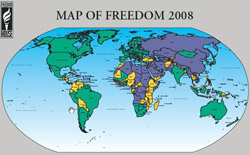
On January 16, Freedom House released the findings from the latest edition of Freedom in the World, the annual survey of global political rights and civil liberties.

The report surveyed 193 countries, 90 of which were rated “free,” 60 were labeled “partly free,” and the remaining 43 were labeled “not free.”

North Korea, rated “not free,” received the lowest rating of 7 in both political rights and civil liberties and remains one of the eight lowest rated countries along with Cuba, Turkmenistan, Uzbekistan, Libya, Sudan, Burma and Somalia.

Click here for the full report.

Share

N. Korea: Last cold warrior standing

Thursday, January 31st, 2008

Joong Ang Daily
1/18/2008

North Korean athletes will enter the 2008 Beijing Olympics in August with a completely different concept of international sport to the one embraced by former Cold War allies.

Eastern Bloc states used to spend heavily on sports systems that turned out Goliaths, whose wins at the Olympics were used to validate what they argued was a superior political system.

The impoverished North, however, is happier playing the role of David, where its rare wins are attributed to the teachings of pudgy leader Kim Jong-il and its losses are blamed on a playing field made unfair by its foes.

“North Korea’s paranoid nationalism can use defeat just as well as it can use victory,” said Brian Myers, an associate professor at Dongseo University in Seoul, South Korea. He specializes in analyzing the North’s ideology. The reclusive North spends its limited resources to inspire its masses and not to impress the outside world on the playing field.

“North Korean nationalism does not boast that North Koreans are physically superior to other races,” Myers explained. The North’s propaganda spreads the message of being morally superior.

North Korea is likely to grab a handful of medals in Beijing in sports such as judo, weightlifting or wrestling. It has shunned overtures from the South to compete as a joint team in Beijing, which could bring it greater sports glory, because its neighbor wants to field a squad with the best athletes on the Korean Peninsula. The North wants equal representation. At the 2004 Athens Olympics, South Korea won 30 medals while the North took five. Their combined 35 would have been seventh highest, just below the 37 of their mutual arch-rival Japan.

“North Korea has realized at this stage that no number of victories on the sports stage could change the country’s reputation as an economic basket case,” Myers said.

North Korea’s athletes may be better at providing entertainment for the opening ceremony than at competing. The North’s biggest sports spectacle is its Arirang Mass Games, a circus-like extravaganza that includes legions of teenage girl gymnasts, goose-stepping soldiers flashing taekwondo kicks and a massive flip-card animation section.

The message of the event, in which some 100,000 play a role, is that the group is North Korea’s strength, and the group reveres and protects the leaders of the destitute state.

Sports are often associated with the ruling communist party, featuring competitions with farming collectives, factory workers and soldiers. Its best athletes are celebrated for upholding “the dignity of the nation”.

“Sports constitute a powerful driving force in firmly preparing the entire people for national defense and labor,” its official media said, citing the teachings of state founder Kim Il Sung.

The North relishes the role of underdog. When one of its athletes or teams achieves even moderate success, it makes the most of the victory, proclaiming it a result of the state’s military-first policy and its self-reliance ideal called “juche.” And of course, Dear Leader Kim Jong-il, who is celebrated in state propaganda for penning operas, piloting jet fighters and shooting 11 holes-in-one the first time he played golf, also turns out to be a remarkable motivator for athletes.

After Jong Song-ok won the women’s marathon gold at the 1999 World Athletic Championships in Seville, state media quoted her as saying: “I ran the race picturing the great leader of our people Kim Jong-il. This greatly encouraged me and was the source of my strength.”

Kye Sun-hui, North Korean Olympic gold medalist in women’s judo, said Kim “gave her strength, courage, matchless guts and pluck.”

Share

North Korea dragged back to the past

Tuesday, January 29th, 2008

In the article below, Dr. Lankov makes a compelling argument that the North Korean government is now attempting to to re-stalinize the economy because the system cannot survive liberal economic reforms.

Altough the trend seems depressing, optimists should take note that Pyongyang’s efforts to reassert control over the economy parallel a decline in belief in the official ideology.  With a deterioration of this ideology, people’s acquiescence to the DPRK’s political leaders declines, and power dynamics are all that hold the system together.  Efforts to control the general population are increasingly seen by the people as self-interested behavior on the part of their leaders, calling their legitimacy into question.

Additionally, efforts to reassert control over the economy are bound to fail because the system has already collapsed, their capital has been stripped, and there are insufficient funds to rescue the system.

In other words, efforts to re-stalinize the economy are bound to fail from both an economic and ideological perspective.

North Korea dragged back to the past
Asia Times

Andrei Lankov
1/24/2008

When people talk about North Korea these days, they tend to focus on the never-ending saga of the six-party talks and the country’s supposed de-nuclearization. Domestic changes in the North, often ignored or overlooked, should attract more attention.

These changes are considerable and should not encourage those optimists who spent years predicting that given favorable circumstances the North Korean regime would mend its ways and follow the beneficial development line of China and Vietnam. Alas, the recent trend is clear: the North Korean regime is maintaining its counter-offensive against market forces.

Merely five years ago things looked differently. The decade that followed Kim Il-sung’s death in 1994 was the time of unprecedented social disruption and economic disaster culminating in the Great Famine of 1996-99, with its 1 million dead. The old Stalinist economy of steel mills and coal mines collapsed once the Soviets discontinued the aid that alone kept it afloat in earlier decades.

All meaningful economic activity moved to the booming private markets. The food rationing system, once unique in its thoroughness and ubiquity, collapsed, and populace survived through market activities as well as the “second”, or non-official, economy. The explosive growth of official corruption meant that many old restrictions, including a ban on unauthorized domestic travel, were not enforced any more. Border control collapsed and a few hundred thousand refugees fled to China. In other words, the old Stalinist system imploded, and a new grassroots capitalism took over.

The regime, however, did not approve the changes – obviously on assumption that these trends would eventually undermine the government’s control. Authorities staged occasional crackdowns on market activities, though those crackdowns seldom had any lasting impact: people had to survive somehow, and officials were only too willing to ignore the deviations if they were paid sufficient bribes.

By 2002 it seemed as if the government itself decided to bow to the pressure. In July that year, the Industrial Management Improvement Measures (never called “reforms”, since the word has always been a term of abuse in Pyongyang’s official vocabulary) decriminalized much market activity and introduced some changes in the industrial management system – very moderate and somewhat akin to the half-hearted Soviet “reforms” of the 1960s and 1970s.

The 2002 measures were widely hailed overseas as a sign of welcome changes: many Pyongyang sympathizers, especially from among the South Korean Left, still believe that only pressure from the “US imperialists” prevents Kim Jong-il and his entourage from embracing Chinese-style reforms. In fact, the 2002 measures were not that revolutionary: with few exceptions, the government simply gave belated approval to activities that had been going on for years and which the regime could not eradicate (even though it had tried a number of times). Nonetheless, this was clearly a sign of government’s willingness to accept what it could not redo.

However, around 2004 observers began to notice signs of policy reversal: the regime began to crack down on the new, dangerously liberal, activities of its subjects. By 2005, it became clear: the government wanted to turn the clock back, restoring the system that existed before the collapse of the 1990s. In other words, Kim Jong-il’s government spent the recent three of four years attempting to re-Stalinize the country.

This policy might be ruinous economically, but politically it makes perfect sense. It seems that North Korean leaders believe that their system cannot survive major liberalization. They might be correct in their pessimism. The country faces a choice that is unknown to China or Vietnam, two model nations of the post-Communist reform. It is the existence of South Korea that creates the major difference.

Unlike China or Vietnam, North Korea borders a rich and free country that speaks the same language and shares the same culture. The people of China and Vietnam, though well aware of the West’s affluence, do not see it as directly relevant to their problems: the United States and Japan surely are rich, but they are also foreign so their experiences are not directly relevant. But for the North Koreans, the comparison with South Korea hurts. Even according conservative estimates, per capita gross national income in the South is 17 times the level it is in the North; to put things in comparison, just before the Germany’s unification, per capita GNI in West Germany was roughly double that in East Germany.

Were North Korea to reform, the disparities with South Korea would become only starker to its population. This might produce a grave political crisis, so the North Korean government seemingly believes that in order to stay in control it should avoid any tampering with the system. Maintaining the information blockade is of special importance, since access to the overseas information might easily show the North Koreans both the backwardness of their country and the ineptitude of their government.

At the same time, from around 2002 the amount of foreign aid began to increase. The South Korean government, following the so-called Sunshine policy, began to provide generous and essentially unmonitored aid to Pyongyang. China did this as well. Both countries cited humanitarian concerns, even though it seems that the major driving force was the desire to avoid a dramatic and perhaps violent collapse of the North Korean state.

Whatever the reasons, North Korea’s leaders came to assume that their neighbors’ aid would save the country from the worst of famine. They also assumed that this aid, being delivered more or less unconditionally, could be quietly diverted for distribution among the politically valuable parts of the population – such as the military or the police, and this would further increase regime’s internal security.

So, backward movement began. In October 2005, Pyongyang stated that the Public Distribution System would be fully re-started, and it outlawed the sale of grain on the market (the ban has not been thoroughly enforced, thanks to endemic police corruption). Soon afterwards, came regulations prohibited males from trading at markets: the activities should be left only to the women or handicapped. The message was clear: able-bodied people should now go back to where they belong, to the factories of the old-style Stalinist economy.

There have been crackdowns on mobiles phones, and the border control was stepped up. There have been efforts to re-enforce the old prohibition of unauthorized travel. In short, using newly available resources, North Korea’s leaders do not rush to reform themselves, but rather try to turn clock back, restoring the social structure of the 1980s.

The recent changes indicate that this policy continues. From December only sufficiently old ladies are allowed to trade: in order to sell goods at the market a woman has to be at least 50 years old. This means that young and middle-aged women are pushed back to the government factories. Unlike earlier ban on commercial activity on men, this might have grave social consequences: since the revival of the markets in the mid-1990s, women constituted the vast number of vendors, and in most cases it was their earnings that made a family’s survival possible while men still chose to attend the idle factories and other official workplaces.

Other measures aim at reducing opportunities for market trade. In December, the amount of grain that can be moved by an individual was limited to ten kilograms. To facilitate control, some markets were ordered to close all but one gate and make sure that fences are high enough to prevent scaling.

Vendors do what they can to counter these measures. One trick is to use a sufficiently old woman as a figurehead for a family business. The real work is done by a younger woman, usually daughter or daughter-in-law of the nominal vendor, but in case of a police check the actual vendor can always argue that she is merely helping her old mother. Another trick is to trade outside the marketplace, on the streets. This uncontrolled trade often attracts police crackdowns, so vendors avoid times when they can be seen by officials going to their offices.

This autumn in Pyongyang there was an attempt, the first of this kind in years, to prescribe maximum prices of items sold in markets. Large price tables were displayed, and vendors were forbidden to sell goods (largely fish) at an “excessive price”. It was also reported that new regulations limit to 15 the number of items to be sold at one stall.

The government does not forget about other kinds of commercial activities. In recent years, private inns, eateries, and even bus companies began to appear in large numbers. In many cases these companies are thinly disguised as “government enterprises” or, more frequently, as “joint ventures” (many North Korean entrepreneurs have relatives in China and can easily persuade them to pose as investors and sign necessary papers).

Recently a number of such businesses were closed down by police. People were told that the roots of evil capitalism had to be destroyed, so every North Korean can enjoy a happy life working at a proper factory for the common good.

Yet even as the government pushes people back to the state sector of the economy, These new restrictions have little to do with attempts to revive production. A majority of North Korean factories have effectively died and in many cases cannot be re-started without massive investment – which is unlikely to arrive; investors are not much interested in factories where technology and equipment has sometimes remained unchanged since the 1930s.

However, in North Korea the surveillance and indoctrination system has always been centered around work units. Society used to operate on the assumption that every adult Korean male (and most females as well) had a “proper” job with some state-run facility. So, people are now sent back not so much to the production lines than to indoctrination sessions and the watchful eyes of police informers, and away from subversive rumors and dangerous temptations of the marketplace.

At the same time, border security has been stepped up. This has led to a dramatic decline in numbers of North Korean refugees crossing to China (from some 200,000 in 2000 to merely 30,000-40,000 at present). The authorities have said they will treat the border-crossers with greater severity, reviving the harsh approach that was quietly abandoned around 1996. In the 1970s and 1980s under Kim Il-sung, any North Korean trying to cross to China or who was extradited by the Chinese police would be sent to prison for few years.

More recently, the majority of caught border-crossers spent only few weeks in detention. The government says such leniency will soon end. Obviously, this combination of threats, improved surveillance and tighter border control has been effective.

The government is also trying to restore its control of information. Police recently raided and closed a number of video shops and karaoke clubs. Authorities are worried that these outlets can be used to propagate foreign (especially South Korean) pop culture. Selling, copying and watching South Korean video tapes or DVDs remain a serious crime, even though such “subversive materials” still can be obtained easily.

It is clear that North Korean leaders, seeking to resume control that slipped from them in the 1990s and early 2000s, are not concerned if the new measures damage the economy or people’s living standards when set against the threat to their own political domination and perhaps even their own physical survival.

Manifold obstacles nevertheless stand in the way of a revival of North Korean Stalinism.

First, large investment is needed to restart the economy and also – an important if underestimated factor – a sufficient number of true believers ready to make a sacrifice for the ideal. When the North Korean regime was developed in the 1940s and 1950s it had Soviet grants, an economic base left from the days of Japanese investment and a number of devoted zealots. The regime now has none of these. Foreign aid is barely enough to feed the population, and the country’s bureaucrats are extremely cynical about the official ideology.

Second, North Korea society is much changed. Common people have learned that they can survive without relying on rations and giveaways from the government. It will be a gross oversimplification to believe that all North Koreans prefer the relative freedoms of recent years to the grotesquely regimented but stable and predictable existence of the bygone era, but it seems that socially active people do feel that way and do not want to go back. Endemic corruption also constitutes a major obstacle: officials will be willing to ignore all regulations if they see a chance to enrich themselves.

It is telling that government could not carry out its 2005 promise to fully restart the public distribution (rationing) system. Now full rations are given only to residents of major cities while others receive reduced rations that are below the survival level. A related attempt to ban trade in grain at markets also failed: both popular pressure and police inclination to take bribes undermined the policy, so that grain is still traded openly at markets.

Even so, whether the government will succeed in re-Stalinizing society, its true intent remains the revival of the old system. North Korean leaders do not want reforms, assuming that these reforms will undermine their power. They are probably correct in this assumption.
Share