Archive for the ‘Political economy’ Category

North Korea’s Cultural Relations Strategy

Sunday, March 2nd, 2008

The international press (and just about every blogger on the planet-including myself) has written something about the NY Philharmonic’s visit to North Korea last week.  Whether one believes that this event is a significant breakthrough in cultural relations or not, what has evaded direct discussion in the media is the purpose of cultural relations in the North Korean system (and indeed its predecessor – the Soviet system).

At the end of World War II, the DPRK imported many Soviet party, state, and military organizations.  One of these was the USSR All Union Society for Cultural Relations with Foreign Countries (known as ‘VOKS’).  Publicly, the mission of VOKS was to promote peace and understanding between the Soviet people and other peoples of the world.  However, the actual mission of VOKS was to promote Soviet ideology, policy, and influence overseas. 

VOKS began its mission in the 1920s.  It undertook activities such as: Attempting to influence French intellectual circles; bringing sympathetic individuals and groups to tour the Soviet Union to see how the construction of the worker’s paradise was proceeding; bringing students from the developing world to be educated in the Soviet Union; sending Soviet scholars and technicians to undertake development projects overseas, etc.  VOKS was even influential in the USA, where it supported a number of pro-Soviet civil society organizations. 

VOKS also played an important role in establishing the legitimacy of Soviet hegemony in North Korea following World War II.  Cultural delegations of North Koreans were taken to the Soviet Union to bear witness to the great accomplishments of the worker’s revolution.  Their impressions were then distributed to the North Korean population at large, along with many other cultural goods produced by the Soviet Union. 

Although VOKS’ success at swaying public opinion in the west is an unresolved question (as far as I know), the details of their activities are well known to western scholars since Soviet archive materials are readily accessible. Effective or not, the take away from this history lesson is that socialist countries have historically treated cultural relations activities, like everything else, as regime-enhancing activities.  In other words, they promote the political incumbents. 

The North Koreans copied VOKS wholesale from the Soviets, and this organization is still functioning in the DPRK today.  It is the Korean Committee for Cultural Relations with Foreign Countries (CCRFC).  Although this body has been around since the founding of the DPRK, it is perhaps most known in contemporary times for supporting the Korean Friendship Association, numerous pro-Pyongyang “Friendship Societies,” and to a lesser degree, several leftist organizations such as the National Lawyers Guild.  These organizations tend to toe the party line and echo Pyongyang’s perspective in international debates.  At a minimum, they promote a marginal distrust of western media and historiography.

Based on the comments I have made so far, many might be led to believe that I am pessimistic on the positive impact that cultural relations broadly, and the the NY Philharmonic visit specifically, might have in changing the North Korean system.  But this would be a mistake.  Since the Arduous March and Kim Jong Il’s rise to power, North Korean institutions have undergone such a transformation that comparison with their Soviet predecessors might not be useful for understanding their purposes today.

Since 1997, the North Korean CCRFC has been chaired by Mun Jae Chol, a North Korean policy elite.  I just finished watching the NY Phil performance-here-and Mun Jae Chol is indeed in the audience, as are several people who work for him who I have met.  Mun Jae Chol took over the committee in 1997 (as best I can put together from KCNA reports–his promotion was not formally announced in the news), and since then the mission of the organization seems to have changed significantly.  To start with, the cold war is over.  North Korean cultural relations activities are not going to convince the world’s people that the North Korean government is the legitimate governing authority for the whole Korean peninsula.  No one will ever believe that now.

Since the propaganda war is over, and resources are scarce, the CCRFC seems to be  focused on generating foreign exchange revenue from tourism, cultural exchanges, and brokering foreign direct investment (all under the guise of their previous mission, however).  Under established laws and customs, the staff of the CCRFC are permitted to interact with foreigners and make regular trips overseas.  They are the very people who have an incentive to promote interaction with the west because they will directly benefit financially from it.  True these people are not paragons of liberalism, but they all own western clothes, use digital cameras, listen to iPods, broker deals between private North Koreans and foreigners (smuggle goods), and travel to China on a regular basis.  There are procedures in place to control their entrepreneurial tendencies, such as never allowing one guide to be alone with a foreigner, however, these rules can be evaded at minimal cost.  They might repeat what they are told to say, but they certainly know better.

Staff of the CCRFC include influential party members and security personnel.  Raising the frequency and profile of cultural relations activities with North Korea will increase the income of these individuals who can buy support directly through cash transfers, or indirectly through business deals, ultimately greasing the cogs of change in the North Korean bureaucracy towards a greater acceptance of openness.  Maybe.

Comment from Dr. Petrov:
CCRFC (known in North Korea as Taewe Munhwa Ryeollak Wiwonhoe or simply TaeMun) is indeed struggling to survive in the changing economic environment. Although most of the projects they try to lure foreigners into are devoid of economic sense, they are still pretty powerful and even allowed to invite journalists to visit N.Korea. Cooperation with CCRFC is a game of unpredictability but in some cases can lead to success. See a success story here.

Share

North Korean embassies having business problems

Sunday, February 24th, 2008

As readers of North Korean Economy Watch are well ware, North Korean embassies do not receive all of their operational funding from Pyongyang.  In most cases, the embassy staff do not only generate their own income, they must also remit money back to Pyongyang.

This system might seem strange to westerners, but it has one major benefit to Pyongyang: the embassies actually earn a profit! The down side, however, is that more than one North Korean diplomat has been caught neck deep in some kind of shady business deal.

It might be possible, though, that business for the embassies is not too brisk these days…

This week, the Daily NK reports that Kim Jong il’s half-brother, who is the exiled ambassador to Poland, seems to be making overhead cutbacks at his embassy:

The North Korea embassy in Poland has not been able to hold Kim Jong Il’s birthday party in the embassy since 2006 due to financial problems. Despite this, they have been holding events, ceremonies and parties in pro-North Korean organizations or North Korean branch companies with pro-North Korean figures in Poland.” (Daily NK)

This is the second DPRK emabssy story in the media recently.  Just a few days ago, it was reported the the North Korean ambassy in Australia was also closing

What other DPRK embassy cutbacks are we unuware of?

The full article can be found here:
Kim Pyong Il Says Kim Jong Il System Will Last For a While
Daily NK
Yang Jung A
2/22/2008 

Share

DPRK anti-corruption drive: purge, policy change, or both?

Thursday, February 21st, 2008

A little over a week ago, the North Korean government announced an anti-corruption campaign in two agencies: the United Front Department and the National Economic Cooperation Council

As I said then, these sorts of campaigns have nothing to do with making the bureaucracy more accountable or responsive to public demands, but are political maneuvers to prevent “rents” or funds from being channeled to uses that lie outside the leadership’s control (or some faction of the leadership).  In other words, they are regime enhancing (like a purge).

Today, the Daily NK offers a scenario whereby this anti-corruption drive might be a necessary precondition for a drastic policy change: 

The fact that the Guidance Department is involved in the current investigation may be a sign that Kim Jong Il is trying to rebuild the party so that he can change the focus of policy from the military to economic matters. Kim Jong Il has already created a militarily powerful country by acquiring nuclear weapons. Now he wishes to improve other areas.

Within the context of the anti-corruption campaign, today’s Daily NK does a wonderful job identifying the specific agencies involved in reorganizing the DPRK’s levers of power:

The Defense Security Command of the [Korean] People’s Army and the National Security Agency are also launching inspections, but these kinds of inspection are limited. A Defense Security Command investigation can inspect military organizations, local party organizations and individual cadres, but it cannot investigate party branches in the capital and the National Security Agency. At the same time, the National Security Agency’s investigators cannot access the party organizations in Pyongyang, the military and the Defense Security Command.

However, the Guidance Department’s inspection can examine every organization including party organizations in Pyongyang, the Defense Security Command, and the National Security Agency. [A Guidance Department investigation requires Kim Jong Il’s direct authorization. It is often said that if one is the target of such an investigation, one stands little chance of reprieve.]

There are only two known examples of a Guidance Department-led investigation in North Korean history. The first was the investigation of the National Security Agency in February, 1984. […] The second case occurred in 1997 and was known as the Shimhwajo case, resulting in the hushed-up removal of many of Kim Il Sung’s close associates. This inspection was approved by Kim Jong Il and was operated by Jang Sung Taek, Kim’s brother-in-law and the First Vice-Director of the Guidance Department. Through the investigation, thousands of high officials who followed Kim Il Sung were punished, expelled, secretly executed, or sent to prison camps.

To read about another similar change in the balance of power in the DPRK, read the rest of the story here:
Inside the North Korean Shake-up
Daily NK
Moon Sung Hwee
2/21/2008

Share

“Special provisions are not necessary. Just do not regulate the markets”

Thursday, February 21st, 2008

market.jpgAt its height, North Korea’s socialist infrastructure was responsible for the vast majority of the people’s standard of living.  Ration coupons and large purchases (such as for a car or refrigerator) were all provided through one’s employer.  This is because society was vertically integrated, with state-owned companies and ministries providing a broad array of social services that are handled by a variety of agents in a capitalist society (food, housing, education, childcare, health care etc..). There was little room for markets, or even prices, in people’s lives.

Although this system only worked for North Koreans in large urban areas, and excluded those in smaller villages and the country side who were much more dependent on themselves, for the vast majority of North Koreans today that system (or social contract) is a distant memory.  Out of fiscal necessity it has been chiseled away over the years, and as a result the scope for individual entrepreneurship in both the public and private spheres is increasing.  I do not want to give the impression that capitalism is running wild, but when compared to the past, the control of the North Korean state over the lives of its people is diminished.

One practice which has been retained to some degree, however, is the distribution of gifts or special provisions on the birthdays of the two leaders, Kim il Sung and Kim Jong il.  The scale of one’s gift, however, allegedly depends on one’s rank in society.  A common farmer might get a new pair of socks.  A senior Worker’s Party official probably receives a good deal more.  One estimate puts the value of these special gifts at USD$20m

The origins of these gifts are mixed.  Some are donated by foreignersSome are imported by the leadershipOthers are made domestically by the people themselves.

According to a story in today’s Daily NK, creeping marketization – bringing with it an increase in price and quality discrimination,  has left many North Korean consumers less than impressed with this year’s gift offerings:

A North Korean source in Shinuiju said in a phone conversation on the 17th, “When looking at the goods provided this time around, the quality has gone up as a whole in contrast to the past. However, the citizens did not attach too much significance to the ‘Great General’s gift’ as in the past.”

The source relayed the public sentiment as “Goods more valuable than his gifts are all over the place in the jangmadang. A portion of the people has said, ‘Special provisions are not necessary. Just do not regulate the markets.'”

In Shinuiju, a bottle of luxury liquor, 2kg of tangerine, and two pheasants were provided to the party organization through the “special provision’ and a bottle of liquor and a modest amount of fruits such as apples and tangerines were given to regular organizations. The People’s Units received a bottle of liquor, a toothbrush, and a bar of soap and pre-school and elementary school students received five pieces of gum, two rice crackers, two packs of chips, and one pack of candy.

The source added, “Those receiving the ‘title of hero’ and the Secretaries in charge of the county parties were given boxes marked with the label ‘gift,’ but its contents are uncertain.”

Another source in Hoiryeong in a phone conversation on this day said, “A bottle of liquor, a bar of soap, and a bottle of toothpaste were provided through the February 16th holiday provision and the children received a pack of candy, two packs of chips, a pack of pea candy, two packs of rice crackers, and seven pieces of gum.”

He also expressed discontent, saying, “It is pitiful to have to wait in line in front of the stores through which provisions are handed out for a mere bottle of liquor and soap.”

In the Hyesan, Yangkang Province region, laborers working at state enterprises were given 3kg of Annam rice (wild rice) and a bottle of liquor and oil were given to average households.

North Korea, in time for Kim Jong Il’s birthday in 2007, provided around 10 food items and daily necessities, including liquor and beer, cider and rice tally, oil, chips, and gum, to civilians.

In 2007, 200g of chips, 200g of candy, 100g of rice snacks, and five pieces of gum were given to elementary school students. Due to the shortage in foreign currency, special provisions were not offered to average civilians.

A caveat to this story is that all of the data points are from the large cities on the Chinese border.  These cities have benefited the most from trade with China and in all likelihood are the most “ideologically contaminated” in the DPRK.  

Source:
Jangmadang Goods Are More Valuable Than the General’s Gifts
Daily NK
Choi Choel Hee
2/21/2008

Share

PBS Will Broadcast Concert From North Korea

Tuesday, February 19th, 2008

Update: Today the New York Times reports that the North Korean government has agreed to broadcast the New York Philharmonic’s Pyongyang concert live on state television.  Why is this interesting? First of all, this means that the US national anthem, and many other beautiful songs, will be played over North Korea’s airwaves–probably for the first time.  Secondly, communist countries are typically very hesitant to broadcast anything live. 

easttheater.JPGThe concert will take place in Pyongyang’s East Theater, located in the Munsu district on the east side of the city.

One thing is for sure, Politics aside, the performance will certainly be more interesting than the concert South Korea’s Shinhwa and Baby V.O.X. put on in Pyongyang! 

Original Post: 2/7/2008 
Today the New York Times (link requires free registration) ran a story on who will be broadcasting the New York Philharmonic’s concert in Pyongyang…

The New York Philharmonic’s concert in North Korea on Feb. 26 will be broadcast that evening on [New York’s local PBS station] WNET, Channel 13, and distributed two days later on PBS, broadcast officials said Wednesday.

In an unusual arrangement, ABC News will cooperate with WNET, New York’s public television station, to produce the broadcast.

Because of the time difference, the concert will actually take place before dawn New York time on Feb. 26. A live broadcast will be made available for any takers by EuroArts Music International, which produces and distributes classical music programming and has the rights to the broadcast outside South Korea.

The most interesting part of the story, however:

One place where the broadcast is still uncertain is North Korea itself. Government officials there have not said whether the concert will be shown on local television, according to Eric Latzky, the Philharmonic’s spokesman.

Given North Korea’s deep isolation and the government’s tight control over its citizens, the broadcast issue is of crucial interest. Orchestra officials said they had pressed hard to have the concert shown on North Korean television, to ensure that it would be heard by more than just a small audience of dignitaries. The broadcast of any event from North Korea is rare.

You can read the stories here:
Concert in North Korea to Be Broadcast Live
New York Times
Daniel Watkin
2/19/2008

PBS Will Broadcast Concert From North Korea
New York Times
Daniel Wakin
2/7/2008

Share

The reports of my death are greatly exaggerated..

Sunday, February 17th, 2008

Update:
It seems opposition efforts to spare the South Korean Ministry of Unification were not entirely successful. Yonhap is reporting that even though the ministry will retain its name, much of the rest of it is on the chopping block.

Sources said that if the ministry is retained, its five divisions and one office may be reduced to a single office and three bureaus, with part of its work transferred to the other ministries.

The ministry’s five division headquarters — including unification policy, economic cooperation and cultural exchange — are likely to be reorganized into smaller bureaus, with public relations and information analysis to come under the direct control of the minister.

The office in charge of the Kaesong industrial complex may be turned over to the newly created Ministry of Knowledge-based Economy.

However, the ministry may retain control of inter-Korean dialogue headquarters, the inter-Korean transit office, and a settlement support team for people who have fled North Korea.  (Yonhap)

Although I personally favor an engagement policy with the DPRK, sending the signal that MoU standard practices will no longer be tolerated might actually encourage the DPRK to use donated funds and supplies in an acceptible way.  Remember: carrots AND sticks.  See the game theory here.  However, since the DPRK’s new game seems to play the US, China, Russia, and South Korea off of each other, some are concerned that pushing the DPRK too hard on accoutability and transparency in managing their donations might simply shift North Korea more firmly into China’s corner–which according to Lankov, they already have a strong incentive to do… 

Original Post: 2/8/2008
In the political shake up following the recent South Korean elections, incoming President Lee Myung-bak floated the idea of merging the Ministry of Unification (responsible for the North Korea protfolio) with the South Korean Foreign Ministry.  The story is here.

Today, Reuters is reporting that the Unification Ministry is here to stay.  Afterall, the first rule of bureaucracy is, “Why have one ministry when you can have two at twice the cost!” 

South Korean lawmakers have agreed to spare the ministry responsible for relations with North Korea and reject a call for its closure made by the president-elect, local media reported on Saturday.

The compromise allows the Unification Ministry to stay while lawmakers try to strike a deal to shut other ministries in a plan backed by Lee to streamline government, local media reported lawmakers as saying.

Critics say Lee’s proposal to close the ministry primarily responsible for relations with North Korea could send the wrong signal to Pyongyang, which has long accused Lee’s conservative party of plotting to keep the peninsula divided.

The Unification Ministry has been at the centre of criticism that the outgoing government had been too soft on the impoverished North, pouring aid across the border despite internationally condemned missile and nuclear tests. (Reuters)

The full article can be found here:
South Korea to keep ministry on North: media
Reuters
Rhee So-eui
2/8/2008

New gov’t to downsize Unification Ministry
Yonhap
2/17/2008

Share

‘Back to the future’ for Pyongyang’s markets?

Friday, February 15th, 2008

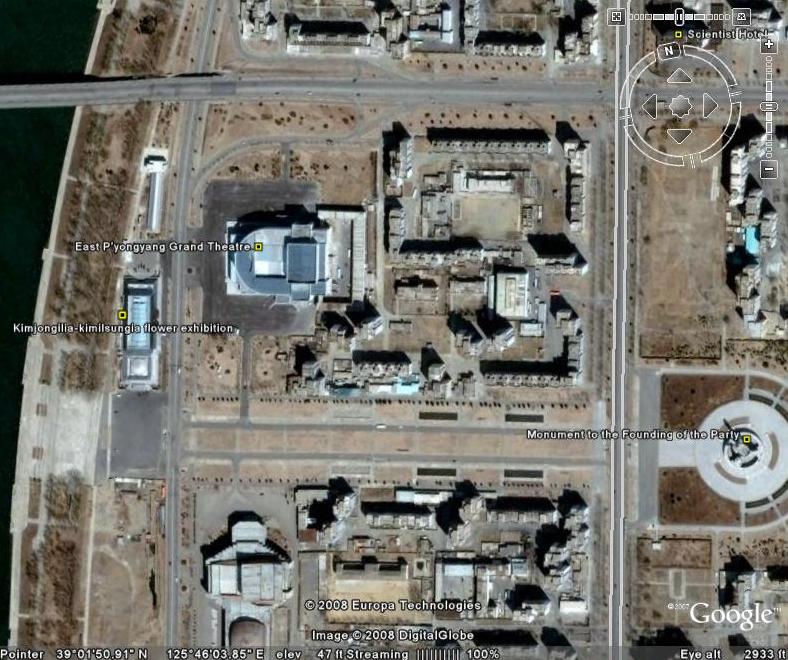
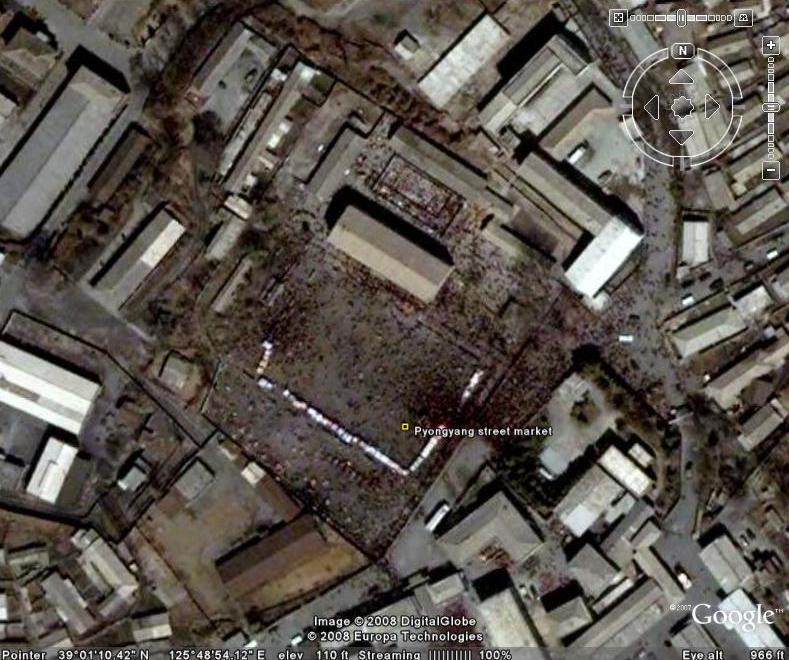
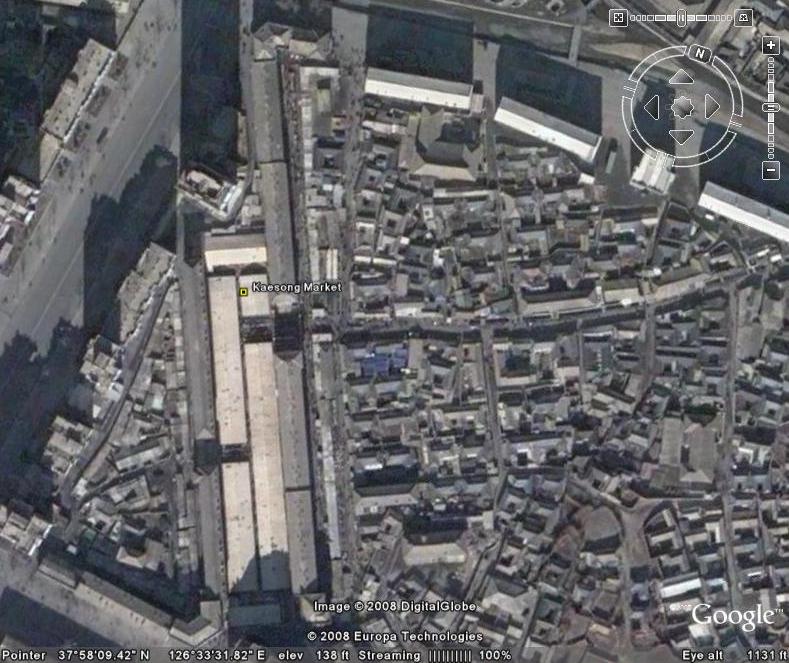
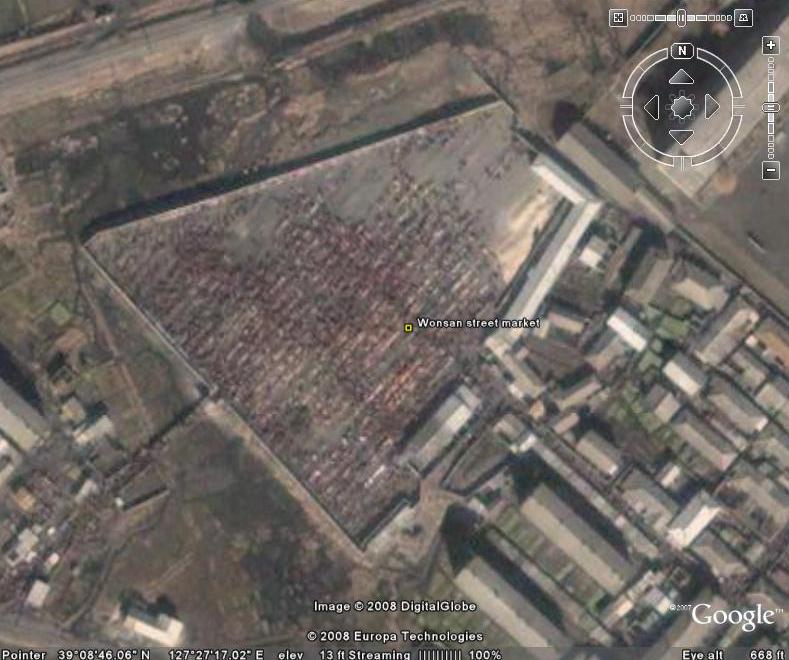
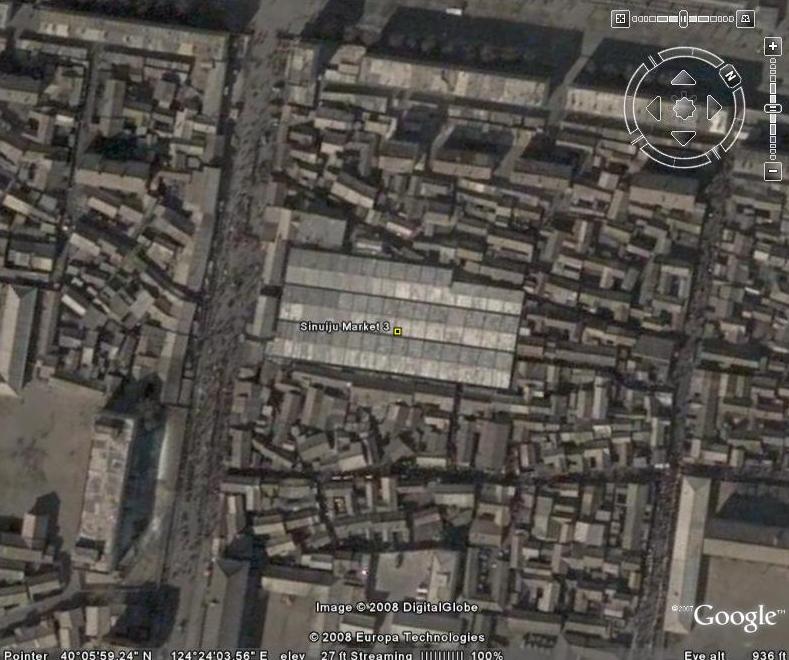
When looking at North Korea’s cities on Google Earth one can’t help but notice the number of monuments to the Great Leader.  But if you are looking for the true heart of the cities, in other words where all the people are, you need to look closely for North Korea’s markets.  They do have them–in all of the major cities visible on Google Earth:

pyongyangmarket.JPG kaesongmarket.JPG
wonsanmarket.JPG sinuijumarket.JPG
(Clockwise from upper left) Markets in Pyongyang, Kaesong, Sinuiju, and Wonsan

This week, the Daily NK reported that the new regulations and crackdowns on market activity are meeting with resentment in Pyongyang. 

What happened?  Supposedly Pyongyang’s new Party Chief Secretary suggested to Kim Jong Il the idea of converting the jangmadang into farmers markets (in other words only selling agricultural goods from the countryside as in the past), and Mr. Kim approved it.

As of January 15, public announcements were placed on the entrances of marketplaces detailing what could/could not be sold in the market.  Violators are subject to having their goods confiscated by inspection units (these sorts of policies are ripe for promoting corruption).

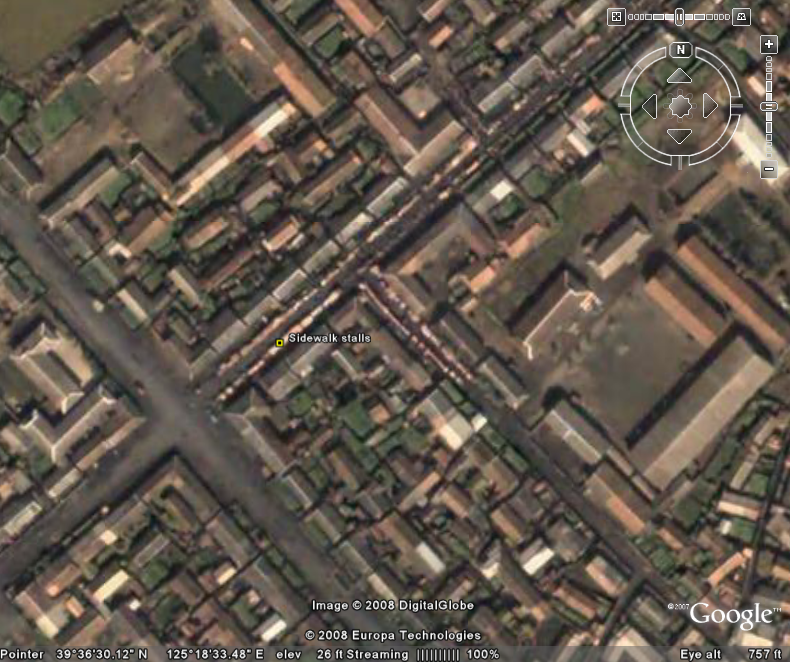
Ever entrepreneurial, North Korean sellers simply adapted, shifting location from inside the marketplaces to back-alleys.  Seemingly, they are still subject to inspection and confiscation in these local neighborhoods, but apparently the risk is lower.  Several of these street markets are also visible on Google Earth:

sidewalkstalls2.bmp

But others have decided to stay put in the markets and simply hide their goods:

A portion of the people still secretly trade in the jangmadang. Simultaneously avoiding the inspection units, they refrain from putting out the goods and bargain with customers by holding up signposts. When they tell the passing-by customers, “This is what I have,” a bargain is reached. Of course, the goods are temporarily stored at a nearby residence and taken out after the bargain. (Daily NK)

Lankov also discussed the regulations and games people play to avoid the market inspection units here

The full article can be found below:
Jangmadang Will Be Converted to Farmers Markets
Daily NK
Jung Kwon Ho
2/13/2008

Share

Miniunific: Show me the money!

Thursday, February 14th, 2008

On February 8, it was announced that the South Korean Ministry of Unification, the agency responsible for official interactions with the North, would not be merged with the Foreign Ministry (full story)–dealing an early policy blow to the newly elected South Korean President’s efforts to reduce the size of the South Korean government.

However, just three days later, on February 11,  the Chosun Ilbo reported that a South Korean government cash donation to North Korea (cash donations are apparently unlawful) has [surprisingly] gone missing:

In March last year South Korea gave US$3.8 million worth of aid, including $400,000 in cash and building materials, to North Korea to build a center for inter-Korean video-link family reunions in Pyongyang. But North Korea has not even started construction on the site, it was known on Sunday.

The donation violated a ban on cash aid to North Korea, but South Korea’s Ministry of Unification said at the time that there would be no room for suspicious dealings because the North agreed to inform the South where the money was spent and the South agreed to visit the construction site to find out whether the money and materials were used properly.

It has been almost a year since the aid was delivered, but it is not clear what the North has done with the cash and building materials. The South Korean government has demanded that it be allowed to visit the construction site, but the North has brushed off the requests, saying it will show the site “next time” or after the center is dedicated.

[and…] 

On eight occasions from early April to late August last year, South Korea delivered to the North building materials such as cement, iron bars, electric cable, tiles, drills, adhesive glue, interior furnishings, elevators, and air-conditioning and heating equipment. It also sent 10 buses and six Rexton SUVs.

When sending the materials, Seoul demanded five times that the North allow South Korean officials to visit the construction site and provide details on where the materials were used. All such demands were rejected. (Chosun Ilbo)

Today, February 14, South Korean military authorities admitted to knowing (since 2003, when the previous Roh Moo-hyun administration was inaugurated), that North Korea has transported rice supplied by the South for humanitarian purposes to front-line units of the Korean People’s Army.

The South Korean military has admitted it found no fewer than 200 South Korean rice sacks transported to North Korean Army units on about 10 occasions to the demilitarized zone including Gangwon Province between 2003 and recently.

This is the first corroboration by the South Korean military of testimony by North Korean refugees that the food aid provided by South Korea is being diverted for military purposes. But despite their knowledge of this fact, neither the South Korean government nor military authorities protested to North Korea or asked it for an explanation, apparently for fear of provoking Pyongyang. (Chosun Ilbo)

Updated: 2/21/2008: North Korea denies it diverted food aid to military

Now, I personally favor some kind of engagement policy with the North, but implementing an effective strategy is difficult.  Strict transparency and accountability are absolutely necessary to avoid mismanagement of public funds.  This is admittedly difficult, even in the OECD, much less in a secretive communist state.  Under the current circumstances, however, the North is treating the South like an unwanted lover, and this is not a healthy outcome. 

Handing out public funds with weak- or no-strings attached (as the South has done for years) creates markets in political corruption in the North.  The North Koreans know that the Ministry of Unification has a bureaucratic incentive to spent the money on aid.  If they don’t, it will not be appropriated in the next fiscal cycle.  This is why government budgets almost never go down, and agency heads go on a spending spree just before the fiscal year ends–use it or lose it.  The North Koreans have simply learned how to say the right things, etc., so the Ministry of Unification can check the box and pay up, because they know there will be no consequences when they fail to deliver.

So what is the solution?  If the South Korean government demonstrated some desire to monitor development aid, and reduce it if necessary (say “no” once in a while), they might encourage the North Koreans to do with the money as they claim (at least more so).

Another option available to the South Korean government is to stop using public funds to develop North Korea and instead free the South Korean business community, and other individuals, to take their chances contracting with North Korean entities themselves.  Putting their own Won on the line will definitely encourage private investors and venders to keep an eye on their balance sheets, and will help depoliticize the development of a country with a poor reputation.  

See the gratuitous game theory here.

You can read the referenced articles below:
S.Korea Knew Its Rice Feeds N.Korean Military
Choson Ilbo
2/14/2008

N.Korea May Have Diverted Cash Aid
Chosun Olbo
2/11/2008

Share

David Kang on North Korean trade potential

Tuesday, February 12th, 2008

Kang: North Korean Trade Potential
Council on Foreign Relations
12/17/2007

Last December, David C. Kang, a professor of government at Dartmouth College and an adjunct professor at Tuck Business School, discussed the North Korean economy for the Council on Foreign Relations. I have excerpted some of his comments below.

His view on the new North-South cargo train service:

It doesn’t have huge economic significance in the overall GDP of North Korea. But it does have major economic significance in the fact that what North Korea had to do in order to let a train go through was an awful lot of adjustment[…]in terms of linking up the railroad, all the ministries had to prepare.  The old [Korean Energy Development Organization] had this problem as well. [W]hen they wanted Americans and South Koreans working in North Korea to build this light-water reactor, [they] had to set up protocols [Post offices, phone calls, where they were going to stay, etc]. It is pretty significant in terms of how much they had to adjust.

He quoted the following figures on North – South trade:

From $200 million in 1998, to now exceeding $1.7 billion in 2007.   South Korea’s total trade volume is $250 billion.

His opinion on the direction of the North Korean economy:

At this point what we’re seeing is very initial steps on the part of North Korea as they try to open up reform and yet maintain control. At the same time, they are being forced into a number of institutional changes and mind-set changes that are the first step forward in this process.

His view of North Korea’s comparative advantage:

Most of the companies that have gone in—the South Korean companies that have gone in—are assembly and light manufactures, such as or textiles and light consumer goods. This is the sort of obvious point of departure. It’s not hugely capital intensive in terms of building factories, and can take advantage of North Korean cheap labor and South Korean technological advantages.

There are a lot of potential mineral resources in North Korea, which would require a whole infrastructure of legal reforms to happen before anyone would take care of them. But at this point the safest bets are the ones that are on the order of assembly and light manufactures in the North and then exporting them out.

His view of South Korea’s long term goals:

If there’s unification, or even better relations, and South Korean companies can use cheap North Korean labor, instead of having to send those factories to China or Vietnam—not only do they speak Korean, they’re culturally similar, and the labor would be cheaper.

[I]f you could reconnect the railroads, from Japan, through Pusan [South Korea], up through North Korea, then out to China and Russia, you would be linking up all these economies in a much more efficient way than they are now. So everybody wants that. But obviously there’s the political problem. And even on the infrastructure side, the North Korean rail system is so old and so decrepit, that basically it would have to be rebuilt from zero. But the potential upsides are massive, in the long run.

His view of China’s engagement:

China has been essentially as deeply involved in economic engagement with North Korea as has South Korea—and by some measures, actually more so. Whereas South Koreans just do this assembling, some Chinese companies are moving in and building full factories in the North. There’s a lot of interest in Chinese-North Korean economic relations on both sides.

Share

North Korea launching massive anti-corruption drive

Monday, February 11th, 2008

Last Friday, Yonhap reported that Kim Jong Il has ordered an anti-corruption investigation of two key agencies, both of which manage South Korean investments in the DPRK: the United Front Department (which Lankov claims is involved in clandestine operations) and the National Economic Cooperation Council.

North Korea is in the midst of a massive anti-corruption drive which has already resulted in the arrest of one of its top officials handling business with South Korea, informed sources in Seoul said Saturday.

The campaign, ordered by leader Kim Jong-il, was prompted by widespread allegations that some top party and administration officials took bribes as they pushed business projects with South Korean industrialists, said the sources well versed in North Korean affairs.

“The probe was launched as National Defense Commission Chairman Kim Jong-il said there was a lack of supervision over the United Front Department [a key party organization that supervises inter-Korean affairs], although lots of suspicions were raised over the department’s corruption,” one source told Yonhap News Agency.

According to the sources in Seoul, the North Korean leader was enraged after getting a report that some party and government officials allegedly pocketed bribes and diverted food and other aid from South Korea to black markets.

Also under investigation is the National Economic Cooperation Council, a government body that handles business with South Korean entrepreneurs, the sources said.

The Council’s chief, Jeong Woon-eop, remains under arrest pending investigation into allegations that he took “huge amounts” of bribes, said the sources, who wanted to remain anonymous. (Yonhap excerpted)

Frequently “anti-corruption campaigns” in developing countries have nothing to do with making the bureaucracy more accountable or responsive to public demands, but rather are political maneuvers to prevent “rents” or funds from being channeled to uses that lie outside the leadership’s control (or some faction of the leadership).  In other words, they are regime enhancing.  The announcement of this campaign demonstrates two important principles that deserve explicit mention:

1. Not all profits earned by North Korean joint ventures are channeled to the leadership, and in fact many of them are siphoned off by middlemen who actually control the financial machinery.  Once skimmed off the top, it is likely that these funds are used in illicit private commercial operations since they cannot be legally declared by the owner (unless there are domestic channels for laundering money in North Korea).

2.  If funds are being siphoned off of high-profile official joint venture operations, then the leadership is not in control of its internal fiscal affairs.  Indeed it is likely that, as in the Soviet Union, the people who keep the private economy running are the trusted mid- to senior-level officials who can skirt the rules and know how to actually get things done within the system.

Update 2/24/2008:

North Korean authorities have been investigating the chief of a North Korean committee in charge of inter-Korean economic cooperation for months after seizing $20 million from his house, a report said Friday.

The full article can be found here:
NK Official Suspected of Embezzling Funds From Seoul
Korea Times
Jung Sung-ki

Update 2/12/2008:

The chief of Daesung General Bureau, a division of the 39th Department which manages foreign transactions, was fired on suspicion of embezzling US$1.4 million last fall.” (Daily NK)

The full article can be found here:
North Korea launching massive anti-corruption drive
Yonhap
2/9/2008

Share