Archive for the ‘International Organizaitons’ Category

Tobacco company pulls out of North Korea

Friday, June 8th, 2007

The Guardian
Julia Kollewe
6/8/2007

British American Tobacco is pulling out of North Korea, but insisted the move had nothing to do with political pressure.

The world’s second largest cigarette group, whose brands include Lucky Strike, Kent and Dunhill, said it had agreed to sell its 60% share in Taesong BAT, its joint venture in Pyongyang with the Korea Sogyong Chonyonmul Trading Operation, a state-owned company.

BAT is selling the stake to SUTL, a Singapore-based trading group that invests in business ventures in South East Asia. The price has not been agreed yet but will be small in relation to the group. The sale is expected to be completed later this year.

Read their press release here.

Share

N. Korea’s food situation not as bad as expected: agricultural scholar

Tuesday, June 5th, 2007

Yonhap
7/6/2005

North Korea’s food situation is stabilizing and is not as bad as expected in rural areas, a South Korean agricultural scholar who just returned from Pyongyang said Tuesday.

In an interview with Yonhap News Agency, Kwon Tae-jin, senior scholar of the state-run Korea Rural Economic Institute, said, “The peak of food shortage usually comes in June, but I didn’t feel it probably because North Korea released food rations.”

Kwon visited Pyongyang, Chongju in North Pyongan Province, Hamhung in South Hamgyong Province and Paechon in South Hwanghae Province, along with officials of World Vision, an international relief agency, May 25-31.

In March, North Korean officials indicated that North Korea faced a shortfall of 1 million metric tons of food and asked the World Food Program (WFP) to expand its assistance.

Jean-Pierre DeMargerie, head of the WFP’s office in North Korea, said that the situation is not as bad as it was in the 1990s when about one million North Koreans are estimated to have died of hunger, but the food situation has again “started to deteriorate because of June and August flooding of critical cropland and major reductions in WFP and bilateral food assistance.”

Kwon said North Korea would have little difficulty planting rice seedlings this year as reservoirs are full of water in most plains, and tractors and rice-planting machines can work at full capacity.

“In some areas the food situation might be worsening, but agricultural production has stabilized. They seem to be focusing on diversifying their sources of income by planting some cash crops,” he said.

A weak harvest in 2006, disastrous summer flooding and a 75 percent fall in donor assistance dealt severe blows to the impoverished nation, according to WFP officials.

South Korea resumed shipments of fertilizer and emergency aid to the North, but it plans to withhold rice aid as an inducement for North Korea to fulfill its promise to shut down its main nuclear reactor as part of the landmark February 13 agreement.

South Korea suspended its food and fertilizer aid to North Korea after the North conducted missile tests in July. Resumption of the aid was blocked due to the North’s nuclear bomb test in October.

According to a recent think tank report, North Korea could run short of up to one third of the food it needs this year if South Korea and other countries withhold aid.

Data from the WFP and South Korea’s Unification Ministry show that the North will need between 5.24 million tons and 6.47 million tons of food this year. Depending on the weather, the availability of fertilizer and other factors, the communist state may only be able to produce 4.3 million tons of food by itself, the report said.

Share

In reclusive North, signs of economic liberalization

Wednesday, May 30th, 2007

Hankyoreh
Authored by Ryu Yi-geun and translated by Daniel Rakove

PYONYANG: “Next time, please come back and purchase something,” implored Mr. Hong to the customers leaving his store empty-handed.

“You’re saying you earn more if you sell more?”

“You bet.”

But this reporter was still suspicious. Four days later, I carefully asked our handler for confirmation.

“Of course it’s true,” he assured me. “Even in the same eight-hour workday, he who produces more results gets paid more.”

The concept of receiving compensation in proportion to the amount of sales is one that is now long familiar to North Koreans. Yet what is surprising is the gusto with which North Korean store staff will go to in encouraging South Korean tourists to buy their products, a phenomenon indicative of how great the materialistic impulse has become in the reclusive communist nation.

Constructed in Pyongyang’s central district in 1995, the 47-story Yanggak Hotel seems to float above the Daedong River like an island. Mr. Hong works at a store there on the second floor. There is even a spot next door to exchange money. Though the set prices are written on each product – in Euros – the South Korean customers managed to save a bit through bargaining. The owner was at first insistent that all products be only sold for the listed price, but he finally gave way after a long give and take with the customers. He decided it worthwhile to sell his products slightly cheaper, if only to make a profit. Though most transactions are conducted at the listed price, there were instances at the hotel store and other establishments of selling to tourists at a discounted rate after haggling over the price.

Elements of capitalism are slowly making their way into North Korean life – wrapped in the euphemism of “utility.” After returning from his trip to North Korea from May 14-18, on which he led 130 economic delegates, Min Byeong-seok, Director of the Hankyoreh Foundation for Reunification and Culture proclaimed, “I could unmistakably feel here and there that North Korea is changing.”

It is of course difficult to confirm the presence of change in North Korea. This is in part because the changes are occurring at a low level. After all, there is always a difference in what we look for compared to what we are shown. This is what makes it difficult for someone to declare unreservedly, “North Korea is this,” or “North Korea is that.” There are also parts of North Korea that are difficult to understand due to the biases originating from the political system and values of the observer. Hankyoreh21 managed to get a spot in the group of Pyongyang-bound economic delegates, and recorded below is a compilation of the various things we witnessed.

“My life has gotten so much better since last year.” These words did not seem to be mere propaganda. Whether spoken by our North Korean guide or the various Pyongyang citizens with whom we came in contact, their words were by and large the same. One citizen told us, “My wages increased from 3,000 to 6,000 North Korean won,” and consumer prices “went up about 10-20 percent.” In other words, wages have increased much faster than has the rate of inflation. Yet that man cannot be taken to be the representative Pyongyang laborer, nor does he have the credibility of an economist.

Indeed, it is hard to grasp the level of inflation in North Korea: all one can do is take an educated guess. Lee Do-hyang of the Institute for National Security Strategy said, “These things are evidence that the financial situation is improving and the economy is enduring,” adding, “It seems that the quality of life for common people is taking a turn for the better.” Yet in North Korea, where it is said some US$30 a month is necessary to get by, a 3,000 North Korean won raise is not exactly a windfall: 6,000 North Korean won is about equivalent to $2, and on the black market, $1 sells for 3,000 North Korean won. Thus, the rationing and side jobs that bring in an additional $15-20 a month are an essential source of income.

Pyongyang’s major marketplaces have grown livelier. Stretching between 2,000 and 3,000 pyeong (1 pyeong is 3.3 sq. meters), one large-scale market has taken up a spot next to Kimchaek Industrial School on a once-empty spot along Otangangan Street. In the shape of a high school gym, the market’s two-story building is covered in a blue roof and the exterior is clean. Visible from the Yanggak Hotel, the market was bustling at 6 p.m. on May 16. The Bonghak Market next to the Pyongyang Cosmetics Factory was also busy once the sun set. At least one marketplace has taken shape in each of Pyongyang’s 18 districts. Each one is a symbol of capitalism’s penetration of the socialist, planned economy. The activities in each market are said to be hardly distinguishable from the capitalism found in other countries.

One citizen said, “The people go to the markets more, where the prices are a little bit cheaper than at the nationally operated stores. Even if one doesn’t buy anything, it is fun to look around, what with the variety of goods for sale and the haggling going on.” Most citizens are said to buy their daily necessities at such markets, having become an essential part of daily North Korean life.

Street food vendors started appearing quite a while ago, but their numbers are ever-increasing. The fairly tidy vendors can be seen here and there throughout Pyongyang, selling a variety of goods, including soft drinks, ice cream, bread, rice cakes, and so on. Each product runs between 100-300 North Korean won.

The local People’s Committee gives licenses for the operation of such stands to various companies or the descendants of revolutionaries. A portion of sales is taken by the state and the remainder of the profit goes to the managing company or individual.

Though the residents of Nampo, a port city 40 minutes by bus from Pyongyang, do not seem to be better off than their Pyongyang counterparts, the city is quite lively. On the journey from the major ship repair factory by the port, through the city center, and to the freeway entrance leading to Pyongyang, 50-60 separate street food vendors were spotted. The products they were selling as well as their method of sale were quite diverse. Some vendors – most likely new ones – simply laid out their goods on the ground for sale, showing even to the outsider that North Korea’s markets have hit a growth surge.

Five years have passed since the July 1, 2002 economic measures were instituted by the North Korean government, raising wages as well as the currency’s value. In addition, the price of rice and other necessities was increased, and a system of incentives and limited independent capital was expanded. Yet very few North Korean people have even heard of “the 7/1 measures.” Only after talking for a significant length of time will they mention the notion of “utility” that has been pursued over the last few years.

At the end of Unification Road in the Nagnang district of southern Pyongyang, the Phoenix Clothing Factory is producing clothing on commission. The 1,000-pyeong factory is unceasingly filled with the whirr of sewing machines. U Beom-su, 53, introduced himself to the South Korean observers as the company’s “chief executive,” explaining, “The workers work eight hours a day, but when the fixed day for shipment draws near, we have no choice but to put them on overtime.” The payment system for workers is multi-tiered, with five levels, the salary increasing with rank. Every month, one laborer is chosen from each team of workers as being the most outstanding, and is given bonus compensation. The ‘chief executive’ explained that further incentive payments were rewarded based upon the factory’s production levels on the whole.

It is unclear as to how widespread this model of business is, but director of the Korea Institute for National Unification Lee Bong-jo said that “the seeds of competition are visible.” However, the workers at the Yuwon Shoe Factory and the Pyongyang Cosmetics Factory were flustered when asked about their salaries or the labor system and evaded giving an answer.

The will for liberalization was evident here and there. At the 10th annual Pyongyang Spring International Trade Fair on May 14, 200 companies from 12 countries participated, either to view the product lines or to display their own. The majority were Chinese companies, including its largest electronics firm, Haier, while there were several sections of the exhibition primarily interested in retailing to the foreign visitors themselves, the determination by North Korea to get its products out to foreign markets was apparent.

Many members from the South Korean team of economic representatives also participated. In particular, representatives from Daewoo Shipbuilding & Marine Engineering Co., Ltd, the world’s second largest shipbuilder, as well as the Korea Port Engineering Company, visited the Yeongnam Ship Repair Factory and the Nampo Port to explore the possibility of making investments in those places. In a gesture of consideration, the Northern handlers prepared a separate automobile for the potential investors to explore the grounds, and held a separate consultation session for them beyond the general one for the economic delegates. On multiple occasions, various North Korean officials expressed an interest in attracting South Korean capital. The self-confidence they showed hinted at a sense that they had to some extent resolved the immediate issues of day-to-day subsistence. It may sound strange, but the consensus of those who had also made the trip last year was that the electricity situation had improved. In other words, basic economic conditions seemed to be on the upswing. Perhaps the self-confidence North Koreans showed in displaying their possession of a nuclear weapon has now flowed into the economic sector, thus explaining their will for some liberalization.

Yet simply because there is a will for opening up does not mean liberalization will come easily. One Daewoo source explained, “[We told the North Koreans that] there must be assurances before we invest. They have to provide the same conditions that China does.” At this point, there is probably not a single person who could make such assurances on behalf of the North Koreans. The country is still unprepared to take advantage of the money available to it from the South through the economic cooperation program. The six-party talks also must also make some progress on the nuclear issue. Furthermore, if North Korean – U.S. relations do not improve, then free trade between North and South will remain uncertain indefinitely.

In the case that external matters are settled and the will for liberalization strengthens, then the vitalization of the North Korean economy could quickly pick up with the improvement of infrastructure, such as the electricity grid and logistics, which are pointed to as the largest stumbling blocks. The reporters who arrived first on May 12 witnessed, for instance, how the automatic doors and the elevator on the first floor of the Yanggak Hotel took 30 minutes to warm up. While the houses themselves gave off light after the sun set, the streets between them were completely dark. The mere 20-30 percent rate of operation at factories as estimated by experts is partially accountable to a lack of raw materials, but most of all to the deficiency of electricity.

The rigidity of the economic system only adds to North Korea’s list of woes. Though the director of Pyongyang Cosmetics has requested raw materials and modern machinery, he does not have the full authority to manage the company. Another company has imported the raw materials from China, and he confessed that he knew little of the specifics on the subject. The director of the Daeanchinseon Glass Factory made a similarly vague request for “raw materials.”

The problems go deeper. For one, there was no sign on the part of the North Korean factory managers to think of the visiting economic representatives as business counterparts in the world of capital and industry. For example, even photography by the group of South Korean trade representatives was forbidden within the factory grounds. Another chronic problem is the ease by which North Koreans that are not economic officials or specialists break promises. Furthermore, as often appears in planned economies, there is a single-minded focus on “production” without consideration of whether the product being made is for domestic use or for export. This sort of difficulty was evident at the cosmetics and shoe factories, as well.

Lee Bong-jo, director of the Korea Institute for National Unification, offered some advice to the South: “Knowledge of North Korea must precede any investments there.”

It seems that amongst difficulty, Pyongyang may be carefully seeking change. Though it remains stuck in the dilemma of pursuing liberalization while maintaining regime stability, it is increasingly sending strong signs to the outside world of a will for liberalization. As South Korean Former Minister of Unification Jeong Sye-hyeon said, “It is difficult for North Korea to go backwards.”
Share

N.K. to send delegation to ASEAN regional forum

Tuesday, May 22nd, 2007

Korea Herald
5/22/2007

North Korea will send two diplomats to a Southeast Asian regional forum opening later this week in Manila, where a senior U.S. official will also be present, according to press reports Monday.

A Filipino official, speaking on condition of anonymity, was quoted as saying that North Korea is expected to send Jong Song-il and Ri Tong-il from the foreign ministry to the senior officials’ meeting of the ASEAN Regional Forum opening in Manila on Friday.

The session is a prelude to the ARF conference in August. Christopher Hill, top U.S. envoy to six-nation denuclearization talks, is also scheduled to participate in the meetings, raising the possibility of contact between Pyongyang and Washington amid a stalemate in the talks.

Jong was a member of North Korea-U.S. bilateral nuclear negotiations in 1993 and 1994 but has not been a part of the six-party talks, which involve South and North Korea, the United States, China, Russia and Japan. He participated in ARF in 2004 and 2006, according to Yonhap News Agency.

Share

Eugene Bell Spring Trip to North Korea

Sunday, May 20th, 2007

Eugene Bell Foundation (Hat tip D.”S.”B.)
207 C Street, SE, Washington, DC 20003   
TEL: 202-393-0645   
FAX: 202-543-2390
For more information:
Alice Jean Suh; alice@eugenebell.org;
+1-202-329-2410

EugeneBell Returns from 2007 Spring Visit to North Korea Initiates Maternal and Infant Care and Children’s Care Programs

The Eugene Bell Foundation earlier this month visited 17 medical institutions in the Democratic People’s Republic of Korea (North Korea) and launched two groundbreaking community health projects targeting the country’s most vulnerable groups: new mothers and infants, and school-aged children.  From May 1-12, EugeneBell’s chairman, Dr. Stephen Linton, and four delegation members visited city, district, and county medical institutions in North Korea’s South Pyongan Province. All 17 institutions received shipments of assistance as part of EugeneBell’s Partner Package Program 

New Maternal and Infant Care Program and Children’s Care Program

EugeneBell confirmed the new programs’ first deliveries of instructional materials, equipment and supplies at two local hospitals in Sunchon and Anju, cities in South Pyongan Province. These new programs will be implemented in three steps to ensure transparency. Our delegation received agreements from the medical staff at both institutions to implement the first step, with the understanding that progress to the second and third steps will require proof of adherence to EugeneBell’s standards on further visits. These new programs signify groundbreaking advances in EugeneBell’s work. In addition to providing training, equipment and supplies for entire institutions, these programs have also tailored assistance to individual patients. For the first time, EugeneBell will partner with doctors at the most basic level of care in North Korea’s system. All citizens in North Korea are assigned family care physicians. EugeneBell’s new programs will strengthen the ability of family doctors to treat individual patients more effectively and transparently.  “I am very excited about this new opportunity to help insure that pregnant women receive the best care possible from early pregnancy through child-birth,” said Dr. Linton. “We hope to help North Korean caregivers manage child health from the womb all the way through grade school, the most critical period for human development.”  The initial phase of these two new programs received an enthusiastic welcome from hospital staffs. EugeneBell plans to extend this effort to other local hospitals as funding becomes available.

Equipment and Training Upgrades for Local Hospitals Dramatically Improve Local Healthcare

During this visit the delegation was able to evaluate the effectiveness of a program to upgrade diagnostic and surgical capacity at seven out of 40 plus medical facilities supported by EugeneBell. The delegation was impressed at the level of technical sophistication achieved by North Korean caregivers after receiving comprehensive training manuals last year. Through self-study North Korean technicians had, in a surprisingly short time, mastered the use of complex diagnostic equipment and had even made minor repairs.  “It was very impressive,” said Dr. Linton, “to see North Korean technicians operating advanced equipment previously unfamiliar to them. More impressive was the level of cooperation between hospitals that had received the same equipment. When we first started this program, these hospitals were empty because patients had little hope of receiving adequate treatment.  Now that they have new equipment, previously empty hospitals are filled to capacity. Patients wait in line to be examined by the new equipment. “It’s worth the effort to watch these hospitals come back to life.”

Support for Children with Tuberculosis

On this visit the delegation found a new emphasis on treating children with tuberculosis. Several new children’s wards have been established to provide better care for young patients in South Pyongan Province, Nampo City and Pyongyang City. Children are particularly at risk of tuberculosis when their immune systems are weakened by poor nutrition. In response to the new emphasis on childhood tuberculosis by North Korea’s health authorities, EugeneBell will include a system for providing assistance directly to young patients this fall.

Medical Institutions Visited

During May 1st – 12th EugeneBell visited 17 North Korean medical institutions in: South Pyongan Province and Nampo City, South Pyongan Province Tuberculosis Hospital (TBH), Children’s Ward-South Pyongan TBH, South Pyongan Province Children’s Hospital, Anju City Tuberculosis Care Center (TBCC), Pyongsong City TBCC, Bukchang County TBCC, Sunchon City TBCC, Daean County TBCC, Ryonggang County TBCC, Anju City People’s Hospital, Sunchon City People’s Hospital, Daean County People’s Hospital, Chollima County People’s Hospital, Nampo City TBH, Nampo City TBCC, Waudo District People’s Hospital, Hanggu District People’s Hospital 

Total Results of Support in Spring 2007: $ 1,793,717.21 This spring EugeneBell shipped a total of $1,793,717.21 worth of medical goods to 45 medical institutions in North Pyongan Province, South Pyongan Province, Pyongyang City and Nampo City.  

EugeneBell in Action

image005.jpg

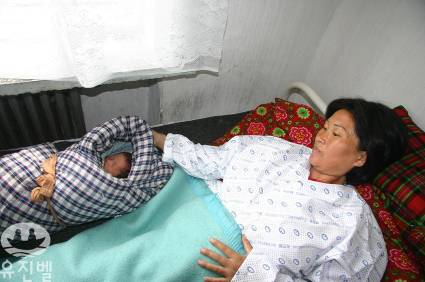
1. New mother and infant at the Anju City People’s Hospital, part of EugeneBell’s new Maternal and Infant Care Program.

image008.jpg

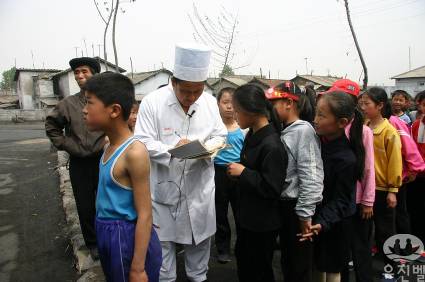
2. Children in Anju City being given health physicals, part of EugeneBell’s new Children’s Care Program.

image006.jpg

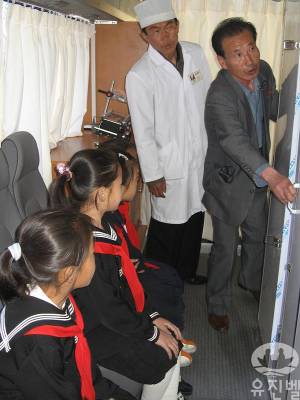
3. Grade school students are examined at a mobile X-ray vehicle donated through EugeneBell to Nampo Tuberculosis Hospital.

image009.jpg

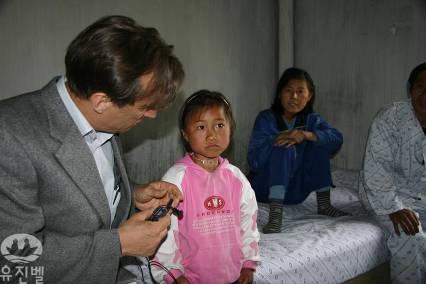
4. Dr. Linton interviews a young patient at the Children’s Tuberculosis Ward at Nampo Tuberculosis Care Center.

image010.jpg

5. A patient is examined with a sonogram donated through EugeneBell at Daean People’s Hospital.

image013.jpg
   
6. Dr. Linton (left) delivers medical supplies and equipment to Chollima People’s Hospital in South Pyongan Province. In the spring of 2007 EugeneBell shipped almost 1,800,000 dollars of medical assistance to 40 odd medical facilities.

image014.jpg

7. Through EugeneBell donors sent 2,200 sets of Patient Necessities Kits to long-term patients in sixteen tuberculosis care centers. EugeneBell does everything possible to identify donors to recipients.

Share

North Korean Propaganda Festival May Signal Shift in Policy

Thursday, May 10th, 2007

Bloomberg
Bradley Martin
5/10/2007

Since 2002, North Korea has invited visitors every few years to a festival featuring 60,000 dancers, gymnasts, acrobats and musicians, along with card-flippers who create vast pictorial mosaics covering one entire side of the 150,000-seat May Day stadium in the capital, Pyongyang.

The previous performance, in 2005, included noisy and bloody tableaux of North Korean soldiers making mincemeat of enemy soldiers. Last week’s Arirang production — named for a famous Korean love song — was different. Battlefield carnage was replaced with scenes of people seeking higher living standards by rebuilding factories and growing crops.

While North Korea is hardly going pacifist seven months after testing an atomic device, the propaganda shift may signal a significant change in policy, according to expatriate businessmen living in the isolated country. Now that it is a nuclear power, North Korea appears to be directing more resources to improving an economy on its knees after decades of sanctions and isolation, they say.

Korean officials “are now confident they can defend their country,” said Felix Abt, the Swiss president of PyongSu Pharma Joint Venture Co. Ltd., which recently started manufacturing painkillers and antibiotics in Pyongyang. “Their next priority is economic development.”

Consumer Goods

The policy emphasizes light industry to produce consumer goods. It was formally expressed in a joint editorial that was run at the beginning of the year in three major newspapers published by the regime, Abt said.

Getting verifiable information about policies in North Korea is still almost impossible, especially on tightly organized trips for foreigners in which government guides keep visitors on a short leash.

And if the propaganda on display during one of these visits last week can be believed, the government continues to conceive any new economic policy along the lines of a traditional, planned economy, focused on state-owned enterprises where workers are inspired to redouble their efforts and produce miracles of socialist endeavor.

The Arirang show made this abundantly clear. In an act called “Power and Prosperity,” the audience was urged to emulate “youth shock brigade” members and other working people in North Pyongan Province who recently completed Thaechon Youth Power Station No. 4 in spite of catastrophic shortages of food, energy and most other materials that became evident in the early- to-mid-1990s.

`The Power’

The performance illustrated that North Korea needn’t depend on foreign donations, said Kim Song Ho, 32, one of the tour guides assigned to foreign visitors this month. “Our country has the power to live by ourselves,” said Kim, who worked for the World Food Program’s Pyongyang office until the government reintroduced rice rationing in 2005 and told foreign-aid organizations it could manage mainly on its own.

In Thaechon, Kim said, “workers constructed a power station despite the bad situation without any help. Now the slogan is, `We will work like Thaechon Power Station workers.’ We renovated factories, built new factories and now the economy is booming more and more.”

Evidence of such economic change wasn’t included on the tour Kim was guiding. Kim said he would happily show such sites to the foreign visitor another time.

Different Conditions

The development schemes aren’t directly modeled on those of China or Vietnam, locals stressed. “The conditions of the Chinese and Koreans are different,” said Kim Hyon Chol, the 32- year-old chief guide of the tour group. “The biggest difference is that our country is not united.”

The regime has kept its propaganda options open on its military direction.

Billboards in the capital city showed a U.S. and a Japanese soldier both skewered on the same bayonet. And while there was no sequence in the Arirang show celebrating the country’s nuclear explosion or missile tests, a military parade on April 25 to which foreign residents were invited showed off a missile said to be capable of hitting U.S. bases on Guam.

At the Demilitarized Zone, which has divided North from South Korea since the Korean War armistice agreement was signed in 1953, Korean People’s Army Captain Han Myong Gil was asked whether North Korea is safer since its nuclear test. He replied that U.S. and South Korean forces had held huge military exercises even as diplomats talked of trying to bring peace to the Korean peninsula.

`Hostile Attitude’

“The saying goes in Korea, `If there are many clouds, it will soon rain,”’ the 28-year-old career officer said. “We can’t feel safe until the U.S. gives up its hostile attitude.”

Han eventually responded to a question about what he thought of his government’s spending money on a huge military apparatus – – North Korea’s troop strength is the world’s fourth largest — while people don’t have enough food.

“We receive fright and oppression from the U.S., so I cannot hide that our living standard is not high,” Han said. “We were on an arduous march for a long time. Now we are very proud because we defended socialism with the military-first policy. A strong country can defend itself, but the weak will be beaten down.”

Share

NK Wants to Join IMF, World Bank

Sunday, May 6th, 2007

Korea Times
5/6/2007

South Korea has expressed its willingness to back North Korea’s move to join the International Monetary Fund (IMF) and the World Bank.

At a news briefing in Seoul Sunday, five lawmakers from the Uri Party, who visited Pyongyang for four days from May 2, said the North is considering applying for membership of the Washington-based World Bank and the IMF.

“We’ve promised to help North Korea become a member of international organizations,” said Rep. Kim Jong-yull who met North Korean leaders, including Kim Yong-nam, chairman of the Presidium of the Supreme People’s Assembly.

The United States and several developed countries have shown a lukewarm attitude over North Korea’s entry into international organizations, including the Asian Development Bank (ADB).

According to South Korean government officials, the U.S. _ a major shareholder in the IMF, World Bank and ADB _ has played a major role in rejecting Pyongyang’s repeated applications for admission, demanding the disposal of nuclear facilities.

The five lawmakers of the Uri Party and the North’s leaders also discussed ways to create a joint peace zone at the mouth of the Han, Imjin and Yeseong rivers.

According to the lawmakers, North Korea reiterated its willingness to normalize diplomatic ties with the United States. The North Korean authorities want their willingness to be conveyed to President Roh Moo-hyun and Washington, said Rep. Kim Hyuk-kyu, chief of the delegation.

He also said the two Koreas have shared a consensus on the need to launch an inter-Korean agency to build a waterway between Seoul and Gaesong, and an ecology park, and to open border rivers along the Demilitarized Zone for joint development and utilization.

They also discussed the development of a joint special economic zone, named the New Yellow Sea Joint Special Economic Zone. Seoul also promised to help the North develop a heavy industrial complex near Haeju. The two sides also agreed to jointly develop coalmining in Dancheon, South Hamgyeong Province, North Korea.

The two sides also discussed sports exchanges for national reconciliation and a joint team for the 2008 Beijing Olympics. The North will consider allowing its soccer players to join in K-League matches in the South, he added.

The lawmaker said, “North Korea predicted the issue over its funds at Banco Delta Asia (BDA) will be resolved soon.”

The North’s funds at BDA have become a stumbling block to implementing the Feb. 13 accord reached in the six-party talks.

North Korea had promised to shut down and seal its primary nuclear facilities by April 14, but it refused to meet the deadline, and insisted it will comply with the February promise only after the money is released.

The money, which was suspected of being related to Pyongyang’s irregular activities such as money laundering and counterfeiting, has been available for withdrawal since earlier this month, but Pyongyang has yet to move the funds.

Share

European firms in N. Korea running business association: chairman

Saturday, May 5th, 2007

Yonhap
5/5/2007

European companies operating in North Korea have been running a business coalition to better coordinate trade ties with the reclusive nation, a businessman said Saturday.

“Our purpose is to build bridges between Europe and North Korea,” Felix Abt, chairman of the European Business Association (EBA), said in an interview with Washington-based radio station Radio Free Asia. The association was founded in April 2005.

The businessman, who is also president of the joint venture PyongSu Pharma Co., said European firms need to do more business with Pyongyang, whose business ties are heavily dependent on Northeast Asia.

The association comprises 11 companies, mostly European or joint ventures between European and North Korean state-run firms. DHL, the logistics arm of Germany’s Deutsche Post AG, is also a member.

North Korea’s trade with the European Union accounted for less than 10 percent of its total volume in 2004, while trade with China surged by 35.4 percent, according to the EBA’s Web site.

Share

Foreign NGOs in N.Korea try to counter culture of dependence

Wednesday, May 2nd, 2007

doctor.jpg

 AFP
 Philippe Agret
 5/2/2007


SARIWON, North Korea (AFP) – To cope with the pouring rain, the hospital tossed sawdust down the stairway leading to the operating theatre.

Two surgeons washed their hands in a sink, but sometimes they lack soap.

Much like the rest of North Korea, a political pariah and economic black hole, the nation’s hospitals subsist with whatever they can get their hands on, making ends meet with obsolete equipment, short-cut procedures and a smattering of foreign assistance.

Even by the standards of the developing world, the facilities here in Sariwon, a 45-minute drive south of the capital Pyongyang, leave much to be desired.

The medical equipment is largely German or Soviet, reused as long as possible, but spare parts are desperately lacking.

“As we lack sufficient or working equipment, we use local anaesthesia and acupuncture for operations,” said the director of the Sariwon hospital, Dr Choe Chol, a surgeon.

In winter, surgeons operate in rooms where the temperature is lower than five degrees Celsius (41 Fahrenheit).

To improve conditions, the doctors and nurses pitch in themselves to make the hospital work, sometimes even laying down the tiling in the operating theatres.

“We do our best here. There’s no bleach, no soap, no disinfectant. We cleanse with distilled water. It’s the volunteers — the doctors and nurses — who regularly do the cleaning up,” said Veronique Mondon, the North Korea head of the French charity Premiere Urgence.

Premiere Urgence is one of only six foreign non-governmental organisations allowed to work in the Democratic People’s Republic of Korea.

Like others NGOs, the group has set a goal of bringing the most basic treatment to the population — but also to encourage North Koreans to develop their own medical infrastructure.

Premiere Urgence’s primary effort has been producing intravenous drips — one of the only medical supplies made in North Korea — for the 12 hospitals where it works.

With 70 to 80 percent of the medicine in North Korea coming from overseas donations, the IV drip — in the form of a packet with a solution of distilled water, glucose and sodium — serves to ease the impact of the lack of supplies.

“These packets can be used for a great number of the medical problems in North Korea such as accidents, malnutrition, dehydration, diarrhea, typhus and hepatitis. They save lives,” said Mondon, a biologist who opened Premiere Urgence’s branch in North Korea in April 2002.

If IV drips are effective, their production is a daily challenge. The packets must be sterilised on site in the most sanitary conditions possible, a process that takes about three and a half hours.

In light of the instability of the electricity and frequent short power cuts, Premiere Urgence has brought in specially made transformers from China.

“The people in the laboratories work during the night to produce the packets so as to save the electricity for the sick people and operations during the day,” Mondon said.

“It was tough at first. It seemed to be an insurmountable task. But now, the North Koreans know that this is needed,” she said.

After the April 2004 disaster in the northern city of Ryongchon, when a cargo train blew up, killing more than 160 people and wounding a thousand others, Premiere Urgence worked round the clock to produce IV drips and distributed 40,000 of them to two hospitals that were treating victims.

Today, the laboratory in Sariwon produces 300 IV drips a day — enough to treat more than 200 patients in this 750-bed hospital.

Across North Korea, Premiere Urgence produces 500,000 packets a year, each one worth around 50 US cents.

The French group has also set up a central laboratory in Pyongyang for quality control over injectable solutions.

North Korea’s communist leadership adheres to the homegrown ideology of “Juche” — self-reliance and self-sufficiency.

But at least hundreds of thousands of people died in a famine in the 1990s and North Korea has since relied heavily on foreign assistance — notably for food — despite continued political defiance, including its test of an atomic device in October.

From the International Committee of the Red Cross (ICRC) to the few NGOs in North Korea, all encourage local initiatives in an effort to prevent a culture of dependence.

Premiere Urgence plans eventually to hand over the maintenance of equipment and training of technical staff to the North Korean ministry of public health.

As for the ICRC, as well as helping produce 1,200 prosthetic limbs in 2006, it has focused efforts on training local people, including orthopaedic specialists and surgeons.

“North Korea’s pharmaceutical industry will never be able to develop if humanitarian groups flood North Korea with foreign medicine. It will continue to vegetate and manufacturer substandard products if foreigners do not buy local medicine,” said Felix Abt, a Swiss businessman who heads PyongSu Pharma JV. Co Ltd., one of the first foreign joint ventures in North Korea.

Pyongsu has set up a “model” pharmacy in Pyongyang and since September 2004 has run a factory with 30 employees manufacturing paracetamol, the pain relief drug sold under name brands such as Tylenol, along with aspirin and antibiotics.

Abt hopes one day to be able to export medicine from North Korea.

“For now, we are giving the North Koreans fish. It would be better to give them nets so they can catch fish,” Abt said.

Share

Korean-Polish Joint Venture

Wednesday, May 2nd, 2007

Via the Eurpoean Business Association:

The Korean-Polish Shipping Co., Ltd. is a joint venture company established in 1967 in accordance with the agreement between the governments of the DPRK and Poland.

The company has head offices in Pyongyang, the DPRK and branch offices in Gdynia, Poland, where well-experienced officials appointed by the two governments respectively are employed.

In close cooperation with shipping agents and brokers of foreign countries in Asia, Europe and other parts of the world, it conducts mainly such businesses as cargo transportation and chartering of vessels. It also engages in brokerage and agency in marine transport, as well as invitation of investment.

The company will, in future, put the management of marine transport on a modern basis and further promote cooperation and exchange in shipping with different countries around the world.

Korean-Polish Shipping Co., Ltd.
Head office
Add: Moranbong District, Pyongyang, DPRK
Tel: 850-2-18111-3814384
Fax: 850-2-3814607
E-mail: korpol@co.chesin.com

Branch office
Gorczycowa Str.4F, 
81-591 Gdynia
Poland
Tel. ++48 (0) 58 629 90 54-55
Fax. ++48 (0) 58 629 90 53
eMail: chopol@gdansk.supermedia.pl

Share

An affiliate of 38 North