Archive for the ‘International Organizaitons’ Category

Choson Exchange’s Open Source Initiative in North Korea

Thursday, August 12th, 2010

According to Luke Hutchison at Choson Exchange:

Choson Exchange is committed to providing educational materials from the world’s best educational institutions to North Korean students free of charge. This goal is made possible through the OpenCourseWare (OCW) initiative, in which dozens of top universities all around the world have chosen to post a large number of course materials such as lecture videos, lecture notes, handouts and assignments on the Internet under the Creative Commons open access license. This license gives people all over the world the ability to obtain a top-quality education for free, and gives professors the ability to legally reuse these materials and incorporate them into their own teaching.

Several other sources of top-quality educational materials are also available under Creative Commons licenses, such as lectures on a wide array of topics in mathematics, economics and finance from the Khan Academy, full high-quality textbooks on WikiBooks.org and encyclopedic content on Wikipedia.org. Recently, WikiBooks and Wikipedia added the ability to select sets of articles and have them assembled into a PDF format e-book for downloading, or these books can be easily printed, bound and shipped with a few mouse clicks through a company called Pedia Press. This provides an easy method for creation of high-quality printed textbooks or e-books that meet the content and pedagogical requirements of our North Korean colleagues.

Choson Exchange has been invited to present Open CourseWare content and e-books at the Pyongyang International Science and Technology Book Fair (PISTBF) in September 2010. The initial content that we will take to North Korea includes both OCW and Wikipedia/WikiBooks-sourced material in the subject areas of business, economics and finance; basic sciences such as physics, chemistry and biology; medicine, including first aid, physiology and gynaecology; computer science and engineering. We plan to bring both electronic copies of lecture videos and lecture notes as well as printed copies of some WikiBooks to use in exhibitions in Pyongyang and training programs.

The quality of many of the materials available through Creative Commons sources is very high. However no educational program can stand on the strength of the educational materials alone, there is a lot of structure and that has to be put in place for an educational program to succeed. For this reason, Choson Exchange is also committed to helping create and support the teaching infrastructure necessary to effectively kickstart training courses incorporating open content. To accomplish this, foreign advisors who are expert in each teaching area are being recruited to assist in helping their North Korean counterparts get up to speed with teaching the new academic material. We are confident this is the fastest way to improve the quality of education, and that improving education will improve quality of life and the level of wellbeing of the country.

Finally, North Korea is unprecedented in its culture and rich history. As we work with our North Korean colleagues to bring the highest quality Creative Commons academic materials from the best educational institutions to North Korea and help them to build programs that employ these resources, we would also like to work with them, if they choose, to contribute North Korean literature, cultural and academic course materials back into the body of Open CourseWare, so that the world can learn about the North Korean story directly from North Koreans themselves. This will add to the richness of the cultural tapestry that is the Creative Commons.

Share

Nosotek developing popular software in DPRK

Thursday, August 12th, 2010

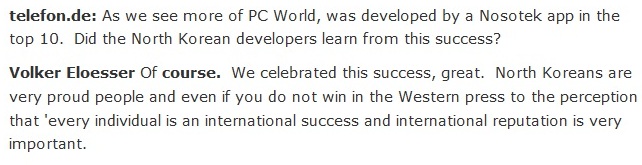
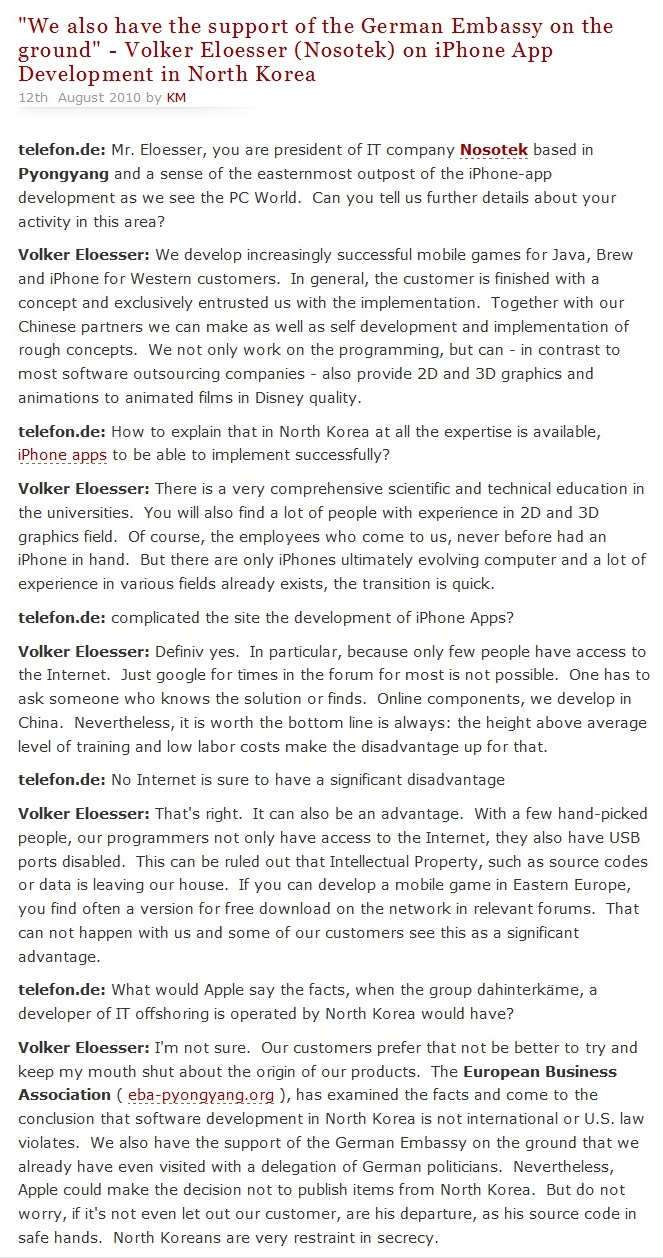
Volker Elosser of Nosotek gives an interview in German here.

Here is a translation of the article by Google Translate:

Click on the images to read the article.  I apologize for using these awkward images, but Google Translate only allowed me to copy/paste the original German.  This was the only fast/easy solution I could come up with.

The article references an article in PC World by Martyn Williams.  You can read this here.

Share

Koryo Tours August 2010 Newsletter

Sunday, August 8th, 2010

Learn more about Koryo Tours at their web page.

New Trips departing from Pyongayng
Be one fo the firts visitors to the DPRK’s second city – newly opened to Koryo Tours’ tourists- Hamhung, the second largest city in North Korea and a major industrial hub on the East Coast of the Korean peninsula, Previously the only foreigners who had been to this remote and very different part of the country were East Germans who participated in the post-war reconstruction of the area’s industry, NGO staff working on projects in the city, and the occasional diplomat or sailor. In May, however, Koryo Tours’ Simon Cockerell became the first tourist ever to go there since Liberation from Japan in 1945. Koryo Tours is pleased to be able to offer this destination to group and independent tourists staying in the city centre or at the nearby Majon beach. Among the places to visit are the giant Hamhung Grand Theatre (the city’s largest building that dominates the skyline), the Hungnam fertiliser factory (where Kim Il Sung made the remark “fertiliser is rice, and rice is communism”), the home of Ri Song Gye (a notable king of ancient Korea), and much more besides. Find more about our independent tours here

Pyongyang to Hamhung is a few hours by road via the port city of Wonsan, so this is not a daytrip destination; but, for pervious visitors or people staying for more than a few days in the DPRK, this is a very good place to head to – amazing views of the countryside all the way there and back contribute to a feeling that you have visited somewhere very special. An unforgettable addition to any tour.

VISIT OUTER MOUNT KUMGANG – In addition to our opening of Hamhung as a destination for tourists, there are more places on DPRK’s East Coast that are now possible to visit; including – for the first time from North Korea – the Hyundai-run resort of Outer Kumgang. This has been closed to tourists who previously went there in their thousands from the South since an incident in 2008, where a tourist was shot by a soldier in mysterious circumstances. Since then the agreement between the government of North Korea and Hyundai – who had leased the area for tourists – has collapsed and it isnow possible to visit (although not stay overnight) from the North. Some stunning hiking trails, within what is justly considered Korea’s most beautiful mountain range, can be embarked upon. Also a visit to the serene and peaceful Samil Lagoon is a must. A visit here takes the best part of a day for any tour already at the East Coast and is a must for anyone interested in seeing some of the most remarkable natural landscapes in East Asia. Good for getting a bit of exercise after the long drive to the East Coast as well!

New Trips to the DPRK’s North East
RASON INDEPENDENT TOURS AVAILABLE – On the subject of the Rason area of North Korea, we are now offering independent tours to this area and have a new page of our website dedicated to this  soon. Koryo Tours is the only western travel company ever to have been to Rason, so do feel free to ask us any questions at all; very few people have even heard of this place, let alone thought about going so if you want reliable advice and information, you know who to call! Full details and information about all the options we offer are available at the above link. Please have a look and let us know if you fancy it. The tour is unforgettable and very unlike the usual areas of the DPRK that we visit. Also it’s an amazing boast to have been there if you’re looking for a great travel story; the least visited part of the least visited country in the world! info@koryogroup.com for more info!

DPRK’s North East and Russia
THE TUMAN TRIANGLE- CHINA/DPRK/RUSSIA – In July we embarked on a brand new tour available exclusively through Koryo Tours. We call it the Tuman Triangle tour as it includes visits to three different countries in the region of the Tuman River (Tumen in China for all the pedants!). The route that our pioneering group of 18 took was a flight to Yanji in NE China’s Jilin province, then to the North Korean free trade zone of Rason (previously known as Rajin-Sonbong, a place where western tourists are almost unheard of but which Koryo tours have been visiting since 1996). We spent 4 days in the area doing a diverse range of activities such as seeing ports and seafood factories, playing beach football against Russian railway engineers, shopping in a public market – the only place this can be done in North Korea – going to the obligatory revolutionary sites, visiting the doctors (!) and local kindergartens, going to a deserted casino, doing a boat trip around the nearby islands, and more!

From DPRK we became the first tourists ever to cross into Russia by train to the town of Khasan and then spent a couple of days in the Russian countryside relaxing and taking a boat trip to a fascinating island in a nature reserve where abandoned WWII bases now provide nesting places for seagulls, before heading to Vladivostok by ferry and touring that previously-closed city and having free time to experience the delights and sights of the Russian Far East. We even made it to a Russian second division football match (Luch Energiya beat Belograd Salut 2-0 in case you’re interested!) before flying back to Beijing to complete this brand new and utterly unique itinerary.

The tour was a great success and we will be offering this again a couple of times next year. Dates and details will go online in a few weeks but do drop us a line on if you’d like to register an early interest; we aim to expand this tour even more for 2011.

A WILD AND MAGNIFICENT TRIP IN 2011 We will have an optional extension that will go to the remote Russian city of Magadan (infamous for Stalin’s gulags) – from Chollima to Kolyma! – as well as to the volcanic peninsula of Kamchatka. If you like the sound of this, then get in touch now! This tour, exclusively available from Koryo Tours will just get better and better. Join us if you want a completely different kind of holiday, and this sounds like your kind of thing!

4. Last chance to see Turkmenistan before the changes
TURKMENISTAN TOUR NOVEMBER 2010 – With the recent news that the Arch of Neutrality in Central Ashgabat is being torn down and replaced with something yet to be confirmed, the plan to relocate Central Asia’s largest market (the anarchic Tolkuchka Bazaar) to a sterile new location, and President Berdymuhammedov’s statement that he wants the amazing Darvaza gas crater to be extinguished and filled-in, it definitely seems like this is the time to visit, and see Turkmenistan at its weirdest and most unique. It will probably take at least a few months for the gas crater to be removed, (it’s the single most remarkable thing you will ever see; look for videos on YouTube for proof and bear in mind, they do not do it justice!) so  and camp next to the strangest accidentally-formed attraction in the world! Full tour details for this trip can be found at http://www.koryogroup.com/turkmenistan/tours.html and the tour can be started from a variety of destinations.

We have a lot more plans for additions to this November tour so if you’ve been thinking about going to Central Asia’s most enigmatic country, then now may be the time. Drop us a line for more information and we hope you can be there to see it with your own eyes!

Share

July 2010 DPRK Business Monthly

Sunday, August 8th, 2010

Long-time DPRK watcher Paul White has published his most recent collection of DPRK business sotries from July 2010.

You can download the PDF here.

Topics discussed include:

Trade with China Growing
“DPRK Leasing Squid Fishing Rights to PRC”
PRC Steel Firms Eye More NK Ore
Russian Diplomats Tour NK Cooperatives
NK to Boost Cooperation with UNPF
US Neurosurgeon Devotes Skills to North Korea
ROK Strengthens Port Barriers Against NK Goods
Credit Dries Up for Hyundai
DPRK Completes Biggest Tideland Reclamation
Details of GPI Consultancy Trade Mission to DPRK
“Kaesong Production Dropping”

Share

RoK bans civic group from visiting DPRK

Monday, August 2nd, 2010

According to KBS:

South Korea has turned down a civic organization’s request to visit North Korea.

The Unification Ministry in Seoul said Monday that it decided not to allow a cross-border trip by a delegation from the Korea NGO Council for Cooperation with North Korea, citing icy inter-Korean relations.

The NGO council sought to make a four-day visit to Pyongyang starting Wednesday to discuss the establishment of a branch office in the North Korean capital.

The government has banned South Koreans from traveling to North Korean regions other than the Gaeseong Industrial Complex and the Mount Geumgang resort in the wake of North Korea’s sinking of the “Cheonan” naval vessel.

Read the full story here:
S.Korea Bans Civic Group from Visiting NK
KBS
8/2/2010

Share

North Korea expanding farming areas

Friday, July 30th, 2010

Institute for Far Eastern Studies (IFES)
NK Brief No.10-07-30-1
7/30/2010

North Korean media outlets are reporting large-scale development of tidelands as part of ongoing economic projects. There have been reports on a land reclamation project in the tideland area of Daekye-do, in North Pyongan Province, that was completed on June 30. The Korea Central News Agency (KCNA) and the Workers’ Party newspaper Rodong Sinmun both ran stories on July 1 stating that the Central Committee of the Workers Party sent a letter of congratulations to the construction workers and supporters of the project, calling it, “A massive project of reclaiming Mother Nature, no less significant than the construction of the West Sea Flood Gates.”

The project, completed at the end of last month, reclaimed tideland in North Pyongan Province from Dasa-do, off the coast of Yeomju and Cholsan villages, to Kacha-do, Soyondong-do, Daekye-do, Tokye-do, and the Cholsan peninsula. It comprises 13.7 km of shoreline and more than 87 million square meters of land.

On July 22, the Choson Sinbo reported that North Korea planned to reclaim more than 59.9 million square meters or farm land by the end of 2012. The story also noted that the second phase of the land reclamation project in North Pyongan Province was in full swing, and that the first phase of a second project around Ryongmae-do, South Hwanghae Province, was scheduled to be completed by 2012.

The massive Daekye-do project completed at the end of June would be more than 10 times the size of Seoul’s Yeoui-do area, with more than two thirds of the area being reclaimed land. As background for the article, the newspaper explained, “As one way to expand crop production in [North Korea], the focus is being placed on the expansion of farmland through tideland reclamation.”

Related to this, the KCNA reported on July 15 that Kim Jong Il had visited the Daekye-do project, and said, “Land reclamation is an important project in the nation’s rich and powerful development.” Such a statement is tantamount to ordering the expansion of reclamation activities. Kim Jong Il also called for focusing national interest on difficult and massive reclamation projects to be carried out in the future, demanding that “policies necessary to support these projects must be thoroughly implemented.”

It was reported that Kim expressed ‘extreme satisfaction’ over the successfully completed Daekye-do project. After inspecting the area, he stated that the reclaimed farm land needed to be used “to full effect,” while at the same time more land reclamation projects should be carried out in order to completely resolve the North’s food shortage. North Korean media reported that Kim Jong said, “What is important here is to continue strongly extending the land reclamation project.” The KCNA also reported that North Korean state authorities, Party and Cabinet ministers, and supervisors from central government agencies accompanied Kim Jong Il on his tour of the Daekye-do land reclamation site.

On July 4, Korea Central Television (KCTV) reported, “Power plants throughout the country produced 1.2 times more electricity in the first half of this year than they did last year,” and the KCNA emphasized increased production in a number of factories, stating that compared to production plans, “In the Bakchon Silk Factory, rug production was 101%, regular cloth production was 107%, and ramie cloth liner production was 130%” of production quotas. In addition, “Along with the Pyongyang Daily Goods Factory production increase of 120%, the Nampo Glorious Soldier Shoe Factory, Hyeechon Silk Factory, Pyongyang Textile Factory and others are all meeting production goals.”

Share

Wilson Center NKIDP document readers

Sunday, July 25th, 2010

The Woodrow Wilson Center’s North Korea International Documentation Project has published some more great document readers compiled from archives in the Soviet Union, USA, ROK, China, Hungary, Romania, Poland and East Germany.

The Rise and Fall of the Detente on the Korean Peninsula: 1970-1974
Download PDF here
A collection of archival documents on inter-Korean, US-ROK and DPRK-Communist bloc relations from 1970 to 1974 compiled in preparation for a 1-2 July 2010 conference.

New Evidence on North Korea
Download PDF here
New archival documents from Russia, China, South Korea, Hungary, Romania, Poland and (East) Germany on North Korean history from 1955-1984.

New Evidence on the Korean War
Download PDF here
New documentary evidence on the Korean War from Russian, Polish and other archives. Compiled in connection with the 16-17 June 2010 conference New Documents and New Histories: Twenty-First Century Perspectives on the Korean War.

A press conference was held at the Truman Presidential Library announcing the release of the latter two Document Readers–which was carried on C-SPAN. You can watch it here.

Share

Choson Excange continues to grow

Thursday, July 22nd, 2010

Geoffrey See at Choson Exchange is putting together a solid team to facilitate innovative academic outreach programs in the DPRK.

Judging from a recent blog post it appears he is having luck making contact with a wide variety of DPRK organizations.

This fall the group plans to launch is first academic program in the DPRK.

Share

US attempts to apply more pressure to DPRK

Thursday, July 22nd, 2010

UPDATE 2: More details are coming out about the US led initiative to track down DPRK-owned accounts in foreign banks.

According to the Choson Ilbo:

North Korean leader Kim Jong-il is believed to have a US$4 billion slush fund stashed away in secret accounts in Switzerland, Luxembourg and Liechtenstein.

According to sources, North Korean bank accounts in Russia are being tracked after the U.S. government obtained information that the Russian mafia is laundering money for the North. Kim Jong-il and other officials cannot engage in financial transactions using their real names, so they are believed to operate secret bank accounts or rely on the Russian mob.

Philip Goldberg, the former U.S. State Department envoy charged with enforcing UN sanctions, visited Russia in August last year and reportedly asked Deputy Foreign Minister Alexei Borodavkin to crack down on the mob for its involvement in laundering money for North Korea.

North Korean accounts held in African banks are being tracked, because the reclusive regime has been earning a substantial amount of money in the region by smuggling ivory and selling weapons. “Despite the UN sanctions, North Korea has opened up new markets in Africa and Latin America,” said one North Korean source.

The U.S. sanctions against North Korea are expected to differ from pressure applied to Macao-based Banco Delta Asia back in 2005. “Rather than freezing the operations of an entire financial institution like BDA by getting the U.S. Treasury Department to blacklist it on suspicion of money laundering, the measures this time will probably involve the tracking of individual North Korean accounts directly linked to illicit activities and freezing them,” a diplomatic source said.

Sanctioning entire banks could prompt North Korea to complain that its legal financial transactions are also being blocked and this could make the lives of ordinary North Koreans even more difficult. This is probably why U.S. Secretary of State Hillary Clinton said these measures “are not directed at the people of North Korea,” but at the “destabilizing, illicit and provocative policies pursued by that government.”

Others say the latest sanctions could be more comprehensive than previous ones by automatically limiting U.S. transactions with all banks found to deal in a certain amount of money with North Korea, rather than singling out particular banks. Under such pressure, banks could voluntarily sever relations with North Korean businesses or individuals to avoid being blacklisted.

The South Korean government has apparently notified the U.S. of between 10 to 20 North Korean bank accounts under suspicion of being involved in illicit deals. There are fears that massive Chinese aid to the North could render the U.S. sanctions useless, but judging from the vehement protests lodged by North Korea when its accounts at BDA were frozen, experts say financial sanctions are an effective means of pressure.

And according to a different Choson Ilbo story:

The U.S. will freeze North Korean leader Kim Jong-il’s overseas secret bank accounts based on a tip-off from a whistleblower at a state-run bank in Liechtenstein in 2006-2007.

The August issue of the Monthly Chosun said since the North’s attack on the South Korean Navy corvette Cheonan in March, speculation has been rife among North Korea experts in Washington that the Obama administration will freeze Kim Jong-il’s secret accounts in Liechtenstein and Switzerland.

The tip-off from Heinrich Kieber, a former employee of LGT Bank, which is owned by the Liechtenstein royal family, contributed decisively to the U.S. obtaining information about Kim’s secret accounts. According to the U.S. Senate, Kieber said the “head of department in a socialist government” wanted to deposit more than US$5 million “with no explanation in the files whatever in regard to the source of the vast amount.”

The U.S. recently signed a tax information exchange agreement with Liechtenstein which could allow it to freeze bank accounts suspected of belonging to Kim.

The US also plans to distribute a lack list of North Korean firms to distribute internationally.  According to Asahi:

The United States plans to release a blacklist of North Korean companies and individuals believed to be involved in transactions of weapons of mass destruction and luxury items as part of new sanctions on Pyongyang in the wake of the sinking of the South Korean corvette Cheonan.

An official with the South Korean government divulged the plan on Friday. Seoul has been contacted by Washington about the blacklist.

The official said financial institutions would be under pressure to freeze or close accounts held by the companies and individuals on the blacklist.

The new measure is designed to avoid the problems that arose in September 2005 when the U.S. Treasury Department designated Banco Delta Asia of Macao as a financial institution suspected of laundering money for North Korea.

That designation caused a run on the bank and the Macao government was forced to place it under its control.

Under the new blacklist proposal, the United States hopes to provide financial institutions around the world with the names of individuals and companies with close ties to North Korea.

A South Korean government official said, “If a foreign government or financial institution does not cooperate with the new sanctions, there is the possibility that it could lose trust so the blacklist would apply silent pressure to conform.”

One problem is that many North Korean-related accounts are held in China and it remains unclear what, if any, cooperation will be obtained from Beijing and Chinese financial institutions.

One report from China does indicate that this strategy will make business with North Korea more difficult.  According to the Korea Herald:

Chinese banks ― mostly bigger institutions with international operations ― will not be able to avoid the sanctions that the U.S. is pursuing against North Korea, an official here said Monday.

“The bigger banks cannot avoid the sanctions because all of its transactions go through the U.S.,” he said.

He stressed that even smaller institutions ― such as Banco Delta Asia in the past ― could come under scrutiny because all wiring services go through New York.

“This means that for everyone dealing with North Korea, it will become difficult for them to send and receive money from the North,” the official said on the condition of anonymity.

The U.S. has already called for a dozen banks around the world including those in China to freeze the North Korean assets in their accounts, according to diplomatic sources in Washington. The accounts are suspected of being used for illicit activities by the North, such as purchasing weapons, luxury goods and trading in counterfeit.

UPDATE 1:  The US has already begun going after DPRK bank accounts.  According to the Donga Ilbo:

The U.S. government will reportedly freeze some 100 illegal bank accounts allegedly linked to North Korea, a diplomatic source said Thursday.

Washington is known to have discovered about 200 bank accounts worldwide linked to Pyongyang in the process of mulling financial sanctions separate from those of the U.N. since the March 26 sinking of the South Korean naval vessel Cheonan.

“The U.S. is closely tracking 100 of the suspected accounts that are highly likely to be illegal,” the source said.

If Washington takes action against the accounts, including suspension of transactions, its sanctions are expected to be stronger than the September 2005 freeze of 25 million U.S. dollars in the North’s accounts at the Macau-based Banco Delta Asia.

“As U.N. Security Council resolutions 1718 and 1874 ban financial transactions that could be used for weapons of mass destruction or missile programs, bank accounts under borrowed names related to such transactions can be seen as illegal,” the source said.

“Investigations by the CIA and the Treasury Department will reveal how many of the 100 accounts are directly linked to illegal transactions.”

The source said the level of sanctions sought will likely be 100 times stronger than the measures taken against Banco Delta Asia.

Even if Washington imposes sanctions on illegal accounts, however, it will likely ask each bank to close them rather than disclosing them on its official gazette, the source said.

“Disclosing the names of the banks where the accounts were opened will likely cause a strong protest from the banks because of possible damage to the banks` reputations and transactions,” the source said. “The U.S. government has continued to consult the banks and will likely induce them to quietly close the accounts.”

A detailed outline of the U.S. financial sanctions is expected to be released by Robert J. Einhorn, new U.S. coordinator for sanctions on North Korea and Iran, when he visits Seoul early next month.

And according to the Joong Ang Daily:

The United States has already begun quietly freezing assets in North Korean accounts at about 10 banks around the world, diplomatic sources familiar with the situation told the JoongAng Ilbo yesterday.

On Tuesday in Seoul, U.S. Secretary of State Hillary Clinton said the U.S. would levy additional sanctions on North Korea for the March sinking of the Cheonan.

“The U.S. Treasury Department and intelligence authorities began looking into about 200 bank accounts that showed suspicious activities involving North Korea,” an informed diplomatic source said. “Bank accounts used to deposit money earned from the North’s exports of arms, in violation of UN Security Council resolutions 1718 and 1874, were studied, along with accounts used to purchase luxury goods believed to be supplied to the North’s leadership.”

Of the 200 suspicious accounts, U.S. authorities narrowed their attention to about 100 and began freezing their assets, the source said. The accounts belong to about 10 banks in Southeast Asia, southern Europe and the Middle East, the sources said. All the accounts were opened and operated under aliases, the source said.

Resolution 1718 was adopted on Oct. 14, 2006, after the North’s nuclear test that month. The main sanctions were an arms embargo, inspection of cargo going in and out of the North, an export ban on luxury goods to the North and the freezing of assets of individuals and entities designated by the UN sanctions committee. Resolution 1874 was adopted in June 2009 after the second nuclear test in May 2009, and it reinforced the existing sanctions.

While the U.S. was public about freezing North Korean accounts at the Macao-based Banco Delta Asia in 2005, the latest freezings were done quietly, the source said.

“When the U.S. authorities informed the banks that there were problems associated with certain accounts, the banks quietly froze the assets, making it hard for the media to detect,” the source said. “The assets in those accounts are likely to be money Kim Jong-il needs to operate his regime, so this will deal a serious blow to the North.”

“The U.S. began the freezings before June,” the source said. “The moves should be interpreted as a part of new sanctions on the North to hold it responsible for the sinking of the Cheonan.”

The assets in those accounts were presumably raised through illicit trade of arms, counterfeiting money, money laundering and drug trafficking, the source said. “In the past, the North deposited money in African bank accounts created under aliases and raised through trafficking in elephant ivory, selling of counterfeit Viagra and exporting arms in Africa,” the source said.

The source said the new financial sanctions will be different from what happened in the Banco Delta Asia crisis that stalled the six-party nuclear talks for years due to the North’s protest. Instead of naming and shaming a specific bank as a money laundering institution and pressuring it to freeze North Korean assets, “quiet” moves are now preferred to avoid blowback from Pyongyang, the source said.

Another source confirmed the additional financial sanctions, noting that, “If the charges are very clear, then the Banco Delta Asia method will be used, while the silent method will be used in more ambiguous cases.”

Meanwhile, a senior U.S. official said a package of sanctions aimed at stopping Pyongyang’s illegal activities will be announced in the next couple of weeks. In a press briefing in Washington on Wednesday, Assistant Secretary of State Philip J. Crowley elaborated on the fresh sanctions announced by Clinton in Seoul.

“Much of what we’ve done up to this point has centered on proliferation activities that stem from specific authorities,” Crowley said. “We’re moving into strengthening our national steps to attack the illicit activities that help to fund the weapons programs that are of specific concern to us – things like the importation of luxury goods into North Korea, concerns that we have long had about trafficking in conventional arms. So there are authorities that we will strengthen nationally, and we’ll have more to say about that in the next couple of weeks.”

North Korea’s counterfeiting of banknotes and cigarettes, diplomats’ smuggling of cigarettes, banking transactions that fund weapons programs and support the government and its policies were named as some of the illegal activities to be tackled under the sanctions.

Crowley also said Robert Einhorn, special adviser for nonproliferation arms control, will soon begin a trip to encourage countries that have been reluctant to implement earlier sanctions, noting that the North has found ways to sidestep the measures.

“They look to see if there are seams and gaps in the international effort,” Crowley said. “That’s what Bob Einhorn is going to be consulting with a range of countries where we think there needs to be more aggressive implementation of Security Council resolutions 1718 and 1874.”

Crowley, however, refused to say what Einhorn’s destinations are and if they include China.

“China obviously has a big role to play in this,” Crowley only said.

ORIGINAL POST: Sec. of State Hillary Clinton has announced the US will impose tighter financial sanctions on the DPRK.  According to Al Jazeera:

The United States will impose new sanctions on North Korea in a bid to stem its nuclear weapons ambitions, Hillary Clinton, the US secretary of state, said.

Clinton said the measures were designed to stamp out illegal money-making ventures used to fund the nuclear programme.

“These measures are not directed at the people of North Korea, who have suffered too long due to the misguided priorities of their government,” Clinton said after talks with defence and military officials in South Korea on Wednesday.

“They are directed at the destabilising, illicit, and provocative policies pursued by that government,” she said.

She said the sanctions would be aimed at the sale or procurement of arms and related goods as well as the procurement of luxury items.

The US will freeze assets as well as prevent some businesses and individuals from travelling abroad, and collaborate with banks to stop illegal financial transactions, Clinton said.

Also the US Department of the Treasury (h/t Josh) has announced new procedures that apply to U.S. financial institutions maintaining correspondent accounts for “foreign banks operating under a banking license issued by” North Korea.  According to FinCEN:

The Democratic People’s Republic of Korea (DPRK) has not committed to the AML/CFT international standards, nor has it responded to the FATF’s numerous requests for engagement on these issues. DPRK’s lack of a comprehensive AML/CFT regime poses a risk to the international financial system. DPRK should work with the FATF to develop a viable AML/CFT regime in line with international standards.

B. Jurisdictions in FATF Statement Section 2 have been identified by the FATF as having strategic AML/CFT deficiencies and not having committed to an action plan developed with the FATF to address key deficiencies. Based on the FATF’s adoption of the ICRG’s findings, a decision by the FATF in which the United States concurs, FinCEN is advising U.S. financial institutions of their increased obligations under Section 312 of the USA PATRIOT ACT, 31 USC § 5318(i). Accordingly, U.S. financial institutions should apply enhanced due diligence, as described under implementing regulations 31 CFR § 103.176(b) and (c) when maintaining correspondent accounts for foreign banks operating under a banking license issued by DPRK and São Tomé and Príncipe.

Read the full statement here.

Also, the US Department of State has added the DPRK’s Korea Mining Development Trading Corporation (KOMID) to its list of sanctioned companies.   According to the Chosn Ilbo:

The U.S. State Department on Tuesday put another North Korean company on a list of sanctions targets based on the Iran, North Korea, and Syria Nonproliferation Act.

The Korea Mining Development Trading Corporation was added to the list due to suspected dealings in weapons of mass destruction or ballistic missiles in violation of the Missile Technology Control Regime since 2006.

The company had already been designated by the U.S. Treasury Department as a target of financial sanctions. The blacklisting came as part of wider U.S. sanctions against the Stalinist country that largely cover well-trodden ground.

KOMID will not be permitted to conclude supply contracts with any U.S. government agencies or to take part in any U.S. government support programs. The newest round of sanctions will be effective for two years from the moment they take effect.

Share

Asian football chief meets with DPRK official

Tuesday, July 20th, 2010

According to Yonhap:

Asian football chief Mohamed Bin Hammam met with a North Korean official in Pyongyang on Monday, the second and last day of his two-day trip to the country, the North’s media said.

“Yang Hyong-sop, vice-president of the Presidium of the Supreme People’s Assembly of the DPRK, met and had a talk with Mohamed Hammam Saad Al-Abdulla, chairman of the Asian Football Confederation (AFC), and his party at the Mansudae Assembly Hall on Monday,” said the North’s Korean Central News Agency (KCNA) in a brief dispatch.

The AFC chief, also an executive member in FIFA, arrived in North Korea on Sunday to launch FIFA’s “Goal Project,” which helps underdeveloped countries build football fields and other sport facilities, according to the Web site of the AFC.

According to the AFC, Hammam planned wide-ranging talks with the president of North Korea’s football governing body and sports minister, before flying to China on Monday.

North Korea, which lost all three group matches in South Africa at its first World Cup in 44 years, was offered free World Cup footage in line with FIFA’s policy to promote football in poor countries.

In a separate report later on Monday, the KCNA also said that a new training camp with 60 beds has been built for the North’s national football team under the FIFA Goal Project.

The report said the camp, with a floor space of more than 2,100 square meters, has bedrooms, dining halls, bath rooms, a swimming pool and a video room, adding the opening ceremony took place on Monday with the attendance of Hammam and North Korean officials.

If anyone knows where this facility is, please let me know.

There are a couple of nicely rebuilt football fields here and here, but I do not know if they are part of this particular camp.

Read the full story below:
AFC chief meets with N. Korean official
Yonhap
7/19/2010

Share

An affiliate of 38 North