Archive for the ‘International Organizaitons’ Category

N. Koreans use phones to sneak information out

Wednesday, June 15th, 2011

According to the Korea Herald:

North Korea is a country that has been almost entirely isolated from news around the world for the past 60 years. The regime in Pyongyang allows Internet access to only a fraction of government officials and its power elite as it prepares for a third-generation hereditary succession to a young man in his late 20s.

The people of North Korea have been brainwashed since childhood to pay respect to the country’s idolized “Great Leader” Kim Il-sung and his son “Dear Leader” Jong-il.

So was Kim Hung-kwang until he began watching South Korean movies and drama in 1995.

“Toddlers are taught by their parents to say ‘thank you, Dear Leader’ before every meal,” Kim said in an interview with The Korea Herald.

“I had been a brainwashed, proud member of the (North Korean Workers’) party myself, until I came across South Korean films in 1995 and eventually learned that the outside world was much better.”

The computer engineering professor managed to flee the North seven years later and arrived in the South in 2003. He was joined by his family two years later.

Born in the eastern coastal city of Hamheung in 1960, Kim graduated from Kim Chaek University of Technology in Pyongyang, meaning he had been one of the North Korean regime’s highly trusted party members. While working as a professor of computer engineering at the Communist University, he was caught for lending some CDs containing South Korean drama to a friend and was sent to a collective farm as punishment.

This prompted him to defect to the South via China in 2003.

In 2008, he launched North Korea Intellectuals Solidarity with about 300 professors, engineers, doctors, journalists and writers from the North.

Now, he runs a dormitory and school for children of fellow defectors from the North, an Internet broadcasting station and publishes a periodical of articles by his colleagues.

The NK Intellectuals Solidarity is also a well-known source of breaking news from the North such as the currency denomination measure in late 2008 thanks to its informants around the China-North Korea border areas.

About 3,000 mobile phones are believed to be secretly used in the North for business purposes or delivering local information across the border, according to Kim.

“About 10 of them are ours, through which we hear about what’s going on there from our informants,” he said.

The informants in the North face the danger of getting caught by the authorities while speaking on the phone near the Tumen and Yalu Rivers with their co-workers in China.

One of Kim’s informants was caught two years ago on charges of spying and was tortured to death.

“She was a mother of three in her 30s who told us things like how the locals perceive the latest economic policies, but (the North Korean authorities) branded her as a spy,” Kim said.

“(Her death) was traumatizing and made us question if we should keep doing this. But we decided not to stop because otherwise, we wouldn’t be able to know about the inhumane crimes committed in the North.”

Kim’s solidarity has also sent in about 300 USBs technically modified to avoid detection.

The USBs do not contain any propaganda, but information on “what the defectors found surprising in the South,” dozens of new media programs such as PDF viewer, MP3 player software and e-books to enable more North Koreans to view South Korean video and text files, Kim said.

“Contrary to what we had expected, copies of Wikipedia entries turned out to be the most popular (among the North Koreans),” he said.

Currently, only five homepage servers are registered under the North Korean domain (.kr). The country connected itself to the Internet in mid-August, but only a handful of selected people are believed to have access to the Web.

Over 20,000 North Koreans have defected to the South since the Korean War ended in a truce in 1953. Hundreds are entering the South each month now mostly via China.

“I think about 4,000 people will arrive (in the South) next year,” Kim said.

“Women used to take up about 80 percent (of the defectors) before, but lately the percentage of men is going up.”

The North still maintains tight vigilance along its borders, but an increasing number of people manage to avoid the authorities’ eyes mainly thanks to bribery.

“Nowadays, it costs between 3.5 and 4 million won to bribe a single person (a soldier along the border, for example) in order to cross the border. The price goes up as (the North) tightens borderline vigilance,” Kim said.

About the North Korean people’s consciousness that they were being mistreated by the dynastical regime in Pyongyang, Kim said it was still in a “germinal stage.”

Pyongyang has tried to soothe its starving people by promising that food supply will be normalized next year, the deadline Pyongyang has set to become a “strong and prosperous nation.”

“But if the food conditions do not improve next year and turns out that it was all words and no action, people will really turn their backs against the government,” Kim said.

“They will know for sure that they are merely being used by the government. They will think that an individual’s basic rights should be placed above their government and start thinking about why there is such a major gap between what the current regime says and the reality.”

The North Koreans are now starting to learn about the need for a social safety net and how the South Korean society is going about its welfare policies through the limited information they receive from outside, Kim said.

“The third stage will be discussing what they have learned among themselves,” he said.

“Starting from groups of two or three people, the discussions will expand and eventually allow certain groups to take action.”

South Korea has reportedly been making contingency plans for various scenarios including a “sudden change” in the North such as the collapse of the Kim regime that will lead to a massive movement of refugees across the inter-Korean border.

“In case of a sudden change, the South can run a buffer zone just south of the border to temporarily house the refugees and prepare them for life in the South, although blocking the people’s free travel would be another issue,” Kim said.

“But because it would be a temporary measure, I don’t think we need to worry too much about a mass influx of refugees.’

Kim also noted that while preparing for a sudden change or unification, South Koreans should not underestimate the North.

“The South has no nuclear weapons, no inter-continental ballistic missiles, no cyber warfare troops, and most important of all, it suffers from internal conflict,” he said, mentioning an online survey last year that showed that some South Koreans did not trust their own government’s conclusion that the North torpedoed the Cheonan.

Kim said the North was training some 3,000 hackers to attack the IT systems of major South Korean institutions.

The prosecution concluded last month that North Korea was behind the cyber attack that paralyzed the banking system of the National Agricultural Cooperative Federation, or Nonghyup, in April.

“Our website was attacked in the same way they attacked Nonghyup,” Kim said.

“The North is very good at stirring up social conflict in the South, prompting certain pro-North groups to call on the government to ‘appease the North,’ or send money to Pyongyang. Their aim is to set up a pro-North regime in the South,” Kim said.

As for the “pro-North people” in the South, Kim said they seemed to hold an illusion that the North Korean system might settle their personal grudges or social problems in the South despite the fact that the Kim regime’s ideology has failed in reality.

Kim called on the South Korean government to set up a clear set of rules and conditions regarding the extent of humanitarian aid the South can send to the North in cases of natural disasters, for example, so that emergency aid to the North becomes more transparent.

Read the full story here:
N. Koreans use phones to sneak information out
Korea Herald
Kim So-hyun
2011-6-15

Share

HgCapital challenged over DPRK links

Thursday, June 9th, 2011

According to City Wire:

Private equity investment trust HgCapital Trust was challenged over links to pariah state North Korea at an investor conference this week.

Ian Armitage, chairman of HgCapital, was asked to explain the trust’s links to talc mines in North Korea via its ownership of the Finnish firm Mondo Minerals.

Talc is a mineral used to make talcum powder but also for paper making, plastic, paint and many other industries. Mondo is the world’s second largest producer and, according to Armitage, the company sells 390,000 tonnes per year. Of this 1,500 tonnes comes from North Korea.

Mark Partington, an investment trust investor attending the conference held by Numis in London, said he was concerned that the mine may have used political prisoners in its labour force.

Armitage told Citywire that Mondo ‘didn’t own a mine in North Korea and had no hand at all in operating a mine but does get supplies from that mine through a joint venture that is part owned by the mine and part owned by Mondo.’ He said that Mondo was just a customer of the mine.

Armitage said that Mondo’s relationship with North Korea was in place when HgCapital bought Mondo and that US investors in the fund had been asked if they objected – at the time there was a ban on investing in ‘axis of evil’ states – and had allowed the deal to go ahead.

But he said: ‘In terms of what happens around the world it is not our job to make moral decisions about difficult countries.’ He added: ‘We are not the world’s policeman and we do not take responsibility for what suppliers (of Mondo) do.’

Mondo makes up about 5% of HgCapital Trust’s portfolio of companies and it is believed that HgCapital is looking to sell the firm – rumours which have not been denied by HgCapital Trust. The trust has a market value of £360 million and it is about 10% of HgCapital’s larger unlisted private equity fund.

The trust is in Citywire Selection, our shortlist of investment ideas, and its shares have returned 42% over the last three years while its net asset value (NAV) has risen by 22%. The shares are now trading around a 4% premium to NAV which means that the shares are worth more than the underlying companies owned by HgCapital.

Read the full story here:
HgCapital challenged over North Korea links
City Wire
Rob Mackinlay
2011-6-9

Share

Orascom releases 2011 Q1 shareholder report

Friday, May 20th, 2011

You can see the whole report here (PDF).

According to Martyn Williams (PC World):

The number of 3G cellular subscriptions in North Korea passed half a million during the first quarter, the country’s only 3G cellular operator said this week.

The Koryolink network had 535,133 subscriptions at the end of March, an increase of just over 100,000 on the end of December 2010, said Orascom Telecom. Egypt’s Orascom owns a majority stake in Koryolink, which is operated as a joint venture with the state-run Korea Posts and Telecommunications Co.

Subscriber growth has been strong ever since the network was launched in late 2008, but the most recent quarter delivered the first signs that Koryolink is having to work harder for new subscribers.

The January to March period was the first time since the third quarter of 2009 that the number of new subscribers during the quarter failed to be more than the previous quarter. In the October to December quarter, the company added just over 130,000 new customers.

Revenue for the quarter was a record US$25.7 million, a jump of 185 percent on the same period of 2010. Orascom doesn’t disclose net profit figures for the company.

The company is keen to launch new value-added services to raise average revenue per user (ARPU) and during the quarter it began offering MMS (Multimedia Messaging Service). Customers gave the service a positive response, Orascom said.

But despite the efforts, ARPU fell to its lowest level since service began in 2009. At just US$12.7 per month, it was down 40 percent on the same period last year.

Orascom also launched pre-paid cards denominated in euros to boost foreign exchange earnings from North Korea. The scratch cards offer free voice and value-added service use during off-peak hours.

The company’s network now covers 92 percent of the population.

North Korea is one of the world’s most heavily controlled countries and communication is severely restricted. Most cell phones don’t have the ability to make or receive international calls.

The Daily NK offers some additional information:

Cell phone customer numbers are rising while the price of the handsets is falling, according to sources from inside North Korea.

One such source from Pyongyang reported on the 18th, “The phone bill is no different from in the past, only the price of the cell phone itself is falling.”

According to sources, in Pyongyang a single-piece handset has gone from $280 to $250, and a clamshell design from $400 to $380 (at the exchange rate in South Pyongan Province, one dollar is presently worth 2,500 North Korean won, while a kilo of rice continues to drift in the 2,000 won range).

The source explained, “Cell phone users keep increasing. In Pyongyang, approximately 60% of people between their 20s and 50s use cell phones. Especially for the younger generation in their 20s and 30s, a cell phone is seen as a necessary item,” he said.

A source from Shinuiju also commented, “Around three out of ten young people have got a cell phone, and prices have been cut a bit.”

A source from South Pyongan Province agreed, too, saying, “Cell phone bills and prices have dropped compared with in the beginning. A basic cell phone (single-piece) is $225 and an expensive one is $300. You pay 30,000 won in our money, and then you can use it for 200 minutes.”

The source went on, “But when you buy a $10 card, you can use it for 600 minutes. This is a state policy to earn dollars.”

He explained that according to the jangmadang exchange rate, $10 is currently 25,000 won, meaning that payment for credit in dollars is of huge benefit in terms of value for money.

However, there is still an application fee of $800 and registration fee of $100, as before.

The source reported, “Cell phone traders purchase cell phones using their families’ and relatives’ names,” because only one handset per person is allowed. “Since there are many people who have obtained a cell phone in another’s name, their cell phones occasionally get confiscated when they go to the telephone office to pay the bill and get their ID checked.”

In a connected story, Radio Free Asia reported on the 19th that Koryo Link has added another 100,000 subscribers to its books since the end of last year, bringing the total number to 535,133 as of the end of March.

However, in contrast with Pyonyang and the interior areas of North Korea where usage is growing, the battle in the border region is still to restrict and control cell phone usage. Distinguishing a Chinese cell phone is not easy, so cracking down on the practice of using them is not easy, either, and therefore the method of applying for a cell phone has been made more difficult, among other measures.

According to one Yangkang Province source, “One person who took cell phones brought in by smugglers in March, remodeled and sold them was arrested by the People’s Safety Ministry, and in the light of that the process for applying for a cell phone here got stricter. The person who wishes to buy the phone must have the signature of a National Security agent now. In the beginning, there was no such rule.”

In North Korea, applications for cell phones are handled by sales offices; however, the procedure is more difficult now, and so some get the handset from a smuggler and only the number from the local office, in order to avoid the process. Of course, bribes are necessary to facilitate that, currently approximately $400-$450 in Yangkang Province.

According to sources, an official North Korean cell phone works on a different frequency to those from China in order to stop their being used to connect outside the country. However, if the frequency of a smuggled phone is changed to match North Korea’s, then the cell phone can be used.

And according to Mobile Business Briefing:

Orascom Telecom’s North Korean mobile arm, koryolink, surpassed the half a million subscriber mark in the first quarter, representing growth of 420 percent year-on-year. Orascom noted during its Q1 earnings yesterday that its North Korean subscriber base has reached 535,133, up from 125,661 a year earlier. While the numbers are still relatively small, Orascom’s North Korean venture – which was first launched in December 2008 – is being closely watched; koryolink is the only commercial operator in the notoriously secretive and totalitarian country and therefore has huge growth potential – as well as being a risky investment. Orascom said that current mobile penetration in North Korea is just 2 percent. Its revenue from koryolink rose 185 percent year-on-year to US$25.8 million in Q1, while earnings (EBITDA) hit US$22.6 million, giving it an impressive EBITDA margin of 87.6 percent.

koryolink’s network currently consists of 341 base stations covering the capital Pyongyang, 14 main cities as well as 72 smaller cities, Orascom said. The network also extends over 22 highways. As of the end of Q1 2011, koryolink covers 13.6 percent of the country’s territory and 92 percent of its population. In January 2011, koryolink launched MMS services for the first time, the latest addition to its VAS portfolio. The firm has also focused on maximising foreign currency revenue, launching in February a recharge card that can be bought in Euros.

Share

Koryo Tours update

Thursday, May 19th, 2011

2012 DPRK tour dates: Koryo has posted travel dates for 2012, including a tour for Kim Il-sung’s 100th birthday.  Check the dates and itineraries here.

2011 Ultimate Frisbee tourney: Pyongyang will be home to its first ever Ultimate Frisbee tourney this summer.  August 27th.  Sign up now.

Ultimate Frisbee in North Korea. The most interesting sports thing you’ve ever done. Unless you’re Usain Bolt, who isn’t responding to my friend request.

The cost will be 890 Euros. This includes flights from and back to Beijing, tourist stuff Saturday and Monday, pizza, all other food that isn’t pizza, hotel, fields, entertainment. Visa fee (not optiona, 50 Euro) and ticket to the mass games (optional, but would be weird not to go: 80, 100, 150 or 300 Euro options) will be extra. North Korean microbrewed beer will be extra, but cheap (and good).

The itinerary includes two full days and three nights of touring. The tournament is a one day hat. We leave Beijing early Saturday and return early Tuesday. Participants should be in Beijing by Friday afternoon in order to collect visas get final info at Koryo Tours.
All nationalities except South Korean can participate.

Write an email to pyongyanghat@gmail.com if interested in attending and want more info.

If you know you’re in, write simon@koryogroup.com and ask for the necessary forms to get it going.

It ain’t cheap, but it will be amazing. We’re looking to get deposits by June 30th.

Tentative Itinerary for Ultimate Frisbee Tour
Thurs 25th Aug: Pickup in Beijing -Introduction to “Extreme Pollution Ultimate”, dinner at Dong Bei Ren Restaurant (Not included in tour fee)

Fri 26th Aug: Briefing/Collect Visas at Koryo Tours office in Beijing

Sat 27th Aug: N/A Arrival by Air Koryo flight from Beijing at 14:20, Fountain Park, Mansudae Grand Monument, Kim Il Sung Square, ARIRANG MASS GAMES

Sun 28th Aug: Taesongsan Park for Frisbee Tournament, picnic lunch Frisbee tournament, evening trip to Kaeson Youth funfair, dinner at Korean restaurant

Mon 29th Aug: Juche Tower, Mansudae Art Studio, Pyongyang Metro (extended ride on the subway), Arch of Triumph, USS Pueblo, Pizza Restaurant Lunch, FRISBEE CLINIC AT LOCAL MIDDLE SCHOOL. Paradise Micro-Brewery, Foreign Languages Bookshop, Farewell dinner at Duck BBQ restaurant, evening Karaoke option.

Tues 30th Aug: 9:00 Air Koryo Flight to Beijing. End of tour.

Previously, Koryo Tours hosted the first cricket match (2008) and first golf tournament (2005) in the DPRK.

Middlesbrough Women’s Football Team booklet: It has been posted to the Koryo Tours web page. You can download it here (PDF).  Learn more about this effort here and here.

Share

The DPRK and national/multilateral development and trade agencies

Monday, May 9th, 2011

Marcus Noland has an interesting post on the plethora of obstacles the DPRK must navigate before it can take advantage of the full range of trade and development programs across the globe.

Read his post here.

Share

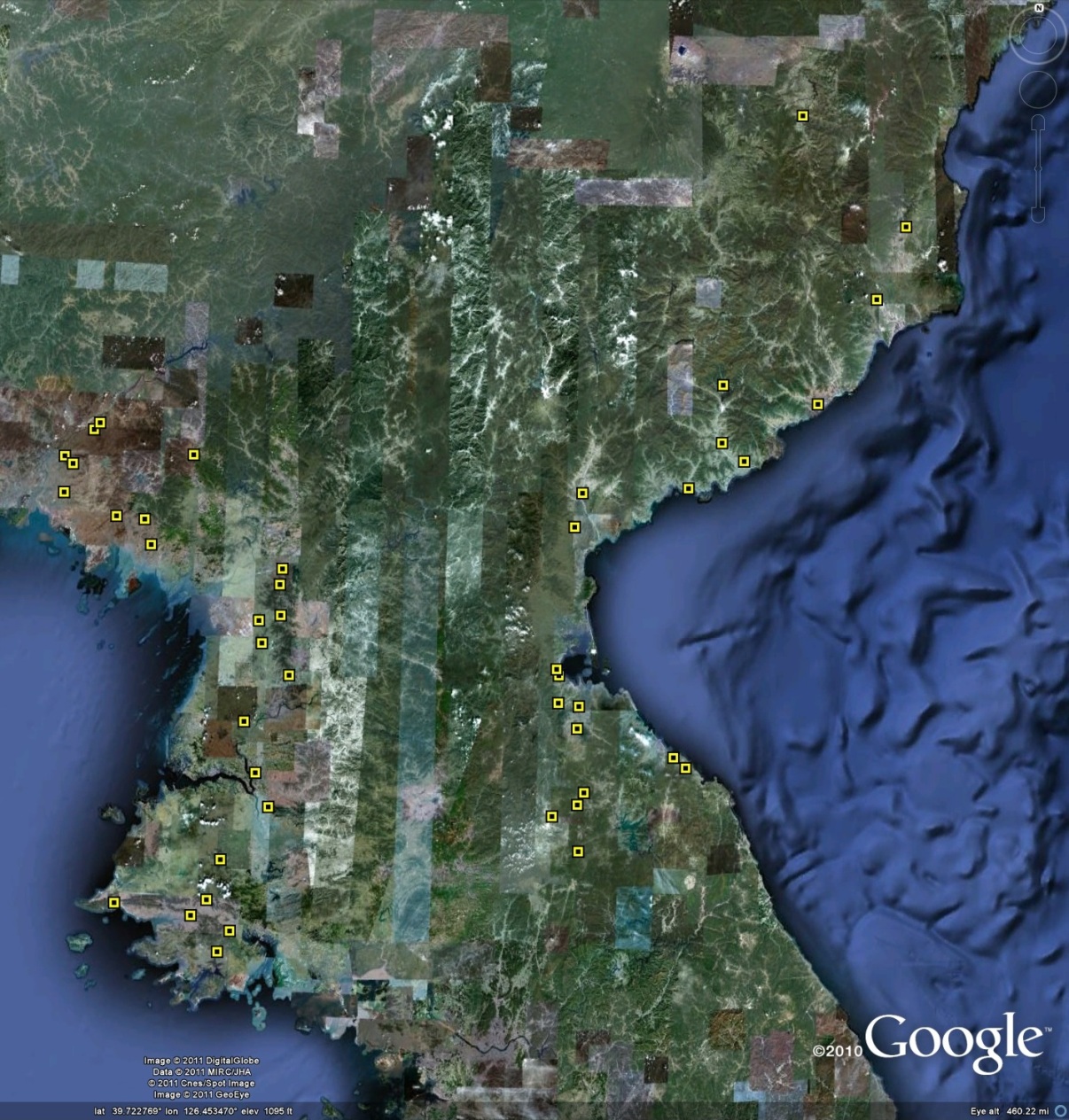
Koryolink employee numbers and other info…

Sunday, May 8th, 2011

Pictured above: Locations of Koryolink (Orascom) moblie phone towers I have identified in the DPRK.  Supposedly 300 exist in total.

The German Financial Times published a story on Orascom.  Much of it was familiar material, but it did contain one interestign nugget I had not seen before:

Etwa 20 Ägypter und mehr als 200 Nordkoreaner arbeiten für Koryolink – die meisten der Expats im Management, ein Großteil der Nordkoreaner als Techniker und im Service. Für die Kundenbetreuung wurde ein modernes Callcenter eingerichtet. Das Netz deckt die Großstädte, die Autobahnen und die Schienenwege ab, insgesamt etwa 15 Prozent der Staatsfläche. In dem Gebiet leben 91 Prozent der Bevölkerung.

And putting this through Google Translate we get:

Throughout the country, told Heikal, meanwhile, more than 300 transmitters spread. Some 20 Egyptians and more than 200 North Koreans work for Koryolink – most of the expatriates in management, the majority of North Koreans as a technician and service. For customer support a call center was established. The network covers the major cities, highways and rail lines, totaling about 15 percent of state land. In the field 91 percent of the population live.

The service has grown to over 500,000 users but still remains out of the hands of the vast majority of the population:

Auch wenn jetzt theoretisch jeder ein Handy haben darf, sind die Tarife für die meisten Nordkoreaner unbezahlbar. 200 Freiminuten und 20 SMS kosten im Monat 800 nordkoreanische Won, nach offiziellem Wechselkurs sind das rund 5,50 Euro. Dazu kommen die Freischaltgebühr und die SIM-Karte für 50 Euro – zahlbar in Devisen. Wer sich nichts in der wuchernden Schattenökonomie dazuverdient, kann sich das nicht leisten.

And again, via Google Translate:

Even though now may theoretically have a cell phone each, the rates for most North Koreans are priceless. 200 free minutes and SMS cost 20,800 North Korean won per month, according to the official exchange rate is around 5.50 €. Then there are the activation fee and the SIM card for € 50 – payable in foreign currency. Anyone who does nothing, earned in the sprawling shadow economy can not afford that.

And on the human resources front…

Auch bei seinen nordkoreanischen Mitarbeitern bemerkt er Veränderungen. “Vom technischen Können her sind sie sehr gut, die Herausforderungen lagen eher im kaufmännischen Bereich und im Marketing”, sagt Heikal. “Aber wir bilden sie im Unternehmen aus, und wir organisieren für sie Trainings im Ausland, vor allem in China. Ich spüre, dass sich ihre Mentalität über die vergangenen drei Jahre gewandelt hat. Sie beginnen, das Geschäft zu kapieren.”

Bisher sind nordkoreanische Angestellte noch nicht ins oberste Management vorgestoßen, aber mittelfristig sollen sie die ägyptischen Expats ablösen. Natürlich wünscht sich das Regime, dass die eigenen Leute dort die Verantwortung übernehmen – und hegt trotzdem, wie so oft, schwere Bedenken dagegen. “Auf der Managementebene muss man mit der Außenwelt kommunizieren”, gibt Heikal zu bedenken. “Wir diskutieren das mit den Behörden. Sie verstehen das Problem, aber ich denke, das wird noch etwas dauern.” Er lächelt. “Im Rückblick erkennt man enorme Verbesserungen und Veränderungen, aber wir haben noch viel vor uns. Eine ganze Reihe von Dingen wird noch eine Menge Geduld brauchen.”

via Google Translate:

Even with his North Korean employees, he noticed changes. “From her technical ability, they are very good, the challenges were more in the commercial sector and in marketing,” says Heikal. “But we are training in the company, and we’ll arrange for her training abroad, especially in China. I feel that their mentality has changed over the past three years. You begin to understand the business.”

So far North Korea’s workers are not pushed into top management, but the medium they are to replace the Egyptian expatriates. Of course, the regime hopes that their own people over there take the responsibility – and still cherishes, as so often, serious concerns about it. “At the management level needs to communicate with the outside world is,” says Heikal pointed out. “We discuss with the authorities. You understand the problem, but I think it will take some time.” He smiles. “In retrospect, there are vast improvements and changes, but we still have a lot to us. A whole series of things still need a lot of patience.”

Read the full story here:
Die Pyramidenbauer von Pjöngjang
German Financial Times
2011-5-8

Share

DPRK mineral exports top US$860m last year

Saturday, May 7th, 2011

According to Yonhap:

North Korea’s exports of mineral resources jumped 17-fold in a decade with its outbound shipment of coals and iron ores leading the growth, a U.S. report showed on Saturday.
According to Radio Free Asia (RFA), the communist state’s exports of mineral resources reached US$860 million last year, compared with some $50 million in 2002.

Citing data compiled by the Korea Trade-Investment Promotion Agency [KOTRA], the RFA said exports of such minerals as coal and iron ore accounted for 63 percent of its total exports to its strongest ally China.

In the first quarter of the year, the North earned around $154 million by exporting coal to the neighboring country, compared with $9.68 million seen a year earlier.

North Korea’s mineral reserves are believed to be among the largest in the world, worth some 7,000 trillion won, based on 2008 prices, according to an earlier report by the Unification Ministry.

I am unable to locate either the RFA story or the KOTRA report so I don’t have much to say on this.  If you have a link please send it to me.

Read the full story here:
N. Korea’s exports of mineral resources top US$860 mln last year
Yonhap
2011-5-7

Share

Choson Exchange looking for volunteers

Sunday, May 1st, 2011

From the Choson Exchange Facebook Page (May 1, 2011):

We are looking for volunteers with an interest in North Korea and the right skill sets to lead workshops in Pyongyang in the September-October period, and for North Koreans outside of Pyongyang in the July-August period.

Those with the following skill sets would be most appreciated and are welcome to email us at CEteam@chosonexchange.org to discuss volunteering opportunities. Those with relevant experiences outside of these areas are welcome to join our mailing list and Facebook page to stay in touch about future opportunities:

Economic Policy
1. Fiscal & Monetary Policy
2. Business Environment Development
3. Investment Policy & Sourcing

Banking
1. Risk Management – Credit, FX, Market, Liquidity, Operational…etc.
2. Asset-Liability Matching
3. Banking IT Systems

Entrepreneurship
1. Developing Business Plans
2. Feasibility Studies

Share

Kim Jong-il actively making field guidance visits in the economy sector

Friday, April 29th, 2011

Institute for Far Eastern Studies (IFES)
(NK Brief 11-04-27)

Kim Jong Il is continuing to make field guidance visits around Ryanggang and the Northern Hamgyong Province.

The Rodong Sinmun reported on April 23 that Kim Jong Il visited Rajin Shipyard. Rajin Shipyard is known for producing ships necessary for advancing fishing, marine transportation, and foreign trade industries. Chairman Kim emphasized the importance of self-reliance, especially on the need to adopt the latest science and technology and partake in the mass technical innovation movement by implementing CNC (Computer Numerical Control) technology into ship design, assembly, and manufacturing.

According to the Korean Central News Agency (KCNA) on April 20, Kim also gave field guidance at Kim Chaek Iron and Steel Complex and newly built Susongchon General Foodstuff Factory in Northern Hamgyong Province. The Rodong Sinmun on April 22 also reported that the DPRK leader provided field guidance at Hyesan Youth Mine in Ryanggang Province. At the Hyesan Youth Mine, he said “The major project of the Party is to complete the technological modernization to radically increase the production of mineral ores.”

At the recent visitation to Songjin Steel Complex at Kim Chaek City, Kim once again emphasized self-reliance. Kim stated, “The self-reliance of the metal industry is the permanent path of our economy.” He further added, “Despite the imperialist’s sanctions and blockade, we reached the highest level of metal production from the revolutionary spirit of self-reliance. The Party’s traditional slogan of self-reliance is the only weapon of victory leading to our nation’s triumph and prosperity.”

North Korea announced that Songjin Steel Complex established Juche steel production system at the end of 2009. At the complex, Kim gave praise to the facility by saying, “The completion of steelmaking process of Juche steel with our own technology is a greater victory than the success of a third nuclear test.”

However, Kim Jong Un, the vice-chairman of the Central Military Commission and the named successor of the DPRK was not included in the list of entourage in the recent field guidance given by the senior Kim at Kim Chaek Iron and Steel Complex, Hyesan Youth Mine and Najin Shipyard.

Kim Jong Il is reported to have conducted 35 official activities in the first quarter of 2011. Although it is a decrease from last year’s number of 41, it is still higher than the average of 21(1999-2010) in the first quarter. The breakdown of the activities of Kim is as follows: 12 economy-related visitations, 10 attendances at performances, 9 inspections at military bases or other military related activities and lastly, 4 meetings with diplomatic delegations.

The economy-related inspections were the highest in the first quarter since 2009. This trend reflects Kim’s intentions of concentrating on inspecting the economic sectors early on in the year to encourage results in this sector. A notable point is that self-reliance and incorporation of CNC was mentioned at all industrial facilities that Kim inspected.

Among the entourage, Kim Jong Il’s sister, Kim Kyong Hui, director of the Light Industry Department of the Korean Workers’ Party (KWP), accompanied the leader 28 times on his recent inspections. Kim Ki Nam, the KWP Secretary and Director of Publicity and Information Department made 24 trips, Kim Jong Un and Tae Jong Su, KWP Secretary and Director of the General Affairs Department made 22 trips each, and Chang Song Taek (Jang Song Thaek), the husband of Kim Kyong Hui and vice-chairman of the National Defence Commission, is known to have made 20 accompaniments.

Recently, North Korea has been making changes in the planned economy by naming the new Central Bank chief, upgrading the State Price Bureau to the State Price Commission, and establishing the State General Bureau of Economic Development.

Kim Jong Il has conducted a total of 161 official activities last year, his most active year since the official launch of the Kim Jong-Il regime in 1998.

Share

ROK denies labor groups’ visit to DPRK

Thursday, April 28th, 2011

According to Yonhap:

South Korea has turned down a request by two umbrella labor unions to visit North Korea for talks with their counterparts, an official said Thursday, attesting to ongoing hostilities between the sides.

South Korea’s two main umbrella unions — the Korean Confederation of Trade Unions (KCTU) and the Federation of Korean Trade Unions — applied for permission earlier this week to send four of their members to the North Korean border town of Kaesong for talks with their northern counterparts. They hoped to discuss possibilities for another general meeting among their members, the last of which was held in 2007 before inter-Korean relations grew tense.

South Korea’s Ministry of Unification, which handles inter-Korean affairs, rejected the visit planned for Thursday, citing a breach of regulations enforced after last year’s deadly sinking of a South Korean warship. Seoul blames Pyongyang for the March torpedo attack that killed 46 South Korean sailors, an allegation that the North vehemently denies.

“Not only is it required by law to apply for permission at least a week in advance, but our nationals are currently prohibited from visiting North Korea” under a set of post-attack measures that also ban cross-border trade, a ministry official said on customary condition of anonymity.

The two labor groups were informed of the decision on Wednesday, he added.

In protest, the KCTU held a rally outside the main government complex in Seoul earlier in the day, saying the ministry denied “the earnest request of workers from the South and North who long for peace on the Korean Peninsula.”

“We will achieve a South-North workers’ general meeting at all costs even if we can’t be together in one place,” the KCTU said in a statement, indicating it may issue a joint statement with its North Korean counterparts after holding separate meetings in Seoul and Pyongyang.

The South Koren government has been allowing some private aid to be delivered to th DPRK.

Read the full story here:
Gov’t rejects labor groups’ request to visit N. Korea
Yonhap
4/28/2011

Share

An affiliate of 38 North