Archive for the ‘International trade’ Category

Due to China’s protest, North Korea’s drug production facility partly closed

Monday, May 21st, 2007

Daily NK
Han Young Jin
5/21/2007

Well-informed sources say Heungnam manufacturer’s production facility shuts down.

Several well-known sources relayed on the 20th that as North Korean drugs flow into China in large amounts, it strongly protested to North Korea and requested that the Heungnam Pharmaceutical Manufacturer in Hamheung be shut down.

Following suit, the North Korean government authorities was known to destroy the Heungnam Pharmaceutical Manufacturer used in producing bingdu (the alias for “ice” classified in the category of Philopon in North Korea).

The well-informed source said, “China’s judicial authorities are strongly coping with the situation by imposing three years of penal servitude to those who sell 10g of Bingdu (so called “Ice” in North Korea) or a penalty of 20,000 yuan. When North Korea demonstrated a lax response, China expressed strong discontent.”

In North Korea, the Nanam Pharmaceutical Manufacturer in Chungjin, North Hamkyung is famous as a representative drug manufacturing company. The source evaluated that Hamheung, which has recently risen as a drug production base, had weak means of living which produced the highest number of deaths during the 90s’ mass starvation and the stimulant “Ice” was misused due to the lack of medical products.

$3,000 per kilogram…dealt for $10,000 at the border

An internal source said, “During the March of Suffering, a part of citizens who even sold raw materials and factory equipment earned big money by selling drugs. Since then, everyone has followed the trend. The people in Hamheung started handling drugs with great ambition due to the fact that at the Heungnam Pharmaceutical Manufacturer, the prime cost for a kilogram is $3,000 dollars and the profit exceeds $5,000.”

The source said, “In the past, people touched drugs hoping to make a big fortune with a single swoop, but everyone is thinking about making money by selling drugs nowadays. Inevitably, the number of civilians who have become ‘ice’ addicts has significantly increased.”

Ice can be produced for $3,000 per kilogram and sold on site for $7-8,000 and at the border region where smuggling is possible, it can be sold for up to $10,000.

Another source said, “Civilians have fallen to the bedazzlement of making a jackpot with drugs, so they have gone to the border region carrying drugs and seeking dealers. However, fakes that have been manufactured ingeniously are also making a wave.”

In North Korea, as drug sales have been unyielding, it was known that teenagers who are touching “ice” are not only seriously in Hamheung but in all regions. They are not showing immediate signs of addiction, but they can be presumed as “high-risk” people for addiction.

North Korean businessman Mr. Kim, who is engaging is trade between North Korea and China, wore a sorry expression and said, “Nowadays, children who are not yet fully grown use ‘ice.’ Not too long ago, my friend’s 12-year old son was found while secretly using his father’s ‘ice.’ After severely beating him, the father asked, “Do you like ‘ice’ so much? The son responded, ‘it is a cure-all.’”

In the mid-1990s, due to deteriorated medical facilities and a shortage of medical goods, citizens started to depend on folk remedies. Civilians who started using ‘ice’ in lieu of cold medicines started using it as emergency medicine even for the flu and strokes.

Mr. Kim said, “Ice has a stimulant quality, so it is used to as a stimulant and a stress-releaser. Even children have come to regard it as a panacea and think that a little suck of ice will instantly get rid of pain and make one refreshed.”

Narcotic squads hardly have any strength

The North Korean authorities issued a narcotics degree in March of last year to prevent drug abuse. It has even issued the threat of putting to death related parties of drug deals. However, businesses that have earned money through drugs feed bribes to inspection organs, so sources said that these institutions cannot exert any strength.

One domestic source said, “Recently, a Central Party inspection group was organized in Shinuiju and came forward to regulate drugs, but authorities such as the National Security Agency, the National Security Office, and others have become implicated. However, exposing them in increasing measures makes punishment difficult, because complicit individuals can come forward in hordes.”

Drug sellers in the border region have divided left-over profits from handing over to China with participating National Security officers. The source said, “If a drug dealer is arrested, if back-money is given, even the ring-leader will be immediately released.”

The source also said that upper-class drug inspection groups can instantly become conspirators due to the high amount of money to be handed over to their superiors.

Share

N.Korean ship sails in South waters

Sunday, May 20th, 2007

China Daily
5/20/2007

A North Korean cargo ship arrived in South Korean waters for the first time in more than 50 years on Sunday, as commercial shipping services began to open up between the divided countries, officials said.

The 1,850-ton Kang Song Ho with a crew of 27 anchored near the southeastern port of Busan early Sunday for inspections by South Korean maritime authorities, said Kim Na-young, a coast guard official.

Kim said the ship – the first North Korean cargo vessel to arrive in South Korea for commercial business since the 1950-53 Korean War – would dock at Busan port on Monday.

The North Korean ship will “carry cargoes between Busan and the North’s northeastern port of Rajin three times a month,” said Lee Won-jae, an official for Kukbo Express Co., a South Korean agent for the North’s cargo ship.

The ship was expected to depart Busan as early as Monday after loading 60 empty containers, said Lee.

Officials handling the issue at South Korea’s Unification Ministry were not immediately available for comment.

Share

Truth Revealed behind Companies in Kaesung

Thursday, May 17th, 2007

Daily NK
Kim Yong Hu
5/17/2007

Kaesong.jpgCompanies in Kaesung Delegate Management over to North Korea

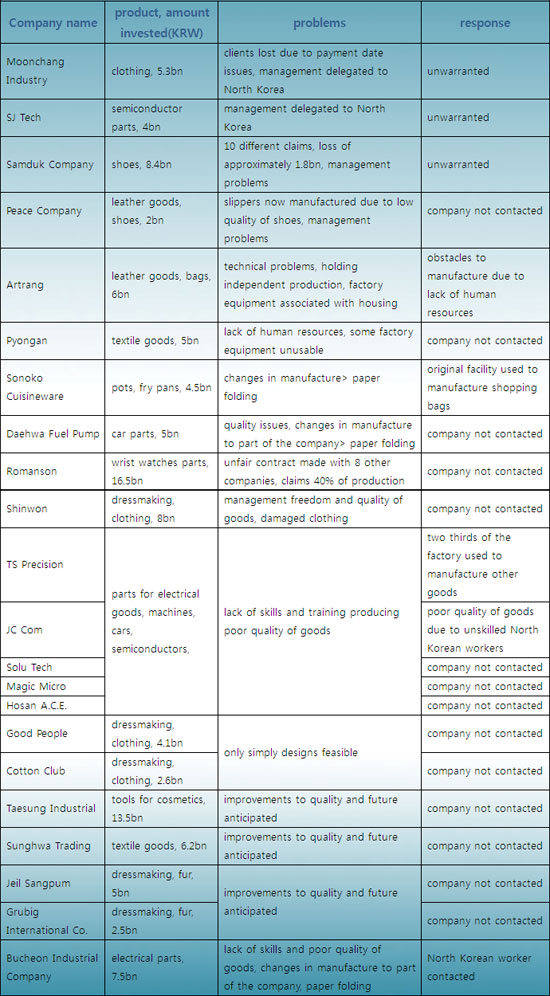
Most of the factories in Kaesung Complex are facing financial problems, a report on the “Situation on 22 factories in Kaesung Industrial Complex” revealed by the Forum for Inter-Korea Relations.

According to the report, most of the companies in Kaesung Complex are facing entrepreneurial difficulties due to restraints in contracts and inadequate resources.

The Forum for Inter-Korea Relations (co-representative Kim Kyu Chul) has been monitoring the South-North economic cooperation. The forum released a report on the 15th which revealed that two companies leasing areas in Kaesung, Moonchang Industry and SJ Tech were facing management difficulties and handed over the right of management to North Korea’s managers. The companies have invested a total of 9bn won.

The Forum bases its evidence on result provided by legal representatives for the 22 companies in Kaesung, collected over a period of 2 years and a North Korean document on the business circumstances in Kaesung to collect difficulties of South Korean managers.

Mr. Kim said, “We confirmed through representatives of two companies leasing areas in Kaesung Complex, Moonchang Industry and SJ Tech that problems were being experienced due to insufficient human resources and freedom of enterprise” and revealed, “Moreover, these companies are facing such severe management difficulties that they have apparently designated the right of management over to the North.”

Regarding this, Director of SJ Tech Lim Hwang Yong said in a conversation with the DailyNK on the 15th, “There is absolutely no evidence to the claim that the companies in Kaesung have handed their business permits over to the North,” strongly denying the act. Similarly, an affiliate of Moonchang Industry commented that the claim was groundless.

In addition, many companies such as Sonoko Cuisineware, Daehwa Fuel Pump, Bucheon Industrial Company made large investments in equipment to manufacture and produce goods, but then again some companies are known to have begun other production such as paper folding. In order to recover from the entrepreneurial ditch, another company has begun manufacturing shopping bags. The total amounts invested by these companies exceed around 17bn won (US$18.3mn).

Regarding this, an affiliate of Sonoko Cuisineware said, “We are merely using our pre-existing equipment to manufacture shopping bags.”

Furthermore, according to the document, a shoe manufacturer Peace Company is using it’s materials initially designed for shoes to produce slippers as it faces management problems during this time. It seems that Peace Company is not able to utilize 100% of its factory materials due to a lack of human resources. Meanwhile, Samduk Comapny has actually made a loss of $1.8mn as a result of 10 different claims made following its entry in Kaesung complex.

Other companies including TS Precision, JC Com, Solu Tech, Magic Micro, HOSAN A.C.E which based their manufacture on electrical parts are currently deliberating in producing other goods, as the goods were found to be below standard due to lack of training and skills by North Korean workers.

An affiliate of TS Precision said, “Our company asked that the workers have basic understanding of maths and English. But no matter how many times we teach the North Korean workers, they do not understand” and revealed, “Currently, only a third of the factory is in operation, while the other materials are being considered to manufacture other goods.”

Lee Hyun Suk of JC Com said, “It is true that the produced goods are of low quality. This is because North Korean workers lack skills as a result of inadequate training” and asserted, “It has been two months since we asked for workers but still we have not been provided with the workers demanded.”

However, he added, “In order to overcome this issue, we are training the North Korean workers ourselves” but refused to comment on whether other goods were being considered for manufacture.

Of all the businesses experiencing management difficulties, Artrang, Pyongan and Sonoko Cuisineware are known to be preparing factory leases.

Mr. Kim revealed, “Companies finding it difficult to increase production with the original factory equipment are known to be leasing areas to other companies.”

He added, “Not only is it illegal for businesses to manufacture goods other than the items listed in the initial contract, it is also illegal to lease the areas to other companies.”

In relation to this, an affiliate of Sonoko Cuisineware said, “Companies other than Sonoko Cuisineware are using the location but after receiving a permit from the Ministry of Unification” and remarked, “However, these companies have not leased the area to help recuperate mismanagement but are rather producing goods needed for our business.”

On the other hand, 7 other companies are showing a glimmer of hope as they conduct regular operations. These companies include Good People, Shinwon, Cotton Club, Taesung Industrial, Sunghwa Trading, Jeil Sangpum and Grubig International Co.

Mr. Kim said, “Though many outsiders perceive Kaesung Complex as a success, the truth of the matter is that most of the companies are experiencing hardships” and asserted, “Unless management, employment, personnel and freedom of contract increases, it is unclear whether these companies will or will not succeed.” 

Share

Inter-Korean railway test

Thursday, May 17th, 2007

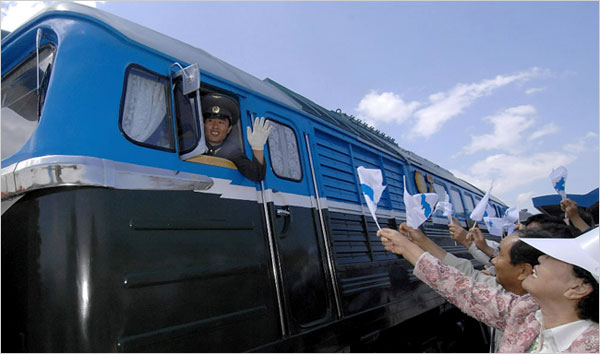
There has been a plethroa of articles on the ROK/DPRK train crossing.  Here is a grab-bag of facts and sources:
17korea337.jpg

Joong Ang Daily
5/15/2007
Unification Minister Lee Jae-joung expressed hope that regular inter-Korean rail services would transport workers to an industrial complex in the North’s city of Kaesong as well as serve as a mode of transportation for South Korean tourists at the Mount Kumgang resort.  However, North Korea has only agreed to one test run.

The sticking point was the number of passengers aboard the trains. South Korea stressed the need for an equal number of North Koreans, but North Korea declined the offer, citing unspecified reasons, ministry officials said. The two sides will exchange passenger lists via an inter-Korean economic office in Kaesong tomorrow.

The two Koreas are set to conduct test runs on a 27.3-kilometer (17-mile) line between Munsan Station and Kaesong Station in the western section, and on a 25.5-kilometer line between Jejin Station and Kumgang Station in the eastern section.

Rare experience aboard N. Korean train across the border
Yonhap
Sohn Suk-joo
5/17/2007

At the urging of North Korean conductors, 100 South Koreans and 50 North Koreans boarded a five-car train at 11:25 a.m. With no speaker system at Kumgangsan Station at the North’s scenic mountain along the east coast, conductors repeated “Please board the train” through a loudspeaker mounted upon a South Korean-made Hyundai Starex utility vehicle.

Painted green on the main body and the roof a faint gray, the facade of the train was far from modern. “The train looks like South Korea’s obsolete third-class train, but its ability is better than that,” said Lim Jong-il, a South Korean official at the Ministry of Construction and Transportation.

South Korean Construction Minister Lee Yong-sup, Kim Yong-sam, the North’s railway minister, and some 20 South and North Korean journalists crowded into the second car of the train. The smell of new paint assailed the nostrils upon ascending the steps, while a pair of portraits of Kim Il-sung and his son Kim Jong-il hung on the wall above the door.

The seating arrangement was face-to-face, and refreshments for passengers were set on a small table in front of the window — one lemon-lime soda, one strawberry juice, one bottled water, two apples and a pear. North Korean female attendants served a cup of ginseng tea for passengers later.

The upright, ivory-colored vinyl seats were a little bit uncomfortable and did not recline, but the cushions were softer than they appeared to be.

Outside the window, a uniformed North Korean conductor waved a red flag and goose-stepped past the train, which signaled the impending departure. A few North Korean security officers came inside to check the number of passengers and asked journalists jostling for position to sit down.   

At 11:27 a.m. a long whistle sounded, reminiscent of an old-time steam locomotive. The train spluttered back and forth several times and then slowly started forward. “North Korean trains usually whistle a lot,” a South Korean transportation official said. 

North Korean middle school students, who attended a ceremony, started to wave their hands, and South Korean passengers responded in kind. The train moved out of Kumgangsan Station at the speed of 10 kilometers per hour, and North Koreans working nearby just looked at the train without reacting in a friendly manner.

Some 50 meters away from the railway on the right side, a paved road appeared as the scenic Mount Geumgang faded from sight. Rice paddies were waiting for rice seedlings to be planted, but no peasant was seen working outside.

Unexpectedly, well wishers were South Korean tourists traveling to the Mount Geumgang resort in a convoy of eight buses. “At this time of the day tourist buses go to the resort,” a South Korean official said.

At 11:30 a.m. the stretch of hills and mountains continued, and the clouds moved quickly against the blue sky, cleansed from the previous day’s rain.

A few Toyota jeeps driven by soldiers, military jeeps and trucks drove parallel with the train and then fell behind. North Korean soldiers were stationed at the checkpoints of major intersections.

Then the track turned sharply, a rare occurrence on South Korean track. The sharp turns came again and again, and a woman peeked outside the window at a nearby village.

The overall atmosphere was friendly, a throwback to a picnic in the 1970s-80s on a slow, squeaking train. Hills and mountains passed by, and splendid pine trees of all kinds of shapes. After awhile the Nam River appeared on the right side of the train. At one village, some 10 residents came out and looked over the communal wall to watch the passing train.

At 11:50 a.m. the train passed Samilpo Station. The painted name on the station was very small, like Kumgangsan Station, and an oversized portrait of Kim Il-sung hung on the front of the station, along with pro-communist and cult propaganda slogans.

The train crossed the river on a bridge restored with steel plates provided by South Korea. Outside the window, North Korean tourist attractions such as Haegumgang and Samilpo were seen a little farther away.

At 11:50 a.m. some passengers pushed up the windows, and the unpolluted air coming through the open windows refreshed them. A group of 10 North Korean soldiers stood guarding a storage house of diesel engine trains built for the railway test run. There was no other train in sight.

The train slowed down at Kamho Station, where North Korean customs officials were stationed. It was 11:55 a.m.

Around 12:00 p.m. four customs officials and two conductors boarded each car of the train. One of them shouted, “We fervently welcome you who have become the first passengers of the train! Now we will start customs clearance procedures.”

Conductors checked the identities of the passengers and digital cameras. They asked a passenger to delete a photo of portraits of Kim Il-sung and Kim Jong-il that had been blurred from the shaking of the camera.

At 12:15 p.m. the conductors suddenly moved to the exit and disembarked. They must have gotten orders to let it pass, as the inspection took longer than expected. The train started to move again right away.

“Now you will see an outpost about 200 meters. It is the Military Demarcation Line,” said Kim Kyong-jung, chief of the inter-Korean railway team at the Ministry of Construction and Transportation.

A sharp whistle blew, and the train picked up speed, double its previous pace. The shaking was palpable, but not enough to affect the bottles on the small table. With the speed increasing, the frequency of the whistle’s call also increased.

In five minutes, the train passed the Northern Limit Line and went into the Demilitarized Zone. At 12:21 p.m., it passed the Military Demarcation Line to roars of applause. The train slowed a bit and the passengers became quiet, awaiting arrival.

At 12:25 p.m., a South Korean tourist observatory appeared, and some 200 tourists on the porch waved their hands eagerly, welcoming the North Korean train. Wide paved roads came into view and the train arrived at Jejin Station five minutes later. Amid the loud sound of a welcoming brass band and the cheering crowd, the train stopped at a South Korean station for the first time in more than half a century.

Trains cross inter-Korean border for first time in over 50 years
Yonhap
5/17/2007

A North Korean train traveling on reconnected track along the east coast of the Korean Peninsula on Thursday crossed the heavily armed border to return to its point of departure after a brief stay here.

At the same time, a South Korean train returned to the South in the west of the Korean Peninsula.

Earlier in the day, the two trains, one carrying 100 South Koreans and the other 50 North Koreans, crossed the Military Demarcation Line (MDL) dividing the two countries for the first time in more than half a century.

“It took more than half a century to cross this short, approximately 20-kilometer distance. We have to prevent anyone from blocking the railways. They were so hard to reconnect,” Kim Yong-sam, North Korea’s railway minister, said in a luncheon speech after arriving here.

In response, South Korean Construction Minister Lee Yong-sup hailed the test run of the cross-border railways, suggesting South and North Korea cooperate in promoting the mutual interest and prosperity of the Korean people.

At 11:30 a.m., Lee, who led the 100-member delegation to North Korea Thursday morning, boarded the North Korean train in Kumgangsan Station near the scenic Mount Geumgang resort for a test run on a 25.6-kilometer track in the eastern section of the peninsula.

At the same time, Kwon Ho-ung, chief councilor of the North Korean Cabinet, who had led the 50-member delegation to the South, boarded the South Korean train at Munsan Station in the western side of the peninsula on a restored 27.3-kilometer track, along with his South Korean counterpart, Lee Jae-joung.

Before the trains departed, South and North Korea held ceremonies to mark the historic event at Kumgangsan and Munsan stations, respectively.

“I hope it will contribute to forming a joint economic community and making balanced development on the Korean Peninsula. A new curtain of peace has been raised on the peninsula,” Lee said in a commemorative speech.

In his speech, Kwon said that North Korea will make every effort to make sure that the “train of unification” runs along a “track” of inter-Korean collaboration, with its emphasis on peace and understanding.

“Right at this moment, however, the challenge from divisive forces inside and outside is continuing. We should not waiver or be derailed from the track of national sovereignty and inter-Korean collaboration,” Kwon said.

The one-time test run came only after North Korea reluctantly agreed to provide military security arrangements last week. The tracks have been set to undergo tests since they were restored in 2003, while a set of parallel roads has been in use since 2005 for South Koreans traveling to the North.

In May 2006, North Korea abruptly called off the scheduled test runs, apparently under pressure from its hard-line military. The cancellation led to the mothballing of an economic accord in which North Korea would receive US$80 million worth of light industry raw materials from the South in return for its natural resources. North Korea’s subsequent missile and nuclear weapons tests further clouded hopes of implementing the agreement.

The reconnection of roads and train lines severed during the 1950-53 Korean War was one of the tangible inter-Korean rapprochement projects agreed upon following the historic summit between then South Korean President Kim Dae-jung and North Korean leader Kim Jong-il in 2000.

South Korea hopes to use the restored railways to help North Korean workers commute to a joint industrial complex in the North Korean border city of Kaesong as well as to transport South Korean tourists to the North’s scenic Mount Geumgang.

The Gyeongui (Seoul-Sinuiju) line cutting across the western section of the border was severed on June 12 in 1951, while the Donghae (East Coast) line crossing the eastern side was cut shortly after the outbreak of the Korean War.

South and North Korea used radio communication between Dorasan Station in the South and Panmun Station in the North for the western rail line, and between the South’s Jejin Station and the North’s Kamho Station for the eastern one. The stations are closest ones to the border on both sides.

In March, the two Koreas agreed to put humanitarian and economic inter-Korean projects back on track just days after North Korea promised to take the first steps toward its nuclear dismantlement in return for energy aid and other concessions from the other five members of the six-party talks.

South and North Korea are still technically at war, as the Korean War ended in an armistice, not a peace treaty.

Korean Train Crossing Seen as Sign of Progress
New York Times

Choe Sang-Hun
5/17/2007

[excerpts]

South Korea has long dreamed of building a trans-Korea railroad that would connect its train network to China and to the Trans-Siberian Railway in the former Soviet Union, creating a so-called Iron Silk Road.

North Korea blocks overland access to Asia, which makes South Koreans “feel as if we live in an island,” the South Korean transportation minister, Lee Yong Sup, said yesterday.

A trans-Korea railroad would offer a faster and cheaper way for South Korea to bring exports that are now shipped by sea to China and Europe. It would also provide a shortcut for Russian oil and other natural resources transported to South Korea. Such a rail system would save South Korea $34 to $50 a ton in shipping costs, said Lim Jae Kyung, a researcher at the Korea Transport Institute.

But before the dream of a trans-Korea rail system comes true, transportation analysts and government officials say, years of confidence-building talks and billions of dollars in investment in North Korea’s decrepit rail system will be needed.

Officials acknowledge that such a dream will not be made real until after North Korea gives up its nuclear weapons and improves its human rights record. Those moves would help build public support in South Korea for large investments across the border and would open the way for international development aid.

South Korean officials say a trans-Korea railroad would invigorate inter-Korean trade, which tripled from $430 million in 2000 to $1.35 billion last year.

It would also bring cash to North Korea, which could collect an estimated $150 million a year in transit fees from trains that pass through its territory, according to some estimates.

But it is unclear whether or when North Korea might agree to regular train service across the border.

Procuring international aid to renovate the rail network and letting trains from one of Asia’s most vibrant economies, carrying exports and tourists, rumble through its isolated territory could threaten the North Korean regime, analysts and others say.

The agreement came after South Korea promised to send North Korea 400,000 tons of rice, as well as $80 million worth of raw materials for shoes, soap and textiles.

South Korea has spent 544.5 billion won, or $589 million, on reconnecting the rail system, including 180 billion won in equipment, tracks and other material loaned to North Korea.

South Korean policy makers have called for patience in working toward reconciliation with the North. They have often been accused by conservative politicians and civic groups of giving in to North Korea’s strategy of extracting economic aid for every step toward reconciliation.

“This is a precious first step for a 1,000-mile journey,” Mr. Lee, the unification minister, said today.

South Korea has seen some tangible results in its overtures to the North in recent years.

The North Korean military cleared mines and moved some of its weapons to make room for the rail system and the Gaesong industrial complex. In addition, South Korean factory managers commute from Seoul to Gaesong using a road that was reconnected in 2004, and South Korean buses regularly take tourists to the Diamond Mountain resort in the North.

Share

Aftereffects of Nuclear Test, Reduction in Foreign Trade

Tuesday, May 15th, 2007

Daily NK
5/15/2007
Yang Jung A

KOTRA “Last year trade deficit $110mn.”

In 2006, North Korea’s trade deficit was over $110mn.

On the 14th, the Korea Trade-Investment Promotion Agency released a report on North Korea’s foreign trade stating, “Last year, North Korea’s imports totaled $2.049bn, an increase of 2.3% compared to 2005. However, exports decreased 5.2%, approximately $1.102bn worth of trade deficit.”

North Korea’s total foreign trade figures were close to $2.996bn, a decrease of 0.2% compared to the previous year.

KOTRA analysts said North Korea’s foreign economic situation worsened following the world attention it caused by its long range missile test last July and the subsequent October nuclear test.

Following the 2002 July economic reforms, North Korea’s foreign trade steadily increased, even peaking at $3bn, a considerable achievement compared to the early 90s. However, a sudden decrease in Western investment led to a significant reduction in overall trade.

Furthermore, North Korea’s number 1 trading partner is China with 56.7% of the total trade. That is followed by Thailand, the EU, Russia and Japan. Then again, trade by these countries including China cover 90% of North Korea’s total trade.

Whenever trade between North Korea, China and Thailand increased, there was a significant decrease in trade with Japan and the EU. Also, as North Korea’s foreign trade situation worsened, greater emphasis was placed on trade with China.

KOTRA’s report stated that a decrease in trade with the EU resulted from the implementation of economic sanctions by western countries which came about after North Korea launched a missile test that has the potential of hitting the United States and then tested a nuclear bomb underground several months later.

Consequently, there was an increase in trade with its traditional friendly nations, China and Thailand, KOTRA added.

KOTRA forecasts that as U.S.-North Korea relations improve, improvements in relations with the other nations will also occur providing a friendlier environment for North Korea’s economic situation. We may see reinvigorated North Korean foreign trade, however that will depend on how well the North Korean nuclear issue is resolved.

Share

China cushions the fall in North Korean trade

Tuesday, May 15th, 2007

Joong Ang Daily
Hwang Young-jin
5/15/2007

North Korean trade with the EU and Japan went into a free fall last year, but China helped pick up the slack.

Missile and nuclear tests interfered with North Korean trade in 2006, leading to the country’s first decrease in five years, a report from the Korea Trade-Investment Promotion Agency said. Decreases in trade with the West caused by political problems were the biggest culprit, the agency said.

North Korean exports to Japan fell 41 percent while imports from Japan dropped 30 percent. Trade with the European Union went down 23 percent in exports and 18 percent in imports. The European Union and Japan are the world’s first- and third-largest economies. Trade with the world’s second-largest economy, the United States, was practically zero.

But trade with China, the nation closest to the North politically and geographically, served as a buffer to reduce the impact of the large drops in European and American trade, so the North’s overall trade figures didn’t change much, the agency said.

Almost 60 percent of North Korea’s trade is conducted with China. The North’s next-biggest trade partner was Thailand, which accounted for 12.5 percent.

The communist country’s trade volume in 2006 fell 0.2 percent, with exports dropping 5.2 percent to $947 million and imports increasing 2.3 percent to $2 billion. Trade has been growing since the start of the new millennium. In 2005, the total trade topped a record $3 billion.

With an international economic blockade in place, trade relations with Japan and the European Union got worse.

The Kotra report said the Feb. 13 agreement reached during the six-nation talks in Beijing regarding the nuclear issue is a positive signal for the recovery of North Korean trade, but it is up to North Korea whether to act on its commitments and allow trade to recover.

Inter-Korean trade was not considered in yesterday’s report. Trade between the two Koreas reached $1.3 billion in 2006, a 28 percent rise year-on-year. The South sold $830.1 million and bought $519.5 million.

Share

Seoul broaches Kaesong at Korea-EU trade talks

Tuesday, May 15th, 2007

Joong Ang daily
5/15/2007

Seoul expects a response on the Kaesong issue at the next round of free trade talks, scheduled to start on July 16.

South Korea wants the European Union to include goods made at a North Korean industrial park in a proposed free trade agreement, casting a potential shadow over their trade negotiations, according to a South Korean negotiator yesterday.

The issue of the products from the Kaesong Industrial Complex was brought up during the first round of free trade talks last week between South Korea and the European Union.

Korea raised the issue in its recently concluded free trade talks with the United States, but the two sides agreed to discuss the matter later.

South Korea considers the industrial park, located just north of the world’s most heavily fortified border, as a model for inter-Korean economic cooperation. More than 10,000 North Korean workers have been employed by 15 South Korean companies in the pilot project, the Ministry of Unification said on its Web site.

“We asked the EU side to positively think over the Kaesong matter during the first round,” South Korean negotiator Nam Young-sook said in an interview with KBS radio. “A good result may be possible if we explain the matter’s symbolic nature well.”

The EU made no particular response to the South Korean request, Nam said, adding, “We will wait for a response in the second round.”

During the 10 months of free trade negotiations between South Korea and the United States, the industrial park was one of the thorniest issues, partially due to the North’s nuclear test in October of last year.

Park Ha-yeon, a spokeswoman of the EU’s delegation in Seoul, couldn’t immediately be reached for comment.

Last week, South Korea and the EU finished their first round of free trade talks in Seoul, with both sides saying they made good progress.

South Korean negotiators said both sides agreed to target eliminating at least 95 percent of the tariffs on goods within 10 years of implementation.

A second round of negotiations will take place the week of July 16 in Brussels.

The EU is South Korea’s second-largest trading partner after China. Two-way trade between South Korea and the EU totaled $79.4 billion last year, and Europe is the largest foreign investor in Seoul, with $5 billion invested in 2005 alone.

Share

Digging up the Past

Thursday, May 10th, 2007

Korea Times
Andrei Lankov
5/10/2007

Since the mid-1990s antique dealers in Seoul have uncovered a new source of quality items: North Korea. Indeed, around that time, antiques secretly excavated in North Korea began to arrive in Seoul in ever increasing quantities.

By the late 1980s, the antique trade in South Korea was going through hard times. Most of the important sources had been used up, and the state had established a fairly efficient control over excavations. Supply was shrinking, and prices kept growing. This was just when the antique items from North Korea hit the market.

This was a result of three important transformations. First, the famine and near collapse of the state bureaucracy in the North meant that many people were ready to do whatever it took to earn some money, and that officials, if given sufficient bribes, would not interfere much, if at all.

Second, the same combination of corruption and collapsing border controls essentially opened the Chinese border with North Korea.

Third, the adjacent areas of China became popular with Korean tourists who frequented the areas, and were on occasion ready to do some small and profitable, if illegal, business.

The major attractions are the Goryeo-era tombs which have been intensively excavated in the last decade (the major centers of the Goryeo Kingdom were located in what is now North Korea). These illegal diggings produced a flood of Goryeo items on the Seoul antique markets. Actually, the amount of antiques that have appeared makes archaeologists wonder about the scale of damage inflicted on the Goryeo sites in recent years. If rumors are to be believed, tomb raiding usually involves North Korean officials, people whose job would be to protect the historical site.

Apart from Goryeo “grave goods,’’ smuggled items include Buddhist images of all kinds, old books, furniture and stoneware. Some of these items originate from the Unified Silla Kingdom (7-10th century) while others are relatively new and can be dated to the early 20th century.

In most cases, the items are “mined’’ on the spot, but there have been a number of confirmed or nearly confirmed instances of books and other works which clearly have been stolen from museums and libraries in the North.

Then the items are transported to the border and smuggled into China. This might require bribing customs and immigration officials, but for a few hundred dollars one can purchase an uncontrolled passage (and, as a merchant told a South Korean journalist in an interview, well-paid custom officials can even help to move heavier items across the border).

The border city of Dandong plays the role of the major illegal market for the smuggled North Korean antique items. In China, some antiques go to the local buyers, but far more frequently the items are smuggled again, this time to Seoul, to appear in the antique shops in the Korean capital.

Some items are bought by rich collectors, while others end up in private museums. However, the Kookmin Ilbo journalists, who investigated the trade in 2005, discovered that museums are very secretive about such acquisitions, being uneasy about the legal implications of provenance, and the likely influence on relations between the two Koreas.

A major role in the business networks is done by two ethnic groups: the Joseonjok, or ethnic Koreans in China, and the hwagyo (huaqiao), the ethnic Chinese in Korea. Members of both groups have ample opportunities for legal cross-border travel, have money and connections, and are fluent in both languages.

They transport the booty, and also provide the North Korean diggers (not exactly experts in Goryeo celadon or early Joseon books) with instructions regarding the most preferable items at any given moment.

This is a risky business, and in the late 1990s the North Korean authorities attempted a number of crackdowns, with few high-level officials arrested for involvement in antique smuggling. However, people take risks.

A good piece of Goryeo-era ware would easily sell for tens of thousands of dollars in Seoul. Only a fraction of this money will go to the grave robbers, of course, with intermediaries and bribe-taking officials along the route pocketing the lion’s share of the profit.

Still, we can presume that a good piece would bring a successful digger a few hundred dollars. In a country where the average salary has fluctuated between one and five dollars a month, this is still a fortune, even for a minor official, and the more high-ranking policemen and security guys are making good living out of this.

It is somewhat difficult to judge these people too harshly, especially those who are driven to tomb raiding by the real threat of starvation, but there is no doubt that extensive and chaotic diggings are wiping out an important historical heritage. When archeologists arrive at the sites, sooner or later as they will, they will have to deal with the havoc produced by the illegal diggers, and many important traces of the past will be lost forever.

In tandem with the antiques, the forgery industry has also developed, with North Korean artisans learning the techniques used by South Korean experts. They know how to make a vase of a bottle from a few small pieces, how to imitate the old patterns on the ceramics, as well as many other tricks of an experienced forger. It seems that the North Korean forgers enjoy some competitive advantages over their South Korean colleagues. At any rate, the boom is not yet over.

Share

Inter-Korean trade jumps 43 percent in Q1

Wednesday, May 9th, 2007

Yonhap
5/9/2007

Despite lingering tension over North Korea’s nuclear weapons program, inter-Korean commercial trade surged 43 percent in the first quarter of this year, compared with the same period a year earlier, the Unification Ministry said Wednesday.

Commercial trade between the two Koreas increased to US$346.99 million in the January-April period, up from $243.36 a year ago, thanks to an influx of zinc bullion, sand, fishery items, shoes and clothing into a joint industrial complex in the North Korean border city of Kaesong.

The industrial complex is the crowning achievement of a landmark summit between the leaders of the two Koreas in 2000. South Korean businesses use cheap North Korean labor to produce goods in Kaesong where 21 South Korean factories employ about 11,160 North Korean workers.

“Non-commercial trade between the two sides dropped 24 percent during the same time span, so the total inter-Korean trade rose 25.5 percent to $411 million,” the ministry said in a statement.

In late March, South Korea started to send fertilizer aid and flood relief supplies to the North.

The shipment came weeks after the two sides agreed to resume humanitarian aid and family reunion events, just days after North Korea promised to take steps to shut down its main nuclear reactor and eventually disable it in return for energy aid from South Korea, the United States, China, Russia and Japan.

Shortly after the North conducted missile tests in July, the South suspended food and fertilizer aid along with its emergency aid to the impoverished North. In retaliation, the communist nation suspended inter-Korean talks, family reunions and the construction of a family reunion center.

Share

Int’l Trade Fair to Open in Pyongyang

Monday, May 7th, 2007

KCNA
5/7/2007
The 10th Pyongyang Spring International Trade Fair will be held at the Three-Revolution Exhibition from May 14 to 17. 

Participating in it will be companies from the DPRK, China, Russia, Syria, the Netherlands, Germany, Bangladesh, Switzerland, Singapore, Australia, Italy, Indonesia, Pakistan, Poland and Taipei of China. 

Machine tools, electric and electronic equipment, vehicles, medicaments, daily necessities, foodstuffs and so forth are to be on display in the fair.

Share
