Archive for the ‘International trade’ Category

DPRK’s trade drops 1st time in 11 yrs in 2009

Wednesday, March 10th, 2010

According to Yonhap:

North Korea’s trade appears to have dropped for the first time in 11 years in 2009 as its trade with China, South Korea and other major business partners declined, a South Korean state-run think tank said Wednesday.

The Korea Development Institute said in a report that Pyongyang’s trade with foreign countries were projected to have contracted “at least” 5 percent last year compared with a year earlier, citing statistics provided by China’s customs authorities.

“North Korea’s trade data have yet to be officially compiled but its trade with China and South Korea, its two major business partners, shrank last year (based on China’s statistics),” the report said. “Trade with the European Union also declined. Based on the statistics, its total trade is sure to fall last year.”

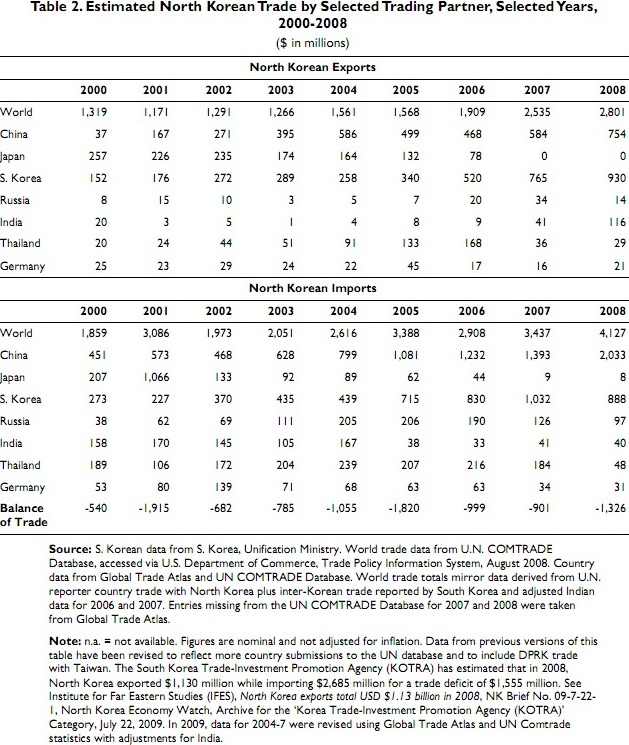
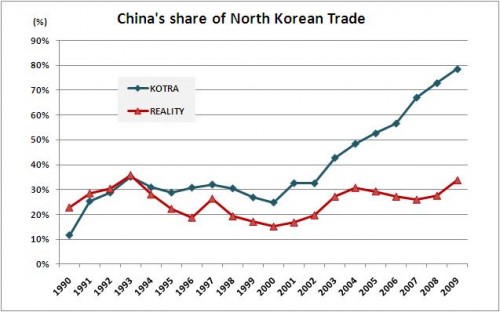
North Korea’s trade with China, its biggest business partner, amounted to $2.68 billion last year, down 4 percent from a year earlier, while its trade with South Korea dropped 8.4 percent, the report showed. The two nations accounted for 81.7 percent of Pyongyang’s annual trade.

“Even if its trade with all other nations held unchanged, North Korea is expected to see a decline considering trade figures with China and South Korea,” the report said. “This would mark the first contraction in 11 years since 1998.”

North Korea’s trade has been on a steady increase over the past decade with the amount estimated at $5.64 billion in 2008, up from $2.39 billion in 2000, the report showed.

The Korea Development Institute regularly publishes analysis of the North Korean economy—in Korean. I believe the data cited in this story comes from this February 2010 report, however I am not exactly sure. If any Korean readers can confirm this, I would appreciate it.

UPDATES in the comments.

Share

China leases Rason port for 10 years

Monday, March 8th, 2010

UPDATE:  According to Defense News:

Fears that China will establish a naval presence at a port facility at North Korea’s Rajin Port appear unfounded.

An agreement with a Chinese company to lease a pier at Rajin for 10 years was reported by the Chinese state-controlled Global Times on March 10.

The Chuangli Group, based at Dalian in China’s Liaoning province, invested $3.6 million in 2009 to rebuild Pier No. 1 and is constructing a 40,000-square-meter warehouse at the port. The leasing agreement has given way to suggestions China could be attempting to establish its first naval base with access to the Sea of Japan.

The North Korean Navy does use Rajin as a base for smaller vessels, such as mine warfare and patrol vessels, but for the time being, it appears economics are the primary motivation for the Chinese company’s presence there, said Bruce Bechtol, author of the book “Red Rogue: The Persistent Challenge of North Korea.”

“Chinese investment has increased a great deal in North Korea in the past five years,” he said. “It would not be a military port for the Chinese – as the North Koreans would be unlikely to ever allow such a thing.” He noted there are no Chinese military installations in North Korea.

The Rajin facility will give Chinese importers and exporters direct access to the Sea of Japan for the first time. “It is the country’s first access to the maritime space in its northeast since it was blocked over a century ago,” the Global Times reported.

China lost access to the Sea of Japan during the Qing Dynasty in the 19th century after signing treaties under duress from Japan and Russia.

Various media in Japan and South Korea have suggested the lease might give China an opportunity to place a naval base at Rajin, but Bruce Klingner of the Heritage Foundation in Washington, D.C., also downplayed the notion, saying North Korea’s negative attitudes toward China and a fear of excessive Chinese influence would negate any chance Beijing could establish a naval presence there.

Klingner also said he doubts North Korea would make a success out of the agreement. “Pyongyang’s aversion to implementing necessary economic reform and its ham-fisted treatment of investors suggests the new effort to turn Rajin into an investment hub will be as much a failure as the first attempt in the 1990s.”

ORIGINAL POST: According to the Choson Ilbo:

China has gained the use of a pier at North Korea’s Rajin Port for 10 years to help development of the bordering region and establish a logistics network there.

Lee Yong-hee, the governor of the Yanbian Korean Autonomous Prefecture in China’s Jilin province, made the announcement to reporters after the opening of the People’s Congress at the Great Hall of People in Beijing on Sunday.

He was quoted by the semi-official China News on Monday as saying, “In order for Jilin Province to gain access to the East Sea, a private company in China in 2008 obtained the right to use Pier No. 1 at Rajin Port for 10 years. Infrastructure renovation is currently underway there.”

In an interview with Yonhap News on Monday, Lee said, “We’re considering extending the contract by another 10 years afterward.”

Jilin abuts the mouth of the Duman (Tumen) River in the southeast but its access to the East Sea is blocked by Russia and North Korea. “We hope that an international route to the East Sea will be opened via Rajin Port,” he added.

Lee did not specify which Chinese company obtained the right and which North Korean agency awarded the concession. The Chinese Foreign Ministry on Feb. 25 said business investment in the North Korea-China border area is a normal business deal and does not therefore run counter to UN sanctions against the North.

According to Yonhap:

South Korea is keeping a close watch over North Korea’s efforts to draw greater foreign investment to one of its ports, as the move might indicate Pyongyang is opening up to the outside world and signal its return to stalled international nuclear talks, officials said Tuesday.

The North has agreed to give a 50-year lease on its Rajin port to Russia, and the country is also in talks with a Chinese company on extending its 10-year lease by another decade, according to an official from China’s Jilian Province, currently in Beijing for the National People’s Congress.

The North’s opening of the port on its east coast has a significant meaning for China as it will give the latter a direct access to the Pacific, but it also means millions of dollars, at the minimum, in investment for the cash-strapped North.

Officials at Seoul’s foreign ministry said the North’s opening of its port or its economy was a positive sign, but that it was too early to determine whether the move will also have a positive effect on international efforts to bring North Korea back to the nuclear negotiations.

“We are trying to confirm the reports, though they appear to be true because they were based on China’s official announcement,” an official said, asking not to be identified due to the sensitivity of the issue.

“We are trying to find out the exact details of the contracts (between North Korea and Russia and China),” the official added.

Additional information 

1. A previous report indcated that there were 250 Chinese companies registered in Rason.  The North Koreans reportedly closed out the insolvent and inoperable businesses. I do not know how many are there now. Read more here.

2. The Russian government recently built a Russian-gauge railway line from Kashan to Rason. Read more here.  It will be interesting to see if China upgrades roads and railways which could connect Rason to China.

3. Rason is sealed off by an electric fence. Read more here.

4. Many other stories about Rason here.

Read the full stories here:
China’s Jilin Wins Use of N.Korean Sea Port
Choson Ilbo
3/9/2010

Seoul closely watching N. Korea’s opening of port to China: officials
Yonhap
Byun Duk-kun
3/9/2010

Share

On tobacco and hard currency

Monday, March 8th, 2010

The Financial Times published a thorough article on the DPRKs eforts to raise hard currency through tobacco re-exports:

North Korean and other Asian trading entities started re-exporting State Express 555 cigarettes, manufactured by British American Tobacco, in February last year, just months before North Korea’s second nuclear test in four years prompted the United Nations to impose tougher sanctions on Pyongyang.

BAT sold the so-called “NK 555s”, made and packaged in Singapore for the North Korean market, to a Singaporean distributor for shipment to Nampo, a port near Pyongyang.

However, at least 15,000 cases worth $6.3m (€4.6m, £4.2m) rebounded out of Nampo to ports in Vietnam and the Philippines, according to documents seen by the Financial Times, to go to other markets where they commanded a higher price.

While the UN banned luxury goods exports to North Korea, member nations have been allowed to compile their own sanctions lists, which critics say created loopholes.

The US, Japan, Australia and Canada banned a broad range of tobacco products. Meanwhile, the European Union and Singapore sanctioned only cigars, which allowed BAT to continue exporting NK 555 cigarettes to North Korea. BAT said it halted exports of the cigarettes from Singapore to North Korea after discovering a diverted cargo of NK 555s in August.

International tobacco companies frown on “grey market” or “parallel” exports of their products to markets for which they were not intended. But national customs authorities target counterfeits rather than so-called “diverted real product”.

BAT has maintained some business ties to the country. It still supplies its former Pyongyang joint venture, from which it divested in 2007, with materials to make and sell cheaper Craven A cigarettes on the domestic market.

BAT says 175m NK 555s were exported to North Korea in 2008. They were made and packaged in Singapore which, like the EU, banned exports of cigars but not cigarettes.

The London-based company sold the NK 555s to SUTL Group, a family-controlled distributor in Singapore, for onward shipment to the North Korean port of Nampo.

“When we became aware of the diversion, we immediately launched an investigation,” Pat Heneghan, global head of BAT’s anti-illicit trade division, told the FT. “We certainly didn’t like what we found.”

While there was no evidence of any involvement by SUTL in the diversion, Mr Heneghan said BAT still had “a very hard discussion with the distributor”. SUTL declined to comment.

There is no evidence that the re-export of NK 555s by a number of unidentifiable North Korean entities and other small trading companies across Asia was illegal.

While tobacco companies consider the re-routing of legitimate cigarettes from their intended market as “illicit”, they are not necessarily “illegal” in the eyes of customs authorities focused on counterfeits and smuggling.

“In August last year, BAT discovered a diverted NK 555 shipment in Singapore, which we assumed could be for transhipment to other markets in Asia,” said a BAT spokeswoman. “But we were unable to inspect the shipment as we could not demonstrate any breach of Singapore law to the authorities.”

On April 10 2009, the NK 555 re-exports were discussed in an e-mail sent by a Singapore-based cigarette trader to a potential buyer in Manila.

“We have to confirm by next week,” wrote Bert Lee of Compass Inc. “Empty containers will have to start moving into Nampo . . . So kindly speak and plan with your buyer and let me know if you want to take up this new NK 555 Blue.”

Compass began to sell cases of NK 555 to a Hong Kong-based trading company in early 2009. E-mails and shipping documents show the cigarettes were first diverted to Dalian, a Chinese port, and then shipped on to Singapore before finally landing in Haiphong in Vietnam.

While the trail ran cold in Haiphong, people tracking the shipment suspected its ultimate destination was China.

“They sell it to someone who can handle it for the China market,” said one person involved in the trade, who asked not to be identified.

Invoices sent from Compass to its Hong Kong buyer in February 2009 do not reveal the North Korean source of the NK 555s. But Mr Lee left no doubt about the cigarettes’ provenance.

“Stocks are now in NK and sample already send [sic] out to us,” he wrote to his potential buyer in Manila. “I hope we can work on this New Blue [555] and controlling the market and stocks as soon as possible.” Mr Lee did not reply to phone calls, e-mails and faxes from the FT.

“As a trader, we just get the product and buy and sell,” said one Compass executive who declined to identify himself or comment on the NK 555 shipments when contacted by telephone. “Where it goes, who knows?”

Read previous tobacco posts here. Read previous BAT posts here.

To date I have been unsuccessful in locating the BAT factory in the DPRK.  If any readers have knowledge of its whereabouts, I would appreciate it. 

Read the full article here:
N Korea draws on tobacco for cash
Financial Times
Tom Mitchell, Pan Kwan Yuk
3/8/2010

Share

Chinese lamps popular in DPRK

Sunday, March 7th, 2010

According to the Choson Ilbo

Chinese-made solar reading lamps are selling like hot cakes in North Korea. According to a North Korean source, the reading lamps sell for 10,000 to 20,000 North Korean won, a price several times the average monthly wage.

The customers are chiefly parents with children preparing for college entrance exams. Due to do the poor power supply, North Korea except for some parts of Pyongyang is plunged into pitch darkness every night, making it impossible to study. The solar-powered reading lamps provide a measure of independence from the power grid.

In the North, background determines if youngsters can enter college, and not all parents can afford to concentrate their energy on their children’s education. But relatively well-to-do families provide tutoring for their children by employing students of prestigious universities, such as Kim Il Sung University or Pyongyang University of Foreign Studies, in efforts to prepare their children for college entrance exams.

Read the full article here:
N.Korean Parents ‘Zealous’ About Children’s Education
Choson Ilbo
3/8/2010

Share

DPRK Myanmar military relationship growing

Thursday, March 4th, 2010

According to the Washington Post:

The Obama administration, concerned that Burma is expanding its military relationship with North Korea, has launched an aggressive campaign to persuade Burma’s junta to stop buying North Korean military technology, U.S. officials said.

Concerns about the relationship — which encompass the sale of small arms, missile components and technology possibly related to nuclear weapons — in part prompted the Obama administration in October to end the George W. Bush-era policy of isolating the military junta, said a senior State Department official, speaking on the condition of anonymity because of the sensitivity of the subject.

Senior U.S. officials have since had four meetings with their Burmese counterparts, with a fifth expected soon. “Our most decisive interactions have been around North Korea,” the official said. “We’ve been very clear to Burma. We’ll see over time if it’s been heard.”

Underlining the administration’s concerns about Burma is a desire to avoid a repeat of events that unfolded in Syria in 2007. North Korea is thought to have helped Syria secretly build a nuclear reactor there capable of producing plutonium. The facility was reportedly only weeks or months away from being functional when Israeli warplanes bombed it in September of that year.

“The lesson here is the Syrian one,” said David Albright, president of the nongovernmental Institute for Science and International Security and an expert on nuclear proliferation. “That was such a massive intelligence failure. You can’t be sure that North Korea isn’t doing it someplace else. The U.S. government can’t afford to be blindsided again.”

Burma is thought to have started a military relationship with North Korea in 2007. But with the passage of a U.N. Security Council resolution last June banning all weapons exports from North Korea, Burma has emerged “as a much bigger player than it was,” the senior U.S. official said.

In a report Albright co-wrote in January, titled “Burma: A Nuclear Wannabe,” he outlined the case for concern about Burma’s relations with North Korea. First, Burma has signed a deal with Russia for the supply of a 10-megawatt thermal research reactor, although construction of the facility had not started as of September.

Second, although many claims from dissident groups about covert nuclear sites in Burma are still unverified, the report said that “there remain legitimate reasons to suspect the existence of undeclared nuclear activities in Burma, particularly in the context of North Korean cooperation.”

Previous posts about the Myanmar-DPRK relationship can be found here

Read the full story here:
U.S. increasingly wary as Burma deepens military relationship with North Korea
Washington Post
John Pomfret
3/4/2010

Share

North Korens advise Vietnam on national celebrations

Thursday, March 4th, 2010

According to TVNZ:

North Korean experts were in Vietnam this week to advise the government on – no, not uranium enrichment – choreography for an extravaganza celebrating Hanoi’s 1,000th anniversary, state media said.

The delegation was led by Song Pyong Won, deputy director of the Arirang performance department in North Korea’s Ministry of Culture, and included experts in mass performance, stage design, sound and lighting, reported the website of the newspaper Saigon Tiep Thi (sgtt.com.vn).

“This is the advance team that will make preparations for the various art performances, including card flipping to make images and words, as well as stage design, sound and lighting for the opening ceremony,” the newspaper said.

Hanoi will mark its 1,000th anniversary on October 10 this year.

Song hoped “through this visit the delegation would gain a precise grasp of the basic material conditions in Vietnam, like human resources, so that the staged programme can be the most unique and best possible,” the article said.

The group met representatives of Vietnam’s Ministry of Culture, Sports and Tourism and planned to visit various anniversary event venues, including the 40,000-seat My Dinh Stadium. It would also visit other sites, such as Ho Chi Minh’s mausoleum, it said.

Read the full story here:
N Korea teaches Vietnam how to party
TVNZ
3/5/2010

Share

Malaysian farmers adopt DPRK agriculture technology

Thursday, March 4th, 2010

According to Bernama (Malyasia):

Farmers in Pahang will soon be able to use North Korean technology to commercially grow paddy, after an alliance was formed between North Korea and Syarikat Sungai Duri Plantations Sdn Bhd.

Sungai Duri Plantations managing director Datuk Normala A. Kahar said the technology acquired from North Korea was used countries like China, Uganda, Angola and the Philippines successfully.

Normala said five experts from North Korea who would be involved in a project that covers an area of 263 hectares in Sungai Pelak, Pekan, would conduct a study and research to help soil enrichment and identify pest that can be a problem to the growth of paddy.

She added that an area of 60 hectares in Mambang, Pekan had already been planted with the MR219 type of seeds produced by Mardi and would be ready for harvest in May.

“The results have been very encouraging and we are optimistic that the project will be a success,” she told reporters after sealing an agreement with the North Korean government here on Thursday.

Normala said through the technology, farmers can reap up to seven tonnes of paddy per hectare a season.

Malaysia has an interesting relationship with the DPRK.  I have been told that Malaysia does not require entry visas for North Koreans.  If this is not true, please let me know.  There are also a couple of North Korean restaurants in Kuala Lumpur.  Finally, the Mansudae Overseas Projets Group built the Rice Museum (“Muzium Padi” located here) in northern Malaysia.

Pahang is here.

Share

South Korea’s trade with the north falls into the red

Thursday, February 25th, 2010

Institute for Far Eastern Studies
NK Brief No. 10-2-25-1
2/25/2010

Inter-Korean trade, in which South Korea recorded surpluses throughout the Kim Dae Jung and Roh Moo Hyun administrations, has now fallen into the red under the current government.

According to customs statistics released on February 25, Seoul ran a trade deficit with North Korea under the Kim Young Sam administration until 1997, then was in the black through the Kim Dae Jung and Roh Moo Hyun administrations, almost until the end of 2007. Seoul has fallen back into the red, however, during the last two years of the current government. In other words, the People’s Government (under Kim Dae Jung) and the Participatory Government (under Roh Moo Hyun) exported more to the North than they imported, while this trend has now been reversed under Lee Myung-bak.

South Korea’s surplus in inter-Korean trade grew 11-fold from 37.9 million USD in 1998 to 417.7 million USD by 2005, then fell to 262.2 million USD in 2007. This trend occurred because exports grew at a much quicker rate than imports, from 128.9 million USD in 1998 to 1.0286 billion USD by 2007. However, as the current administration came into power, inter-Korean trade statistics dropped in to the red, with a 54 million USD deficit in 2008 and a 200.9 million USD deficit last year.

South Korean exports to the North grew considerably from the time of the People’s Government until 2008, but have fallen considerably over the past two years. In 2008, exports to North Korea amounted to 883.4 million USD, down 14.1 percent from the previous year. Last year, exports fell another 17.1 percent, to 732.6 million USD.

Last year, electrical products made up the majority of exports, at 24.8 percent (182 million USD). Following electrical products were short, synthetic ‘staple fiber’ (160 million USD) and cotton fabrics (67 million USD), followed by computers and other electronic devices (60 million USD).

On the other hand, clothing (390 million USD), fish (131 million USD), and electrical goods (122 million USD) were the top three imports. While South Korea is in the red, overall trade continues to grow, despite the international financial difficulties. This growth is driven largely by processing-on-commission manufacturing and products from the Kaesong Industrial Complex.

[NkeconWatch: I have a personal probelm with the way “the media” generally reports trade deficits as if they are somehow equivalent or comparable to budget deficits.  They are not.  Additionally, bilateral comparisons of trade deficits are silly. Bilateral comparisons are usually published by someone seeking to generate some kind of political response, but really they don’t tell you anything about what is going on in the economies of the countries involved.] 

Share

Border crossing more expensie

Friday, February 19th, 2010

According to the Daily NK:

Since the redenomination on November 30 last year, the cost of crossing the Tumen River has risen as high as 10,000 Yuan on the back of tighter border regulations.

A source from North Hamkyung Province told the Daily NK on Thursday, “Since border security was strengthened in February, it has cost at least 10,000 Yuan to cross the border into China.” This is equal to around 400,000 North Korean won at the black market exchange rate, or $1400.

In 2006, the cost of crossing the Tumen River around Musan and Onsung in North Hamkyung Province was just 500 Yuan.

The reason is because now there is an alliance of brokers monopolizing the crossing business, and a number of regulations designed to both circumscribe the ability of citizens to cross and limit the relationship between guard companies and local citizens.

In the distant past, if people wanted to cross the river, they approached guards and haggled over the price directly. However, now people have to rely on professional brokers who put them in contact with guards and guides in China. One pays a price to the broker, who shares it with North Korean border guards and Chinese guides respectively at a ratio of 4:3:3.

The North Korean authorities designated the period from February 5th until Kim Jong Il’s birthday on the 16th as a period of “special vigilance,” handing down special instructions to strengthen the border guard and regulations covering migration in border cities.

According to a Daily NK source, this measure is primarily intended to limit the ability of those suffering since the redenomination to smuggle or cross the border to make money in China, as well as to regulate citizens in advance of Kim Jong Il’s birthday, which is customary.

The source emphasized, “Since December last year, the number of citizens using human networks in China to make money has been increasing. Therefore, agents of the National Security Agency and the People’s Safety Agency have been watching those people closely.”

The source further explained, “Now, the authorities are forcing border guards to observe each other in order to track down those doing business with brokers and border crossers. In January, in Yusun-dong, Hoiryeong, one company commander was dismissed after a platoon commander informed on him for assisting border crossers.”

In the mid-2000s, along the border near settlements such as Namyang, Sambong, and Jongsung in North Hamkyung Province, the authorities set up nail boards and extra barbed wire along the Tumen River in order to inhibit defection. However, as these physical measures were not as effective as hoped, in 2006 the authorities took to switching guard posts between different guard companies without notice and awarding a prize, membership of the Party, to guards who caught people crossing the border. These measures were designed to break down connections between individual guards and the local populace

Therefore, the source added, “These days, no border guards are helping people cross the river, and the cost is soaring.”

Read the full story here:
Tight Rules Make Border Costs Soar
Daily NK
Lee Sung Jin
2/19/2010

Share

UNSC investigating DPRK sanctions violations

Sunday, February 14th, 2010

UPDATE:  It looks like case 4 was a shipment of contraband to central Africa.

ORIGINAL POST: Ertugrul Apakan, Chair of the 1718 Sanctions Committee, is reported to be investigating four cases of UNSC sanctions violations by the DPRK. I have listed 3 of the 4 cases below with links (as identified by Business Week):

Case 1: A North Korean shipment of chemical-safety suits that may have been destined for Syria’s military.

Case 2: Italy’s seizure of two luxury yachts allegedly bound for North Korea

Case 3: Thailand’s interdiction of North Korean arms aboard a plane allegedly bound for Iran

Case 4: ?

According to Business Week:

Apakan told a closed session yesterday that South Korea said the suits were from North Korea and that his committee had received an unsolicited letter from Syria denying any involvement, according to diplomats who attended the briefing. They asked not to be identified.

Bashar Ja’afari, Syria’s ambassador to the UN, said his government sent the letter because South Korea’s report of the incident stated that the suits were bound for his nation. He said Syria conducted a “deep inquiry” and concluded it had nothing to do with the case.

Syria and the DPRK were also allegely working on a nuclear reactor together and Syria’s Tishreen War Museum was built by the North Koreans.

Security Council Report, an independent not-for-profit organisation in affiliation with Columbia University’s Center on International Organization, published a February 2010 report on the DPRK which contains additional information.  See it here.

Share

An affiliate of 38 North