Archive for the ‘International trade’ Category

DPRK-China Economic Cooperation: First Six Months in Review after Kim Jong Un’s Rise to Power

Thursday, July 12th, 2012

Institute for Far Eastern Studies (IFES)
2012-7-12

After Kim Jong Un’s succession following the death of his father, Kim Jong Il, added attention is drawn to the economic cooperation between China and North Korea.

The DPRK-China economic cooperation has totaled 990 million USD from January to April this year, a rise of 16.5 percent against the previous year. Other economic cooperation projects are also underway as appropriate system and regulations are currently being established along with recruitment and training of employees.

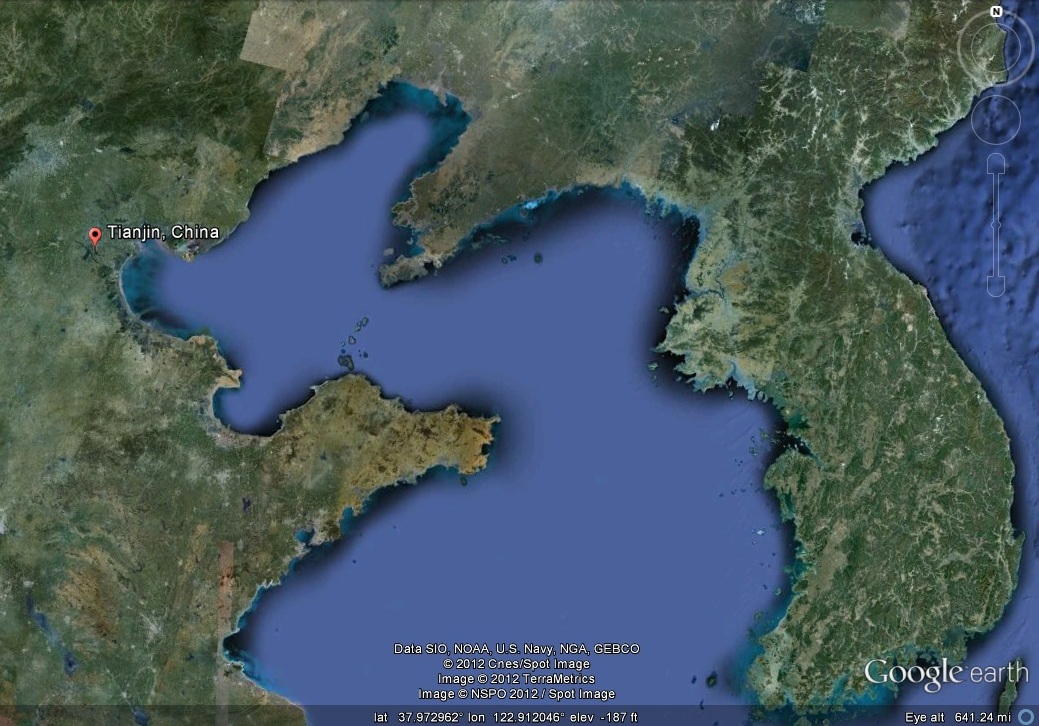
According to Yonhap News Agency on July 4, Chinese commerce ministry invited about 20 North Korean economic government officials and scholars to Tianjin for training in special economic zones from late May. The main purpose of the training was identified; to promote and revitalize the special economic zones in North Korea, including Hwanggumpyong and Wihwa Islands and Rajin-Sonbong.

The invited North Korean trainees are top officials from economic, administrative, finance, and customs sectors to receive two-month training in Tianjin from Chinese experts with years of experience and knowledge in the area of operations, management, and investment promotion of economic zones. The entire training cost is supported by the Chinese government with full support of education and accommodations.

The details of the program consisted of a month of training in theoretical background and a month of practical training in economic zones of Shanghai Pudong and Shenzhen.

Hwanggumpyong and Wihwa Islands began as China and North Korea partnered up to develop it as the next Kaesong Industrial Complex. Last June, China’s Commerce Minister Chen Deming and the DPRK’s vice-chairman of National Defence Commission Jang Song Thaek met and hosted the groundbreaking ceremony for the development of the area. However, the development in Hwanggumpyong area is making a slow progress.

On June 25, Kyodo News Service of Japan reported that China and North Korea both expressed to delay the joint development project of Hwanggumpyong for the lack of economic value after North Korea conducted its satellite launch. However, on the following day, Chinese foreign ministry made a statement that Hwanggumpyong joint development project was on track and criticized Kyodo for the inaccurate account of the situation.

China has obtained port usage right of Rajin Port in 2008, which connects Tumen River with Hunchun of Jilin Province in China. The construction for the 53 km-long road that connects Rajin with Hunchun is expected to be completed by the end of this year and sea route to this area will officially take off. China invested in the entire cost of construction as it hopes to develop it into an international distribution base, as a part of the Chang-Ji-Tu Development Project in Northeast China.

Nearly 70 percent of China-DPRK trade is located in Dandong and Sinuiju area. Many experts agree that it will be a matter of time before the development of Hwanggumpyong economic zone become full-fledged. Despite the apparent delay in development, North Korea has already established a Law on Hwanggumpyong and Wihwa Islands Economic Zone and joint management committee were formed consisting of Chinese and North Korean officials. Rapid progress in this zone can be expected after the New Yalu River Bridge is completed in 2014.

As economic trade and cooperation between North and South Korea ebbed, North Korea is likely to increase its efforts with China, combining the land and manpower of North Korea with China’s resources and technologies to develop other SEZs similar to Kaesong. However, a large-scale dispatch of North Korean employees to China will be difficult challenge to overcome.

Share

Inter-Korean visits drop 7% in 2012

Tuesday, July 10th, 2012

According to Yonhap:

The total number of South and North Koreans visiting each other’s country fell nearly seven percent in the first five months of 2012 from a year earlier, the Seoul government said Tuesday, as tensions persist over the North’s deadly attacks on the South in recent years.

A total of 47,432 South Koreans visited North Korea in the January-May period, while no North Koreans visited the South, according to data from the Unification Ministry, which handles inter-Korean affairs. The figure is down 6.9 percent from the same period last year, when the number of inter-Korean visits reached 50,925, including 13 North Koreans who visited the South.

Read the full story here:
Inter-Korean visits drop 7 pct this year
Yonhap
2012-7-10

Share

DPRK officials receiving SEZ training in China

Wednesday, July 4th, 2012

Pictured Above: Tianjin’s location relative to the DPRK

The Daily NK reports:

“A group of 20 trainees made up of economic officials and academics from the DRPK Ministry of Trade has been receiving training in Tianjin since the end of May upon an invitation from the Chinese Ministry of Commerce.”

“The aim of the training is the vitalization of North Korea’s special economic zones at Hwanggeumpyeong, Wihwa Island and Rajin-Sonbong,” he added.

According to the source, the North Koreans, who come from the finance and economics, administration and taxation sections of the ministry, will remain in China for two months. The costs of the program, including accommodation and training fees, are being covered by the Chinese side, and they are staying in a state guest house.

For the first month, the 20 were reportedly due to receive training in techniques pertaining to the operation, management and attraction of investment to SEZs from Chinese experts. For the second, they are set to receive field training in Shanghai, seeing how China’s SEZs operate.

Previous posts on Hwanggumphyong are here.

Previous posts on Rason are here.

Read the full Daily NK story here:

20 NK Officials Getting Schooled in Tianjin
Daily NK
Chris Green
2102-7-4

Share

Some recent publications

Friday, June 29th, 2012

Networks, Trust, and Trade: The Microeconomics of China–North Korea Integration
Stephan Haggard and Marcus Noland
Peterson Institute Working Paper (May 2012)

The Microeconomics of North–South Korean Cross-Border Integration
Stephan Haggard and Marcus Noland
Peterson Institute Working Paper (May 2012)

Gender in Transition
Stephan Haggard and Marcus Noland
Peterson Institute Working Paper (June 2012)

New East German and Soviet Evidence on North Korean Support to South Korean Political Parties and Labor Unions
James Person
Wilson Center, NKIDP

DPRK Perspectives on Korean Reunification after the July 4th Joint Communiqué
Jong-Dae Shin
Wilson Center, NKIDP

Zhou Enlai and China’s Response to the Korean War
Charles Kraus
Wilson Center, NKIDP

China and the Post-War Reconstruction of North Korea, 1953-1961
Shen Zhihua and Yafeng Xia
Wilson Center, NKIDP

Budget Blanks and Blues
Aidan Foster-Carter
38 North

Share

North Korean high-ranking official visits Taiwan

Thursday, June 28th, 2012

Institute for Far Eastern Studies (IFES)
2012-6-28

A high ranking North Korean official visiting Taiwan gave a statement that, “North Korea is using most of its resources for national defense and military.”

This was revealed in a report released by KOTRA Taiwan Trade Mission. In this report, Kim Jong Gi, the chairman of the Committee for the Promotion of International Tradeof DPRK visited the Taiwan-(North) Korea Business Association to attend a meeting discussing North Korean business trade.

Kim criticized South Korea, Japan and other neighboring countries for harboring antagonistic attitudes toward communist North Korea, and especially the United States for enforcing “violent sanctions” against North Korea.

He also admitted the country was suffering from economic hardships and food shortages since 1995 with four years of continuous natural disasters. In 2011, the total food needed is around 6.5 million tons but the actual production output was only 5.1 million tons, leaving the country 1.4 million tons short.

Kim also explained that North Korea experienced similar economic growth as South Korea and Taiwan in the 1970s and 1980s but as socialist countries began to collapse one after another in the early 1990s, North Korea’s economic trade agreements with other nations became null and hence hindered its economy and trade.

At that time, North Korea was signing purchase agreements on magnesium oxide (about 800,000 ton) with Eastern European countries every year and barter trade with other socialist nations. But with the fall of socialist countries, North Korea quickly lost its long-term trading partners and it failed to take appropriate and necessary actions. Thus, it fell into the vicious cycle of unsold commodities with insufficient funds, leading to inevitable economic downturn.

Kim was the highest official from the DPRK to visit Taiwan. The purpose for his visit was to 1) attract investment from Taiwan for Hwanggumpyong Island and Rajin-Sonbong Special Economic Zone, and 2) express gratitude toward the Tzu Chi Foundation, a Buddhist charity for continuous assistance to North Korea. The Tzu Chi Foundation is reported to have sent aid to North Korea nine times.

Share

North Korea aiding Syria to upgrade Scud D capability

Wednesday, June 27th, 2012

According to IHS Janes:

In marked disregard of UN sanctions (Resolutions 1718 from 2006 and 1874 from 2009 both prohibit North Korea from conducting security-related exports), North Korean technicians and engineers stationed in Syria are working with specialists from Syria’s Scientific Studies and Research Centre (SSRC) to develop an arsenal of advanced SSMs. Co-operation between Pyongyang and Damascus also constitutes a Syrian violation of the same two resolutions, which, among other sanctions, include “an arms embargo, which also encompasses a ban on technical training or services”.

Nevertheless, IHS Jane’s has learned that engineers from North Korea’s Tangun Trading Corporation are working with engineers from the SSRC’s Project 99 in a compound located in Jabal Taqsis, near the city of Hama, to advance the Scud D development programme.

Read the full story here:

North Korea aiding Syria to upgrade Scud D capability
IHS Janes
Robin Hughes
2012-6-27

Share

Tumen – Namyang trade

Tuesday, June 26th, 2012

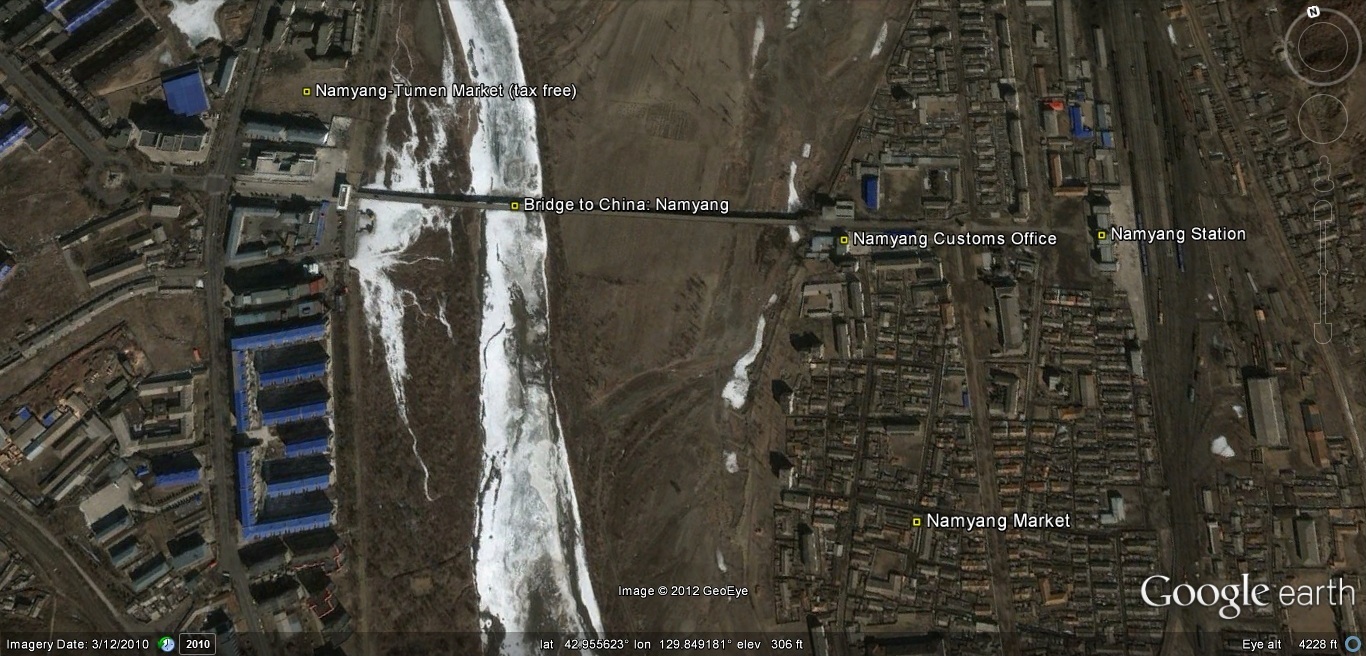
Pictured above: The Namyang (DPRK) – Tumen (PRC) border (Google Earth:  42.954725°, 129.850223°). A big thanks to Christopher Green for assistance.

Back in 2010, Asahi and KBS reported that a market had opened in Tumen (PRC) to facilitate trade with the DPRK. The report mentioned that Chinese traders were permitted to cross into Namyang (DPRK) to buy goods which could then be exported and sold in the Tumen market (tax free up to a specified level). It is unclear if North Koreans were permitted to travel to Tumen to trade in the market.  According to the report :

The market in Tumen, Jilin province, opened on Oct. 13. It appears to be the latest development in growing economic exchanges between Beijing and Pyongyang following a visit to China by North Korean leader Kim Jong Il in August and moves to secure a smooth transition of power to his third son, Kim Jong Un, the sources said.

The market, which has a total space of about 10,000 square meters, is located on the banks of the Tumenjiang (Tumengang in Korean) river, which serves as the common border between the two countries.

Currently, the market is open twice a week, but there are plans for it to become a daily feature in the near future, the sources said.

According to the sources, Chinese residents in Tumen, which is located inside the Yanbian Korean Autonomous Prefecture within Jilin province, can obtain travel permits to North Korea by presenting identification.

With entry permits in hand, the Chinese are able to cross the river to Namyang, where they are allowed to buy products at designated areas, provided they return to China the same day.

Purchases worth up to 8,000 yuan (about 96,000 yen, or $1180) are treated as duty-free and can be sold at the Tumen market.

The sources said about 150 people showed up at the market on Oct. 13, including merchants as well as ordinary citizens.

The Daily NK reports this month (June 2012) that now Chinese traders are able to enter the DPRK and sell goods to the North Koreans:

Chinese traders are operating with the permission of the North Korean authorities in the public market in Namyang, part of rural Onsung County in North Hamkyung Province.

The news has aroused considerable surprise, even arousing claims of a ‘Kim Jong Eun-style opening’.

A North Hamkyung Province source explained the scene to Daily NK today, saying, “From the start of this month, Chinese traders have been coming through Tumen to trade with locals in Namyang market. They are staying from 9AM to 5PM.”

Namyang has a small population and lies far from significant population centers. However, there is a customs house located in the immediate vicinity, making it a key contact point for cross-border trade.

According to the source, “Somewhere between 50 and 70 of them come in for the day, and take up around a third of the stall space.” Namyang market used to have approximately 100 stalls, but it has apparently been expanded to accommodate the new arrivals.

The Chinese traders sell a range of items, including some that are formally forbidden such as grains, but also fruits, processed foods including instant noodles, clothing and shoes. Most also take the chance to trade the other way, buying natural products such as seaweed and seafood, wild herbs and mushrooms to sell in China.

The move is surprising because while ethnic Chinese citizens residing in North Korea have long played the role of wholesaler to the country’s domestic markets thanks to the relative ease with which they can traverse the Sino-North Korean border, it is unprecedented for ordinary Chinese citizens to be allowed to trade directly in domestic North Korean markets.

Naturally, most North Koreans in the area welcome the new presence, because it both shortens supply chains and brings down prices, while also allowing them to order products directly from China and, with a slice of luck, receive them within 24 hours.

According to the source, “There are even people already coming up from Chongjin to trade fish with the Chinese! The security services are cracking down on cross-border activities, but the number of people is continuing to rise all the same.”

However, existing North Korean traders do harbor unease at the new situation, mostly because they are being forced to yield market share to the Chinese, whose products are frequently cheaper and mostly of a higher quality than those they offer. In many cases, the North Korean traders have little hope of competing with their Chinese counterparts, not least since the latter can move more freely between the two countries.

The move is said to be one outcome of Chinese demands made when Kim Jong Il visited North Korea’s sole major ally in 2010. As such, it joins the leasing of port facilities at Raijin and Chongjin and the construction of a road between Namyang and Chongjin as outcomes of the former leader’s visit.

However, it could just as easily be rescinded as continued. According to the source, “Onsung County cadres say that they opened up because the General (Kim Jong Il) ordered it, but that comrade Kim Jong Eun has said they need to keep a close eye on things. Because of the [freedom of information] effect it might have on the people, a limit to the number of Chinese people being allowed in has been set.”

In one of few previous examples of something similar, Chinese citizens were permitted to trade in the immediate vicinity of Wonjeong-ri Customs House near the special economic area at Raijin-Sonbong in around 1996. However, this was not allowed to become permanent.

Chris Green also wrote more extensively about this development.

Read the full story here:
50-70 Traders Arriving in Namyang Daily
Daily NK
Choi Song Min
2012-06-20

Share

DPRK loggers in Russia: Economic data

Monday, June 25th, 2012

According to the Asahi Shimbun:

More than 100 North Korean defectors are now in Russia, with about 30 in Moscow, according to the Office of the United Nations High Commissioner for Refugees.

Each day, the former logger felled larch and other trees and transported them to stations from 8 a.m. to around 10 p.m. at the No. 13 office in Tygda in the Amur Oblast.

About 700 North Koreans worked as loggers at the office, with three to four dying in accidents every year.

Loggers made about $500 (40,000 yen) a month on average and $2,000 to $3,000 in a season, according to accounts of other former workers. But more than 70 percent of their pay was siphoned off by the government.

The man remembers he received a maximum of $160 a month in certificates, but supervisors said half of the payment had been sent to his family in North Korea. He was never told how much he made.

North Korean workers dispatched around the world send home several hundreds of millions of dollars a year. The workers, along with mineral resources, are a key source of hard foreign currency for the country, which suffered a trade deficit of $630 million last year.

North Korea’s Forestry Ministry operated its Russian representative office on the outskirts of Khabarovsk, with branches in Tygda and Chegdomyn in the Khabarovsk district, its two largest logging bases.

During the peak, up to 20,000 North Koreans worked as loggers in Russia, with half of them based in Tygda and Chegdomyn, according to sources.

The defector said he volunteered to go to Russia in September 1995 “to make a living.” At that time, rations were suspended in a food crisis, and people were starving to death in rural areas.

At the No. 13 office in Tygda, eight loggers formed a group. Two workers were each responsible for cutting, selecting, transporting and loading trees onto cargo trains. With equipment in short supply, the monthly quota of 3,000 cubic meters was seldom met.

North Korea focused on logging in Russia’s Far Eastern region after it concluded a contract with the former Soviet Union in 1967. Under the agreement, North Korea would take about 35 percent of the trees felled.

North Korean workers are dispatched abroad only for three years. But the man managed to extend his stay, paying bribes to representatives at the No. 13 office, including those from the ruling Workers’ Party of Korea and the State Security Department, or the secret police.

The man won the trust of senior officials and started working outside the logging base on a part-time basis in around 2000. He would earn 2,000 rubles (4,800 yen, or $60) if he worked at a road construction site for one week.

North Korea has closed many logging bases in Russia. Tygda and Chegdomyn have only several hundred workers between them, according to sources.

But there are still 15,000 to 20,000 North Korean workers in Russia, according to South Korean human rights groups and other sources.

A little less than 5,000 work in Vladivostok, and plans are under way to have several thousand North Koreans engage in farming or construction in the Amur Oblast.

North Korea has also sent workers to other parts of the world. About 19,000 entered China on a work visa between January and March, a 40-percent increase from the same period the previous year.

Kim Tae San, a former employee of North Korea’s Light Industry Ministry, was responsible for running a joint venture shoe sewing factory in the Czech Republic for three years from 2000.

The 60-year-old said workers could save only less than 10 percent of what they made because the remainder was confiscated by the government.

Female workers at the plant each made $150 a month, but $75 to $80 was unconditionally remitted to North Korea. In addition, the factory collected $40 for lodging expenses, $1 for subscriptions for airlifted Rodong Sinmun, the official newspaper of North Korea’s ruling party, and $2 for flowers. On a memorial day, a basket of flowers was presented before the Kim Il Sung statue in Pyongyang on behalf of all workers overseas.

Read previous posts on loggers in Russia here, here, here, here, here, here, and here.

The full story story is well worth reading here:
FAR EAST FOCUS: Pyongyang exploits N. Korean loggers in Russia
Asahi Shimbun
Yoshihiro Makino
2012-6-25

Share

China offers large-scale food aid to North Korea from February

Friday, June 22nd, 2012

Institute for Far Eastern Studies (IFES)
2012-6-22

China began to provide large-scale food assistance to North Korea from late February, reported KOTRA (Korea Trade-Investment Promotion Agency) in its recent report.

The Korea Business Center (KBC) in Canton, KOTRA’s overseas branch, released a report about the details of China’s food assistance to North Korea. “China is the largest supplier of material goods to North Korea but even the major North Korean experts in China do not have the exact figures of aid provided to North Korea.” Based on the information gained from local media and interviews with experts, “North Korea requested food assistance of at least 200,000 tons, as well as assistance in construction materials. The amount is estimated at more than 600 million yuan RMB.”

According to Chian Grain Reserves Corporation and Dalian Commodity Exchange, 6,600 million yuan RMB is equivalent to 150,000 tons of rice or 26.5 million tons of corn, calculated with the wholesale price in the Northeast China region. 600 million yuan RMB of rice exported to Shinuiju from Dandong can purchase about 17.1 million tons of rice.

Old rice and flour is being gathered in Dandong from all over China, and is being sold to North Korea at a very low cost without ever entering the Chinese domestic market. The KBC report evaluates that this is a welcomed change because North Koreans are not selective about their food, since they do not have enough money to buy food. It reports, “Cheap food is considered the best food,” and “North Korean customs automatically allows the food to enter the country and small amounts of a few tons of food is not even tariffed,” said an unnamed North Korean trader.

China’s recent food aid to North Korea was conducted largely in two ways: First, it was provided quietly without the public being notified; second, it went via the World Food Programme (WFP) and other international organizations. According to the WFP China Office, the recent 600 million yuan food aid to North Korea was not related to WFP aid to North Korea.

China is careful about releasing information related to its food aid to North Korea. However, what is known is that the aid consists of selling food at a low-cost and through nongovernmental exchanges. There are several trading companies in Dandong that ships food and other materials to North Korea when charitable organizations in Beijing make the request for shipment.

On the other hand, the May 24 (2010) Measures (of South Korea) has suspended all trade between North and South Korea. This has propelled North Korea-China trade to expand and the trade volume between the two nations increased 32 percent or 1.9 billion USD from January to April, compared to the same period of the previous year, according to the Korea International Trade Association.

During this period, North Korea’s export to China recorded 793 million USD, which also jumped 33 percent against last year and the revenues from import also increased 32.8 percent equalling 1.16 billion USD.

Share

ROK investigates firms doing business with DPRK

Thursday, June 7th, 2012

According to the Hankyoreh:

Prosecutors carried out a large-scale investigation of companies involved in inter-Korean trade over the past year. They were seeking evidence of violations of the Inter-Korean Exchange and Cooperation Act (IKEC Act) in their remittances to North Korea. Around 200 such companies were found to have been fined.

The fined companies argue that their penalties are attributable to differing interpretations and application of the law by the Lee Myung-bak administration. The same actions were not deemed problematic under the administrations of Kim Dae-jung and Roh Moo-hyun (1998-2008). Those governments took a softer line on North Korea; things changed significantly when the conservative Lee Myung-bak government took office in 2008.

The Inter-Korean Economic Cooperation Promotion Committee, under chairman Jeong Yang-geun, estimated that as many as 200 companies involved in inter-Korean trade had been fined as of late May. A biggest change was the Lee government’s May 24 measures, put in place after the March 2010 sinking of the Cheonan warship. The measures suspended almost all transactions with North Korea.

Companies that were already on the brink of bankruptcy were stuck with fines ranging from one million to eight million won. Companies with high transaction volumes were fined the legal limit of 10 million won (about US$8500).

They were accused of violating Article 13, Item 1 of the Exchange and Cooperation Act, citing Article 4 of a Jan. 2008 Unification Ministry notice stating that anyone sending a third-party remittance to North Korea through a Chinese bank account must receive separate permission from the Unification Minister.

The president of Company “H,” identified by the initial “K,” has been called and visited several times since late last year by police public security officers and detectives from in and around Seoul and elsewhere investigating items brought in from North Korea. In April, he was summoned to a police station in South Gyeongsang province.

K had been involved in transactions since before the Kim and Roh administrations. He said there were no problems because the items in question were subject to blanket approval by the Unification Minister and had already passed through normal procedures.

The president of Company T, identified as Lim, was investigated on the same charge between January and April of this year. He confessed being cowed by the demand to travel from Seoul to a police station in Incheon and report to the security division there. He said he wasted time and suffered hardship submitting three rounds of documentation at the police’s request. Five companies had already been investigated by that same police station, Lim said.

“The police asked for an authoritative interpretation, and the officials at the Unification Ministry couldn’t make a proper judgment about whether there had been a violation. It was as though they had no idea such a rule existed,” he added.

The president of Company C, who goes by the initial “G,” paid a visit to Korea Exchange Bank in late 2007 to send a remittance to pay for sand, and was told that a third-party remittance was not possible. G went to the Bank of Korea. There, he was told they wouldn’t be able to do a remittance either. So he put one of the employees there in touch with the Unification Ministry. After that, he was able to notify the Bank of Korea and send remittances within their limit without a problem.

Some time around March of 2011, police launched an investigation and began calling him in. He asked them just what kind of permission he was supposed to receive. There was no information in the Jan. 2008 ministry notice about the procedure or documents for remittances. He also asked what kind of law for exchange and cooperation the IKEC Act was. G was fined according to another law after lawfully sending the remittance according to the Foreign Exchange Transactions Act.

Experts and attorneys countered that the transactions in question were already approved according to Article 13, Item 4 of the IKEC Act, which empowers the Unification Minister to issue blanket approvals to “items involved in transactions with North Korea, forms of transactions, and methods of payment.” And since North Korea does not have an international financial system, nearly all the companies’ remittances took the form of third-party transactions through Chinese banks.

Experts and attorneys said the fines could only be interpreted as prosecutors taking issue with the very notion of money being sent to North Korea. The businesspeople in question had also agreed with the ministry to follow a normal procedure of reporting third-party remittances to the Bank of Korea in accordance with the Foreign Exchange Transactions Act, they said.

An attorney for Corporation “T” said, “Not only is there ample room for debate about judicial authorities punishing activities deemed lawful by Article 13, Item 4 of the IKEC Act on the basis of the Unification Minister’s notice, but it also shows a disregard for what the ministry has recognized over the past years.”

Indeed, a trade company sent a question to the ministry asking whether any of the 500 firms it knew to be involved in inter-Korean economic cooperation had requested approval from the minister for third-party remittances to North Korea. None, the ministry replied.

The ministry was also found not to have taken any follow-up measures on documentation or procedures in its presiding offices after specifying in its notice that the minister’s approval was required for third-party remittances.

University of North Korean Studies professor Yang Mu-jin, a onetime secretary to the Unification Minister, said, “After the May 24 measures, now they’re killing these businessmen twice.”

But a senior ministry official said there was no problem with application of the law in the prosecutors’ investigation, although it was done without prior discussion with the ministry.

Another senior official said the notice was issued “in the interest of ensuring transparency in remittances to North Korea.”

Those on the receiving end of the fines said the measures were tantamount to using the Exchange and Cooperation Act to kill off the companies involved in exchange and cooperation.

“They’re about to keel over anyway because of the state inter-Korean relations are in,” one said. “What good is the law once all the companies are gone?”

Unification Ministry figures show a steady increase in the amount of North Korean items brought in through inter-Korean trade (including consignment processing), rising from US$258 million win 2004 to a peak of US$645 million in 2007. The level stayed above US$600 million as recently as 2008, the first year of the Lee administration.

But as relations with North Korean headed downhill, the numbers plummeted below US$500 million starting in 2009, finally bottoming out at US$4 million in 2011 after relations were severed with the May 24 measures.

Read the full story here:
When it comes to trading with North Korea, it’s no longer business as usual
HK
Kang Tae-ho
2012-6-7

Share