Archive for the ‘Epidemics’ Category

Expert says N.K. becoming more open, better at dealing with national disasters

Monday, September 24th, 2007

Yonhap
9/24/2007

North Korea is becoming more transparent and effective in dealing with disasters, spurred by both internal and external factors, an Asia-Pacific regional specialist said in his latest paper.

Dr. Alexandre Mansourov, a securities studies professor at the Asia-Pacific Center for Security Studies (APCSS) in Hawaii, noted five trends in the North Korean government’s responses over the past decade to nationwide shocks, including floods, typhoons, drought and avian influenza outbreaks.

Increasing transparency is one of the trends, with Pyongyang more quickly admitting to disasters that have struck the nation, he said in a paper (download here) released last week through the Korea Economic Institute in Washington.

It took North Korea several years to admit the impact of natural disasters in the mid-1990s that led to massive starvation and chronic food shortages. But in August 2000, when it was hit by Typhoon Prapiroon, North Korea released the news three weeks after it occurred, and in the two following years, when other typhoons struck, North Korea reported it within three to six days, Mansourov said.

Pyongyang immediately acknowledged flooding in August 2007, he said.

“Observers agree that the timeliness, details, and amount of coverage of flood damage and rehabilitation work in August 2007 is unprecedented.”

North Korea is also showing institutional knowledge and a capacity for disaster management, with new organizations growing out of a decade of learning and experience, such as various provincial centers, the professor said.

The North Korean Red Cross Society has been exceptional, he said, working with the International Federation of Red Cross and Red Crescent Societies, and has made itself the leading agency in disaster preparedness and response.

Inter-agency coordination has also increased, with deputy prime minister-level working groups working closely together in each disaster since the flood of 2001, as there are preventive programs through which basic relief supplies are stored in town and villages.

For example, the 10-year strategy against avian influenza, worked out by the emergency commission in 2005, would have been unthinkable a decade ago, Mansourov wrote.

Another notable trend is the increasing cooperation between the North Korean government and international humanitarian community, gradually allowing joint needs assessments and monitoring, he noted.

Mansourov argued that external factors helped bring about the changes.

“International factors did make a difference in what happened in (North Korea), especially through the introduction of innovative ideas and dissemination of best humanitarian practices,” in addition to foreign aid, he said.

The scholar also argued that while the country’s top leader, Kim Jong-il, does control any institutional changes, there is also adaptation driven by needs.

“There has been some degree of autonomous institutional learning and adaptation; it is incremental in nature and caused by both positive and negative feedback from the environment regarding institutional performance in crisis situations,” he said.

Share

Int’l Red Cross to continue N.K. aid on containing measles

Thursday, July 19th, 2007

Korea Herald
7/19/2007

The international Red Cross will continue to help North Korea in treating measles-related illnesses, including medicine aid, the organization said Wednesday in its program update, Yonhan News Agency reported.

In the first phase of a joint immunization plan, the International Federation of Red Cross and North Korea campaigned to vaccinate 6 million children between 6 months and 15 years old.

“The DPRK Red Cross and the federation are contributing 10.2 million doses of vitamin A. The federation is also contributing 262,000 doses of ampicillin to health facilities in four provinces for the treatment of measels-related complications,” the update said.

DPRK stands for Democratic People’s Republic of Korea, an official name of North Korea.

Share

More Help Needed to Improve NK’s Public Health

Wednesday, May 23rd, 2007

Korea Times
Lee Jin-woo
5/23/2007

A middle-aged American doctor who grew up in South Korea has stressed that it’s time to move on to helping North Korea with public health issues.

“North Korea’s food situation is at least better. We need to move on to public health issues including rebuilding the North’s nine provincial and 200 county hospitals,” John A. Linton of Yonsei University’s Severance Hospital in Seoul told The Korea Times in an interview on Monday. The 47-year-old doctor heads the hospital’s international health care center.

Linton, who is well-known for his Korean name Yin Yo-han and thick South Jeolla Province accent, proposed a three-stage medical support program for North Korea from the South Korean government.

“Number one, we need to help them with a vaccination program, which should be followed by supplies of diagnostic equipment,” he said. “The final stage should be an exchange of doctors between the two Koreas.”

He said North Korean doctors need basic diagnostic equipment _ ultrasound and x-ray machines, and clinical pathology supplies _ as well as more operating theaters.

“You have to have a healthy population in the North, for them to survive and become competitive enough to receive economic finance and business opportunities.”

He hoped that large-scale medical support to the North on a regular basis would be discussed during ministerial talks between the two Koreas in the near future.

“Nobody can argue with health care,” he said. “North Korea has been an enemy, but now at the same time they are brothers. Even if they are an enemy, you must help them.”

Linton, who visited the North 17 times between 1997 and 2003 to help eradicate tuberculosis in the Stalinist state, said it should be South Korea, not the United Nations or the World Health Organization (WHO), that needs to take the lead in helping the North.

“You have to be very, very careful with the U.N. and WHO. They treat the two Koreas as two separate countries differently,” he said. “Eventually policy should be looking towards unification. South Koreans should take the lead.”

Asked whether he is a big fan of South Korea’s engagement policy toward Pyongyang, dubbed the `Sunshine policy,’ he said he supports it wholeheartedly. Linton, however, emphasized the need to guarantee transparency in the process.

“We should not encourage some of the North Korean leadership as middle management is very corrupt. We should not reward corrupt people there. That’s not for us that’s for North Korea.”

His dedication toward helping the North was initiated by his mother, who worked to eradicate tuberculosis in Suncheon in South Jeolla Province for some 40 years. She decided to donate ambulances to North Korea in 1997.

“When we got there in Pyongyang, we suddenly received a special request from North Korea asking for assistance treating TB throughout the whole country,” he said. “We visited the entire country while helping them fight TB.”

In his autobiography published last year, Linton recalled his unforgettable experiences as an interpreter during the bloody Kwangju pro-democracy movement in May 1980.

He served as a translator to people who occupied the provincial capital against the then military regime led by former President Chun Doo-hwan.

“Immediately following this experience, I was labeled as an insurgent ,” he said. “The American embassy in Seoul asked me to leave Korea, just for translating for three to four hours for reporters.”

He said his experience in Kwangju changed his personal life and made him understand what injustice is and how dangerous newspapers are.

He said such a great sacrifice should never ever happen again on the Korean Peninsula.

Share

Eugene Bell Spring Trip to North Korea

Sunday, May 20th, 2007

Eugene Bell Foundation (Hat tip D.”S.”B.)
207 C Street, SE, Washington, DC 20003   
TEL: 202-393-0645   
FAX: 202-543-2390
For more information:
Alice Jean Suh; alice@eugenebell.org;
+1-202-329-2410

EugeneBell Returns from 2007 Spring Visit to North Korea Initiates Maternal and Infant Care and Children’s Care Programs

The Eugene Bell Foundation earlier this month visited 17 medical institutions in the Democratic People’s Republic of Korea (North Korea) and launched two groundbreaking community health projects targeting the country’s most vulnerable groups: new mothers and infants, and school-aged children.  From May 1-12, EugeneBell’s chairman, Dr. Stephen Linton, and four delegation members visited city, district, and county medical institutions in North Korea’s South Pyongan Province. All 17 institutions received shipments of assistance as part of EugeneBell’s Partner Package Program 

New Maternal and Infant Care Program and Children’s Care Program

EugeneBell confirmed the new programs’ first deliveries of instructional materials, equipment and supplies at two local hospitals in Sunchon and Anju, cities in South Pyongan Province. These new programs will be implemented in three steps to ensure transparency. Our delegation received agreements from the medical staff at both institutions to implement the first step, with the understanding that progress to the second and third steps will require proof of adherence to EugeneBell’s standards on further visits. These new programs signify groundbreaking advances in EugeneBell’s work. In addition to providing training, equipment and supplies for entire institutions, these programs have also tailored assistance to individual patients. For the first time, EugeneBell will partner with doctors at the most basic level of care in North Korea’s system. All citizens in North Korea are assigned family care physicians. EugeneBell’s new programs will strengthen the ability of family doctors to treat individual patients more effectively and transparently.  “I am very excited about this new opportunity to help insure that pregnant women receive the best care possible from early pregnancy through child-birth,” said Dr. Linton. “We hope to help North Korean caregivers manage child health from the womb all the way through grade school, the most critical period for human development.”  The initial phase of these two new programs received an enthusiastic welcome from hospital staffs. EugeneBell plans to extend this effort to other local hospitals as funding becomes available.

Equipment and Training Upgrades for Local Hospitals Dramatically Improve Local Healthcare

During this visit the delegation was able to evaluate the effectiveness of a program to upgrade diagnostic and surgical capacity at seven out of 40 plus medical facilities supported by EugeneBell. The delegation was impressed at the level of technical sophistication achieved by North Korean caregivers after receiving comprehensive training manuals last year. Through self-study North Korean technicians had, in a surprisingly short time, mastered the use of complex diagnostic equipment and had even made minor repairs.  “It was very impressive,” said Dr. Linton, “to see North Korean technicians operating advanced equipment previously unfamiliar to them. More impressive was the level of cooperation between hospitals that had received the same equipment. When we first started this program, these hospitals were empty because patients had little hope of receiving adequate treatment.  Now that they have new equipment, previously empty hospitals are filled to capacity. Patients wait in line to be examined by the new equipment. “It’s worth the effort to watch these hospitals come back to life.”

Support for Children with Tuberculosis

On this visit the delegation found a new emphasis on treating children with tuberculosis. Several new children’s wards have been established to provide better care for young patients in South Pyongan Province, Nampo City and Pyongyang City. Children are particularly at risk of tuberculosis when their immune systems are weakened by poor nutrition. In response to the new emphasis on childhood tuberculosis by North Korea’s health authorities, EugeneBell will include a system for providing assistance directly to young patients this fall.

Medical Institutions Visited

During May 1st – 12th EugeneBell visited 17 North Korean medical institutions in: South Pyongan Province and Nampo City, South Pyongan Province Tuberculosis Hospital (TBH), Children’s Ward-South Pyongan TBH, South Pyongan Province Children’s Hospital, Anju City Tuberculosis Care Center (TBCC), Pyongsong City TBCC, Bukchang County TBCC, Sunchon City TBCC, Daean County TBCC, Ryonggang County TBCC, Anju City People’s Hospital, Sunchon City People’s Hospital, Daean County People’s Hospital, Chollima County People’s Hospital, Nampo City TBH, Nampo City TBCC, Waudo District People’s Hospital, Hanggu District People’s Hospital 

Total Results of Support in Spring 2007: $ 1,793,717.21 This spring EugeneBell shipped a total of $1,793,717.21 worth of medical goods to 45 medical institutions in North Pyongan Province, South Pyongan Province, Pyongyang City and Nampo City.  

EugeneBell in Action
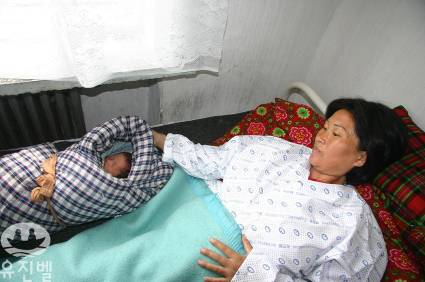
image005.jpg

1. New mother and infant at the Anju City People’s Hospital, part of EugeneBell’s new Maternal and Infant Care Program.
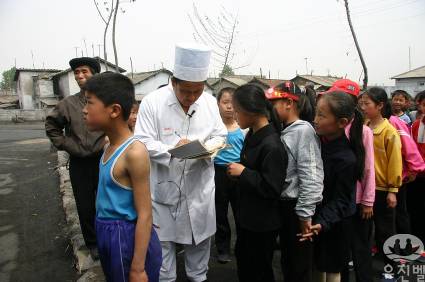
image008.jpg

2. Children in Anju City being given health physicals, part of EugeneBell’s new Children’s Care Program.
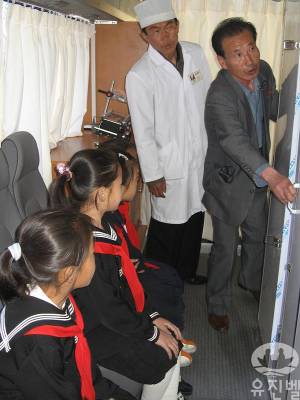
image006.jpg

3. Grade school students are examined at a mobile X-ray vehicle donated through EugeneBell to Nampo Tuberculosis Hospital.
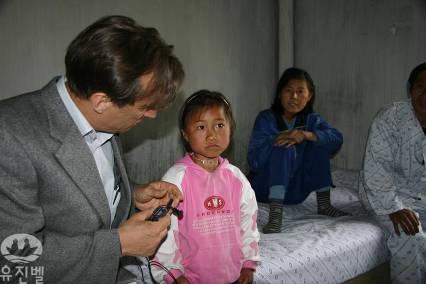
image009.jpg

4. Dr. Linton interviews a young patient at the Children’s Tuberculosis Ward at Nampo Tuberculosis Care Center.
image010.jpg

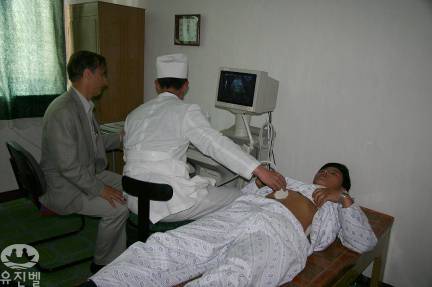
5. A patient is examined with a sonogram donated through EugeneBell at Daean People’s Hospital.
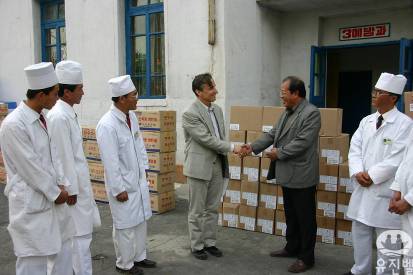
image013.jpg
   
6. Dr. Linton (left) delivers medical supplies and equipment to Chollima People’s Hospital in South Pyongan Province. In the spring of 2007 EugeneBell shipped almost 1,800,000 dollars of medical assistance to 40 odd medical facilities.
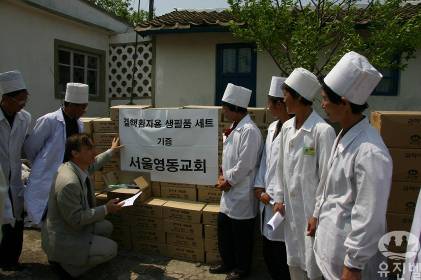
image014.jpg

7. Through EugeneBell donors sent 2,200 sets of Patient Necessities Kits to long-term patients in sixteen tuberculosis care centers. EugeneBell does everything possible to identify donors to recipients.

Share

About 16 million immunized against measles in N. Korea

Friday, April 20th, 2007

Kyodo News
4/20/2007

About 16 million children and adults have been immunized against measles in North Korea in one of the fastest responses to a major outbreak of the disease, it was revealed Friday.

The mass vaccination was organized by the U.N. Children’s Fund, the World Health Organization, the International Federation of the Red Cross and Red Crescent Societies and North Korea after the government asked for help in February.

According to the international organizations, the immunization campaign was done in two phases, with 6 million children aged 6 months to 15 years vaccinated last month and 10 million people aged 16 to 45 years immunized earlier this month.

The campaign was arranged following the appearance of several cases of measles in North Korea last November. By February this year two adults and two children had died and more than 3,600 had been infected.

Measles had not been reported in North Korea before this outbreak since 1992, according to a joint press release from the international organizations involved, and many health workers in the country were unfamiliar with the disease.

“This was a remarkable example of good cooperation between different organizations,” said Jaap Timmer, the International Federation’s head of delegation in North Korea.

“The Red Cross mobilized more than 15,000 of its volunteers to visit families and explain the importance and benefits of the vaccination campaign.”

Measles is spread by contact with fluid from an infected person’s nose or mouth and is highly contagious. Symptoms include fever and a rash.

Sending vaccines and syringes to North Korea cost about $6 million, the press release said.

Share

FAO Controls Foot & Mouth Disease in North Korea

Saturday, April 7th, 2007

Daily NK
Kim Song A
4/6/2007

Aid for North Korea to prevent further spread of outbreak

The spread of foot and mouth disease that took over the province of Sangwon, Pyongyang has been brought under control announced the U.N. Food and Agricultural Organization (FAO) on the 4th, further adding that future endemics were improbable.

The FAO and the World Organization for Animal Health (OIE) conducted tests over a period of one week inspecting the infected areas of North Korea.

The FAO Newsroom site reported Chief Veterinary Officer, Joseph Domenech who said, “Based on the mission’s visit to the infected area and discussions with North Korean veterinary authorities we concluded that there is a limited risk that new outbreaks could occur.” Nonetheless, North Korea is yet to remain on the alert list he said.

In relation, the DailyNK made similar reports in February on the rise of foot and mouth disease in the border regions of North Hamkyung province and control measures taken by North Korean authorities to block further contamination.

The disease was identified in cows of Hoiryeong city in early January. Consequently, North Korean authorities secluded the region for 40 days until Feb 24th, even terminating all transportation to the North Korea-China border.

The FAO is preparing a proposal to prevent further epidemics by assisting North Korea with vaccines, an emergency plan as well as laboratory infrastructure and training.

In future, North Korea will need to strengthen its system where animals are registered and identifiable as well as improving quarantine and controlled supervision of animals during transportation.

This epidemic was the first to occur in North Korea since 1960. So far, 400 infected cattle and 2,600 pigs have been rounded up and are undergoing the standard regulatory procedures.

Previously on March 28th, the South Korean government sent 280 mn won worth of medicine, antiseptic and instruments to North Korea to prevent further outbreak. Additionally, extra supplies requested by the North including sterilization are being prepared to be sent.

Share

S. Korea sends medicine, aid equipment to N. Korea

Wednesday, March 28th, 2007

Yonhap
3/28/2007

South Korea on Wednesday shipped medical aid to North Korea to help stem the spread of foot-and-mouth disease in the communist country, the Unification Ministry said.

The shipment includes six types of medicine and five types of medical equipment worth about 280 million won (US$280,000), the ministry said in a statement.

Last Thursday, South Korea endorsed its package of emergency aid worth 3.3 billion won for the North, which has culled hundreds of cows and thousands of pigs infected by the disease since July.

South Korea plans to make additional shipments after the two sides hold a working-level meeting of quarantine officials in the North Korean border city of Kaesong on Friday.

The World Organization for Animal Health confirmed the outbreak, and South Korea has proposed to support the North’s quarantine measures. 

Share

South Helps North Fight Scarlet Fever

Tuesday, March 6th, 2007

Korea times
Lee Jin-woo
3/6/2007

The Ministry of Unification said Tuesday it has provided some 400 million won ($400,000) to help North Korea stem the spread of scarlet fever, an infectious disease, a ministry official said.

Yang Chang-seok, spokesman for the ministry, said the money has been provided to an association of some 51 local private relief organizations.

As the money was financed by the inter-Korean cooperation fund under a matching fund system, the association promised to provide some 200 million won for the aid program.

Yang said the decision was made at a government meeting on Feb. 12.

The spokesman, however, said the decision was not in opposition to Unification Minister Lee Jae-joung’s earlier remarks not to provide any government-level assistance over the infectious disease in the impoverished North.

During a press briefing in January, the minister stated that the government would not provide medical aid to the North as scarlet fever is not a fatal infectious disease.

“Given the nature of the disease, we believe that North Korea itself will be able to solve the problem,” Lee told reporters on Jan. 11.

The spokesman said Minister Lee was referring to government-level aid through the Korean National Red Cross (KNRC), not financial assistance from private relief organizations.

South Korean humanitarian aid groups have shipped various types of medicine including penicillin and other antibiotics to Pyongyang since last December. Scarlet fever broke out in northern Ryanggang province last October.

Scarlet fever is intrinsically not a serious communicable disease, but if not treated properly it can become serious like cholera or typhoid. The impoverished North lacks medicine.

South Korea suspended its government-level humanitarian aid to North Korea after the North’s missile tests last July. A possible resumption of the aid was blocked due to the North’s nuclear bomb test in October.

During ministerial talks in Pyongyang last week, the two Koreas agreed to hold a series of meetings to restart the aid project. 

Share

N Korea ‘hit by measles epidemic’

Tuesday, February 20th, 2007

BBC
2/20/2007

North Korea has been hit by a measles epidemic that has killed four people and infected some 3,000, the Red Cross has said.

Measles has been found in 30 counties since the outbreak began in November, the International Federation of Red Cross and Red Crescent Societies said.

Pyongyang has requested five million doses of vaccine to fight the epidemic.

Correspondents say medicine is in short supply and years of malnutrition has weakened resistance to disease.

In a statement, the IFRC said North Korea had confirmed two children and two adults had died from measles and its complications such as pneumonia.

More than 1,000 people are still receiving treatment for the disease.

The authorities in Pyongyang only confirmed the measles outbreak last week because the disease was believed to have been eradicated from the country in 1992, the federation statement added.

The Red Cross, the World Health Organization and other international bodies are now helping to tackle the outbreak.

There have been recent reports of outbreaks of scarlet fever and typhoid in the reclusive Communist state, where most people are faced with daily food shortages and a dilapidated health service.

4 Dies From Measles Epidemic in North Korea
Korea Times
2/20/2007

A measles epidemic has claimed at least four lives and infected about 3,000 people in North Korea, the International Federation of Red Cross and Red Crescent Societies said Monday.

The federation said in a statement that measles has been found in 30 North Korean counties since the outbreak started in November last year.

It added that four deaths were reported on Jan. 4 when two children and two adults died from measles and its complications such as pneumonia. Around 3,000 North Koreans were confirmed to have infected with the disease.

Pyongyang has asked international organizations for massive doses of vaccine to prevent further spread of the epidemic.

The North has requested 5 million doses of measles vaccine to immunize its citizens aged from seven to 45.

The requested doses cost $1.5 million, and North Korea will pay the costs for transportation, distribution and staff training.

UNICEF is expected to lead the immunization campaign and keep the related organizations informed of developments.

North Korea’s Ministry of Public Health confirmed the measles epidemic last Thursday, and the information was immediately discussed in a joint meeting the following day by the North Korean Red Cross, the World Health Organization (WHO) and UNICEF.

The federation said the disease was initially believed to be rubella. The first identification of measles came on Nov. 6 in the northern region of the country.

It added that the communist country has failed to bring the epidemic under control and the disease spread throughout the country.

The WHO supplied Pyongyang with testing kits in January, but there were constraints because North Korea was thought to have eradicated the disease in 1992.

The country’s health care workers were thus not familiar with the disease, the federation pointed out.

Share

S. Korea Investigating Aid to North

Monday, January 22nd, 2007

Donga (Hat Tip DPRK Studies)
1/22/2007

It is expected that the government’s aid to North Korea will be affected as the international community has decided to investigate the general situation of aid projects using U.N. funding including the United Nations Development Program (UNDP). So far, the government and private groups supporting North Korea have often used international organizations as a means to give humanitarian aid to the North, as such aid through the World Health Organization (WHO), United Nations Children’s Fund (UNICEF), World Food Programme (WFP) and others are less influenced by the inter-Korean relations.

Last year, the government and private organizations didn’t provide previously planned corn aid to the North in the aftermath of North Korea’s missile and nuclear tests. However, they spent 5.912 billion won in malaria preventive measures and infant and child support.

In 2005, they sent products worth 25.773 billion won in food aid and quarantine measures against malaria. Besides, they provided goods worth 2.254 billion won in aid and preventive measures against malaria with the North in 2004, and offered North Korea goods worth 20.303 billion won in corn, malaria preventive measures, and vaccine and immunizing agents in 2003.

The total sum Korea spent on the North in humanitarian assistance over the last 10 years (from 1995 to 2004) amounts to $119.43 million, 7.99 percent of the total U.N. financial aid of $1.49 billion to North Korea. During the period, apart from world organizations, the government gave the North $1.16 billion in financial support.

A government official said, “The government’s support for North Korea through international groups is its obligation as a responsible member of the international community,” and added, “Assistance for North Korea through world organizations is for humanitarian purposes, and as far as I know, there is no possibility for misappropriating funds since the aid is being carried out based on a principle of providing 100 percent goods.”

However, contrary to the above government’s official statement, the government seems rather perplexed at the suspicion that its aid through world organizations was diverted to be used for the North’s nuclear development program. The government has used world organizations as an indirect route for its aid toward North Korea because it was worried about getting embroiled in accusations that it is being too lenient on North Korea.

Unification Minister Lee Jae-Jeong also said in his inaugural speech that even humanitarian aid should be divided into emergency aid, assistance in loan form and aid for development, and that emergency aid should continue under any circumstances in order to emphasize the continuation of government’s support for North Korea through world organizations.

Minister Lee has so far expressed regret to the WFP over the suspension of food aid to the North and emergency relief aid for North Korea’s catastrophic flood damage. Another government official stated, The “UNDP seems to have nothing to do with humanitarian aid since it is aid for the development of North Korea. Still, it will still affect the government’s humanitarian assistance program for the North in the future.”

Meanwhile, it was revealed that the government is investing in the Tumen River Area Development Programme (TRADP) the government has been participating in since 1995 under the auspices of the UNDP. An official at the Ministry of Finance and Economy noted, “This year, the government will pay $181,000 for the operating expenses of the TRADP office.”

Share

An affiliate of 38 North
