North Korea’s exports of anthracite coal to China grew 15.5 percent in 2013 from a year earlier, data showed Friday.
North Korea shipped a total of US$1.37 billion worth of anthracite to China last year, compared with $1.19 billion sold to the neighbor a year earlier, according to the data from the Korea International Trade Association.
North Korea exported only $162.6 million worth of the coal to China In 2007, but the figure has grown every year since then, according to the data.
The total anthracite exported to China last year was measured at 16.5 million tons, up 39.7 percent from what was exported in 2012, the data also showed, indicating that the North sold the coal to China at cheaper prices last year.
In December alone last year, the North shipped $118.06 million worth of anthracite, almost the same amount as November’s $121.45 million.
This means North Korea continued anthracite exports to China after executing leader Kim Jong-un’s once-powerful uncle Jang Song-thaek in early December for allegedly attempting to overthrow the regime and committing anti-state crimes, including selling North Korean natural resources abroad at excessively low prices.
North Korea’s anthracite exports are one of its major income sources and China is virtually the only destination for the shipments.
Read the full story here:
N. Korea’s coal exports to China up 15.1 pct in 2013 Yonhap
2014-1-24
Trade and economic levels between South and North Korea remained quite wide last year, data showed Monday, pointing to prolonged lackluster business and economic conditions in the reclusive North.
According to the data by Statistics Korea, South Korea’s total trade volume stood at US$1.07 trillion as of 2012, which is 157 times larger than the North’s $6.8 billion. In particular, the South’s exports came to $547.9 billion, 188.9 times larger than those of the North.
The nominal gross national income (GNI) levels between the two Koreas also remained wide.
The GNI for the South was estimated at 1,279.5 trillion won ($1.21 trillion) last year, 38.2 times larger than the North, the data showed. On a per-capita basis, South Korea’s GNI was 18.7 times larger than that of the North.
South Korea also outperformed the North in infrastructure and other social overhead capital spending.
The South’s road network totaled 105,703 kilometers, which compared with the 26,114 km for the North, the data showed. The South had the power generating capacity of 81.8 million kilowatts a year, which is 11.3 times larger than the North.
The only category that the North outperformed the South was in coal production. It produced a total of 25.8 million tons of coal last year, about 10 times the amount of coal produced by the South, according to the data.
The two Koreas had a combined population of 74.4 million, with the South holding a population of about 50 million, the data showed.
The statistics agency has been providing such information on the North every year since 1995 as a way to provide a glimpse into the economic and industrial conditions of the reclusive country.
Read the full story here:
Trade, economic gaps between 2 Koreas remain wide: data Yonhap
2013-12-23
The first chairman of the National Defence Commission of North Korea, Kim Jong Un, took office two years ago. Since then, construction of sports and entertainment facilities are reported to have increased considerably. According to the South Korean Ministry of Unification, North Korea’s Pyongyang Folk Park (September 2012), Taesongsan General Hospital (March 2013), and Haedanghwa Service Complex (April 2013) were recently completed. Since the launch of the Kim Jong Un regime, the Masik Pass Ski Resort and other similar sports facilities have been undertaken and are nearing completion.
In addition, the People’s Theatre (April 2012), Rungna People’s Pleasure Ground (opened in July 2012), Sunrise Restaurant (September 2012), and Unification Street Center (September 2012) have been recently renovated. In addition, the Mirim Riding Club, Pyongyang Gymnasium, Munsu Wading Pool, Aprok (Yalu) River Amusement park, Karma Hotel, and New Day Hotel and other hotels around Pyongyang are currently under renovation and repair. Entertainment and sports facilities around other major cities are being constructed as well. Furthermore, after the successful launch of Kwangmyongsong 3-2 last December, North Korea has begun to construct major residential complexes for scientists, granting them preferential housing in Unha scientist residence, Kim Il Sung University educator residence, and Pyongsong residence. Other large-scale housing projects are also reported to be under development.
In the wake of major celebrations in North Korea — such as the 100th anniversary of the birth of Kim Il Sung and 60-year anniversary of the “Victory in the Fatherland Liberation War” — a large memorial was erected and existing facilities were repaired. Specifically, the Korean People’s Army Exhibition of Arms and Equipment, Kumsusan Memorial Palace, War Victory Monument, and the Cemetery of the Fallen Fighters of the KPA were refurbished.
Unlike the large-scale construction of sports and entertainment facilities, new constructions of harbors, roads, power plants and other social overhead capital (SOC) is reported to be in decline.
Last August, North Korea’s trade with China has shown an 8 percent increase in exports and 6 percent decrease in imports, following a similar trend from last year. According to the South Korean Ministry of Unification, North Korea’s current trade volume with China is reported to be 4 billion USD (1.89 billion USD in exports and 2.2 billion USD in imports).
North Korea’s most popular export items are mineral resources such anthracite, coal, and iron ore. In the case of clothing products — which are mostly consigned processing — there has been an increase of 42 percent (200 million USD) against the previous year. Major categories of imports from China are crude oil, food, and fertilizers. Compared to the previous year, food imports have declined 57 percent (17.4 million tons), and fertilizer and crude oil imports are also showing gradual reduction at 27 percent (18.3 million tons) and 6 percent (34.6 million tons), respectively.
According the Russian outlet Izvestia (translated by Google Translate):
Tensions between the U.S. and North Korea do not interfere with the group Evraz, the largest shareholder is Roman Abramovich, it is advantageous to work with both countries: part of the holding coal company “Raspadskaya (Распадской)” began selling coal in North Korea. At the end of 2013 the total supply of “Raspadskaya” to North Korea could reach $ 32 million – half of it is comparable to last year’s total exports from Russia to North Korea.
During the first half of 2013 “Raspadskaya” delivered to North Korea coking coal at $ 4.5 million, follows from the statements of the company. In the total volume of exports “Raspadskaya” is about 4%, which makes the DPRK fifth largest export market for sales of coal (after China, Ukraine, South Korea and Japan).
…
In the DPRK embassy in Russia, “Izvestia” reported that, except for “Raspadskaya”, none of the Russian coal industry supplies goods to North Korea. There’s also clarified that the recipient of coal – Metallurgical Works named. Kimchaek– one of the largest steel companies in North Korea. Total design capacity metkombinatu them. Kimchaek on all kinds of products, according to various estimates, 6.5 million tons, but in recent years the plant has significantly underutilized. According to South Korean estimates, the actual production of steel in all of North Korea is 1.25 million tons per year (Statistics Korea itself does not publish a lot of years).
The volume of coal supply to the “Raspadskaya” to North Korea – to 20 kt (4-5 railroad tracks) on a monthly basis under the current annual contract, described in the company. Price is tied to the international price system (quotation Australian HCC with a discount for the quality of the brand SHCC). That is the sum total of the contract – about $ 32 million, considered BCS analyst Oleg Peter and Paul: The current market price of coking coal at $ 152 per ton (FOB Australia), but the average price for the first half was $ 134.
– Last year, the entire bilateral trade between Russia and North Korea amounted to less than $ 80 million – says Ludmila Zakharova, a senior researcher at the Center for Korean Research Institute of Far Eastern Studies. – At present, trade between our two countries in a state of crisis, Russia accounts for less than 1% of North Korea’s foreign trade.
In 2012, Russian exports to Korea totaled $ 65 million, told “Izvestia” in Economic Development. North Korea among foreign trade partners of Russia occupies 124th place with a “specific weight of 0%,” stated in the department. Starting this year, however, there is growth of sales: in January-July 2013 two-way trade turnover of Russia and North Korea reached $ 56 million ( an increase of 31% compared to the same period in 2012), including Russian exports totaled nearly $ 51 million (an increase of 38%).
A small volume of direct trade is partially offset by other forms of economic cooperation continues Ludmila Zakharova. For example, it is estimated that about $ 100 million a year is the so-called labor services: experts from North Korea come to work in Russia (for the current year quota for North Korean workers reached 35 thousand people). Since the DPRK shortage of agricultural land, there are projects to provide Koreans to lease farmland in the Primorye Territory. In the last few years has intensified investment direction of Russian-North Korean cooperation. The other day, completed the reconstruction of the railway Hasan-Rajin. Investment in this project is a joint Russian Railways and the Ministry of Railways North Korea amounted to more than $ 200 million
According to data provided by the Ministry of Economic Development, the amount of accumulated investment of Russia to the DPRK at the end of the first quarter of 2013 amounted to only $ 572 million, while the DPRK in Russia – more than $ 79 million
Evraz – a vertically integrated global company with assets not only in Russia but also in other countries, including the United States. Evraz North American division includes several large steel companies formerly known as Oregon Steel, Rocky Mountain Steel, Claymont Steel and Ipsco.
– Evraz to some degree of risk. Under existing U.S. sanctions against the DPRK any large company with offices in the U.S. carries certain risks, working with North Korea – warns Ludmila Zakharova. – America includes a list of objects sanctioned North Korean banks and organizations that are involved in nuclear and missile program. All legal entities operating in the United States, engaging in economic relations with the companies on this list are subject to the relevant law and can not only get the fines, but generally lose access to the U.S. market and the U.S. banking system. In this case, unlike the UN sanctions, the U.S. rules imply a sufficiently broad interpretation than may be exploited Evraz. Of course, the steel industry is difficult to draw to a nuclear program, but you can.
The contract with the DPRK was verified for international risks assured “News” in the “Raspadskaya”.
– At Evraz in America a lot of assets, but the supply of this market are small. Much more dangerous for her to lose access to local banking system – says Oleg Peter and Paul. – Still, the U.S. market civilized, hardly any of the competitors Evraz want to speculate on its relations with the DPRK. Also tied to the steel industry’s nuclear program would be extremely difficult.
If any Russian translators care to improve on the text offered by Google Translate, please do so.
Read the full story here:
Компания Абрамовича подзаработает в Северной Корее Известия
2013-9-23
Trade between North Korea and China contracted 2.3 percent on-year in the first five months of 2013 mainly due to Pyongyang importing less from its neighbor, a report showed Tuesday.
The report by the Korea International Trade Association (KITA) showed two-way trade at US$2.45 billion in the January-May period, with North Korea’s exports to China growing 6.5 percent on-year to $1.12 billion. The North’s imports from China, however, dropped 8.5 percent to $1.33 billion.
The trade association said the North shipped $613.6 million worth of coal, making it the top export commodity for the communist country, followed by such raw materials as iron and lead ores.
In exchange, the North bought $265 million worth of crude oil, a decrease of 5 percent from January-May of 2012. The country imported $52 million in large cargo-hauling vehicles, as well as flour and soybean oil from its neighbor.
KITA did not elaborate on the reason for the decrease in overall trade volume and the drop in crude oil imports from China.
Related to economic developments in the North, the U.S. Department of Agriculture said in a report that food conditions in the isolationist country remain one of the most precarious in all of Asia.
In its 2012-2013 food security report, which inspected 22 countries in the region, the North came in at the bottom with Afghanistan and Yemen.
The findings, which are used as reference material for food aid provisions by Washington, claimed that while the North was able to produce 7.5 million tons of grain annually up until the early 1990s, this has since plunged to around 4.3 million tons in 2012.
Read the full story here:
N. Korea-China trade drops 2.3 pct: report Yonhap
2013-7-2
On March 31, KCNA reported on the recent plenary meeting of the Korean Worker’s Party:
The historic March, 2013 plenary meeting of the Central Committee of the Workers’ Party of Korea took place at the building of the WPK Central Committee, supreme staff of the Korean revolution, on Sunday.
First Secretary of the WPK Kim Jong Un guided the meeting.
Present at the meeting were members and alternate members of the WPK Central Committee and members of the Central Auditing Commission of the WPK.
Present there as observers were senior officials of ministries, national institutions, provincial, city and county committees of the WPK, complexes, major munitions factories and enterprises.
The participants paid silent tribute to President Kim Il Sung and leader Kim Jong Il.
Taken up for discussion at the meeting were the following agenda items “1. On tasks of our Party on bringing about a decisive turn in accomplishing revolutionary cause of Juche as required by the present situation and the developing revolution”, “2. On personnel affairs issue to be submitted to the 7th Session of the 12th Supreme People’s Assembly” and “3. On organizational matter”.
Kim Jong Un made a report and concluding speech on the first agenda item.
The plenary meeting set forth a new strategic line on carrying out economic construction and building nuclear armed forces simultaneously under the prevailing situation and to meet the legitimate requirement of the developing revolution.
This line is a brilliant succession and development onto a new higher stage of the original line of simultaneously developing economy and national defence that was set forth and had been fully embodied by the great Generalissimos.
It was stressed at the meeting that the party’s new line is not a temporary countermeasure for coping with the rapidly changing situation but a strategic line to be always held fast to, in the supreme interests of the Korean revolution.
The nuclear weapons of Songun Korea are not goods for getting U.S. dollars and they are neither a political bargaining chip nor a thing for economic dealings to be presented to the place of dialogue or be put on the table of negotiations aimed at forcing the DPRK to disarm itself.
The DPRK’s nuclear armed forces represent the nation’s life which can never be abandoned as long as the imperialists and nuclear threats exist on earth. They are a treasure of a reunified country which can never be traded with billions of dollars.
Only when the nuclear shield for self-defence is held fast, will it be possible to shatter the U.S. imperialists’ ambition for annexing the Korean Peninsula by force and making the Korean people modern slaves, firmly defend our ideology, social system and all other socialist treasures won at the cost of blood and safeguard the nation’s right to existence and its time-honored history and brilliant culture.
When the party’s new line is thoroughly carried out, the DPRK will emerge as a great political, military and socialist economic power and a highly-civilized country which steers the era of independence.
The meeting set forth tasks for carrying out the new line and ways for doing so.
All the officials, party members and other people should wage bold offensive and all-people decisive battle with faith in sure victory and strong determination and thus make the flame of miracle and innovation sweep all fields of national economy.
The pilot fields of the national economy, the basic industrial fields should be drastically developed and production be increased to the maximum. Forces should be directed to agriculture and light industry, key fields in building an economic power to improve and put on a stable basis the people’s living standard at the earliest possible date.
The self-reliant nuclear power industry should be developed and the work for developing light water reactor be dynamically promoted to actively contribute to easing the strain on the electricity problem of the country.
Spurs should be given to the development of space science and technology and more advanced satellites including communications satellites be developed and launched.
The country’s economy should be shifted into knowledge-based economy and the foreign trade be made multilateral and diversified and investment be widely introduced.
The economic guidance shall be fundamentally improved as required by the new situation and Korean-style advantageous economic management methods be completed by embodying the Juche idea.
The DPRK’s possession of nukes should be fixed by law and the nuclear armed forces should be expanded and beefed up qualitatively and quantitatively until the denuclearization of the world is realized.
The People’s Army should perfect the war method and operation in the direction of raising the pivotal role of the nuclear armed forces in all aspects concerning the war deterrence and the war strategy, and the nuclear armed forces should always round off the combat posture.
As a responsible nuclear weapons state, the DPRK will make positive efforts to prevent the nuclear proliferation, ensure peace and security in Asia and the rest of the world and realize the denuclearization of the world.
Institutions in charge of security and safeguard, judicial and prosecution and people’s security and the Korean People’s Internal Security Forces should resolutely foil the vicious moves of the imperialist reactionaries and class enemies, devotedly defend the party, social system and people and surely guarantee the new line of the party with arms and by law.
The party and working people’s organizations and power bodies should increase their militant function and role in every way in the struggle for implementing the party’s line.
The meeting entrusted the Presidium of the SPA and the Cabinet with the matters of taking legal, administrative and technical measures for implementing the tasks.
At the meeting a decision on the first agenda item “On carrying out economic construction and building nuclear armed forces simultaneously and thus bringing earlier the final victory in the cause of building a thriving socialist nation” was adopted with unanimous approval.
The second agenda item, personal affairs issue to be submitted to the 7th Session of the 12th SPA, was discussed and decided at the meeting.
The meeting also dealt with an organizational matter, its third agenda item.
Members of the Presidium of the Political Bureau of the WPK Central Committee, members and alternate members of the Political Bureau were recalled and new ones were elected to fill vacancies.
Pak Pong Ju was elected to fill a vacancy of a member of the Political Bureau of the WPK Central Committee.
Hyon Yong Chol, Kim Kyok Sik and Choe Pu Il were elected to fill vacancies of alternate members of the Political Bureau of the WPK Central Committee.
Members and alternate members of the WPK Central Committee were recalled and new ones were elected to fill vacancies.
Upon authorization of Kim Jong Un, Paek Kye Ryong was appointed as director of the Light Industrial Department of the WPK Central Committee and Yun U Chol as editor-in-chief of Rodong Sinmun, organ of the WPK Central Committee.
Members of the Central Auditing Commission of the WPK were also recalled and new ones were elected to fill vacancies.
Central Committee of the Workers’ Party of Korea Stresses Development of Agricultural, Light, and Nuclear Industries
Institute for Far Eastern Studies (IFES)
2013-4-4
The Korean Central News Agency (KCNA) reported on March 31 that a plenary meeting of the Central Committee of the ruling Workers’ Party of Korea was held. At the meeting, a new strategic line was announced to have been set, which called for building a stronger economy and nuclear arsenal. This meeting is drawing attention as it is suspected that Pyongyang will pursue a new economic policy.
The news described the new strategic line as, “most revolutionary and people oriented policy for the construction of a powerful socialist nation by consolidating defense capacity through development of defensive nuclear weapons and economic construction.”
It stressed that this policy is significant as a “creative and parallel policy for defense and economy continuing the policies of Kim Il Sung and Kim Jong Il, which must be adopted as a permanent strategy.”
At the plenary meeting, the main agendas for the parallel policy of economy and defense were announced as: 1) Improvement of the production of people’s economy and capacity enhancement for agricultural and light industries to stabilize prices to improve the lives of the people; 2) development of self-reliant nuclear power industry and light water reactors; 3) development and launch of more satellites including communication satellites through advancement in space science and technology; 4) transition to knowledge economy and diversification of foreign trade to vitalize foreign investments; and 5) establish legislation to be recognized as a nuclear state and develop nuclear arsenal both in quantity and quality until denuclearization is realized worldwide.
At the plenary, the new parallel policy was commended, “The supremacy of the policy is demonstrated by expanding capability in war deterrence and national defense without increasing defense budget and enabled concentration on economic development and improvement of the lives of the people.”
The statement released by the KCNA stated that the plenary meeting’s emphasis on transition to knowledge economy and diversification of foreign trade as the main tasks and appears to be pursuing a “fundamental improvement in economic leadership.”
In addition, the plenary assigned the presidium of the Supreme Peoples’ Assembly and the Cabinet to serve as the economic control tower to oversee the future projects decided at the plenary meeting.
North Korea is continuing to place emphasis on light and agricultural industries. The Kim Jong Un regime entered its second year. The leader was reported to have attended the light industry conference, which was held for the first time in ten years and underscored the importance of concentrating on development of the capacity of light industry.
The new Korean line, 병진 (Pyongjin, Byungjin) is the simultaneous development of nuclear weapons and the economy. Learn more about it here.
Following the central committee plenary meeting, the 7th Session of the 12th Supreme People’s Assembly was held. According to KCNA:
The Seventh Session of the 12th Supreme People’s Assembly (SPA) of the DPRK took place at the Mansudae Assembly Hall Monday.
Kim Jong Un, first secretary of the Workers’ Party of Korea, first chairman of the National Defence Commission of the DPRK and supreme commander of the Korean People’s Army, was present at the session.
Present there were deputies to the SPA.
Also present there as observers were officials of party, armed forces and power bodies, public organizations, ministries and national institutions and those in the fields of science, education, literature and art, public health and media.
All the participants observed a moment’s silence in memory of President Kim Il Sung and leader Kim Jong Il in humblest reverence.
The session decided the following agenda items of the Seventh Session of the 12th SPA of the DPRK:
1. On amending and supplementing some contents of the Socialist Constitution of the DPRK
2. On adopting the DPRK Law on the Kumsusan Palace of the Sun
3. On adopting the ordinance of the SPA of the DPRK “On Consolidating the Position of Nuclear Weapons State for Self-Defence”
4. On adopting the DPRK Law on Developing Space
5. On adopting the decision of the SPA of the DPRK “On Setting up the DPRK State Space Development Bureau”
6. On the work of the DPRK Cabinet for Juche 101 (2012) and its tasks for Juche 102 (2013)
7. On the review of the fulfillment of the DPRK’s state budget for Juche 101 (2012) and state budget for Juche 102 (2013)
8. Organizational matter
The session discussed the first and second agenda items.
Deputy Kim Yong Nam, president of the Presidium of the DPRK SPA, made a report on amendment and supplement to some contents of the Socialist Constitution of the DPRK and on adopting the law on the Kumsusan Palace of the Sun.
Then followed speeches on the first and second agenda items.
Deputy Kim Ki Nam, secretary of the WPK Central Committee, spoke on behalf of the WPK, Deputy Choe Ryong Hae, director of the General Political Bureau of the KPA, on behalf of the KPA and Deputy Jon Yong Nam, chairman of the C.C., the Kim Il Sung Socialist Youth League, on behalf of the youth.
The speakers fully supported and approved of deliberation and adoption of the draft amendment and supplement to the Socialist Constitution of the DPRK and the law on the Kumsusan Palace of the Sun at the current SPA session reflecting the unanimous feelings of all party members, service personnel and youth across the country.
The ordinances of the SPA of the DPRK “On Amending and Supplementing Some Contents of the Socialist Constitution of the DPRK” and “On Adopting the DPRK Law on the Kumsusan Palace of the Sun” were adopted at the session with the approval of all deputies.
The session discussed the third, fourth and fifth agenda items.
The ordinances of the SPA of the DPRK “On Consolidating the Position of Nuclear Weapons State for Self-Defence” and “On Adopting the DPRK Law on Developing Space” and the decision of the SPA of the DPRK “On Setting Up the DPRK State Space Development Bureau” were adopted at the session with the approval of all deputies.
Deputy Choe Yong Rim, premier of the Cabinet, made a report on the sixth agenda item.
Deputy Choe Kwang Jin, minister of Finance, made a report on the seventh agenda item.
Then followed speeches on the sixth and seventh agenda items. Written speeches were presented at the session.
The speakers noted that the Cabinet work and the fulfillment of the state budget for last year were correctly reviewed and summed up, clear tasks of the Cabinet were set forth to meet the requirements of the general offensive to open an epochal phase in building an economic power at the final stage of the all-out action against the U.S. and the state budget was correctly shaped. They expressed full support and approval of them.
They expressed their determination to reenergize the overall economy of the country, step up the grand advance for improving the standard of people’s living to make loud shouts of hurrah for the Workers’ Party and socialism heard this year marking the 65th anniversary of the DPRK and the 60th anniversary of the victory in the Fatherland Liberation War, true to the historic New Year Address of Kim Jong Un and the decision of the March, 2013 plenary meeting of the WPK Central Committee.
The decision of the SPA of the DPRK “On Approval of the Report on the Work of the DPRK Cabinet and the Review of the Fulfillment of the State Budget for Juche 101 (2012)” and the ordinance of the SPA of the DPRK “On the DPRK’s State Budget for Juche 102 (2013)” were adopted at the session with the approval of all deputies.
The session discussed the organizational matter.
At the session Deputy Choe Yong Rim was recalled from the post of premier of the DPRK Cabinet and Deputy Pak Pong Ju was elected premier of the DPRK Cabinet at the proposal of the WPK Central Committee.
Choe Yong Rim was elected honorary vice-president of the Presidium of the DPRK SPA.
Deputies Kim Jong Gak and Ri Myong Su were recalled from the posts of member of the DPRK National Defence Commission (NDC) due to the transfer to other jobs.
Deputies Kim Kyok Sik and Choe Pu Il were elected members of the DPRK NDC to fill vacancies at the proposal of the WPK Central Committee and the WPK Central Military Commission.
Deputy Thae Hyong Chol was recalled from the post of secretary general of the Presidium of the DPRK SPA and Deputy Hong Son Ok was elected secretary general of the Presidium of the DPRK SPA.
Some members of the Cabinet were relieved of their posts and appointed at the session.
Deputy Pak Pong Ju, premier of the DPRK Cabinet, took an oath at the SPA.
KCNA also issued several reports that stemmed from the SPA meeting:
Report on Adopting Draft Amendment and Supplement to Socialist Constitution and Law on Kumsusan Palace of Sun
Pyongyang, April 1 (KCNA) — Kim Yong Nam, president of the Presidium of the Supreme People’s Assembly, made a report on adopting the draft amendment and supplement to the Socialist Constitution of the DPRK and the law on the Kumsusan Palace of the Sun.
According to the report, the draft amendment and supplement to the Socialist Constitution and the law on the Kumsusan Palace of the Sun to be submitted to the session for discussion will legalize the plan and intention of the Workers’ Party of Korea to fix by law the shining achievements made in accomplishing the cause of perpetuating the memory of the leaders and complete it on a new higher stage.
To be supplemented to the preface of the Socialist Constitution is the sentence which says that the Kumsusan Palace of the Sun where President Kim Il Sung and leader Kim Jong Il lie in state is a grand edifice for the immortality of the leaders, a symbol of the dignity of the whole Korean nation and its eternal sacred temple.
The law on the Kumsusan Palace of the Sun specifies that its noble mission is to preserve and glorify forever the palace, which is the supreme temple of Juche, as the eternal temple of the sun of the entire Korean nation.
The law stipulates that Kim Il Sung and Kim Jong Il will be held in high esteem forever as in their lifetime at the Kumsusan Palace of the Sun and that it is the obligation of all the Koreans to regard the Palace as a symbol of dignity and a great pride of the nation.
It also specifies the state duty to spruce up the Palace in a sublime and perfect way with the state, all-people and nationwide efforts and devotedly safeguard the Palace in every way so that no one can violate.
Also stipulated in the law are matters for carrying out the work of eternally preserving the Palace as the most important state work with consistency, organizing the committee for the eternal preservation of the Palace and preserving for photos, train coaches, cars, boat and other relics and orders which represent the noble lives of the great Generalissimos.
Orders were also set so that Korean people, overseas Koreans and foreigners can pay respects to the great Generalissimos at the Kumsusan Palace of the Sun.
Also mentioned in the law are the matters of establishment of special sanctuary of the Palace for its protection and management as well as the management of buildings in the premise of the palace, park, arboretum, outdoor lighting and lighting facilities and orders concerning the operation of the plaza and the park of the Palace.
It was specified in the law that electricity, facilities, materials and other supplies needed for the Palace shall be planned separately and be provided without fail on a top priority basis. The law also set the duty to be fulfilled by relevant institutions to strictly supervise and control on a regular basis the work for safeguarding, eternally preserving and providing the conditions for the management and operation of the Palace.
The reporter said that the law on the Kumsusan Palace of the Sun is the unique code for the immortality of the leaders, adding that it is the biggest honor for the army and people of the DPRK to have the legal weapon for the immortality of the leaders.
The adoption of the law will serve as a historic occasion for defending and further glorifying the idea on perpetuating the memory of the leaders clarified by the dear respected Kim Jong Un, he stressed.
The reporter said that the Presidium of the Supreme People’s Assembly of the DPRK submits the draft amendment and supplement to the Socialist Constitution and the draft law on the Kumsusan Palace of the Sun to the SPA session for discussion according to Article 95 of the Socialist Constitution.
And…
DPRK’s Law on Kumsusan Palace of Sun Adopted
Pyongyang, April 1 (KCNA) — The DPRK’s Law on the Kumsusan Palace of the Sun was adopted.
The ordinance of the DPRK Supreme People’s Assembly on it was promulgated Monday.
The Kumsusan Palace of the Sun where President Kim Il Sung and leader Kim Jong Il lie in state is the
eternal temple of the sun of the whole Korean nation.
The ordinance says that the SPA decides to adopt this law to eternally preserve and glorify forever the
Kumsusan Palace of the Sun as a grand edifice for the immortality of the leaders symbolic of Kim Il Sung’s and Kim Jong Il’s Korea.
And…
Law on Consolidating Position of Nuclear Weapons State Adopted
Pyongyang, April 1 (KCNA) — A law on consolidating the position of nuclear weapons state for self-defence was adopted in the DPRK.
An ordinance of the Supreme People’s Assembly of the DPRK in this regard was promulgated on Monday.
The ordinance said as follows:
The DPRK is a full-fledged nuclear weapons state capable of beating back any aggressor troops at one strike, firmly defending the socialist system and providing a sure guarantee for the happy life of the people.
Having an independent and just nuclear force, the DPRK put an end to the distress-torn history in which it was subject to outside forces’ aggression and interference and could emerge a socialist power of Juche which no one dares provoke.
The Supreme People’s Assembly of the DPRK decides to consolidate the position of the nuclear weapons state as follows:
1. The nuclear weapons of the DPRK are just means for defence as it was compelled to have access to them to cope with the ever-escalating hostile policy of the U.S. and nuclear threat.
2. They serve the purpose of deterring and repelling the aggression and attack of the enemy against the DPRK and dealing deadly retaliatory blows at the strongholds of aggression until the world is denuclearized.
3. The DPRK shall take practical steps to bolster up the nuclear deterrence and nuclear retaliatory strike power both in quality and quantity to cope with the gravity of the escalating danger of the hostile forces’ aggression and attack.
4. The nuclear weapons of the DPRK can be used only by a final order of the Supreme Commander of the Korean People’s Army to repel invasion or attack from a hostile nuclear weapons state and make retaliatory strikes.
5. The DPRK shall neither use nukes against the non-nuclear states nor threaten them with those weapons unless they join a hostile nuclear weapons state in its invasion and attack on the DPRK.
6. The DPRK shall strictly observe the rules on safekeeping and management of nukes and ensuring the stability of nuclear tests.
7. The DPRK shall establish a mechanism and order for their safekeeping and management so that nukes and their technology, weapon-grade nuclear substance may not leak out illegally.
8. The DPRK shall cooperate in the international efforts for nuclear non-proliferation and safe management of nuclear substance on the principle of mutual respect and equality, depending on the improvement of relations with hostile nuclear weapons states.
9. The DPRK shall strive hard to defuse the danger of a nuclear war and finally build a world without nukes and fully support the international efforts for nuclear disarmament against nuclear arms race.
10. The related institutions shall take thorough practical steps for implementing this ordinance.
And…
DPRK Law on Developing Space Adopted
Pyongyang, April 1 (KCNA) — The Law on Developing Space was adopted in the DPRK.
The ordinance of the DPRK Supreme People’s Assembly on it was promulgated Monday.
And…
DPRK SPA Decides to Set Up State Space Development Bureau
Pyongyang, April 1 (KCNA) — The DPRK decided to set up the State Space Development Bureau.
The decision of the Supreme People’s Assembly (SPA) of the DPRK promulgated on Monday said:
The DPRK is a full-fledged satellite manufacturer and launcher.
It is an invariable stand of the DPRK to develop the country into a world-class space power by exercising its legitimate right to space development for peaceful purposes.
To step up economic construction and improve the people’s standard of living by radically developing the space science and technology of the country and guide and manage all the space activities of the DPRK in a uniform way, the SPA decides as follows:
1. The DPRK State Space Development Bureau shall be set up.
2. The bureau is a state central institution which guides and manages the supervision and control over the working out of a space development program and its implementation and space development work in a uniform way.
3. The Cabinet of the DPRK and other institutions concerned shall take practical measures to implement this decision.
And…
Work of Cabinet for Last Year and Tasks for This Year
Pyongyang, April 1 (KCNA) — At the 7th Session of the 12th Supreme People’s Assembly held on Monday, Deputy and Premier Choe Yong Rim made a report on the last year’s work of the DPRK Cabinet and this year’s tasks.
According to the report, last year electricity and coal production and the volume of railway freight transport increased amid the endeavors to shore up the four pilot fields of the national economy. Increase was also made in the production of a variety of industrial goods, the report said, and went on:
The Kumsusan Palace of the Sun was remodeled to be the supreme temple of Juche, the National Gifts Exhibition House, Pyongyang Folklore Park, Changjon Street, Rungna People’s Pleasure Park and other big edifices in the era of Songun have been built.
Big industrial projects such as the Huichon Power Station, Tanchon Port, Taedonggang Building Materials Factory were completed and technological updating and modernization of major factories and enterprises in the field of metal, machine, chemical and light industries have been pushed forward, consolidating the material and technological foundation of the national economy.
Satellite Kwangmyongsong 3-2 was successfully manufactured and launched and the third underground nuclear test by the use of smaller and lighter A-bomb of great explosive power was successfully conducted.
The bases for the production of cutting-edge technical goods were built and projects for the development of science and technology have been successfully carried out and the modernization of the information and communications field have been stepped up.
A law on the enforcement of the universal 12-year compulsory education was promulgated. This paved a wide avenue for consolidating the socialist education system and raising the quality of education.
In the field of health care, a telemedicine service has been successfully introduced. The DPRK’s players glorified the honor of the country at major international sports events including the 30th Olympic Games and other signal achievements were made in the field of cultural construction.
The reporter said that this year’s tasks are to realize at an early date the lifetime desire of President Kim Il Sung and leader Kim Jong Il, who devoted their whole lives to putting the country’s economy on the level of a prosperous and powerful country and to making the people live with no more to desire in the world.
According to the report, this year the Cabinet will organize the economic work with a main emphasis on solving issues arising in the people’s living by shoring up the pilot fields, the basic industrial field, consolidating the springboard for building an economic power and concentrating all efforts on agriculture and light industry while regarding coal industry and metal industry as key fields.
It is necessary to increase the production of coal.
Technological updating and modernization of iron works and steel works will be stepped up while improving the bases for the production of Juche iron which have already been built in the field of metal industry. Strict measures for supplying raw materials and fuel should be taken to increase the production of rolled steel more than 3.5 times as compared with last year and thus meet the need for steel.
The field of railway transport will ease strain on transport by consolidating the material and technical foundation of railways.
The grain production plan for this year should be carried out without condition.
The whole country should make efforts for the reclamation of Sepho Tideland and the construction of stock-breeding bases and thus complete the creation of grassland within this year.
The production should be put at a high rate at major chemical factories and the percentage of locally available raw materials should be significantly increased. The production at mines, factories and enterprises in Tanchon area should be increased and exports be boosted to ensure in a responsible manner funds for improving the people’s living standard.
Big efforts should be directed to the construction of dwelling houses. Wonsan area should turn into a world-level resort and tourist destination and living environment and conditions be improved in provinces, cities and counties.
The state investment in the field of science and technology should be increased and the flame of industrial revolution in the new century be raised so as to bring about a decisive turn in building an economic power by dint of science and technology.
Ultra-modern technological goods of high competitiveness should be massively researched and developed. Scientific and technological issues arising in the technological updating and modernization of the national economy should be satisfactorily solved.
The state investment will be increased in education and the preparations for enforcing the universal 12-year compulsory education system be rounded off within this year and fresh progress be made in education, public health, literature, arts, sports and all other fields of cultural construction.
All the fields and units of the national economy should build under a long-term plan export bases for producing second-stage and third-stage processed goods and finished goods of high competitiveness at international markets by relying on locally available resources and indigenous technology. Latest scientific and technological achievements should be positively introduced to increase the varieties of exports and remarkably raise their quality.
Trade should be made diversified and multilateral while conducting a variety of trade activities. The joint venture and collaboration should be actively promoted and the work for setting up economic development zones be pushed forward.
And…
Review of Fulfillment of State Budget for Last Year and State Budget for This Year
Pyongyang, April 1 (KCNA) — Deputy Choe Kwang Jin, minister of Finance, made a report on the review of the fulfillment of state budget for last year and the state budget for this year at the 7th Session of the 12th Supreme People’s Assembly held on Monday.
According to the report, the state budgetary revenue last year was over-fulfilled by 1.3 percent, an increase of 10.1 percent over the previous year.
The plan for local budgetary revenue was carried out at 113.8 percent.
The state budgetary expenditure was implemented at 99.6 percent, an increase of 9.7 percent over that in the previous year.
44.8 percent of the total state budgetary expenditure for the economic development and improvement of people’s living standard was used for funding the building of edifices to be presented to the 100th birth anniversary of President Kim Il Sung, the consolidation of the material and technological foundation of Juche-based, modern and self-supporting economy and the work for face-lifting the country.
38.9 percent of total expenditure was spent for enforcing popular policies and measures for social culture under socialism such as the universal free compulsory education system, free healthcare, social insurance and social security, recuperation and relaxation systems as well as those for development of literature and art and building of a sports power.
Some of the total state budgetary expenditure went to national defence.
According to the report, this year’s state budgetary revenue and expenditure have been shaped in such a way as keeping the overall economy afloat and bringing about a decisive turn in stabilizing and improving the standard of people’s living.
The state budgetary revenue is expected to increase 4.1 percent over that last year.
Out of this, the transaction tax, main source of budgetary revenue, is expected to grow 3.5 percent, the revenue from the profits of state enterprises 6 percent, revenue from the profits of cooperative enterprises 5.3 percent, the revenue from the depreciation 2.8 percent and revenue from real estate rent 3.4 percent.
In the total state budgetary revenue, national budgetary revenue will account for 83 percent and local budgetary revenue 17 percent.
Provinces, cities and counties are envisaged to ensure expenditure with local import and put a huge amount of fund into national budget.
The state budgetary expenditure is expected to grow 5.9 percent over last year.
It was decided to increase expenditure in the field of coal, electricity, metal and railway transport 7.2 percent, the field of agriculture and light industry 5.1 percent, basic investment in capital construction and big overhaul 5.8 percent, the field of science and technology 6.7 percent, the field of education 6.8 percent, the field of public health 5.4 percent, the field of social insurance and security 3.7 percent, the field of sports 6.1 percent and the field of culture 2.2 percent.
Some of the total state budgetary expenditure will go for national defence.
A large amount of educational aid fund and stipends will be sent for the education of Korean children in Japan to promote the development of the democratic national education of the General Association of Korean Residents in Japan.
The reporter called for working hard to glorify this significant year marking the 65th anniversary of the DPRK and the 60th anniversary of the victory in the Fatherland Liberation War as a year of gigantic creation and innovations, in hearty response to the historic New Year Address by Kim Jong Un and the decision made at the March, 2013 plenary meeting of the WPK Central Committee.
Here is what Yonhap had to say about the DPRK’s defense budget:
North Korea is expected to spend 16 percent of its budget on national defense in 2013, up 0.2 percentage point from the year before, the country’s state media said Tuesday.
According to the Rodong Sinmun, an organ of the North’s ruling Workers’ Party, Finance Minister Choe Kwang-jin reported to a meeting of the Supreme People’s Assembly in Pyongyang on Monday that the money is needed to effectively cope with “indiscriminate” provocations by the United States and its followers.
The paper, however, did not disclose the exact size of the defense budget, although South Korea’s unification ministry speculated that last year’s military budget totaled US$910 million.
The proportion of the spending plan compared to the overall budget, is the highest tallied since 1998, according to South Korean analysts.
From 1998 through 2002, the North is estimated to have spent 14.4 percent to 14.5 percent of its annual budget on defense, with numbers going up and being fixed at 15.8 percent in the 2007-2012 period, they said.
Additional information:
1. Here and here is KCTV footage of the SPA meeting.
While Beijing has not made clear whether the test would disrupt its investment plans for the Rason economic zone, an official at the zone’s joint management office told Reuters that all previously announced Chinese projects for the zone remain on track, including a power line from China to ease acute electricity shortages there.
“All the people of the management office are still here working as usual… If there is any major impact (from the nuclear test), do you think we would still be here?” he said by phone from Rason, which lies near where North Korea, China and Russia converge. “All works are proceeding as planned.”
There are about 60 Chinese and North Korean people working at the management office, and the number may grow with the launch of more projects, said the official, who declined to be identified as he was not authorized to speak to the media.
China and North Korea jointly set up the Rason management committee in October to handle the planning, construction and development of the zone, also known as Ranjin-Songbong, one of the country’s highest profile economic projects.
…
“China has normal relations with North Korea. We will conduct normal trade and economic exchanges with North Korea,” Hua Chunying, China’s foreign ministry spokeswoman, said when asked whether China would continue to work with North Korea to develop its special economic zones after the nuclear test.
…
Led by China’s commerce ministry, Chinese firms, including State Grid Corp, Jilin Yatai (Group) and China Railway Construction Group and other state enterprises, have indicated interest in investing in power, building materials, transport and agriculture projects in the zone.
Yatai, a Shanghai-listed cement and coal producer, signed a framework agreement last year with the North Korean government to construct a 500,000-square-metre building materials industrial park, including a cement plant, in Rason.
State Grid finished the final review of the feasibility study of the 97.8-kilometre power line early this year, but has not started construction as it has not yet won all approvals, the official and a source close to the plan said.
The planned line would cut through a Siberian tiger natural reserve, and State Grid is awaiting a green light from China’s National Development and Reform Commission and coordinating with various other authorities, the source told Reuters.
There is no timetable for the project as State Grid is unsure when it would receive government approvals, he added. State Grid was not immediately available for comment.
Jilin Yatai may delay its cement project in Rason — which is critical to the construction of other projects such as the railway there — due to “issues on the North Korean side,” said an official at Yatai’s securities office.
But the likely delay of the project was not related to the nuclear test, the official said by phone from Changchun, capital city of Northeast China’s Jilin province, which borders North Korea. He declined further comment.
In a filing with the Shanghai bourse in August, Yatai said it planned to complete the construction of its first cement plant in North Korea by September this year only if there is sufficient power capacity available.
Read the full story here:
China moves ahead with North Korea trade zone despite nuclear test Reuters
2013-2-28
The Nautilus Institute has put together an amazing research paper on the DPRK’s energy sector. I cannot understate the value of the quality/quantity of facts/figures/tables in this research.
Energy demand and supply in general—and, arguably, demand for and supply of electricity in particular—have played a key role in many high-profile issues involving North Korea, and have played and will play a central role in the resolution of the ongoing confrontation between North Korea and much of the international community over the North’s nuclear weapons program. Energy sector issues will continue to be a key to the resolution of the crisis, as underscored by the formation of a Working Group under the Six-Party Talks that was (and nominally, still is) devoted to the issue of energy and economic assistance to the DPRK.
The purpose of this report is to provide policy-makers and other interested parties with an overview of the demand for and supply of the various forms of energy used in the DPRK in six years during the last two decades:
1990, the year before much of the DPRK’s economic and technical support from the Soviet Union was withdrawn;
1996, thought by some to be one of the most meager years of the difficult economic 1990s in the DPRK; and 2000, a year that has been perceived by some observers as a period of modest economic “recovery” in the DPRK, as well as a marker of the period before the start, in late 2002, of a period of renewed political conflict between the DPRK, the United States, and it neighbors in Northeast Asia over the DPRK’s nuclear weapons development program; and
2005, also a year in which observers have again noted an upward trend in some aspects of the DPRK economy, as well as the most recent year for which any published estimates on the DPRK’s energy sector and economy are available.
2008, the last year in which the DPRK received heavy fuel oil from its negotiating partners in the Six-Party talks; and
2009, the most recent year for which we have analyzed the DPRK’s energy sector.
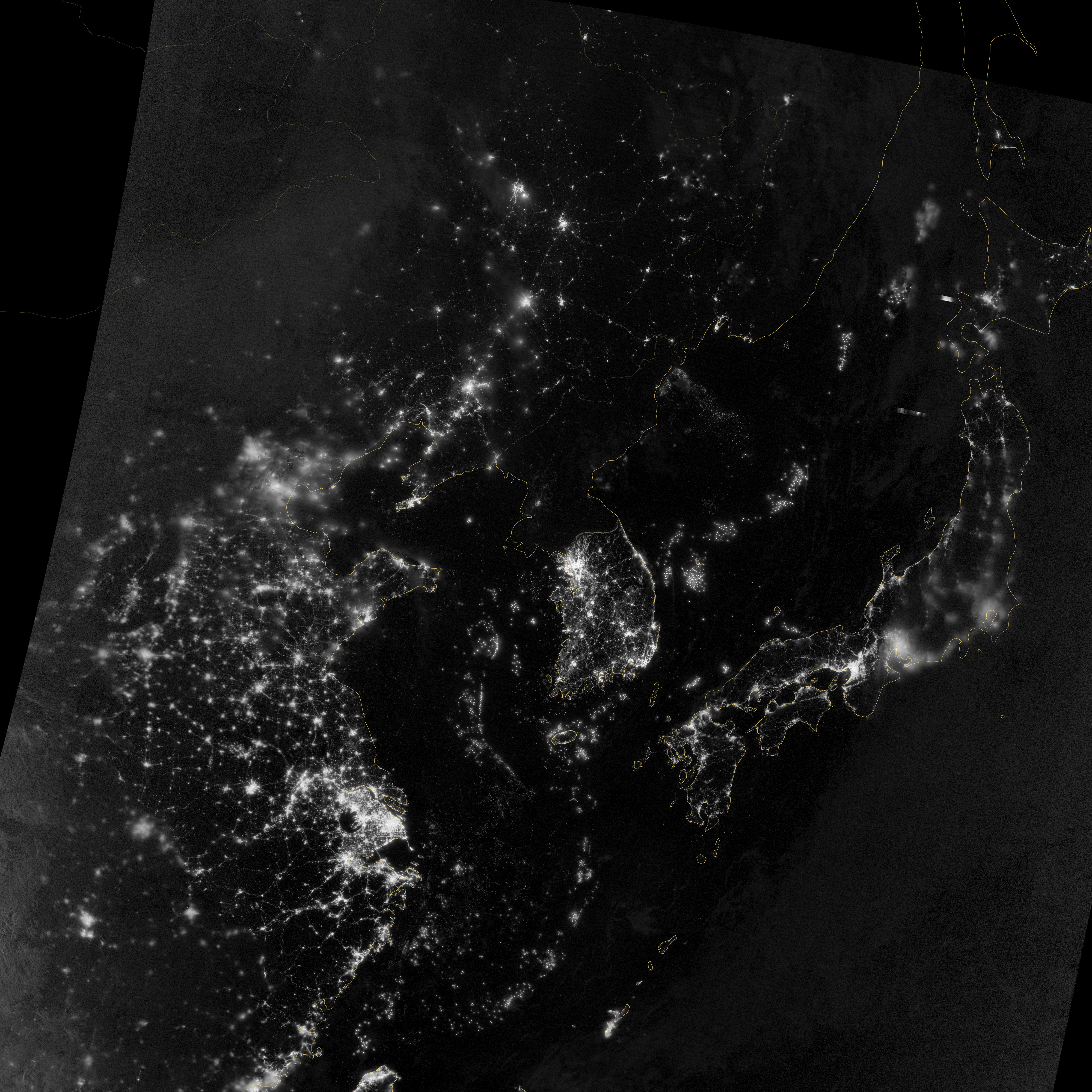
City lights at night are a fairly reliable indicator of where people live. But this isn’t always the case, and the Korean Peninsula shows why. As of July 2012, South Korea’s population was estimated at roughly 49 million people, and North Korea’s population was estimated at about half that number. But where South Korea is gleaming with city lights, North Korea has hardly any lights at all—just a faint glimmer around Pyongyang.
On September 24, 2012, the Visible Infrared Imaging Radiometer Suite (VIIRS) on the Suomi NPP satellite captured this nighttime view of the Korean Peninsula. This imagery is from the VIIRS “day-night band,” which detects light in a range of wavelengths from green to near-infrared and uses filtering techniques to observe signals such as gas flares, auroras, wildfires, city lights, and reflected moonlight.
The wide-area image shows the Korean Peninsula, parts of China and Japan, the Yellow Sea, and the Sea of Japan. The white inset box encloses an area showing ship lights in the Yellow Sea. Many of the ships form a line, as if assembling along a watery border.
Following the 1953 armistice ending the Korean War, per-capita income in South Korea rose to about 17 times the per-capital income level of North Korea, according to the U.S. Central Intelligence Agency. Worldwide, South Korea ranks 12th in electricity production, and 10th in electricity consumption, per 2011 estimates. North Korea ranks 71st in electricity production, and 73rd in electricity consumption, per 2009 estimates.
The Daily NK reports that coal prices in the DPRK have surged this winter (150,000w/ton in 2011 vs. 300,000w/ton in 2012) . They also report the price in hard currency:
At the time of writing, this coal can be bought at source for $150-$200 per ton. Wholesalers then sell it on in regional centers like Chongjin for up to $300. However, according to Daily NK’s source, “They even say that $300 leaves them with little profit, given the cost of transportation.”
The Daily NK gives the following reasons for the price increase:
1. Inflation (2011-11 exchange rate with USD was between 2,9oow – 5,000w. 2012-11 exchange rate 4,000-8,000w)
2. Decreased supply from exhausted mines
3. Exports to China (According to statistics published by the Korean Trade Association in late 2011, coal exports from North Korea to China in the nine months to September that year were worth USD$830 million, double the 2010)
If we had the economic data it would be a fairly straightforward regression to determine the contributions of each of these variables on the price of coal. But we do not have the data.
Read the full article here:
Coal Prices Fuelling Chilly Times Daily NK
Choi Song Min
2012-12-5