Archive for the ‘Hwanggumphyong and Wihwado Economic Zones (Sinuiju)’ Category

38 North highlights

Thursday, March 1st, 2012

I have been pretty busy lately so blog posts have taken a hit.  I am mostly caught up now, but there were several 38 North publications released in February that I wanted to highlight:

Is North Korea Opening? What Might That Mean?
Aidan Foster-Carter
38 North
2012-2-29

Dealing with the Kims
38 North
Joel Witt and Jenny Town
2012-2-24

China’s Embrace of North Korea: The Curious Case of the Hwanggumpyong Island Economic Zone
38 North
2012-2-19

Share

New DPRK restaurant opens in Dandong

Friday, February 17th, 2012

According to the Daily NK:

The largest of a collection of overseas restaurants run by the North Korean authorities,‘Pyongyang Koryogwan’ opened for business in Dandong, China on Thursday. An opening ceremony was held in front of the restaurant, which is located at the entrance to Dandong’s development zone.

The ribbon-cutting, which lasted for 30 minutes beginning at 9:30AM, included North Korean and local Chinese government officials, the restaurant management team and more than 50 female staff members, over 100 people in total. Staff must have been freezing after spending the whole time in Korean traditional dress despite sub-zero temperatures.

The restaurant is staffed by more than 200 workers from North Korea, 120 of whom are general staff, with the remainder working in the kitchens or on administrative tasks. The menu is mostly a collection of different sets, with the cheapest item being cold noodles at around USD$4.75.

Read the full story here:
Dandong Opening for New NK Restaurant
Daily NK
Choi Cheong Ho
2012-02-17

Share

Daewoo Shipbuilding [not] to invest in DPRK SEZ

Friday, February 10th, 2012

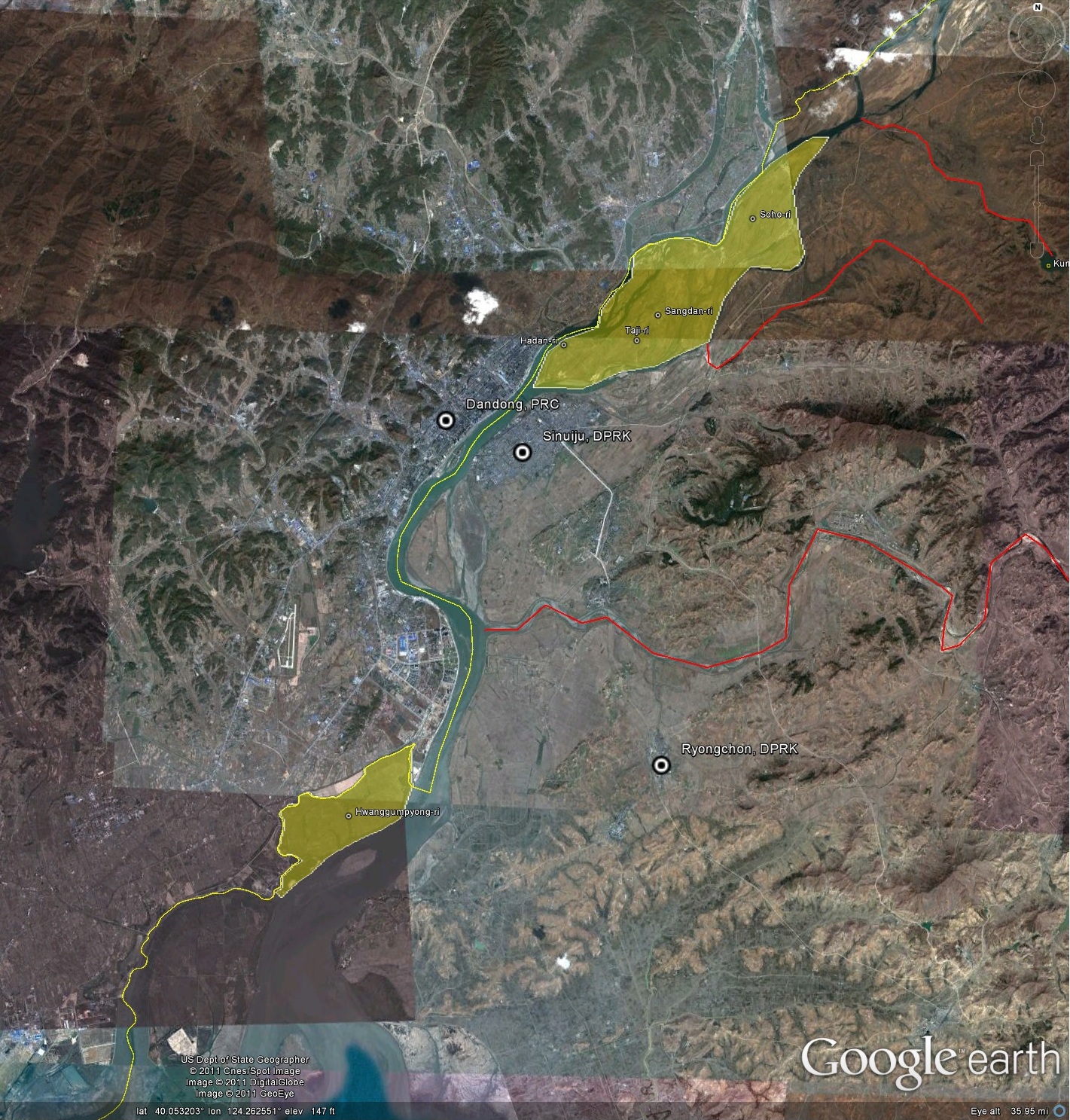
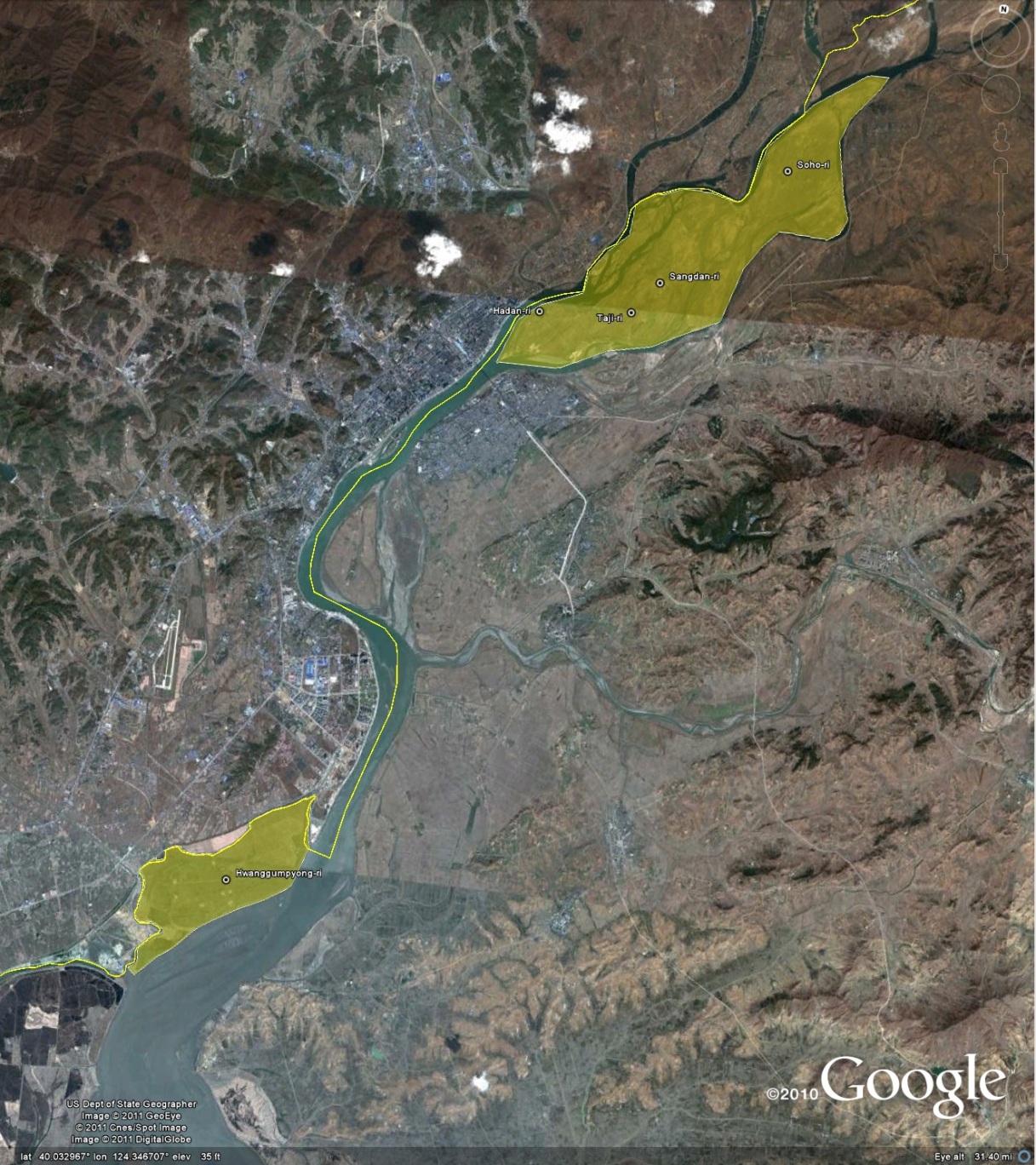
Pictured Above (Google Earth): The Hwanggumphyong and Wiwha Island SEZ on the Yalu/Amnok River which separates the DPRK and PRC.

On Friday, the Donga Ilbo reported that Daewoo Shipbuilding was going to invest in the DPRK’s Hwanggumphyong SEZ (see the original post below).  Today the report appears to be incorrect. According to the Wall Street Journal:

Daewoo Shipbuilding & Marine Engineering Co. on Monday shot down news reports that it had agreed to build a shipyard in North Korea.

“We don’t have any plans to do that,” a spokesman said.

According to some South Korean news accounts over the weekend, the company, which is the world’s second-largest builder of ships and whose controlling stake is owned by the South Korean government, had agreed to help a Chinese company develop an island off North Korea’s northwest coast, near the Chinese city of Dandong.

The DSME spokesman said the company held discussions with the Chinese company but isn’t close to an agreement.

The news accounts said DSME would build a shipyard that would be devoted to repair work. One report said the idea would be presented to DSME’s directors and announced in April.

The company spokesman said it’s unclear how the accounts originated.

See the original report bleow:

(more…)

Share

Preciseness emphasized for the tax investigation of special economic zones

Monday, January 23rd, 2012

Institute for Far Eastern Studies (IFES)
2012-1-18

North Korea is continuing to put forward new laws for the special economic zones (SEZs) such as Rajin-Sonbong and Hwangumpyong Island. Recently, North Korea announced special guidelines for the tax investigations of foreign businesses in the zones.

North Korea’s Academy of Social Science Newsletter Volume 4 (published on November 2011) released an article titled, “Suggestions to Improve Tax Investigations in the Special Economic Zone,” which included detailed instructions for the policy improvement for tax investigation for SEZs. Here, particular emphasis was placed on the enhancement of the tax investigation system — to be accurate and rational — for the foreign investment companies.

The article explained, “Based on the principles of equality and reciprocity for the construction of powerful economic state, the tax investigation system in the SEZ must be improved especially at the present time when SEZs are being constructed and expanded to increase economic trade with other nations.”

It also stressed tax officials must be equipped with, “comprehensive knowledge and experience who accurately understand the entire process of business management. They must be capable of creating new tax investigation methods and be able to discern the various forms of tax evasions.”

For the qualifications of the tax officials, the article recommended that the officials be selected based on their knowledge and experience; ability to develop techniques for tax investigation; awareness of rules and regulations of tax laws and bylaws, and regulations of rights and responsibilities of taxpayers; and capability of conducting research on foreign tax investigation policies.

The Academy of Social Science is a government agency of the DPRK, and the recent article on the tax investigation reflects that the government has already begun the process of implementing the tax investigation guidelines and laws in the SEZs.

The article emphasized establishing a tax investigation system acceptable to foreign companies. One can construe this as North Korea’s effort to attract more businesses to the SEZ, which is currently suffering from poor performance.

In addition, North Korea is believed to be placing weight on the tax investigation based on its past experiences with the South Korean companies in the Kaesong Industrial Complex (KIC). In the past, the officials of the Central SpecialDirect General Bureau toured the industrial districts in China and showed keen interests in the tax management.

On December 8, 2011, the KCNA reported that the Standing Committee of the Supreme People’s Assembly (SPA) has adopted the Economic Zone Act for Hwanggumpyong and Wihwa Islands. The law was revised and supplemented to include the Free Economic and Trade Act of Rajin-Sonbong. However, the details of these laws were not disclosed and some experts are predicting that these laws are likely identical to the Chinese laws in China’s flourishing SEZs.

However, on January 11, 2012, Yonhap News Agency of South Korea reported that China rejected the new Special Economic Zone Act of the DPRK because it is “not business-friendly.” The news reported, “China said the law was not business-friendly, telling North Korea that the law had some problemsregarding taxes, accounting, remittance of profits and stability of investment.” It is reported that North Korea is working on the revision of these laws and likely for a new special zone act to be passed by the Standing Committee of the DPRK’s Supreme People’s Assembly (SPA).

Share

SEZ Law Enacted by Supreme Assembly

Friday, December 9th, 2011

Pictured Above (Google Earth): The Hwanggumphyong and Wiwha Island SEZ on the Yalu/Amnok River which separates the DPRK and PRC.

UPDATE 1 (2012-3-19): Read the laws governing the SEZs here.

ORIGINAL POST (2011-12-9): According to the Daily NK:

North Korea has enacted a law governing activities at Hwanggeumpyeong and on Wihwa Island, two new special economic zones in the vicinity of Shinuiju on the Sino-North Korean border.

Chosun Central News Agency revealed the news this morning, stating, “The Hwanggeumpyeong-Wihwa Island Economic Zone Act was adopted by the Standing Committee of the Supreme People’s Assembly of the Chosun People’s Democratic Republic.” It did not offer any further details.

The provisions of the new law are reported to have been circulated to various Chinese governmental and economic figures, and it is said to contain provisions reflecting successful elements in the development of China’s own special economic zones.

Naturally, one key part of the intent behind the new law’s enactment appears to be to reassure potential Chinese investors of the stability of the investment climate in North Korea.

At this stage, although there was a large opening ceremony for the zone in June this year attended by Workers’ Party figures including Jang Sung Taek, who plays a key role in the attraction of overseas investment to North Korea, the pace of construction remains limited.

However, there may not be long to wait. Dai Yulin, who heads the Municipal Committtee of the Chinese Communist Party across the Yalu River in Dandong told the China Daily back in September, “Concrete plans for the development of the Hwanggeumpyeong Special Economic Zone will be completed by the end of this year.”

Read the full story here:
SEZ Law Enacted by Supreme Assembly
Daily NK
Kim Tae Hong
2011-12-9

Share

DPRK establishes “HGP” and Wihwa SEZ bureau

Wednesday, November 2nd, 2011

Pictured Above (Google Earth): The new PRC/DPRK economic zone: Hwanggumphyong-ri (“HGP” in Sindo County) and Wihwa Island (Sinuiju and Uiju Counties).  See islands in Google Maps here and here.

According to Yonhap:

North Korea has opened a bureau tasked with running a free trade zone near its border with China, a source familiar with the country said Wednesday, indicating the North’s continued efforts to revive its forlorn economy.

The move came shortly after North Korea and China agreed to create joint economic complexes on the border islands of Hwanggumpyong [HGP] and Wihwa following a summit between their leaders in May.

“North Korea has opened a bureau with some 10 staff members on Hwanggumpyong,” the source said, asking for anonymity. “It opened around August or September.”

The staff includes a ranking official who was in charge of operating the Kaesong industrial complex near the western border with South Korea in the early 2000s, the source said, a sign that the North may want to develop Hwanggumpyong in a similar way to Kaesong.

The inter-Korean industrial park in Kaesong combines South Korea’s capital and technology with cheap labor from the North. More than 47,000 North Koreans work at about 120 South Korean firms operating in the zone to produce clothes, utensils, watches and other goods.

In a related move, North Korea has added two more vice chairmen to a state-run investment committee charged with attracting foreign investment, the source said. The committee, which was launched in July last year, is known to be under the control of Jang Song-thaek, brother-in-law of North Korean leader Kim Jong-il and vice chairman of the North’s powerful National Defense Commission.

North Korea is seeking to boost economic cooperation with China, its closest political and economic ally, as Pyongyang struggles to achieve its stated goal of becoming a prosperous country by 2012.

Read previous posts on Hwanggumphyong (HGP) and Sinuiju here.

Read the full story here:
N. Korea opens bureau to run free trade zone with China: source
Yonhap
2011-11-2

Share

Plans for SEZ between China and the DPRK to Come Out at Year’s End

Thursday, October 13th, 2011

Institute for Far Eastern Studies (IFES)
2011-10-5

Dai Yulin, secretary of the Dandong Committee of the Communist Party of China, said in his interview with the China Daily on September 28 that concrete plans for the joint development projects between China and North Korea in the Hwanggumpyong and Rajin-Sonbong regions will be announced at the end of the year.

This past June, Dai stated both countries agreement to jointly develop Hwanggumpyong and Rajin-Sonbong as an economic development zone and reported smooth progress in its plans.

According to Secretary Dai, “The joint management committee between China and North Korea has already been formed to promote the Hamggumpyong development project. Both countries are getting up steam to advance the project.”

In addition Dai explained, “China has secured 10 square kilometers of national land to be used to support the joint development of Hamggumpyong.” He also added, “A think tank comprised of 72 experts was also established to advise and buttress the project.”

When DPRK Cabinet Premier Choe Yong Rim visited China last month, Dai commented, “Choe’s visit to China is underlined with North Korea’s strong interest in economic reform. All the high level officials in the economic sectors accompanied him on the trip.”

While visiting China for five days, Choe met with Premier Wen Jiabao and expressed strong motivation for strengthening trade and cooperation with China, especially to improve its infrastructure. He stated, “For those Chinese companies investing in North Korea, we will provide special accommodations to encourage more investments.” In response, Wen Jiabao commented, “China will do all it can to support North Korea, so that they may seek development method most appropriate for them.”

After the meeting between the two top officials, the two nations came to an agreement to cooperate in trade, investment, and infrastructure, resources and agriculture development.

Prior to meeting with Wen, Choe visited Lanxing Chemical Industrial Machine Co. After he paid his courtesy visit to President Hu Jintao of China in Beijing, he continued to make economic related visits to Baoshan Steel Group, Bailian Xijiao Goods Purchasing Center, and industrial facilities in Jiangsu Province.

After North Korea designated Hwanggumpyong Island as a free trade zone, China has signed a 50 year-lease agreement to develop the island. Despite being a “joint development” in name, in actuality, China has the exclusive development rights based on Chinese capital.

However, North Korea is requesting for revision of the name to “co-development between China and the DPRK,” a request that China is expressing some uneasiness over. The initial agreement was to “lease Hwanggumpyong Islands to China,” which gave exclusive and autonomous development and management rights to China in the zone.

China has articulated on many occasions the Hwanggumpyong project must be strictly based on market principles and expressed apprehension that Chinese businesses may be unwilling to invest in the area if North Korea continues to pursue to change it as a joint development.

Share

Chinese foreign ministry publication frank on Rason and Hwanggumphyong

Wednesday, August 31st, 2011

The Choson Ilbo reports:

The World’s Knowledge biweekly published by World Knowledge Publishing House under the [Chinese] Foreign Ministry supervision dismissed the North Korean plan to build what it called “its own Hong Kong.” In its latest edition, Tang Longwen, an associate professor at the Dandong party school, said, “The North’s plan to develop the two islands by leasing them to Chinese enterprises costs too much.”

Chinese businesses “need to check if it is worth making huge investment in areas that neither have abundant resources nor are worth developing,” Tang wrote.

Tang also mentioned risks from the lack of proper governance in North Korea. Citing the joint Korean Kaesong Industrial Complex as an example, he said, “What is important is not the development of the two islands but whether the North genuinely intends to open its doors. Everybody worries that the North will just open and close the islands as it likes.”

He cited the North’s habitual disregard for international norms, apparently referring to its unilateral abrogation of its contract with Hyundai Asan in the Mt. Kumgang package tour project and repeated bans on passage to the Kaesong industrial park.

“The North is calling for simultaneous development of the Rajin-Sonbong area and Hwanggumpyong, but China is more interested in the Rajin-Sonbong area, which would give it access” to the East Sea, he said. As Chinese President Hu Jintao said during Kim’s visit to China in May, “the two countries should seek ‘win-win’ economic cooperation. It should not be sought through one-sided aid.”

On three visits to China between May last year to May this year, Kim asked China to support the development of Wihwa and Hwanggumpyong islands, but Beijing told him cooperation “should be sought based on market principles.”

Chinese officials attended a ground-breaking ceremony on Hwanggumpyong at the North’s request in June, but there has reportedly been no progress in construction since then.

A recent in the Financial Times article quotes another Chinese academic who expresses some skepticism about the success of the new ventures:

North Korea’s past experience of working with other countries has left it with a serious credibility problem and this will stop a lot of foreign investment from even considering these new zones,” says Zhang Liangui, a professor of international strategic research at China’s central Communist party school.

Mr Zhang graduated from the Kim Il-sung University in North Korea and is considered one of China’s top experts on the country. “Even though Chinese entrepreneurs are being encouraged and supported by China to invest there, they are still very cautious about considering the Hwanggumphyong Island Economic Zone, and investors from other countries will be even more circumspect,” he explains.

“It will be very difficult to build this zone up,” he adds, citing the unpredictability of the political situation in North Korea and UN sanctions which would prevent many investors from considering the venture.

In addition, analysts warn that similar moves in the past have led to nothing. The Rason zone that Chinese and North Korean officials broke ground on in June will incorporate an area that was designated as an investment zone in the early 1990s but never attracted any real interest.

Previous posts on Hwanggumphyong here.

Previous posts on Rason here.

Read the full story here:
Chinese Magazine Dismisses N.Korean Development Dreams
Choson Ilbo
2011-8-31

Share

Economic performance and legitimacy in the DPRK

Sunday, August 28th, 2011

Geoffrey See and Andray Abrahamian (both representatives of Choson Exchange) wrote an article in the Harvard International Review which asserts that economic successes are becoming more important to the political narratives that reinforce the DPRK leadership’s claims to legitimacy. Below is an excerpt from their article:

North Korea’s most important domestic policy statement comes each New Year, when the major newspapers publish a joint editorial. The editorial often signals where government priorities will be in the coming year. In 2010 the newspapers spoke of “Bring[ing] about a decisive change in the people’s lives by accelerating once again light industry and agriculture.” Similar themes were echoed in 2011. This is opposed to the joint editorials of the past few years, which have focused on the more traditional themes of military strength, revolution, and socialism.

Another public sign of a shift towards focusing on economic issues is the type of official visits and inspections carried out by Kim Jong Il. Following in the footsteps of his father, Kim uses these visits to signal emphasis or encouragement of specific industries, activities, and policies. According to a report by the Institute for Far Eastern Studies, the first six months of 2011 have seen Kim exceptionally busy, participating in 63 official activities. Unlike previous years, however, the number of military visitations has dropped off: only 14 visits were military related, the lowest number ever recorded. By contrast, 28 visits were economic related.

In terms of policy, North Korea has been haltingly experimenting with Special Economic Zones (SEZ) since the mid-nineties, but has recently built a bit more momentum in this area. Rason, an SEZ in the far northeast, is finally seeing some basic infrastructure upgrades that were long talked about but always delayed. Government investment bodies have started to promote the idea that Rason will be the “next Singapore,” an ambitious marketing claim to anyone who has been to Rason. With both Russia and China leasing port space, it seems more likely to be transformed into a regional transportation hub. Meanwhile, along the Chinese border in the northwest, the Hwanggumpyong SEZ recently held a groundbreaking ceremony, attended by high-ranking North Korean officials and Wang Qishan, China’s commerce minister.

Senior politicians in North Korea are increasingly judged by their ability to bring in foreign direct investments. These efforts appear to be competitive rather than coordinated. North Korean leaders associated with the National Defense Commission, the highest level policy body, have been meeting with visiting foreign investors. In 2009, the Daepung International Investment Group was re-purposed along the lines of a holding company model as a vehicle for attracting foreign direct investment l with “27 joint ventures planned and to be managed by the Group.” Daepung Group is backed by specific high-level individuals. Jon Il-Chun, reportedly the Director of Office 39, a murky international trade and finance organ, is definitely involved with the Daepung Group. Media reports also indicate that Kim Yang Gon, Director of an organization tasked with managing contacts with South Korea, the United Front Department of the Workers’ Party, is also behind the group.

In July of the same year, the Joint Venture & Investment Commission (JVIC) was established. Instead of a holding company model, JVIC is a government institution modeled as a “one-stop shop” for investors – that is, JVIC is meant to “seek out investments and assist investors in setting up operations in North Korea.” While multiple institutions claiming to hold such authority have always existed in North Korea, many of these institutions have been merged into JVIC and long-time investors have been directed to liaise with JVIC as their primary government contact. JVIC’s nominal and public head is Ri Chol, a high-ranking North Korean government official.

In August of 2010, we received credible reports that foreign investors were approached to help set up a group similar to Daepung that would be backed by another member of the National Defense Commission. Given this proposed initiative’s similarities to Daepung, the prior establishment of JVIC, and that all three groups do not appear to communicate with each other, we surmise that these various groups have a competitive relationship with the support of different patrons. Investment officials with whom our teammates have met confirm that the relationship between the agencies is “very competitive.” If this is the case, it is a signal that influential groups in Pyongyang sense that future power bases will require the ability to attract and deploy capital.

The full article is worth reading here:
Harvard International Review
Geoffrey K. See and Andray Abrahamian
August 23, 2011

Share

Lankov pessimistic on the DPRKs SEZs

Thursday, July 14th, 2011

Pictured above (Google Earth) is the electrified fence around the Rason special economic zone.

Lankov writes in the East Asia Forum:

SEZs are acceptable to the North Korean government because they are relatively easy to control. North Korean SEZs have been fenced off with barbed wire and all visitors have had their IDs carefully studied at checkpoints.

The North Korean government obviously hopes that small areas of controlled capitalism will generate enough income to make a difference — or at least to keep afloat the long-decaying economy.

Similar SEZs with China to those recently declared have been attempted before. At Raseon a major problem was its isolated location and underdeveloped transport infrastructure, even by meagre North Korean standards. At Sinuiju there were numerous problems. One was North Korea’s choice of the Chinese entrepreneur Yang Bin to lead the project as he wanted to transform the city into a gambling centre, a Macau of the North. This was not welcomed by the Chinese government. Also, it did not help that the North Koreans, following their modus operandi, did not bother to liaise with the Chinese beforehand.

The success of KIZ might seem encouraging, but it is actually a very special case. It is viable because the South Korean government is willing to go to great lengths to support it. It has subsidised industrial development and has provided adventurous developers and companies with generous subsidies and guarantees that made the entire undertaking possible. This willingness is driven by a multitude of political considerations. Frankly, it is doubtful whether the Chinese side would be equally interested in subsidising a similar undertaking by Chinese companies in Sinuiju.

What will happen to these two planned new SEZs? The fate of Raseon seems pretty certain. Available evidence indicates it is largely about transportation links. Chinese Manchuria is landlocked, so Chinese companies will save a small fortune on transportation costs if they are given access to a seaport on the Eastern coast of the Korean Peninsula. If this is what happens in Raseon, it has a relatively bright future.

The future of the Hwanggumpyong SEZ is far less certain. Obviously Chinese businesses want to do there what their South Korean counterparts did in Kaesong, take advantage of low labour costs in North Korea. Even though Chinese labour is cheap, North Korean labour is much cheaper still, since US$15-20 a month would be seen by the average North Korean worker as a good wage. For the same labour, they would have to pay a Chinese worker between US$100 and US$150 a month.

But that said, the business reputation of North Korean managers leaves much to be desired. They are likely to intervene in operations − partially as a way to extort bribes, but largely because they will worry about excessive exposure of their population to dangerous Chinese influences. South Korean businesses in Kaesong accept such interference, but they are backed by the South Korean government. It remains to be seen whether the same situation will develop in a Chinese-led zone.

Previous posts on the Sinuiju (including Waudo and Hwangumphyong) can be fond here.

Previous posts on Rason (Rajin-Sonbong) can be found here.

Read the full story here:
North Korea-China special economic zones
East Asia Forum
Andrei Lankov
2011-7-14

Share

An affiliate of 38 North