Archive for the ‘Special Economic Zones (Established before 2013)’ Category

Download glitch fixed: North Korea Google Earth (version 11)

Thursday, August 14th, 2008

The most authoritative map of North Korea on Google Earth
Download it here

This map covers North Korea’s agriculture, aviation, cultural locations, markets, manufacturing facilities, railroad, energy infrastructure, politics, sports venues, military establishments, religious facilities, leisure destinations, and national parks. It is continually expanding and undergoing revisions. This is the eleventh version.

Additions include: Mt. Paegun’s Ryonghung Temple and resort homes, Pyongyang’s Chongryu Restaurant, Swiss Development Agency (former UNDP office), Iranian Embassy, White Tiger Art Studio, KITC Store, Kumgangsan Store, Pyongyang Fried Chicken Restaurant, Kilju’s Pulp Factory (Paper), Kim Chaek Steel Mill, Chongjin Munitions Factory, Poogin Coal Mine, Ryongwun-ri cooperative farm, Thonggun Pavilion (Uiju), Chinju Temple (Yongbyon), Kim il Sung Revolutionary Museum (Pyongsong), Hamhung Zoo, Rajin electrified perimeter fence, Pyongsong market (North Korea’s largest), Sakju Recreation Center, Hoeryong Maternity Hospital, Sariwon Suwon reservoir (alleged site of US massacre), Sinpyong Resting Place, 700 Ridges Pavilion, Academy of Science, Hamhung Museum of the Revolutionary Activities of Comrade Kim Il Sung, South Hamgyong House of Culture, Hamhung Royal Villa, Pork Chop Hill, and Pyongyang’s Olympic torch route. Additional thanks go to Martyn Williams for expanding the electricity grid, particularly in Samjiyon, and various others who have contributed time improving this project since its launch.

Disclaimer: I cannot vouch for the authenticity of many locations since I have not seen or been to them, but great efforts have been made to check for authenticity. These efforts include pouring over books, maps, conducting interviews, and keeping up with other peoples’ discoveries. In many cases, I have posted sources, though not for all. This is a thorough compilation of lots of material, but I will leave it up to the reader to make up their own minds as to what they see. I cannot catch everything and I welcome contributions.  Additionally, this file is getting large and may take some time to load.

Share

Hyundai Asan pays DPRK for July tourism

Tuesday, August 12th, 2008

Excerpt from the Choson Ilbo:

Asan said Thursday it paid US$675,250 to North Korea to cover costs accrued by 10,380 South Korean tourists who visited the mountain resort on July 1-11, until the tours halted after a South Korean tourist was shot and killed by a North Korean soldier at Mt. Kumgang.

Asan sends the payment at the end of each month, at the rate of $30 per person for a one day tour, $48 for two days or $80 for three days. Later this month, Asan will pay a further $928,560 to the North to cover the cost of trips to another tourist destination, Kaesong City. The cumulative payments Asan made to the North for the first six months of the year amounts to $10.7 million for the Mt. Kumgang tour, and $5.1 million for the Kaesong tour.

Read the full story here:
Asan Pays N.Korea for July Tours
Choson Ilbo
08/08/08

Share

Rajin SEZ electrified perimeter on Google Earth

Friday, July 25th, 2008

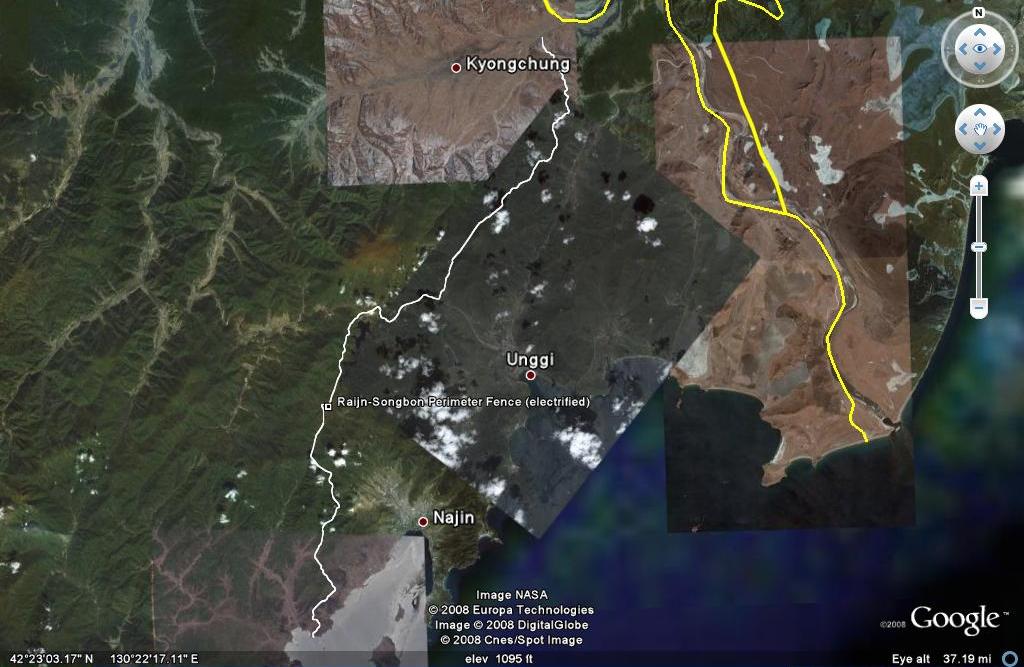
According to Lankov and Kim’s “North Korean Market Vendors: The Rise of Grassroots Capitalists in a Post-Stalinist Society” there is an electrified perimeter fence surrounding North Korea’s first  “special economic zone,” Rajin Songbon.

I have spent a lot of time looking at this area on Google Earth, but never seen the electrified fence.  Last night, however, I found it.  Before reading Lankov’s article, I thought it was a highway, or highway construction, on account of its approximate 35 mile/56 km length (as calculated using the Google Earth ruler).  The image of the perimeter (shown below) will be added, along with a few other new locations, to the next version of North Korea Uncovered (due in early August).

raijinperimeterfence.JPG

Click on image for larger version

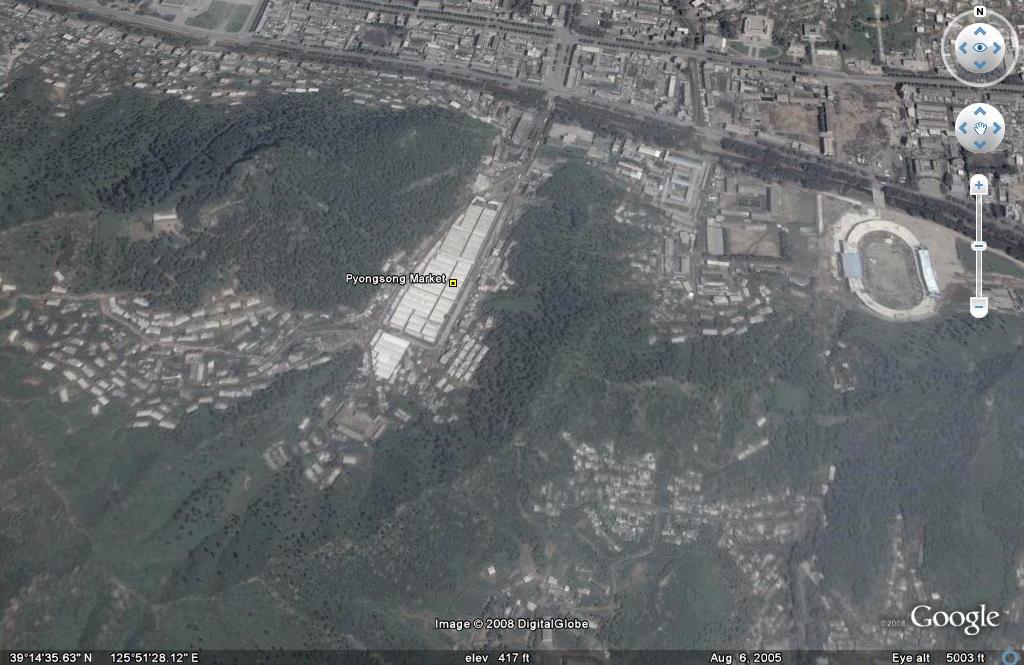
And in case you missed it, Lankov’s article mentions North Korea’s largest market in Pyongsong.  Satellite imagery of this location is below.

 pyongsongmarket.JPG
Click on image for larger view


Share

Russia-DPRK economic relations

Thursday, July 24th, 2008

From Dr. Leonid Petrov in the Asia Times:

Russia cooperation with North Korea
Since the early 2000s, overall relations between Russia and the DPRK have been improving. The DPRK’s importation of refined oil from Russia saw its first increase in 2002-2003 (from $20 million to $96 million) and was caused by the beginning of the US-DPRK nuclear confrontation and the subsequent demise of the international Korean Peninsula Energy Development Organization project that was to construct a light water reactor nuclear power plant in North Korea.

During 2004-2005, petroleum trade between Russia and North Korea grew from $105 million to $172.3 million. Until the six-party talks produced their first results, in the list of Russia’s exports to the DPRK, oil products dominated at 63%. Rampant corruption in both countries also let a trickle of Russian oil to be smuggled to North Korea unaccounted for.

In 2006, Russia was the DPRK’s third-largest trading partner after China and South Korea and absorbed 9% of the total $3.18 billion spent by the North on imports (approximately $286 million). The Kremlin’s approval of international sanctions against the former communist ally was accompanied by the curtailment of trade with the North. At the time of North Korea’s nuclear test in October 2006, Russia’s trade statistics showed that exports of petroleum had dropped 91.1% compared to the same period of the previous year.

The pragmatic mood in bilateral relations prevails, and these days Russia delivers oil and food to North Korea only in accordance with its obligations associated with progress at the six-party talks. This year, Russia has already delivered 100,000 tonnes of fuel oil to the DPRK in two batches and, according to Russian Deputy Foreign Minister Alexei Borodavkin, a top Russian envoy to the six-party talks, will deliver another 100,000 tonnes by October 2008. In June, the Russian government announced it would provide 2,860 tonnes of flour to the DPRK. According to an official KCNA news agency report, this food aid arrived at the border city of Sinuiju in the DPRK’s northern Pyongan province in early July.

Recently, for the first time in the post-Soviet era, North Korea saw a major Russian investment. In the city of Pyeongseong, the Russian auto plant KamAZ opened its first assembly line, specializing in the production of medium-size trucks named “Taebaeksan-96”. Although less than 50 trucks were assembled in 2007, this cooperation became an important milestone in the development of bilateral relations. While the project doesn’t violate United Nations sanctions on North Korea, it shows Moscow’s drive to expand its influence in the country. Ironically, the more trucks assembled the heavier North Korea’s dependence on imported fuel, engine oils and other petrochemical products.

The importance of the DPRK’s Rajin-Seonbong special economic zone to Russia’s national interests continues to grow. The state-run monopoly OAO Russian Railways is currently upgrading its railway connections with North Korea in Khasan-Tumangang, investing at least 1.75 billion roubles (US$72 million) into this project, and plans to participate in an ambitious plan to rebuild a trans-Korean railway. By connecting Rajin (and the rest of northern Korea) to its Trans-Siberian railroad, Russia hopes to benefit form the transit of South Korean and Japanese cargo which could be sent via its territory to Central Asian and European markets. Pyongyang seems to endorse these plans and other Russian initiatives, but does not commit any financial resources.

Eighty percent of overall bilateral economic trade between Russia and North Korea consists of cooperation, barter and investment-in-kind between the regional areas. The most active Russian regions trading with the DPRK are Eastern Siberia and the Far East. Maritime province (Primorsky Krai) itself exports to North Korea more than $4 million worth of refined oil per year. There are no oil fields in Maritime province and oil has to be borrowed through a chain of federal bureaucratic structures from the oil-rich areas of Eastern Siberia. Instead of money, the local governments agree to receive the labor of North Korean workers.

North Korean laborers in Siberia and the Far East were common under the Soviet system and they are still visibly present. In 2004, the Russian Federal Immigration Service issued 14,000 visas for foreign laborers, of whom North Koreans numbered 3,320 in 2005 and 5,000 in 2006. Since the DPRK has no other way to pay in goods or services, its government started paying for oil imported from Russia by dispatching thousands of laborers at zero cost. Following strong demand from local companies, just in 2006 regional authorities of Primorsky Krai agreed to issue an extra 5,000 working visas to North Koreans. This openness is contrary to local government policy that normally restricts the entry of labor from China.

DPRK citizens are sent to Russia to work as woodcutters and builders but some have also managed to find work in the agricultural and marine industry. Through the presence of these laborers, Russia has enjoyed a partial repayment of the DPRK’s post-Soviet debt through North Korean workers being contracted to work in mines and lumber mills in Russia’s Far East.

The wages they are able to make in Russia are far greater than what they would make at home. However, the foreign worker quota is set not by provincial governments but by Moscow, which often tries to put a stop to these programs due to the complexity of the matter. Part of this opposition stems from the fact that the North Korean workers in Russia still fall under DPRK laws and, therefore, are subject to intrusive supervision.

Among the most difficult but negotiable issues in the way of Russia-North Korea cooperation remains the problem of external debt. During the Soviet era, the DPRK incurred a debt of approximately $8 billion, which Pyongyang still owes to Moscow but cannot repay. This debt remains a stumbling block in most negotiations on new aid and development programs. However, this debt can potentially make trilateral Russian-Korean relations closer and stronger.

In January 1991, soon after the opening of diplomatic relations with South Korea, Moscow received $3 billion from Seoul in the form of a three-year loan. The collapse of the Soviet Union left this loan largely unpaid. The new Russian government in the 1990s provided South Korea with armaments worth $150 million to be counted as payment in kind for the remaining debt. In 2003, after bilateral negotiations on this issue were completed, part of this Russian debt was canceled and the remainder was rescheduled to be paid over the next 23 years.

Taking into account its own debts to the South, Russia could easily write off a significant portion of North Korean debt. To resolve this question, a certain agreement between all three parties is needed. To engage in a mutual and reciprocal round of debt cancelation, Russia might choose to see the North and the South as one country. Such an agreement would have unblocked the road for broader cooperation between Russia and the two Koreas, and simplified Russia’s energy cooperation with China and Japan.

The full article is worth reading here:
Russia is key to North Korea’s plight
Asia Times
Leonid Petrov
7/24/2008

Share

(UPDATED) South Korean tourist fatally shot at Kumgang

Monday, July 21st, 2008

UPDATE 13-August 28:   Yoon Man-jun stepped down as CEO of Hyundai Asan over the July 11 killing of the 53-year-old South Korean woman by a North Korean soldier at the North’s Diamond Mountain resort, the company said in a statement. The company quoted Yoon as saying that he wanted to take “moral responsibility” for the death. (ETN news)

UPDATE 12-August 8: Despite bringing a halt to tourism in Kumgangsan, South Korea sent arrears to the DPRK.  From the Choson Ilbo:

Despite stalemate over the shooting death of a South Korean tourist at North Korea’s Mt. Kumgang, tour operator Hyundai Asan made its July payment for tours to North Korea.

Asan said Thursday it paid US$675,250 to North Korea to cover costs accrued by 10,380 South Korean tourists who visited the mountain resort on July 1-11, until the tours halted after a South Korean tourist was shot and killed by a North Korean soldier at Mt. Kumgang.

Update 11-August 8: DPRK to expel all remaining ROKs from Kumgnag starting August 10.   

UPDATE 10-Auguts 4: KCNA issues statement. 

UPATE 9-August 3: Though no date was given, North Korea intends to expell most remaining South Koreans from Kumgang (Yonhap):

North Korea’s official media said earlier in the day that Pyongyang will expel all “unnecessary” South Korean personnel from the Mount Geumgang resort, where a South Korean tourist was shot dead by a North Korean soldier last month.

More than 260 South Korean workers are stationed at the scenic resort, according to Hyundai Asan, the South Korean tour organizer. 

UPDATE 8-July 26: North Korea succeeds in preventing shooting concerns from being mentioned in official summary of ASEAN meeting.

UPDATE 7- July 23: South Korean government prevents South Korean civic groups from visiting DPRK until the North’s government agrees to participate in shoting investigation. (Donga Ilbo) 

As of Tuesday, six organizations had been offered invitations to visit the DPRK (Donga Ilbo):

One hundred members of the Korean Teachers and Educational Workers’ Union applied for permits to visit North Korea during August. In addition, 120 South Gyeongsang Province officials including Governor Kim Tae-ho are reportedly planning to visit the regime.

Humanitarian organizations such as Good Neighbors International, Nanum International and the Korean Sharing Movement will reportedly send 40-150 delegates to the North in August (for the former two) and September. In addition, North Korean officials invited around 120 members of Peace Three Thousand, and the representatives of the two will meet in Gaesong on Saturday to discuss the invitation.

These organizations [would] stay two to four days in North Korea and [] attend joint meetings with the North Korean Teachers’ Union, visit North Korean industrial facilities, tour Mount Baekdu, and attend an Arirang performance – a play propagandizing the regime.

UPDATE 6- July 21: Suspension of the Kumgang Tours will cost the DPRK $20 million per year.  If South Korea suspends the Kaesong tours (to the city, not the industrial zone) it will cost the DPRK government $15 million. (Choson Ilbo)

Maybe these numbers are sinking in. According to the Donga Ilbo:

North Korean officials recently followed one after another in expressing their perplexity regarding the incident, and fell over themselves to invite a horde of South Korean civic groups in August. These recent moves by the North have led some to believe that the North Korean authorities have somehow changed its stance towards the South.

An American source who recently met with North Korean officials in China and a working-level official at a South Korean civic group also said, “North Korean authorities told us that the shooter was a ‘very young’ person.”

The source added, “North Korean authorities told us that the incident equally took them aback. They added that especially at a time when the South Korean authorities are anxious to give them 50,000 tons of corn, those who thought the incident was intentional simply do not know anything about their regime.”

Unification Ministry spokesman Kim Ho-nyun also confirmed the Dong-A Ilbo’s report that North Korea invited a large group of South Korean visitors to Mount Baekdu and Pyongyang.

The Choson Ilbo remains skeptical

UPDATE 5 – July 17: The North’s story has changedDPRK rejects South’s inspectors. Seventy percent of officials of the United Front Department who were in charge of foreign affairs with South Korea were expelled from their positions early this year. It seemed to be an initiative step for taming the Lee administration and controlling the South’s policy (Daily NK).

UPDATE 4 – July 15: South Korea ups the ante by threatening to suspend tours of Kaesong unless the DPRK participates in the Kumgang shooting investigation (Bloomberg). 

NKeconWatch analysis: Suspending tours to Kumgang is relatively expensive for both North and South.  Hyundai and the South Korean government spent a lot of money developing the facilities, and by this time, the North Koreans who were earning from the project have grown accustomed to the cash flow.  The tours of Kaesong are different, however.  The South invested relatively little capital in the Kaesong tours, so suspending them idles few of their resources but hits the pocketbooks of the North Koreans who sponsor the program.  Could the Kaesong Industrial Zone be turned into a bargaining chip? 

UPDATE 3 – July 14: South Korea officially casts doubt on North Korea’s portrayal of events leading up to the shooting based on CCTV video and an eyewitness account. (Choson Ilbo) 

UPDATE 2: This story in the Korea Times (h/t ROK Drop) seems to indicate that there was a witness to the shooting and that there were no substantial barriers or warnings that vacationers could wander into a restricted military zone.   

UPDATE 1: The North Koreans expressed regret for the shooting, but says the responsibility lies entirely with Seoul.  They also refuse to cooperate with the South Korean government in an investigation of the incident citing that they have already sorted things out with Hyundai Asan. Although South Korea’s President Lee Myung-Bak ignored the situation in a parliamentary speech he gave shortly after the shooting, the Unification Ministry has now publicly stated that the shooting was “wrong by any measure, unimaginable, and should not have occurred at all.” 

ORIGINAL POST:Tourism numbers at the Kumgnag resort were up this year, despite high political tensions. 

From the AP:

A North Korean soldier fatally shot a South Korean tourist Friday at a mountain resort in the communist North, prompting the South to suspend the high-profile tour program just as South Korean’s new president sought to rekindle strained ties between the divided countries.

The news of the unprecedented shooting of a 53-year-old woman at Diamond Mountain resort emerged just hours after new President Lee Myung-bak delivered a nationwide address calling for restored contacts between the two Koreas, which have been on hold since he took office in February.

Kim said South Korea would suspend future Diamond Mountain tours until it completes an investigation. The other some 1,200 tourists already at the resort are to complete their tours as scheduled by as late as Sunday, said Hyundai Asan, the South Korean company that operates the resort.

Links to full stories below the fold:

(more…)

Share

N Korea worker killed in Kaesong

Thursday, July 17th, 2008

From the BBC:

A North Korean worker was killed and four others were injured in an accident in the Kaesong industrial complex in North Korea, Southern officials said.

It happened when a steel frame collapsed at a factory owned by a South Korean company, Pyeongan, on Wednesday.

An investigation into the cause of the accident is reportedly under way.

Two of the four injured are in critical condition, a spokesman for South Korea’s Unification Ministry said, according to Associated Press.

They are all being treated in a hospital in the zone.

Read the full story here:
N Korea worker killed in Kaesong
BBC
7/17/2008

Share

labor constraints at Kaesong

Wednesday, July 9th, 2008

According to the Korea Times, the end of official North-South dialogues has put plans on hold to expand housing for workers in the Kaesong Industrial Zone. 

From the article:

Officials at the complex expressed concerns that South Korean companies intending to set up operations there may be unable to do so as a lack of housing will likely see manpower shortages.

According to the Gaesong Industrial District Management Committee, the number of North Korean workers at 72 companies operating in the site totals 30,084 and the figure could reach 40,000 by late this year.

Besides, approximately 80,000 to 100,000 workers would be needed by 2010 when 450 companies are expected to settle in the industrial park.

However infrastructure projections show that less than 60,000 North Korean workers will likely be able to commute to the industrial site.

Currently, North Korean workers head for their workplaces by 88 commuter buses and bicycles and the authorities promised to provide an additional 100 buses until the year’s end.

South and North Korea agreed last December to build dormitories to accommodate 15,000 North Korean workers.

The two sides were to conduct a geological survey early this year and start construction work in the first half of the year following the agreement but the suspended talks have hindered the plan.

After conservative President Lee Myung-bak vowed a tougher line toward the North, the communist North kicked South Korean officials out of its territory in March and cut off official communication channels.

The Seoul government recognizes the lodging problem as urgent. Yet, it admitted it cannot find a solution at the moment since the North is rejecting any talks.

Read the full story here:
Gaeseong Complex Lacks in Lodgings for N. Korean Workers
Korea Times
Kim Sue-young
7/9/2008

Share

(Updated) Inter-Korean trade up this year

Tuesday, July 8th, 2008

According to Yonhap (citing a Ministry of Unification report), trade volume between the two Koreas increased 23% to US$880 million (up from $718.2 million) in the first half of 2008.  This is due to an increase in commercial trade (not official exchanges), which were up 47% to $823.6 million from $558.7 million.  Commercial trade comprises 94% of trade volume, up from 78% last year. The number of firms conducting inter-Korean trade reached 526, up from 324, and and they manufactured 736 items (up from 686).

Goods traded in larger volume than a year ago: plate glass, clams, brackens and textiles from the Kaesong complex.

(UPDATE) Much of this is due to brisk activity in the Kaesong Industrial Zone, which employs 30,084 North Koreans (as of July 4, 2008), up from 225 in 2004.  The zone comprises 72 South Korean firms. 

Total production at the complex has been on a steady rise from US$15 million at the end of 2005 to $373.8 million as of the end of May, up 147 percent from last year, the Kaesong Industrial District Management Committee said.

“Such a rise in production is notable in that 33 of the 72 firms in the complex are start-ups operating there for less than one year,” said Kim Min-kyong, a public relations official of the committee.

To learn more, read the full articles below:
Number of N.K. workers at Kaesong complex tops 30,000
Yonhap
Shim Sun-ah
7/8/2008

 Inter-Korean trade rises sharply in first half despite political chill
Yonhap
Shim Sun-ah
7/7/2008

Share

Factory in Kaesong complex closed down over dispute

Tuesday, July 1st, 2008

Excerpt from Yonhap:

A South Korean factory operating in the joint industrial complex in Kaesong has been closed for nearly 20 days over a feud with a North Korean controller, government and company officials said Monday.

The company, which employs around 300 North Korean workers, took the measure on June 12 after South Korean employees and North Korean officials scuffled over supplies, they said.

The firm demanded the North Korean authorities replace the North Korean controller who allegedly assaulted South Koreans in the fight, but the demand was not met.

It was not known exactly what caused the fight.

A total of 28,277 North Koreans were working for 70 South Korean labor-intensive manufacturers in Kaesong as of the end of May, according to the Unification Ministry.

Read the full article here:
Factory in Kaesong complex closed down over dispute
Yonhap
Shim Sun-ah
6/30/2008

Share

Interview with president of Nosotek, JV company in DPRK

Tuesday, July 1st, 2008

Via Interview Blog:

UPDATE: Here is an interview with Jürgen Bein about the Kaesong Industrial Zone (In German)

Klaus-Martin Meyer: Mr. Eloesser, you recently became the President of Nosotek Joint Venture Company in Pyongyang, the capital of North Korea. In which the field of business is Nosotek operating?

Volker Eloesser: We do general IT outsourcing. This includes data base applications, 3D technology development as well a games production. Nosotek’s customers come from all over the world and some of our products are even used in the US.

Klaus-Martin Meyer: According to your CV, before you were heading to North Korea, you’ve been the general manager of Elocom, a subsidiary of a German Joint Venture between News Corporation (NWS.A) and Verisign (VRSN). It’s quite unusual for a high-ranking manager of a US based public company to move to North Korea.

Volker Eloesser: That’s true. But I don’t see my job as a political mission. At Elocom, I was managing a company producing mobile phone software technology. Neither my old job nor my new one is a political one.

Klaus-Martin Meyer: What’s your opinion about the demolition of the nuclear cooling tower in Yongbyon and the announcement of the US President George W. Bush to remove the country from the terrorism blacklist?

Volker Eloesser: This was great news. I think that both parties, the Korean and US government, took wise decisions which hopefully help giving peace a chance through diplomacy. For our business, lifting the sanctions will have a very positive impact, as well as for the People in the DPRK. North Korean Companies, domestic and foreign-invested, were suffering a lot under the sanctions. Foreign trade was very difficult and many potential customers feared to get trouble when making business with the DPRK.

Klaus-Martin Meyer: When did you first get interested into the DPRK? Did you already do active business with North Koreans before?

Volker Eloesser: Of course I did. In the beginning of 2005, I held lectures at the Pyongyang Business School. The Korean participants of my lectures were great people really interested into international business.

Klaus-Martin Meyer: Who are the shareholders of Nosotek? Is it a state-run company?

Volker Eloesser: Nosotek is a joint-venture between a European owned private holding company and the General Federation of Science and Technology of DPRK, a non-government organization.

Klaus-Martin Meyer: Along being the president of Nosotek, you are Chairman of the Supervisory Board of Next Generation Entertainment N.V. (NGE), a Dutch public company. Are there any links between NGE and North Korea?

Volker Eloesser: NGE’s management is highly interested in investing into the DPRK software industry. The CEO Dr. Stefan Heinemann believes that the DPRK will become a very important sourcing market in the near future, which has many advantages over China and India. Having this in mind, it makes a lot of sense for NGE to have a board member with experience in dealing with North Koreans.

Klaus-Martin Meyer: How would you describe the difference of outsourcing software in the DPRK compared to China or India?

Volker Eloesser: The DPRK’s software industry is already very well developed, but only for the demands of the domestic market. Although the skill level of the engineers is as high as the skill level in China or India, most DPRK software companies never made successful international business in large scale. The Korean engineers usually have no experience with western culture, habits and taste. But of course you’ll experience the same, when working with some small Indian or Chinese companies. One major advantage of the Korean engineers is that they don’t move to a new job frequently, like the Chinese. In this matter, you can compare the Koreans with Japanese staff, who usually never leave the company to move to another job. The result is obvious: the experience and knowledge stays within the company and there is no risk of IP leak.

Klaus-Martin Meyer: Are you personally living in North Korea or can you do your job remotely?

Volker Eloesser: It’s definitely required to have western management in a company dealing with western customers. Every attempt of people trying to do this remotely has failed. I’m planning to live in Pyongyang most of the year. I have a nice apartment in the city centre.

Klaus-Martin Meyer: Living in Pyongyang sounds hard. How are the living conditions for foreigners in Pyongyang? What about your family?

Volker Eloesser: Well, it’s not as hard as western readers may think. Of course the hardest thing is to live separated from my wife, but she promised to visit me frequently. Generally, the living conditions for westerners in Pyongyang are good: The air is totally clean, there is no risk of becoming a crime victim, there is a lot of green in the city and the Korean people are generally very friendly .

Klaus-Martin Meyer: Usually, western media has almost no idea about the real working and living conditions of the people in North Korea. Can you tell us something about the working conditions of your local staff?

Volker Eloesser: One of my goals is to achieve working conditions according to German standard. The staff is equipped with the latest computer hardware and enjoys a lot of incentives from the company to make their live comfortable. For example, the company is providing free lunch for the whole staff, which is delicious and nutritious. I myself have lunch together with my engineers every day, and I like it very much. Additionally to the large number of public holidays, the company even sponsors a one-week holiday trip. This is the way we appreciate the performance on the job.

Klaus-Martin Meyer: What are the most difficult obstacles, western managers are facing in the DPRK? Do you stuffer from political pressure?

Volker Eloesser: I’ve not yet experienced any political pressure, but of course you need to get used to the local security regulations and bureaucracy. When you behave politely, don’t do derogative statements about politics and respect the Korean culture, you won’t face any serious problems. The most difficult obstacle is the absence of international experience of the software engineers, combined with the cultural differences typical to Asian countries.

Klaus-Martin Meyer: How many European businesspeople like you have discovered the DPRK as tomorrow’s sourcing market?

Volker Eloesser: Actually, not many so far. The European community in Pyongyang is very small. After a few weeks, you know every foreigner. Most Europeans who do business in the DPRK are organized in the European Business Association. But I feel that the community is growing since business managers are more and more recognising that doing business in and with the DPRK is of course working with a frontier framework but also with a great potential of highly-skilled people with an impressive work ethic and an attractive cost-performance ratio – and also an emerging domestic market.

Klaus-Martin Meyer: What drives you personally to go there and build up an internationally operating company?

Volker Eloesser: Leading a foreign invested company in North Korea is a great challenge for me. During my lectures at the Pyongyang Business School, I realized that the skilled North Korean IT engineers have a huge potential for successful software development. This potential is almost unrecognized in the world and therefore unused. I like to be the pioneer who builds up this new outsourcing destination. I believe that economic progress will lead to a general improvement of the people’s living conditions and IT business is a key to economic progress. If you ask me, I would tell you that my work will have a greater impact on improving the North Korean living conditions then just sending bags of rice.

Klaus-Martin Meyer: Do you experience economic progress or political changes in North Korea?

Volker Eloesser: The question about political changes should better be answered by the politicians. But indeed you can see economic progress: Compared to my first visit in 2005, there are now much more cars in the street and the number of foreign investment seem to have significantly grown. A group from Hong Kong is building a large shopping and business area along the Taedonggang river and Orascom from Egypt is continuing the Ryugyong Hotel construction as well as investing into a modern mobile phone network. And recently the German-based Prettl Group (Automotive industry) announced that it will be the first foreign non-Korean company to build a factory in Kaesong.

Klaus-Martin Meyer: Nosotek is located in Pyongyang. Do you think things could be easier for companies operating out of the Kaesong free trade zone?

Volker Eloesser: I’ve never been in Kaesong myself. From what I’ve heard, the free trade zone, which has been build with ROK investment, is a modern factory area, mostly targeted to low-cost production of shoes or textile. I don’t know of any software development in Kaesong. Pyongyang, being the economic and cultural centre of the DPRK with large universities, offers a huge number of qualified engineers.

Klaus-Martin Meyer: What are your plans for Nosotek’s future? How do you see your company in five years? What is your strategy?

Volker Eloesser: My plan for Nosotek is a constant growth. First of course, everybody in Nosotek has to understand the demands of our customers; not only the technical demands but also the usual communication style and habits of the western world. At the moment, we’re only fifty people and I’m starting to build up a powerful middle management, who knows their customer’s expectations. After this has been done, we can begin scaling the business volume.

Klaus-Martin Meyer: Are there other western IT companies having operations in the DPRK?

Volker Eloesser: Nosotek still is the only one. But according to Paul Tjia of GPI Consultancy who organizes business missions to the DPRK, the number of people interested into software development in the DPRK is constantly growing. I hope that Paul will bring more people here to operate software companies. With other Foreigners here, working in the same or similar field of business we together can help strengthening the DPRK to become a better known source for software development. Bangalore is still far, but I’m sure the quality delivered by the Korean IT engineers will be convincing, not only to grow Nosotek, but also to grow the country itself as an outsourcing destination.

Klaus-Martin Meyer: Mr. Eloesser, thank you for the interview.
Share