Archive for the ‘Private property’ Category

North Korea home brews…

Wednesday, April 9th, 2008

Where do North Koreans get their alcohol?  The Daily NK has the scoop:

North Korean citizens started producing/distributing home-brewed liquor in 1987 after the prohibition of the production and sale of liquor in North Korea was lifted. 

Liquor made in the home of an average North Korean citizen consists of ingredients such as corn or rice and malt. The yeast cultivated from rice powder is combined with porridge prepared from the powder and fermented in a vat. After 12~14 days, the rice porridge and the yeast will produce a chemical reaction and will turn into a thick porridge, which is called “liquor porridge” in North Korea.

Refrigerating the steam from the cultivated liquor porridge and turning it into fluid produces liquor. North Korean citizens enjoy over 40% of alcohol content-liquor and approximately 800ml of liquor is produced from a kilogram of corn. A bottle of liquor (500 ml) is close to the price of a kilogram of corn, so selling liquor made from this produce can bring in a small profit.

Read the full story here:
North Korea’s Inspection of Home-Brewed Wine by the Party
Daily NK
Jung Kwon Ho
4/9/2008

Share

Haggard-Noland on North Korea’s economic integration

Tuesday, April 8th, 2008

Stephen Haggard and Marcus Noland published a piece focusing on North Korea’s economic integration.  Download it here: petersoninstitute.pdf

Although not the focus of the piece, here is an excerpt:

A first corollary of the injunction to avoid top-down approaches is that any collective development assistance must be extended in support of economic reform. Experience throughout the developing world demonstrates that assistance will have only marginal effects and may even have negative consequences if not coupled with policy changes. It is not simply that aid sustains the regime; since aid is fungible, even purely humanitarian aid will have that effect. The problem is that too much aid can delay or even undermine the reform process. Whatever the multilateral mechanism that ultimately emerges, it should encourage reform and economic opening in the North.

A second corollary of the injunction against top-down approaches is the importance of engaging the private sector: through trade, foreign direct investment, private capital flows (including remittances), and sheer expertise. Economic rehabilitation will require investment in social overhead capital, which will be led primarily by the public sector. But if North Korea is to evolve toward a self-sustaining market-oriented economy, private-sector involvement will be crucial. Participation of foreign firms means that projects are subject to the market test of profitability, and it encourages North Korean authorities to think of economic engagement in terms of joint gain rather than as political tribute.

(and)

North Korea is in need of depoliticized technical assistance for a whole panoply of issues running from the mundane but critical, such as developing meaningful national statistical capabilities, through basic agricultural and health technologies, to social infrastructure of a modern economy. This infrastructure includes policy mechanisms to manage macroeconomic policy, including through reform of the central bank; specify property rights and resolve commercial disputes; regulate markets, including financial markets as they emerge; establish and implement international trade and investment policies; and so on.

Read the full paper here:
A Security and Peace Mechanism for Northeast Asia: The Economic Dimension
Staphen Haggard and Marcus Noland
Peterson Institute Policy Brief
April 2008

Share

Women and police clash in DPRK Markets

Saturday, March 22nd, 2008

Institute for Far Eastern Studies (IFES)
NK Brief No. 08-3-22-1
3/22/2008

Recently, North Korea passed a measure prohibiting women younger then 49 from selling goods in markets, leading to clashes between police enforcing the rule and younger women wanting to work in markets.

The March 19th newsletter from ‘Good Friends’, an organization providing aid for North Korea, reported that on February 5th in Haeju, South Hwanghae Province, women who were not allowed to enter the local market and so were selling goods on a nearby corner physically clashed and police. This reportedly led to the arrest and detention of 9 people.

The newsletter reported, “The women held at the police station were subjected to harsh interrogation as to ‘who was the ringleader’, and after being subjected to four days of torture, one who could no longer hold out confessed to being the ringleader and was sent to a detention center, while the remaining women were all released.”

North Korean authorities announced the measure restricting women under 49 from selling goods in markets after December 1st last year, and that measure is being enforced not only in Pyongyang, but in rural areas as well.

According to Good Friends, “Just like other cities, Haeju City has received absolutely no food rations since March,” and “Women from households barely managing regular meals through market trading are being reduced to the weakest level by North Korean authorities’ prohibition on trading.”

It follows that in Haeju City, either authorities recognize that if these women can not sell in the markets their families will starve to death and so turn a blind eye to their activities, or these women, prevented from selling in markets, will continue to clash with authorities.

The newsletter also reported, “On March 3, in Chungjin City, North Hamkyung Province, organized protests by women prevented from market activities by the new regulations broke out, and Chungjin City authorities are now allowing all women, with no exception, to sell goods in markets.”

Immediately following organized protests by these women, Chungjin City officials reported the disturbances, but no policies to deal with the issue were forthcoming, and so it appears that all women, with no exception, are now allowed to conduct market activities.

Share

DPRK tries to increase “taxes” on bus (coach) market

Monday, February 18th, 2008

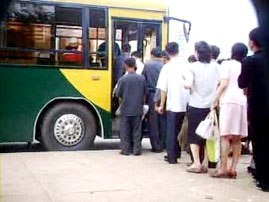
bus.jpgDuring the late 1990s, North Korea suffered a terrible economic collapse which resulted in famine and massive social dislocation.  During this time, most ministries and state-owned companies  were cash-strapped and unable to maintain their operations.  Out of desperation they turned to private investment for much needed revenues by outsourcing many basic services. (Individuals who were capable of taking up such opportunities were probably small in number at the time, but apparently now compose a healthy sub-section of the population.)

Outsourcing has benefited both the government and private entrepreneurs.  Outsourcing allows state-owned companies to receive capital financing from private individuals as well as a share of joint-venture revenues (tax revenues).  Private entrepreneurs need a legal business environment where they know they will not be subject to ex-post expropriation of profits.  Leasing the name of a government body gives them some of this legal cover.  This system is no doubt tolerated because it allows the government create space for entrepreneurship (and tax revenue) within the existing state structure while still maintaining de jure control of the means of production.   

According to the story in the Daily NK, the regulations for establishing a legitimate passenger bus company under this system (or “coach” company for readers in Her Majesty’s Commonwealth) are fairly strict.  Once an individual acquires a bus (appx US$6,000-10,000), he has to register it with the government body for whom he is working.  Revenues are then split 70/30 (the government taking 30%) for three years, after which the individual is required to “donate” the privately acquired bus to the state-owned enterprise.  This policy literally gives North Korean entrepreneurs just three years to recoup their investments!

The response of the North Korean business community was predictable:  investors sell the buses before the three years are up or they forge registration papers.  This is not hard to do in the DPRK.  In fact if you have just one other associate who owns a bus in similar condition, all you need to do is trade with him every three years and re-register the new vehicle. 

Word of this game has finally reached the top and they have responded by increasing their share to 70% of passenger bus revenues–leaving just 30% for the purchaser of the vehicle.  It is unclear from the story if investors are still required to “donate” their busses after three years, but realizing that the confiscation of buses was not enforceable, the North Korean government probably just opted for a larger share of the revenue over time.

The good news is that it is not likely that many people pay 70% of revenues either.  After-all, someone has to collect these taxes and he has needs too.  Sounds like some kind of arrangement could be reached…

You can read the full story here:
North Korea Regulates Operation of “Service Car”
Daily NK
2/18/2008

Share

NK Forced to Revert to Agricultural Market System?

Tuesday, December 11th, 2007

Daily NK
Jung Kwon Ho
12/11/2007

Several sources in China have relayed that it is rumored North Korean authorities are planning to take extreme measures to prevent the sale of industrial products at the jangmadang (markets) next year.

One Chinese merchant, whom DailyNK met in Dandong, China on the 6th, said, “Rumors are circulating that a measure preventing all kinds of Industrial products from being sold in the jangmadang will be implemented next year, making Chinese merchants involved in trade between North Korea and China nervous.”

He informed that “In place of industrial products, only farm produce from the fields of homeowners will be allowed to sell in the jangmadang. Marine products that up to now have been selling in the jangmadang will only be made available at appointed marine shops, meat products at food shops, and industrial products at state operated stores.”

The Chinese source also maintained that, “There are quite a few overseas Chinese who, not knowing what will happen, have bought loads of industrial products with the idea that this might be their last chance, and they have brought them into the North.”

The North Korean authorities began unfolding a series of market regulations immediately following the Inter-Korea Summit in October. These included such policies as limiting the types of items for sale and imposing a minimum age limit on female merchants. However, limiting the sale of industrial products themselves, after having abolished permanent markets, can be seen as a means of returning to “agricultural markets,” where farmers traded only vegetables and a surplus of produce.

According to other Chinese merchants with whom DailyNK met in Dandong on the 3rd, “Under the name of the North Pyongan Party Committee in Shinuiju, a three-day meeting was held between the Secretaries of the Party and of the Army and enterprise managers, from November 20th to the 22nd.”

They informed that “The meeting was held to discuss whether to prohibit jangmadang operations and put people who have been trading in the market to work at enterprises or factories, since regular provisions will resume starting next year.”

The recent efforts to regulate the markets have been analyzed as means to revert the standard of societal regulation to that of the pre-90s by restoring the provision system and normalizing factory operations. However, such an extreme measure is likely to give rise to serious civilian opposition, so there are doubts as to whether or not it can be realized.

The North Korean civilians, before the mid-90s, relied on a complete provision system supplied by the State, which included the provision of goods such as soap, clothes and other necessities. However, after the food shortage, the national provision system completely collapsed. As a result, civilians began acquiring most necessities, goods and food items through the jangmadang.

However, agricultural markets, where miscellaneous cereals, vegetables and other agricultural items raised in home gardens were traded, existed around the time when North Korea’s provision system was in normal operation.

Following the execution of the “July 1st Economic Management Improvement Measure” of 2002, the North Korean government established general markets which brought simple agricultural markets out in the open in February 2003. Since then, individuals leasing stands from the city mercantile department have been able to sell all kinds of industrial products as well.

One source in Chongjin stated in a phone conversation on the 6th regarding the recent rumors, “If the sources are Chinese merchants, than the rumor is not likely groundless. A majority of citizens sustain their livelihoods through the jangmadang.”

He agreed that “It is highly feasible that measures to toughen the regulation of industrial products in the market will be executed.”

Share

The Number of Day Laborers Hired by Private Parties Increasing in North Korea

Tuesday, December 11th, 2007

Daily NK
Lee Sung Jin
12/11/2007

The number of day labor jobs offered by private parties is gradually increasing in the North. Unlike those with full time jobs at State-run factories, individuals with day labor jobs work by the day.

According to inside sources and many defectors who came to the South earlier this year, individuals looking for day labor jobs normally work as gold miners, construction workers in cities, as luggage carriers for train passengers and maids.

In North Korea, these day laborers are called “Bulbulee (which means a person sweats for labor),” “Sakbari (which means a person waiting for wages)” or “Ilkkun (workers).” It is reported that there are day labor hiring centers in big cities and around the closed mining areas.

Daily laborers’ wages vary based on the type of work. Laborers working at gold mines are provided with housing and food and get paid 1,500 North Korean won per day. In the city construction sites, skilled laborers such as plasterers earn 2,000 won daily whereas unskilled laborers make less than 1,000 won. Daily laborers are making good money compared to factory workers whose average monthly wages fall between 3,000 and 5,000 won.

Kim Yong Chul (pseudonym), a defector who used to work as a day laborer at a mine in Hoichang of South Pyongan Province said, “Since 2004, day labor hiring centers started to appear in the jangmadang (market) of Hoichang. Employers hired young men and women in good health on the spot and took them to workplaces.” He used to work at a mine well-known across the country since the Japanese colonial period. Mr. Kim said, “Day laborers not only dug for gold but were also mobilized to build or fix houses for their employers.”

In Hoichang, there are some gold mines closed by the authorities that were thought to be tapped out. In the mid 1990s, some locals dug the mines again and made a great fortune. Years later, around 2003, these locals began looking out for workers and started hiring individuals from other provinces. Now the county has a great number of day laborers from various provinces working at mines.

Good Friends, the Seoul-based relief organization dedicated to North Korea, said in a recent report, “On October 23rd at around 10 A.M., a gold mine in Hoichang of South Pyongan Province collapsed, leaving three miners dead and two wounded.” In the North, private parties are banned from trading gold and pine mushrooms by law, and only the State can make these types of transactions. However, it is well known that many officials in charge of enforcing the ban frequently take bribes and allow those who pay them to dig for gold in closed mines.

Gold miners usually stay underground between 15 to 30 days each time they begin a mining operation. The miners dig up the ore, crush it using a machine called a Maguanggi (ore-polishing machine) and apply mercury to extract gold. The whole process is done in underground tunnels, and the processed gold is sold to gold dealers in Pyongsung and Sinuiju.

Individuals who run the crushing machine are laborers from other provinces, and most of them are females. With food and housing provided by their employer, they make 1,000 won daily. If they work year-round this way, they can earn decent money.

45-year-old Park Jong Moo (pseudonym) who came to the South this year said, “I earned 2,000 won per day when I worked as a plasterer, building a house for a man who made his money from trade in Chongjin City.”

Mr. Park’s son worked as a cargo porter at the Chongjin railway station. Since there were so many “Sakbari (referring to cargo porters working for daily wages)” at the station, competition among “Sakbari” was fierce. Normally, these porters made less than 1,000 won per day.

It is becoming popular among party cadres and the new wealth to have a maid who does housework and takes care of children. These people introduce the maid to their neighbors as a ‘distant relative’ because having a maid is unthinkable in the Socialist North. While performing maid services and getting paid for the work that she does, the maid pretends to be a family member and acts as if she is merely helping out with the housework.

A source inside the North said, “There was once a party official in Chongjin who employed a girl as a maid after having paid her parents. When the official was accused of having a maid, the official said she was a ‘relative.’”

Regarding the rise in day laborers, an expert on North Korea says, “Those North Koreans who made a fortune from mining or trade privately employ laborers to further expand their businesses…However, since the regime will never allow the rich to become too powerful, it will begin to regulate the employment activities of private parties at the proper time.”

Share

North Korean Market Research

Friday, November 23rd, 2007

Daily NK
Yoon Il Geun
11/23/2007

Unlike its external gesture towards openness as observed in the case of a recent agreement to expand South-North economic cooperation, the North Korean authorities regulate market activities at home.

On October 3rd, the Workers Party delivered a public message that urges the North Korean people to have a proper understanding about the market and to eradicate anti-socialist activities which threaten people’s interest. According to the message, the state bans females who are less than 40 years old from doing business and orders them to get back to factory complexes.

In regard to the recent regulation imposed on the market, many experts on North Korean affairs explain that the North Korean authorities are trying to hold in check a nouveau riche class who have made a fortune in the market and stop the infiltration of foreign culture and news into the society.

Experts believe that the North has decided to regulate the market, the very source of living of its people because it posed a treat to the Kim regime.

◆ The growth of the market since the mid 1990s

In 1990s, the country’s economy collapsed and the state failed to distribute food to its people. Many starved to death, and those survived turned to the market

In those days, despite the state’s tight regulation, the North Korean people had to make their living by either selling in the market or smuggling to China anything they could find in the sea, mountain or river such as fish, pine mushrooms, hemp, alluvial gold, etc. Some even stole metal such as copper and white gold from refineries or dismantled equipments from plants or factory complexes, and smuggled them to China.

Many North Koreans were able to secure the minimum amount of purchasing power by selling national resources overseas. Moreover, many defectors started to send money to their remaining family members in the North, and helped secure the purchasing power of their family. It was around this time when Chinese goods started to flow into North Korea and a new type of market began to grow. The new type of market differed from the state-approved farmer’s markets in the past. For the first time, it became possible for North Koreans to earn bread for a day in the market.

◆ The growth of a new type of market

On July 1, 2002, the nearly bankrupted country adopted an economic improvement measure designed to improve the competitiveness of factory complexes. As many individuals illegally sold national resources overseas and factories were shut down, the state ran short of revenue and became unable to give wages to workers, officials and college professors. In order to solve the shortage, the state began to issue paper money to fill national treasury.

Unfortunately, that increased workers’ wage 10 to 15 times on average. Moreover, the exchange rate which was about 220 won per dollar on June 30, 2002 increased to 1,800 won per dollar nine months after the adoption of the July 1st Economic Management Reform Measure.

Foreign Policy, an American magazine of global politics listed North Korea once again this year as one of the world’s worst currencies and pointed out the problem of the country’s skyrocketing inflation. The magazine also pointed out that the price for rice has increased by 550 percent since the adoption of the July 1st Economic Management Reform Measure. It should be noted that rice is one of those items whose prices have increased the least.

◆ The more the market grows, the more it threatens the regime

As inflation continued, more people turned to the market to make a living and started to manage their economic life independently. Having noticed that, the authorities began to worry what kinds of changes the market would bring about.

The authorities’ foremost concern lies in the rapid spread of foreign information through the market. As North Koreans’ preference for products from South Korea and Japan increases, so does their interest in these two countries. Many defectors say that a countless number of foreign VCDs have been circulated among people through the market.

In addition, the state has lost authority as more people relied on the market and became self-sufficient and individualistic. Prevalent corruption has also undermined its authority.

Lastly, illegal activities have increased so much that they are threatening public security. In fact, the North Korean people nowadays would do anything to make money.

For instance, many party cadres, hospital workers and Red-Cross personnel are stealing aid supplies sent by the United Nations and advanced countries, and army personnel are selling military provisions including rice in the market. Furthermore, many violent crime incidents and lootings are taking place in the areas not under the government control.

“The army and gangsters are savagely looting the market” says a woman in her 50s says recalling her visit to Hwanghae Province prior to coming to Dangdong, China.

◆ The impact of adopting market regulatory measures

The growth of the market will likely deepen the crisis of the Kim regime. Any measure designed to restrict the market would backfire among people.

Since the second half of the year, the North Korean authorities have been promoting market regulatory measures in the hope of protecting the regime. Some have raised a possibility that the North might try to restore its public distribution system using international aid. However, unless the North continues to open its door, the country would never secure an amount of food enough to run the distribution system again.

“Kim Jong Il is aware of the importance of the market for people’s survival, so he tacitly approves its existence. However, when he feels that capitalism is spreading too quickly, he would try to control it.” says Gao Jingzhu, professor of Korean studies at Yanbian University.

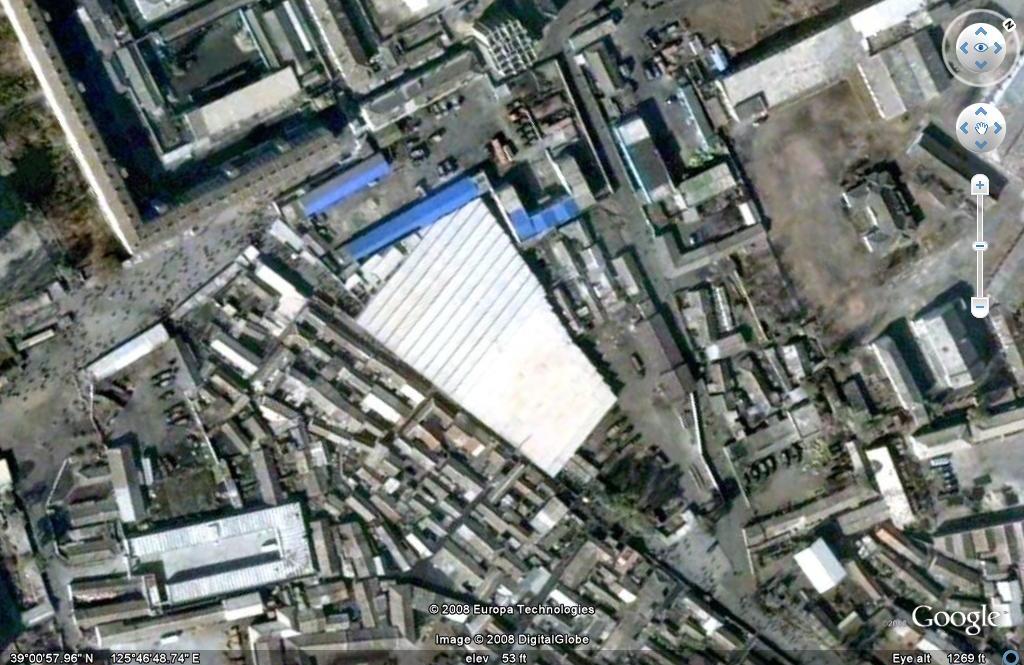
Share

Economic doldrums, restrictions on hawking cost jobs in N. Korea: aid group

Friday, October 26th, 2007

Yonhap
10/26/2007

North Koreans have been suffering from chronic job shortages due to worsening economic conditions and a recent move by North Korean authorities to limit the number of hawkers for fear of capitalism spreading in the isolated, communist state, an aid group said Friday.

The North has recently forbidden women under the age of 40 from selling merchandise on their own, Good Friends said in its latest newsletter. The previous age limit was 30.

Share

North Korea Farming Region Destroyed, So the Cost of Rice Increases

Wednesday, October 17th, 2007

Daily NK
Han Young Jin
10/17/2007

Due to the flood damage which heavily affected the central region of North Korea last August, the next year’s price of rice has been putting an increasing burden among civilians.

Min Nam Su (pseudonym), a North Korean trader who has come to Dandong, China, said on the 15th, “In Hwanghae and South Pyongan Province this year, farming has been affected for the flood damage, so the price of rice has been showing signs of an increase. Currently in the Jangmadang (markets) in Shinuiju, 15kg of rice costs 25,000 North Korean won (KRW8,000, USD8.7).

“The farmlands in Hwanghae and South Pyongan have been completely submerged, so we were only able to look to farming in North Pyongan Province. It is obvious that they will be taken up for provisions for the People’s Army, so people who have money are already busy buying and hoarding rice.”

A majority of urban civilians are directly purchasing rice from the jangmadang, with the exception of Hwanghae and Pyongyang, after the breakdown of the provision system in North Korea. If the price of rice skyrockets, the livelihood of North Korean citizens will be directly affected.

It is possible that the rice aid from South Korea or international society, which will be distributed from the end of this month, may stabilize the price of rice.

Good Friends, beginning early this month, relayed through its newsletter, “Only when the rice aid comes in quickly will the overall price of rice decrease, no matter whose hands it falls into. It is difficult to buy a kg of rice for 1,700~1,900 won.”

Rice aid to North Korea flows in through Pyongyang, Nampo, or through Chongjin Harbor. The rice, after it goes to the People’s Army or large-city political employees, travels down a path of smuggling into the jangmadang. NGOs for North Korea estimate that the actual amount of rice allocated to civilians is around 30% of all the aided rice.

The North Korean authorities recently gave an instruction to factories and offices to guarantee six-months worth of food provisions to laborers, but the factories are reportedly in a difficult situation due to the rice shortage.

Mr. Min said, “From now on, 15kg of rice is supposed to hike up to 50,000 North Korean won (approx. USD17.4). In places like Yongcheon plain and Jungju plain, some farming has been well done, so the armies are mobilized and will do harvest. This year in particular, there will probably be a lot of thieves in farmlands.”

He said further, “The price of rice is supposed to have risen even more in Kaecheon, Suncheon, and Pyongsung in South Pyongan Province than in Shinuiju. There have been news that people are even coming from the Hwanghae region, which is a famous farming province, to North Pyongan to buy rice.”

Mr. Min said, “In early August, when the initial flood damage occurred, a kilogram of rice rose to 1,960 (approx. USD0.7) in the Shinuiju and in the second week of August, remained stable at 1,500 won (approx. USD0.52). It seems like the price of rice will continue to rise. But, the situation would change when the support is distributed to the civilians, but who expects that?”

Share

North Korean Citizens Are Differentiated into Six-Levels

Friday, September 21st, 2007

Daily NK
Lee Kwang Baek
9/21/2007

The expansion of Jangmadang’s private economy

Several years ago, I met a defector from North Korea and is currently residing in Japan. He frequently meets people coming and going from North Korea.

The change he relayed regarding North Korea was interesting and vivid. Although hundreds of people are not dying from starvation as in the past, transformation brought about by the expansion of the private economy, such as the Jangmadang (markets).

I asked him what the most significant change in North Korea was after the mass starvation of the mid-90s.

It was the reorganization of North Korean society’s class system. According to him, there are currently six levels of classes forming in North Korea.

First is the top privileged class based on Kim Jong Il. It is the class that feeds and lives on Kim Jong Il’s administrative funds, all kinds of support coming in from South Korea, and extractions from civilians.

The second is the power class engaging in the area of foreign currency earning activity. A portion of money gained from the foreign currency earning business is offered to the Kim Jong Il regime and the rest are accumulated as their own wealth.

The third is the “moneybag” class who has earned money from exchanges with the products from Jangmadang and China. They use “violence” and “money,” like the Russian mafia, to secure the commercial rights of each region via the Jangmadang.

The fourth is the class whose sustenance depends on provisions. It can be deduced that people in the middle-class take up approximately 20~30% of the civilian population.

The fifth is the common class who depend on Jangmadang and individual patches. Approximately 60% of the total population falls into this class. They live day to day on their labor power.

The lowest class is the elderly, the handicapped, Kotjebi (begging children), city migrants, and diseased patients.

The most outstanding class is the 5th class. They are a class who has started living independently without depending on the Kim Jong Il regime and counts as 60% of the population.

South Korean administration believes that there is a need to seek a North Korean policy while considering the size and characteristics of the lower class.

That is, direct support or loans to the North Korean government should be reduced and a direct commercial transaction with North Korean citizens should be increased. Gradually, Kim Jong Il regime’s political position should be weakened and the status of self-sufficient lower-class citizens have to be elevated. This can become an important foundation for North Korean society’s move towards a market economy.

The second eye-catching element is the most venerable people in the lower class. Approximately 10% of people who fall under this class are humanitarian aid recipients of our government and international society. The latter two have steadily continued their support to them.

Despite this, according to a recent North Korean source, a significant amount of people are suffering from malnutrition among those who have been admitted to hospitals, long term reeducation camps, and concentration camps for beggar children. Why are such events occurring?

The defector said that when the rice that the South Korean government sends arrives at the North Korean harbor, North Korean authorities or organizations immediately sell them for money.

Similar testimonies have come forth from North Korean civilians. Rice which is sold at the harbor can only be bought with foreign currency. People who can purchase rice by paying foreign currency are “moneybags” for a portion of bureaucrats who have accumulated wealth. Moneybags and corrupt officials hand over this rice to the Jangmadang and collect the enormous balance.

The humanitarian aid provided by the outside, before they are even relayed to the lowest class who should be receiving support, are flowing into the hands of moneybags and corrupt bureaucrats. If such defectors’ testimonies are true, the South Korean government’s humanitarian rice support has lost its original function.

The solution regarding this is two-fold. First is directly relaying medical products and rice to North Korea’s lowest class. Through civilian and organizational efforts, a humanitarian support team jointly based on South Korean civilians and government should be formed and they should initiate humanitarian aid activity by directly going into North Korea.

Further, a large-sized South Korean humanitarian support activity inspection team should observe the activities of the North Korean Red Cross and raise the transparency of distribution. If this is difficult, there is a need to simplify the window through the support of international society whose monitoring is much ahead of our government’s monitoring of formality.

The government should urgently restore the original capacity of humanitarian support in order to avoid falling into a policy of failure geared only towards a dictatorship regime.

Share

An affiliate of 38 North