Archive for the ‘Price liberalization’ Category

Kim Jong-il and his sister on markets and the market economy

Monday, August 22nd, 2011

Stephan Haggard and Dan Pinkston have found and posted comments attributed to Kim Jong-il revealing some of his thinking on “markets” and the “market economy”:

Kim Jong-il, “On the promotion of a superior socialist economy…adhering to the principles of socialism” June 18, 2008, dialogue with party and state officials.

“…As I said on many occasions during the recent period, one must have a correct understanding of the market. As we allowed a certain use of markets with respect to economic management, some people understood this as a departure from the socialist principle and as a move towards a market economy through “reform” and “opening up” of the country’s economy.

But this is a very wrong way of reasoning. Having a misguided understanding of the market and the market economy on the part of economic planners shows their lack of ideology and knowledge… [If] one fails to exactly and deeply recognize the party’s ideology and policy with regards to economic planning, that person will have his or her faith in the superior socialist economy shaken and can be dazzled by “reform” or “opening up” that the imperialists brag about and also be captured by the fantasy that the capitalist market economy promises.

Workers need to be awakened from these pitfalls…. Markets are both home to and a hotbed for un-socialist phenomenon and capitalist factors in the economic sectors. Without devising a national plan about markets and neglecting them as they are, or further encouraging their activities and expanding their reach, the country’s economy will inevitably turn into a market economy. However, following the practical conditions by using the market to a certain extent while keeping it under national control does not necessarily mean a movement towards market economy. Markets and a market economy are not the same concepts. The question resides in how to perceive and treat the market, and how to use it following [appropriate] principles and direction…”

-Original text in Korean

“…….내가 최근시기 여러 기회에 말하였지만 시장에 대한 인식을 바로 가져야 합니다. 우리가 경제관리에서 시장을 일정하게 리용하도록 하였더니 한때 일부 사람들은 사회주의 원칙에서 벗어나 나라의 경제를 《개혁》《개방》하여 시장경제로 넘어가는 것처럼 리해한 것 같은데 이것은 아주 잘못된 생각입니다. 경제지도일꾼들이 시장과 시장경제에 대한 그릇된 인식을 가지게 되는 것은 사상의 빈곤 지식의 빈곤에 빠져있다는 것을 말해줍니다. 누구나 할 것 없이 경제사업과 관련한 당의 사상과 방침을 정확히, 깊이있게 인식하지 못하면 사회주의 경제의 우월성에 대한 신념이 흔들리게 되어 제국주의자들이 떠벌이는 《개혁》《개방》에 현혹될 수 있고 자본주의 시장경제에 대한 환상에 사로잡힐 수 있는 것입니다. 이에 대하여 일군들이 각성을 높여야 합니다….시장은 경제분야에서 나타나는 비사회주의적 현상, 자본주의적 요소의 본거지이며 온상입니다. 시장에 대하여 아무런 국가적 대책도 세우지 않고 그대로 내버려 두거나 시장을 더욱 조장하고 그 령역을 확대하는 방향으로 나간다면 불피코 나라의 경제가 시장경제로 넘어가게 됩니다. 그러나 현실적 조건에 따라 국가적 통제 밑에 시장을 일정하게 리용하는 것이 곧 시장경제로 가는 것은 아닙니다. 시장과 시장경제는 같은 개념이 아닙니다. 문제는 시장을 어떻게 보고 대하며 그것을 어떤 원칙과 방향에서 어떻게 리용하는가 하는데 있습니다….”

Marcus Noland followed up with a [longer] publication by Kim Jong-il’s sister, Kim Kyong-hui:

Strengthening Centralized, Unified State Guidance Over Economy, Kyo’ngje Yo’ngu

Our army and people are vigorously carrying out a general onward march to elevate the economy to a stage of leaping development through a new great revolutionary upswing under the great party’s military-first leadership.

Today, when our country is displaying its majestic appearance and might as a politically, ideologically, and militarily powerful state, in order to build it into an economically powerful socialist state and a socialist paradise where the people enjoy an affluent life with nothing more to desire in the world by concentrating efforts on the economic construction and on improving the people’s living standard, it is necessary to adhere to the socialist principle in the economic work and bring the superiority of the socialist planned economy into high play, and what is important in this is to strengthen the centralized and unified guidance of the state over the economic construction.

The great leader [ryo’ngdoja] Comrade Kim Jong Il [Kim Cho’ng-il] has pointed out the following:

“Above all else, it is necessary to strengthen the centralized and unified guidance of the state over the economic construction.”

Strengthening the centralized and unified guidance of the state in the socialist economic management arises as a basic demand for improving the economic management in line with the intrinsic nature of socialist society, further consolidating and developing the socialist economic system by bringing the superiority of the socialist planned economy into high play, and accelerating the construction of an economically powerful state.

Strengthening the centralized and unified guidance of the state is a basic demand for improving the socialist economic management because, above all, managing and operating the country’s economy in a planned manner under the state’s centralized and unified guidance is an intrinsic demand of the socialist economy that is based on collectivism and a basic principle of the socialist economic management.

Realizing the centralized and unified guidance of the state in the socialist economic management serves as a lifeline of the socialist economic management, which stems from the natural law-governed nature of the socialist economic development and the essential characteristics of the socialist economy.

The centralized and unified guidance of the state over the economy is, above all, an intrinsic demand of the socialist economy that is based on collectivism. The socialist economy is a large-scale collective economy in which all sectors and units of the people’s economy are organically connected with each other based on social ownership of the means of production, and it is a highly organized and centralized planned economy. This is the essential superiority of the socialist planned economy, which is distinct from the capitalist market economy that operates spontaneously on the basis of private ownership of the means of production. In a capitalist society, the bourgeois state is not able to perform the function of interconnecting the management activities of different enterprises and leading them in one direction. In a capitalist society, the economy moves in a spontaneous manner amid the pursuit of profits and competition based on the law of the jungle due to the conflict of interests between the capitalist class and the working popular masses and among capitalists, and this accompanies the bankruptcy of enterprises.

In contrast, the socialist economy is based on social ownership of the means of production, and it is managed and operated through goal consciousness by the popular masses as the masters. Social ownership of the means of production calls for combining all economic sectors and units into a single production organism, and also for the factories and enterprises comprising its components to move under a unitary command. Realizing planned ties between factories and enterprises and ensuring that the economy operates under a single unitary command are firmly guaranteed by the unified guidance of the socialist state.

The centralized and unified guidance of the state over the economy is also a basic principle of the socialist economic management.

Apart from the centralized and unified guidance of the state and the principle of managing a planned economy, socialism cannot be defended in the economic field, and the socialist economy cannot be developed.

The initiative of lower units has to be brought into high play in the socialist economic management, but this has to be achieved strictly on the basis of firmly guaranteeing the centralized and unified guidance of the state and within the framework of the socialist planned economy. It is only through the centralized and unified guidance of the state that it is possible to correctly map out plans so as to guarantee the greatest actual profits consistent with national interests and the all-people’s economic interests, mobilize all production potentials of the country to the maximum, concentrate forces and resources on the objects that are of key significance in the overall economic development, and thus achieve a planned and balanced development of the economy. If one moves in the direction of giving a free rein to economic management and enterprise management in an attempt to enhance the initiative of lower units and strengthen their “independence” and “self-reliance,” then the lower units will break way from the unified guidance and control of the state and act as they please, and this will not only bring about tremendous national waste and loss but also make it impossible to neither defend socialism in the economic field nor develop the socialist economy.

Strengthening the centralized and unified guidance of the state is a basic demand for improving the socialist economic management also because the centralized and unified guidance of the state over the economy has to be strengthened in order to be able to mobilize all potentials to the maximum based on the principle of self-reliance and thus elevate the country’s economy to a stage of leaping development and accelerate the construction of an economically powerful socialist state.

Today’s great upswing calls for more highly holding up the banner of self-reliance, and an economically powerful socialist state is a powerful state of self-reliance, a powerful state with a mighty self-supporting national economy.

We have laid the strong foundation of a socialist self-supporting national economy by highly displaying the revolutionary spirit of self-reliance under the wise leadership of the great leader [suryo’ngnim] and the respected and beloved general. Mobilizing and utilizing the potential of the already provided foundation of a self-supporting economy to the maximum is the most accurate way to elevate the country’s economy to a stage of leaping development and accelerate the construction of an economically powerful socialist state in our style in the present circumstances.

Though many obstacles are still lying in the way ahead of us, we have to open a road of advance for victory by relying on the boundless creative ability of all the people, our resources and technology, and the superiority of our system.

The centralized and unified guidance of the state over the economy has to be strengthened in order to elevate the country’s economy to a stage of leaping development by mobilizing the potential of the already provided foundation of a self-supporting national economy to the maximum and to accelerate the construction of an economically powerful socialist state.

Above all, the centralized and unified guidance of the state has to be strengthened in order to ensure a balanced and harmonious development of the economy in conformity with the aspiration and demand of the popular masses. An important task we are faced with in the economic construction at the present time is to rely on the superiority of the socialist planned economy to closely combine the normalization of production with modernization and push ahead with it vigorously, and thus decisively surpass the highest production level in all sectors of the people’s economy. It is only under the condition of strengthening the centralized and unified guidance of the state that it is possible to create the military-first era’s speed of waging the general onward march by mobilizing all production potentials of the country to the maximum from the viewpoint of national interests consistent with the party’s policy demands, and also accelerate the construction of an economically powerful socialist state by harmonizing the production ties centered on the objects of key significance in the economic development, guaranteeing the planned and disciplined nature of the economic work, and thus achieving a balanced development of the overall economy.

The centralized and unified guidance of the state has to be strengthened also to be able to bring the initiative of individual sectors and units, and local areas into high play and thus actively mobilize and utilize the potential of the self-supporting economy.

There may be things that are in short supply and that are missing in the process of building an economically powerful state. This is why the demand for bringing the initiative of each sector and unit into high play arises in order for all sectors and units of the people’s economy to normalize production and surpass the highest production level based on the existing assets.

Only when the centralized and unified guidance of the state over the economy is realized smoothly, is it possible to enhance the initiative of all sectors and units in line with the intrinsic requirement for the development of socialist economy that is based on collectivism and decisively boost the economic effectiveness in mobilizing and utilizing the reserves.

Strengthening the centralized and unified guidance of the state over the economy in no ways means disregarding the initiative of lower units. The socialist economic construction can be carried out successfully only when the unified guidance of the state is combined correctly with the initiative of lower units. This is because if the state’s centralized and unified guidance enables the economy to develop harmoniously on a pan-social level, then the initiative of lower units spurs factories and enterprises to increase production and perfect the production and technical processes on their own by positively exploring and mobilizing the existing reserves and production potentials pursuant to the economic plans established by the state. If the lower units are restrained based on the opinion that the management activities of each unit should be unconditionally subordinate to the state, then the initiative of factories and enterprises will be suppressed and the production will not proceed smoothly. This is why the centralized and unified guidance of the state over the economy is based on the premise of further enhancing the initiative of lower units.

All the economic guidance functionaries should have a correct perception of the state’s centralized and unified guidance and realize it correctly, and thus bring the genuine superiority of socialist planned economy into high play.

“위대한 당의 선군령도따라 우리 군대와 인민은 새로운 혁명적대고조로 경제를
비약적인 발전단계에 올려세우기 위한 총진군을 힘있게 벌려나가고있다.

정치사상강국, 군사강국의 위용과 위력을 온 세계에 떨치고있는 오늘 경제건설과
인민생활향상에 힘을 집중하여 우리 나라를 사회주의경제강국으로, 인민들이
세상에 부러움없이 잘 사는 사회주의락원으로 건설하기 위하여서는 경제사업에서
사회주의원칙을 고수하고 사회주의계획경제의 우월성을 높이 발양시켜야 하며
여기서 중요한것은 경제건설에 대한 국가의 중앙집권적, 통일적지도를
강화하는것이다.

위대한 령도자 김정일동지께서는 다음과 같이 지적하시였다.

《무엇보다도 경제건설에 대한 국가의 중앙집권적, 통일적지도를 강화하여야
합니다.》

사회주의경제관리에서 국가의 중앙집권적, 통일적지도를 강화하는것은
사회주의사회의 본성에 맞게 경제관리를 개선하고 사회주의계획경제의 우월성을
높이 발양시켜 사회주의경제제도를 더욱 공고발전시키며 경제강국건설을
다그치기 위한 기본요구로 제기된다.

국가의 중앙집권적, 통일적지도를 강화하는것이 사회주의경제관리개선의
기본요구로 되는것은 무엇보다먼저 나라의 경제를 국가의 중앙집권적,
통일적지도밑에 계획적으로 관리운영하는것이 집단주의에 기초한 사회주의경제의
본성적요구이며 사회주의경제관리의 기본원칙이기때문이다.

사회주의경제관리에서 국가의 중앙집권적, 통일적지도를 실현하는것은
사회주의경제발전의 합법칙성과 사회주의경제의 본질적특성으로부터 출발한
사회주의경제관리의 생명선이다.

경제에 대한 국가의 중앙집권적, 통일적지도는 우선 집단주의에 기초한
사회주의경제의 본성적요구이다. 사회주의경제는 생산수단에 대한 사회적소유에
기초하여 인민경제의 모든 부문들과 단위들이 유기적으로 련결된 대규모의
집단경제이며 고도로 조직화되고 중앙집권화된 계획경제이다. 이것은 생산수단에
대한 사적소유에 기초하여 자연발생적으로 움직이는 자본주의시장경제와 다른
사회주의계획경제의 본질적우월성이다. 자본주의사회에서는 부르죠아국가가
각이한 기업체들의 경영활동을 서로 맞물리고 하나의 방향으로 이끌어나갈수
있는 기능을 수행할수 없다. 자본주의사회에서는 자본가계급과
근로인민대중사이, 자본가들사이의 리해관계의 대립으로 하여 경제가 리윤추구와
약육강식의 경쟁속에서 자연발생적으로 진행되며 이것은 기업파산을 동반한다.

이와는 달리 사회주의경제는 생산수단에 대한 사회적소유에 기초하고있으며
인민대중이 주인이 되여 목적의식적으로 관리운영된다. 생산수단에 대한
사회적소유는 모든 경제부문, 단위들을 하나의 생산유기체로 결합시키는 한편 그
구성부분으로 되는 공장, 기업소들이 유일적인 지휘에 따라 움직일것을
요구한다. 공장, 기업소들사이에 계획적인 련계를 실현하며 경제가 하나의
유일적인 지휘밑에 움직이도록 하는것은 사회주의국가의 통일적지도에 의하여
확고히 담보된다.

경제에 대한 국가의 중앙집권적, 통일적지도는 또한 사회주의경제관리의
기본원칙이다.

국가의 중앙집권적, 통일적지도와 계획적경제관리원칙을 떠나서는 경제분야에서
사회주의를 지킬수 없고 사회주의경제를 발전시킬수도 없다.

사회주의경제관리에서 아래단위의 창발성을 높이 발양시켜야 하지만 그것은
어디까지나 국가의 중앙집권적, 통일적지도를 확고히 보장하는 기초우에서,
사회주의계획경제의 테두리안에서 이루어져야 한다. 국가적리익,
전인민경제적리익에 맞게 가장 큰 실리를 보장할수 있도록 계획을 세우며 나라의
모든 생산잠재력을 최대한으로 동원하고 전반적경제발전에서 관건적인 의의를
가지는 대상들에 력량과 자원을 집중하여 경제의 계획적, 균형적발전을
이룩하는것은 국가의 중앙집권적, 통일적지도에 의해서만 옳게 실현될수 있다.
아래단위의 창발성을 높이고 《독자성》과 《자립성》을 강화한다고 하면서
경제관리, 기업관리를 풀어놓는 방향으로 나간다면 아래단위들이 국가의
통일적지도와 통제에서 벗어나 제멋대로 움직이게 되며 국가적으로 막대한
랑비와 손실을 가져오는것은 물론 경제분야에서 사회주의를 지킬수도 없
사회주의경제를 발전시킬수도 없다.

국가의 중앙집권적, 통일적지도를 강화하는것이 사회주의경제관리개선의
기본요구로 되는것은 다음으로 경제에 대한 국가의 중앙집권적, 통일적지도를
강화하여야 자력갱생의 원칙에서 모든 잠재력을 최대한 동원하여 나라의 경제를
비약적인 발전단계에 올려세우고 사회주의경제강국건설을 다그칠수
있기때문이다.

오늘의 대고조는 자력갱생의 기치를 더 높이 들것을 요구하며
사회주의경제강국은 자력갱생의 강국, 위력한 자립적민족경제의 강국이다.

우리는 위대한 수령님과 경애하는 장군님의 현명한 령도밑에 자력갱생의
혁명정신을 높이 발휘하여 사회주의자립적민족경제의 토대를 튼튼히 마련하였다.
이미 마련된 자립적경제토대의 잠재력을 최대한 동원리용하는것은 오늘의
형편에서 우리 식으로 나라의 경제를 비약적인 발전단계에 올려세우
사회주의경제강국건설을 다그치는 가장 정확한 길이다.

우리앞에는 의연히 많은 난관이 가로놓여있지만 전체 인민의 무궁무진한
창조력과 우리의 자원과 기술, 우리 제도의 우월성에 의거하여 승리의 진격로를
열어나가야 한다.

이미 마련된 자립적민족경제토대의 잠재력을 최대한 동원하여 나라의 경제를
비약적인 발전단계에 올려세우고 사회주의경제강국건설을 다그치자면 경제에
대한 국가의 중앙집권적, 통일적지도를 강화하여야 한다.

우선 국가의 중앙집권적, 통일적지도를 강화해야 인민대중의 지향과 요구에 맞게
경제의 균형적이고 조화로운 발전을 보장할수 있다. 현시기 경제건설에서
우리앞에 나서는 중요한 과업은 사회주의계획경제의 우월성에 의거하여
생산정상화와 현대화를 밀접히 결합시켜 힘있게 밀고나감으로써 인민경제 모
부문에서 최고생산수준을 결정적으로 돌파하는것이다. 국가의 중앙집권적,
통일적지도를 강화하는 조건에서만 당의 정책적요구에 맞게 국가적리익의
견지에서 나라의 모든 생산잠재력을 최대한 동원하여 선군시대의 총진군속도를
창조할수 있으며 이와 함께 경제발전에서 관건적인 의의를 가지는 대상들을
중심으로 생산적련계를 조화롭게 하고 경제사업에서 계획성과 규률성을 보장하여
전반적경제의 균형적발전을 이룩함으로써 사회주의경제강국건설을 다그칠수
있다.

또한 국가의 중앙집권적, 통일적지도를 강화하여야 개별적부문과 단위, 지방의
창발성을 높이 발양시켜 자립경제의 잠재력을 적극 동원리용할수 있다.

경제강국을 건설하는 과정에는 부족한것도 있고 없는것도 있을수 있다. 따라서
인민경제 모든 부문, 모든 단위에서 있는 밑천을 가지고 생산을 정상화하
최고생산수준을 돌파하기 위하여서는 매개 부문, 단위의 창발성을 높이
발양시켜야 할 요구가 제기되게 된다.

경제에 대한 국가의 중앙집권적, 통일적지도를 원만히 실현하여야 모든 부문,
모든 단위의 창발성을 집단주의에 기초한 사회주의경제발전의 본성적요구에 맞게
발전시킬수 있으며 예비를 동원하고 리용하는데서 경제적효과성을 결정적으로
높일수 있다.

경제에 대한 국가의 중앙집권적, 통일적지도를 강화한다는것은 결코 아래단위의
창발성을 무시한다는것을 의미하지 않는다. 사회주의경제건설은 국가의
통일적지도와 아래단위의 창발성을 옳게 결합시킬 때 성과적으로 진행될수 있다.
그것은 국가의 중앙집권적, 통일적지도가 전사회적범위에서 경제가 조화롭게
발전될수 있게 한다면 아래단위의 창발성은 공장, 기업소들이 국가가 세운
경제계획에 따라 있는 예비와 생산잠재력을 적극 탐구동원하여 생산을 늘이
자체로 생산기술공정을 완비하도록 추동하기때문이다. 만일 매개 단위의
경영활동이 국가에 무조건 복종되여야 한다고 하면서 아래단위를 얽어매놓으면
공장, 기업소들의 창발성이 억제되여 생산을 원만히 진행할수 없게 된다.
그러므로 경제에 대한 국가의 중앙집권적, 통일적지도는 아래단위의 창발성을
더욱 높이는것을 전제로 한다.

모든 경제지도일군들은 국가의 중앙집권적, 통일적지도에 대한 옳은 인식을
가지고 이를 옳바로 실현함으로써 사회주의계획경제의 참다운 우월성을 높이
발양시켜나가야 할것이다.”

Share

The secret world of North Korea’s new rich

Tuesday, August 9th, 2011

Andrei Lankov provides some anecdotal evidence and a taxonomy of the DPRK’s growing entrepreneurial class (perhaps one of the most interesting and least reported aspects of the DPRK).  He also gives us a glimpse of how the North Korean version of the “infant industry” mindset can impede economic reform.

Here is a great blurb from the article in the Asia Times:

Who are they – the North Korean new rich? The upper crust of this social group consists of high-level officials. Some of them have gained their wealth through illegal means, but many have seen their business activities permitted and even actively encouraged by the government. Most of the money is made in foreign trade, with China being by the far the most significant partner.

Many North Korean companies, despite being technically owned by the state, are effectively private and are run by top officials and their relatives.

That said, these people are not that frequently seen on the streets of Pyongyang. They live in their own enclosed world, of which not much is known.

But if we go one or two steps down, we will encounter a very different type of North Korean entrepreneur – somebody who has made his or her (yes, surprising many of them are women) money more or less independent of the state.

Complete independence is not possible because every North Korean businessman has to pay officials just to make sure that they will not ask too many questions and turn a blind eye to activities that are still technically illegal. In many cases, North Korean entrepreneurs prefer to disguise their private operations under the cover of some state agency.

Take for example Pak. In his early 40s, he runs a truck company together with a few friends. The company has seven trucks and largely specializes in moving salt from salt ponds on the seacoast to major wholesale markets. The company employs a couple of dozen people, but officially it does not exist. On paper, all trucks are owned by state agencies and Pak’s employees are also officially registered as workers of state enterprises.

Pak bought used trucks in China, paying the Chinese owners with cash. He then took them to North Korea where he had the vehicles registered with various government agencies (army units are the best choice since military number plates give important advantages). Pak paid officials for their agreement to “adopt” the trucks. This is so common in the North that there is even an established rate of how much fake registration of a particular type of vehicle costs at which government agency.

Kim was a private owner of a gold mine. The gold mine was officially registered as a state enterprise. Technically, it was owned by a foreign trade company that in turn was managed by the financial department of the Party Central Committee. However, this was a legal fiction, pure and simple: Kim, once a mid-level police official, made some initial capital through bribes and smuggling, while his brother had made a minor fortune through selling counterfeit Western tobacco.

Then they used their money to grease the palms of bureaucrats, and they took over an old gold mine that had ceased operation in the 1980s. They restarted the small mine and hired workers, bought equipment and restarted operations. The gold dust was sold independently (and, strictly speaking, illegally) to Chinese traders.

The brothers agreed with the bureaucrats from the foreign trade company on how much money they should pay them roughly between 30-40% and the rest was used to run the business and enjoy life.

One step below we can see even humbler people like Ms Young, once an engineer at a state factory. In the mid-1990s, she began trading in second-hand Chinese dresses. By 2005 she was running a number of workshops that employed a few dozen women.

They made copies of Chinese garments using Chinese cloth, zippers and buttons. Some of the materials was smuggled across the border, while another part was purchased legally, mostly from a large market in the city of Raseon (a special economic zone which can be visited by Chinese merchants almost freely).

Interestingly, Ms Young technically remained an employee of a non-functioning state factory from which she was absent for months on end. She had to pay for the privilege of missing work and indoctrination sessions, deducting some $40 as her monthly “donation”. This is an impressive sum if compared with her official salary of merely US$2.

The North Korean new rich might occasionally feel insecure. They might be afraid of the state, because pretty much everything they do is in breach of some article of the North Korean criminal code. A serious breach indeed – technically any of the above described persons could be sent to face an execution squad at the moment the authorities change their mind.

And before we all get our hopes up that this emergent entrepreneurial class will eventually push the leadership to adopt economic reforms, Lankov reminds us how they could just as well serve to prolong the regime’s life:

Paradoxically, the long-term interests of the emerging North Korean business class might coincide with that of the Kim regime. Unlike normal people in the North, both groups – officials and entrepreneurs – have an interest in maintaining a separate North Korean state. Unification with the South is bound to spell disaster for both groups.

A person who is now running a couple of small shops might eventually, if North Korean capitalism continues uninterrupted growth, become an owner of a supermarket chain. If unification comes, he or she would be lucky to survive the competition with the South Korean retail giants and keep the few corner shops they had.

The full story is well worth reading here:
The secret world of North Korea’s new rich
Asia Times
Andrei Lankov
2011-8-10


Share

Kangdong market prices

Tuesday, July 26th, 2011

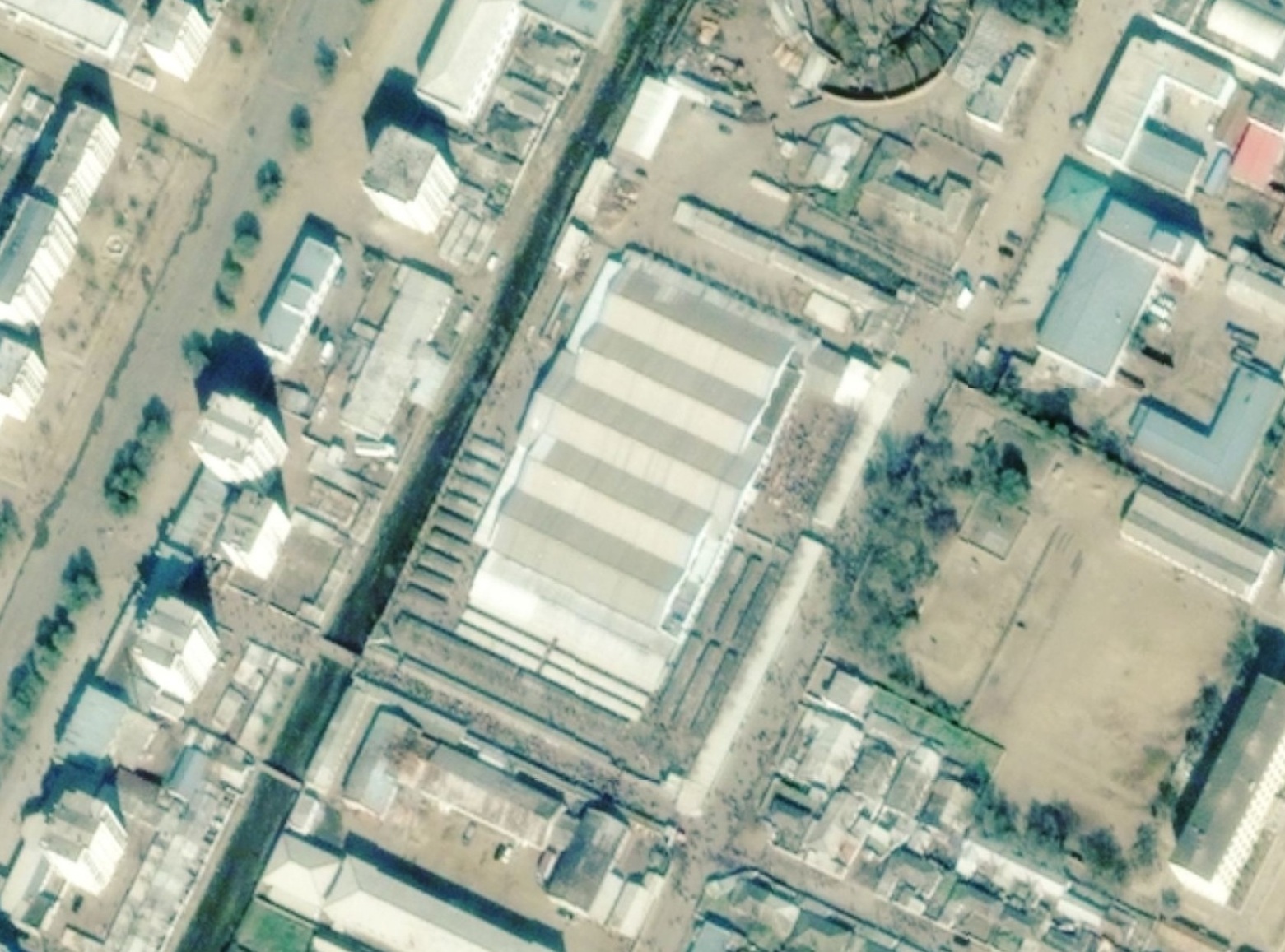
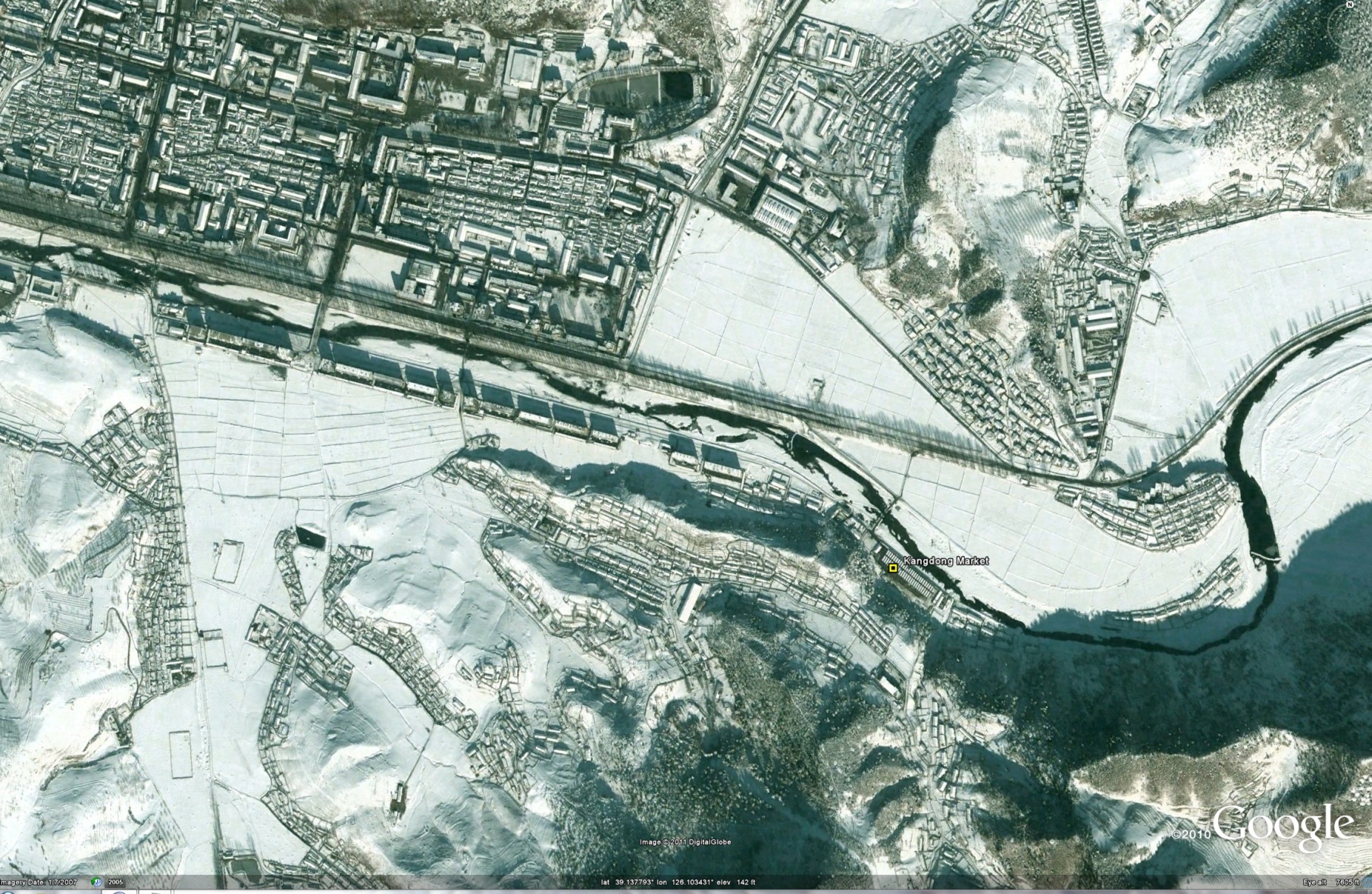
Pictured above (Google Earth): The Kangdong Market (39.134801°, 126.109387°)

According to the Daily NK:

It has been revealed that the cost of living in Pyongyang has more or less held steady over the past month, despite a modest decrease in rice prices.

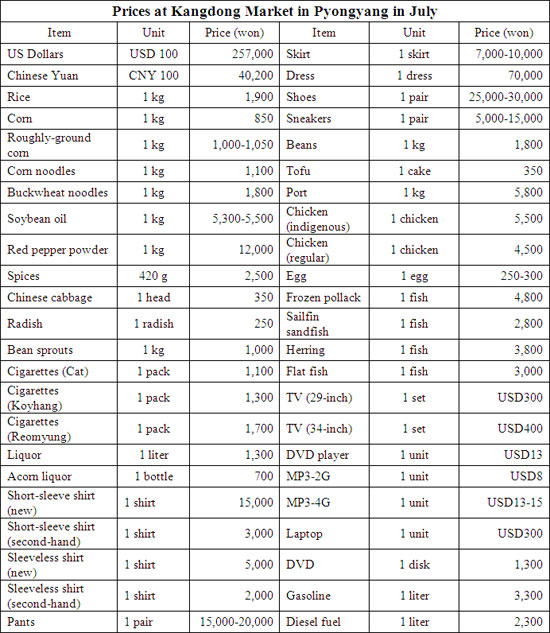
According to sources in Pyongyang, one kilogram of rice is trading for about 1,900 North Korean won, which represents a fall of about 100 won on June prices. It is thought that a modest easing of the exchange rate of North Korean Won against Chinese Yuan and the importation of a large amount of rice from China are partially responsible for the change.

“Chinese rice is currently selling for roughly 200-300 won less than Chosun (North Korea) rice,” one source said, explaining, “Chinese merchants and the like brought the rice into the country en masse at the start of the year when the price of rice was rising, but now it’s not selling so well. The price of rice has fallen across the broad and is fluctuating at around the 2,000 won mark.”

At the end of January, the price of a kilogram of rice temporarily soared past the 3,000 won mark. There was some speculation at the time that wholesalers were colluding to raise prices. After the price went up, a natural increase in market supply and a drop in purchasing power from currency redenomination kicked in to force prices back down. Since then it has more or less stabilized at around the 2,000 won per kilogram mark again.

The price for corn, which usually trades for about half the price of rice, has also recorded a small fall to 850 won per kilogram, down 130 won on last month’s prices. Pork prices are stable at 5,800 won per kilogram, which is the same price as last month.

Moreover, second-hand clothes are showing brisk trade on the market. One source attributed their popularity to the fact that they sell for less than half the price of new clothes.

Additionally, the source claimed that the warmer weather is encouraging more people to purchase sleeveless and short-sleeve shirts, as well as shorts and skirts. “Sleeveless shirts are prohibited by the authorities, so people only wear them at home. Mostly young people are doing this,” he said.

“Short-sleeve shirts, shorts and skirts are selling like hotcakes as well, but it is required that the latter two items go down past the knees.”

The cost of living in North Korea has more or less returned to the levels they were at before the currency redenomination. It is business as usual at the jangmadang, but with trade volume well down from what it was before. The source explained that, while people are not holding onto cash as a result of the currency revaluation, it is only food items and lifestyle goods that are selling relatively well, while sales of high-ticket electronic goods have actually decreased.

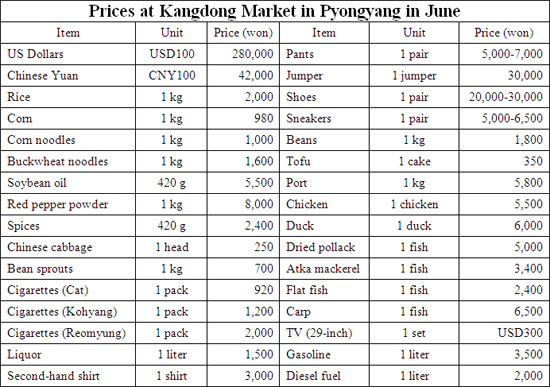
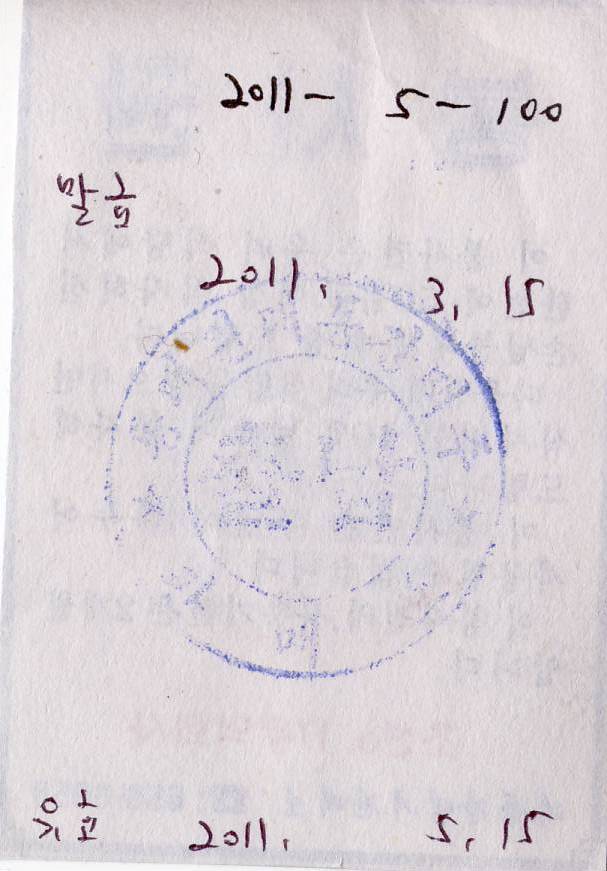
Here is the price data collected from the Kangdong Market on the outskirts of Pyongyang (JPG):

Left: June 2011, Right: July 2011

Links to the discussion of North Korea’s food crisis can be found here.

Read the full story here:
Market Prices Stable, Sleeveless Shirts Popular
Daily NK
Choi Cheong Ho and Park Sung Kook
2011-7-20

Share

DPRK food prices rising

Tuesday, July 5th, 2011

According to Bloomberg:

North Korean rice prices have quadrupled this year amid concern the regime is facing further economic isolation, according to a South Korean research report.

Rice prices jumped to as much as 2,200 North Korean won per kilogram during the first six months of the year from about 500 won at the end of 2010, South Korea’s state-run Korea Development Institute said today in an e-mailed statement. The difference was mostly caused by a slump in the domestic currency, which is a factor the government considers in setting the price, the report said.

North Korea’s won is not freely traded though the U.S. dollar is the de facto currency used in many markets.

South Korea in May last year cut off most trade with North Korea, accusing Kim Jong Il’s regime of torpedoing one of its warships in March that killed 46 sailors. The U.S. is assessing whether to provide food assistance to North Korea, which is also under United Nations sanctions for its nuclear tests.

The North Korean currency has weakened “sharply” since the regime shelled South Korea’s Yeonpyeong island in November amid concerns worsening relations will lead to further shortages of goods, the report said. North Korea has also increased coal exports to China to make up for the shortfall in trade with South Korea, causing energy shortages, it said.

While the regime lifted its ban on street markets that was placed at the end of 2009, high prices and goods shortages are preventing them from helping meet North Koreans’ needs, the report said.

Read the full story here:
North Korean Rice Prices Quadruple
Bloomberg
Bomi Lim
2010-7-5

Share

Retail competition in the DPRK

Wednesday, May 25th, 2011

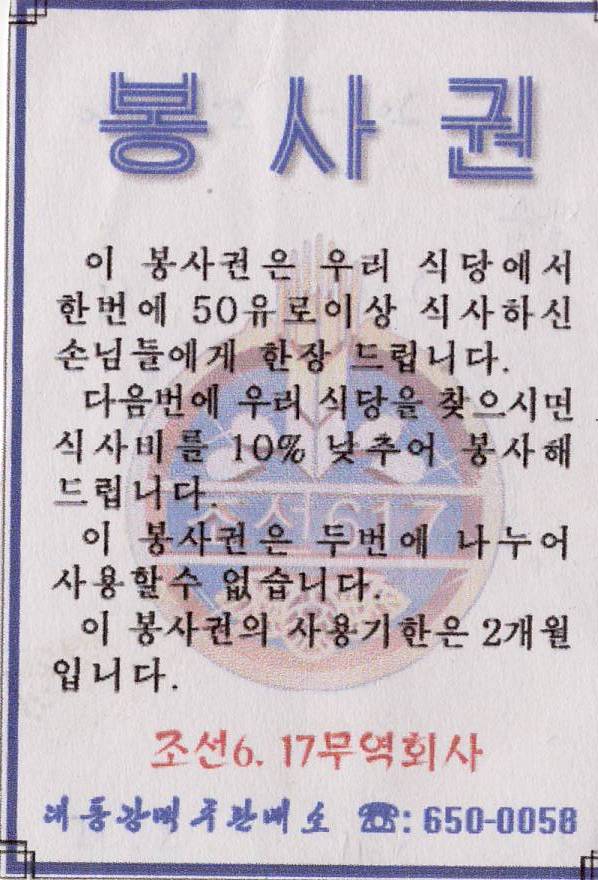
A visitor to the DPRK sends in a picture of a 10% discount coupon received at a hard currency shop in Pyongyang.

The coupon is issued by the 6.17 Trading Company, and according to a member of my crack translation team it reads:

One coupon per party is given when the party has spent more than 50 Euros at our restaurant during their visit. The next time you visit our restaurant, 10% discount will be applied to your bill.  This coupon cannot be used twice or split over visits. The expiration date of this coupon is in two months.

I am also told that the coupon lexically equates “discount” with “service” as in “we will serve you at 10% lower price”.

The coupon is interesting because it signals that there seems to be some real price competition among hard currency shops in the capital. These shops not only cater to foreigners, but also to North Koreans with sufficient forex balances, so they don’t just have to compete against each other, but also with the black market.

Do other readers have any experience with discount coupons in the DPRK, or is this a relatively new phenomenon?

Share

Some current economic data points

Tuesday, May 17th, 2011

According to Daily NK:

Things are growing more difficult for many North Korean people as they pass through the spring lean season, according to a new interview with a citizen from the edge of Pyongyang, Kang Mi Soon. There has been little distribution this year, even in the capital, which has traditionally received preferential treatment, and while people are trading to try and improve matters, it’s not easy at the moment.

This is because, as a lingering after-effect of the currency redenomination, a lot of people have exhausted their reserves of cash, while prices have returned to levels commensurate with before the redenomination. In spite of relative commercial freedom in the jangmadang, the number of transactions has fallen and the class of small traders which lives day-to-day is struggling.

Kang, who hails from Gangdong County in Pyongyang, revealed this and more news from the city in an interview she gave to The Daily NK in Yanji, where she recently visited relatives,

The following is a transcript of the interview with Kang:

– What is the state of the distribution system?

In December last year and then January this year, there were eight days-worth of distribution. In February there were ten days, including the 16th (Kim Jong Il’s birthday), but in March there was no distribution. In April there were five days, including the Day of the Sun (Kim Il Sung’s birthday).

(One day of distribution ordinarily means 700g of rice or other grain for laborers, 900g for miners and workers in other strategic industries, 800g for members of state security, 400-500g for students (depending on grade) and 300g for housewives)

– Is the jangmadang operating well?

The jangmadang is working normally. However, the situation is that though the number of sellers is on the rise, people do not have money so products are not selling well.

– What things are selling the most?

Mostly, rice and corn are the mainstays of jangmadang sales. Since February of this year, there has been a drastic reduction in sales of other household items and industrial products. Though the supplies of rice and corn in the jangmadang are similar to last year, the number of buyers and the amounts being bought are both decreasing.

– What is the overall situation in terms of prices?

Overall, they have risen to a level similar to that of before the redenomination. In the case of Chinese products, prices have increased to more than before the redenomination. Socks made in China were 1,500won before, but now they are 2,000won.

– They say that the food situation during the spring lean season is hard. Can you tell us more?

Starting from last year, after the currency redenomination, the situation started getting worse, and this year it is really bad.

– Has anyone starved to death?

In Gangdong [Kangdong] County, since the beginning of February about twenty people, including two families which committed suicide, have died of hunger.

(Gangdong County had a population of 221,539 in 2008)

– What is the overall food supply situation?

60% of people in the county are living off three meals a day of corn porridge or corn flour noodles, 30% on corn rice and the remaining 10% are eating three meals of rice a day. In March and April of last year, the number of people eating three meals of rice was 30 or 40%, and less than 5% were living on corn porridge or noodles; the rest are corn rice.

– What about other regions?

With the exception of central Pyongyang and other big cities (Sinuiju, Pyongsung, Chongjin etc), it seems to me that other rural regions are in the same situation as Gangdong. The price of rice looks likely to stay the same or rise, and so, until around June 10th when the potatoes are gathered, the numbers of starving people is likely to rise.

Read the full story here:
Gangdong County Hit by Spring Shortages
Daily NK
Choi Cheong Ho
2011-5-17

Share

Official holiday gifts for sale in marketplace

Thursday, April 14th, 2011

For the last few years, stories have appeared in the media about people selling their official 2.16 and 4.15 holiday gifts from the leaders.

The Daily NK gets the first story this time around:

“Is it true that Day of the Sun gifts are being sold in the jangmadang?”

Most defectors answer to that question is something like, “Isn’t it obvious; selling them can give us enough money for one kilogram of rice?” In the past, gifts from Kim Il Sung and Kim Jong Il on national holidays used to be quite precious and an honor for the people, but now they have become a way to lessen difficulties.

According to defectors, special stalls selling “Day of the Sun gifts” have even appeared.

Even the annual crackdown on selling such gifts is a mere formality. Ham In Suk, who came to the South in 2009, said, “The crackdown is carried out temporarily, but it is not effective and not particularly problematic.”

On the biggest national holidays, the Day of Sun and Kim Jong Il’s birthday, the authorities present gifts to children in day nurseries (four to five years of age), kindergartens (six year old) and elementary students (seven to eleven years old).

In one pack, there are usually around 400g of cookies, 400g of candy, 50g of jellies, 100g of rice crackers and five pieces of gum, although the quality and quantity of gifts differs by province.

A ceremony for giving the gifts to children is held a few days before the birthday in kindergartens, and elementary schools, meaning roughly February 14th and April 13th.

Then, on the afternoon of the day when the ceremony finishes you can easily find gifts in the jangmadang. People sell them to traders for a comparatively cheap price decided by weight.

A one-kilogram pack is sold for 1500 won, and the traders sell them on for 2000 won. Therefore, people can earn enough for one kilogram of rice by selling one pack of the gifts and thus have a hot dinner with family to commemorate the national holiday.

According to defectors, the General’s gifts have been on sale in the jangmadang since the March of Tribulation. This is because even though food distribution was suspended during that tough period, gifts from Kim Il Sung and Kim Jong Il continued.

Before that, it was apparently hard to find the gifts in the markets at all, no matter how hard lives were. At that time on the morning of the holiday, parents even made their children bow to portraits of Kim Il Sung and Kim Jong Il before they ate the gifts.

One defector who came to South Korea in 2009 said, “Selling gifts was beyond our imagination before the March of Tribulation, and we even stopped our children from opening the pack of cookies before saying a pledge of loyalty.”

In the 2000s, when people began to purchase Chinese products and food and several kinds of cookies in the jangmadang, the situation for snacks also changed; people in more affluent households sold their gifts from the authorities to the jangamdang to purchase more delicious cookies for their children.

In poor houses, however, parents take the gifts from their children and sell them to get a kilogram of rice. Instead of the General’s gifts, they give their children corn cookies costing around 150 won.

Here are previous posts on this topics.

Read the full story here:
General’s Gifts on Sale in the Jangmadang
Daily NK
Kang Mi Jin
2011-4-14

Share

Exchange rate data

Wednesday, April 6th, 2011

The The UN World Food Prgram’s Rapid Food Security Assessment Mission (RFSA) offered some exchange rate data that I thought was worth pointing out:

Currently the official exchange rate is about USD1=KPW100 yet the market rate is closer to USD1=KPW3000. In other words, the redenomination of the national currency that occurred in November 2009 is all but neutralized. The effects of this policy on ordinary citizens appear to be mixed where people with over KPW 100,000 lost their savings. The purpose of such a policy was to control inflation by reducing money supply and to curb the growth in private enterprise. Worker salaries remained the same, but prices were reduced significantly.

The PDS prices were revised downwards in the wake of the currency revaluation making it even more affordable, at least in principle. For example, PDS prices of rice declined from KPW 44 to KPW 24 per kg and maize declined from KPW 24 to KPW 14. At these low prices the issue is the lack of commodities in the market, rather than consumers lacking money to purchase them.

An average worker makes around KPW 3,000 to KPW 4,000 per month. This translates into a dollar per month which only works in DPRK because everything is heavily subsidized and ordinary citizens do not rely on direct purchases of imported commodities. If PDS were to run out of cereals at the end April, people would not have the means to purchase cereals on the black market, where prices are KPW2000 per kilogram of rice and about KPW 1000 for maize. It is highly doubtful that the barter system which is the backbone of this informal economy will be able to withstand a shock of this magnitude over more than a couple of weeks. A humanitarian crisis is the likely outcome of such a series of events.

Share

Daily NK reports on DPRK food prices

Sunday, February 13th, 2011

According to the Daily NK:

Overall average prices in North Korea have doubled since the end of last year.

Sources say that the reason behind the price rises is insufficient supplies within North Korea coupled to the effect of relatively strict crackdowns on the smuggling of goods in from China.

Rice is now reportedly 2,000 won per kilo (as of the 11th). Late last year it was between 900 and 1,000 won.

In late January, rice even reportedly reached 3,000 won in some areas. A source explained why, “There were rumors that state rice stores were empty, because even those people who are targeted for state distribution didn’t get any food in late January in some areas.” So, he went on, “Around that time, wholesalers colluded to fixed the price at 3,000 won.”

Thereafter, the source said, “Now, rice has dropped to around 2,000won,” explaining that, “When the price went up, the supply increased, so the price was amended again.” According to the latest research by The Daily NK, rice is now selling for 2,000 won in Pyongyang and Shinuiju, while in Nampo it is 1,900 won and 1,800 won in Hyesan..

Corn, which generally costs half as much as rice, now sells for between 1,000 and 1,200 won, which is exactly double the price at the end of last year. Pork, which sold for 3,500 won per kilo in December last year, now goes for 6,500 won.

Sugar is even worse, having tripled: late last year it was 1,700 won per kilo, but has now reached more than 5,000 won. Red chilli pepper powder has also gone up from 7,000 won per kilo to 15,000 won.

Even though the North Korean authorities emphasized improving light industrial and agricultural production in the New Year’s Common Editorial, in reality the country is experiencing serious inflation due to a lack of goods in the markets. Therefore, it seems inevitable that people’s lives will get harder.

Read the full story here:
Inflation on the Rise in 2011
Daily NK
By Park Jun Hyeong
2/13/2011

Share

DPRK food prices drop

Monday, January 31st, 2011

According to the Choson Ilbo:

The price of rice and foreign currency exchange rate in North Korea have both dropped drastically in a matter of a week, according to Radio Free Asia.

The radio station reported Saturday that rice in Hyesan, Yanggang Province was selling for 2,000 won per kg as of Friday, down from 3,300 won or nearly 40 percent from six days earlier. The Chinese yuan was trading for 400 North Korean won, down from 520.

A local source said that various rumors had prompted merchants to stockpile rice and then suddenly release it. The source also added that the rice requisitioned for the military, a key cause of recent price increases, is being siphoned off and sold, bringing the price down.

Read the full story here:
Rice Prices in N.Korea Plunge 40%
Choson Ilbo
1/31/2011

Share

An affiliate of 38 North