Archive for the ‘Economic reform’ Category

DPRK reorganizing rents in Rason

Monday, January 27th, 2014

When Jang Song-thaek was purged, the North Korean prosecutors provided a laundry list of offenses committed against the nation. Among his crimes, Jang was specifically criticized for his management of assets in the Rason Economic and Trade Zone. The public accusation stated, “Jang made no scruple of committing such act of treachery in May last as selling off the land of the Rason economic and trade zone to a foreign country for a period of five decades under the pretext of paying those debts.”

The unnamed “foreign country” in the quote is obviously China, and the subtext of the quote implies that Rason contracts signed under Jang’s protection are in danger of being violated as the North Koreans reorganize the allocation of rents among key leadership organizations. This has to be unnerving to the Chinese business partners that signed these contracts and have been investing in the zone. In a best-case scenario for the investors, the reorganization of patronage would simply mean that they are just making payments to different organizations, but otherwise, business is pretty much unchanged. However, if the North Koreans are taking the drastic step of invalidating contracts and confiscating property, then we would expect to see a significant slow down in development of the zone in the future.

Following news of Jang’s purge, initial reports indicated that both DPRK and Chinese members of the Rason Management Committee had departed the SEZ and that most activities have come to a complete halt. But there are not enough reports to firmly conclude this is the case. Now New Focus has published information on some of the changes taking place in the Rason SEZ. The usual caveats apply:

The Kim Il-sung villa in Rajin-Sonbong is no longer available for hire, according to a reliable source in the area. The de-listing happened in the course of a Ministry of State Security (MSS) surveillance operation in North Korea’s Rajin-Sonbong special economic zone.

The operation was instigated under orders from the Organisation and Guidance Department (OGD) of the Workers’ Party, as it tightens its grip on the zone in the aftermath of Jang Song-thaek’s purge and execution. Nevertheless, the operation is being conducted in a relatively discreet manner so as not to startle Chinese businessmen in the zone.

The talk among senior DPRK cadres is that although Rajin-Sonbong’s Party Secretary, Party Committee Chair and MSS Supervisor are Jang Song-thaek’s associates, they are being left alone for the time being because of their close personal relations with Chinese investors; but that following the Supreme People’s Assembly elections in March, they will be replaced.

Nevertheless, the highest ranking female cadre in Rajin-Sonbong, the Tourism Director, was taken away. This prompted rumours that she was Jang Song-thaek’s lover, but her circumstances make this very unlikely.

The International Club in Rajin-Sonbong closed after the purge of Jang Song-thaek and the coming and going of Chinese businessmen has also decreased. The Kim Il-sung holiday villa in Rajin-Sonbong, which had been rented by HK investing company Emperor Group, has now been confiscated.

This villa is a 70s construction built as a getaway for Kim Il-sung and was a prized landmark in Rajin-Sonbong, with even a commemorative monument to mark the villa’s location. When the Emperor Group set up a casino in the area, they asked for permission to hire the villa for its VIP guests. At first, the Rajin-Sonbong Party Committee refused because it was considered a sacred landmark related to Kim Il-sung.

The person who secured the deal for the Emperor Group was an ethnic Korean Chinese named Ri Bong-hui, director of a fuel oil company. He donated US$1 million as a brokerage fee and the rental permit was granted. Rumours have now been spread that this fee had gone personally to Jang Song-thaek.

Existing land lease agreements in the Rajin-Sonbong special economic zone have also been affected. These originally stipulated that at US$20 / m2, plots of land could be leased for 20-50 years, depending on their location. The agreements have now been invalidated on the grounds that the details had been mismanaged by Jang Song-thaek.

Further, personnel tax and operating tax have been re-calculated and a request has been made by Party authorities in Rajin-Sonbong for the appropriate payments to be made in yearly groupings. As the Rajin-Sonbong authorities have asked for ten years back payment, many small investors from China are complaining about their losses.

The fact that the new rulings are being applied only to smaller companies is said to be exacerbating their disgruntlement. Chinese firms making larger investments are currently exempt, but some are still worried that the new measures might be applied to the bigger investors in a second phase of rulings.

Share

North Korean academic journal suggests conditions for attracting foreign capital

Thursday, January 23rd, 2014

Institute for Far Eastern Studies (IFES)
2014-1-23

North Korea is promoting stable “political and military environment” as a necessary component to attract foreign investment and regional development through advancement in economic development zones (EDZs).

The Academy of Social Sciences’ newspaper (November 15, 2013 edition) published an article entitled “The Critical Issues in Advancement of Economic Development Zones to Construct a Powerful Economy.” Five major challenges were identified, which included the “creation of a favorable political and military environment.”

As the newspaper explained, “Investors take into consideration the political and military environment of the countries that they will invest in,” and “our fundamental objective is to ensure stability of investments through favorable political and military environment in the EDZs.” Other important issues raised in the article included the creation of a stable political situation, removal of the risk of war, and strengthening of military power.

This corroborates the reality that North Korea is faced with, as the country must create favorable political and military environment as the Kim Jong Un regime pursues its stated national goals of improving the lives of its people and the construction of a powerful economy.

In his New Year address, Kim Jong Un emphasized the need to improve inter-Korean relations and urged the South Korean government to positively respond to this effort. He also refrained from using confrontational remarks. North Korea seems to be demonstrating a willingness to manage the political atmosphere on the Korean peninsula.

North Korea is seeking to mollify the turmoil that followed the regime’s execution of Kim Jong Un’s uncle, Jang Song Thaek, last month, and to encourage favorable atmosphere necessary for economic development.

In addition, the newspaper described the four other major tasks for the advancement of EDZs: infrastructure maintenance of railway, roads, airfields, ports, power plants, water and sewage, hotels, and postal services; enactment of EDZ laws that take into consideration the interests of the state and the investors; provisions for preferential treatment for foreign investors; and business management and operation that fully take into consideration regional characteristics.

In May 2013 North Korea enacted its new EDZ law and announced plans to install special economic zones across the country. In November 2013 the names of 13 EDZs were announced*, with each one said to be tailored to its own area’s local characteristics and environment.

*NKeconWatch: 14 zones were announced.

Share

Social Science Institute on the DPRK’s Economic Development Zones

Monday, January 20th, 2014

According to the Hankyoreh:

The latest issue of the quarterly publication of North Korea’s Social Science Institute – published on Nov. 15, 2013, and viewed on Jan. 19 – included an article titled, “Major Issues Pertaining to Making the North Korean Economy Stronger by Establishing and Expanding Economic Development Zones.”

According to the North Korean article, there are five important tasks that must be accomplished if the new Zones are to be successful.

1. building infrastructure such as roads and railroads

2. enacting laws for the special economic zones that take into account the profit of the government and of investors

3. providing benefits for foreign investors

4. operating and managing projects in a way that is suitable to the characteristics of the zones

5. creating the right political and military environment

Read more here:
N. Korea connects politics and military to economic development
Hankyoreh
Choi Hyun-june
2014-1-20

Share

North Korea promoting localization of raw materials for light and construction industries

Monday, January 20th, 2014

Institute for Far Eastern Studies (IFES)
2014-1-20

North Korea is encouraging “localization” of raw materials in light and construction industries from this year to improve the lives of the North Korean people.

On January 7, Rodong Sinmun introduced that various Cabinet organizations were espousing the New Year’s address of Kim Jong Un. It reported, “The Ministry of Light Industry’s executives and employees are engaging in discussions to explore ways to increase localization of raw materials in light industry factories.”

Pyongyang City rally was held earlier this month at the Kim Il Sung Square pledging to accomplish national tasks put forward by Kim Jong Un. Tong Jong Ho, Minister of Construction and Building-Materials Industry delivered a speech that vowed to “make an unprecedented leap in localization of building materials (cement, glass, metals, and other construction materials),” by repairing building materials factories in all provinces.

The Choson Sinbo, pro-North Korean newspaper in Japan reported on January 2 that at the New Year Meeting at the Pyongyang Socks Factory, the plant manager, Lee Sung Hui made a speech and promised to “raise the level of socks production and localization of raw materials to a higher level in Vinalon and PP fibers (synthetic) this year.”

North Korea is promoting light and construction industries as the key sectors to improve the living standards of the people and asserting localization of raw materials should take precedence to make advancement in these fields.

In his New Year message, Kim Jong Un emphasized that the lighting industry had a “significant role in improving people’s lives,” and the construction sector was “at the frontline to providing a place of happiness for the people.”

In particular, he encouraged modernization of factories in light industry and directed normalization of production and placed great importance on localization of raw materials.

Many experts analyze the rising emphasis on the localization of raw materials this year reflect the intentions of the North Korean authorities to achieve realistic and achievable policy goals first. However, localization of facilities entail construction of domestic production base but this is met with limitations such as international sanctions and lack of foreign currency which is not an easy issue that can be resolved in a short period.

From 2012, North Korea’s launch of a long-range rocket and third nuclear test was accompanied with rising weight on the importance of localization of equipment and technology. On December 3, 2013, Rodong Sinmun carried an article entitled, “Localization and National Pride,” that reported on the onsite inspection visits by Kim Jong Un to various economic sectors where he underscored the importance of “equipment, materials, and elements of localization” and “our strengths and technology” on many occasions.

North Korea acclaimed the launch of long-range rocket in December 2012 was a “successful launch of a satellite based on 100 percent domestic science and technology.” Then in February last year immediately following the nuclear test, it boasted, “Thrilling clap of independent nuclear thunder broke out based on 100 percent of our own wisdom and technology.”

Share

DPRK-China trade

Tuesday, January 14th, 2014

From the PRC’s Global Times:

“Like the ancient Chinese verse that goes ‘a duck knows the coming of springs beforehand,’ the so-called ‘gray’ trade on the border of China and North Korea serves as a thermometer of North Korea’s politics and economy,” Lin Jun, a merchant from Dandong, a border city of Northeast China’s Liaoning Province, told the Global Times. Lin has 12 years of experience in Sino-North Korean border trade.

Since Jang Song-thaek, allegedly the second powerful man in North Korea, was purged in December, the northeast Asian country has released mixed signals toward the outside world: On the one hand, it seems to be toughening its political stance, but on the other, it pledges continued reconciliation with South Korea and further economic development.

The sensitive border trade between the two countries has witnessed dramatic ups and downs during recent months.

“My North Korean partner came by speedboat on December 30, bringing orders from Sakchu, Bakcheon and Pyongyang, demanding all the goods ready by the next day,” said a man surnamed Deng, who works for Lin.

“However, the next day he suddenly called to cancel the deals without giving any reason. There was no such precedent, even after North Korea conducted the nuclear test [in February last year],” he said.

Luxury goods

“Two years ago, North Korean people mainly needed cooking oil, rice, garments and second-hand electric appliances,” Deng told the Global Times reporter when taking his ship to Sakchu down the Yalu River.

“Nowadays, they will also ask for Apple computers, iPads, cell phones, Japanese washing machines and brand-new fridges, though the consumers of these luxury goods are mostly officials. Even senior officials in Pyongyang are using tablet computers bought from us,” Deng said proudly.

Such gray trade between China and North Korea has been an established fact for a long period, Lü Chao, a Korea expert with the Liaoning Academy of Social Sciences, told the Global Times.

He noted that it was quite commonly seen at border areas that people throw a pack over from one side of the border and those on the other side would pick it up and go away on a motorcycle, hence “gray trade” is also known as “bag-throwing trade.”

Given the long border between China and North Korea and the common language people living around the border share, it is hard to eliminate such trade, Lü noted.

However, although gray trade was not fully legal, it was indeed a supplement to the North Korean economy and a market always short of goods, especially for people’s daily lives, Lü said.

“Those engaged in the border trade are definitely not ordinary people,” Cui Mingxuan, a Dandong businessman who has retired from border trade for more than a year, told the Global Times.

Read the full story here:
Gray trade
Global Times
2014-1-14

Share

Black market home prices falling

Thursday, January 9th, 2014

According to Radio Free Asia:

Houses in impoverished North Korea are fully owned by the government and trading on them is forbidden. But some dwellers “sell” their homes illegally with the approval of corrupt officials to cash in on the acute shortage of homes.

Sources in provinces along North Korea’s border with China told RFA’s Korean Service that the value of their home transactions had fallen by as high as 85 percent from last summer.

“Housing prices in Gilju-gun, North Hamgyong province, dropped to around U.S. $500 from what was U.S. $3,300 last summer,” a source from the province told RFA’s Korean Service on condition of anonymity.

He said that in North Hamgyong’s Cheongjin city, the trading price for a two-bedroom home had plummeted to around U.S. $3,300 from U.S. $8,300 in the summer last year, and yet no buyers were showing any interest.

Another source from Yanggang said housing prices in his province had been similarly affected in the last several months.

“I was barely able to afford my house near the Yalu River [separating North Korea from China] at around U.S. $3,300 early last year,” he said, also speaking on condition of anonymity.

“The trading price of my house, which was still U.S. $3,300 in August last year, has now dropped to about U.S. $990.”

The Yanggang source said the housing crash began in the fall in the capital Pyongyang and had led to widespread unease because the cause of the depreciation remained unknown.

He added that it was impossible to guess how far prices would drop.

Other sources said that the market crash had led to increased tension in the affected areas.

Read the full story here:
Housing Prices in North Korea Plunge on Black Market
RFA
2014-1-9

Share

North Korea’s ‘New Economic Management System’: Main Features and Problems

Wednesday, January 8th, 2014

Korea Focus
Park Hyeong-jung
Senior Research Fellow
Korea Institute for National Unification

Here is the summary/assessment:

The objective of the New Economic Management System in North Korea is the building of an “unplanned socialist economy,” or something similar to the “socialist commodity economy” China implemented between 1984 and 1992. Agricultural, industrial and financial measures that North Korea is trying to introduce along with the installation and expansion of special development zones under the New Economic Management System are mutually connected and therefore need to be simultaneously implemented.

North Korea has the conceptual blueprints for each economic measure and its leadership includes individuals who are interested in promoting the areas where they are specialized. However, the country apparently lacks the capabilities to create the proper economic and political conditions for these measures. Against this backdrop, production increase and overall economic growth cannot be expected and confusion would intensify.

North Korea had not made sufficient preparations economically and politically before the introduction of the New Economic Management System. Introduction of new measures inevitably affects the interests of those who had been active under the old system. Transitional imbalance may arise in the process of putting the new system into practice. Reserve resources are necessary to address such problems.

The sub-unit management system in the agricultural sector showed how the reform effort can be stymied. This new system spurs independent efforts of farmers and stimulates their motivation for production increase but it invited the resistance of agricultural bureaucrats. When the state and farmers begin to share products by a ratio of 7:3 instead of the previous ratio of 9:1, imbalance will emerge somewhere in the distribution of farm products. Reserve resources are necessary for such a sudden change. The same is expected of the industrial management system. Factory enterprises were given autonomous operation rights but the new system did not result in production increase. Reserve resources are needed here, too.

The new policy under the Kim Jong-un rule lacked consistency and often exposed zigzagging directions. Officials responsible for the implementation of the new policy were unable to win over dissenters and failed to secure reserve resources needed to overcome the material imbalance in the transition period.

Eventually, the management reform at factory enterprises and experiments with sub-units in farming areas were virtually abandoned. The sub-unit management failed because of resistance from agricultural bureaucrats, the authorities` unease about relaxation of peasant control and uncertainty about the food security for the privileged class. The sub-unit management system most seriously threatened the stockpiling of food grain for the military and the power elite. It is certain that the military was the biggest opponent to the new agricultural management system.

The New Economic Management System accompanied policies that reduced the privileged role of the military in the economy. Similar problems were certainly exposed in the reform of industrial and financial management, such as non-cooperation from the privileged group, concerns about loosening control of workers and managers, and lack of guarantees for special interests.

Yet, the sub-unit management in farms and increased autonomy of factory enterprises were not entirely meaningless. Interestingly, some in North Korea`s leadership believed that the sub-unit system with incentives to individual farmers was necessary despite many problems attached to the farmers` self-interests. Although it was not successfully implemented, it did help farmers gain more independence from state control.

The unavoidable trend of changes in the North calls for systemic reforms like the sub-unit management just as youths grow up to become adults and then to the middle age. The problem is how to operate the changed system to achieve production increase. To be successful, those in the North Korean leadership who advocate the New Economic Management System should be able to politically suppress those opposing it or win them over economically by assuring them of the distribution of surplus. What has happened to date shows that the new system has failed to make much progress in that direction.

Concerning the projects of building special economic development zones, similar problems have been detected. The Workers` Party Central Committee decided in a plenary meeting in March 2013 to take measures to diversify foreign trade, develop new tourist zones, and build special economic zones suitable for the specific conditions of each province. The Economic Zones Development Act was enacted in May and, as of October 2013, each province is boosting efforts to attract foreign investment and create new economic development zones.

The concept of special economic development zone can be defined as conforming to the “unplanned socialist economy” or the “socialist commodity economy.” But the success of special economic zones needs the three steps that were required to tackle the problems faced by the sub-unit farm management and the autonomous operations of factory enterprises as observed above.

MY NOTES:

This paper is the most comprehensive assessment of the origination and implementation of the DPRK’s “June 28” policies.

The author classifies the June 28 policies as an attempt to transform the DPRK from a system composed of KWP rule + decentralized reform + state ownership of production means to KWP rule + coexistence of market and planned economies + state ownership of production means. This state is called “socialist commodity economy” or “unplanned socialist economy”. The transition involves moving management to enterprises and farms where production is carried out on the basis of contract and state planning.

The plan was carried out by a group under the cabinet led by Ro Tu-chol.

ENTERPRISE SECTOR:
* No more production quotas/Enterprises make own plans and profit distribution
* Raw materials are traded firm to firm via “direct supply centers” (intended to provide nominal state oversight of firm-to-firm transactions)
* Enterprise officials appointed/fired by KWP
*30% profit tax

AGRICULTURE SECTOR
*70/30 split of output (previously state took fixed share regardless of output)
*Smaller collective farm sub ubits
*Smaller private plots and kitchen gardens.

FOOD MANAGEMENT:
*PDS do be abolished but increased control of markets
*Government employees (teachers/doctors) to buy food at “food supply centers” (where all food producers sell supplies).
*military personnel are to buy food at subsidized/fixed price
*”Independent accounting enterprises” (August 3rd?) employees are to be paid in cash and buy food. Enterprises still controlled by state to get rations.

Stephan Haggard wrote about the paper here and here.

All posts on the June 28 policy can be found here.

Share

Economic Cooperation Office for Overseas Koreans

Sunday, December 29th, 2013

According to a recent article in Yonhap, the DPRK has established a new body to facilitate investments from overseas Koreans.

According to the article:

North Korea has established a government agency to facilitate investments in the communist nation by overseas Koreans, with its services to get into full swing by January, an official was quoted Sunday as saying.

Pyongyang established the “economic cooperation office for overseas Koreans” in August to provide support and guidance for investments from Koreans living overseas, the agency’s chief, Pak Kyong-jin, said in an interview with Minjoktongsin, a pro-North Korean website operated by a U.S.-based Korean.

The agency’s establishment is part of efforts to rebuild the economy, Pak said.

“An increasing number of overseas Koreans have been visiting the North to discuss investment issues. We have established the agency to handle these issues exclusively,” he was quoted as saying, adding that the agency will begin operation in earnest in January.

Pak said he would advise potential investors to focus on construction and light industries for the time being, rather than resources development projects that require massive amounts of capital.

I have been unable to locate any articles about this organization in KCNA or Naenara.

The DPRK also has the State Economic Development Commissio/Association for managing special economic zones/economic development zones (except for Hwanggumphyong, Rason, Kumgang, and Kaesong which have their own management committees), and the Joint Venture Investment Company for managing joint venture investments outside of the SEZs (presumably from non-Koreans). There is also a little known group called the Peach Economic Development Group which was recently announced. Their specific jurisdiction is unknown.

It is unclear what relationship (if any) this new organization has with these other offices.

You can read the full article here:
N. Korea establishes agency handling investments from overseas Koreans
Yonhap
2013-12-29

Share

Orascom’s Audit 2013

Monday, December 23rd, 2013

UPDATE: I got the official exchange rate wrong in the initial post. I have corrected it.

ORIGINAL POST: A couple of weeks ago news came out that Orascom was holding off further investment in the DPRK until it was able to repatriate some of its profits. A few days later Orascom issued a press release denying this and asserting that they are looking for new investment opportunities in the DPRK.

This correction raises questions about just how significant Orascom’s profits in the DPRK are. Information on the growth of KoryoLink has been scarce since it was spun off into a subsidiary company (it no longer appears in Orascom shareholder reports)Martyn Williams did us all a favor, however, and found the Jan-Sept 2013 audit for Orascom Telecom Media and Technology Holding (OTMT), the company now holding the KoryoLink portfolio.

I have uploaded the audit to this site, and you can download it here (PDF). It contains the consolidated financial reports for OTMT, including KoryoLink.

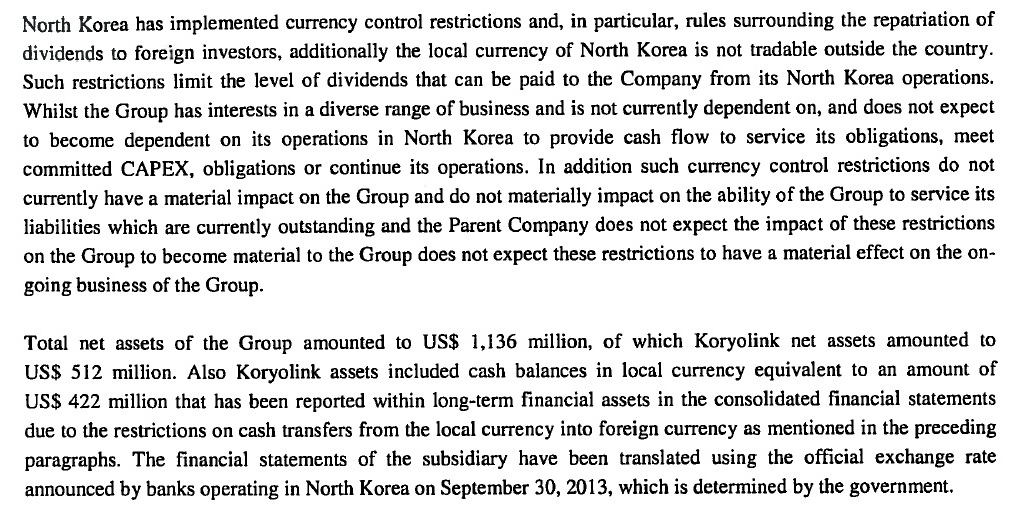
The audit is posted as an image PDF (so the text is not searchable or easily copied into blog posts), but I offer some key data below. The caveat to keep in mind is that all of the USD$ calculations appear to be determined by converting DPRK Won (KPW) at the official rate (appx 100KPW/1US$ and 130KPW/1 Euro). This may be the appropriate accounting standard to employ, but needless to say, this radically overstates the market value of the firm’s position since the current black market rate of the won is approximately 8,000KPW/1US$:

OTMT-screenshot-1-2013-09

US$422 million is $42.2 billion North Korean Won (converted at the official rate). Converted back to US$ at the black market, the total is just US$5,275,000.

OTMT EBITDA (Earnings before income tax, depreciation, amortization) for the period Jan-Sept 2013 are listed as USD$178,962,000. This is just  US$2,237,025 million at the black market rate.

Capital expenditure from Jan – Sept 2013 is listed as USD$40,931, 000 (Appx $665,128 at black market rate).

KoryoLink’s tax exempt status ended on Dec 15, 2013.

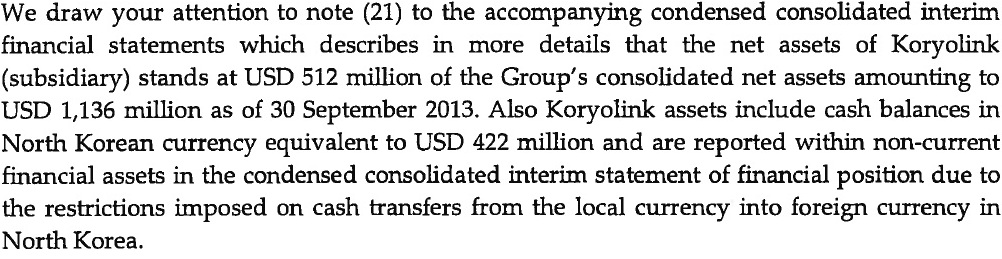
The audit specifically addresses the difficulties of operating in North Korea’s official financial sector:

OTMT-screenshot-2-2013-09

Some additional documents from June of this year can be found here and here. I am not an accountant and already have enough on my plate, so if there are any researchers out there that want to take a crack at this stuff, please do.

Share

Koreas promoting Kaesong Industrial Center to foreign investors

Thursday, December 19th, 2013

According to the Associated Press:

North Korea allowed about 30 foreign government officials, central bankers and diplomats to tour the industrial complex in Kaesong. The foreigners were in Seoul, South Korea, for a conference of the Group of 20 countries.

“This is an authoritarian regime with a very nasty way of punishing anybody … who is against the regime,” said Paola Subacchi, director of international economics research at Chatham House, an independent policy institute based in London. “There’s no transparency, no accountability, nothing that could make an international investor happy and willing to invest.”

But Subacchi said the complex’s expansion might bring positive changes to North Korea because it would provide jobs and help feed North Korean workers and their families.

Hong Yang-ho, South Korean chairman of the committee that oversees management of the park, estimated the complex would create jobs for about 120,000 North Korean workers if it is fully occupied with factories. About 40 percent of the complex is currently being used.

The industrial park combines South Korean capital and technology with cheap North Korean labor. Currently around 53,000 North Koreans are working in the complex at some 120 companies. North Korea is estimated to have received $80 million in workers’ salaries in 2012, an average of $127 a month per person, paid in U.S. dollars, according to South Korea’s Unification Ministry.

The invitation to visit Kaesong was the first concrete step that the two Koreas have taken toward opening the complex to overseas investors since they agreed to restart the park in September.

Operations had been halted in April when North Korea withdrew its workers amid tension over its threats of nuclear war. The complex reopened after North Korea toned down its rhetoric and began pursuing diplomacy with South Korea.

The two Koreas also agreed to work toward attracting overseas investment and discuss other ways to improve business, including better communication and allowing people and goods to move more freely to and from Kaesong.

Domenico Lombardi, a think tank director, said he would not build a factory in Kaesong if he were a businessman because of the risks and high uncertainty.

But he said it was a positive sign that North Korea was eager to show the park to foreigners.

“This is the first step of what a more open North Korea would be one day,” said Lombardi, director of the Global Economy program at the Center for International Governance Innovation, based in Ontario, Canada.

The next challenge for North Korea will be “making their own economy more accessible to foreign investors,” Lombardi said.

Read the full story here:
Inter-Korean Factory Park Tough Sell to Outsiders
Associated Press
Youkyung Lee
2013-12-19

Share