Archive for the ‘Economic reform’ Category

North Korea seeks investments from overseas Koreans

Friday, March 7th, 2014

Institute for Far Eastern Studies (IFES)
2014-3-7

North Korea has been showing increased efforts in attracting economic investment from overseas Koreans. In particular, recent foreign media outlets run by overseas Koreans are showing increased emphasis on economic cooperation with North Korea.

In the March issue of the monthly magazine Joguk (Homeland) published by the General Association of Korean Residents in Japan (a pro-North Korea association), featured an interview with Park Kyung Jin, the director of Economic Cooperation Office for Overseas Koreans.

In the interview, Director Park described the plans for the organization: “We are diligently working to create an environment where overseas Koreans can successfully do business with North Korea.” He also emphasized that they are continually working to protect the rights and provide special legal treatment for overseas Koreans.

On February 24, US-based pro-North Korean website Minjoktongsin (Minjok Thongsin) introduced Kim Ji Hyuk and Ri Hak Song, department heads of the (DPRK) State Economic Development Commission in an article, “Where Is the North Korean Economy Heading?”

In the article, the officials stressed that North Korea is actively looking to foster economic experts and said, “We welcome the participation of experts, businesses, and organizations of overseas Koreans who wish to invest in North Korea.”

In addition, in order to increase economic cooperation with overseas Koreans, the commission introduced future plans of easing the travel process to and from North Korea including visa and other entry requirements.

North Korea is subject to international sanctions that limit its trade with most of the world and appears to be turning to overseas Koreans to overcome the country’s economic crisis. Rather than reaching out to other foreigners, North Korea is likely to be reaching out to overseas Koreans who share a common language and ethnicity, with relatively easier access.

Since the establishment of the Joint Venture Act in 1984, North Korea has worked extensively with the General Association of Korean Residents in Japan and with ethnic Koreans living in China. Since the launch of the Kim Jong Un regime, economic development zones (EDZs) are being set up across the country and ties with overseas Koreans are likely to be strengthened in efforts to further attract foreign investments into North Korea.

Share

DPRK as e-waste conduit

Thursday, March 6th, 2014

According to Bloomberg:

How did North Korea become the conduit by which thousands of tons of old junk moved from the developed world into China’s bustling e-waste recycling industry?

As with any smuggling story, the tale starts with a prohibition. In this case, Chinese laws and regulations prohibit e-waste — most commonly understood as old, non-working electronics like laptops, monitors and mobile phones — from being imported into the country. The reasons are several, including a government interest in keeping used foreign goods from competing against new ones, and environmental concerns about how some of those goods are recycled. Nevertheless, China’s national-level environmental and customs authorities have long struggled to maintain those prohibitions against local ports and authorities — especially in south China — who view e-waste recycling as a good source of jobs, tax revenue, and used components to drive local industry. Of the several conduits through which e-waste has traditionally been smuggled, the most common and long-standing was over the Hong Kong-China border.

That all changed in February 2013 when — for reasons that are still unclear — Beijing announced “Green Fence,” a high-level crackdown on the import of prohibited waste and recycling exports, including old electronics. Nonetheless, here and there, imported old electronics still turned up in Chinese recycling facilities (I personally saw them).

The likely means, as described in state media after the North Korea bust, was convoluted. A Hong Kong “gang” allegedly received containers of used electronics from abroad. They arranged for them to be placed them on smaller ships bound for a “country in Northeast Asia.” The culprit’s identity is clear from the awkward phrasing. Criticism of North Korea in the Chinese press is exceedingly rare and -– needless to say — connecting the country to an e-waste smuggling ring qualifies as criticism. Were the country Japan, or even South Korea, it would have been named.

In fact, North Korea has long been rumored to be an e-waste recycling center. Since January 2008 a Chinese company based in Liaoning Province along the border has advertised for scrap to feed its e-waste recycling operations in North Korea itself. The facilities are located, according to the ad, in the port of Nanpo, and “take advantage of North Korea’s environmental policies and inexpensive labor resources.” There, the ad promises, prohibited e-waste can be dismantled and transformed into a product acceptable for export to China.

The smuggling ring was allegedly doing something similar, although its “transformed” e-waste clearly did not meet environmental standards. In North Korea the bulky e-waste was dismantled (steel cases would be removed from old desktop PCs, for example), segregated into marketable components like computer chips for re-use, and then sent to Dandong, a Chinese city and port on the Yalu River, directly across from North Korea. From there, the goods were trucked south, to recycling and re-use centers in Guangdong Province, a straight-line distance of roughly 1,800 miles.

Read the full story here:
Did North Korea Recycle Your Laptop?
Bloomberg
Adam Minter
2014-3-6

Share

State Economic Development Commission and the Jang purge

Wednesday, February 26th, 2014

Two officials at the State Economic Development Commission have apparently been reinstated following their removal during the purge of Jang Song-thaek. According to Yonhap:

Kim Ki-sok and Kim Chol-jin, chief and deputy chief of the North’s State Economic Development Commission, had been sacked in connection with the purge and execution of leader’s uncle, Jang Song-thaek, in December last year, but have been reinstated after undergoing an “ideology re-education,” the source said on the condition of anonymity.

“Kim Ki-sok and Kim Chol-jin were forced to resign from the posts after being involved in the case of Jang Song-thaek, but reinstated as they were considered not so close to Jang,” the source said.

After reinstatement, Kim Ki-sok, chief of the North Korean commission, made secret visits last week to Beijing and Shenzhen, southern China, during which he met with Chinese business people, according to the source.

Here is what the Choson Ilbo had to say:

A source in Beijing said Kim visited Beijing, Shenzen, Singapore and Malaysia last week. He met with businesspeople interested in developing North Korea’s special economic zones.

Kim also met with Chinese officials who had experience in developing special economic zones, the source said. In Singapore, Kim discussed the development of a tourism zone in Wonsan.

But he apparently returned empty-handed.

Diplomatic sources in Beijing say North Korea is poised to push for more economic exchanges with China after elections for its rubber-stamp parliament on March 9. It will form a new team to handle the initiative now that Jang and his associates have been purged.

Prime Minister Pak Pong-ju or Ri Su-yong, a deputy department chief in the Workers Party who used to manage the coffers for former leader Kim Jong-il, may pay an official visit to China, according to sources.

Read other posts about the State Economic Development Commission here.

Read the full story here:
N. Korea reinstates key officials on economic projects with China
Yonhap
2014-2-26

Share

Babson on post-Jang economic management

Monday, February 24th, 2014

Writing in 38 North, Bradley Babson comments on the effect Jang Song-thaek purge will have on North Korea’s economic management moving forward:

With Jang’s demise there is now a potential opportunity to make fundamental changes in the North Korean economic management and financial systems. Removing his influence over major foreign exchange earning enterprises operating outside any institutionalized supervision means that some other mechanisms must be put in place to manage these important national resources. Whether this will lead to a more rational system of cabinet-managed financial institutions serving an economic development strategy endorsed by Kim Jong Un is a basic question. Early indications are that the cabinet will be empowered to exercise more centralized control over the economy,[2] but how far this will extend into the fragmented financial system remains to be seen.

One indicator of possible significant change is whether the KPA will regain its former economic independence or become more closely integrated with national economic and financial management. This is important for improving efficiency in allocation of resources for economic development and having more control in balancing security expenditures with investments in the general economy.

Another indicator will be whether the existing system that provides funds for sustaining luxury goods patronage for the Pyongyang elite and for showcase projects like equipping the new Masik Pass ski resort, will be handed over to new more loyal technocrats to manage. Or will the Cabinet be given more latitude to shape the future political economy and distribution of wealth, given the reality that access to market power is becoming more valuable for the Pyongyang elite than receiving patronage? This would be a major change that could lead to new incentives for more rational economic management. Acknowledgment that markets are here to stay would open the possibility of addressing the need to build new financial institutional capabilities required for mobilizing and regulating private savings and economic activity. This would also help focus attention on ways to improve macroeconomic management of the mixed state-directed and market economy system.

Read the full story here:
The Demise of Jang Song Thaek and the Future of North Korea’s Financial System
38 North
Bradley Babson
2014-2-24

Share

2013 Inter-Korean trade

Monday, February 24th, 2014

According to Yonhap:

Trade between South and North Korea fell to its lowest level in eight years in 2013 due to their strained relations, data showed Sunday.

Inter-Korean trade reached US$1.15 billion last year, down a whopping 41.9 percent from the previous year’s $1.98 billion, according to the data from the Korea International Trade Association (KITA).

South Korean exports to the North nose-dived 41.1 percent on-year to $531.8 million, with imports from the communist country sinking 42.5 percent to $617.2 million.

The 2013 inter-Korean trade volume was the lowest since 2005, when the figure came to $1.06 billion.

In contrast to the plunge in trade with South Korea, the North’s trade with China, its chief ally and largest benefactor, jumped 10.4 percent on-year to a record high of $6.54 billion last year, according to the data.

Between 2009 and 2014, North Korea’s trade volume with China, the world’s second-largest economy, had been growing an annual average of more than 40 percent, the data showed.


According to the Choson Ilbo:

Inter-Korean trade fell to 18 percent of the North’s trade with China, the lowest since 2005.

South Korea’s imports of textile goods and electric and electronic products from the North fell 45 percent and 43 percent, while the North’s imports of mineral and textile products from China increased 15 percent and 33 percent.

Of course inter-Korean trade was down due to the DPRK’s closure of the Kaesong Industrial Complex (KIC). Once the complex was reopened, trade began to recover.

More on China-DPRK trade in 2013 here.

Read the full stories here:
Inter-Korean trade hits 8-year low in 2013
Yonhap
2014-2-23

N.Korean Trade with China Grows
Choson Ilbo
2014-2-24

Share

The rise and fall of the Rakwon Chicken Specialty Restaurant (a case study in inter-Korean business)

Tuesday, February 18th, 2014

UPDATE 4 (2014-2-18): Western tourists are still visiting the restaurant (meaning it has a contract with KITC). The restaurant still has the sign “Rakwon Chicken Specialty Restaurant”, though it is a different color than the original. See tourist video here and here.

UPDATE 3 (2014-2-17): The Hakyoreh updates us on the fate of the inter-Korean chicken restaurant:

In 2005, Choi made his first trip to North Korea to inquire about chicken imports. Soon he had changed plans: he would open his own restaurant there selling South Korean-style chicken. Acquaintances tried to talk him out of it, but he was determined. “I went to Pyongyang and I could see there was money in it,” he recalled. And with economic cooperation between South and North at an all time high, he didn’t see much of a political risk either.

He went back and forth to Pyongyang a few times looking for partners. Finally, in June 2007, he opened up the Rakwon Chicken Restaurant, selling South Korean-style chicken on Puksae Road in the Kaesonmun neighborhood of Moranbong District. His North Korean partner provided the building and staff; Choi was responsible for the interiors, ingredients, recipes, and management system. He reached a deal where he took 70% of profits with a total investment of 500 million won (US$470,000). The opening drew a lot of media attention at the time, with write-ups in the South Korean press and foreign outlets like the Washington Post and Japan’s NHK.

Early on, he did strong business selling at fairly steep prices – the equivalent of US$11.30 for a single bird. His clientele came mainly from the city’s upper class and Chinese visitors. Sales of 100 million won (US$94,000) a year looked to be in sight. “My plan was to open up 100 restaurants in the North,” Choi said.

But in 2008, less than a year after he opened the restaurant, Lee Myung-bak took office as South Korean President. Lee’s administration put a stop to the previous decade’s policies of engagement and cooperation with North Korea, opting for sanctions and containment instead.

“There was a promise between the two sides, and I never thought that would be rejected completely,”Choi said. “Suddenly, that was the reality.”

Bit by bit, exchange ground to a halt. A March 2008 shipment of ingredients through Nampo turned out to be Choi’s last interaction. He had not yet received a single share of revenue.

Then came the announcement of the so-called “May 24 measures” in 2010. Following the sinking of the ROKS Cheonan warship the preceding March, Seoul had called a complete halt to all exchange and economic cooperation with North Korea.

“All the May 24 measures did was drive it home,” Choi insisted. “Most of the economic cooperation had been choked off long before that.”

For the next four years, Choi wasn’t able to set foot in North Korea. Without his support, the restaurant lost its chicken focus and began selling ordinary cuisine. Choi’s other business began to suffer too.
“I’d put my house and buildings up as collateral to borrow the 500 million won to invest in the North,” he said. “Then, to top it all off, there was the US financial crisis. Things began to go downhill rapidly in South Korea, and my business started to fall apart.”

UPDATE 2 (2009-1-1): The BBC offers an update of the new chicken restaurant:

The governments may not be on the best of terms but a South Korean businessman seems to have found a way to North Koreans’ hearts: their stomachs.

Choi Won-ho, the owner of a fried chicken chain, was told he was doomed to fail when he opened his first branch in the impoverished North last year.

But encouraged by his progress so far, he is already preparing to open another one.

Mr Choi runs a fast food franchise in South Korea with a total of 70 stores.

He opened one more last year – no real challenge you might think – except this extension to his fried chicken empire is in the heart of one of the most secretive and business-unfriendly places on the planet.

But Mr Choi says the citizens of Pyongyang have been queuing in front of his shop which is taking around $1,000 a day.

He is now preparing to meet North Korean officials in January to finalise the approval for a second outlet.

His customers are almost certainly all members of North Korea’s elite, a country in which the World Food Programme says up to 9m people will face urgent food shortages this winter.

Relations between the two Korea’s have been at a low since the conservative government of President Lee Myung-bak came to power in the South in February.

North Korea has severed official contacts, stopped all cross-border tourism and restricted entry to a joint industrial zone built with southern money.

But despite the chill, Mr Choi’s fried chicken venture seems to be sizzling.

Read the full story here:
South Korea Chicken Success in NK
BBC
John Sudworth
2009-1-1

UPDATE 1 (2008-11-1): The restaurant is set to open in February 2008. According to Yonhap:

An inter-Korean joint-venture chicken franchise will open its first store in Pyongyang early next month, the head of the franchise’s South Korean partner said Friday.

The store set to open in early February will provide a food delivery service using motorbikes for the first time in the communist country, Choi Won-ho, president of the South Korean company said.

No North Korean restaurants offer food delivery service now, according to defectors from North Korea.

Fried, grilled and steamed chicken dishes as well as draft beer are available for delivery, he said, adding the food will be prepared in the North Korean style.

“I recently received a photo of the store’s interior design from our North Korean business partner, Rakwon General Trading Corporation, along with the offer to open the first store before the 66th birthday of North Korean leader Kim Jong-il,” Choi told Yonhap News Agency by phone. “After opening, I will use radio and newspaper ads to promote the business.”

Kim’s birthday, which falls on Feb. 16, is the most festive holiday in the North.

The North Korean company will provide land, some 20 low-cost workers, chicken, and draft beer. The early-stage investment, equipment, cook and spicy chicken will come from the South Korean chicken franchise called “Matdaero Chondak,” Choi said.

The first “Rakwon” chicken restaurant in Pyongyang will have the capacity of seating about 200 people, he added.

The businessman said he will visit North Korea next week to discuss the opening of the store.

“I hope the business will thrive enough so that we can open store No. 10 in Pyongyang,” he added.

Read the full story here:
Inter-Korean joint venture chicken franchise to open first store in Pyongyang
Yonhap
1/11/2008

ORIGINAL POST (2007-11-3): A South Korean entrepreneur is investing in a new fried chicken restaurant in Pyongyang:

According to Reuters:

A South Korean businessman plans to begin a fried chicken delivery service in the North Korean capital, with the first foreign-run restaurant in a country that struggles to feed its own people.

Choi Won-ho, head of a fried chicken franchiser that has about 70 restaurants across South Korea, said Friday he is opening a 50-table restaurant in Pyongyang on Nov. 15. It will also deliver chicken and draft beer to homes.

“I have wanted to be the world’s best chicken brand,” Choi told The Associated Press in a telephone interview.

“But I thought it makes no sense to conquer the world without sharing food with our compatriots. That’s why I went there first,” he said. “I plan to get into the Chinese market via Pyongyang.”

He laughed off concerns his venture may be too risky in the impoverished and isolated country of 23 million, where the elite citizens of the capital are much better off than others.

“I don’t think that I’m going to lose money at all,” he said.

It will be the first foreign-run restaurant in North Korea, according South Korea’s Unification Ministry.

Choi, 48, who has been in the fried chicken business for 15 years, said he hired an ethnic Korean Chinese as the main cook for the Pyongyang outlet and taught him all his cooking know-how. About 20 North Koreans will also work at the restaurant and five scooters will be used for deliveries, he said.

Choi said he invested about 500 million won (US$551,339, ?382,264) in the joint venture with a North Korean trading firm that will take 30 percent of the profits from the business.

North Korea is one of the poorest countries in the world and has relied on foreign food aid to feed the population for more than a decade since natural disasters and mismanagement devastated its economy.

Relations between the two Koreas have improved significantly since their first-ever summit in 2000, spurring a series of exchange projects between the Cold War rivals that fought the 1950-53 Korean War. That conflict ended in a truce, not a peace treaty, leaving the two sides still technically at war.

According to the Joong Ang Ilbo:

South Koreans are making two very different attempts to improve the culinary life of impoverished North Koreans.

First, a South Korean fried chicken franchise will open the only foreign-run restaurant in North Korea, targeting family dining on special occasions.

Second, the labor union of a South Korean conglomerate has built a plant in Pyongyang to provide cheap corn noodles to northerners who suffer from food shortages.

Choi Won-ho, who runs Matdaero, a 70-store fried chicken franchise in the South, said yesterday he would open a restaurant in a joint venture with a North Korean state-run trading company, near the Arch of Triumph in central Pyongyang on Nov. 15.

The restaurant will both receive walk-in customers and deliver chicken and draft beer to homes. Such places are common in South Korea, but it will be the first chicken joint of its kind in North Korea.

Choi has invested 500 million won ($551,000) in the restaurant’s cooking facilities, interior decoration and delivery scooters. He will split the profit 70-30 with the North Korean firm.

Choi, 48, who has been a chicken entrepreneur for 15 years, said there should be sufficient demand despite North Korea being one of the world’s poorest countries, because he plans to offer lower prices to locals.

“I will charge about $3 for a whole chicken for North Koreans and at least $12, the same price as in South Korea, for tourists from the South and other countries,” Choi said yesterday by phone. “One whole chicken will be enough for a four-member family, so the price of $3 will not be too burdensome for special occasions.”

The store will hire about 20 North Koreans to take telephone orders, fry the birds and make home deliveries. It will have seating for 50.

Separately, the labor union of Hyundai Motor Company, Korea’s top automaker, said in a statement that it has completed an 1,800-square-meter corn-noodle plant in Pyongyang. The plant can produce two tons of corn noodles a day, it said.

Hyundai Motor’s 44,000 unionized workers agreed in August to help a South Korean humanitarian group build the noodle factory. Workers donated about 12,000 won each, 500 million won in total, for the facility.

“The plant will be a great help to relieve the food problems of North Koreans,” Chang Kyu-ho, a spokesman for the labor union, said. “Corn is a staple food for North Koreans.”

Read the full stories here:
Fried chicken franchise goes North
Joong Ang Daily
Moon So-young
11/3/2007

S Korean businessman to debut fried chicken at first foreign-run restaurant in North Korea
Reuters (Via DPRK Studies)
Jaesoon Chang
11/3/2007

Share

The status of the cabinet still rising

Sunday, February 9th, 2014

Institute for Far Eastern Studies (IFES)
2014-2-9

In this third year of the Kim Jong Un regime, the expanding activities of the Cabinet are drawing much attention. High-level officials of the Cabinet are frequently appearing at public events in North Korea and Kim Jong Un is repeatedly emphasizing the importance of this organ of state power.

North Korean media reported on the February 12th annual mass rally celebrating Kim Jong Un’s Songun leadership at the secret camp in Mount Paektu. The speakers at the event were reportedly Senior Workers’ Party of Korea (WPK) Department Deputy (1st vice) Director Choe Hwi, Vice Minister of the People’s Armed Forces Kang Pyo Yong, and Vice Premier Jon Sung Hun.

At the event, Vice Premier Jon delivered a speech and expressed determination to “follow the ideology and policy of our revered leader Kim Jong Un and solidify the monolithic leadership system of the Party in all state economic policy.” In addition, he promised to elevate the status and responsibilities of the Cabinet as “the control tower” of the nation’s economy.

The annual mass rally is held for those to display loyalty to the deceased leader Kim Jong Il (whose birthday is celebrated on February 16). The event is attended by party, state, and military officials. Since Kim Jong Un’s power transition in 2011, it is unprecedented for the North Korean media to cover the speech of the vice premier at this rally.

In addition, a national conference of sub-workteam heads in the agricultural sector (National Conference of Subworkteam Leaders in the Agriculture Sector) opened at the Pyongyang Indoor Stadium from February 6 to 7. At the conference, DPRK Premier of the Cabinet Pak Pong Ju, DPRK Vice Premier and State Planning Commission Chairman Ro Tu Chol, Vice Premier and Minister of Agriculture Ri Chol Man, Vice Premier and Minister of Chemical Industry Ri Mu Yong, and other high-level Cabinet officials were present, demonstrating the rising status of the Cabinet.

In particular, Kim Jong Un sent a letter (“Let Us Bring About Innovations in Agricultural Production under the Unfurled Banner of the Socialist Rural Theses”) to the participants at the conference. In the letter, he stated that “It is essential to enhance the role of the Cabinet and the agricultural guidance organs,” and that the power to make a transformation in agricultural production will depend “largely on the role of the Cabinet and the agricultural guidance organs.”

Furthermore, DPRK Premier Pak is actively conducting onsite inspections of various agricultural and economic related sites. He visited the construction site of the Sepho Tableland on January 29 and made a field survey of the Hwanghae Iron and Steel Complex and Posan Iron Works on February 2.

In a speech in April 2012, Kim Jong Un mentioned plans to strengthen the power of the Cabinet. This policy appears to be ongoing. As North Korea continues to emphasize agriculture as a core economic focus as well as improvement of the lives of the people, the role and the activities of the Cabinet are likely to be reinforced.

Share

A new electronic entry system launched for the Kaesong Industrial Complex

Thursday, February 6th, 2014

Institute for Far Eastern Studies (IFES)
2014-2-6

A pilot operation of the new electronic entry system, or radio frequency identification system (RFID), to facilitate the travel to and from the Kaesong Industrial Complex (KIC) was completed on January 15 and pilot operation began from January 28, 2014.

According to a Ministry of Unification (MOU) official, “The construction of the system began from December 11 last year and it was completed this month on the 15th. The trial operation period will begin from the 28th.”

The RFID system was agreed upon last September at the second meeting of the South-North Joint Committee for the Kaesong Industrial Complex in order to improve the South Korean companies’ access to the KIC.

The new RFID system will replace the paper document inspection with an electronic card system and personnel screening will be reduced to 5 seconds from 13 seconds while vehicle screening time will be reduced to 7 seconds from 15 seconds.

In particular, the reduced inspection time will facilitate the travel and ease the heavy traffic during Monday mornings and Friday afternoons: for personnel screenings, from 17 minutes to 5 minutes; for vehicle inspections, from 19 minutes to 8 minutes.

However, the existing personnel and vehicle access to the KIC which requires a 3-day advance notice still remains in effect, and the mobility of personnel and vehicles will still be strictly monitored and chaperoned by the North Korean military.

On the other hand, the fourth round of the sub-panel meeting was held on January 24 to discuss the operation of the RFID system, Internet connectivity, and simplification of customs process at the KIC.

In regards to the streamlining of the customs process, the two countries agreed to change it from ‘complete’ to ‘selective’ examination, but differences still remain over the ratio to be applied to the selective probe.

As for the issue of Internet connection, it is still in the infant stage and the two sides agreed to resume the negotiation on February 7.

Share

More measurement of the importance of markets in the DPRK: residential and public sector energy consumption

Monday, February 3rd, 2014

According to Yonhap (via the Korea Herald):

A fuel ration system in North Korea seems to have been dismantled due to a chronic fuel shortage, a report said Monday.

The report by the state-run Korea Energy Economics Institute (KEEI) said a majority of households in North Korea secure their fuel for heating and cooking on the black market or by themselves, hinting that the country’s fuel ration system might have been scrapped.

The report was made on the basis of data compiled from a poll of 350 North Korean defectors who fled the country after 2011.

According to the report, 51.1 percent of the North’s households bought their heating and cooking fuel on the market, with 42 percent gathering their fuel, such as firewood, by themselves.

Only 6.8 percent of them were provided with fuel for heating and cooking through the country’s fuel ration channel.

The energy consumption of a North Korean household was estimated at 0.291 tons of oil equivalent (TOE) as of 2011. The TOE is a unit of energy which is equivalent to the amount of energy released by burning one ton of crude oil.

The consumption of energy gaining from coal briquettes accounted for 36.8 percent of the total, reaching 0.107 TOE, followed by wood with 0.069 TOE, electricity with 0.038 TOE, oil products with 0.025 TOE and propane gas with 0.023 TOE.

The energy consumption for heating took up 50.9 percent of the total, amounting to 0.148 TOE.

The KEEI said a program for fuel aid to North Korea should be mapped out on the basis of exact data on the energy consumption in the North’s private sector.

You can download the full report here in Korean (PDF). Here is the web page for the Korea Energy Economics Institute.

Read the full story here:
Fuel ration seems to have been dismantled in N. Korea: report
Yonhap
2014-2-3

Share

Kim chol-jin and the Economic Development Committee

Monday, February 3rd, 2014

ÝÁ °æÁ¦°³¹ß '¼ûÀº ½Ç¼¼' ±èöÁø ±¹°¡°æÁ¦°³¹ßÀ§ ºÎÀ§¿øÀå

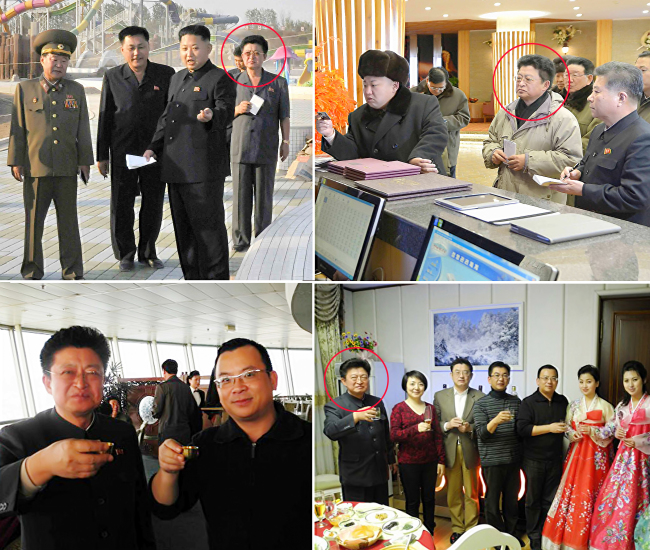
Kim Chol-jin, the deputy chief of North Korea’s National Committee for Economic Development, is seen with North Korea head-of-state Kim Jong-un in Pyonyang’s water park (top left) and at the Masik Pass ski resort (top right). A Shanghai businessman uploaded the two lower pictures showing Kim meeting Chinese businessmen onto his blog in January 2012. (Yonhap)

According to the Korea Herald:

Kim Chol-jin is the newest influential economic policymaker in North Korea said analysts, after television images recently showed the bureaucrat accompanying head of state Kim Jong-un on multiple inspection rounds.

The North Korean Central News Agency broadcast images of Kim Chol-jin, the deputy chief of the National Committee for Economic Development, shadowing the North Korean leader to economically symbolic sites such as the Masik Pass ski resort last December. The ski resort opened last year as part of efforts to boost foreign tourism in the reclusive country.

“That deputy seat is actually closer to that of a minister here in the South,” said Ahn Chan-il, the head of the World North Korea Research Center. “He will likely have clout on North Korea’s economic policies.”

North Korea analysts expect Kim Chol-jin to spearhead much of the North’s recent economic plans to earn cash through foreign investment.

But the latest television images showing Kim Chol-jin do not include his immediate boss, the chief of the National Committee for Economic Development, implying that he is the de facto executive and his boss a mere figurehead, according to sources.

The deputy committee chief is an experienced trade official. He served at the North’s Ministry of Foreign Trade and at government agencies facilitating Chinese investment. Sources say he has extensive business connections in China and experience trading with South Korea in the mid-2000s.

Kim, along with Park Bong-ju [Pak Pong-ju], the Premier of North Korea and Roh Du-chol [Ro Tu-chol], head of the National Planning Commission, are expected to be the key members of North Korea’s economic policy team. North Korea experts consider Park and Roh to be market-orient reformists although one analyst voiced caution.

“Yes, (there) are changes on the margins, but they’re more for maintaining the current (political) system,” said Daniel Pinkston, the Deputy Project Director of the International Crisis Group’s North East Asia office.

The North’s economic development committee is the communist country’s key macroeconomic decision-making body. The committee oversees special economic zones, which lower taxes for foreign companies willing to invest there. Russia and China have been the main bidders.

Read the full story here:
New economic czar emerges in N. Korea
Korea Herald
Jeong Hunny
2014-2-3

Share