Archive for the ‘Economic reform’ Category

Markets close for rice planting

Thursday, June 8th, 2006

From the Daily NK:

In June, the highest peak of rice-planting season, North Korean authorities station security guards to be at the crossroads of Jangmadang(a type of black market) and get undercover police officers to wander the streets and regulate people with focused control who are trading. During the rice-planting ‘period of full mobilization’ goods that are sold secretly are all collected.

Also, it has become known that rice in the Onsung region is trading for 1,200won ($0.4).

North Korean citizen, Lee Hyun Sook (32 years, born in Onsung) who to obtain food passed Tumen River revealed while meeting a reporter on the 5th near Yanji City, China that “The people are driving the whole rice-planting battle.”

Lee who came to China bringing a 5 year old child after losing her husband barely ran a business in Jangmadang, and continues her living as a common homemaker. After authorities shutdown Jangmadang in spring, Lee says she was driven to the village, thus crossed the Tumen River as otherwise her child would die of hunger.

Following Is Questions and Answers with Ms. Lee

– It’s said Jangmadang was shutdown?

The security office controlled and did not permit morning Jangmadang. Security guards stationed the road that intersects with Jangmadang, whilst common police officers roamed the street controlling people trading. Goods that are secretly in trade during ‘the period of full mobilization’ are all collected.

– How will you live if Jangmadang is shutdown?

From 6 o’clock in the evening Jangmadang doors are open. People like me who earn a daily income and live off their daily income are about to die.

– When is the period of full mobilization until?

Every year when it is farming season, full mobilization is set up. There is no designated date, but is terminated when rice-planting and weeding is complete.

– What type of people are targeted for full mobilization?

After morning, it is quiet and there are no people in the city. Factories, companies, people on the street, students, no differently anyone who holds a spoon all leave. Even the people from far distances (long distance trading) are supervised on the street.

– It’s said that even traveling permission have been reinforced…

The security office does not even issue traveling permissions. People that must go take a citizen warrant, but security guards and police officers come stop their cars on the street regulating people and even collect goods. In particular, people from other provinces are especially made to do a lot of work.

– How much, how long are you made to work?

Supervised people are only sent away when a rice seedbed, 9m long and 1.6m wide is pulled by hand. Those assigned rice-planting pair-up together and only send people away at night, when all the seeds have been planted

According to Lee, when the “Rice-planting full mobilization group” is organized, executive officers go to each farm to manage the people’s Jangmadang and direct the people’s village mobilization. On one hand, she says “When it is morning the broadcasting car roams the streets announcing ‘You have to farm well, to win the fight with Americans’ ‘You have to farm well, to realize the general’s worrying thoughts of the people’s hunger problem.’

Price Increase in the Period of Full Mobilization

It appears that during the period of village mobilization, the price of good rises due to operation restrictions. People wanting to buy rice wander trying to find rice sellers and people that secretly sell and buy in the alleyways are disciplined and carried off to the security office.

The price in Onsung Jangmadang is 1,200won ($0.4) per 1kg of rice and 250won ($0.083) for corn. Fresh pork is 1,800 won ($0.6) per 1kg, as it can spoil easily in the warming weather, but can be bought for 1,600won ($0.53) towards the end of day. It is of course unreasonably expensive compared to a laborer’s monthly income of 5,000won ($1.67).

In a way, on commencement of trade, the people cannot even spread open their goods at Jangmadang but sell to people secretly. Lee said “Food is given, a lunch meal per day for people mobilized to the village.”

After the Resumption of Rationing, There is No News for a Long Time in Onsung

Lee says that it has been a long time since distribution in the Onsung has stopped.

After being questioned “How much rationing have you seen?” Lee said that “No rationing was received since 1994.” Lee comments that last year October, she knew of the truth that rationing had been resumed, but as a non-laborer with no husband, there wasn’t a time she received the classified rations.

Last year October, North Korean authorities instructed the distribution of rations according to districts, but smaller districts were given rice only for a few months before being exhausted. The distributions to the people from factories are 15day rations to last a few days, but Lee and other similar housewives respond to the distributions as completely unfamiliar terms.

People like Lee who earn a daily income and live off their daily income, become suffocated in the reality of their lives when mobilized to the villages. For this reason, there is an actual increase of North Korean people crossing the Tumen River to do suitcase business and earn money.

Share

Seoul says no DPRK aid without railways test

Thursday, June 8th, 2006

From the Korea Times:

South Korea’s chief delegate for the inter-Korean economic talks yesterday reaffirmed the North will not be getting any new economic support unless it pushes ahead with the railways test-run.

In a radio interview, Vice Finance Minister Bahk Byong-won said, “We created a structure in which the additional economic cooperation is only possible after the railways test-run.”

The two Koreas closed their 12th Economic Cooperation and Promotion Committee meeting in Jeju on Tuesday with a nine-article agreement on support for light industries, natural resources development and others.

The two sides concurred such agreements will only be implemented when “conditions are met,” which they verbally confirmed referred to the cancelled cross-border test-runs.

North Korea abruptly cancelled the scheduled testing last month, prompting an angry response from the South.

The South, remaining steadfast to its policy of engaging more economically with its communist neighbor, believes staunch military authorities to be behind the cancellation.

“(The North’s) military authorities are closely connected with the procedures of implementing many of the inter-Korean agreements. And the (preconditioning) clause refers to just that,” Bahk said, emphasizing that the North Korean military must take visible measures such as preparing a military guarantee for the railways operation.

The two railways, on the east and west of the Korean Peninsula, run through heavily fortified borders. It would be the first time in over five decades that the trains run.

“Although we said ‘conditions’ in the agreement, both sides made clear when we read out the agreement that the conditions referred to the railways test to avoid any conflicting interpretations in the future,” Bahk said.

([email protected])

By Lee Joo-hee

Share

North Korea’s Military-First Policy: A Curse or a Blessing

Thursday, June 8th, 2006

Nautilus Institute
Alexander V. Vorontsov
6/8/2006

The “Songun Chongch’i” or military-first politics mantra adopted by North Korean leader Kim Jong-il as a guideline for domestic governance and foreign policy has elicited mostly negative responses from Korea-watchers. Many view songun as the final phase in the deterioration of North Korea and a serious threat to neighboring states saying that an impoverished country of 24 million inhabitants supporting a military of more than 1 million soldiers is incapable of modernization and economic reform. They argue that greater military participation in politics creates a dual-pronged threat: the army may appropriate a greater share of already-dwindling state funds to increase its readiness and effectiveness; and the generals, supposedly the most militant sector of the policy-making structure, will have a louder voice in foreign policy formulation, which could lead to hostile rhetoric towards South Korea.

A less alarmist interpretation of military-first politics is that Kim Jong-il is trying to maintain the existing order, to strengthen his regime based on personal authority, and consolidate control of military forces with the goal of preventing an overthrow of the state.

So, is military authority a curse or a blessing? The lessons from history are ambiguous, as states ruled by the military have experienced both prosperity and hardship. But some argue that South Korea represents a relatively positive example in which it has experienced a national revival because of a period of military rule.

In 1961, Park Chung-hee, a colonel in the ROK army, seized authority South Korea in a bloodless coup and established a rigid dictatorship with his military comrades. Though politics became more repressive, the national economy grew exponentially and General Park is remembered by many as the “father of the South Korean economic miracle.” Few dispute that this economic growth planted the seeds for the ensuing process of democratization. So it is hardly accidental that, in recent years, Kim Jong-il has started to speak favorably of General Park and his role in the modernization of the Republic of Korea.

The implementation of songun in the mid-1990s increased the role of the Korean People’s Army (KPA) in daily life. The army began to participate even more in social and economic decision-making, from large-scale infrastructure development to providing its own food. While military personnel are required to serve for ten years, they spend most of their service participating in different areas of the country’s socio-economic life. Thus, the army is now not as heavy economic burden, and is serves as an important resource and catalyst for developing the national economy.

The movement to the military-first policy has accompanied a gradual transformation of North Korea’s planned economy to the direction of a mixed economy. The result may eventually be a network of large, less state-controlled corporations that share close ties with government agencies, similar to the “chaebol” that Park Chung-hee created in South Korea. Because of this, the North Korean military is now involved in different spheres of economic activity, including foreign economic ties and trade operations, and will likely play a key role in this ongoing process of privatization.

With songun also come changes in ideology. This change and its underlying goal of building a powerful and prosperous state – “kangsong taeguk,” are justified by flexible and creative interpretations of the bedrock ideal of self-reliance – “juche,” a nationalist ideology developed by revolutionary leader Kim Il-sung. The songun concept replaces the proletariat and the vanguard Communist Party with the army as the driving force in society. This innovation is significant because the army is typically a less ideological and more pragmatic institution than the Party.

The army’s role in society is not the only example of Kim Jong-il’s liberation from orthodox ideologies. Since the early 1990s, North Korea has shifted its emphasis from socialist ideals to historical and spiritual values. This is reflected in the use of Confucian norms in public policy and everyday life, and legitimizing the state through reference ancient Korean kingdoms. Again, the parallels with Park Chung-hee are very strong. Kim Jong-il has also sought to reduce the prevalence of the personality cult. From early 2004, for example, there could be only one portrait of Kim Il-sung in public places. Similarly, Kim Jong-il is to be described only by his official positions, rather than the use of laudatory epithets such as “Dear Leader.”

Songun should not be automatically dismissed as an ideological dead-end. As the experience of South Korea under Park Chung-hee demonstrates, military rule can have positive effects on society under certain conditions.

Share

Joint railway tests still on the agenda…

Wednesday, June 7th, 2006

From the Joong Ang Daily:

South Korean delegates at the inter-Korean economic talks here won a victory of sorts early yesterday morning; North Korea agreed to Seoul’s linkage of the completion of test runs of the newly reconnected railroads across the Demilitarized Zone to its offer of raw materials for the North’s light industries.

But in what apparently was a face-saving gesture to the North, the linkage was not made explicit in the joint announcement of the results of the four-day meeting. South Korea agreed to supply a package of raw materials for the North’s shoe, soap and textile industries worth $80 million, which will be delivered “when necessary conditions are met.” The agreement said nothing more about the conditions, but the rail tests, most recently cancelled by North Korea the day before they were to be conducted last month, were clearly the point at issue. Kim Chun-sig, the Seoul delegation’s spokesman, made that explicit. “The trial train runs are linked with the supply of raw materials, and the agreed announcement was issued with that understanding by the North.” He said agreement to the linkage was not easily won from the North; Seoul’s delegates stressed the uproar that would break out here if that condition were not attached.

The aid will be in the form of a loan to be repaid in kind ― North Korean natural resources ― over a 15-year period with an interest rate of 1 percent. The two delegations met the press to announce the agreement, saying they had signed a nine-point agreement and a 10-point supplemental document dealing with the aid package.

In the agreement, the aid is to be delivered in August. Mr. Kim said that meant that the necessary military-to-military agreement on safeguards required before travelers cross the Demilitarized Zone must be in place and the rails tests completed.

The strings attached to the aid package are something of a departure for the Roh administration, which has been tolerant ― far too tolerant, critics in the South contend ― of North Korea’s penchant for accepting aid donations while failing to keep promises it had made in return. Pyongyang’s cancellation of the railroad tests in late May was, apparently, too much for Seoul to stomach politically. The tests were cancelled the day before they were to take place, and the North blamed “political instability” in the South and the lack of a military safeguards agreement that the North itself has blocked.

A Seoul delegate said proudly, “Unlike in the past, we focused on enforcement of the agreement and secured some leverage over North Korea.” The two sides made some modest progress on other issues. They agreed to conduct negotiations on a joint project to mine gravel from the mouth of the Han River inside the Demilitarized Zone. They agreed that military-to-military agreements would be necessary for safety and security reasons. The project had been suggested by Seoul in April, and reflects the dwindling supply of such material here because of South Korea’s 30-year construction boom.

Other agreed meetings will address administrative procedures at the Kaesong Industrial Complex, flood control on cross-DMZ rivers and exchanges of weather data, especially on the yellow dust storms that originate in China’s Gobi Desert.

Share

Koreas agree on business contracts

Wednesday, June 7th, 2006

From the Korea Herald:

JEJU – The two Koreas yesterday agreed on a set of contracts to stimulate North Korea’s light industries and mining operations, but only when “conditions are met.” South Korean officials say the expression is a diplomatic term being used to describe the North’s obligation to allow the test run of trains on two cross-border rail links.

Economic delegates from Seoul and Pyongyang ended their four-day meeting on Jeju Island early yesterday morning, working out a nine-point agreement on various economic cooperation plans.

The talks were held against a background of hostility in the South following North Korea’s unilateral cancellation of the landmark testing of cross-border railways on May 25.

After marathon talks, the two sides managed to achieve a reluctant consensus on how to describe Pyongyang’s duty to revive the cancelled railway test-runs in return for a package of business cooperation deals.

The two sides resorted to indirectly referring to Pyongyang’s railway obligation by using the term “when conditions are met,” instead of using more direct language. Some observers said the “ambiguous” preconditioning leaves room for Pyongyang to pull out from the agreement later on.

The North apparently faces opposition from the military authorities who are apparently against opening the railways to the South. The North Korean military has demanded the two Koreas first conclude a full military guarantee.

“The implication of the agreement is that if there is no test run for the railways, there will be no economic support,” said Kim Chun-sig, spokesman for the South Korean delegation, during a press briefing.

Underscoring that the agreement is strong enough to encourage North Korea fulfill its part of the bargain, Kim said that the two Koreas would soon begin to discuss the military guarantees.

Based on the agreement, South Korea will provide some $80 million worth of raw materials needed for the destitute state to manufacture garments, shoes and soaps from August this year. North Korea will repay 3 percent of the loans in the form of minerals such as zinc. The interest rate was set at a low 1 percent.

The two Koreas also agreed to jointly develop North Korean mines and designate an organization to take charge of the project within one month from now.

Seoul officials argue that this agreement raises the level of inter-Korean cooperation to a mutual and commercial relationship from one-sided aid from Seoul to Pyongyang.

Other agreements included a joint excavation of aggregates in the Han River estuary that is located along the demarcation line, and to open working-level contacts from June 26-27 to discuss how to prevent the Imjin River from flooding nearby areas.

The two Koreas also saw eye-to-eye on advancing their joint businesses into third countries.

Another working-level meeting on the Gaeseong industrial park will be held from June 20-21.

The next Economic Cooperation and Promotion Committee meeting will be held in September in Pyongyang.

South Korean delegation was headed by Vice Finance Minister Bahk Byong-won and the North Korea team was led by Ju Tong-chan.

By Lee Joo-hee

From Yonhap:

The following is the full text of a joint press statement issued by South and North Korea at the end of their four-day economic cooperation meeting on the southern South Korean island of Jeju, Tuesday.

South and North Korea held the 12th meeting of the Inter-Korean Economic Cooperation Promotion Committee in Jeju Island on June 3-6, 2006.

During the meeting, the two sides discussed the issues to further develop the inter-Korean economic cooperation project in the interest of the Korean people in the spirit of the June 15 joint declaration, and agreed on the followings.

1. South and North Korea agree to adopt an accord on South-North Cooperation in Light Industry and Natural Resource Development and enforce it at the earliest possible time in favorable conditions.

2. South and North Korea agree to discuss and then implement a project to extract sand from the Han River’s estuary as military safety measures are taken.

3. South and North Korea agree to make necessary conditions for making the Kaesong Industrial Park globally competitive. To that end, the two sides will hold the second meeting of working-level officials for Kaesong industrial park construction and discuss ways of introducing an ID system, simplifying customs and passage procedures, securing a stable source of workers and building dormitories and convenient facilities to solve problems stemming from an increase in the number of workers.

4. South and North Korea agree to hold the first working-level meeting in Kaesong on June 26-27 to prevent flooding in shared areas near the Imjin River to review each other’s survey reports, discuss joint survey plans and ways of establishing a flood warning system.

5. South and North Korea agree to cooperate actively in preventing such natural disasters as flood, forest fires and yellow dust storms and discuss concrete issues at a working-level meeting in Kaesong sometime in July.

6. South and North Korea agree to discuss their advance into third countries in the field of natural resource development at a working-level meeting in Kaesong sometime in July.

7. South and North Korea agree to exchange economic observation delegations when an accord on South-North Cooperation in Light Industry and Natural Resource Development takes place.

8. South and North Korea agree to discuss and finalize the schedules of working-level meetings for fishery, science and technology cooperation, as well as a timetable for business arbitration committee talks, visits to Kaesong and Mount Geumgang and exchange of lists and other things, in the form of exchanging documents.

9. The 13th meeting of the Inter-Korean Economic Cooperation Promotion Committee will be held in Pyongyang in September 2006 and the date will be determined after consultation in the form of exchanging documents.

Share

Oil in the DPRK’s waters

Tuesday, June 6th, 2006

Hat tip to the Korea Liberator:

China and North Korea announce joint efforts to extract oil from the Yellow Sea. According to Yahoo News:

Tuesday June 6, 12:07 PM
China and North Korea have agreed to explore jointly for oil in the Yellow Sea that borders both countries, the Chinese foreign ministry said.

‘China and North Korea have agreed on the joint development of oil resources in the border sea and signed a joint development agreement between governments,’ ministry spokesman Liu Jianchao told journalists.

Liu gave no further details other than to say the two nations will continue work on the details of the arrangements.

Another foreign ministry official later confirmed the area to be jointly developed will be in the Yellow Sea.

The announcement came as North Korean Foreign Minister Paek Nam-Sun ended an eight-day visit to China today, a trip that Liu described as ‘successful’ while giving away few other details.

According to a report issued in December by the Washington-based Center for International Policy, North Korea has already laid claim to three northernmost Yellow Sea basins thought to hold oil.

The North Koreans had discovered up to 3 bln tons of recoverable oil and gas reserves in the Yellow Sea off its coast, the center said, citing a report by Chinese authors in the Marine Geology Letters journal.

China’s foreign ministry gave few details about Paek’s visit to China, other than to say he met Chinese Premier Wen Jiabao and Foreign Minister Li Zhaoxing.

But how much reserves does the DPRK have?  According to the Center for International Policy’s Asia Program,

One-third of 15 exploratory wells have shown oil, and Pyongyang may be sitting on information about larger deposits.

“North Korea has found on the continental shelf of the West Bay basin an area containing 3bn tonnes (21.9bn barrels) of oil and gas reserves,” Li Yandong and Mo Jie wrote in a 2002 issue of journal Marine Geology Letters.

North Korea says these are recoverable reserves pinpointed by its own scientists, said a Chinese expert with knowledge of the situation, who declined to be named.

Even a more modest estimate of 1.2bn barrels reported by Busuph Park, an expert in North Korea’s offshore efforts, would meet centuries of current consumption, although some academics say the peninsula has almost no commercial oil.

At the North Korean embassy in Beijing, an official dismissed with a laugh reports of up to 9bn tonnes of reserves and said the country was still investigating.

Additionally, the story points out the the British company Aminex has committed to building North Korea’s oil industry.  Chief Executive Brian Hall told Reuters, “We have involved their people and are training them, so we are trying to build ourselves into the framework of things.”

“They can take a very long time to do things, we have quite a high degree of frustration sometimes. You have to be prepared to tough it out… but the prize is worth persevering for.”

UK oil firm strides into N Korea
BBC

9/20/2004

Anglo-Irish oil company Aminex has signed a 20-year deal to develop North Korea’s oil industry.

Aminex said it would provide technical assistance to North Korea. In addition, it will be permitted to explore and drill throughout the secretive country.

Should Aminex strike oil, it will get royalties on any of its own production, as well as being entitled to earnings from wells drilled by other firms.

Aminex believes its prospects of striking oil in North Korea are good.

“We all dream of making a big discovery,” chief executive Brian Hall told BBC News Online. “And if you don’t put yourself in a position where the possibilities are high, you will never do it.”

A number of potential sites are close to some of China’s most productive oil fields, he said. Announcing the contract, Aminex called North Korea as “highly prospective”.

Patience rewarded

The company, which is listed on the London and Dublin stock markets, reckons that a lack of resources has so far restricted progress in prospecting for oil the East Asian country.

North Korea “has an existing petroleum industry and several wells have been drilled onshore and offshore over a 25 year period, resulting in limited discoveries of oil,” Mr Hall.

Aminex has been looking at opportunities in North Korea since its first visit there in 2001.

It signed a deal with North Korean officials on 30 June 2004 in Pyongyang but postponed an announcement “because of a number of outstanding issues that have now been resolved”.

Mr Hall said he hoped that developing the oil industry might help to thaw international relations, which have become frosty in recent months amid concerns about the country’s nuclear programme.

“At present, relations between North Korea and the outside world are strained but the important relationship with South Korea appears to be improving and commercial co-operation is on the increase,” said Mr Hall.

“An expanding energy industry may possibly help to build bridges between North Korea and the outside world.”

Tough environment

North Korea is one of the world’s most secretive countries, and among the poorest.

Millions of are thought to have died during the famine of the late 1990s. More recently, North Korean officials have made tentative steps towards economic reforms similar to those implemented by China, one of its few allies. But tensions over the country’s nuclear programme remain a stumbling block to investment.

Aminex has existing operations in the US, Russia and Tanzania.

Share

It’s official, KEDO is finished

Friday, June 2nd, 2006

Korea Herald 
Lee Joo-hee
6/2/2006

An international consortium yesterday announced the termination of a technically defunct nuclear reactor project in North Korea.

The Korean Peninsula Energy Development Organization said it will also seek compensation from Pyongyang for the dissolution of the costly light-water reactor project in Geumpo.

“KEDO requires payment from the DPRK for financial losses in connection with the light-water reactor project, and any issues between KEDO and the DPRK in this regard should be settled in accordance with KEDO’s agreement with the DPRK,” the statement said. DPRK stands for Democratic People’s Republic of Korea, North Korea’s official name.

South Korea, the United States, Japan and the European Union created KEDO in 1994 after an agreement between Washington and Pyongyang to build a light-water reactor in the energy-stricken state in return for the North’s suspension of any nuclear activities. The construction began in Aug. 1997.

But the project was halted in 2002 when the United States accused North Korea of a clandestine nuclear weapons program using uranium.

The participating countries, most of which now belong to the current six-party talks, agreed last year that the KEDO project was defunct.

All the materials that were being built outside North Korea for the reactor will be handed over to South Korea’s Korea Electric Power Corporation, the main contractor for the project.

The materials, including a nuclear reactor, turbine generator and other supporting tools, are reportedly worth 830 million won.

KEPCO will in turn bear some 150 million to 200 million won in compensation that must be given out to other smaller contractors involved with the project, the Unification Ministry here said.

KEPCO will also be liberated from any other legal or political responsibilities that could follow the termination of KEDO by bearing the compensation costs, it said.

North Korea, in the meantime, will be required to return all the other assets related to the light-water reactor.

The entire termination will likely take about a year, the ministry said.

South Korea has been taking the initiative in the $1.56 billion project. Seoul put up nearly $1.14 billion, while Japan provided $407 million and the EU $18 million. The United States was in charge of providing heavy fuel oil.

All the South Korean and American workers who were staying in the construction site for maintenance returned home in January this year.

After the invalidation of the 1994 agreement between Washington and Pyongyang, multilateral negotiations convened in 2003 under Chinese mediation.

After years of deadlock, the six nations finally agreed on the joint statement of principles last September.

Based on the new agreement, five of the six members are to give unspecified aid to the North in return for a complete dismantlement of nuclear programs.

The implementation of the agreement, however, faces many hurdles as North Korea has since refused to join the next round of negotiations, citing the United States’ hostile policies.

Joong Ang Daily
6/2/2006

The death knell sounded on Wednesday in New York for a once-ambitious project to build two nuclear power plants in North Korea.

The board of the Korean Peninsula Energy Development Organization officially abandoned the project, citing a lack of cooperation by North Korea.

A statement from the organization complained of a “continued and extended failure” by Pyongyang to cooperate in international efforts to end its nuclear weapons programs.

In Seoul, a Unification Ministry official said that the board of the organization, an international consortium overseen by the governments of Korea, Japan, the United States and the European Union, had also agreed to formulas on how to liquidate the assets of the organization. Because Seoul committed to shoulder the bulk of the costs of the nuclear power project, its termination, government officials fear, could leave it open to criticism for a waste of taxpayer money.

To try to head off that criticism, the ministry official emphasized that even though Korea would shoulder the remaining outstanding costs of winding up the project, it would also take title to all the equipment that had been manufactured for the project but not yet shipped to the North. He said the value of that equipment was estimated at about $800 million. In total, he added, the Korean government has paid $1.1 billion of the $1.5 billion that has been spent on the project throughout its life; its remaining obligation in wind-up costs, he said, would be about $200 million.

The project was conceived in 1994 as an effort to cool tensions between the United States and North Korea over the latter’s nuclear programs, which Washington believed were focused on developing nuclear weapons. Pyongyang agreed to freeze those programs in return for two power reactors and a supply of fuel oil that would continue until the reactors came on line. The agreement began to unravel in late 2002, when Washington accused Pyongyang of secretly developing a nuclear weapons program using uranium.Work on the project was suspended in November 2003, and North Korea ordered a KEDO caretaker force out of the site last January.

A bid by Seoul to divide the termination costs among other KEDO members apparently failed. Seoul had tried to keep the project alive for as long as possible in hopes that the infrastructure at the nuclear site could be used in some sort of new arrangements with North Korea.

The statement by the KEDO board also reportedly demanded – certainly without any expectation of success – that North Korea compensate the organization for its financial losses.

As the KEDO nuclear project shriveled, a new effort to strip North Korea of its nuclear weapons emerged, the “six-party talks” among the Koreas, China, Japan, Russia and the United States, to try to find a formula to end the North’s nuclear ambitions. Those talks have also floundered. Yesterday, Pyongyang invited Christopher Hill, the U.S. negotiator at those talks, to visit Pyongyang to discuss efforts to revive them, saying his visit would be a sign of Washington’s political will to implement an agreement in principle last September that Pyongyang would abandon its nuclear efforts in return for development aid and diplomatic recognition.

A senior Korean official said he doubted Mr. Hill would go, adding that Pyongyang would have to make some sort of gesture of its serious intent in order to tempt Washington into agreeing to such bilateral contacts.

Share

Reflections on Kedo

Thursday, June 1st, 2006

Joong Ang Daily
6/1/2007

The Korean Peninsula Energy Development Organization, or KEDO, announced yesterday that the project to build light water reactors at Sinpo, North Korea, has been scrapped. The infiltration of a North Korean submarine into Gangneung, South Korea, in 1996 and the firing of a Daepodong missile in 1998 were all incidents that cast a shadow on the project. In particular, the admission in 2002 by North Korea that it was working on a nuclear program using enriched uranium was the final straw in the Bush administration’s decision to halt a project that it was already skeptical about. In response, the North withdrew from the Nuclear Proliferation Treaty in 2003 and went on to declare in 2005 that it possessed nuclear weapons. Such developments led to today’s situation.

The confrontation between North Korea and the United States does give us something to think about. While agreeing with us on the denuclearization of the Korean Peninsula, the North secretly hung on to developing nuclear weapons. In response, in 1994, we cooperated with the United States but were not even allowed into the negotiations yet we still agreed to cover 70 percent of the cost of the light water reactor project. That may have been inevitable, because South Korea was the country most threatened. Nevertheless, it is debatable whether the negotiations in which Seoul paid the bills but had no say in the matter were the best method. This is an issue that the government needs to ponder seriously.

It has also become clear that the changes in U.S. foreign policy with a new administration are too much for us to deal with. Even though we threw away $1.1 billion, a solution to the North Korean nuclear problem seems to be even further away, Washington continues to cling stubbornly to its new policies.

So the administration should think about what it has learned from this experience and how it should use that knowledge. One good example is the announcement by Seoul last year that it would provide 2 million kilowatts of electricity to the North even before figuring out what the North’s answer would be.

The announcement was billed as an “important proposal,” but the North has turned a blind eye to it and says it wants a light water reactor. With an astronomical amount of tax money already having disappeared, isn’t offering to provide electricity to the North another burden? Whether it’s North Korea or the United States, others have an ability to think strategically and look into their opponents’ minds. Why not us?

Share

Kaesong products to be marked

Wednesday, May 31st, 2006

Joong Ang Daily
5/31/2006

By the end of the year, products made in North Korea’s Kaesong Industrial Complex, as well as visitors’ passes, will be tagged with special radio chips to speed up customs procedures, the Information Ministry said yesterday.

The Kaesong complex is one of four government projects that will use the radio frequency identification chips.

According to the Information Ministry, embedding the chips on Kaesong-made products with details about the products will shorten the time it takes to get through customs from three hours to 30 minutes.

The government also plans to tag arms and ammunition and install the chips at port facilities to improve logistics and track waste management, such as the safer disposal of medical waste.

The chips ― which contain information about the product to which they are attached as well as its location ― are picked up by radio frequency signals from a control station equipped with a transceiver.

“These projects are the first steps toward the widespread use of these chips in Korea,” an Information Ministry official said.

Share

Living Art/Sonoko goes down in flames (literally)

Monday, May 29th, 2006

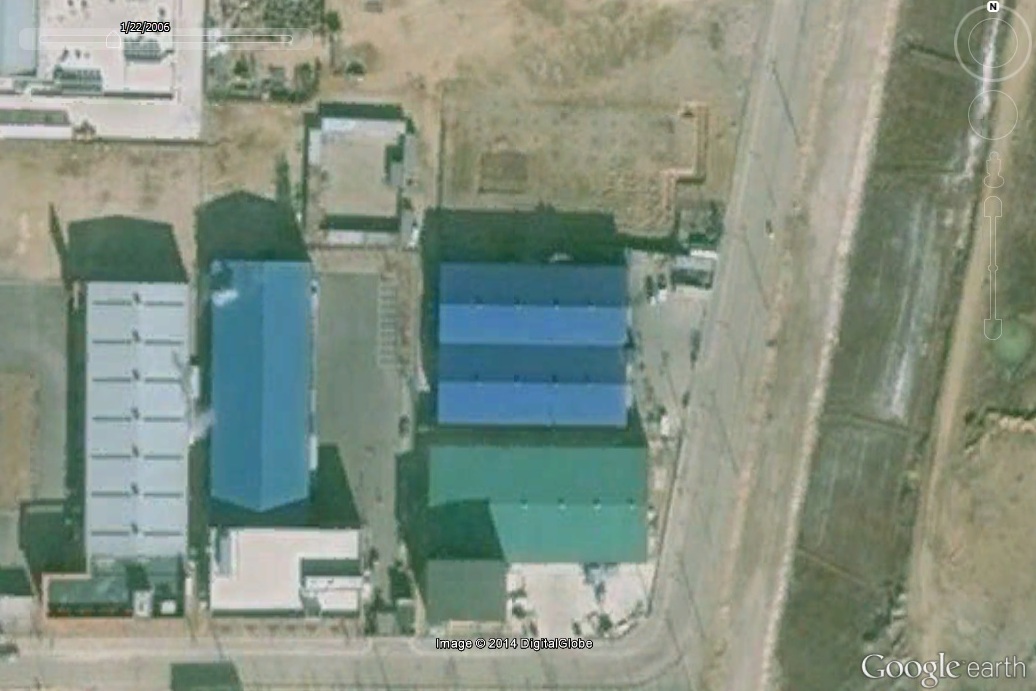
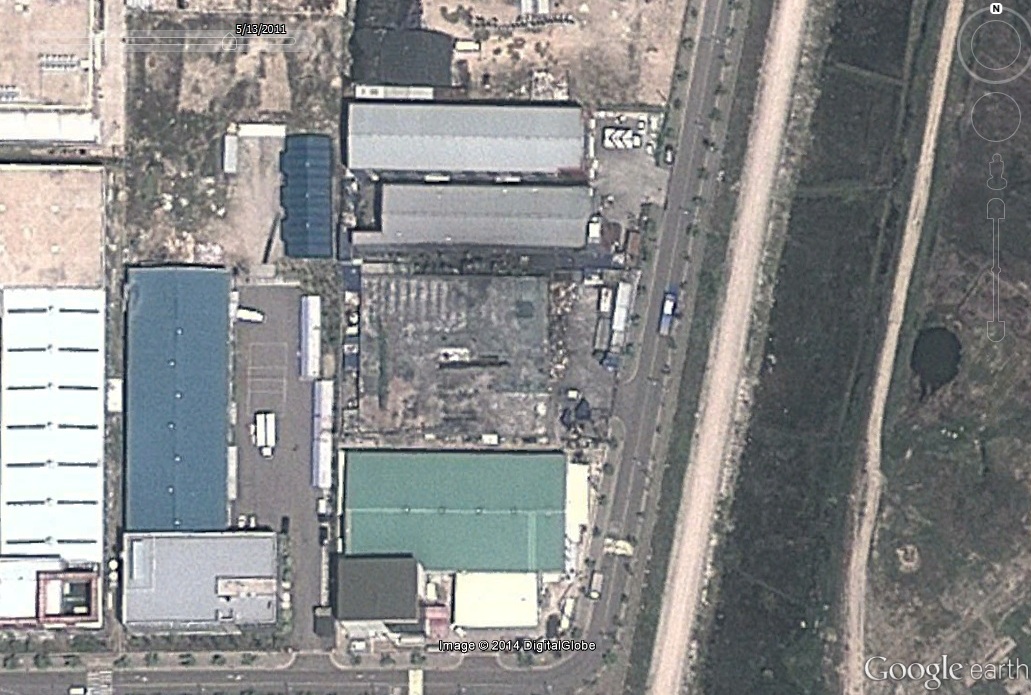
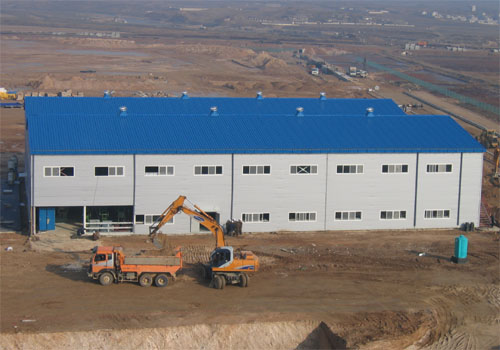
Living-art-factory-ground-2004-12-15 Living-art-GE-2006-1-22 Sonoko-fire-GE-2011-5-13

Pictured Above: (TL) A Picture of the Living Art/Sonoko Factory (source) (TR) A Google Earth Image of the Factory (B) The remains of the fire

UPDATE 4 (2012-1-16): The Living Art/Sonoko Factory has burned down. According to Yonhap:

For Kim Suck-chul, Christmas 2010 was a nightmare that nearly cost him his fledging factory in North Korea.

Kim was the first South Korean businessmen to make an inroad into the joint inter-Korean industrial complex in the North Korea’s western border city of Kaesong.

Kim set up his factory in Kaesong in late 2004 to produce kitchenware and hired some 350 North Korean workers.

[…]

Cooking pots made in the North were brought to South Korea for sale in late 2004, where they made headlines and quickly sold out in a major department store. The kitchenware was later exported to Mexico and Germany also.

A pre-dawn fire on Christmas Eve, 2010, destroyed half of Sonoko Cuisineware’s factory in the Northern economic enclave, costing Kim about 2 billion won (US$1.7 million).

The fire began in a shipping container in the factory’s compound after North Korean workers did not switch off an electric pad and electric heater the previous day, Kim said.

He said the South Korean authorities had inadequate fire fighting measures for the South Korean factories in the complex.

“Firefighters came to the scene more than 40 minutes after the fire tore through the factory,” Kim told Yonhap News Agency by phone from his office in Ilsan, west of Seoul.

He said a fire engine and water wagon came from a fire station just 300 meters away, though the water wagon held so little water it had to return to the station to refill before coming back to the scene.

The blaze completely destroyed machines and other equipment in the factory, bringing the operation to a halt for more than a year.

“All of my North Korean employees are working for other South Korean factories in the complex as I could not pay them wages,” Kim said. He added that four of his eight South Korean workers had either quit or taken leaves of absence.

Kim said he has yet to recover from the devastating damage due to financial constraints.

He sent official documents to former and then current unification ministers on four occasions between April and October of last year to try to secure financial assistance to resume operations, but was only told to “wait.”

Out of frustration, he posted his latest appeal on the Web site of the Unification Ministry, which handles inter-Korea affairs.

“I’m in deathly agony and I can not sleep,” he said. In a worst-case scenario, he said, he may file a suit against the government over the issue.

Unification Ministry spokesman Kim Hyung-suk indicated the government can not give special favors to the kitchenware manufacturer, saying it needs to exercise fairness in its handling of the more than 120 South Korean companies in the complex.

Despite lingering tensions on the Korean Peninsula, the two Koreas have kept intact the shared complex that serves as a key legitimate cash cow for North Korea.

UPDATE 3 (2006-11-28): Living Art and Sonoko managers indicted for embezzlement. According to the Korea Herald:

Prosecutors yesterday indicted the chief executives of two kitchenware manufacturers that operated a joint venture in North Korea’s Gaeseong industrial complex on charges of embezzling government funds granted to promote inter-Korean ties. One was also charged for delaying salary payments for his employees.

This is the first time any business concern in the industrial complex has faced criminal charges.

The Seoul Central Prosecutors Office charged Kim Seok-chul, the chairman of Sonoko Cuisineware Inc., and Kang Man-soo, head of Living Art Co., for colluding to embezzle 300 million won – part of the 3 billion won in government loans which they received as aid for investing in Gaeseong.

The two companies set up a joint venture in Gaeseong in 2004 under the name of Living Art. The kitchenware maker began to use the name of Sonoko in January this year after Living Art pulled out of the venture three months earlier citing financial difficulties.

“After receiving the loans on Oct. 26, 2004, Kim and Kang took the total amount of money in a month,” said a prosecutor investigating the case, declining to be identified.

The prosecutor said Kim and Kang used part of the money to pay their personal debts.

The government funds were extended as low-interest loans, sums of which Living Art redeemed before going bankrupt. Sonoko Cuisineware is reportedly covering the monthly interest payments as it has been independently operating in Gaeseong to produce pots, pans and other kitchenware. The two companies dissolved their partnership in October of last year.

Prosecutors said Kim is also charged of violating inter-Korean economic exchange laws after providing factories in Gaeseong to three different companies where had no business approval by the Unification Ministry which oversees all inter-Korean businesses.

Prosecutors suspect Kim had approached investors by promising to help them gain entry into North Korea, and allegedly led an investors visit to Gaeseong in June of this year with false identities provided by Sonoko.

Prosecutors also accused Kim of delays in payment of salaries to his employees to the tune of over 20 million won in October 2004.

Kim also sent gifts such as expensive imported liquors to North Korean officials in return for business favors. He claimed to have used his own money for the gifts.

The history of Sonoko and Living Art dates back to before Living Art was selected to enter the Gaeseong pilot project in 2004.

Kim was then in charge of exports at Living Art. He persuaded the company to set up a plant in Gaeseong.

Living Art was to invest in the manufacturing equipment, while Kim financed the plant-building.

The 3 billion won of government loans were for building the production facility, but Kim reportedly claimed Living Art failed to pay for the equipment.

Living Art was feted for manufacturing the first Gaeseong-made products that were exported overseas with tags on the pots and pans declaring “Made-in-Korea.” However, the company soon slipped into financial difficulties, leaving Sonoko to cope on its own. In October last year, Sonoko broke off all ties with Living Art and began to independently operate in Gaeseong.

Read the Full story here:
Two Kaesong potmakers indicted for embezzlement
Korea Herald
2006-11-28

UPDATE 1 (2006-5-31): According to the Korea Herald:

In separate news, the Unification Ministry yesterday denied local reports that there was any wrongdoing behind the selection of Living Art as one of the first businesses to enter Gaeseong.

Reports said there were suspicions of backroom deals involving Living Art, which was the first business to roll out products from the inter-Korean complex with the help of millions of won in government loans. Notwithstanding, the enterprise quickly went bankrupt.

“Living Art was not initially among the first 15 companies selected to enter Gaeseong, but was among the next 10 candidates. Living Art was added to the list after two vacancies occurred,” the ministry said.

The ministry said Living Art has paid back 700 million won out of the 3 billion won in government loans it received, and that the company did not appear delinquent at the time the loans were approved in September 2004.

Read the full story here:
Korea Herald
Lee Joo-hee
2006-5-31

ORIGINAL POST (2006-5-29): Living Art (리빙아트 공장) has become the first company to go bankrupt in the KIC. According to the Choson Ilbo:

A kitchenware manufacturer that was among the first to move to the joint Korean Kaesong Industrial Complex in the North in 2004 went bankrupt not long afterwards. The firm was picked despite being in serious trouble already, prompting suspicions of irregularities in the selection process. The prospect of recovering the hefty startup loan from the Inter-Korean Economic Cooperation Fund looks dim.

Living Art was one of only 15 companies chosen from among 136 hopefuls in June 2004. Korean Land Corporation, which was in charge of selection together with the Unification Ministry and the Export-Import Bank of Korea, at the time stressed it would choose only financially sound businesses.

But Living Art went belly-up early in 2005, stopped all activities and sold its plants. As of at the end of May, It had yet to submit its audit report for last year to the Financial Supervisory Service.

In September 2004, soon after the company was selected, its South Korea plant and facilities in Incheon were temporarily seized and put up for auction, but only a month later it was given a loan of W3 billion (US$3 million) from Exim Bank. A financial expert says it is hard to understand how that could happen. Sonoko Cuisineware, an affiliate of Living Art, still makes cookers in Kaesong but is in serious financial trouble because of the Living Art bankruptcy.

Living Art released first products from the Kaesong Industrial Complex in December 2004 and held a grand celebration attended by politicians and officials from the Unification Ministry and Korea Land Corporation. The products were sold in Korean departments stores.

Read the full story here:
Bankruptcy Casts Shadow Over Kaesong Complex
Choson Ilbo
2006-5-29

Share