Archive for the ‘Economic reform’ Category

Koreas Begin Talks on Shipbuilding Project

Tuesday, December 25th, 2007

Korea Times
Yoon Won-sup
12/25/2007

The two Koreas began four-day talks in the southern port city of Busan Tuesday to discuss ways of establishing shipbuilding areas in North Korea, according to the Unification Ministry.

A sub-committee for shipbuilding and marine cooperation, part of an agreement reached at the inter-Korean prime ministers’ meeting last month, convened for the first time to map out the details of the shipbuilding project.

(more…)

Share

S. Korea’s president-elect vows cooperation for N. Korea, closer ties with U.S.

Wednesday, December 19th, 2007

Yonhap
Byun Duk-kun
12/19/2007

Lee Myung-bak, almost certain to be South Korea’s next president, will likely continue engaging North Korea through economic cooperation, but the extent should rely deeply on Pyongyang’s commitment to full denuclearization, unlike his predecessor who has often been under fire for granting unconditional aid to the North, analysts said Wednesday.

Closer ties with Washington will also be prioritized by the incoming administration of conservative Lee, who has criticized President Roh Moo-hyun for alienating the U.S. in dealing with the nuclear-armed communist North.

The entrepreneur-turned-politician says he can and will increase the communist nation’s per capita income to US$3,000 in 10 years, if Pyongyang completely abandons its nuclear ambitions.

“There will be no immediate changes to the country’s North Korea policy if the North continues to move down the path of denuclearization,” Kim Woo-sang, a political science professor at Seoul’s Yonsei University and a key advisor to the president-elect for security and foreign policy, said in an earlier interview with Yonhap News Agency.

Under a six-nation deal, North Korea has to disable its key nuclear facilities and disclose all its nuclear programs by the end of the year in return for economic and energy assistance and political benefits.

North Korea began disabling the Yongbyon complex early last month, but has yet to make a full declaration of its nuclear programs amid a five-year dispute between Pyongyang and Washington over the existence of a secret nuclear weapons program in the North.

The nuclear crisis erupted in late 2002 when the U.S. accused the North of running a uranium enrichment program. North Korea denies having any uranium program.

Seoul has regularly provided hundreds of thousands of tons of food and other humanitarian aid to the North since the historic inter-Korean summit between then President Kim Dae-jung and North Korean leader Kim Jong-il in 2000.

The Lee administration will continue to provide such assistance strictly based on humanitarian views, but economic cooperation between the divided Koreas will suffer significant reduction should the communist nation choose not to give up its nuclear weapons, Kim noted.

Further development or continuation of “ongoing economic cooperation projects, such as the Kaesong industrial complex, will be left to the market,” Kim said.

“The government will no longer try to encourage South Korean businesses to move into the industrial complex by providing subsidies and other benefits as it currently does, but will try to foster a better environment so the businesses and foreign investors will invest voluntarily,” he added.

At an October summit in Pyongyang, President Roh Moo-hyun and the North Korean leader agreed to launch various other reconciliatory projects, but Lee has said some of those projects will be subject to reconsideration.

Another visible change in policy towards North Korea will come in the way Seoul deals with the nuclear issue, the Yonsei professor said.

“Mr. Lee puts more weight on the six-nation denuclearization process than anything else, so the new administration will never try to take its own initiative or try to pressure China to convince North Korea to denuclearize,” he said.

While seeking more international cooperation in denuclearizing the North, Lee is expected to move closer to the United States, an ally Lee says has served as a capstone for Seoul’s security and economic development since the end of 1950-53 Korean War.

“The governments of Kim Dae-jung and Roh Moo-hyun neglected Korea’s relationship with the United States. China and Japan are important partners, but the next government will be moving in a different direction, focusing on Korea’s traditional relationship with Washington,” Lee had said in September.

The 65-year-old Lee has also noted his administration may try to push back the timing of taking back the wartime operational control of South Korean troops from the United States, which is currently scheduled to occur in 2012.

“As Mr. Lee has repeatedly said, there will be no renegotiation of the transfer of wartime operational control, but the scheduled timing of the transfer could become very sensitive depending on security conditions surrounding the Korean Peninsula in 2012,” said Kim.

Share

Russian Railways Plans $100 Million Terminal in North Korea

Tuesday, December 18th, 2007

Bloomberg
Lucian Kim
12/18/2007

OAO Russian Railways plans to build a $100 million container terminal in North Korea as the world’s largest rail company tries to create a land transport corridor linking Asia to Europe.

State-run Russian Railways wants to turn the North Korean port of Rajin into a hub capable of handling 320,000 containers a year for shipment across Russia to Europe, the company said in a statement distributed to reporters today.

The investment is part of a plan that originated in 2001, when North Korean leader Kim Jong Il traveled by rail from Pyongyang to Moscow to visit President Vladimir Putin. As the first step in linking the Korean peninsula to the Trans-Siberian Railway, Russian Railways is upgrading 54 kilometers (34 miles) of track from the border south of Vladivostok to Rajin.

Russian Railways will spend 1.75 billion rubles ($70 million) on improving the track, the company said. Another $100 million will be needed to turn Rajin port into a terminal capable of loading containers shipped from South Korea on to freight trains bound for Europe. The proposed terminal will be operated by a Russian-North Korean joint venture.

Delays over financing and feasibility have plagued the plan for an “Iron Silk Road.” Russian Railways Chief Executive Officer Vladimir Yakunin previously said the rail link to Rajin would be completed by the end of 2006.

The two Koreas opened regular freight train service across the demilitarized zone on Dec. 11.

Share

Wireless Comms, Internet in Kaesong Industrial Complex and Kumgang Mountain Tourist Resort

Monday, December 17th, 2007

Institute for Far Eastern Studies (IFES)
NK Brief No. 07-12-17-1

12/17/2007

North and South Korea are poised to allow Internet, telephone, and cellular services to be available in the Kaesong Industrial Complex (KIC) and at the Kumgang Mountain Tourist Resort beginning next year. The 7th Defense Ministerial Talks opened on December 12 at the ‘Peace House’ on the South Korean side of Panmunjum, and at the meeting, North and South Korea reached an agreement regarding communications, transportation, and customs.

According to the agreement, Pyongyang has given permission for the use of Internet landlines and cellular phones in the two largest inter-Korean cooperative projects. However, while the South Koreans pushed for the inclusion of “mobile phones” in the agreement, the North insisted on “wireless telephone communications”, suggesting that they hope to use dual-use wired telephones rather than mobile cellular phones.

In addition, under the agreement, North and South Korean rail and road traffic will be allowed to cross the border daily from 7:00am to 10pm, with the exception of Sundays and official holidays. Currently traffic in the area is limited to 7am~6pm in the summer, and 8am~5pm in the winter months.

The two sides also agreed to new procedures aimed at simplifying customs inspections and reducing delivery delays. From now on, the two sides will exchange lists of goods being moved, after which time any specific good that is flagged will be inspected. Currently, both sides are required to supply a list of goods to be pass through the area three days in advance, and every piece is individually inspected, complicating customs procedures.

The agreement was signed ROK Defense Minister Kim Jang-soo and Kim Il-chul, minister of the DPRK People’s Armed Forces, and went into effect on December 13. With this agreement, exchange and cooperation in the KIC and Kumgang Mountain resort are expected to even more actively grow.

Share

N. Korean airline to be used to ferry S. Korean tourists to Mt. Paektu

Sunday, December 16th, 2007

Yonhap
12/16/2007

North Korea’s state-run airline is likely to be used to ferry South Korean tourists to the North’s Mount Paektu, a government official said Sunday.

The official, who declined to be identified, said Air Koryo planes may be used to carry tourists, owing to concerns about safety related to Samjiyeon Airport, about 30 kilometers southeast of the mountain.

He did not elaborate on the nature of safety concerns, but said it may be inappropriate for South Korean flag carriers like Korean Air and Asiana to use the airport.

Tours to the 2,744-meter-high mountain, held sacred by many Koreans, are the result of the summit meeting between South Korean President Roh Moo-hyun and North Korean leader Kim Jong-il in early October.

He added that flights would probably use Seoul’s Gimpo International Airport, fly over Gangwon Province, head out into the East Sea before turning north toward Mount Paektu, on the North Korea-Chinese border.

The official said Gimpo has been selected as it can easily handle greater numbers of people than provincial air terminals, and the high level of airport security that can be maintained.

Hyundai Asan, which is responsible for organizing tours to North Korea, said direct flights linking Gimpo and Mount Paektu should begin in May, 2008.

The company currently organizes tours to Mount Geumgang on the east coast, and the historic city of Kaesong just north of the demilitarized zone separating the two Koreas on the west coast.

Share

Divided Koreas move closer to setting up joint fishing area in East Sea, statement says

Sunday, December 16th, 2007

Yonhap
12/16/2007

South and North Korea are still far apart over setting up joint fishing areas along their disputed western sea border but they have made some progress in establishing similar zones off their shared eastern sea border, a South Korean government report said Sunday.

In a statement posted on its Website, South Korea’s Unification Ministry said working officials of both Koreas made some meaningful headway on a proposal to open their shared eastern sea border to fishing boats from both sides.

“The South and the North agreed to actively cooperate to allow South Korean ships begin fishing at designated areas in the North Korean side of the East Sea within 2008,” the ministry said, outlining a six-point agreement reached at a two-day inter-Korean working meeting that ended at the North’s border city of Kaesong on Saturday.

The two Koreas have yet to agree on many specifics on the eastern sea border, including where to set up the proposed joint fishing areas, but they agreed on some details, including how South Korea should pay for its fish catch in the northern side of the border, it said.

North Korea, among other things, agreed to allow South Korean ships to pay in goods, not cash, the statement said.

The sides also agreed to hold a new round of working talks early next year to discuss Seoul’s provision of “fishing implements and gears that will constitute its fishing fees” and other related issues,” it said.

They have also agreed to begin construction on a joint fishery research and storage center in the North before the end of the year, for which a survey team of some 20 South Korean officials will travel to the North on Dec. 21-25, according to the agreement.

It’s unclear how such agreement on the eastern sea border would affect efforts by the two Koreas to ease tension along their acutely disputed western sea border, the site of two bloody naval clashes in 1999 and 2002.

During an October summit, South Korean President Roh Moo-hyun and North Korean leader Kim Jong-il agreed to turn the disputed western maritime border into a peace zone in which fishing boats of both sides would jointly operate.

High-level military officials of both sides met at the inter-Korean border village of Panmunjom last week to discuss the western sea border but failed to reach agreement.

North Korea insisted that the proposed joint fishing areas in the West Sea must be established south of the Northern Limit Line (NLL), an interim border unilaterally set by the American-led U.N. Command right after the 1953 end of the Korean War.

South Korea turned down the North’s demand, counterproposing that any joint fishing area in the area must conjoin waters on both side of the NLL.

Share

North Korea Google Earth (Version 7)

Friday, December 14th, 2007

The most authoritative map of North Korea on Google Earth
North Korea Uncovered v.7
Download it here

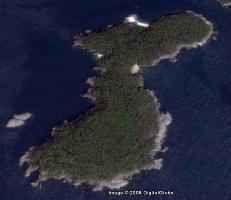
koreaisland.JPGThis map covers North Korea’s agriculture, aviation, cultural locations, manufacturing facilities, railroad, energy infrastructure, politics, sports venues, military establishments, religious facilities, leisure destinations, and national parks. It is continually expanding and undergoing revisions. This is the sixth version.

Additions to the latest version of “North Korea Uncovered” include: A Korean War folder featuring overlays of US attacks on the Sui Ho Dam, Yalu Bridge, and Nakwon Munitians Plant (before/after), plus other locations such as the Hoeryong Revolutionary Site, Ponghwa Revolutionary Site, Taechon reactor (overlay), Pyongyang Railway Museum, Kwangmyong Salt Works, Woljong Temple, Sansong Revolutionary Site, Jongbansan Fort and park, Jangsan Cape, Yongbyon House of Culture, Chongsokjong, Lake Yonpung, Nortern Limit Line (NLL), Sinuiju Old Fort Walls, Pyongyang open air market, and confirmed Pyongyang Intranet nodes.

Disclaimer: I cannot vouch for the authenticity of many locations since I have not seen or been to them, but great efforts have been made to check for authenticity. These efforts include pouring over books, maps, conducting interviews, and keeping up with other peoples’ discoveries. In many cases, I have posted sources, though not for all. This is a thorough compilation of lots of material, but I will leave it up to the reader to make up their own minds as to what they see. I cannot catch everything and I welcome contributions.

Share

North Korea aiming to become a strong and prosperous country by 2012

Thursday, December 13th, 2007

Institute for Far Eastern Studies
NK Brief No. 07-12-13-1
12/13/2007

North Korea has paved the way to achieve its goal of becoming a strong and prosperous country by 2012, the one-hundred year anniversary of the birth of Kim Il Sung. This goal of reaching such a status in only five years was announced at the recent nationwide open assembly of intellectuals, the first such meeting in 15 years. Pyongyang first introduced the ‘Strong and Prosperous Country’ strategy in August 1998, announcing the national strategy of the Kim Jong Il regime through an article printed in the ‘Rodong Shinmun’, the newspaper of the North’s communist party.

Choi Tae-bok, secretary of the political department of the Workers’ Party central committee, stated in the closing speech of the recent intellectual’s assembly that the 100-year anniversary of the birth of Kim Il Sung was deeply significant, and stressed that “every intellectual must open the doors to [the era of] a strong and prosperous country” by the 100th anniversary of the birth of the nation’s founder.

Taking the position that North Korea has already become a strongly ideological nation by sticking to socialism, that on October 9, 2006, the North became a strong military nation by testing a nuclear weapon, and the focus in this year’s New Year’s Editorial on becoming an economically powerful country through economic development and improvement of the lives of the people, it appears that the North is proceeding with this national strategy on all fronts. This means that if the North can focus on its economic problems and become an economically strong nation over the next five years, it can proclaim to have become a Strong and Prosperous Country.

North Korea’s recent position on solving its nuclear issues and improving relations with the United States and South Korea adds some credence to the idea that Pyongyang has decided to solve its economic woes in a move to become this strong and prosperous country.

According to the North Korean point of view, the three issues of security, economy, and succession are related, and that security and succession issues cannot be resolved without first solving economic problems. North Korea showed a bold initiative in beginning to implement the February 13 agreement, and hosting the inter-Korean summit meeting was a reflection of Kim Jong Il’s ‘strategic resolve’.

Share

NK Forced to Revert to Agricultural Market System?

Tuesday, December 11th, 2007

Daily NK
Jung Kwon Ho
12/11/2007

Several sources in China have relayed that it is rumored North Korean authorities are planning to take extreme measures to prevent the sale of industrial products at the jangmadang (markets) next year.

One Chinese merchant, whom DailyNK met in Dandong, China on the 6th, said, “Rumors are circulating that a measure preventing all kinds of Industrial products from being sold in the jangmadang will be implemented next year, making Chinese merchants involved in trade between North Korea and China nervous.”

He informed that “In place of industrial products, only farm produce from the fields of homeowners will be allowed to sell in the jangmadang. Marine products that up to now have been selling in the jangmadang will only be made available at appointed marine shops, meat products at food shops, and industrial products at state operated stores.”

The Chinese source also maintained that, “There are quite a few overseas Chinese who, not knowing what will happen, have bought loads of industrial products with the idea that this might be their last chance, and they have brought them into the North.”

The North Korean authorities began unfolding a series of market regulations immediately following the Inter-Korea Summit in October. These included such policies as limiting the types of items for sale and imposing a minimum age limit on female merchants. However, limiting the sale of industrial products themselves, after having abolished permanent markets, can be seen as a means of returning to “agricultural markets,” where farmers traded only vegetables and a surplus of produce.

According to other Chinese merchants with whom DailyNK met in Dandong on the 3rd, “Under the name of the North Pyongan Party Committee in Shinuiju, a three-day meeting was held between the Secretaries of the Party and of the Army and enterprise managers, from November 20th to the 22nd.”

They informed that “The meeting was held to discuss whether to prohibit jangmadang operations and put people who have been trading in the market to work at enterprises or factories, since regular provisions will resume starting next year.”

The recent efforts to regulate the markets have been analyzed as means to revert the standard of societal regulation to that of the pre-90s by restoring the provision system and normalizing factory operations. However, such an extreme measure is likely to give rise to serious civilian opposition, so there are doubts as to whether or not it can be realized.

The North Korean civilians, before the mid-90s, relied on a complete provision system supplied by the State, which included the provision of goods such as soap, clothes and other necessities. However, after the food shortage, the national provision system completely collapsed. As a result, civilians began acquiring most necessities, goods and food items through the jangmadang.

However, agricultural markets, where miscellaneous cereals, vegetables and other agricultural items raised in home gardens were traded, existed around the time when North Korea’s provision system was in normal operation.

Following the execution of the “July 1st Economic Management Improvement Measure” of 2002, the North Korean government established general markets which brought simple agricultural markets out in the open in February 2003. Since then, individuals leasing stands from the city mercantile department have been able to sell all kinds of industrial products as well.

One source in Chongjin stated in a phone conversation on the 6th regarding the recent rumors, “If the sources are Chinese merchants, than the rumor is not likely groundless. A majority of citizens sustain their livelihoods through the jangmadang.”

He agreed that “It is highly feasible that measures to toughen the regulation of industrial products in the market will be executed.”

Share

The Number of Day Laborers Hired by Private Parties Increasing in North Korea

Tuesday, December 11th, 2007

Daily NK
Lee Sung Jin
12/11/2007

The number of day labor jobs offered by private parties is gradually increasing in the North. Unlike those with full time jobs at State-run factories, individuals with day labor jobs work by the day.

According to inside sources and many defectors who came to the South earlier this year, individuals looking for day labor jobs normally work as gold miners, construction workers in cities, as luggage carriers for train passengers and maids.

In North Korea, these day laborers are called “Bulbulee (which means a person sweats for labor),” “Sakbari (which means a person waiting for wages)” or “Ilkkun (workers).” It is reported that there are day labor hiring centers in big cities and around the closed mining areas.

Daily laborers’ wages vary based on the type of work. Laborers working at gold mines are provided with housing and food and get paid 1,500 North Korean won per day. In the city construction sites, skilled laborers such as plasterers earn 2,000 won daily whereas unskilled laborers make less than 1,000 won. Daily laborers are making good money compared to factory workers whose average monthly wages fall between 3,000 and 5,000 won.

Kim Yong Chul (pseudonym), a defector who used to work as a day laborer at a mine in Hoichang of South Pyongan Province said, “Since 2004, day labor hiring centers started to appear in the jangmadang (market) of Hoichang. Employers hired young men and women in good health on the spot and took them to workplaces.” He used to work at a mine well-known across the country since the Japanese colonial period. Mr. Kim said, “Day laborers not only dug for gold but were also mobilized to build or fix houses for their employers.”

In Hoichang, there are some gold mines closed by the authorities that were thought to be tapped out. In the mid 1990s, some locals dug the mines again and made a great fortune. Years later, around 2003, these locals began looking out for workers and started hiring individuals from other provinces. Now the county has a great number of day laborers from various provinces working at mines.

Good Friends, the Seoul-based relief organization dedicated to North Korea, said in a recent report, “On October 23rd at around 10 A.M., a gold mine in Hoichang of South Pyongan Province collapsed, leaving three miners dead and two wounded.” In the North, private parties are banned from trading gold and pine mushrooms by law, and only the State can make these types of transactions. However, it is well known that many officials in charge of enforcing the ban frequently take bribes and allow those who pay them to dig for gold in closed mines.

Gold miners usually stay underground between 15 to 30 days each time they begin a mining operation. The miners dig up the ore, crush it using a machine called a Maguanggi (ore-polishing machine) and apply mercury to extract gold. The whole process is done in underground tunnels, and the processed gold is sold to gold dealers in Pyongsung and Sinuiju.

Individuals who run the crushing machine are laborers from other provinces, and most of them are females. With food and housing provided by their employer, they make 1,000 won daily. If they work year-round this way, they can earn decent money.

45-year-old Park Jong Moo (pseudonym) who came to the South this year said, “I earned 2,000 won per day when I worked as a plasterer, building a house for a man who made his money from trade in Chongjin City.”

Mr. Park’s son worked as a cargo porter at the Chongjin railway station. Since there were so many “Sakbari (referring to cargo porters working for daily wages)” at the station, competition among “Sakbari” was fierce. Normally, these porters made less than 1,000 won per day.

It is becoming popular among party cadres and the new wealth to have a maid who does housework and takes care of children. These people introduce the maid to their neighbors as a ‘distant relative’ because having a maid is unthinkable in the Socialist North. While performing maid services and getting paid for the work that she does, the maid pretends to be a family member and acts as if she is merely helping out with the housework.

A source inside the North said, “There was once a party official in Chongjin who employed a girl as a maid after having paid her parents. When the official was accused of having a maid, the official said she was a ‘relative.’”

Regarding the rise in day laborers, an expert on North Korea says, “Those North Koreans who made a fortune from mining or trade privately employ laborers to further expand their businesses…However, since the regime will never allow the rich to become too powerful, it will begin to regulate the employment activities of private parties at the proper time.”

Share

An affiliate of 38 North