Archive for the ‘Secretariat’ Category

Mansudae Overseas Development Group Projects

Wednesday, June 23rd, 2010

According to the Daily NK:

North Korea has earned more than $160 million in the last ten years thanks to the construction of sculptures and other edifices in countries across Africa.

A Daily NK source in China revealed on the 18th, “Since 2000, North Korea has been earning colossal quantities of dollars through contracts for the Mansudae Overseas Project Group of Companies under the Mansudae Art Institute to construct sculptures.”

Mansudae Art Institute is an organization primarily dedicated to the idolization of Kim Il Sung and Kim Jong Il through public works, one whose construction of edifices such as the Juche Tower and Arch of Triumph in Pyongyang has added to the status of the country.

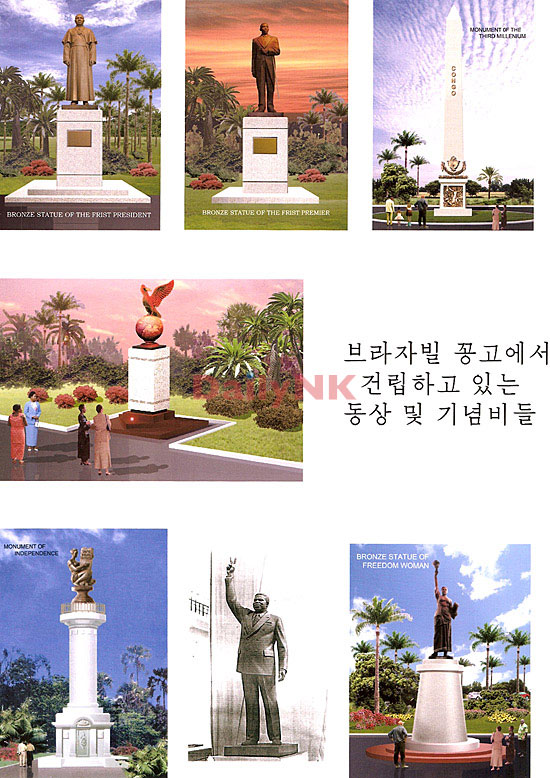
It has also been building revolutionary monuments in African countries such as Ethiopia since the 1970s in order to maintain cordial relations with socialist states, but in the early 2000s started doing work in African countries to earn foreign currency as well.

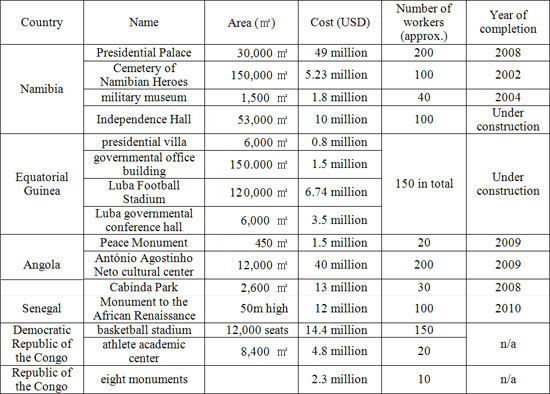
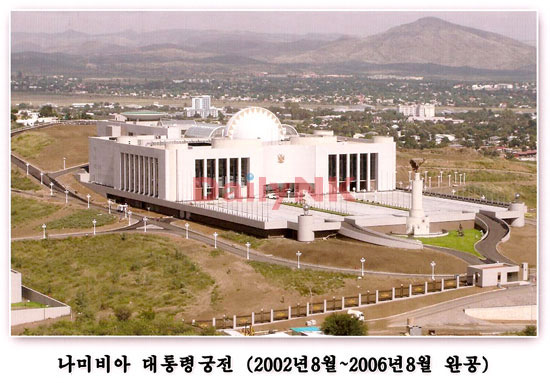
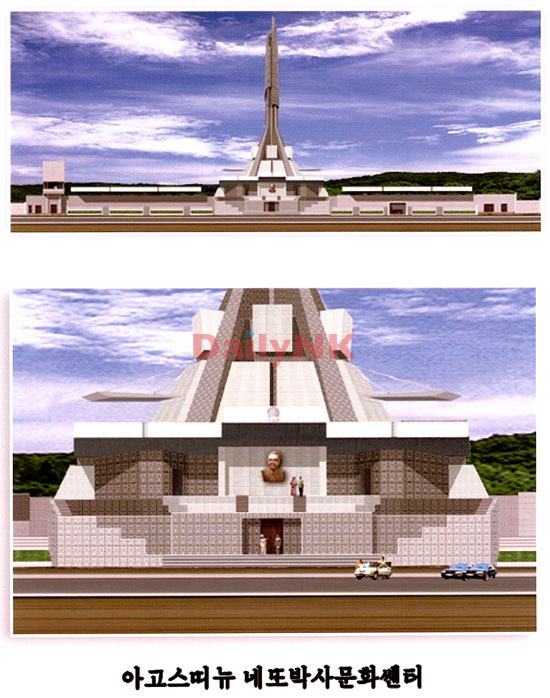
According to the source, North Korea has earned $66.03 million from Namibia alone thanks to the construction of the Presidential Palace ($49 million); the Cemetery of National Heroes ($5.23 million); a military museum ($1.8 million); and Independence Hall ($10 million).

It has also earned almost $55 million from Angola via the António Agostinho Neto culture center ($40 million); Cabinda Park ($13 million); and the Peace Monument ($1.5 million).

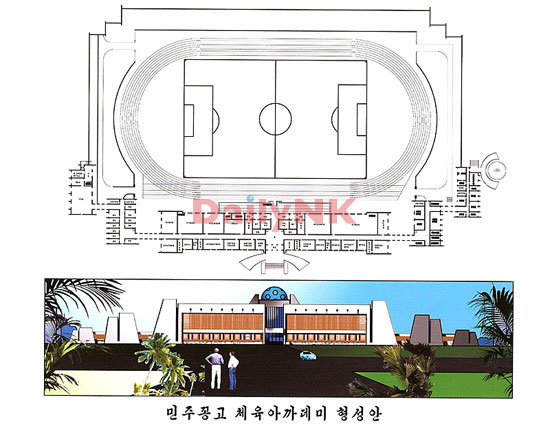
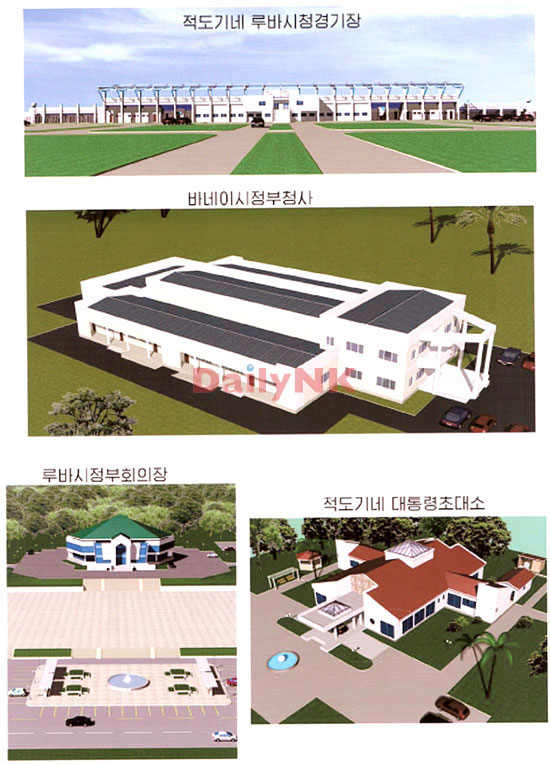
Additionally, the North has constructed a basketball stadium ($14.4 million) and an athlete academic center ($4.8 million) in the Congo, earning almost $20 million dollars in total.

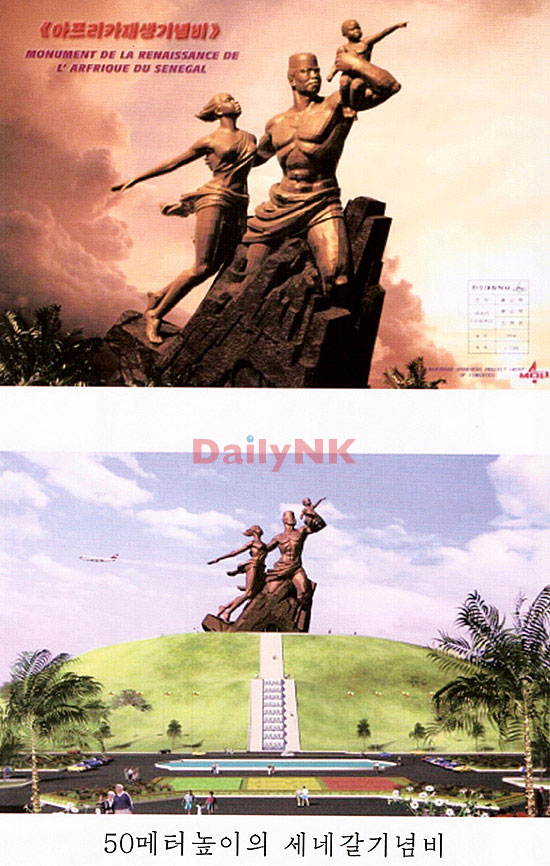
Thanks to the Monument to the African Renaissance in Senegal, the North has made another $12 million dollars.

There are around 19.8㎢ set aside for a vacation spot for the president of Equatorial Guinea, which is supposed to earn Mansudae around $800,000, not to mention a government office building ($1.5 million), Luba Stadium ($6.74 million) and conference halls ($3.5 million).

The source also reported, “The money earned from these construction projects is managed by the No. 39 Department. Some of these dollars are used for domestic governance, while the rest go to secret accounts in Switzerland or Macau to become Kim Jong Il’s secret funds.”

Here are the images from the story including a table of financial data (which I would take with a grain of salt):

dnk-mansudae-1.jpg dnk-mansudae-2.jpg dnk-mansudae-3.jpg dnk-mansudae-4.jpg dnk-mansudae-5.jpg dnk-mansudae-6.jpg dnk-mansudae-7.jpg

Additional Information:

1. I blogged here about the Derg Monument in Ethiopia.

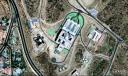
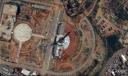
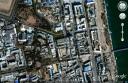
2. I have located some of the Mansudae Overseas projects mentioned in this story (as well as numerous other places not menioned in this story: Egypt and Syria, Zimbabwe, DR Congo). However, here are GeoEye satellite images of some of the Namibia and Angola projects mentioned above courtesy of Google Earth:  

Namibia National Heroes Acre (22°39’46.02″S,  17° 4’41.06″E):

national-heroes-acre-namibia-thumb.jpg

Namibia State House (22°35’28.83″S,  17° 6’2.76″E)

namibia-state-house-thumb.jpg

Cultural Center of António Agostinho Neto (Mausoleum) (8°49’24.73″S,  13°13’8.52″E)

angola-nehro-thumb.jpg


Share

Room (Bureau) 38 allegedly restored

Wednesday, June 23rd, 2010

According ot the Choson Ilbo:

North Korea in March restored a special department in the Workers Party codenamed Room 38 which manages leader Kim Jong-il’s coffers and personal slush funds, it emerged Monday. The North last fall merged Room 38 with Room 39, which manages party slush funds.

“Rooms 38 and 39 were merged to simplify Kim Jong-il’s slush funds,” said a North Korean source. “But when it became difficult to secure hard currency due to international sanctions, Room 38 seems to have been restored because there was a feeling that Room 39 alone can’t meet the need.”

Room 38 is reportedly led by Kim Tong-il, who heads three regional departments in charge of earning hard currency.

Room 39 tries to maximize earnings from gold and zinc mining and farming and fisheries. It also manages stores and hotels exclusively for foreigners in Pyongyang. Room 39 seems to have suffered badly due to the recent suspension of inter-Korean trade. “Taesong Bank and Zokwang Trading, which received remittances from Mt. Kumgang tourism, are both controlled by Room 39, and is also in charge of the exports of agricultural and fisheries products,” said a government source.

Kim Jong-il needs dollars to maintain the party elite’s loyalty to him and his heir presumptive. He is said to have told party bigwigs in February, “From now on I will judge your loyalty based on the amount you contribute to the fund.” His son Jong-un is also said to be amassing separate slush funds for his own use.

But international sanctions on exports of weapons, counterfeit dollars, fake cigarettes and drugs remain in place, and the United States is pushing ahead with additional financial sanctions over the North’s sinking of the South Korean Navy corvette Cheonan in March. Pyongyang was dealt a heavy blow in 2005 when the U.S. froze US$25 million in the Banco Delta Asia in Macao which was apparently for Kim’s personal use.

Kim earlier this year appointed his high school friend Jon Il-chun head of Room 39. Jon was also named chairman of the National Development Bank, established early this year with a view to conducting normal international financial transactions to induce foreign investment. “North Korea seems to be planning to divert part of foreign investment to Kim’s slush fund,” said a government official.

NK Leadership Watch has more

Read the full story here:
Kim Jong-il Restores Special Department to Swell Coffers
Choson Ilbo
6/24/2010

Share

DPRK abandons food rations, orders self-sufficiency

Thursday, June 17th, 2010

Institute for Far Eastern Studies (IFES)
NK Brief No. 10-06-17-1
6/17/2010
 
As North Korea’s food shortages worsen and reports of starvation continue to grow, the Workers’ Party of Korea have acknowledged the failure of the central food ration program. Since the end of May, the Party has permitted the operation of 24-hour markets, and the regime has ordered the people of the North to provide for themselves.

The human rights organization Good Friends reported this move on June 14. According to Good Friends, the Workers’ Party organization and guidance bureau handed down an order on May 26 titled ‘Relating to Korea’s Current Food Situation’ that allowed markets to stay open and ordered North Koreans to purchase their own food. This order, recognizing that the food shortages in the North have continued to worsen over the last six months, since the failed attempts at currency reform, acknowledged the difficulty of providing government food rations. It calls on those who were receiving rations to now feed themselves, while also calling on the Party, Cabinet, security forces and other relevant government agencies to come up with necessary countermeasures. Now, authorities officially allow the 24-hour operation of markets, something that most had already tacitly permitted, and encourage individuals, even those not working in trading companies, to actively import goods from China.

It has been reported that government food rations to all regions and all classes of society, even to those in Pyongyang, were suspended in April. The last distribution of food was a 20-day supply provided to each North Korean on April 15, the anniversary of the birth of Kim Il Sung. Because of the difficulty of travelling to markets, the suspension of rations caused many in farming communities to starve to death. When Kim Jong Il’s recent visit to China failed to secure expected food aid, the Workers’ Party had no choice but to hand down the ‘May 26 Party Decree’. While the suspension of rations has considerably extended the economic independence of North Korean people, the regime has significantly stepped up other forms of control over society. Public security officers have begun confiscating knives, saws and other potential weapons over 9 centimeters long in an effort to stem murder and other violent crimes. Additionally, state security officials are cracking down on forcefully resettling some residents of the age most likely to defect, while sending to prison those thought to have contacted relatives in South Korea.

According to Daily NK, North Korean security officials are pushing trading companies to continue trading with China, while calling on Chinese businesses to provide food aid. It also appears that North Korean customs inspections along the Tumen River have been considerably eased, and there is no real attempt to identify the origin or intended use of food imported from China. Sinheung Trading Company has asked Chinese partners investing in the North to send flour, corn and other foodstuffs. The Sinheung Trading Company is operated by the Ministry of State Security, and is responsible for earning the ministry foreign capital. It appears that food acquisition is now a matter of national security, as North Korea is expecting South Korea and the rest of the international community to economically isolate the country.

Share

DPRK looking for Chinese investors in Taebong gold mine

Tuesday, May 4th, 2010

According to the Daily NK:

The chairman of North Korea’s State Development Bank, Jeon Il Chun visited China on April 8, reportedly to try and bring Chinese investment to Daebong Mine, located near Hyesan, Yangkang Province.

Daebong Mine is one of North Korea’s major gold mines, managed under the auspices of the No. 39 Department of the Central Committee, a special department charged with raising funds for Kim Jong Il’s personal use. Jeon Il Chun is the person in charge of the No. 39 Department.

Attempts to sell shares in a gold mine directly controlled by the 39 Department, Kim Jong Il’s own private safe, to China seem to indirectly imply that Kim is suffering from a debilitating foreign currency supply crisis.

One Daily NK source in China who is well-acquainted with North Korean affairs reported that while Jeon was in China, he met with the management of three or four Chinese enterprises which already have investments in North Korea, and suggested investment conditions under which the North could transfer some of its mineral rights to them and receive capital investments in return.

The source said, “For now, as far as I know, executive managers of the No. 39 Department have been in contact with Chinese enterprises. Since the Workers’ Party is trying to sell shares in a gold mine, it seems the funding of the Party might be serious.”

“It is not clear whether or not this attempt was done on Kim Jong Il’s instructions, but attracting foreign investment in a gold mine is not a commonplace affair,” the source pointed out, adding that an investor has not yet been put in place.

What is the Daebong Mine for?

The Daebong Mine is a relatively large gold mine on the border of Woonheung and Gapsan in Yangkang Province. Until 2001, a Yangkang provincial foreign currency earning enterprise and the foreign currency earning department of the People’s Safety Agency jointly managed it. However, in May, 2002, it became a No. 39 Department affiliated enterprise.

The No. 39 Department has been raising private funds for the leader and Party operations under the Finance and Accounting Department of the Central Committee since the mid-1970s. According to defectors, it has the highest authority and the largest funds of all North Korea’s foreign currency earning enterprises. Especially, it has the ability to mobilize tremendous financial resources since it manages and controls supplies of gold and silver and rare non-ferrous metals.

A source from Yangkang Province explained, “According to Chongjin University of Mining and Metals and Kim Chaek University of Technology, the purity of the gold from the Daebong Mine is more than 76 percent, while production from Hoichang and Eunsan in South Pyongang Province is 63 percent and 61 percent respectively. More than 150kg of solid gold is produced annually, so this mine is known as the ‘loyalty mine’.”

“People say that the government earns four or five million dollars a year through this mine. Neither Yangkang Provincial Committee nor Hyesan Municipal Committee is involved with the business of the mine.”

The source added, “Since the No. 39 Department deals with the mine, only those discharged soldiers with good family backgrounds are dispatched there by the Central Committee. In October of last year, around 200 discharged soldiers with good family backgrounds came to the mine.”

Almost all the gold produced in the Daebong Mine is stored in Swiss and Austrian banks in gold bars.

A Chinese company had a contract with the DPRK’s Musan Mine which has been canceled for an unknown reason.

Click here to see what I believe is the mine’s location.

Read the full article here:
No. 39 Department Hawking Shares in Key Gold Mine
Daily NK
5/3/010
Lee Sung Jin

Share

More on Kim Jong-il’s court economy

Wednesday, April 28th, 2010

According to the Choson Ilbo:

North Korean leader Kim Jong-il’s youngest son and the heir apparent Kim Jong-un is already said to be busy amassing his own slush fund. Despite North Korea’s dire economic difficulties, Kim Jong-il himself is said to have stashed away between US$200-300 million every year to finance his lavish lifestyle and maintain the party elite’s loyalty to him.

With the money, North Korea would be able to import between 400,000 to 600,000 tons of rice, which would be enough to cover half the country’s food shortage of 1 million tons of rice per year.

Key departments within the Workers Party are pressuring agencies under their control to offer “loyalty funds” for the successor, a source familiar with North Korean affairs said. “A separate company has been established under the leadership of Kim Jong-un to secretly amass foreign currency.”

The source said Kim senior uses his slush fund to finance his expensive tastes, build monuments in his own honor and buy gifts for his loyal aides. Faced with increasing difficulties bolstering his slush funds under international sanctions, the Kim is said to have issued an ultimatum to his top officials in February, saying from now on he would judge their loyalty based on the amount they contribute to the fund.

The North is estimated to have imported more than $100 million worth of high-quality liquor, cars and other luxury goods in 2008. And also on the list are pet dogs, which the Kim family are said to adore. Kim buys dozens of German shepherds, Shih Tzus and other breeds from France and Switzerland every year. He also buys dog food, shampoo and other pet products as well as medical equipment for the dogs and has foreign veterinarians check their health.

Before nation founder Kim Il-sung’s birthday on April 15 this year, Kim imported around 200 high-end cars from China at a cost of some $5 million. A North Korean source said secret funds are also used to finance nuclear missile development and other state projects Kim Jong-il orders personally.

It is difficult to estimate the total amount of Kim’s slush fund. Experts can only guess that Kim has stashed huge sums of money in Swiss or Luxembourg bank accounts, as did other dictators like former president of the Philippines Ferdinand Marcos and ex-Iraqi leader Saddam Hussein. The international press estimates Kim’s slush fund to be worth around $4 billion.

Kim started amassing his slush fund as soon as he was picked as the next leader of North Korea in 1974 to be able to buy the loyalty of top officials. A special department within North Korea’s Workers’ Party called Room 39 which manages Kim’s slush fund by collecting the loyalty funds, exporting local staples including pine mushrooms and operating stores in hotels. A large portion of the $100 million to $200 million North Korea makes each year from exporting weapons, producing counterfeit dollars, smuggling fake cigarettes and selling drugs are also put into Kim’s slush fund.

A North Korean source said a lot of the cash profits generated by the joint tourism business with South Korea end up inside Kim’s personal slush fund too, judging by the fact that Daesong Bank and Zokwang Trading, which do business with the South, are both controlled by Room 39.

Early this year, Kim appointed his high school friend Jon Il-chun to head Room 39. Jon was made the chief of a state development bank North Korea opened recently to lure foreign investment. A South Korean government official said there are suspicions that Kim is diverting some of the profits of the state development bank into his own slush fund as well.

Read the full story here:
How N.Korea’s Ruling Family Swells Its Private Coffers
Choson Ilbo
4/28/2010

Share

Head of Office 39 replaced

Thursday, February 4th, 2010

According to the Guardian:

It is the nerve centre of North Korea’s money-making operations, the department dedicated to raising hard currency for Kim Jong-il while his country teeters on the brink of collapse.

Room 39 is responsible for some legal ventures, such as the country’s limited exports of ginseng and other items. But according to defectors, most of its energy goes into drug-trafficking, sales of weapons and missile technology, and the production of counterfeit US dollar bills.

Today, it was reported the department’s head – Kim Jong-il’s personal finance manager – has been sacked, possibly in response to international action against the alleged illegal moneymaking. South Korea’s Yonhap news agency said Kim Dong-un was dismissed because he had been blacklisted by so many foreign governments, including the EU in December, leaving him unable to travel on behalf of Room 39’s legal companies. He has been replaced by his deputy, Jon Il-chun, Yonhap said, citing an unidentified source.

Housed in an unremarkable government compound in Pyongyang, Room 39 oversees 120 companies and mines, accounting for a quarter of all North Korean trade and employing 50,000 people, according to Lim Soo-ho, a research fellow at the Samsung Economic Research Institute. He said Kim’s dismissal may be part of attempts to get around international sanctions.

While its inner workings remain a mystery to all but its occupants and the family they serve, Room 39’s role in enabling the regime to survive even in times of widespread famine and international pressure, has come under greater scrutiny since the imposition last year of tough UN sanctions over its nuclear programme.

Some of the money generated by Room 39 is used to buy the loyalty of senior party officials, a role that may take on greater prominence as Kim Jong-il, who suffered a stroke in 2008, prepares to hand over power to his third son, Kim Jong-un. Analysts have estimated that illegal activities account for up to 40% of all North Korean trade and an even higher share of total cash earnings.

Additional information: 

1. More on the EU travel ban is here.

2. Office 39 is reportedly located here.  Kim Jong Il’s office is reportedly nearby here.

3. This week the KWP’s finance director, Pak Nam-gi, was also let go.

4. Mike Madden notes the new director’s  appearance with KJI at an “On the Spot Guidance” visit this week.  Mike also points to a possible appearance the Korea Taepung International Investment Group meeting.

Share

Bureau 39 update

Wednesday, August 12th, 2009

Vanity Fair has published a lengthy article about the DPRK’s mysterious Bureau 39 which is allegedly behind a number of illicit activities such as counterfeiting US currency and cigarettes, smuggling drugs and bilking western insurance companies with fraudulent claims. The full article is worth reading here.  (h/t DPRK Studies)

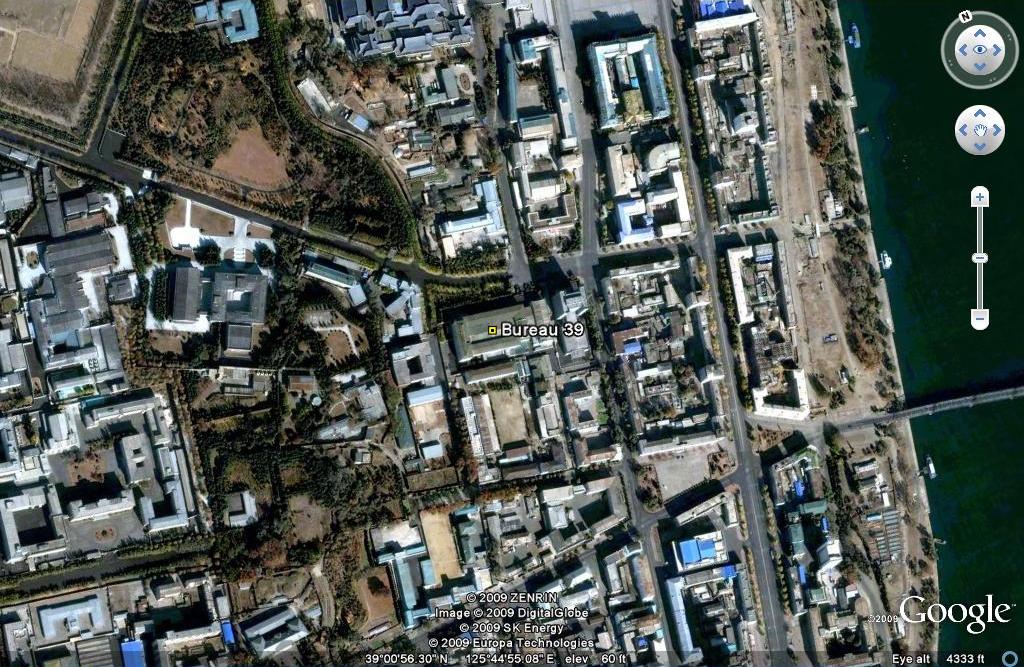
Of immediate interest, here is the supposed location of Bureau 39 just south of the Grand People’s Study House:

bureau39.JPG

Click image to enlarge

Here is a short excerpt:

Hamer’s three-year investigation—code-named Operation Smoking Dragon—began not with supernotes but with counterfeit cigarettes, which were being shipped by freight container from China into California ports by the millions. These, too, says Asher, originated in North Korea, and were the subject of a report by the Coalition of Tobacco Companies, one of whose investigators made an undercover visit, posing as a buyer, to North Korean factories in Pyongyang and the northeastern city of Rajin. These turn out fake Western brands, such as Marlboros, in such quantities that they generate as much as $720 million in gross revenue each year. Hamer set up a number of front operations to get inside the cigarette-smuggling business, and soon had many contacts who dealt with him as if he were a smuggler, too. In the spring of 2004, Hamer and his colleagues were asked by F.B.I. headquarters to see if they could acquire North Korean supernotes. One of Hamer’s best customers, Chao Tung “John” Wu, who eventually pleaded guilty to smuggling counterfeit currency, cigarettes, and narcotics, as well as conspiring to broker a deal for Chinese-made, shoulder-fired missiles, but died before he was sentenced, promised he could supply them with the help of a man who was a frequent visitor to North Korea—Wilson Liu. The notes were so good, Wu said at a secretly recorded meeting, “you can even go to Las Vegas and slide them into the machines—they take them right away.”

Share

DPRK reinsurance update

Sunday, June 21st, 2009

In December 2008 this blog discussed how the DPRK’s Korea National Insurance Corporation (KNIC) received USD$58 million from several European reinsurance companies in a legal settlement.

Well, the Washington Post offers an update on how the money is being moved and even highlights the story of a defector who claims to be involved in the DPRK’s insurance racket:

For Kim Jong Il’s birthday, North Korean insurance managers prepared a special gift.

In Singapore, they stuffed $20 million in cash into two heavy-duty bags and sent them, via Beijing, to their leader in Pyongyang, said Kim Kwang Jin, who worked as a manager for Korea National Insurance Corp., a state-owned monopoly.

Kim said he helped arrange the shipment and watched in February 2003 as the cash was packed. After the money arrived, Kim Jong Il sent a letter of thanks to the managers and arranged for some of them to receive gifts that included oranges, apples, DVD players and blankets, Kim said.

“It was a great celebration,” he said.

The $20 million birthday present and the gratitude of its recipient, who is known as the Dear Leader, were annual highlights of a sophisticated global insurance fraud that North Korea has concocted to provide its communist leadership with hard currency, said Kim, who spent five years as an executive of the state insurance company in Pyongyang and worked for a year at its banking subsidiary in Singapore before defecting to South Korea.

The British court ruled the way it did [NKeconWatch: this might be an error as the court did not rule on the case–it was settled] because the reinsurance companies contractually agreed to be bound by the North Korean court system (which to nobody’s surprise systematically rules in favor of domestic agencies and firms).  Since the western reinsurance firms could not prove that the DPRK was committing fraud, they had to pay up.

And how does this program work?

While working for North Korea’s insurance monopoly, Kim Kwang Jin said, he and other managers had a tightly focused mission: to find reinsurance companies and brokers in different parts of the world who would accept high premiums to reinsure KNIC’s policies.

Those policies, he said, usually covered losses from common North Korean disasters such as mining accidents, industrial fires, transportation crashes and crop losses due to floods.

“The major point of the reinsurance operation is that they are banking on disaster,” he said. “Whenever there is a disaster, it becomes a source of hard currency.”

According to Kim, KNIC would target a different potential disaster and a different reinsurance company each year. “We pass it around,” he said. “One year, it might be Lloyd’s; the next year, it might be Swiss Re; and the next, Munich Re.”

In London, the expert on the insurance industry familiar with the helicopter case echoed Kim’s assessment of how KNIC operated. He spoke on the condition of anonymity because he was not authorized by reinsurers to talk about the case.

“They pay good premiums, and they are very sophisticated, very clever,” he said. “They would divvy business up into very small bites and use different brokers in different places. The division of losses was such that it would never be apparent to a prospective reinsurer just how bad the business was.”

The North Koreans were known in the reinsurance industry for their capacity to prepare meticulously documented claims, speed them through puppet courts in Pyongyang and demand quick payment from international reinsurers. The North sometimes restricts the ability of reinsurers to dispatch investigators to verify claims.

The North Korean insurance monopoly sometimes took advantage of the geographical and political ignorance of brokers and reinsurers, according to the London-based insurance expert. Some brokers and companies, he said, thought they were dealing with a company from South Korea, while others were unaware that North Korea is a secretive totalitarian state with one of the world’s worst human rights records.

When he worked at KNIC, Kim said, annual revenue from North Korea’s reinsurance claims was about $50 million to $60 million. Most of that money, he said, was used to scout out potential disasters inside North Korea, to buy more reinsurance on the global market and to pay premiums.

“The remaining hard currency should have been used to help people recover from disasters and accidents, but it was not used that way,” Kim said. “It is just going into the pocket of Kim Jong Il.”

He said cash shipments of $20 million arrived yearly in Pyongyang, usually in the week before Feb. 16, which is Kim Jong Il’s birthday and a national holiday. In his six years at KNIC, Kim said, bags of cash arrived in Pyongyang from Singapore, Switzerland, France and Austria.

The money, he added, was delivered to an entity called Bureau 39 of the Korean Workers’ Party Central Committee. It was created by Kim Jong Il in the 1970s to collect hard currency and give him an independent power base, according to defectors, Seoul-based analysts and published reports. These sources agree that Bureau 39 spends foreign currency on luxury goods for the North Korean elite, components for missiles and other weapons programs.

With Bureau 39 skimming off hard-currency earnings returned to North Korea by KNIC’s global operation, Kim said, claims to disaster victims had to be paid in won, North Korea’s currency.

“That money is nearly worthless at present, because the economy has collapsed,” he said. “This means that little is done to help people recover from fires or whatever.”

But Kim Jong Il has been pleased with the state insurance company, Kim said.

“It brings him large amounts of hard currency,” Kim said. “Working in insurance is one of the best professions in North Korea. Many people want to do it.”

Mr. Kim is working in the Washington DC area this year with the Committee for Human Rights in North Korea.

Read the full artocle here:
Global Insurance Fraud By North Korea Outlined
Washington Post 
Blane Harden
6/18/2009

Share

Tunnels, Guns and Kimchi: North Korea’s Quest for Dollars – Part II

Thursday, June 11th, 2009

Yale Global
Bertil Linter
6/11/2009

BANGKOK: The global economic meltdown has claimed an unexpected victim: North Korea’s chain of restaurants in Southeast Asia. Over the past few months, most of them have been closed down “due to the current economic situation,” as an Asian diplomat in the Thai capital Bangkok put it. This could mean that Bureau 39, the international money-making arm of the ruling North Korean Workers’ Party – which runs the restaurants and a host of other, more clandestine front companies in the region – is acutely short of funds. Even if those enterprises were set up to launder money, operational costs and a healthy cash-flow are still vital for their survival. And, as for the restaurants, their main customers were South Korean tourists looking for a somewhat rare, comfort food from the isolated North of the country. The waitresses, all of them carefully selected young, North Korean women dressed in traditional Korean clothing, also entertained the guests with music and dance.

But thanks to the global economic crisis, not only has the tourist traffic from South Korea slowed, the fall in the value of won has also reduced their buying power. The South Korean won plummeted to 1,506 to the US dollar in February, down from 942 in January 2008. No detailed statistics are available, but South Korean arrivals in Thailand – which is also the gateway to neighboring Cambodia and Laos – are down by at least 25 percent.

Though staunchly socialist at home, the North Korean government has been quite successful in running capitalist enterprises abroad, ensuring a steady flow of foreign currency to the coffers in Pyongyang. North Korea runs trading companies in Thailand, Hong Kong, Macau and Cambodia, which export North Korean goods – mostly clothing, plastics and minerals such as copper – to the region. At the same time, they import various kinds of foodstuffs, light machinery, electronic goods, and, in the past, dual-purpose chemicals, which have civilian as well as military applications. Those companies were – and still are – run by the powerful Daesong group of companies, the overt arm of the more secretive Bureau 39.

North Korea embarked on its capitalist ventures when, in the late 1980s and early 1990s, the country was hit by a severe crisis caused by the disruption in trading ties with former communist allies. More devastatingly, both the former Soviet Union in 1990 and China in 1993 began to demand that North Korea pay standard international prices for goods, and that too in hard currency rather than with barter goods. According to a Bangkok-based Western diplomat who follows development in North Korea, the country’s embassies abroad were mobilized to raise badly needed foreign exchange. “How they raised money is immaterial,” the diplomat says. “It can be done by legal or illegal means. And it’s often done by abusing diplomatic privilege.”

North Korea’s two main front companies in Thailand, Star Bravo and Kosun Import-Export, are still in operation. In the early 2000s, Thailand actually emerged as North Korea’s third largest foreign trading partner after China and South Korea.

Bangkok developed as a center for such commercial activities and Western intelligence officers based there became aware of the import and sale of luxury cars, liquor and cigarettes, which were brought into the country duty-free by North Korean diplomats. In a more novel enterprise, the North Koreans in Bangkok were reported to be buying second-hand mobile phones – and sending them in diplomatic pouches to Bangladesh, where they were resold to customers who could not afford new ones. In early 2001, high-quality fake US$100 notes also turned up in Bangkok and the police said at the time that the North Korean embassy was responsible as some of its diplomats were caught trying to deposit the forgeries in local banks. The North Korean diplomats were warned not to try it again.

The restaurants were used to earn additional money for the government in Pyongyang – at the same time, they were suspected of laundering proceeds from North Korea’s more unsavory commercial activities. Restaurants and other cash-intensive enterprises are commonly used as conduits for wads of bills, which banks otherwise would not accept as deposits.

For years, there have been various North Korean-themed restaurants in Beijing, Shanghai and other Chinese cities. But the first in Southeast Asia opened only in 2002 in the Cambodian town of Siem Reap. It became an instant success – especially with the thousands of South Korean tourists who flocked to see the ancient ruins of Angkor Wat. It was so successful that Pyongyang decided to open a second venue in the capital Phnom Penh in December 2003. A fairly large restaurant in the capital’s Boulevard Monivong, which offered indifferent Korean staple kimchi and other dishes and live entertainment by North Korean waitresses, closed earlier this year for lack of business.

In 2006, yet another Pyongyang Restaurant – as the eateries were called – opened for business in Bangkok. It was housed in an impressive, purpose-built structure down a side alley in the city’s gritty Pattanakarn suburb, far away from areas usually frequented by Western visitors but close to the North Korean embassy and the offices of its front companies in the Thai capital. This was followed by an even grander restaurant in Thailand’s most popular beach resort, Pattaya, which was also housed in a separate building with a big parking lot outside for tour buses. A much smaller Pyongyang restaurant opened in Laos’s sleepy capital Vientiane, but that one became popular not with South Korean tourists, but with Chinese guest workers and technicians. The Vientiane restaurant may be the only North Korean eatery that is still in operation.

After years of watching North Korea’s counterfeiting and smuggling operations, the United States began tightening the screws on Pyongyang’s finances in September 2005. This occurred after Banco Delta Asia, a local bank in Macau, was designated as a “financial institution of primary money-laundering concern.” The bank almost collapsed, and North Korea’s assets were frozen. The money was eventually released as part of an incentive for North Korea’s concession in the Six-Party talks and returned to North Korea via a bank in the Russian Far East. But, coupled with UN sanctions, the damage to North Korea’s overseas financial network was done – including the ability of Pyongyang’s many overseas front companies to operate freely. For example, the two-way trade between Thailand and North Korea peaked at US$343 million in 2006 – but then began to decline. It was down to US$100 million in 2007, and US$70.8 million in 2008.

Now with North Korea conducting a second nuclear test and firing off missiles, Washington has raised the possibility of the re-listing of North Korea as a state that supports terrorism. If that were to happen, many private companies would become hesitant to deal with Pyongyang and its enterprises for fear of being blacklisted by the US Treasury.

With its various money-making enterprises coming unstuck, Pyongyang is increasingly under pressure. The worldwide financial crisis has already put North Korea in a tight corner. There was never anything to suggest that the money earned by North Korea’s economic ventures abroad were to be used for social development at home, or to be spent on basic necessities such as putting food on the tables of the country’s undernourished people. Now, there won’t even be food for sale to South Korean tourists in the region.

Share

DPRK ministerial shakeup and SPA elections announced

Monday, January 5th, 2009

UPDATE 3: According to numerous media sources, Choe Sung Chol has been shot (h/t Marmot). Read more here: Bloomberg, Reuters, Korea Times.

UPDATE 2: According to the Joong Ang Daily:

North Korea’s point man on South Korea, who was earlier said to have been sacked for misjudgment, is said to be undergoing what sources called “severe” communist training at a chicken farm, sources here said yesterday.

Choe Sung-chol, once a vice chairman of the Asia-Pacific Peace Committee, the North’s state organization handling inter-Korean affairs, was reported to have been dismissed in early 2008 for what sources called his lack of foresight on South Korea’s new conservative administration under President Lee Myung-bak.

Political dissidents in North Korea are said to often undergo training on the communist revolution. This includes hard labor in harsh environments, such as mines or in labor camps.

Choe, 52, became better known to South Korean officials and the public in 2007, when he escorted then-President Roh Moo-hyun throughout his visit to Pyongyang for a summit with North Korean leader Kim Jong-il.

He is also known to have played a key role in arranging the summit.

Officials in Seoul have acknowledged the dismissal of Choe, but could not confirm his whereabouts or why he was sacked.

“He has been undergoing training for about a year now, so it really is hard to tell whether he will be reinstated or not,” another source said, also speaking on condition of anonymity.

(UPDATE 1) Shortly after the DPRK’s ministerial and leadership changes were dscovered, the DPRK announced the Supreme People’s Assembly will be recomposed in March.  According to Reuters:

The reclusive North’s official media said in a two-sentence dispatch the election for deputies to its Supreme People’s Assembly would be held on March 8, without offering details.

North Korea wants to promote economic elite to the assembly to help lay the groundwork for the next generation of its leadership, a think tank affiliated with the South’s intelligence service said in a report in December, Yonhap news agency said.

However, analysts cautioned against reading too much into the leadership changes, saying Kim Jong-il and his inner circle hold the real power while ministers and other government officials have almost no influence in forming policy.

The assembly session that typically meets in April each year is a highly choreographed affair focused on budget matters where legislation is traditionally passed with unanimous approval.

North Koreans can vote only for the candidates selected by supreme leaders who allocate assembly seats to promote rank-and-file officials and purge those no longer in favor.

“Even if we know that someone was replaced, everything related to it is pure speculation because we have no clue as to the individual inclinations of these people,” said Andrei Lankov, an expert on the North at the South’s Kookmin University. (Reuters)

The Joong Ang Ilbo provides some additional facts:

The election is also a mere formality in the North because the candidates are hand-picked by the Workers’ Party and then approved by North leader Kim Jong-il.

The five-year terms of the 687 representatives, selected in 2003, were supposed to end last September. North Korea watchers have speculated that Kim’s health was linked to the election delay. According to intelligence sources in Seoul, Kim suffered a stroke in August.

North Korea watchers said Kim’s appearance at a polling station will put an end to speculation about his health. Kim had cast ballots in the 1998 and 2003 elections, according to past North Korean media reports.

With the upcoming election, Kim’s regime will enter its third term. The newly formed legislature will, on paper, form a cabinet, devise a national budget plan and conduct foreign policy.

Following former leader Kim Il Sung’s death in 1994, the Supreme People’s Assembly did not meet for four years. At that meeting, it elected the younger Kim as the National Defense Commission chairman and officially launched his regime. At the time, the legislature also amended the Constitution and undertook a dramatic cabinet shakeup.

ORIGINAL POST
According to the Joong Ang Daily:

Yu Yong-sun, a 68-year-old Buddhist leader, has become North Korea’s senior South Korea policy maker, a top Seoul official told the JoongAng Ilbo yesterday.

Choe Sung-chol, deputy director of the United Front Department of the North Korean Workers’ Party, was in charge of Pyongyang’s South Korean affairs until early last year. After he lost the job, Yu, head of the Korean Buddhists Federation, was appointed to the post, the source said.

“Yu succeeded Choe in March last year,” the source said. “Choe was once deeply trusted by [North Korean] leader Kim Jong-il, but he stepped down because he had failed to accurately assess the outcome of the 2007 presidential election in the South, the Lee Myung-bak administration’s North Korea policy and the outlook for inter-Korean relations.”

The source also said corruption scandals involving the overseas North Korean assistance committee under the United Front Department played a role in Choe’s sacking.

Choe played a crucial role in arranging the second inter-Korean summit between the president of South Korea at the time, Roh Moo-hyun, and Kim in 2007.

Yu, the successor, is not an entirely new face in inter-Korean affairs. Since 2000, he represented the North in several rounds of inter-Korean ministerial talks. He has led the Buddhist group since May 2006.

“We’ve also obtained intelligence that Kwon Ho-ung, who used to be the chief negotiator for the inter-Korean ministerial talks, stepped down from the post and has been put under house arrest,” the source said.

The North reshuffled its cabinet recently, according to the South’s Unification Ministry. Ho Thaek, vice minister of the electric power industry, was promoted to minister. Other minister-level promotions also took place at the Ministry of Railways, Ministry of Forestry and Ministry of Foreign Trade. (Jeong Yong-soo, JoongAng Ilbo)

The Choson Ilbo reports on some more ministerial changes:

North Korea has reshuffled two cabinet ministers and appointed a new man to a key post in the Workers’ Party. North Korean state media reported that Kim Tae-bong was appointed new metal industry minister and Hur Tack new power industry minister. They replace Kim Sung-hyun and Pak Nam-chil. Kim Kyong-ok as newly-named first deputy director of the ruling party’s Organization Guidance Department that controls the party, Army and administration and is headed by leader Kim Jong-il.

It is rare for reshuffles to be announced separately. The new economic appointments may be related to the emphasis on “economic recovery” in a New Year’s statement released in the state media last week that is the closest the North has to an annual message from Kim Jong-il, a government official here speculated. The statement described the metal industry as the “pillar of the independent economy of socialism” and said the electricity, coal and railroad sectors “should take the lead in the people’s economic development through reforms.” Hence replacement of the metal and power industry ministers, according to the official. He admitted little is known about the newly appointed ministers.

The Organization and Guidance Department’s new first deputy director Kim Kyong-ok is reportedly in charge of regional party organizations.

“If the power succession is to move smoothly, the economy must be revived and control of the party organization is essential,” an intelligence officer here said. He predicted noticeable changes in the North’s power structure this year. A researcher at the Korea Institute of National Unification said North Korea “is going to take various steps in a bid to prevent Kim Jong-il’s authority from weakening due to ill health.”

And from Yonhap:

North Korea promoted industrial veterans to top posts in its latest Cabinet reshuffle, signaling Pyongyang’s stepped-up drive to rebuild the country’s frail economy, Seoul officials and analysts said Tuesday.

A reshuffle in the communist state is usually inferred when new faces appear in its media, as the country does not publicize such moves.

Five new names were mentioned as the North’s ministers of railways, forestry, electricity, agriculture and metal industry in the North’s New Year message and reports in October, Seoul’s Unification Ministry Spokesman Kim Ho-nyoun said.

“They are formerly vice ministers or those who climbed the ladder in each field. The reshuffle considered their on-spot experiences and expertise,” the spokesman said.

It was not clear when the reshuffle took place, he said.

North Korean media have been reporting a brisk campaign to rebuild the country’s ailing industrial infrastructure, following up on the New Year economic blueprint rolled out by leader Kim Jong-il. Kim called on citizens “to solve problems by our own efforts” and increase production in electricity, coal and daily equipment.

In the reshuffle, Jon Kil-su was named minister of railways; Kim Kwang-yong minister of forestry; Ho Taek minister of power industry; Kim Chang-sik minister of agriculture; Kim Tae-bong minister of metal industry.

Kim Kwang-yong and Kim Chang-sik were vice ministers and Jon held a senior post in their respective ministry. Ho was formerly a power plant chief, while little was known about Kim Tae-bong, Seoul officials said.

The shakeup was rumored to have affected more posts, but the Seoul spokesman could not officially confirm it.

Koh Yu-hwan, a North Korea studies professor at Seoul’s Dongguk University, said the reshuffle is a sign that the North is shifting its focus to the economy from the military. In its New Year message, Pyongyang pledged to build a “prosperous and powerful nation” by 2012, the 100th anniversary of North Korean founder Kim Il-sung’s birth, he noted.

“The key word this year is the economy,” Koh said. “The reshuffle seems to suggest officials with technical expertise should take the initiative to develop the economy.”

Kim Young-yoon, a researcher with the Korea Institute for National Unification, said Pyongyang is turning to its natural resources amid suspension of South Korean aid. The Seoul government halted its customary aid of rice and fertilizer this past year as Pyongyang refused offers of dialogue.

“North Korea has no other way but turn to its own natural resources as long as inter-Korean relations and the nuclear issue are in limbo,” he said.

Read the full articles here:
Buddhist leader gets North’s South policy spot
JoongAng Daily
Jeong Yong-soo
1/5/2009

N.Korea Reshuffles Economic Posts
Choson Ilbo
1/5/2009

N. Korea promotes industry veterans in Cabinet reshuffle
Yonhap
Kim Hyun
1/6/2008

North Korea says to elect MPs in government shake-up
Reuters
1/6/2009

North to hold parliamentary election
Joong Ang Ilbo
Ser Myo-ja
1/8/2009

Top North official said to be getting re-educated
Joong Ang Daily
1/12/2009

Share

An affiliate of 38 North