Archive for the ‘State Offices’ Category

Distribution of Soy Sauce Resumed

Monday, December 29th, 2008

Daily NK
Lee Sung Jin
12/29/2008

A source has relayed news that North Korea has begun to so-called “essential food factories” in provincial capitals for the first time since Kim Il Sung’s death, and that distribution of soy sauce and soybean paste to civilians in those cities has resumed.

A source from Yangkang Province said in a phone conversation with the Daily NK on the 28th, “Essential food factories situated in each province entered production in October and every household has been provided with a kilogram of soybean paste and a kilogram of soy sauce on a monthly basis ever since. Such provision is on a par with the amount rationed when the Supreme Leader (Kim Il Sung) was alive in the 1990s.”

A North Hamkyung Province source said, “At a North Hamkyung Province essential food factory in Chongjin, production began in October and a kilogram of soybean paste and soy sauce has been being provided to each household once a month.”

North Korea changed the name of “food factories” in each city and province to “essential food factories” in 1993, and remodeled the buildings. It also pursued the modernization of equipment for soy sauce and soybean production. However, due to the “economic crisis” following Kim Il Sung’s death in 1994, the operation of all food factories ceased.

Accordingly, the resumption of operations has triggered the analysis that the “confidence” of the North Korean authorities has been restored regarding both North Korea’s agricultural production and the food situation this year.

A source from Yangkang Province emphasized, “Soybean and peas which have been coming in as foreign aid have sometimes been used to produce the soybean and soy sauce to be provided to Pyongyang, the military and the construction units, but this is the first time that rations to average civilians have resumed since the Kim Il Sung’s death. The reason for the state’s display of concern for the civilian economy is because farming went well this year.”

He then said, “Not only in Yangkang Province, but essential food factories in Hamheung and Pyongsung have also been brought back online. The civilians are hoping that soybean paste and soy sauce distribution will be normalized.”

The source noted, “In the Hyesan Essential Food Factory, approximately 22 tons of ingredients for soybean paste and soy sauce, including peas and wheat, are used daily. At such a rate, a kilogram of soybean paste and soy sauce can be provided to civilians each month over a fixed term.”

He then went on to explain the backdrop, “The storage capacity of the soybean paste fermentation tank in the Hyesan Essential Food Factory is about 60 tons, but with the 22 tons of ingredients that have been coming in each day, only a portion of the production equipment has been operating.

According to North Korea’s central pricing system, a kilogram of soybean paste and soy sauce are 150 North Korean Won and 80 won, respectively. The source added, however, “The soybean paste produced from the factories has been extensively sold in the jangmadang for 300 won per kilogram. Homemade hot pepper paste has been being sold for 900 won per kilogram.”

Therefore, North Korean authorities are said to have held civilian education lectures nationwide, on or around the 19th, stressing the subject, “Regarding strictly adhering to the national grain regulations and preserving army rations as the top priority.”

The source added, “Within less than a month of the resumption of the essential food factories, some managers and cadres of the factories were found to have embezzled the soybean paste ingredients, so the state authorities held formal reeducation lectures for officials. Also, the civilians in the counties or farmlands have not been receiving soy sauce and soybean paste, because only the essential food factories have been operating.”

Share

Inter-Korean economic cooperation office closes after 3 years; cross-border cooperation withering

Friday, December 19th, 2008

Institute for Far Eastern Studies (IFES)
NK Brief No. 08-12-19-1
12/19/2008

On October 28, 2005, an office housing the Inter-Korean Council for Economic Cooperation was established in order to create a channel for routine dialog between North and South Korean authorities and to assist with direct business deals between the two countries. Now, three years later and as inter-Korean relations have stalled, the office has completely closed its doors, causing economic cooperation to wither.

For over three years, the office served as a window fro North and South Korean businesses and workers, assisting with agreements between businesses, passing on documents, delivering samples, and more. In particular, it facilitated a total of 1,269 consultations and deliberations, with a mere 43 in 2005, growing by more than one thousand percent to 446 in 2006 and continuing to grow to 510 in 2007, while only 270 were held this year, bringing together a total of 4070 South Koreans with 3634 North Koreans, for a total of 7704 people making use of the services this office had to offer.

The office also served as a go-between for 10,539 documents sent from the South and 10,656 documents drafted by the North, and mediated the drafting of 668 new regulations for enterprises in the complex. This includes company proposals and promotions, delivery of samples, letters of recommendation, notarization of authentication, and other documents related to economic cooperation.

Of the 1354 samples that passed through the office, 560 were from the South, while 794 were from the North. There were eleven officials from the Ministry of Unification, Ministry of Finance, and other related South Korean government bureaus in the office, as well as another ten officials from the South Korean Trade Council, KOTRA, the Export-Import Bank, the Small and Medium Business Corporation, and the North Korean National Economic Cooperation Federation.

However, on March 24 of this year, North Korea ordered all South Koreans to evacuate the office after Unification Minister Kim Ha-joong stated that “it would be difficult to expand the Kaesong Industrial Complex if the North Korean nuclear issue is not resolved,” and three days later, all eleven government officials were ordered out, leaving only three officials, from KOTRA, the Export-Import Bank, and the Small and Medium Business Corporation behind, along with two employees to manage the facilities.

Now, with North Korean measures restricting land crossings over the military demarcation line, the full closure of the Inter-Korean Economic Cooperation Office, and the expulsion of South Korean workers implemented on the 24th of last month, all South Korean workers in the office had to return to South Korea on the 28th. This is causing considerable difficulties for small and medium businesses that could previously trade with or invest in North Korea at lower costs through the office.

Share

Orascom 3G wrap up

Friday, December 19th, 2008

UPDATE: Here is an older paper by Stacey Banks which I have not read: North Korean Telecommunication: On Hold.

ORIGINAL POST: On Monday the Orascom 3G mobile network launched in North Korea.  Just about everyone covered this story…so here are the highlights:

Telecommunications in North Korea: Has Orascom Made the Connection?
Working Paper: Marcus Noland

The topicality of the second paper, on the Egyptian firm Orascom’s role in North Korea’s telecommunications modernization, received a boost this week with the announcement in Pyongyang that Orascom was finally rolling out its cell phone service and creating a joint venture bank with a North Korean partner.  The planned Orascom investments are large: if actualized, they would be the largest non-Chinese or non-South Korean investments in North Korea, and would exceed total private investment in the Kaesong Industrial Complex to date

Financial Times

Orascom is confident North Korea is opening up its economy and says it has been assured by the ­government that everyone will be allowed to buy a mobile. However, experts think that such a volte-face is highly unlikely and reckon only senior military and government officials will be allowed access, and then only to a closed network.

When asked how many people would ultimately use the service, Orascom’s chairman Naguib Sawiris said: “We have a modest target of 5 to 10 per cent of the population.” The population is about 23m. Mr Sawiris expects 50,000 subscriptions in the first three-to-six months.

Jim Hoare, Britain’s former chargé d’affaires to Pyongyang, says the new network is bound to have severe restrictions.

“It’s unlikely that a country that doesn’t allow you to have a radio unless it’s set to the state frequency will suddenly allow everyone to have mobile phones. It’s more credible that there will be a limited network for officials in Pyongyang and Nampo.”

Dong Yong-sung, chief of the economic security team at the Samsung Economic Research Institute in Seoul, believes another obstacle to ordinary North Koreans owning phones will be the cost. “As far as I know, mobile phone registration costs about $1,000,” he said, a sum equivalent to the average annual income.

(NKeconWatch: Others put the price at $700…and there are many problems with asserting that the DPRK’s per capita income is $1,000 per year.)

Bloomberg

The inauguration of Koryolink took place today in North Korea, Orascom Telecom said in an e-mailed statement. Orascom Telecom Chief Executive Officer and Chairman Sawiris attended the event, a company official said, requesting anonymity. The Cairo- based company got a 25-year license and exclusive access for four years in January. It plans to spend as much as $400 million on a high-speed network and the license for the first three years.

The North Korean venture is “in line with our strategy to penetrate countries with high population and low penetration by providing the first mobile telephony services,” Sawiris said in a statement earlier this year.

CHEO Technology JV Company, the North Korean unit that will operate under the Koryolink name, is 75 percent owned by Orascom Telecom and 25 percent by the state-owned Korea Post and Telecommunications Corporation.

The unit will see average revenue per user of $12 to $15 this year as Orascom Telecom targets three of the country’s biggest cities, according to company forecasts.

Koryolink has rolled out its so-called third-generation grid to initially cover Pyongyang, with a population of 2 million.

Orascom is counting on four potential markets in the Stalinist nation, according to a study by Marcus Noland of the Peterson Institute for International Economics.

The military and government officials are the top targets, followed by foreigners working for UN organizations and diplomats. The others are customers from South Korea, which has several economic projects with its neighbor, and local demand from rich North Koreans.

To protect its investment, Orascom “hedged its bet, committing only half of its investment at the outset and making additional investment conditional on its assessment of conditions going forward,” Noland said.

If the deal is threatened, Orascom may withdraw specialized equipment or technicians, reducing the value of the network to Pyongyang, Noland said in his study.

“Orascom may have spread the wealth informally, creating beneficiaries within the decision-making apparatus who would stand to lose if the agreement failed,” according to the study.

Bloomberg

Orascom Telecom, the Middle East’s biggest wireless company, opened Ora Bank in Pyongyang in the presence of Chairman and Chief Executive Officer Naguib Sawiris, a company official said on condition of anonymity. Ezzeldine Heikal, who is also head of Koryolink, Orascom’s North Korean mobile-phone network, was appointed president of the bank, the official said without providing further details.

“This is a big deal, especially as far as North Korea is concerned, because the current banking system is virtually non- existent,” Marcus Noland of the Peterson Institute for International Economics said in a telephone interview from Washington, D.C. “It’s a ground that others have feared to tread and is perhaps an endorsement for North Korea that says ‘we’re open for business.’”

Ora Bank is a joint venture between Orascom Telecom and North Korea’s state-owned Foreign Trade Bank, North Korea’s official news agency reported today. The director of North Korea’s central bank Kim Chon Gyun and Egypt’s ambassador to Pyongyang Ismail Abdelrahman Ghoneim Hussein, were also present at the opening ceremony, the news agency said.

Radio Free Asia

Chinese traders who regularly travel back and forth to North Korea said local residents showed little enthusiasm for the new service, which cost more than U.S. $900 to set up before the Ryongchun explosion.

North Korean defector Kim Kwang-jin, a senior researcher at the Institute for National Security Strategy in Seoul, said the fact that the government had once pulled the plug on North Korean cell phones meant that it could easily do so again.

“In the beginning, people will be hesitant, because a few years ago many of them made a big investment in cell phones. But service was suspended abruptly, so they are still very concerned that might happen again,” Kim said.

“People are also worried that the ability to pay such a high amount of money for a cell phone may raise a red flag and bring them under scrutiny by the North Korean authorities.”

Most foreigners are banned from using cell phones while in North Korea, although a network for government officials is believed to exist in the capital, Pyongyang.

(NKeconWatch: I personally saw elite North Koreans use mobile phones and even some western journalists in 2005.)

The Guardan

North Korea first experimented with mobile phones in 2002, but recalled the handsets 18 months later after a mysterious train explosion that killed an estimated 160 people. Some experts argue that officials feared the incident was an attempt to assassinate the regime’s “dear leader”, Kim Jong-il, and that mobile phones were involved.

BBC

Some reports suggest that handsets for the new network will cost around $700 each, putting them far beyond the reach of the vast majority of people in the impoverished country.

Choson Ilbo

Although the technology would enable users to send and receive text messages and video content, North Korean customers will only be allowed to speak over their phones.

BMI Political Risk Analysis, Dec 16, 2008 (h/t Oliver)

BMI View: North Korea has officially begun third-generation (3G) mobile phone services, thanks to Egypt’s Orascom Telecom (OT). However, the growth of the network could be limited by the regime’s fear that mobile phones will increase the scope for anti-regime activities.

North Korea has officially commenced third-generation (3G) mobile phone services, thanks to an investment by Egypt’s Orascom Telecom (OT). The firm’s initial target is 100,000 subscribers in three major cities, including Pyongyang, and it eventually hopes to develop a nation-wide network connecting North Korea’s 23mn citizens. OT has promised to invest US$400mn in network infrastructure over the next four years. It has signed a 25-year contract with the North Korean government, and owns 75% of their joint-venture (known as Korealink). OT’s exclusivity rights will last for four years. Orascom’s foray is something of a coup, given that North Korea’s communications network is so rudimentary (for further background see December 8 2008, Industry Trend Analysis – North Korea Prepares For Mobile Network Launch).

Why Pyongyang Fears Mobile Phones
North Korea launched a mobile phone service operated by a Thai subsidiary firm in 2002, but reversed course in 2004, apparently because of a devastating bomb blast on a train in Ryongchon in April of that year. Given that North Korean leader Kim Jong Il’s personal train had passed through the area only a few hours earlier, there was speculation that the explosion had been an assassination attempt, possibly triggered by mobile phone. Since then, only those living in areas close to the border with China have had access to mobile phones, thanks to the proximity of the Chinese network.

Aside from the notion of mobile phones as bomb triggers, they can also make it easier for citizens to communicate with one another. This would increase citizens’ ability to organise anti-government activities – such as protests or sabotage. For example, the popular uprising that led to the overthrow of Philippine president Joseph Estrada in 2001 was dubbed the ‘text message revolution’, because that is how the marches were announced and coordinated. Admittedly, the Philippines is a far more open society than North Korea, but the subversive aspect has not been lost on the regime.

Mobile phones would also make it easier for North Koreans to communicate with the outside world, and thus allow the real-time transmission of information or intelligence to foreign media or spy agencies, and vice versa. They would also allow the North Korean elite to communicate more efficiently, allowing dissident elements to plot against the regime.

Thus, even something as basic as mobile phones are seen as potentially regime threatening.

Mobile Service Difficult To Spread
Consequently, Orascom will surely find it difficult to spread its mobile service across the country. For a start, registration will be tightly watched. Secondly, the cost of the handsets, at several hundred dollars, will mean that only the political and moneyed elites will be able to afford mobiles. Of course, elements of the elite can ‘misuse’ their phones to arrange subversive actions if they deem it worthy, but it seems that the regime are counting on loyalty. Indeed, depending on the sophistication of their equipment, the regime will probably be able to snoop in on the elite’s conversations and movements, giving them an additional layer of security.

Read the full articles below:
Orascom eyes North Korean network
Financial Times
Christian Oliver
12/14/2008

Orascom Telecom’s Sawiris Signs North Korean Deal
Bloomberg
Tarek Al-Issawi
12/15/2008

Orascom Telecom of Egypt Opens Bank in North Korea
Bloomberg
Tarek Al-Issawi
12/16/2008

North Korea Brings Back Cell Phones
Radio Free Asia
Jung Young
12/16/2008

Secretive North Korea launches restricted mobile phone service
The Guardian
Tania Branigan
12/16/2008

N Korea launches 3G phone network
BBC
Steve Jackson
12/15/2008

N.Korea Restarts Cell Phone Service
Choson Ilbo
12/17/2008

Share

DPRK takes measures to restrict market trading

Tuesday, December 2nd, 2008

Institute for Far Eastern Studies (IFES)
NK Brief No. 08-12-2-2
12/2/2008

North Korean authorities appear to have taken some action on their recent decision to strengthen market restriction policies.

According to information weaned from statements made by contacts within North Korea, the DPRK cabinet passed a measure to turn the North’s markets into ’10-day Markets’, allowing them to open only on the 1st, 11th, and 21st day of each month beginning in 2009.

This information came from a lecture meeting for North Korean authorities, but it appears that workers in the Market Management Office have also been telling average citizens about similar measures since November. Some North Korean residents believe this is an effort to close general markets and convert them into farmers’ markets from next year.

There are some that expect strong opposition from North Korean residents that will make the likelihood of effective enforcement slim. There was much talk at the beginning of this year, as well, of transforming general markets into 10-day markets or farmers’ markets, but ultimately, such measures could not be enforced. Some believe that if current general markets are transformed into farmers’ markets, rioting could ensue.

As most goods circulating in general markets are in some way tied to the authorities, there is some doubt as to whether these authorities would abandon their personal profits in order to crack down on market trading. It has been reported that as of yet, there have been no significant shifts in the North’s major regional markets, and they are open daily and running smoothly.

Since November 10, there have also been rumors that all personal trade would be banned, but it appears that there has been no actual enforcement of this measure, either.

Share

Last call at Kaesong…

Monday, December 1st, 2008

The end of sunshine?
According to Yonhap (here and here), Friday, November 28, was the last day of the Kaesong day tours (210 tourists made the trip) and the last day the “train to nowhere” made its inter-Korean trip.

As for the Kaesong Industrial Zone (KIZ)…According to (Bloomberg), on December 1 the DPRK cut the number of “windows” available each day for South Korean vehicles to enter and leave the KIZ from 19 to 6 (though the Donga Ilbo claims just 3), and limited the number of South Koreans allowed in the complex to 880—about 20% of the 4,200 previously permitted to enter the complex.

According to the  Donga Ilbo, Pyongyang delivered notice at 11:55pm Sunday saying those allowed to stay in Kaesong are 27 staff of the management committee; four from the (South) Korea Land Corp.; 40 from Hyundai Asan Corp.; five at restaurants and living quarters; two at shops and hospitals; and 800 from South Korean companies. Border crossings are also limited to 250 staff members and 150 vehicles each time.

Jeopardizing more than Kaesong
As previously discussed (here and here), South Korea and Russia are interested in building oil and natural gas pipelines which would cross the DPRK. If these projects went through, the DPRK government would benefit from construction and “rental” fees—in effect taking a cut of all the energy resources that cross their borders.  North Korea, is now telling the Russians that the project is not too palatable at the moment.

Still more red than green it seems.

What now?
So while the DPRK chases away investment from the South, they solicit more from Kuwait and Singapore (where Chris Hill is due to stop by):

North Korean Foreign Trade Minister Ri Ryong Nam, now in Singapore, has urged Singapore companies to invest in the isolated country, the Singapore government said Monday.

The North Korean minister “briefed…on economic developments in North Korea and possible investment opportunities for Singapore companies,” in a meeting with Singapore’s former Prime Minister Goh Chok Tong, now a senior minister in the Cabinet, a government statement said.

Goh said, “Singapore would be glad to explore ways to strengthen bilateral cooperation, including in the areas of trade and investment, once international concerns were assuaged and the environment improved.”

Singapore Foreign Minister George Yeo made a trip to North Korea in May, accompanied by a business delegation, in what was the first official visit to North Korea by a Singapore Cabinet minister.

On that trip, Yeo met North Korea’s No. 2 political leader Kim Yong Nam and Ri.

Yeo said at the end of his visit North Korea might be keen to learn from some aspects of the Singapore development model and that Singapore is ready to offer help and ideas. (Kyodo-Japan Economic Newswire)

Chewing gum manufacturers beware!

Share

Little sunshine on this cloudy day

Monday, November 24th, 2008

Last week, North Korean Economy Watch reported Pyongyang’s irrational economic policy threats which could end the flow of millions of South Korean dollars into North Korean coffers.  I use the word “irrational” because government policies are typically designed to increase revenues to the treasury (or to coalition / constituent members), not scare them away.  Today, however, North Korea reaffirmed its commitment to closing the border with South Korea on December 1, though with some qualifications:

1. The North Koreans will end “the train to nowhere(c) NKeconWatch. This is puzzling because of all the inter-Korean projects, this one is the least “contaminating.” The South Korean government pays the North Korean government to send an empty train across the border each day.  Why jeopardize this easy money?

2. The North Koreans will end the Kaesong day tours.  This will not be good for Hyundai Asan (HA), which is already suffering losses from the idle Kumgangsan resort.  On the plus side for HA, since this project merely bussed people around Kaesong, they will not be leaving much fixed capital on the northern side of the DMZ.  Still, it is strange that the North Koreans would seek to end this program.  Although it is slightly “contaminating” in that hundreds of South Koreans are shuffled through Kaesong every day, the North’s citizens are generally isolated from their wealthy neighbors. Additionally, I estimate that this program has grossed the North Koreans nearly USD$10 million since it was launched nearly a year ago. This is not an insignificant amount of money to the DPRK.

3. The ultimate fate of the Kaesong Industrial Zone remains uncertain.  Although the North Koreans have threatened to “selectively expel” up to half of the South Koreans in the facility, some managers remain optimistic:

“(The North) never said it would halt production or expel staff related to the production process. So even in the worst case of operating with only half of the staff, we think there won’t be any problem in production,” said Lee Eun-suk, an official at Shinwon Corp, which has clothing factories at Kaesong. (Reuters, via the Washington Post)

Unless North Korea’s policy makers are terminating the flow of economic rents into the country to curb the power of some particular official or interest group, there are not many instances where these actions could be considered shrewd.  Adding to the confusion, most analysts presume that the majority of the South’s construction and wage fees are distributed to the small cohort of high-ranking North Korean policy makers who ostensibly signed off on the projects in the first place.  So why would they now decide to end their own direct funding?

These policy decisions, moreover, will likely affect the North Koreans in ways they do not yet seem to anticipate, particularly when it comes to attracting private foreign direct investment (which is desperately needed).  Private investors will not be attracted to a business environment where the rules of the game are prone to changing every few months.  Investment entrepreneurs will not risk the appropriation of large scale fixed assets.  International aid and official foreign direct investment will probably go on as usual as these tasks have more to do with political decisions than economic.

So what is going on?  That is the million dollar question, and speculation in this case is not worth all that much.  The Daily NK, however, claims to have interviewed an “official” from Pyongyang who discussed recent developments in the Kaesong Industrial Zone.  His claim is that the North Koreans made the decision to close the Kaesong Zone for internal political reasons:

Q. What is the reason that North Korea is trying to suspend the business in the Kaesong Industrial Complex?

A. In fact, the story about the suspension of the Kaesong Complex has emanated from Pyongyang since this fall, but it had been decided as an instruction of the Party in Pyongyang late last year.

It is hard to say conclusively what is happening in Kaesong, because there are so many complicated things at work. People from the Party in Pyongyang say that the Kaesong Complex and tourism should fall into disuse and the Mt. Geumgang tourism site should be left alone. Whether or not the Kaesong Complex is thrown away is only up to our economy condition and also the General (Kim Jong Il)’s decision.

Q. Do you mean that instructions on the Kaesong Complex have already been decided internally by the Party?

A.Yes, you can say that. This was because at the beginning, they started it on in the precondition of switching workers once a year, but now they know that switching workers every year is impossible.

Additionally, rumors on South Chosun have been constantly circulating among workers and their families, so illusion of the South have now become uncontrollable among the people. The authorities cannot overlook this situation.

From the Party’s view, each worker in Mt. Geumgang and Kaesong is like a poster advertising capitalism. Due to them, our socialist system could be cracked.

As I know, at least 20 affiliates with Kaesong Complex came into questioning for advertising South Chosun and capitalism.

There was a thorough reshuffling in the Party last year. There is nobody who talks about Kaesong or Mt. Geumgang.

Q. Can North Korea ignore the abundant dollars from Kaesong in practice?

A. Frankly speaking, we have relied on it due to money. Even right now, if South Korea treats things like the Mt. Geumgang shooting accident flexibly and starts the tours again, everything is okay. The money we want does not need to come only from South Korea. There are Yuan, Rubles and dollars as well. They are all the same.

Although our economy is so terrible, we will not establish the national vision only targeted on making money. You should bear this point in mind.

Thoughts and opinions apprecaited. 

Read more here:
There Is an Internal Reason for the Bluff on Kaesong
Daily NK
Jung Kwon Ho
11/16/2008

Kaesong Staff to Be Expelled
Daily NK
Kim So Yeol
11/24/2008

Kaesong Tour and Trains are Suspended
Daily NK
Jeong Jae Sung
11/24/2008

North Korea to Halt Cross-Border Rail Service, Tours
Bloomberg
Heejin Koo
11/24/2008

North Korea prepares to shut border with South
Reuters (via Washington Post)
Jonathan Thatcher
11/24/2008

N. Korea Stiffens Diplomatic Stance
New York Times
Choe Sang-hun
11/24/2008

Share

Pyongyang University of Science and Technology (PUST) update

Sunday, November 23rd, 2008

The Pyongyang University of Science and Technology  (PUST) has launched a new web site (click here) featuring pictures of the campus nearing completion in Southern Pyongyang.  The university’s opening, however, is behind schedule—now planned for spring of 2009. 

According to an email from Norma H. Nichols, Director, International Academic Affairs Office, Yanbian University of Science & Technology, sent to the CanKor list:

I have been rather deeply involved in preparing for the new university [PUST] since its beginning stages. We did not open in May and we still cannot announce an opening this fall. We really do think it will happen, although we still do not have the desperately needed EAR from the US Commerce Dept. that would allow us to take in the equipment we think we need. –CanKor report #312

Click here to see the PUST campus (under construction) in Google Maps

Share

DPRK authorities reclaim plots for tree planting

Tuesday, November 18th, 2008

Institute for Far Eastern Studies (IFES)
NK Brief No. 08-11-18-1
11/18/2008

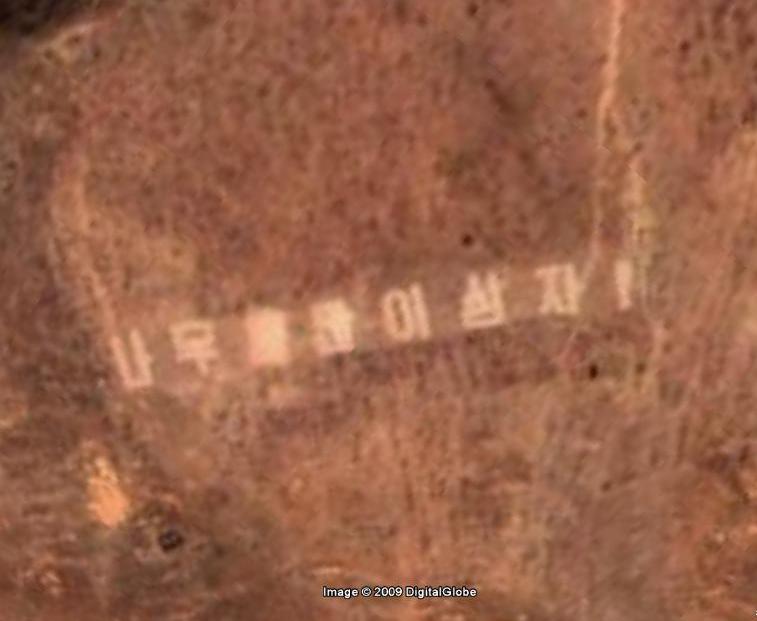
The South Korean civic organization ‘Good Friends’ recently reported that North Korean authorities have prohibited North Koreans from working private plots in the mountains which had been cleared and used for grain production, and have recently begun replanting trees in these areas.

A source for Good Friends stated, “The Central Party decreed last September 29th, ‘The Fatherland’s mountains and fields must be adorned with green so that not one single desolate plot exists by the year 2012.’” Accordingly, garden plots are already being reclaimed from individuals and planted with trees.

North Korea is declaring 2012, the year which marks the 100th anniversary of the birth of Kim Il Sung and the 70th birthday of Kim Jong Il, ‘The Year Opening the Gates to a Strong and Prosperous Nation’.

The source stated that local residents in Booryung, North Hamm planted corn, potatoes, beans, and millet on those plots, relying on them for between 3 and 6 months worth of food, and that with the new decree prohibiting farming, more people would die. 

*NKeconWatch: The DPRK just recently replaced its Minister of Forestry.  This is his first large-scale policy initiative. 

Share

Famine in North Korea Redux?

Monday, November 3rd, 2008

Peterson Institute Working Paper
WP 08 – October 2008
Stephan Haggard and Marcus Noland

Read the paper here

Abstract: In the 1990s, 600,000 to 1 million North Koreans, or about 3 to 5 percent of the precrisis population, perished in one of the worst famines of the 20th century. North Korea is once again poised on the brink of famine. Although the renewed provision of aid is likely to avert a disaster on the scale of the 1990s, hunger-related deaths are already occurring and a dynamic has been set in motion that will carry the crisis into 2009. North Korea is a complex humanitarian emergency characterized by highly imperfect information. This paper triangulates quantity and price evidence with direct observation to assess food insecurity in North Korea and its causes. We critique the widely cited UN figures and present original data on grain quantities and prices. These data demonstrate that for the first time since the 1990s famine, the aggregate grain balance has gone into deficit. Prices have also risen steeply. The reemergence of pathologies from the famine era is documented through direct observation. Although exogenous shocks have played a role, foreign and domestic policy choices have been key.

Keywords: Famine, North Korea
JEL codes: Q1, O1, P2

Share

Organizational Loyalty on Display

Friday, October 31st, 2008

Daily NK
Jeong Jae Sung
10/31/2008

North Korean youth and women’s organizations have been holding meetings to elicit a vow of loyalty to Kim Jong Il since mid-August, when he disappeared from public view.

Meanwhile, North Korean media report that Kim Jong Il mails letters and gifts frequently in order to prevent a potentially unstable social situation caused by rumors of his serious illness. These loyalty vow meetings are also a tool by which to emphasize solidarity with the current political system.

Chosun (North Korea) Central News Agency reported on Friday that the Primary Organization Chairmen’s meeting of the Union of Democratic Women was held on the 30th in the People’s Palace of Culture, Pyongyang, at which Party Secretary Kim Jung Rin was present and a further “oath statement” to Kim Jong Il was selected.

The News Agency described the meeting thus, “Chairwoman of the Union of Democratic Women Roh Sung Sil reported their activities, after which they evaluated sub-organizational achievements as led by the leadership of the Party and discussed the duties of the primary organizations’ chairwomen and ways to raise their results.”

The Union of Democratic Women consists of around 200,000 women between 31 and 55 years old who do not have jobs. Women who meet these registration conditions have to affiliate with the Union.

On the 28th, a North Korean representative youth organization, the Kim Il Sung Socialist Youth League, held its 38th Assembly in order to discuss a way to enact Kim Jong Il’s instruction, “The youths should take the role of vanguard and storm troopers in the hardest fields, to establish a great and strong country,” according to the News Agency.

The Kim Il Sung Socialist Youth League was founded on January 17, 1946 and today consists of around five million students, workers and soldiers between 14 and 30. Its role is to act as a rearguard for the Party.

Vice Chairman of the General Federation of Korean Trade Unions, the largest workers’ organization, Kim Sung Cheol said in late September through the Chosun Central News Agency (KCNA) that “The core of the spirit of the thousands of soldiers and people is to firmly support the Leader, so we should put pressure on members to strengthen their spirits.” 

Share

An affiliate of 38 North