Archive for the ‘State Offices’ Category

Increase in DPRK’s mineral resources exports to China expected again for this year

Monday, February 28th, 2011

Institute for Far Eastern Studies (IFES)
2/24/2011

The trade volume between North Korea and China has steadily increased, reaching its record high of USD 3.4 billion in 2010. Total exports amounted to 1.19 billion USD while imports doubled that figure to USD 2.22 billion. Imports have continued to grow, increasing by 2.4 times over the previous year.

Since the Cheonan incident and the implementation of May 24 sanctions, inter-Korean economic cooperation has come to a halt, naturally resulting in rise in exports to China. In particular, a significant growth in anthracites exports was observed. The monthly anthracites exports that averaged around USD 10 million surpassed USD 70 million mark last August and maintained USD 50 million monthly average between September to November. In addition, cost-per-ton of anthracite in March which was USD 52.2, jumped to USD 82.8 in November, a climb of 60 percent. This boost is attributed to its increased export.

The current supply of electric power consists mostly of hydroelectric power — reaching over 60 percent– but during the winter season most of the hydropower plants are unoperational due to frozen facilities from harsh winter weather. Anthracites were the alternative resource to fill this gap. Sacrificing power production and exporting great amount of anthracites despite severe winter is a strong indication of the poor foreign currency situation in North Korea.

In its New Year’s joint editorial, North Korea placed heavy emphasis on its anthracite export that took up 60 percent of its total exports. In the statement, four vanguard sectors of coal, electricity, metals, and railroads were highlighted as important industries as “rich underground resources that will help with securing funds and resolving raw material problems.” This is the first time in 13 years – that is, since the Arduous March — for coal to be mentioned first in the New Year’s message.

North Korea also began to lift export restraints of mineral resources like coal and silver from the latter half of last year and ordered to increase imports of rice and corns in place of minerals.

The reason food procurement is placed first at the expense of its mineral resources is believed to be associated with the implementation of the succession involving Kim Jong Un, and to keep North Korean people’s dissatisfaction under control and manage the domestic situation.

North had placed restraints on coal, gold, silver, lead, and zinc exports from 2007 through adopting export control of mineral resources.

In addition, North Korea and China will meet in Beijing to sign an agreement on joint development of underground resources. This agreement will include Musan Mine and rare-earth mines that POSCO (The Pohang Iron and Steel Company of South Korea) has shown interest in in the past for development. China’s moves in this sector are suspected as China’s attempt to monopolize the DPRK’s underground resources.

The DPRK’s Joint Venture and Investment Guidance Bureau and China’s Ministry of Commerce were expected to meet on February 15 to discuss agreements related to underground resources development. On the agenda was Musan Mine, abundant in gold and anthracite, and other mines rich in rare-earth elements. Other mines are also known to be specified in the agreement.

China is expected to bring private companies into the underground resources development project after reaching an agreement with the DPRK. According to our source, “both parties will establish a joint venture investment corporation in Hong Kong after signing the agreement.”

Construction of a highway connecting Heilong City of Yanbian Korean Autonomous Prefecture to Nampyong and Chongjin of North Korea and railway system linking the cities of Heilong, Nampyong, and Musan are currently underway, expected to be in operation by end of this year. Jilin Province and Ministry of Railways of China began construction of this railway system from October 2010 investing CNY 1.19 billion, which runs a distance of 41.68 km. However, it is expected to extend further onto Chongjin and is considered to become the major transportation hub, integrating economic cooperation between the two countries.

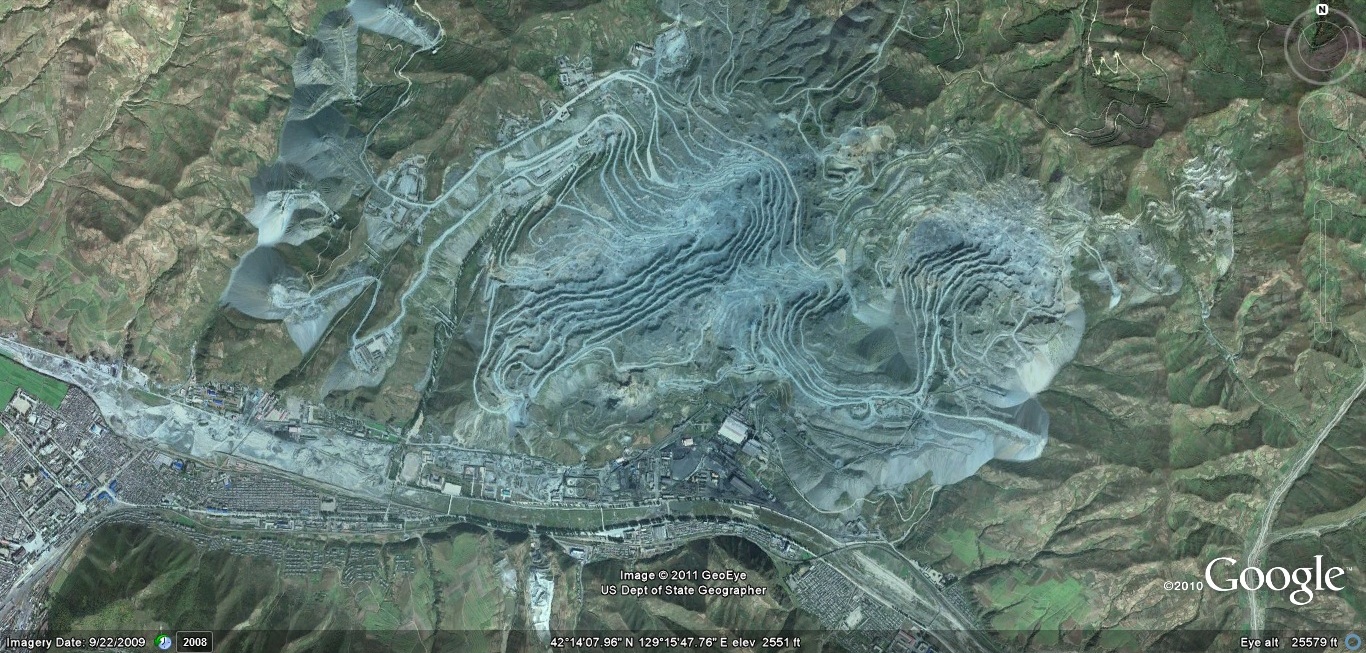
Musan Iron Mine is known as the largest outdoor iron mine in Asia and Tonghua Iron and Steel Group along with three other Chinese corporations acquired 50-year development rights of Musan Iron Mine. They are bringing in about 120 tons of iron ore each year and more is expected to be brought in once the Heilong-Musan rail link is completed.

Share

Office 38 reportedly back in business–and other changes

Sunday, February 20th, 2011

UPDATE 4 (2/20/2011): Kim Tong-un (김동은) named Kim Jong-il’s fund manager.  According to Yonhap:

A senior official of North Korea’s ruling party has been named to lead a special party bureau, code-named Office 38, that oversees coffers and raises slush funds for its leader Kim Jong-il and the ruling elites, a source on North Korea said Sunday.

Kim Tong-un, formerly head of Office 39 in the Workers’ Party of Korea, assumed the post in May last year, when North Korea revived Office 38, which was merged with Office 39 in 2009, the source said on condition of anonymity. Office 39 is believed to be another organ that governs a wide network of business operations both legal and illegal.

Both Offices 38 and 39 belong to the Secretariat of the Workers’ Party, which Kim Jong-il chairs, according to a diagram of the North’s power structure released by the Unification Ministry, which handles inter-Korean affairs. Last year, the ministry had only included Office 39 in a similar diagram.

In a meeting with reporters last week, a ministry official said Office 38 has been spun off from Office 39 and is now running on its own again. The official, who would speak only on the condition of anonymity citing the sensitive nature of his comments, described “a stream of information” that has come through since mid-2010.

Office 38 mainly oversees transactions involving foreign currency, hotels and trade, the official said, while Office 39, headed by Jon Il-chun, drives revenue by dealing in narcotics, arms, natural resources and others.

The North’s revival of Office 38 is interpreted as an effort to cover the increasing cost of leader Kim Jong-il’s ceding of power to his youngest son, Jong-un.

The story was also reported in Yonhap.

UPDATE 3: Here are links to the Ministry of Unification‘s English language organization charts of the North Korean leadership in which some of the changes mentioned below are listed (though not all): Workers’ Party, State Organs, Parties and Organizations

UPDATE (2/15/2011): According to the Daily NK:

The number of Special Departments under the Secretariat of the Chosun Workers’ Party has been increased from 18 to 20, a move that includes the revival of the No. 38 Department, which previously served as Kim Jong Il’s private bank vault, and the foundation of a film department.

The Ministry of Unification revealed the news yesterday in its 2011 North Korean Power Structure and Index of Figures, Agencies and Organizations. It incorporates North Korean changes from December, 2009 up to the present day, completed after consultation with relevant agencies and experts.

The revival of the No. 38 Department and founding of a film department

The report states, “The No. 38 Department, which was merged with the No. 39 Department in 2009, was spun off again last year. Kang Neung Su, who was appointed Deputy Prime Minister in June of 2010, was introduced as head of the film department at the same time. The exact foundation date of the film department is unknown; however, it appears to be newly established.”

No. 38 and No. 39 Departments are directly controlled by Kim Jong Il and serve as a private vault for his ruling funds. The No. 38 Department manages hotels, foreign currency stores and restaurants etc, while illegal weapons trading through foreign trade companies, the smuggling of gold, illegal trade in drugs and the distribution of counterfeit dollars, so-called supernotes, are handled by the No. 39 Department.

“They combined two offices which had different functions, and it appears that this did not result in the intended efficiency,” a knowledgeable source commented.

Meanwhile, on the establishment of a film department, the source added, “North Korea’s cultural art is a political means by which to carry out Party policy and a policy tool to implant policy in the North Korean citizens.”

Among the reshuffled special departments, the existing ‘Munitions Industry Department’ has been renamed the ‘Machine Industry Department’, and the ‘Administration and Capital Construction Department’ has been scaled back to simply ‘Administration Department’.

Elsewhere, the existing National Resources Development and Guidance Department under the Ministry of Extractive Industries has been promoted to National Resources Development Council and, as reported, the Joint Investment Guidance Department rose to become the Joint Investment Committee, while the National Price Establishment Department became the National Price Establishment Committee. Again, as reported, the ‘People’s Safety Agency’ under the Cabinet became the People’s Safety Ministry under the National Defense Commission, while the Capital Construction Department was downsized to become the General Bureau of Capital Construction.

The Central Court and Central Prosecutors Office were also renamed the Supreme Court and Supreme Prosecutors Office respectively.

The Ministry of Unification report also notes that North Korea added Nampo City to its list of eleven cities and provinces, increasing the total number to twelve.

The newly designated Nampo City includes five former parts of South Pyongan Province; Gangseo, Daean, Oncheon, Yonggang, and Chollima districts. Previously, Nampo was under the direct control of the central government as part of South Pyongan Province proper.

At the same time, North Korea also transferred the existing Kangnam-gun, Joonghwa-gun, Sangwon-gun, and Seungho-district, all formerly southern sections of Pyongyang City, to North Hwanghae Province.

Military Commission placed under the Central Committee of the Party

The relationship of the Central Committee and Central Military Commission, which was formerly said to be in parallel, has been changed, reflecting the idea that the Military Commission is now under the Central Committee of the Party.

The Ministry of Unification commented, “By revising the Party regulations, the Central Military Commission and Central Committee were marked as parallel in 2009 and 2010. However, after confirming the revised Party regulations at the Chosun Workers’ Party Delegates’ Conference on September 28th last year, this relationship was adjusted, and an election is now held for the Central Military Commission via a plenary session of the Central Committee.”

Also, the ‘Bureau of General Staff’ under the National Defense Commission was judged to be below the Ministry of the People’s Armed Forces, but is now shown to be in a parallel relationship with the Ministry of the People’s Armed Force and ‘General Political Department’.

ORIGINAL POST (2/14/2011): According to Yonhap:

North Korea has revived a special party bureau, codenamed Office 38, that oversees coffers and raises slush funds for its leader Kim Jong-il and the ruling elites, South Korea said Monday in its annual assessment of the power structure in the communist country.

In 2009, the bureau had been merged with Office 39, another organ that governs a wide network of business operations both legal and illegal, according to the Unification Ministry in Seoul.

In a meeting with reporters, however, a ministry official said Office 38 has been spun off from Office 39 and is now running on its own again. The official, who would speak only on the condition of anonymity citing the intelligence nature of his comments, cited “a stream of information” that has come through since mid-2010.

The official would not elaborate on how the information has been obtained, only saying the ministry works closely with “related government bodies” to outline the North’s power structure.

Office 38, whose chief remains unknown, mainly oversees transactions involving foreign currency, hotels and trade, the official said, while Office 39, headed by Jon Il-chun, drives revenue by dealing in narcotics, arms, natural resources and others.

A source privy to North Korea matters said the spin-off suggests that North Korea has been experiencing difficulties in earning foreign currency since merging the two offices.

“Efficiency was probably compromised after the two, which have different functions, were combined,” the source said, declining to be identified citing the speculative nature of the topic. “More importantly, it seems related to the current state of foreign currency stocks. The North is apparently trying to address those difficulties.”

In August last year, the United States blacklisted Office 39 as one of several North Korean entities to newly come under sanctions for involvement in illegal deeds such as currency counterfeiting.

North Korea is also believed to have been hit hard financially after South Korea imposed a series of economic penalties last year on Pyongyang when the sinking of a warship was blamed on it.

Both Offices 38 and 39 belong to the Secretariat of the Workers’ Party, which Kim Jong-il chairs, according to a diagram of the North’s power structure released by the Unification Ministry. Last year, the ministry had only included Office 39 in a similar diagram.

Both offices have often been referred to as Kim Jong-il’s “personal safes” for their role in raising and managing secret funds and procuring luxury goods for the aging leader.

Read the full story here:
North Korea Splits No. 38 and 39 Departments Up Again
Daily NK
Kim So Yeol
2/15/2011

N. Korea revives ‘Office 38’ managing Kim Jong-il’s funds: ministry
Yonhap
Sam Kim
2/14/2011

Share

KJU supporter takes over Rajin-Sonbong (Rason)

Monday, February 14th, 2011

According to the Donga Ilbo:

North Korea has reportedly appointed Vice Trade Minister Jo Jong Ho as chairman of a civic committee for Rajin-Sonbong Special City, a major post in the North, to succeed Kim Su Yol, who was dismissed late last year.

Jo is a member of a group that supports Kim Jong Un, the youngest son of North Korean leader Kim Jong Il and heir apparent, and reportedly has helped set the North’s new economic policy.

A source on North Korean affairs said Sunday, “Jo Jong Ho has been named the new chairman of the people’s committee, a post which has remained vacant after the dismissal of former chairman Kim due to sluggish foreign investment.”

“Since Jo used to work with former Trade Minister Im Kyong Man, chief secretary of the ruling Workers’ Party for Rason City, he will likely enjoy a harmonious working relationship with Im.”

Pyongyang has apparently deployed a key member of the power elite among supporters’ groups of Kim Jong Un to an important economic region to lay the foundation for a successful power succession based on economic achievements.

The source said, “The North deployed a Kim Jong Un supporter at a time when Pyongyang is striving to establish the structure for power succession,” adding, “Since Jo is fluent in English, activities to attract foreign investment from overseas enterprises will likely gather momentum.”

Read the full story here:
NK appoints heir apparent`s supporter to key post
Donga Ilbo
2/14/2011

Share

DPRK to distribute light industrial goods to the people by April 2012

Sunday, February 13th, 2011

Institute for Far Eastern Studies (IFES)
NK Brief No. 11-02-08
2011-02-08

In last month’s New Year’s Joint Editorial, North Korean authorities reaffirmed the national drive to strongly develop the country’s light industrial sector by 2012, the 100th anniversary of the birth of Kim Il Sung. On February 2, the Choson Sinbo, the newspaper of the pro-North Korean residents’ league in Japan, proclaimed that all efforts were being focused on delivering high-quality light industrial goods by April of next year.

North Korea’s minister of light industry, forty-seven year old Hu Chul San, was interviewed by the paper’s Kook Jang Eun. Hu stated that light industrial zones already in operation would be further bolstered and the provision of raw materials would be prioritized for celebrations surrounding the 100-year birthday of the country’s founder.

The North Korean regime has set 2012 as the year in which it will “open the doors to a great and prosperous nation,” and Kim Il Sung’s April 15 birthdate has been set as the first target for economic revival. Just as in 2010, this year’s Joint Editorial called for light industrial growth and improvements in the lives of the North Korean people as the ‘strong and prosperous nation’ goal is pursued.

Minister Hu gave one example of the expected boost in production, stating that all students, from elementary school to university, would receive new school uniforms by next April. “Originally, school uniforms were issued to all students once every three years, but as the nation’s economic situation grew more difficult, [the regime] was unable to meet the demand.” He promised that for the 100-year anniversary, “Rationing would take place as it did when the Great Leader was here.”

The minister also explained that all preparations for distributing light industrial goods to the people next April needed to be completed by the end of this year, since Kim Il Sung’s birthday fell so early in the spring. He stated that a strong base had already been established for the production of high-quality goods, and that many organizations had already mass-produced high-quality goods for the celebration of the 65th anniversary of the Korean Workers’ Party founding last year, offering the Pyongyang Sock Factory, the Sinuiju Textile Mill, the Botong River Shoe Factory, and the Pyongyang Textile Mill as examples.

When asked how North Korea would resolve raw material shortages, the minister explained that since the February 8 Vinalon Complex began operations last year, Vinalon and several other types of synthetic materials were available. The Sunchon Chemical Complex and other industries were also providing synthetic materials to light industrial factories throughout the country, strongly supporting indigenous efforts to increase production. He added, “Raw rubber, fuel and other materials absent from our country must be imported,” but that “national policies were being implemented” to ensure steady supply.

Minister Hu admitted that there was no shortage of difficulties, but that every worker was aware of the importance of meeting the April deadline, and that because raw material shortages were being resolved, light industries were now able to press ahead with full-speed production.

Share

KPA in charge of fulfilling 2012 Pyongyang construction

Wednesday, February 9th, 2011

According to the Joongang Daily:

North Korea’s leadership wants “renovations” of its capital city of Pyongyang, a South Korean government source said yesterday, and much of the so-called renovations will reflect the rising power of the military.

The source said that leader Kim Jong-il and heir-apparent Kim Jong-un had given orders to hand the Ministry of Capital City Construction Development over to the military.

The source also said military men took over key positions in the ministry.

The modernization of the capital is a long-term project that began in 2001. The Ministry of Capital City Construction Development was included in the cabinet in that year.

In 2006, Kim Jong-il’s brother-in-law Jang Song-thaek, often called the second-most powerful man in North Korea, took charge of the ministry.

It is unclear, however, whether Jang will continue to head the ministry after the military takes over.

The change is being seen as part of North Korea’s often stated goal of becoming a “strong and prosperous country” by 2012.

That will also include improving Pyongyang and the economy as a whole, with the military controlling much of the activity.

Temporary youth brigades were mobilized last September to help with construction throughout the country. They were assigned to military brigades as regular soldiers.

North Korea analysts have said that the change in the ministry was for “mobilization and stronger control.”

“North Korea has recently stopped calling laborers and farmers the ‘leaders of the revolution,’ and said the soldiers are,” said Jung Chang-hyun, a professor of North Korean studies at Kookmin University in Seoul.

“Assigning civilian groups to the military means that the leadership aims to mobilize the people and gain effective control to create a strong and prosperous country by next year,” Jung added.

Kim Jong-il said in October 1996, during a speech honoring the 50th anniversary of Kim Il Sung University: “Only the military can be trusted.”

Kim’s reliance on the military and the mobilization of civilians into the military reflects his songun, or “military-first,” ideology.

The moves also aim to solidify Kim Jong-un as the next leader of North Korea, with his name on the orders along with his father’s. If the projects improve people’s lives, the positive results can be attributed to Kim Jong-un, said Lee Jo-won, professor of political science at Chung-Ang University in Seoul.

The number of facilities in Pyongyang that have been renovated over the past 10 years are too numerous to mention here.  Most showcase factories, schools, theaters and restaurants have been renovated.  Some more than once.

Additionally, the North Korean government has sought to boost the quantity of housing in the city.  A high-profile project near the Potonggang Gate has already been completed, and labor units are busy trying to complete 100,000 new housing units by next February.

Here are previous posts on: Real estate and Construction.

Read the full story below:
Kims want to ‘renovate’ Pyongyang for people
Joongang Daily
Jeong Yong-soo
2/9/2011

Share

North Korea increasing coal production – seeking to ease power shortages and boost exports

Wednesday, February 2nd, 2011

Pictured Above: Pongchon Coal Mine (Google Earth)

Institute for Far Eastern Studies (IFES)
NK Brief No. 11-01-18
1/28/2011

The DPRK Workers’ Party’s newspaper, the Rodong Sinmun, recently featured a front-page editorial urging the North Korean people to increase coal production. On January 26, the KCNA reiterated the call, reporting that the newspaper editorial highlighted fertilizer, cotton, electricity, and steel as products suffering from a lack of coal, and that “coal production must be quickly increased in the Jik-dong Youth Mine, the Chongsong Youth Mine, the Ryongdeung Mine, the Jaenam Mine, Bongchon Mine [Pongchon Mine] and other mines with good conditions and large deposits.”

The editorial also emphasized that “priority must be placed on the equipment and materials necessary for coal production,” and, “the Cabinet, national planning committee, government ministries and central organizations need to draft plans for guaranteeing equipment and materials and must unconditionally and strongly push to provide,” ensuring that the mines have everything they need. It also called on all people of North Korea to assist in mining endeavors and to support the miners, adding that those responsible for providing safety equipment for the mines and miners step up efforts to ensure that all necessary safety gear is available.

In the recent New Year’s Joint Editorial, coal, power, steel and railways were named as the four ‘vanguard industries’ of the people’s economy. Of the four, coal took the top spot, and all of North Korea’s other media outlets followed up the editorial with articles focusing on the coal industry. On January 15, Voice of America radio quoted some recent Chinese customs statistics, revealing that “North Korea exported almost 41 million tons of coal to China between January and November of last year, surpassing the 36 million tons exported [to China] in 2009.” It was notable that only 15.1 tons were exported between January and August, but that 25.5 tons were sent across the border between August and November.

North Korea’s coal exports to China earned it 340 million USD last year, making the coal industry a favorite of Pyongyang’s economic and political elites. Increasing coal production is boosting output from some of the North’s electrical power plants, while exports to China provide much-needed foreign capital. However, even in Pyongyang, where the electrical supply is relatively good, many houses lack heating and experience long black-outs. Open North Korea Radio, a shortwave radio station based in the South, reported on January 24, “As electrical conditions in Pyongyang worsen, now no heating is available.” Farming villages can find nearby timber to use as firewood, but because prices are so high in Pyongyang, even heating has become difficult. Some in the city even wish for rural lifestyles, just for the access to food and heat.

Share

DPRK establishes State General Bureau for Economic Development

Sunday, January 16th, 2011

According to KCNA:

The DPRK Cabinet adopted its decision on “10-Year State Strategy Plan for Economic Development” and decided to establish the State General Bureau for Economic Development.

This governmental body will handle all issues arising in implementing state strategy projects for economic development.

This step was taken at a time when miracles and innovations are being performed in the socialist economic construction everyday on the basis of a solid springboard laid for building a thriving socialist nation under the outstanding and tested Songun leadership of Kim Jong Il.

The above-said plan set a state strategic goal for economic development. It puts main emphasis on building infrastructure and developing agriculture and basic industries including electric power, coal, oil and metal industries and regional development. It, at the same time, helps lay a foundation for the country to emerge a thriving nation in 2012 and opens a bright prospect for the country to proudly rank itself among the advanced countries in 2020.

When the above-said strategy plan is fulfilled, the DPRK will emerge not only a full-fledged thriving nation but take a strategic position in Northeast Asia and international economic relations.

The DPRK Cabinet entrusted the Korea Taepung International Investment Group with the task to fully implement major projects under the strategic plan.

The historic Conference of the Workers′ Party of Korea and events to mark the 65th anniversary of the founding of the WPK successfully held in the DPRK fully demonstrated the might of the single-mindedly united country in the aspects of politics and ideology and in military technique. All the people are dynamically advancing to fling open the gate of a thriving nation in 2012.

According to Yonhap:

Cho Bong-hyun, a Seoul-based analyst with IBK Bank, said North Korea had been working on the 10-year plan since late 2009 and that it covers 12 areas worth US$100 billion.

According to Cho, the dozen categories include agricultural development, the building of five logistics districts, an airport and a port, and urban development.

“Setting up this 10-year plan is to help find breakthroughs for the North Korean economy through foreign investments, since the North has reached a point where it can’t solve economic problems on its own,” Cho observed.

The analyst also said the North’s current regime appears to be trying to build economic achievements credited to Kim Jong-un, the heir apparent to Kim Jong-il, and smooth the impending hereditary power succession.

I am unsure of the relationship between this new organization and the Korea Taepung International Investment Group and the State Development Bank (previous posts here).  I have a major exam next weekend so I will take a closer look after then.

Here also are some quick country rankings by per capital GDP: IMF, CIA.

Share

Naenara, TaeMun, and KCNA get new URLs

Thursday, January 13th, 2011

UPDATE (1/14/2011): More form Martyn Williams here.

UPDATE (1/13/2011): According to Yonhap:

South Korea has blocked its people in the South from accessing Web sites using North Korea’s national Web domain name, saying the sites contain “illegal information” under the nation’s anti-communism and security laws, officials said Thursday.

The blockage by the South’s state-run Communications Standards Commission came less than a day after an expert said North Korea had renewed the use of its own national Web domain name of “.kp” in an apparent effort to widen public access to its propaganda sites.

The commission started blocking Web sites using the “.kp” domain from Internet users in the South attempting to view those sites, including an Internet portal with an address of http://www.naenara.com.kp, officials said.

“We continue to monitor propaganda activities by North Korea throughout the Internet,” said a commission official. “The Web sites were briefly accessible (in South Korea) because North Korea used its national domain (.kp) it had not used usually.”

Earlier in the day, Martyn Williams of IT research group IDG said in an e-mail that he found http://www.naenara.com.kp operating over the weekend while http://www.friend.com.kp and http://www.star.edu.kp likely came into use at about the same time. All of the sites use “.kp” — assigned to North Korea — as their final domain names.

“It was assigned in 2007 and managed by a company based in Germany, but the domain and a handful of sites also managed by the company disappeared in the second half of last year for reasons that are still unclear,” he wrote in his online article.

The re-emergence of the domain name represents “a step-up in the country’s Internet presence,” Williams said.

Kim Yong-hyun, a North Korea professor at Seoul’s Dongguk University, said, “North Korea seems to be trying to increase public access to its sites as part of its recent online propaganda campaign.”

The sites have separate addresses to allow Internet users to access them. According to Williams, the sites, which include one that represents the North’s official Korean Central News Agency (KCNA), all have their servers based in the communist country.

In the e-mail, the Tokyo-based technology expert said the main record for all the .kp names was updated on Jan. 3.

“So that’s the earliest any of these sites could have reappeared,” he said.

In recent months, North Korea has opened accounts at world-famous sites such as Twitter, YouTube and Facebook, drawing wide public attention. But the one on Facebook no longer operates while its Twitter and YouTube accounts were apparently hacked last weekend.

Naenara at http://www.naenara.com.kp is a multilingual portal site, and http://www.friend.com.kp is mainly an English Web site run by an organ that handles exchanges with other countries. The KCNA has its Web site at http://www.star.edu.kp.

South Korea bans its citizens from accessing pro-North Korea propaganda sites, citing the technical state of war it has been in with Pyongyang since the 1950-53 Korean War ended in a truce.

UPDATE (1/11/2011): Martyn Williams at North Korea Tech offers some more information:

Offline for months, the service has resumed via servers run by Star JV, the Internet joint venture formed by the North Korean government and Thailand’s Loxley Pacific. As reported previously, dot-kp was run by the KCC Europe operation in Germany but went offline in the third quarter of last year.

Two websites are already available via KP domain names. Both are hosted on the same web server. The first, Naenara, has been available for a few months via an IP address and the second, Friend.com.kp, has been offline since its domain name disappeared. You can find out more about each site in The North Korean Website List.

I’ve done a little digging around in the DNS (domain name system) records for KP and found the following eight KP top-level domains have been prepared for future use: net.kp, com.kp, edu.kp, gov.kp, org.kp, rep.kp, tra.kp and co.kp.

Both Naenara and Friend are already using com.kp. A domain name has been prepared for the Star Internet provider: star.net.kp, and one for the state-run Korea Posts and Telecommunications Co.: kptc.kp. I can’t find any other registered domain names at present.

Friends.com.kp is the web page of the Committee for Cultural Relations with Foreign Countries (aka TaeMun.  In Korean: 대외문화련락위원회)

UPDATE (1/9/2011): The Naenara URL came back online this weekend. The IP address http://175.45.176.14 has been replaced by the more memorable http://www.naenara.com.kp, though the IP address still works.  The Naenara mirror site, kcckp.net, apparently did not survive the transition.    Content from 2008 to the present is available, but all the content from 2005-2007 remains off-line and probably will not return.

ORIGINAL POST (Oct 28, 2010): North Korea’s premier web outlet, Naenara, was frequently inactive in the month of August.  Sometimes it was there, other times it was not.  The web portal was up for one day in September under a slightly different URL.  It has not appeared at all under its original URLs in October.

Today, Martyn Williams, who broke the story on the DPRK’s acquisition of a block of IP addresses, reports that Naenara has been migrated to the new DPRK addresses alongside the newly created KCNA web page.

According to Martyn:

North Korea’s Naenara website is back. The site went offline around early September when the dot-kp domain name space went down.

Naenara is run by Pyongyang’s Korea Computer Center and offers news, photos, shopping, tourism information and MP3 files from North Korea.

It’s running inside North Korea’s recently-activated domestic IP address space, but isn’t working perfectly. Some of the links point to dot-kp addresses, which are still not working. It’s worth keeping an eye on.

You can find it at http://175.45.176.14/en/

The IP address Martyn mentions is for the English version.

The Korean version is here: http://175.45.176.14/ko/

The French version is here: http://175.45.176.14/fr/

The Russian version is here: http://175.45.176.14/ru/

The German Version is here: http://175.45.176.14/de/

The Spanish version is here: http://175.45.176.14/sp/

The Chinese version is here: http://175.45.176.14/ch/

The Japanese version is here: http://175.45.176.14/ja/

The Arabic version is here: http://175.45.176.14/ar/

I will go through the new site to see if it is different in any way.  One obvious difference is that the archived materials from 2005 & 2007 are gone.

Share

ROK government to leave Kaesong office unstaffed

Tuesday, January 11th, 2011

According to KBS:

South Korea says it will not re-station personnel at the inter-Korean economic cooperation office inside the Gaeseong Industrial Complex in North Korea.

An official from the Unification Ministry in Seoul said Tuesday that the decision was made as there is no work to be done at the office.

Seoul banned inter-Korean economic cooperation and trade in May of last year as part of its retaliatory measures for Pyongyang’s sinking of South Korea’s “Cheonan” naval vessel in March.

North Korea notified the South on Monday that it plans to resume operations at the economic cooperation office in the business park.

Meanwhile, the South accepted North Korea’s proposal to reopen the Red Cross communication channel at the truce village of Panmunjeom. The ministry official said that a South Korean liaison officer will answer the phone if North Korea attempts to contact the office Wednesday morning.

Read the full story here:
Seoul Will Not Send Officials to Gaeseong Office
KBS
1/11/2011

Share

DPRK elevates status of national resource development office

Tuesday, December 28th, 2010

Institute for Far Eastern Studies (IFES)
NK Brief No. 10-12-22
12/22/2010

On December 1, the North Korean Supreme People’s Assembly Standing Committee announced an order to elevate the position of the National Resource Development Office, which is overseen by the Cabinet’s Ministry of Extractive Industry, to the Ministry of National Resource Development. According to the Korea Central News Agency, this measure is aimed at increasing development and export of underground resources as international sanctions against the North further limit Pyongyang’s access to foreign capital.

The regime’s focus on increasing earnings can be seen in Kim Jong Il’s on-site guidance trips, as well. The KCNA reported on December 3 that Kim had recently visited Danchon, South Hamgyong Province, touring the Danchon Magnesia Factory, the Danchon Mining Equipment Factory, and the Danchon Port facilities. During his visit to the magnesia factory, Kim Jong Il emphasized the need for increasing the production of quality asphalt. In addition, after receiving a report on the status of implementation of CNC in the Danchon Mining Equipment Factory, he stated, “The factory needs to normalize at a high level of mass production to turn out the necessary numbers of mining and processing equipment.” Upon reviewing the Danchon Port facilities, Kim Jong Il urged staff to work towards ensuring a loud chorus of boat whistles in the port for the upcoming 100th anniversary of the birth of Kim Il Sung in 2012.

U.S. financial sanctions levied against the North have made it difficult for Pyongyang to collect export earnings from its mining efforts, one of its key earners of foreign capital. In May of last year, when sanctions were strengthened in response to North Korea’s second nuclear test, European and even Chinese banks froze money transfers to North Korea. The [North] Korea Magnesia Clinker Manufacturing Group could not collect 4.6 million USD in earnings from the export of zinc to Europe. It appears that the North has tried to compensate for these losses by increasing the export of iron ore from Musan. Exports to China passing through the Musan customs office have more than doubled, rising from 1200 to 2500 tons per day.

The mines of Musan, holding more than seven billion tons of iron ore, are the North’s primary vehicle for earning foreign capital. In 2004, China’s Tonghua Steel and Iron Group signed a contract with North Korean authorities granting the group 50-year development rights at some key North Korean mines, and is planning to invest seven billion Yuan in developing the sites. Beijing plans to use the access to North Korean mines to meet some of the expected 80 million ton shortfall of iron ore in 2010. However, there are rumors that North Korea has canceled the contract with no explanation, causing much speculation about the direction of Pyongyang’s export strategy.

Share

An affiliate of 38 North