Archive for the ‘DPRK organizations’ Category

Samjiyon Information Technology Center (SITC)

Monday, April 2nd, 2007

Samjiyon Information Technology Center was established as a professional multimedia technology department under the control of KCC on October 24, 1990.

From that time down to this day, SITC has been conducting research & development activities about fields of multimedia communication, image processing, audio & video processing, embedded application, educational application, multimedia contents and authoring tools, and the many powerful and good products were developed.

Our products are being on sale on home and foreign markets, and well received by the customers.

SITC is making inroads actively into the foreign markets based on cooperative relations established with several companies of Japan and China in fields of marketing and joint research & development.

SITC is very proud of its employees, among them more than 80% are qualified with masters or doctoral degrees.

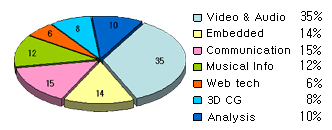
Distribution ratio of technical personnel by fields
pie.gif

Strategy
  – Continuous improvement of the qualitative growth of technical forces
  – Strengthening of the cooperative relations between enterprises and educational & research institutions
  – Maximum intellectual property

Management Goal
  – 3 unique products and services
  – 10 unique core technologies
  – Certification acquisition from ISO9001 Pyongyang Certificate authority and CMM3 acquisition

As in the past, SITC will meet customers’ expectations by superior technology and improved service while amplifying cooperation and exchange with home and foreign partners. 

Share

Academies

Sunday, April 1st, 2007

Korea Times
Andrei Lankov
4/1/2007

Where is science produced? A typical Western answer would be: “in a university, of course.” Actually, it is not really the case these days, since an average teaching routine at most universities is increasingly incompatible with serious research, so a growing share of research is conducted in the corporateowned or independent research centers supported by industry, and by private and/or government money.

Somewhat surprisingly, the communist world was first in separating pure research from a teaching-oriented university. This was initially a Soviet approach, widely accepted by all communist countries, including North Korea.

Most Communist countries had a special academic body whose staff was responsible solely for conducting scientific research. This body was and is called an Academy of Science. In its original Soviet form it could be best described as a self-governing Ministry of Science and Humanities.

The Soviet Union inherited this institution from the old Russia of the tsars. Historically, in pre-Soviet times, the Academy used to be a prestigious closed club of prominent scholars and scientists.

The Communist government took on its payroll, but the institution retained a lot of its ingrained traditions and established privileges. The Soviet Academy of Science was governed by a council of full members, usually well-known scholars and/or academic administrators, who periodically voted new scientists into their circle. Government interference in the process could be serious, but elections still remained contested.

Full membership was a tenured position that could not be withdrawn, even if the bearer was engaged in acts the authorities did not like. Soviet authorities, incidentally, tolerated a high level of critical expression among academy members.

The academy ran a huge network of research centers that formed the backbone of the Soviet research community: the academy always had the best people and the best equipment.

North Korea acquired its own academy in 1952. The preparations began in spring, and on the 1st of December 1952, the academy was officially established. This date became its official foundation day and is regularly celebrated.

At the time of its foundation, the North Korean Academy of Science included 10 full and 15 candidate members and was responsible for 9 “research institutes” and 43 smaller “research laboratories.” Hong Myng-hi was elected as the first President of the Academy, but this aged man was hardly a good administrator. In all probability, Hong was chosen for his background and longstanding reputation as a leftist intellectual of high integrity. In 1956 he was replaced by Paek Nam-un, a prominent historian and another defector from the South (such defectors were very prominent in the North Korean intellectual circles of the 1950s). Unlike his predecessor, Paek was willing to become a real administrator.

Nowadays, the North Korean academy is a large institution. It runs 40 research institutes, about 200 smaller research centers of various kinds, a factory which produces research equipment and 6 publishing houses which issue books and about 40 periodicals. In 1982 the Academy became a ministry, unlike its Soviet counterpart which always had some trappings of an independent “scientists’ club.” But at the same time, the North Korean Academy never even gave a hint of the intellectual, let alone political, independence which was a hallmark of its Soviet counterpart in earlier times.

In the USSR, academies proliferated in the 1940s and 1950s when minor fields began to lobby the government for permission to acquire an academy of their own. Not least, they were attracted to the prestige associated with the name of an “Academy” (and, of course, leading authorities in their respective fields also wanted to be styled a “full member of such-and-such academy”). Thus, the Academy of Medical Science, the Academy of Agricultural Science and even the Academy of Pedagogical Science were born. Each had its own autonomous network of research centers.

A similar process was witnessed in the DPRK where there are minor academies as well. Following the Soviet example, North Korea established an Academy of Medical Science and an Academy of Agricultural Science. Nothing was heard about pedagogy, but the North did create two academies with no Soviet analogue: the Second Academy of Natural Sciences, responsible for military research; and the Academy of Social Science, responsible for the humanities. In 1992 the minor academies, with the exception of the second scademy, fused with the major Academy of Science, but in 1998 the old Soviet-style structure of one major and a number of minor academies was restored.

In better times, a much-coveted job with an academic research institute provided a North Korean scientist with some equivalent of an ivorytower life. Being a staff member of the academy meant good wages, good rations (in North Korea, the latter was more important than the former) and a lot of prestige. In some cases, especially in the natural sciences, the scientists could be even somewhat protected from ongoing political campaigns. However, over the last 15 years, the positions of the academy and its personnel have undergone a dramatic decline.

Share

Stop Illegal Trade! Rations Will Begin April

Thursday, March 29th, 2007

Daily NK
Han Young Jin
3/29/2007

North Korean inside source informed that authorities had been asserting control over illegal selling and use of mobile phones at the markets near the border regions. National Security Agents have also been conducting in-depth investigations on illegal acts such as drug smuggling and slave trade.

In a telephone conversation with a reporter on the 28th, Park Jong Run (pseudonym) of Musan, North Hamkyung said, “Authorities came to the People’s Units and said furtively, ‘Rations will be distributed in April. In future, you will live a good life. So, stop engaging in illegal trade.’ Why would we listen to them when they tell us to stop selling especially since they aren’t going to give us distributions anyway?”

Park relayed, “They said, don’t sell our confidential information about our country through the mobile phone. People already in possession of mobile phones will be forgiven if they self-confess at the National Security Agency.” Since last year, North Korean authorities have been keeping a close watch on mobile phone use particularly in the border regions.

He said, “They threaten us with a declaration, so that we will report cases of illegality or corruption such as slave trade and drug trade.” For example, large amounts of drugs were found in the home of a Chairwoman for the Women’s Union of Hoiryeong City, late February.

According to Park, authorities will directly carry out the procedures at Jangmadang (markets) themselves, with assistance from Hoiryeong Security Agency and various police departments. Some goods found to be linked to illegal trade are in part taken away by the sudden wave of control. In particular, these authorities have a keen eye for goods made overseas such as Chinese items.

National Security Agents and the police confiscate the items arguing that, “now we have a gap between the rich and poor, as well as the richer getting richer and vice versa, because you, tradesmen have tasted some money. Now, socialism has been infected by capitalism.” However, even the security agents are acting tactful by removing only some of the goods as a mere example of punishment.

Goods confiscated are locked up at the security agency and kept in provision. The endless lines in the waiting rooms of the security agency make up the people ready to pay a fine and recollect their items, says Park. Nonetheless, security agents are reluctant to return the goods back to the traders and so bribes must be ready at hand also.

“I barely got my goods back after bribing them with 10 packets of cigarettes, but there was only half the goods left remaining in the bundle” Park criticized and said that the security agents sarcastically remarked, ‘Hey, let us eat and live a little.”

Following the nuclear experiment, authorities have been trying to gather regime support and elevate the nation’s pride arguing the nation had become a strong militaristic country. They proclaim, “The world is cooperating with us and is throwing their goods at us. In future, you will live well.” It will be difficult for North Korean authorities to prohibit trade, especially with the people’s strong will power to make money.

Share

Successes Made in Physical Prospecting

Tuesday, March 27th, 2007

KCNA
3/27/2007

The Central Physical Prospecting Group under the State Bureau of Natural Resources Development is successfully carrying on the survey of underground resources by advanced physical prospecting methods, thus greatly contributing to the economic progress of the country and the land construction. Recently, the prospecting group has introduced the advanced methods in the geological survey and developed modern facilities to explore a new phase for surveying the underground resources. 

The prospecting group, founded in January Juche 46 (1957), has already registered great achievements in the survey of underground resources and the land development. 

Over the last five decades, it has powerfully propelled the development of the national economy with its successful survey of valuable raw materials and fuel resources and greatly contributed to the geological development and the land development in the country with scientific geological survey and the confirmation of the geological foundation. 

It has found out many geological layers and systematized their formation periods and geological composition in a well-arranged way.

They, on the basis of their success, have discovered the law on the distribution of valuable minerals and surveyed and registered scores kinds of minerals, several hundreds of mineral deposits, thousands of mineral bodies and outcrops, and a thousand and several hundreds of heavy mineral streams and metal diffusion zones.

They have achieved many successes not only in the prospecting of abundant iron ore, coal resources and the new graphite deposits but also in the confirmation of the amounts for nonferrous metals, rare metallic mineral resources, nonmetallic mineral resources and magnesite mineral resources. 

The survey of groundwater, hot springs, subterranean heat and the foundations of many construction projects including the Kumsong dam and the Samsu Power Station dam are associated with the efforts of the Central Physical Prospecting Group.

Share

Protocol on DPRK-Russia Cooperation Signed

Tuesday, March 27th, 2007

KCNA
3/27/2007

A protocol of the fourth meeting of the Inter-governmental Committee for Cooperation in Trade, Economy and Science and Technology between the DPRK and Russia was signed in Moscow on Mar. 23. It was signed by Rim Kyong Man, minister of Foreign Trade who is chairman of the DPRK side to the committee, and Konstantin Pulikovski, director of the Supervision Bureau of Ecology, Engineering and Atomic Energy who is chairman of the Russian side to the committee.

Share

Fake North dollars used to cash UN check in ‘95

Monday, March 26th, 2007

Joong Ang Daily
Lee Sang-il
3/26/2007

North Korean bank allegedly gave counterfeit U.S. $100 notes to a foreigner working for the United Nations Development Program when he cashed a check at a bank in Pyongyang in 1995, a diplomatic source in Washington told the JoongAng Ilbo.

A spokesman for the UN agency confirmed the suspicion, adding that the bills will be handed over to the U.S. Treasury Department for verification.

In 1995, the UNDP’s Pyongyang office issued a check to an Egyptian consultant for his services on a North Korea project.

The consultant claimed that he cashed the check at the Foreign Trade Bank in Pyongyang and that the bank gave him 35 $100 bills.

After returning home, the consultant attempted to exchange the bills for Egyptian currency, but the bills were rejected as fakes, the source said.

The Egyptian sent the bills back to the UNDP office in Pyongyang, and the UN officials confronted the Foreign Trade Bank and asked for real money, the source said. The request was turned down, and the UN agency has been holding the bogus bills for 12 years.

The revelation of the incident highlights charges by the American government that North Korea has been passing so-called “supernotes” ― fake $100 bills ― for many years. Washington’s claim that Banco Delta Asia in Macao was a conduit for the release of the notes was one reason for the freezing of $25 million in North Korean funds in September 2005.

That money is now due to be released as a precondition for progress in the six-party talks. The U.S. has cut the suspect bank’s access to the American financial system.

In an e-mail interview with the JoongAng Ilbo, David Morrison, spokesman for the United Nations Development Program, said the agency is in the process of giving the notes to the Treasury Department. Mr. Morrison said he was not aware of any other incidents.

Mr. Morrison added that the Egyptian consultant has not provided further evidence that the bills were passed by the Pyongyang bank. He also said that UNDP had used Banco Delta Asia to send money to the North to finance projects from January 2000 to December 2002. He said they chose the bank for its convenient financial services.

Asked if North Korea asked the agency to use Banco Delta Asia, Mr. Morrison said it was an independent decision. He said the UN body stopped transactions with the Macao bank when the settlement currency was changed from dollars to euros.

UNDP opened its office in Pyongyang in 1980 and has carried out public hygiene, agricultural, energy and environmental projects.

Share

Water Quality Improver Developed

Wednesday, March 21st, 2007

KCNA
3/21/2007

Kim Chaek University of Technology has developed a new kind of water quality improver.   The machine is made with the application of the cutting-edge science and technology such as nano technology.  The kernel of the improver is a filter bar. A bar is capable of refining 2,500 liters of water as “spring water”.

The filter bar, made with nano materials, consists of a layer for removing floating matters and microorganism, a layer for deodorizing smell, a layer for absorbing heavy metals and two physical filter layers. 

The new improver is superior to other kinds of water purifiers in various points.  It eliminates heavy metals, floating matters and microorganism harmful to the human body.  The water purified by the improver is clean and low in chemical combination. It supplements microelements to and improves the digestion function of the human body, thus effectively preventing various diseases.

Share

Maebong Company-Ringleaders of Foreign Currency

Tuesday, March 20th, 2007

Daily NK
Han Young Jin
3/20/2007

(UPDATE: On Oct. 23, [2008] the State Department blacklisted two North Korean companies, Korea Mining Development Corp. and Korea Taesong Trading Co., for violating U.S. bans on the sale of equipment used in building missiles or other weapons of mass destruction to Iran and Syria. Citation: “North Korean Plane Was Grounded at U.S. Request “, Wall Street Journal, Jay Solomon, 11/1/2008 )

Daesung Trading Company and Maebong Company, Two Pillars of North Korea’s foreign currency

In the 80~90’s, the aim of the People’s Army of North Korea was to make foreign currency and consequently, each division of the government began to operate trading companies. However, there were many kinds of trading companies.

The Maebong Company under the General Staff which was established in the 80’s, Birobong Trading Company, Yongsung Trading Company, Manpoong Trading Company and Danpoong Trading Company founded in the 90’s, all under the top 5 trading companies in North Korea. Of these, Maebong Company is the most well-known; once also known as Kwangmyung Trading Company until 2000.

Following “Military First Politics,” Maebong Company became one of North Korea’s active traders with Daesung Trading Company belonging to the Worker’s Party Division 39.

One of the reasons that the military became directly involved in foreign currency came from the fact that the nation was unable to acquire the necessary war supplies itself due to the economic crisis. Further, as the Soviet Union and the East European bloc collapsed, trade was changed from bartering goods to dollars and hence, North Korea was in a dire state of insufficient currency.

Presently, the Maebong Company’s main office is in Pyongyang with branches throughout the country such as the border districts of Shinuiju, Haesan and Hoiryeong.

In order to attract powerful Chinese traders, Maebong Company only appoints those who have experience with foreign money as regional directors such as North Korean citizens with relatives in China. After giving the title of regional director, a permit is given. Though the regional director is registered as a tradesman for the military, actually he/she is in fact not a soldier.

With a certificate which states their position of foreign tradesmen, regional directors have the privilege of freely entering and exiting China.

Trading branches in each city, trading with Japan in the opensea

Trading partners are mostly China and Japan. Traders from Maebong Company dealing with China exchange goods such as second hand cars, medicinal herbs, silk cocoons and seafood.

With copies of Kim Jong Il’s orders distributed by Maebong Company, trading partners are able to transport secured goods supplied by foreign currency directors as far as the border regions without much difficultly from security posts.

One defector from Shinuiju said “In 1995, hundreds of trading companies were established in Shinuiju… Maebong Company was one of these companies which served as a shabby storage factory stocking 10tons of flour and medicinal herbs in which people could exchange for aluminum. At that time, these people who were called foreign currency directors wore overcoats made of dogs fur and rode second hand bicycles made in Japan.”

At one point, Maebong Company illegally sold second hand cars along the border region and gained considerable income. Nowadays, medicinal herbs and minerals are more popular and whereas more of the traders from the West Coast export seafood such as shells and razor clams to China, expectedly, export seafood to Japan occurs mainly on the East Coast.

Conceal illegal foreign currency, smuggling of gold prohibited

In 1997, authorities conducted a thorough investigation against traders in order to straighten the chaotic mess created by border tradesmen. After the investigation, Kim Jong Il ordered every trading company to be merged under the control of each agency. As a result, trading companies which had once been organized by the military divisions were disintegrated and became incorporated as part of the Maebong Company, now an integrated trading group.

After becoming a director for Maebong Company in Hoiryeong, “Kim” who had once lived a tough life is now known to be one of the richest people living in the area, frequently traveling to China.

According to one defector who had worked under the Korea Service Bureau of Workers’ Party division 16, there were 6 employees at the Hoiryeong Maebong Company located in Manghyang, which planned to earn $100,000 annually. Also, additional funds are kept in celebration of national events such as Kim Il Sung and Kim Jong Il’s birthday.

There is a great number of Maebong Company employees who engage in corrupt activity and ultimately are defaced. There is a saying in North Korea, “earning foreign currency is educational punishment,” meaning that though earning foreign currency is an occupation preferred by the many, it does at the same time involve greatest risk. In 1997, an investigation was made targeting central authorities. Many of these directors in charge ended up receiving severe punishment.

Once, “Park” a director of Shinuiju Maebong Company was convicted under the suspicion of depositing foreign currency into a Chinese bank and while undergoing the preliminary hearing was known to have attempted self-injury by swallowing a spoon. On another occasion, ‘Kim’ of Chongjin Maebong Company was known to have been executed for being involved in a case of smuggling gold.

Share

Money Means Everything

Monday, March 19th, 2007

Daily NK
Kim Min Se
3/19/2007

Today, a rich person in North Korea is someone who can spend roughly US$100~$500 (300,000~1.5mn North Korean won) a month. This amount is so large, that it is a figure unfathomable to the average North Korean.

Nowadays, a small number of lower class North Koreans sell noodles at the markets and earn 1,500~2,000won a day. On average, this equates to 50,000~60,000won a month. Additionally, the living costs of a family of 4 in Pyongyang normally costs about 50,000~100,000won.

While a laborer with a stable job earns about 2,000~3,000won (approx. US$0.66~1) a month, spending more than 100,000won (approx. US$32.2) a month is an extravagant figure. Simply put, it has become difficult to live only on selling noodles.

Anyone who spends more than 100,000won a month is probably eating rice and can afford to eat nutritious vegetables. This is the middle class of North Korea today.

The distinctive nature of this middle class is the disparity of the work as well as their past background being rather simple. This class has naturally appeared simply because of their genuine skills. These people know exactly the flow of the market and know how to make money. The only thing important to them is finding the opportunity to make money. In all, they have come to an understanding that money is needed in order to buy goods and live a life to the envy of others.

This middle class is closely linked to power. If a person only takes pride in the sense that he/she can money, then that person will be hit with a severe fall. It is a characteristic of North Korean society that power is critical in living a life making lots of money without trouble.

With money, these people are earning even more by buying the supervision of low ranking safety and security agents and local administrative officers. Simply put, the small amount of money invested as bribery in securing a good location at the markets is petty compared to the income reaped. In other words, whenever a new market is established at a village, a person can be confident in having the best spot by winning over the person in charge. For example, the bidding for the best spot at the Sunam Market, Chongjin is 900,000~1.5mn won (approx. US$290~$490).

Entrepreneurs may become the rich after regime reform

In 2002, the North Korean government passed the July 1st economic reforms which gave more freedom to marketers with less control by authorities and hence, trade became more active.

The mindset of the middle are so fixated on money, that they believe that money can solve anything even if a war was to break out the following day or North Korea was to be completely overturned. Though these people conspire with those in power in order to make money, they are unconcerned with what happens or rather does not happen to the Kim Jong Il regime.

There is a definitive difference between the middle class who are rubbing hands and the central class just in case the Kim Jong Il regime did collapse, compared to the upper class. The middle class are not from any particular special background, but with the skills and guile of making wealth, they are confident that there will be no problems irrespective of regime change.

People from this class even have the freedom to save and keep some food and daily necessities in preparation of this incident. Furthermore, currency is undoubtedly being saved, this also being foreign currency such as dollars. This, they call emergency relief in preparation for the time the North Korean regime does collapse, as well as a safe deposit to use whenever trade needed.

In addition, with the change of the North Korean regime, this class will be able to celebrate and radically transform from being an entrepreneur to the newly-rich with all the wealth acquired during the Kim Jong Il regime.

Share

North Korea’s Middle Class…“Money is Power”

Sunday, March 18th, 2007

Daily NK
Kim Min Se
3/18/2007

In socialism, the laborer and the peasant dominate the nation and society. However, since the late `60’s, the role of the laborer and peasant has decreased with the bureaucracy taking power, to the extent that a country can no longer remain in traditional socialism.

Currently, North Korea’s leader Kim Jong Il with a minority of the central class surround this core power. In North Korea, the laborers and peasants are rather subject to extortion.

Amidst a North Korean market economy, a middle class is being established. The middle class comprises of people who have assets that the average citizen cannot afford and own medium-sized businesses or engage in wholesale trade.

Undoubtedly, this group of people are dominating the middle class as well as playing a vital role in the lifeline of North Korean citizens and market, a fact that could not have been fathomable in North Korea’s past.

Until the 80’s, North Korea’s economy was a planned economy. Supply and demand of goods was distributed according to the national plan. However, in the late-80’s, small holes began to emerge in the socialist planned economic system and with a lack of daily necessities, people began to rely on the black market.

Arising from the major cities, goods were secretively traded in the black market and eventually the majority of North Koreans acquired their needed goods through this system. This system operated evading the control and regulation of North Korean authorities, but when caught, a person was condemned to severe punishment and the goods confiscated.

However, the mass food crisis of the mid-90’s completely collapsed the remnants of a socialist planned economy that had subsided unto the time. What had happened was the end of the national food distribution system.

In particular, the collapse of the food distribution meant the death sentence. Tens and hundreds of thousands of North Koreans began to die of starvation and as a means to live, people became active in the market and trade began to emerge in different regions of North Korea.

Mass starvation which created expert tradesmen

The immobilization of a socialist planned economy activated Jangmadang (North Korea’s integrated markets) which then led to the formation of a new class within North Korea’s own expert tradesmen. North Korean authorities who had no other countermeasures had little choice but to comply as the lives of the citizens were now left to the hands of trade.

In the mid-90’s, North Korean authorities approved personal trade to occur between North Korea and China and then permitted markets to exist along the border districts. Simply put, the mass food crisis created a new class which actually gave North Koreans an opportunity to trade.

At first, people would sell goods that they already had such as household appliances, television, recorder and bicycle. Furthermore, any type of stock accessible, particularly clothing, candy and other foods coming from China such as rice, flour and corn were also traded.

As people gained more experience and came to know the basics of marketing, tradesmen became more specialized. People who sold rice, only sold rice, whereas people who traded fabric only sold fabric.

North Koreans began to realize that specializing in a particular field was the way to make money and the people who were unable to assimilate to this culture broke away penniless.

Accordingly, the market gradually became a center for specialized tradesmen to provide goods and daily necessities. The goods sold by these tradesmen eventually became the mark for the middle class merchant. During this time, stabilized distributors began to dominate the market and more individualized entrepreneurs surfaced.

People skilled at cooking, baked decorative and delicious bread in their homes and then sell them at the markets. In addition, candy distributors have made a mark at the markets with candy making having become an advanced skill. People who once made candy in their homes now brag that they have been able to produce a small-scale sugar factory. In particular, clothes making and candy making has become enterprises leading to great money.

Today, 50% of candy, home-made clothing and 30% of uniforms, sold at North Korean markets are products made from home. Through goods such as these, Chinese merchants, tradesmen and the middle class are earning money through North Korea’s markets supplying the customers, the majority of the lower class.

Share
