Archive for the ‘DPRK organizations’ Category

Tobacco company pulls out of North Korea

Friday, June 8th, 2007

The Guardian
Julia Kollewe
6/8/2007

British American Tobacco is pulling out of North Korea, but insisted the move had nothing to do with political pressure.

The world’s second largest cigarette group, whose brands include Lucky Strike, Kent and Dunhill, said it had agreed to sell its 60% share in Taesong BAT, its joint venture in Pyongyang with the Korea Sogyong Chonyonmul Trading Operation, a state-owned company.

BAT is selling the stake to SUTL, a Singapore-based trading group that invests in business ventures in South East Asia. The price has not been agreed yet but will be small in relation to the group. The sale is expected to be completed later this year.

Read their press release here.

Share

International Day of Biodiversity Observed in DPRK

Tuesday, May 22nd, 2007

KCNA
5/22/2007

May 22 is the International Day of Biodiversity.

The global ecosystem has been seriously destroyed, rapidly decreasing the bio-resources needed for the life of the people. The actuality has risen as an urgent problem to protect the biodiversity in recent years.

According to the data released by the World Conservation Union, biological species which have been extinguished total over 1,000 and those on the brink of extermination far exceed 10,000.

The DPRK is abundant in biodiversity compared with the size of its territory. Under the correct nature preservation policy of the government, the work for protecting ecological diversity have been undertaken as an affair of the state and all people from long ago.

Lots of nature reserves including the Mt. Oga nature reserve, natural parks including Mt. Myohyang and Mt. Kumgang, reserves for native animals, plants and birds and their habitation, reserves for natural products and reserves for natural resources have been set to protect ecological diversity.

The Paektusan biosphere reserve has been preserved and managed amid the special concern of the Korean people from long ago. It was registered as an international biosphere reserve in April Juche 78 (1989).

The biological resources have been protected and increased by various methods including recovery of ecosystem and enhancement of biological function outside the reserves.

The production units such as forestry, agriculture and fishing industry are protecting the biodiversity through development and application of new science and technologies and, at the same time, are taking measures to ensure their sustainable utilization.

The relevant units including the Ministry of Land and Environment Conservation and the DPRK Natural Conservation Union have worked out strategies and action programs for biodiversity and are directing primary efforts to protecting and propagating indigenous species, those in a crisis and rare ones.

The state is pushing ahead with the protection of biodiversity through the institution of laws and regulations and the establishment of administrative and technical management systems. And it does not stint investment to the development of management technologies for analyzing, removing or minimizing the threat to the biodiversity.

And the state is turning the protection of biodiversity into the work of popular masses through the education and propaganda.

It is also taking positive measures for strengthening the international exchange and cooperation as an important part of the international efforts to ease the ecological crisis.

Share

N. Korean leader makes reshuffle of top military officials

Monday, May 21st, 2007

Yonhap
5/21/2007

North Korean leader Kim Jong-il recently made a reshuffle of his top military officials that may solidify his already firm grip on the country’s military, intelligence officials said Monday.

Ri Myong-su, former operations director of the North’s Korean People’s Army (KPA), has been named a resident member of the National Defense Commission (NDC), the highest decision-making body under the communist nation’s constitution that was revised in 1997 to reflect its military first, or “songun,” policy, an official said while speaking anonymously.

Ri was replaced by Kim Myong-guk, who had served in the post from 1994-1997, while Jong Thae-gun, an Army lieutenant general, has been named the propaganda director of the KPA’s General Political Bureau, according to the sources.

The reshuffle first appeared to be a routine rearrangement of personnel, but the sources said it may have been aimed at expanding the role and power of the already powerful NDC.

“The NDC seems to have become, at least externally, the North’s highest decision-making body as a number of top military officials have recently been appointed to (new) permanent posts of the defense commission,” a source said.

“We believe the NDC may become an actual organization in the near future with hundreds of resident staff like the other top decision-making bodies” such as the Workers’ Party, the official added.

Headed by the North’s reclusive leader, the defense commission has been the most powerful organization in the country where the military comes before everything.

But it has mostly been regarded as a faction of a group, namely the KPA, as most of its members concurrently served in other posts of the army, according to the sources.

Kim Yong-chun, the former Chief of General Staff of the KPA, was named the first deputy chairman of the NDC in April.

The sources said it is too early to determine why the commission’s permanent staff has been increased, but they said it may be linked to Pyongyang’s ruling system after Kim Jong-il.

The 65-year-old Kim has yet to name his successor, raising questions worldwide whether the reclusive leader is considering a collective ruling system after his death.

Kim was named as successor to his father, the founder of North Korea Kim Il-sung, at the age of 32 in 1974.

He has three sons from two marriages, but his oldest son, Jong-nam, 35, has apparently fallen out of favor following a 2001 incident in which the junior Kim was thrown out of Japan after trying to enter the country with a forged passport.

His two other sons, Jong-chul and Jong-un, both in their early 20s, have not held any official posts.

N. Korea enhances Kim’s defense commission
Korea Herald

Jin Dae-woong
5/21/2007

North Korea is beefing up the National Defense Commission, a top military decision-making body directly controlled by Kim Jong-il, Seoul intelligence sources said.

Pyongyang recently conducted a major reshuffle of its top military leadership, including the repositioning of Kim’s closest confidants to the committee, they said on condition of anonymity.

Chaired by Kim, the committee is an organization independent of the Cabinet and the ruling Korean Workers’ Party. It is next only to the communist country’s president, a post permanently held by the late founder and Kim’s father Kim Il-sung since his death in 1994.

The sources said that Gen. Ri Myong-su, former operation director of the Korean People’s Army, has been appointed as a standing member of the NDC. Gen. Kim Myong-kuk has been named to replace Ri as the top operations commander.

The reshuffle followed the appointment of Vice-Marshal Kim Yong-chun, former chief of the general staff of the Korean People’s Army, as vice chairman of the NDC during last month’s general session of the Supreme People’s Assembly, the nation’s parliament.

The personnel reconfiguration, which also affected key posts in the North Korean armed forces, is seen as part of Pyongyang’s move to further enhance the NDC, a powerful state body, under North Korea’s military-first policy.

The generals have been regarded as the most influential figures in the military as they frequently accompany Kim during his field unit inspections.

The commission has the power to direct all activities of the armed forces and national defense projects, establish and disband central defense institutions, appoint and dismiss senior military officers, confer military titles and grant titles for top commanders. It also can declare a state of war and issue mobilization orders in an emergency.

The National Defense Commission, presently chaired by Kim Jong-il, consists of the first deputy chairman, two deputy chairmen and six commission members. All members are selected for a five-year term.

The reshuffles are the latest known change to the commission. Gen. Hyon Chol-hae, former vice director of the KPA General Political Bureau, moved to the post of NDC vice director in 2003.

Experts noted that the figures are taking full-time posts in the NDC and relinquishing their posts in the People’s Army.

Other current members concurrently hold posts at both organizations, sources said.

Vice Marshal Jo Myong-rok, the first vice-chairman of the NDC, also assumes the position of director of the KPA General Political Bureau. Vice Marshal Kim Il-chol concurrently serves as a member of the NDC and minister of the People’s Armed Forces.

“As high-ranking military officers have moved to the NDC as full-time members, the NDC may be preparing to take follow up measures to expand its role and function in the future,” the sources said.

The NDC has been known as a consultative body of top military leaders without extensive subordinate organizations comparable to the ruling party and the Cabinet.

The intelligence sources said the NDC may have more manpower and organization under its wing.

“The NDC began equipping itself with organizational apparatuses with the 2003 transfer of Hyon Chol-hae from the KPA position to the post of NDC,” another source said.

In addition, the NDC has continued recruiting personnel such as Kim Yang-gon, councilor of the NDC, from other government departments, to strengthen the NDC’s policy functions, sources said.

“It is in line with North Korea’s long-term move to concentrate the country’s decision-making power on Kim Jong-il and his close subordinates,” said Nam Sung-wook, North Korean studies professor at Korea University. “It is mainly aimed at preventing possible regime dissolution amid rising international pressures over its nuclear weapons program. Kim is also seen directly intervening in a resolution of the nuclear issue.”

Kim Yong-hyun, a professor at Dongguk Univsersity, also agreed that the enhancement of the NDC will lead to the centralization of power in North Korea, reducing the role of the Korea Workers’ Party.

“Through the organizational reform, the North’s regime seeks to further streamline decision-making procedures to more effectively tackle an array of issues,” Kim said.

The North Korean studies expert said it is an answer of North Korean leadership to continuing economic hardship. The leadership has given over a comparatively extensive amount of power to the Cabinet for dealing with economic stagnation.

Kim also said it could be interpreted as preparation for the post-Kim Jong-il system.

“After his death, a collective leadership led by core subordinates of Kim Jong-il is expected to emerge, so, the move could be one related to future changes,” he said.

Share

Distributions Increased in South Hamkyung To Boost Birthrate

Wednesday, May 9th, 2007

Daily NK
Han Young Jin
5/9/2007
“If you have a second child, your rations become equivalent to a family of 4”…citizens respond apath 
 
North Korean authorities have been scrutinizing over the decreasing number of birthrates by young couples and as a result have proposed to increase the amount of rations to families having children.

If a couple gives birth to a second child in the district of Hamheung, South Hamkyung, the whole family will receive 6 months worth of distributions, a source informed. If a third child is born, the rations increase all the more.

After giving birth to a child in a hospital, a married woman from Hamheung can obtain a birth certificate, which is then submitted to the local district office, to receive distributions equivalent to a family of 4. These proposals resemble policies implemented by local district offices in South Korea.

Though Hamheung city has made efforts to increase the birthrate with distributions, the people’s response is all but cold, the source said. How many people would really have a second child just to scavenge off a few months worth of distributions.

One of the main reasons that the birthrate is decreasing in North Korea is due to the fact that women are avoiding giving birth, informed the source.

The source said, “Nowadays, North Korean women engage in businesses and are the breadwinners of the family. They are not satisfied with just having children and bringing them up” and added, “Everyone knows that it is hard enough to live and even harder if you have a lot of children.”

North Korea’s birthrate has continued to decline since the late 1990’s. The average birthrate in North Korea in 1993 was 2.1 births per family and in 2002, 2.04. Comparatively, in South Korea the birthrate per family in 1970 was 4.53 and 1.19 in 2003. Within a period of 33 years, the number of childbirths per family had reduced to 3.34 persons.

In an interview with the Jochongryeon last December, Kang Nam Il, head of the North Korea Population Research Center said, “The decrease of birthrates in our country (North Korea) is no different to that of other nations” and remarked, “Women want to have 2 children, though in the cities women have either 1 or 2 children.”

The source said, “There may be slight differences in each district. Nonetheless, most of the larger cities have adopted this proposal” and added, “This policy was implemented as North Korean authorities are finding it difficult to reach the quota for conscription and the number of students enrolling in schools.”

Share

Photos of Kim Jong Il’s Brother, Kim Pyong Il and Recent Visits

Wednesday, May 9th, 2007

Daily NK
Kim Song A
5/9/2007

KPI.jpg

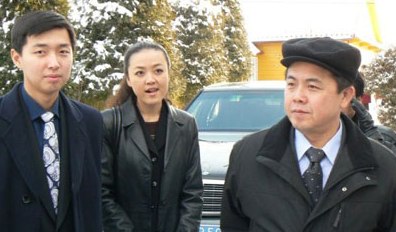
Photos of Kim Jong Il’s half-brother, Kim Pyong Il and the North Korean ambassador in Poland were recently made public.

Kim Pyong Il’s daughter, Eung Song and son, In Kang who have until now lived a sheltered and private life are also exposed in the photos. They are Kim Jong Il’s niece and nephew.

The photos were first released in March on Poland’s City of Narew homepage. The photos show Kim Pyong Il, his children and city officials making visitations to industrial sites, exhibitions, museums and participating recreational activities. In reference to the photos, it seems that these events took place on February 10.

Throughout the past, North Korea has maintained economic and cultural exchanges through the Korean Friendship Association with various countries in the East-European bloc. The events that took place on this day were organized by the association with North Koreans residing in Poland also participating in the occasion.

The homepage showed photos of Kim Il Pyong Il visiting NARMET Pty Ltd, his son, In Kang playing a game of table tennis and daughter Eun Song playing the piano.

Through the photos of Kim Pyong Il, you can see an exact resemblance of his father, though a “younger Kim Il Sung.” His two children are known to have completed a Masters degree in Poland and look healthy and well in appearance.

Kim Jong Il has one younger sister Kim Kyung Hee (married to Jang Sung Taek) as well as half-brothers (to different mothers) Kim Pyong Il, Kim Young Il (deceased 2000) and half-sister Kim Kyung Jin (51, married to Kim Kwang Sup, Ambassador to Austria). After being appointed as the successor in 1974, Kim Jong Il sent his brothers and sisters to work at alternative foreign departments so that they could not interfere with his power.

According to elite North Korean officials, there was a time where Kim Il Sung had considered appointing his succession to his three sons, “Jong Il, the Party, Pyong Il, the military and the government to Young Il.” However, after winning a power conflict with his uncle Kim Young Joo, Kim Jong Il ousted his uncle to Jagang province and sent his other siblings including Pyong Il to other departments where they could not come near of his power.

Kim Pyong Il was born on August 10 1954 and graduated from Kim Il Sung University with a major in economics. Following, he was appointed a high rank position and after passing the Kim Il Sung National War College, began working as a battalion commander at the guards headquarters. Once it was confirmed that Kim Jong Il would succeed his father, Kim Pyong Il left Pyongyang in 1979 to work at the North Korean Embassy in Yugoslavia. Around the same time, Kim Kyung Jin left with her husband for Czechoslovakia and Kim Young Il to East Germany.

In 1988, Kim Pyong Il was appointed Ambassador for Hungary but as soon as South Korea and Hungary developed amiable relations in December that year, he was re-appointed as the Ambassador to Bulgaria. Then in 1998, he became the official Ambassador to Poland where he has continued his services until now.

Kim Pyong Il’s wife is Kim Soon Geum. It is the first time that photos of their daughter Eun Song and son, In Kang, have been exposed to the public. When Kim Jong Il and his first wife Kim Young Sook had their first daughter, Kim Il Sung named the child “Sul Song.” When Kim Kyung Hee had her first daughter, she was named “Geum Song.” Similarly, it seems that Kim Il Sung named Kim Pyong Il’s first daughter, “Eun Song.” Kim Kyung Hee’s first daughter Jang Geum Song was known to have committed suicide last year in France as her parents opposed a marital proposal.

Of North Korea’s central committee under the Workers’ Party, the office 10 is known for regulating, controlling and being responsible for Kim Jong Il’s half-siblings.

Kim Pyong Il: North Korea’s Man in Poland
Daily NK
Nicolas Levi
5/17/2009

In February 2005, when I met Kim Pyong Il in Poland for the first time, he told me that he favored ameliorating the human consequences of the division of Korea.

Afterwards he started to talk to the other people present there in a room at the North Korean embassy; one of them later told me that Kim Pyong Il is usually very discrete, and is rarely present at receptions in other embassies in Warsaw. He generally only goes to the Chinese and Russian embassies, and sometimes to the Romanian and Algerian ones as well. North Korea was a model for both communist Romania under Ceaucescu and Algeria, that’s why the North Korean ambassador has special ties with those countries. In addition, Shaif Badr Abdullah Qaid, the last Yemeni ambassador in Warsaw studied in Pyongyang in the 70’s and became Kim’s good friend; their conversations dealt with life in North Korea, but never about the private life of half brother of Kim Jong Il.

In February 2006, I had occasion to talk with Kim Pyong Il again during a reception on Kim Jong Il’s birthday. During this meeting I saw a confident Kim Pyong Il, happy in Poland. However our conversation remained very diplomatic; Kim agreed that Korea should be reunified peacefully.

I never talked with Kim In Kang (26), Kim Pyong Il’s son, but I did have the chance to meet his daughter Kim Eung Song (28) some 10 times, both with her friends and face to face. She was a very open person. She was not only a nice girl; she also had impressive languages-skills (she is fluent in English, Polish, French and presumably Russian). She had a great social life in Poland with many friends. However, her father ordered her to return to Pyongyang in 2007, where she was supposed to marry the son of a North Korean General. She refused for a time, but finally went back to the North Korean capital.

Kim Sun Gum (56), the wife of Kim Pyong Il is a very discreet person, and rarely talks to others. Theirs was an arranged marriage. The wedding was personally organized by Kim Il Sung. It is said that she has a political background; her family apparently comes from the special services.

The last time I met Kim Pyong Il, in February 2009, I told him that I was preparing a doctoral thesis about his extended family (Kim Il Sung has two official wives: Kim Jong Suk, the mother of Kim Jong Il and Kim Sung Ae who is Kim Pyong Il’s mother). He reacted violently, telling me it was too dangerous.

That was my last contact with Kim Pyong Il; we haven’t met again since.

Kim Jong Il has a younger sister called Kim Kyung Hee (married to Jang Sung Taek) as well as half-brothers Kim Pyong Il (55) and Kim Yong Il (deceased in 2000), and half-sister Kim Kyung Jin (51), who is married to Kim Kwang Sop, Ambassador to Austria. After being appointed successor to his father in 1974, Kim Jong Il sent his half-brothers and sisters to work in overseas missions so that they could not interfere with his power. Kim Pyong Il started out in Yugoslavia, before moving to Hungary in 1988. However, he was swiftly relocated to Bulgaria as part of a protest over the opening of diplomatic relations between Hungary and South Korea. He then went on to work in Finland, but since January 1998 has resided in Warsaw.

Nicolas Levi is a Polish free publisher whose interests are mainly connected with the Korean Peninsula.

Share

National Scientific and Technological Festival Held

Tuesday, May 8th, 2007

KCNA
5/8/2007

The national scientific and technological festival commemorating the 95th birth anniversary of President Kim Il Sung was held from May 3 to 7 at the Three-Revolution Exhibition. 

The 22nd festival of this kind took place in the forms of a symposium on latest scientific and technological achievements, a presentation of results of scientific researches, a presentation of achievements in technical innovation and a diagram show. 

Officials, scientists, technicians and working people across the country presented achievements, experiences and many scientific and technical data attained in the course of the massive technical innovation movement at local scientific and technological festivals. 

At least 570 items of data of scientific and technological results highly appreciated there were made public at 18 sections of the national festival. 

During the festival the participants introduced achievements in agriculture and light industry and valuable scientific and technological data helpful to revitalizing the national economy and lifting to a high level the technical engineering of such major fields as IT and nanotechnology, bioengineering and basic sciences and widely swapped experiences. 

Five persons carried away special prize and 53 top prize at the festival. 

The closing ceremony of the national festival took place on Monday. Present there were Choe Thae Bok, secretary of the C.C., Workers’ Party of Korea, Ro Tu Chol, vice-premier of the Cabinet, Pyon Yong Rip, president of the State Academy of Sciences, and others. 

The decision of the jury of the festival was made public at the closing ceremony and the festival cups, medals and diplomas were awarded to those highly appraised. And prize of scientific and technological merits went to seven officials who had given precious help to scientists and technicians and presented materials of new research results to the festival. 

A closing speech was made by Pak Yong Sin, secretary of the Central Committee of the Korean General Federation of Science and Technology.

Share

N. Korea, Switzerland try new bank program to help N.K.’s farmers

Monday, April 30th, 2007

Yonhap
4/30/2007

Years of efforts to cultivate North Korea’s mountainous farmland is beginning to yield results, and Swiss and Korean officials are testing a bank credit program for the farmers in the Asian country, a Swiss aid office said on Sunday.

North Korea is showing “many promising signs of changes in progress,” including the emergence of consumer markets that are now established as part of the country’s economic system, Adrian Schlapfer, assistant director-general of the Swiss Agency for Development and Cooperation (SDC), said on the agency’s Web site.

Schlapfer was comparing the current situation to that during his previous visit to Pyongyang four years ago.

“The farming land in which the starving people started to work back then is now recognized as providing scope for agricultural initiative,” he wrote.

“The SDC, together with North Korea’s Central Bank, is therefore in the process of testing a micro-credit program to encourage farmers to base their investment decisions on economic feasibility considerations — an innovation for North Korea,” he said.

But North Korea still suffers from food scarcity, and aid is still essential, he said.

The SDC, an agency of the Swiss Foreign Ministry, has maintained an office in Pyongyang since 1997, focusing on agricultural programs to improve food production and on supporting domestic reform. The Swiss government started providing humanitarian assistance to North Korea in 1995.

Schlapfer described North Korea as the most little-known and enigmatic partner of the SDC, and acknowledged there are constant doubts on whether Swiss engagement there will yield results.

“Are there any meaningful approaches for long-term development partnership in this country with its planned economy, backwardness and secretiveness? Given the context, is it at all possible to initiate change?” he asked.

Pyongyang is “not an easy partner,” he said. “The key values, priorities and methods of Switzerland’s development cooperation have to be repeatedly insisted upon.”

“However, the projects implemented over the past 12 years are encouraging,” Schlapfer added.

Share

North Korea’s IT revolution

Tuesday, April 24th, 2007

Asia Times
Bertil Lintner
4/24/2007

The state of North Korea’s information-technology (IT) industry has been a matter of conjecture ever since “Dear Leader” Kim Jong-il famously asked then-US secretary of state Madeleine Albright for her e-mail address during her visit to the country in October 2000.

The answer is that it is surprisingly sophisticated. North Korea may be one of the world’s least globalized countries, but it has long produced ballistic missiles and now even a nuclear arsenal, so it is actually hardly surprising that it also has developed advanced computer technology, and its own software.

Naturally, it lags far behind South Korea, the world’s most wired country, but a mini-IT revolution is taking place in North Korea. Some observers, such as Alexandre Mansourov, a specialist on North Korean security issues at the Honolulu-based Asia-Pacific Center for Security Studies (APCSS), believes that in the long run it may “play a major role in reshaping macroeconomic policymaking and the microeconomic behavior of the North Korean officials and economic actors respectively”.

Sanctions imposed against North Korea after its nuclear test last October may have made it a bit more difficult for the country to obtain high-tech goods from abroad, but not impossible. Its string of front companies in Hong Kong, Singapore, Thailand and Taiwan are still able to acquire what the country needs. It’s not all for military use, but as with everything else in North Korea, products from its IT industry have both civilian and non-civilian applications.

The main agency commanding North Korea’s IT strategy is the Korea Computer Center (KCC), which was set up in 1990 by Kim Jong-il himself at an estimated cost of US$530 million. Its first chief was the Dear Leader’s eldest son, Kim Jong-nam, who at that time also headed the State Security Agency, North Korea’s supreme security apparatus, which is now called the State Safety and Security Agency.

Functioning as a secret-police force, the agency is responsible for counterintelligence at home and abroad and, according to the American Federation of Scientists, “carries out duties to ensure the safety and maintenance of the system, such as search for and management of anti-system criminals, immigration control, activities for searching out spies and impure and antisocial elements, the collection of overseas information, and supervision over ideological tendencies of residents. It is charged with searching out anti-state criminals – a general category that includes those accused of anti-government and dissident activities, economic crimes, and slander of the political leadership. Camps for political prisoners are under its jurisdiction.”

In the 1980s, Kim Jong-nam studied at an international private school in Switzerland, where he learned computer science as well as several foreign languages, including English and French. Shortly after the formation of the KCC, South Korean intelligence sources assert, he moved the agency’s clandestine overseas information-gathering outfit to the center’s new building in Pyongyang’s Mangyongdae district. It was gutted by fire in 1997, but rebuilt with a budget of $1 billion, a considerable sum in North Korea. It included the latest facilities and equipment that could be obtained from abroad. According to its website, the KCC has 11 provincial centers and “branch offices, joint ventures and marketing offices in Germany, China, Syria, [the United] Arab Emirates and elsewhere”.

The KCC’s branch in Germany was established in 2003 by a German businessman, Jan Holtermann, and is in Berlin. At the same time, Holtermann set up an intranet service in Pyongyang and, according to Reporters Without Borders, “reportedly spent 700,000 euros [more than US$950,000] on it. To get around laws banning the transfer of sensitive technology to the Pyongyang regime, all data will be kept on servers based in Germany and sent by satellite to North Korean Internet users.” Nevertheless, it ended the need to dial Internet service providers in China to get out on the Web.

Holtermann also arranged for some of the KCC’s products to be shown for the first time in the West at the international IT exhibition CeBIT (Center of Office and Information Technology) last year in Hanover, Germany. The KCC’s branches in China are also active and maintain offices in the capital Beijing and Dalian in the northeast.

Another North Korean computer company, Silibank in Shenyang, in 2001 actually became North Korea’s first Internet service provider, offering an experimental e-mail relay service through gateways in China. In March 2004, the North Koreans established a software company, also in Shenyang, called the Korea 615 Editing Corp, which according to press releases at the time would “provide excellent software that satisfies the demand from Chinese consumers with competitive prices”.

Inside North Korea, however, access to e-mail and the Internet remains extremely limited. The main “intranet” service is provided by the Kwangmyong computer network, which includes a browser, an internal e-mail program, newsgroups and a search engine. Most of its users are government agencies, research institutes, educational organizations – while only people like Kim Jong-il, a known computer buff, have full Internet access.

But the country beams out its own propaganda over Internet sites such as Uriminzokkiri.com, which in Korean, Chinese, Russian and Japanese carries the writings of Kim Jong-il and his father, “the Great Leader” Kim Il-sung, along with pictures of scenic Mount Paekdu near the Chinese border, the “cradle of the Korean revolution”, from where Kim Il-sung ostensibly led the resistance against the Japanese colonial power during World War II, and where Kim Jong-il was born, according to the official version of history. Most other sources would assert that the older Kim spent the war years in exile in a camp near the small village of Vyatskoye 70 kilometers north of Khabarovsk in the Russian Far East, where the younger Kim was actually born in 1942.

The official Korean Central New Agency also has its own website, KCNA.co.jp, which is maintained by pro-Pyongyang ethnic Koreans in Japan, and carries daily news bulletins in Korean, English, Russian and Spanish, but with rather uninspiring headlines such as “Kim Jong-il sends message of greetings to Syrian president”, “Kim Jong-il’s work published in Mexico” and “Floral basket to DPRK [North Korea] Embassy [in Phnom Penh] from Cambodian Great King and Great Queen”.

On the more innocent side, the KCC produces software for writing with Korean characters a Korean version of Linux, games for personal computers and PlayStation – and an advanced computer adaptation of go, a kind of Asian chess game, which, according to the Dutch IT firm GPI Consultancy, “has won the world championship for go games for several years. The games department has a display showing all the trophies which were won during international competitions.”

Somewhat surprisingly, the North Koreans also produce some of the software for mobile phones made by the South Korean company Samsung, which began collaboration with the KCC in March 2000. North Korean computer experts have received training in China, Russia and India, and are considered, even by the South Koreans, as some of the best in the world.

More ominously, in October 2004, South Korea’s Defense Ministry reported to the country’s National Assembly that the North had trained “more than 500 computer hackers capable of launching cyber-warfare” against its enemies. “North Korea’s intelligence-warfare capability is estimated to have reached the level of advanced countries,” the report said, adding that the military hackers had been put through a five-year university course training them to penetrate the computer systems of South Korea, the United States and Japan.

According to US North Korea specialist Joseph Bermudez, “The Ministry of the People’s Armed Forces understands electronic warfare to consist of operations using electromagnetic spectrum to attack the enemy by jamming or spoofing. During the 1990s, the ministry identified electronic intelligence warfare as a new type of warfare, the essence of which is the disruption or destruction of the opponent’s computer networks – thereby paralyzing their military command and control system.”

Skeptical observers have noted that US firewalls should be able to prevent that from happening, and that North Korea still has a long way to go before it can seriously threaten the sophisticated computer networks of South Korea, Japan and the US.

It is also uncertain whether Kim Jong-nam still heads the KCC and the State Safety and Security Agency. In May 2001, he was detained at Tokyo’s airport at Narita for using what appeared to be a false passport from the Dominican Republic. He had arrived in the Japanese capital from Singapore with some North Korean children to visit Tokyo Disneyland – but instead found himself being deported to China. Since then, he has spent most of his time in the former Portuguese enclave of Macau, where he has been seen in the city’s casinos and massage parlors. This February, the Japanese and Hong Kong media published pictures of him in Macau, and details of his lavish lifestyle there – which prompted him to leave for mainland China, where he is now believed to be living.

Whatever Kim Jong-nam’s present status may be in the North Korean hierarchy, the KCC is more active than ever, and so is another software developer, the Pyongyang Informatics Center, which, at least until recently, had a branch in Singapore. Other links in the region include Taiwan’s Jiage Limited Corporation, which has entered a joint-venture operation with the KCC under the rather curious name Chosun Daedong River Electronic Calculator Joint Operation Companies, which, according to South Korea’s trade agency, KOTRA, produces computers and circuit boards.

The US Trading with the Enemy Act and restrictions under the international Wassenaar Arrangement, which controls the trade in dual-use goods and technologies (military and civilian), may prohibit the transfer of advanced technology to North Korea, but with easy ways around these restrictions, sanctions seem to have had little or no effect.

North Korea’s IT development seems unstoppable, and the APCSS’s Mansourov argues that it can “both strengthen and undermine political propaganda and ideological education, as well as totalitarian surveillance and control systems imposed by the absolutist and monarchic security-paranoid state on its people, especially at the time of growing conflict between an emerging entrepreneurial politico-corporate elites and the old military-industrial elite”.

So will the IT revolution, as he puts it, “liquefy or solidify the ground underneath Kim Jong-il’s regime? Will the IT revolution be the beginning of the end of North Korea, at least as we know it today?” Most probably, it will eventually break North Korea’s isolation, even if the country’s powerful military also benefits from improved technologies. And there may be a day when the KCNA will have something more exciting to report about than “A furnace-firing ceremony held at the Taean Friendship Glass Factory”.

Bertil Lintner is a former correspondent with the Far Eastern Economic Review and is currently a writer with Asia-Pacific Media Services.

Share

North Korea Uncovered (Google Earth)

Sunday, April 22nd, 2007

DOWNLOAD IT HERE (to your own Google Earth)

Using numerous maps, articles, and interviews I have mapped out North Korea by “industry” (or topic) on Google Earth.  This is the most authoritative map of North Korea that exists publicly today.

Agriculture, aviation, cultural, manufacturing, railroad, energy, politics, sports, military, religion, leisure, national parks…they are all here, and will captivate anyone interested in North Korea for hours.

Naturally, I cannot vouch for the authenticity of many locations since I have not seen or been to them, but great efforts have been made to check for authenticity. In many cases, I have posted sources, though not for all. This is a thorough compilation of lots of material, but I will leave it up to the reader to make up their own minds on the more “controversial” locations.  In time, I hope to expand this further by adding canal and road networks. 

I hope this post will launch a new interest in North Korea. There is still plenty more to learn, and I look forward to hearing about improvements that can be made.

Share

A Mission to Educate the Elite

Friday, April 13th, 2007

Science Magazine
Vol. 316. no. 5822, p. 183
DOI: 10.1126/science.316.5822.183
Richard Stone
4/13/2007

In a dramatic new sign that North Korea is emerging from isolation, the country’s first international university has announced plans to open its doors in Pyongyang this fall.

Pyongyang University of Science and Technology (PUST) will train select North Korean graduate students in a handful of hard-science disciplines, including computer science and engineering. In addition, founders said last week, the campus will anchor a Silicon Valley-like “industrial cluster” intended to generate jobs and revenue.

One of PUST’s central missions is to train future North Korean elite. Another is evangelism. “While the skills to be taught are technical in nature, the spirit underlying this historic venture is unabashedly Christian,” its founding president, Chin Kyung Kim, notes on the university’s Web site (www.pust.net).

The nascent university is getting a warm reception from scientists involved in efforts to engage the Hermit Kingdom. “PUST is a great experiment for North-South relations,” says Dae-Hyun Chung, a physicist who retired from Lawrence Livermore National Laboratory and now works with Roots of Peace, a California nonprofit that aims to remove landmines from Korea’s demilitarized zone. To Chung, a Christian university is fitting: A century ago, Christianity was so vibrant in northern Korea, he says, that missionaries called Pyongyang “the Jerusalem of the East.”

The idea for PUST came in a surprise overture from North Korea in 2000, a few months after a landmark North-South summit. A decade earlier, Kim had established China’s first foreign university: Yanbian University of Science and Technology, in Yanji, the capital of an autonomous Korean enclave in China’s Jilin Province, just over the border from North Korea. In March 2001, the North Korean government authorized Kim and his backer, the nonprofit Northeast Asia Foundation for Education and Culture (NAFEC), headquartered in Seoul, to establish PUST in southern Pyongyang. It also granted NAFEC the right to appoint Kim as PUST president and hire faculty of any nationality, as well as a contract to use the land for 50 years.

NAFEC broke ground in June 2002 on a 1-million-square-meter plot that had belonged to the People’s Army in Pyongyang’s Nak Lak district, on the bank of the Taedong River. Construction began in earnest in April 2004. That summer, workers–a few of the 800 young soldiers on loan to the project–unearthed part of a bell tower belonging to a 19th century church dedicated to Robert Jermain Thomas, a Welsh Protestant missionary killed aboard his ship on the Taedong in 1866.

NAFEC’s fundraising faltered, however, and construction halted in fall 2004. The group intensified its Monday evening prayers and broadened its money hunt, getting critical assistance from a U.S. ally: the former president of Rice University, Malcolm Gillis, a well-connected friend of the elder George Bush and one of three co-chairs of a committee overseeing PUST’s establishment. “He made a huge difference,” says Chan-Mo Park, president of Pohang University of Science and Technology (POSTECH), another co-chair. South Korea’s unification ministry also quietly handed PUST a $1 million grant–more than it has awarded to any other North-South science cooperation project. This helped the school complete its initial $20 million construction push.

At the outset, PUST will offer master’s and Ph.D. programs in areas including computing, electronics, and agricultural engineering, as well as an MBA program. North Korea’s education ministry will propose qualified students, from which PUST will handpick the inaugural class of 150. It is now seeking 45 faculty members. Gillis and other supporters are continuing to stump for a targeted $150 million endowment to cover PUST operations, which in the first year will cost $4 million. Undergraduate programs will be added later, officials say. PUST, at full strength, aims to have 250 faculty members, 600 grad students, and 2000 undergrads.

PUST hopes to establish research links and exchanges with North Korea’s top institutions and with universities abroad. “It is a very positive sign,” says Stuart Thorson, a political scientist at Syracuse University in New York who leads a computer science collaboration between Syracuse and Kimchaek University of Technology in Pyongyang. “Key to success will be achieving on-the-ground involvement of international faculty in PUST’s teaching and research.”

Some observers remain cautious, suggesting that the North Korean military could use the project to acquire weapons technology or might simply commandeer the campus after completion. A more probable risk is that trouble in the ongoing nuclear talks could cause delays. At the moment, however, signs are auspicious. Park, who plans to teach at PUST after his 4-year POSTECH term ends in August, visited Pyongyang last month as part of a PUST delegation. “The atmosphere was friendly,” he says. “The tension was gone.” The Monday prayer group continues, just in case.

Share
