Archive for the ‘DPRK organizations’ Category

A Scientific City Pyongsung Became a Distributors Haven for Goods

Monday, July 9th, 2007

Daily NK
Kim Min Se
7/9/2007

Pyongsung, a city located in the province of South Pyongan has recently been targeted as a scientific city transformed into distribution hub.

In the late 1960’s, North Korean authorities established Pyongsung as an area for scientific research with a population of 300,000.

In Pyongsung, there are 25 scientific research centers beginning with a nature centre. Further, there is Pyongsung Scientific University and a training centre for scientists and engineers. Pyongsung lies on the outer-skirts of Pyongyang near the districts of Soonan, Samsuk and Yongsung.

Park Chan Joo (pseudonym) a North Korean tradesman on business in Dandong, China introduced the changes occurring in Pyongsung in a telephone conversation with reporters.

Park currently works as an employee for the Myungjin Trade Company and imports goods needed for everyday living into North Korea.

Park said, “All goods made from China pass through Shinuiju and are generally dispatched from Pyongsung to each region for sale. This includes eastern regions such as Hamheung and Wonsan. Of course traders from Sariwon, Haeju and Nampo in southern provinces also come to Pyongsung to receive their goods.”

Regarding Pyongsung which developed into a distributor of imports, Park said, “The delivery cost is double if goods made from China pass through Shinuiju and are delivered directly to eastern and southern regions. However, stopping over at Pyongsung can make a profit on time and cost effective.”

Further, he said, “It’s close to eastern regions and in the vicinity of southern regions. This area has increasingly become an intermediary wholesalers district with the rise of warehouses.”

Park said, “We are located right next to Pyongyang where the population is greatest. Also, many Pyongyang citizens with high standards of living compared to other regions come and buy the goods.”

“It only takes about one hour to travel from Pyongyang to Pyongsung via car or train. Tradesmen and citizens must obtain a travel permit to enter Pyongyang, but any North Korean citizen can easily come to Pyongsung with an ordinary identification card. Nowadays, you can travel to any special district (excluding Pyongyang and border regions) as long as you have an identification card” he added.

Also, Park said “There are more and more people wanting to living in Pyongsung because of trade” and informed, “All this happened as Pyongsung changed into a centre for wholesalers. Even up until a few years ago, it wasn’t so hard to live in Pyongsung, but now you have to pay thousands of dollars to move in the area to Pyongsung’s People’s Safety Agency (police).”

As Pyongsung emerged into a distributors haven, more and more long distance bus services have been operated connecting rural districts to Pyongsung city.

Kim Jong Hoon (pseudonym) a Shinuiju resident who came to Dandong to visit his relatives said, “People with money hire second hand buses made from China and register the vehicle at the traffic registry and operate the services while offering some profits” and “It takes 3 days to get from Shinuiju to Dancheon in South Hamkyung. It took me 3 days to go to Pyongsung, then from Pyongsung to Wonsan and then Wonsan to Dancheon.”

Presently, the only direct bus services in operation from Pyongsung are to Shinuiju, Wonsan, Sariwon, Nampo and Haeju.

Institute for Far Eastern Studies (IFES)
NK Brief No. 07-7-9-1
9/7/2007

The North Korean city of Pyongsung, situated in the South Pyongan province, is undergoing a transformation. Previously known as the center of North Korean scientific research, it is now becoming a distribution hub for goods imported from neighboring China. Pyongsung, with a population of approximately 30,000, was established by DPRK authorities in the mid 1960s in order to serve as a center for scientific studies. It is a satellite city on the outskirts of Pyongyang, bordering the Soonan, Samsuk, and Yongsung areas of the capital. The Institute of Natural Sciences and 24 other scientific research centers are located there, along with the Pyongsung College of Science and numerous scientific and technical training facilities.

These days, most Chinese imports being brought into the country through Shinuiju are coming though Pyongsung before being sold to various regions throughout the country. Traders from the east-coast cities such as Hamheung and Wonsan, as well as Sariwon, Haeju, Nampo and other areas regularly travel to Pyongsung in order to stock up on goods.

Located close to eastern cities and bordering southern provinces, Pyongsung is becoming the new distribution center of Chinese goods due to the considerably lower cost of delivering wares through Shinuiju and directly to these regions. This new route is much more lucrative in terms of both cost and time. Therefore, the number of wholesalers erecting warehouses and filling orders in the city has been growing quickly.

Pyongyang, the capital city with a population greater than any other city in the North and a higher standard of living than the rest of the country, is only one hour away by train or car, and so many Pyongyang residents have been purchasing high-end goods from there.

Traders and ordinary North Koreans need a travel permit with an approval number in order to enter Pyongyang, but anyone can easily travel to Pyongsung with only a general registration permit. In recent times, North Koreans can travel throughout the country with only a resident permit, with the exception of some particularly sensitive areas such as the border region or the capital city. Recently the number of people wishing to live in Pyongsung in order to trade has been on the rise. Only a few years ago, it was relatively easy to move to Pyongsung, but today someone wishing to relocate in this new market must hand over several thousand dollars. 

Share

Famine: A Disaster Waiting to Happen

Sunday, July 8th, 2007

Korea Times
Andrei Lankov
7/8/2007

aid.jpgNowadays, the severity of famine appears to be a thing of the past _ at least outside Africa. Indeed, modern technology makes it possible to feed crowded cities almost effortlessly. Thus, any reports of famine nowadays can be argued to be the direct result of mismanagement and deliberate political decisions. The recent North Korean famine of 1996-2000 vividly demonstrates this and supports such a theory.

Stalinist agriculture has never been very efficient. The lack of incentive makes it sluggish and wasteful. However, in some cases, the heavy investments in machinery and fertilizers did, in fact, help to overcome some of the deficiencies created by the inept social system.

This was the case in North Korea. In the late 1950s all North Korean farmers were herded into the so-called “agricultural co-operatives.’’ While less restrictive than the “people’s communes’’ in Mao’s China, they imposed a harsher control than Stalin’s “kolkhozs.’’

The North Korean government invested heavily in agriculture. Its efforts produced a remarkably energy-intensive agricultural system. Electric pumps were running huge irrigation projects; chemical fertilizers and tractors were used on a grand scale. In attempts to reclaim arable land, steep hills were made into terrace fields. These fields, endorsed by Kim Il-sung himself, remained the poster image of North Korean agriculture until the mid-1990s.

Initially these efforts seemingly paid off. In the 1980s North Korea produced some 5-6 million tons of grain (largely, rice and maize) a year. Its population never enjoyed anything like the present-day South Korean abundance: meat or fruits were rare delicacies. Nonetheless, the 6 million tons of grain was sufficient to feed the country’s population. This was done through the rationing system. Depending on one’s position in the complicated hierarchy of social groups, daily rations varied from 500 to 900 grams per adult _ sufficient to provide enough calories.

But in 1991 the situation changed. The much trumpeted “self-reliance’’ of North Korea proved to be a complete fake. The Soviet decision to discontinue sales of oil and other goods at hugely discounted prices wrought havoc in the country’s economy. The agricultural sector was especially vulnerable, since without the heavy input of energy and resources it stood no chance of survival. Tractors required diesel oil, which was not forthcoming, and electric pumps could not operate when power stations were idle due to a shortage of spare parts.

In 1992-1993 the North Korean media began to argue the benefits of having only two meals a day as opposed to the traditional three, claiming the latter was unhealthy and excessive. By 1994, people in some remote areas could not get food for days at a time. They were issued the usual rationing coupons, but no foodstuffs were available in the shops. Rations were also cut. These were signs of things to come.

However, the North Korean government did not follow the example of China or Vietnam, where the return to private agriculture led to an instant revival in food production. In the early 1990s the Pyongyang leaders saw how the reformist Communist governments of East Europe had been wiped out, and they considered any reform potentially dangerous to their own survival. Thus, no reform was undertaken, and in the years 1992-1995 agricultural production continued its free fall.

And then the real catastrophe came. In July and August 1995 unusually heavy rains led to disastrous floods. The North Korean authorities blamed the floods for all subsequent developments. In the aftermath of the disaster, they even decided to break with the decades-old tradition of covering or playing down all the problems of their country. Pyongyang stated that some 5.4 million people had been displaced by the 1995 floods (the subsequent U.N. survey indicated that the actual figure was much smaller _ probably, by an order of ten). Politically, this was understandable: if the country was hit by a natural disaster of unprecedented proportions, the authorities were not to be held responsible!

There is, however, good reason to doubt these statements. After all, the Korean Peninsular is small, but impact of the very same floods on the South was negligible. However, the contribution of the flood to the disaster is undeniable. The already strained power grid was destroyed, and entire irrigation systems were wiped out. Most of the terrace fields, the pride of the “juche agriculture,’’ were simply washed away.

In 1996, the country harvested some 3 million tons of grain _ just above half the pre-crisis level. This meant famine. It was to last for four years and take between half million and one million lives.

Share

Kim Yun-kyu Resumes N. Korean Business

Tuesday, July 3rd, 2007

Korea Times
Yoon Won-sup
7/3/2007

Kim Yun-kyu, who stepped down as vice president of Hyundai Asan, South Korea’s operator of inter-Korean business and tourism, due to illegal use of corporate funds in October 2005, is resuming work with North Korea.

Kim set up his own company for North Korean business last year, dubbed Acheon Global Corp., which imported 531 kilograms of caviar from North Korea via the East Coast train on June 21, and entered the Gaeseong Industrial Complex, according to the Unification Ministry.

The importing of the caviar is Acheon’s first business transaction with North Korea, which was finalized by Kim’s aide Yuk Jae-hee, vice president of Acheon and former executive of Hyundai, during Yuk’s visit to Mt. Geumgang in North Korea June 18 to 20.

Kim will visit Mt. Geumgang Thursday, the first time since his resignation, to discuss additional imports with North Korean government officials. His North Korean counterpart is a business association in charge of fisheries.

Kim is reportedly seeking to bring North Korean sand to the South. Accordingly, he visited Gaeseong June 19, and Yuk plans to visit Gaeseong soon for further discussion on sand importing.

However, the two CEOs of Acheon are not likely to meet senior North Korean government officials, though they previously have met with and will, again, meet with working-level officials on inter-Korean affairs, in Gaeseong and Mt. Geumgang.

“Kim got approval from North Korea to visit the country for trade of agricultural and fishery projects, and the discussion has been conducted according to the purpose of his visit to North Korea,” a South Korean government official said on condition of anonymity.

Kim already discussed imports of North Korean fisheries and sand to the South and the establishment of an office in Gaeseong, with Choi Seung-chul, vice chairman of Asia Pacific Peace Committee of North Korea.

In line with Kim’s plan, Acheon signed a contract with the Korea Land Corp. to rent 1,400 square meters of land in the Gaeseong complex.

A building is to be set up there to accommodate restaurants, coffeehouses and other facilities for workers in Gaeseong, but it is not yet decided what kind of facilities will be built by Acheon. A permanent office of Acheon also is likely to be set up in Gaeseong.

Some observers say Kim’s resumed activity may lead to competition with Hyundai Asan regarding inter-Korean business, but the dominant opinion is that the chance is slim for the time being.

Kim led the inter-Korean business with Mt. Geumgang tourism and Gaeseong complex under the confidence of late Hyundai Group founder Chung Ju-yung and his late son Mong-hun, former president of Hyundai Asan. Now Hyun Jung-eun, widow of Chung Mong-hun, leads Hyundai Asan.

Share

Purchase Popular Jangmadang Goods at State-Operated Stores

Tuesday, July 3rd, 2007

Daily NK
Yang Jung A
7/3/2007

A North Korean insider source relayed on the 2nd that citizens’ complaints have been rising because the North Korean government recently gave guidelines to sell a portion of products which have been selling with popularity at the jangmadang (markets) only at state-operated stores.

This source, who resides in North Pyongan, revealed in a phone conversation with DailyNK, “Recently, plastic floors have been popular, so “plastic sales” is earning a lot of money. However, government authorities have mandated that the commerce office directly oversee plastic floors and that they be sold at state-operated stores.”

The insider relayed, “Families above middle-class have been showing a lot of interest in acquiring furniture. Besides floors, drawers on which TV can be placed and cabinets displaying wines and others are very popular.”

Previously, floors made of paper covered the floors of houses, but since North Korean civilians’ standard of living started rising recently, Chinese-made plastic floors decorated in flowers is drawing popularity.

He said, “Rumor has been leaking that pork (1,700 North Korean won per kg), the price for which has declined recently, is also directly managed by the commerce office, along with plastic floors.” “Besides this, the complaints of merchants have been rising since rumor starting circulating that the list of items to be overseen by the office will increase.”

He added, “Would they want to do any business given that individual sales are discouraged and turned over to national control when sales go even remotely well? There are grievances due to the fact that earning a livelihood through jangmadang sales is not even allowed, on top of the lack of provisions.”

Further, he said, “Regulations regarding people engaging in “Chapan-Jangsa (sales by trucks)” using privately-owned buses or trucks exceeding eight tons have begun. If one is caught, the vehicles become registered as national property and the vehicle owner receives a salary from the country instead.”

“Chapan Jangsa” refers to carrying out wholesale while ferrying the load on trucks. The “plastic floor” and “Chapan Jangsa,” along with what is popularly known as “ice (drug) sales” are counted are the top three business that brings in the most amount of money.

“The complaints of people are high, but the scope of regulation is wide-ranging, so there are people who think that the inspections will stop after several times.”

Even guideline to prevent wearing of wedding dresses

He also said, “Since October 2006, there were even guidelines to prevent wearing of wedding dresses at weddings. Not only wedding dresses, but wearing white gloves were also prohibited.”

In North Korea, wearing wedding dresses at weddings became a trend seven to eight years ago. Nowadays, many civilians are known to wear them. Even if they do not wear wedding dresses, North Korea’s general wedding culture is donning flowers on the chest part of dresses and on the head and putting on white gloves.

Additionally, the insider relayed, “The size of the flower of the groomsmen and the bridesmaids should not be bigger than the groom’s and the bride’s. The flower of the groom and the bride is fixed at 7cm and the flower of the groomsmen and bridesmaids fixed at 5cm. In the case with those who go against the orders and get their pictures taken after marriage, the photo volunteer in charge’s volunteer card (employment permit) can be revoked.”

Share

Spies in Triplicate

Tuesday, July 3rd, 2007

Korea Times
Andrei Lankov
7/1/2007

What is the “North Korean KGB?’’ This common question is actually rather meaningless _ not because North Korea does not have an analogue to the Soviet agency (it does), but because the structure of the North Korean “intelligence community’’ is remarkably complicated. In North Korea there are three major independent intelligence services _ and an array of minor sub-services.

Each service has its own field of responsibility and expertise, but in some areas they are compete fiercely. Presumably, such competition makes the North Korean leaders a bit less restive in their sleep: in a dictatorship, an excessive concentration of intelligence in one agency’s hands is fraught with danger.

Since we have mentioned the KGB, let’s start from North Korea’s closest analogue, the Ministry for Protection of State Security or MPSS. Back in the 1950s, the MPSS’s predecessor grew up absorbing a serious influence from the KGB. Like its Soviet prototype, the MPSS combines the functions of political police, counterintelligence, and political intelligence.

As a political police force, the MPSS runs a huge network of informers, manages the camps for political prisoners, and enforces manifold security regulations. As a counterintelligence agency, it does everything it can to prevent foreign spies from effecting infiltration into North Korea. And, finally, it is engaged in intelligence gathering overseas and, to some extent, in South Korea. A special role of this agency is emphasized by the fact that it is headed not by a regular minister but by Kim Jong Il himself. Yes, the “Dear Leader’’ is also the minister of his own security _ a wise arrangement, perhaps, taking into consideration the tendency of intelligence bosses to become too powerful.

However, the mighty MPSS is not very prominent when it comes to operations in South Korea. A North Korean peculiarity is the existence of the party’s own intelligence branch. The Korean Workers Party’s (KWP)own secret service is euphemistically called the Third Building _ after the number of the building in which the relevant departments are located. The Third Building bureaucracy consists of a few departments and bureaus, each with its peculiar tasks.

The KWP’s secret service has survived from the late 1940s when the party operated in both parts of the country. The Communist underground in the South, and the then powerful guerrilla movement, were managed by special departments of the KWP Central Committee. The South Korean Communist underground was wiped out in the early 1950s, but the related bureaucracy in the North survived and found justification for its existence (once created, bureaucracies are very difficult to kill). Its raison d’etre is the need to promote Juche/Communist ideas in the South, with the resurrection of the Communist movement as a supreme goal; a Communist-led unification is a more distant task. In the course of time, these goals were seen as more and more remote, but were never abandoned completely.

In fact, the Third Building is largely responsible for attempts to influence the South Korean political situation, and for gathering intelligence which makes such influence more efficient. The United Front Department, a part of the Third Building, is also responsible for clandestine operations in other countries where it strives to change the local attitudes in North Korea’s favor.

Since the Third Building should aim at starting local insurrections, many of its staff have undergone commando-style training. The only known political assassination in recent years was conducted by the officers of the Operational Department, which is a part of the Third Building. In 1997 they hunted down and shot dead Yi Han-yong, a relative of Kim Il-sung who had defected to the South and published some highly critical books about the North Korean ruling dynasty.

In addition to the MPSS and the Third Building, North Korea also has a military intelligence service whose operations largely target South Korea. Their major interest is the South Korean military and the USFK, as well as any intelligence which may be of use should a new war erupt on the Korean Peninsula.

Many people still remember the September 1996 incident when a North Korean submarine ran ashore on the eastern coast and was abandoned by the crew whose members became engaged in frequent clashes with the police and army. This was a routine operation of military intelligence that went wrong due to a navigational mistake. The commandos were supposed to survey the military installations on the coast, and then move back to the North, but it did not work as intended.

The efforts of North Korean intelligence services are concentrated on the South. But this does not mean that other countries are immune to their activity. The North Korean spies are especially active in Japan, and this was once again demonstrated by the dramatic events of 2001.

Share

Elections for Supreme People’s Assembly Representatives Will Be Carried out in August

Tuesday, June 26th, 2007

Daily NK
Kwon Jeong Hyun
6/26/2007

A source from North Korea reported on the 23rd that the election of the 12nd representatives of the Supreme People’s Assembly will be carried out at the beginning of August.

The North Korean Supreme People’s Assembly officially announced on the 19th that it plans to execute the elections of provincial representatives of the city, village, and district People’s Assemblies on July 29th. In North Korea, elections for city, village, and district People’s Assembly representatives are carried out every four years and in August 2003, 26,650 provincial representatives were selected.

On one hand, the election for the Supreme People’s Assembly representatives, according to North Korean constitutional law, has been carried out every five years. Accordingly, the normal timetable should be August 2008 for the upcoming election. However, due to the Kim Il Sung’s death in ’94, the ’98 10th representative elections occurred in eight years and three months.

The current 11th representative elections were held at the same time as provincial representative elections in August 2003.

The source said, “The government, starting beginning of June, gathered civilians’ residential cards and entered into composing a roster for the Supreme People’s Assembly’s representative elections. The People’s Safety Agency is currently in the middle of a secret investigation into the deceased, missing people, and those who have not reported because they have moved.”

The making of the election roster is also carried out for provincial representative elections.

Detailed evidence for whether the Supreme People’s Assembly elections and the provincial representative elections will be carried out at the same time has not been discovered yet. The North Korean government, through the Chosun (North Korea) Central News Agency, formally announced, “The city, village, and district representative elections will be carried out on July 29th, but a reference has not been made regarding the Supreme People’s Assembly elections yet.”

However, it is difficult to completely exclude the possibility of the simultaneous execution of elections as long as one can expect change in North Korea’s foreign relations and the economic sacrifice problem.

If North Korea simultaneously carries out the provincial representative elections and the Supreme People’s Assembly representative elections at the same time, the possibility is high that it will terminate the process of searching for missing citizens’ whereabouts which has continued these last 10 years as well as the defector issue and will spur building the solidarity of the domestic system.

Kim Sung Hoon (pseudonym, Chongjin, North Hamkyung), who defected in December 2006, explained, “In North Korea, failure to participate in elections is considered as a ‘political reactionary activity’ and if one does not participate in elections without ‘report his or her death,’ the official documents of history are submitted to the National Security Agency and that person becomes, in essence, a ‘public criminal.'”

Share

N.Korea’s Kang Sok-ju Appointed to NDC

Monday, June 18th, 2007

Choson Ilbo (Hat Tip DPRK Studies)
6/18/2007

North Korea’s First Vice Foreign Minister Kang Sok-ju, who is in responsible for Pyongyang’s diplomatic affairs including the nuclear issue, was in May made a member of the ruling National Defense Commission (NDC) led by dictator Kim Jong-il, Russian sources said Sunday.

The sources said Kim appointed Kang to the leadership body to strengthen his power base, with the move seen as ensuring the NDC holds sway over the military as well as domestic and foreign affairs.

Kang has served as the First Vice Foreign Minister since 1986 and is known as the only foreign ministry official who can directly advise Kim. He was a signer of the 1994 Geneva Accords between the U.S. and North Korea and the leader of Pyongyang’s representatives in the six-nation talks. Kang recently visited Moscow for treatment of a cataract.

The sources also said that General Lee Myung-soo, who was the North Korean military’s director of operations, has been made an organizer in the NDC.

The NDC currently consists of the country’s nine most powerful leaders, including Kim who serves as the body’s head, Vice Marshal Cho Myong Rok, who is Kim’s special envoy, Vice Marshal Kim Young-choon, General Rhee Yong-mu, General Kim Il-cheol and Secretary Chun Byung-ho.

Share

“North Korea Must Increase Transparency to Enlarge International Aid.”

Thursday, June 14th, 2007

Daily NK
6/14/2007

At the North and South Korea’s agricultural cooperation-related symposium sponsored by World Vision, in commemoration of the opening of the North Korea Agricultural Research Institute (Chief Park Hyo Geun), the Senior Researcher of Korea Rural Economic Institute Agricultural Researcher Kwon Tae Jin emphasized, “North Korea’s action, while ignoring the reality of aid organizations, of requesting or intervening in aid for development is an action which ignores international norms and processes.”

Researcher Kwon did acknowledge the necessity of change from an emergency aid form to aid for development.

However, he insisted, “If it is doubtful whether or not North Korea, while requesting a conversion to aid for development, is truly prepared to receive development aid, then the propriety of such aid and transparently showing the goal and content in addition to the process and means of monitoring as well as institutional equipping for evaluating the results should take place.”

Researcher Kwon pointed out that support to North Korea has played a positive role in preserving supply and demand of food provisions and the open and reform of North Korea, but the problem of not providing sufficient information to patrons and the failure to promise transparency has been exposed.

Further, regarding support for North Korea, he maintained that our government has caused tension by pursuing aid projects while failing to solidify the chemistry of citizens and choosing means of pursuing projects sporadically according to political reasoning.

On one hand, Researcher Park Hyo Geun pointed out, “The principal issue of North Korean agriculture is that the poor are not able to escape the cycle of poverty. The weakening of productivity of labor is sustaining the cycle of poverty of the destitute.”

Chief Park pressed, “When the February 13 agreement is actualized and the North Korean nuclear issue becomes resolved, domestic support for North Korea will increase epochally. The influence that support for North Korea will have on South Korea’s agricultural industry should greatly be considered.”

Share

Buddhist Ceremony

Monday, June 11th, 2007

China Daily
6/8/2007

praying.jpg

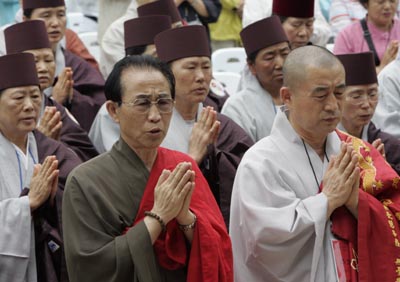
South Korean monk Joo Jeong-san (R), head of the Chontaejong, a branch of Buddhism, and Sim Sang-jin (L front), vice chairman of North Korea’s Buddhist Alliance, participate in a Buddhist ceremony celebrating the third anniversary of restoration of the Ryongtong temple, which was established in 1027, in Kaesong, North Korea, about 70 km (45 miles) northwest of Seoul June 8, 2007.


Pilgrimage, with U.S. dollars, to North Korea temple
Boston Globe
Jack Kim
6/11/2007

In a rare nod to religion, communist North Korea has welcomed 500 Buddhist monks and followers from the South to a temple dating from the 11th century when Kaesong was capital of a unified peninsula.

The visit offered an unusual glimpse of the hermit state where references to the divine, at least in the official media, are normally limited to Kim Il-sung, who became the reclusive state’s eternal president on his death in 1994, and Kim Jong-il, his son and the current leader.

North Korean officials were quick to stress that this month’s nine-hour visit to the picturesque Ryongtong temple on the outskirts of Kaesong was strictly religious fare.

“We are opening the door wide open for pilgrimages to answer the wish of Buddhist believers in the South,” Ri Chang-dok, from the North’s Council of National Reconciliation, told a small group of reporters traveling with the Buddhists.

The pilgrimage marking the restoration of the temple was the first in a series that will see more than 2,000 South Korean Buddhists travel across the heavily fortified border that has divided Korea for more than half a century.

“There won’t be any sightseeing,” Ri insisted.

North Korea watchers and critics say the hardline Pyongyang government persecutes religious followers and the only practices tolerated are carefully choreographed displays for outsiders.

FREEDOM OF RELIGION

Not so, the Council’s vice-chairman, Jong Tok-gi, told Reuters after a Buddhist service at Ryongtong.

“We have freedom of religion.”

But when a North Korean Buddhist leader spoke at the service, his words had the clear ring of politics and Pyongyang’s official obsession with one day ending the divide on the Korean peninsula.

“I have no doubt that if we make this pilgrimage a regular event and allow South Korean believers to come to the temple, North-South cooperation will deepen and that will open a shortcut to the unification of the fatherland,” said Sim Sang-jin, vice-chairman of the North’s Korea Buddhists Federation.

The North Korean Buddhists, with full heads of hair and colorful costumes looked anything but the typical monks of the South with their shaven heads and austere grey robes.

Despite Ri’s assurances that this was a strictly spiritual affair, the visitors’ buses made several stops at tourist sites in the cash-strapped state to give them the chance to buy souvenirs.

“Have you bought anything? Come on, go and buy something,” a North Korean guide urged his visitors, pointing to stalls where young women in traditional costume offered local goods ranging from mushrooms and fake Viagra to books of teachings by the country’s father-and-son leaders — all for U.S. dollars.

“We’re not going to hide anything,” said another guide, who declined to give his name, as the buses maneuvered their way through Kaesong’s residential streets where disheveled locals flashed startled looks at the gleaming vehicles.

“We have the discipline, the intelligence and the will (to make ties with the South work),” he said. All that was needed was for the wealthy South to deliver on its commitments to invest in the North.

ANCIENT CAPITAL

The birthplace of the small Chontae Buddhist sect, Ryongtong was raised from the rubble of a 17th century fire in 2005 at a cost of 5 billion won ($5.4 million) donated by its South Korean chapter.

“Kaesong was the seat of the Goryeo dynasty (918-1392) for 500 years,” said Ju Jung-san, a senior monk from the South. “It should now be the place of national love to lay the ground for unification.”

With such high aims, an indignant Ri dismissed criticism from some in the South that charging each visitor 170,000 won for the relatively short trip was excessive.

“I fail to understand just who these people are who are talking about money when what we have here is a pilgrimage to such a holy temple, the Ryongtong Temple.”

Share

To be or not to be the N.K. foreign minister

Sunday, June 10th, 2007

Korea Herald
Lee Joo-Hee
6/11/2007

Following the death of former foreign minister of North Korea Paek Nam-sun this January, eyes and ears are open to who would succeed him.

While in most countries, being named the next foreign minister would be a coveted honor, it was the opposite in North Korea.

Kang Sok-ju, the first vice foreign minister, indeed, has tried with all his means not to be named the new foreign minister, according to sources familiar with the North Korean system.

“North Korea designated Kang as the successor of late Paek, but he somehow dodged the actual appointment citing his illness, possibly arthritis,” a source was quoted as saying by Yonhap News.

Instead, former ambassador to Russia Pak Ui-chun was named to the seat on May 18 after it was vacant for four months.

Whether it was possible for Kang to “dodge” the appointment remains unconfirmed, the situation is quite understandable considering how North Korea bestows actual authority on the No. 2 man while the more public figure takes on the official top seat. Kang, seeking to remain in a position of real power, may have wanted to stay where he is.

The clearest example of this power ranking system is Kim Yong-nam, who, as head of the Presidium of the Supreme People’s Assembly, is the formal president of North Korea. North Korea is, however, ruled by Kim Jong-il, whose official title is the chairman of the National Defense Commission.

“We deem that Kang believed becoming a foreign minister could mean going on all the official and open duties but being distanced from being one of the close confidantes of Kim Jong-il,” the source was quoted as saying.

Kim Jong-il, with intense interest in relations with the United States, reportedly has talked directly with Kang instead of the foreign minister to discuss pending issues since the 1990s.

A possible threat to Kang’s status could now be North Korea’s chief nuclear negotiator Kim Kye-gwan, according to sources quoted by Yonhap. Kim Kye-gwan was reportedly a candidate to succeed Kang if Kang was to be named the foreign minister.

Kim Kye-gwan earned the trust of the communist leader by successfully negotiating the lift of the freeze of North Korean funds at Banco Delta Asia in Macau, the sources said.

He was recently allowed to move into “the club,” a luxurious villa compound located in Pyongyang for some 30 households in which Kim Jong-il’s close confidantes reside.

Share