Archive for the ‘DPRK organizations’ Category

DPRK eases fees for investors

Monday, September 7th, 2009

According to Yonhap:

North Korea has taken steps to attract more overseas investors by scrapping extra land use fees and introducing selective import rules that can help foreign-owned companies maintain a market share, a Chinese newspaper said Friday.

According to the Jilin Newspaper, the official daily of China’s Jilin Province, a North Korean official promoted the new foreign-investor friendly measures during a recent trade exposition held in the city of Changchun.

“We revised pertinent laws and regulations so as to relegate land use fees, which have been paid annually by foreign-invested companies to their (North) Korean partners that loan the land,” Yun Yong-sok, a senior official at the international investment department of the North’s Ministry of Foreign Trade, was quoted by the paper as saying at the expo. North Korea’s Radio Pyongyang reported a delegation’s trip to the Chinese expo on Aug. 26.

Foreign investors have so far paid annual land use fees to the North Korean government in addition to a one-off lease payment, which will be still levied after the revisions.

The measures come as North Korea faces tightening international sanctions over its May nuclear test. The U.N. sanctions ban North Korea’s arms trade, a major source of income for the impoverished country, and closely scrutinize cash flows to the North.

North Korea also introduced “state support measures,” such as banning imports of goods that are already produced in adequate quantities within the North by foreign companies to ensure investors’ profits, Yun was quoted as saying.

Foreign companies that invest in science and technology in the North will get additional tax incentives, but those who take North Korean minerals, timber or fish abroad will be levied a new “resource tax” to protect the country’s natural resources, Yun added.

Read the full story here:
N. Korea boosts incentives for foreign investors
Yonhap
9/4/2009

Share

Felix Abt’s advice on starting JV company in the DPRK

Thursday, September 3rd, 2009

German Asia-Pacific Business Association
Ausgabe 3/2009
Download the full publication here (PDF)
Download Mr. Abt’s article here (PDF)

North Korea – doing business in a demanding environment
Despite political obstacles within the system and internationally, it is possible to set up successful business in North Korea, says Felix Abt. Identifying partners and exploring market potentials are difficult tasks. Having completed them, one can count on a dedicated workforce.

The Right Local Partner: The Most Important Requirement to Succeed First, you need a Korean partner for your business as you cannot do any business without one and, second, you do have to find the right one if you want to succeed. When you start with your fact finding mission you come across people who want to introduce you to a specific business partner or they want you to do business with themselves. Of course, they have a vested interest and, most likely, they will not introduce you to alternative and potentially more suitable business partners. But you need to know that in every industry there are companies of different sizes, competence, ranges of products, competitiveness etc.

(more…)

Share

Association No. 2 – North Korean loggers in Russia

Wednesday, September 2nd, 2009

tynda-bbc.JPG

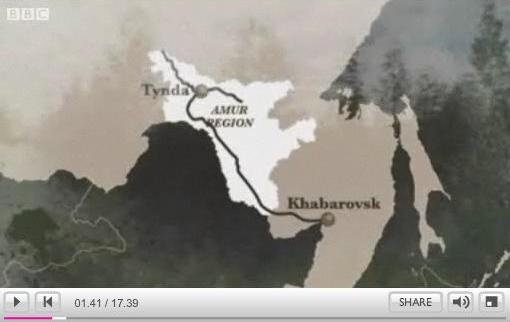
The BBC ran an interesting video story on North Korean loggers felling trees in Russia.  Of course this has been going on for a long time. However, this is the first video footage of the logging facilities that has appeared in the Western media.

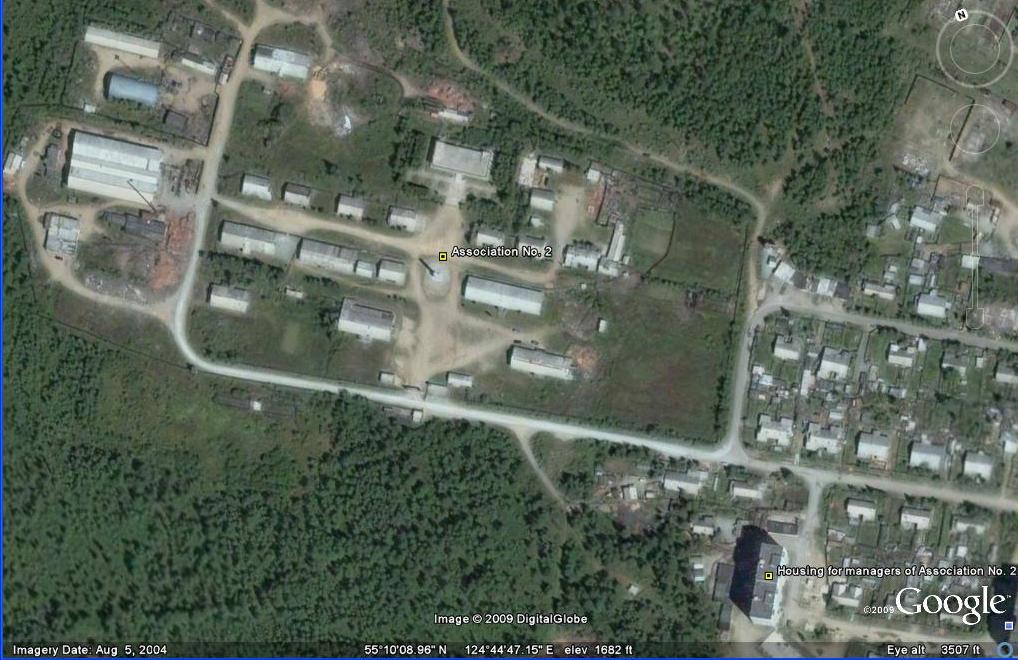
According to the video, North Korea’s logging concessions are managed by a company called “Association No. 2,” which is housed in a compound in northern Tynda, Russia.  According to the story, Association No. 2 receives 35% of proceeds of logging (appx $7m) some fraction of which is repatriated to the DPRK’s Ministry of Forestry.  Using the video, I located the Association No. 2 compound on Google Earth. Here is an image:

assn2.JPG

(Click on image for larger version.  You can see it in Google Maps here.)

Additional Notes:

1. I have not been able to locate the other North Korean logging camps in Russia.  If any readers can find them, please let me know.

2.  The DPRK appointed a new Minister of Forests last October.

3. Bertil Lintner on North Koreans working in Russia.

4. Andrei Lankov on the loggers.

5. Claudia Rosette on the loggers.

6. YouTube video on NKs in Russia.

Share

The trial of US journalists and North Korean criminal law

Tuesday, August 18th, 2009

Institute for Far Eastern Studies (IFES)
IFES Forum No. 09-8-18-1
Choi Eun-suk, Research Professor, IFES, Kyungnam University
8/18/2009

Detention of U.S. Journalists

Korean-American Euna Lee (Lee Seung-eun) and Chinese-American Laura Ling, reporters for the U.S.-based Current TV, were detained by North Korean soldiers on March 17, 2009 while near the Tuman River border between North Korea and China. On June 8, the Central Court, the highest court in North Korea, sentenced each of the two to an unprecedented 12 years of ‘Reform through Labour.’ However, after less than two months, a visit by former U.S. President Bill Clinton on August 4 led to the ‘special pardon’ of the two women, bringing a relatively swift conclusion to their plight.

What laws were enforced against the two American reporters? North Korean criminal code article 69 (Jo-seon-min-jok-Jeok-dae-joi, or literally, Korean Nation Antagonism Crime) states, “If a foreign person resides abroad with the intention of antagonizing Korea or injuring the body or assets of a sojourning Korean, or if national discord arises, they shall be faced with a sentence of more than 5 and less than 10 years of Reform through Labour (Ro-dong-Ky-ohwa-hyeong). In serious circumstances, [the person] faces a sentence of more than 10 years Reform through Labour.” Criminal Law article 233 (Illegal Border Crossing) dictates that “A person illegally crossing the national border faces less than 2 years of labor discipline (Ro-dong-dan-ryeon-hyeong). In serious circumstances, [the person] faces less than 3 years of reform through labour (Rodong Kyohwa-hyeong).

North Korea’s Criminal Procedures and the Accused’s Right to Council

The North Korean legal system maintains a 3-tier, 2-trial system. That is, the courts are divided into three levels, but actually, trials may only be heard twice. However, in the case of the two reporters, the trial was directly handled by the Central Court, meaning that only one trial would be held, and there was, of course, no chance to appeal.

Examining the North’s judicial system and criminal law, one can see that the DPRK constitution divides power among the Central Court, Provincial Courts, People’s Courts, and Special Courts (Constitutional Law, article 153). In addition, according to North Korea’s Criminal Procedure Law, the Central Court was established in order to handle appeals when verdicts handed out by lower courts were challenged (Criminal Procedure Law, article 129, clause 1), and it was designated the supreme court in the North Korea (Constitutional Law, article 161). The law also allows for the direct intervention of the Central Court, or for a case to be sent to a court on the same level or of the same kind as the court giving the initial verdict (Criminal Procedure Law, article 129, clause 2). Furthermore, according to the system established by these codes, after a case is opened in one of these courts, it must be completed within 25 days (Criminal Procedure Law, article 287). In the case of the two American reporters, the prosecution received notice of their charges on May 14, meaning that if they were to be prosecuted, the trial would have to have been completed by June 7.

When the Central Court holds the initial hearing in a prosecution, there are two possibilities for retrial. Only “in the event that it becomes known that the evidence upon which a decision is based was false,” or, “facts become known that could influence a decision and that were not known at the time of the trial,” can a Central Court case be reheard (Criminal Procedure Law, article 409). The decision to retry is in the hands of the North’s judicial authorities, meaning that it would have been difficult to find a route to appeal or retrial for the two reporters.

The verdict in an initial trial is decided by a judge and two civilian jurors, although in special cases a panel of three judges is allowed (court organization law, article 9). Any North Korean citizen with the right to vote can be a judge or civilian juror (Court Organization Law, article 6), and judges and jurors are chosen through democratic elections (Court Organization Law, article 4). A criminal case in North Korea follows a process of investigation, pretrial hearing, indictment, and trial (in that order). A detention order must be signed by a public prosecutor within 48 hours of a suspect’s arrest, and charges must be filed within 10 days (Criminal Procedure Law, article 144, clause 1).

The two reporters were apprehended March 17, and were not transferred to the court until May 14, almost two months later. According to North Korean law, a preliminary hearing must be held within two months of opening a pre-trial investigation (Criminal Procedure Law, article 151, clause 1). If investigators want to extend the investigation period, they must receive permission from a public prosecutor, and then can only extend the investigation for an additional two months (Criminal Procedure Law, article 152). Charges of crimes against the state or against the nation are investigated by the State Security Department (Criminal Procedure Law, article 124). In the case of Lee and Ling, investigators did not apply for an extension, and handed the case over to the courts within the allowed two-month period.

The North Korean constitution guarantees a public trial and the guaranteed the right of defense, although in some cases courtrooms are allowed to be closed (Constitutional Law, article 158). The constitution also guarantees that a foreigner will be able to speak in their native tongue during a hearing (Constitutional Law, article 159). A defendant has the right to choose their legal counsel, and that choice can include family members or a representative from work (Criminal Procedure Law, article 108), as well as the freedom to waive their right to council (Criminal Procedure Law, article 109). The right to choose one’s lawyer is directly related to one’s basic freedoms. In the case of the two American reporters, Laura Ling retained council, while Euna Lee chose not to be represented or give any statement.

The North Korean Central Court sentenced Lee and Ling to ten years of reform through labour for ‘Korean Nation Antagonism Crime’ (Criminal Law, article 69) and an additional four years for illegally crossing into the country (Criminal Law, article 233). However, in the North, in the case of multiple charges, the sentence for the more minor charge is halved, then added to the sentence of the more serious offence, meaning a 12-year sentence for the two reporters. This sentence was to begin within 10 days of the verdict. North Korean law dictates that reform through labour be carried out in reform institution (Judicial Conduct Law, article 25). When a defendant is sentenced, they are to be sent to a reform institution within 10 days, along with a copy of the court’s decision, detention orders, and all other relevant paperwork (judicial conduct law, article 33). This, in a nutshell, is the North Korean legal system, from arrest to starting to serve a sentence.

Kim Jong Il’s Power of Pardon and the Release of U.S. Journalists

When North Korea released the two U.S. reporters, the government claimed to do so based on its “humanitarian and peace-loving policy,” and stated that former President Clinton’s visit deepened understanding and helped to build trust between Washington and Pyongyang. This was an interesting use of Kim Jong Il’s power of pardon. It appears that last April, at the first session of the 12th Supreme People’s Assembly, there was a constitutional revision that transferred the ability to grant pardons from the SPA Presidium to the Chairman of the National Defense Commission (NDC). According to a ‘report’ of Clinton’s visit released by North Korean authorities on August 5, “In accordance with the Socialist Constitution Article 103, pardon is granted to two U.S. reporters sentenced to reform through labour; the Chairman of the National Defense Commission of the Democratic People’s Republic of Korea passed down the order for [their] release.”

After the previous constitutional revision, coinciding with the launch of the Kim Jong Il regime in September 1998, article 103 clause 5 specified the duties and powers of the chairman of the NDC, but there was no mention of the ability to pardon. However, article 110, clause 17, which defines the duties and powers of the SPA Presidium, states that it “exercises the right to grant general amnesties or special pardon.” In the past, when pardons were granted on national holidays or in conjunction with other important events, they were done so in the name of the SPA Presidium. North Korea has yet to publicize what constitutional changes were made in April, but with the release of the two Americans in the name of Kim Jong Il, it can be seen that the ability to grant general amnesty has been transferred to the NDC chairman. Earlier, on May 22, the Japanese newspaper Nikkei (日本經濟新聞) quoted members of a delegation from the Economic Research Institute for North East Asia (ERINA) as saying that their North Korean counterparts had explained that the power to ratify and nullify treaties, to grant amnesty, and to issue announcements in times of emergency had been transferred to the chairman of the NDC.

After 142 days, Euna Lee and Laura Ling have finally returned to their families.

Share

The new Majon Hotel

Thursday, August 13th, 2009

UPDATE: With a big hat tip to Korea Beat, I have located the new Majon Hotel in North Korea.  See a satellite picture of it here.  Here are some pictures  of the inside c/o the Choson Ilbo.

ORIGINAL POST:

majon.JPG

According to the Choson Ilbo:

North Korea on Monday celebrated the completion of what it has hailed as a “world-class” hotel in the Majon resort area in Hamhung, South Hamgyong Province, North Korean Central Broadcasting reported Tuesday.

The broadcast said the Majon Hotel “is equipped with top-class accommodation and recreation facilities such as an indoor swimming pool, a steam sauna, a public bath, and even a beach resort.”

Although it did not specify the size, the broadcast called the hotel a “creation that illuminates the era of the Korean Workers’ Party,” suggesting it is relatively luxurious.

The completion ceremony was attended by key leaders of the party, the government and the military, including People’s Armed Forces Minister Kim Yong-chun, party Secretaries Kim Ki-nam and Choe Thae-bok, and Prime Minister Kim Yong-il.

In a congratulatory speech, Kim Ki-nam said the hotel was “another proud creation built thanks to leader Kim Jong-il’s love of the people in the military-first era.”

The Majon resort area where the hotel is located is famous throughout North Korea. It has a sandy beach park 6 km long and 50-100 m wide along the east coast and 16 recreational buildings, 13 public buildings, and a boy scout camp — all on an area measuring some 3 million sq. m.

Here is the official KCNA press coverage:

Majon Hotel Completed

Pyongyang, July 28 (KCNA) — Modern Majon Hotel sprang up at the Majon recreation ground in Hamhung City, a good destination of holiday makers.

The hotel has all modern cultural and welfare facilities such as bedrooms of various sizes and styles, restaurants, indoor swimming pool, saunas and bath facilities. It has also a bathing resort. This is another edifice to be proud of in the era of Songun, a product of General Secretary Kim Jong Il’s love for the people as he has always worked hard to provide people with better conditions for their recreation.

A ceremony for the completion of the hotel was held on the spot on Monday.

Present there were Premier Kim Yong Il, Minister of the People’s Armed Forces Kim Yong Chun, Secretaries of the Central Committee of the Workers’ Party of Korea Choe Thae Bok and Kim Ki Nam, department directors of the C.C., WPK, officials concerned and employees of the hotel.

Kim Ki Nam in his speech at the ceremony underscored the need for the staff of the hotel to steadily improve the service so that Kim Jong Il’s boundless love may reach people as quickly as possible.

At the end of the ceremony the participants looked round the interior and exterior of the hotel.

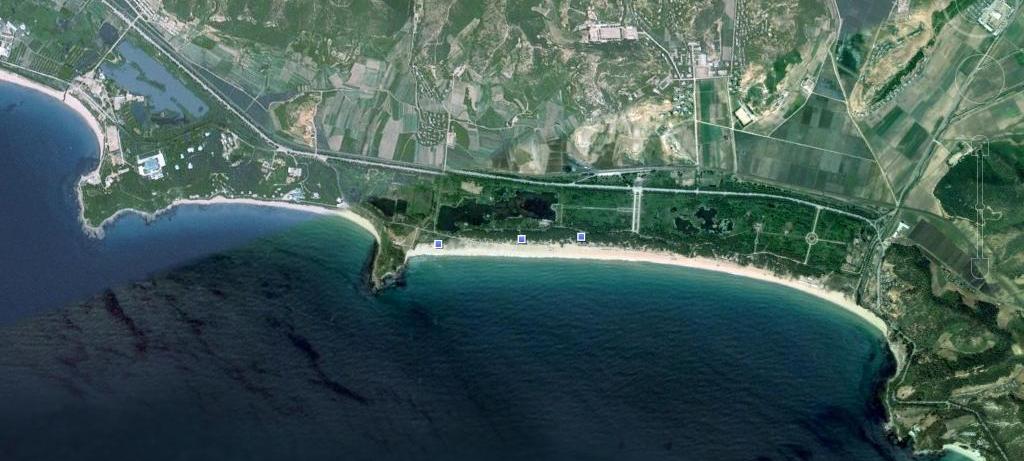
Here is the location of the beach.  Some travelers have been there, but photos of the area remain scarce.  If anyone comes across a photo of the hotel, or can identify the exact location, please let me know.  Parts of the beach and surroundings are still not in high resolution on Google Earth, so this also complicates the discovery of the hotel’s location.

Read the full stories here:
N.Korea Completes ‘Luxury’ Resort Hotel
Choson Ilbo
7/29/2009

KCNA

Share

DPRK aims to increase food rations

Wednesday, August 12th, 2009

Kim Jong il sets sights on increasing processed food rationing in order to improve the daily lives of the people
Institute for Far Eastern Studies (IFES)
NK Brief No. 09-8-10-1
8/10/2009

North Korean authorities, recognizing that rationing of processed foods is directly linked to the daily lives of the residents of North Korea, are concentrating on a policy of increasing distribution as part of the campaign to build a ‘Strong and Prosperous Nation’ by 2012. The policy calls for the construction of regional food processing facilities throughout the country and using domestic ingredients for all processed foods. In addition, the government plans to undertake diversification of small-scale factories in order to produce soybean paste, soy sauce, cooking oil and other staples, as well as noodles, rice-cake and other foods, all kinds of side dishes, and alcoholic beverages.

This movement was announced in concurrence with Kim Jong Il’s visit to the Samilpo Special Products Factory and Store, both run by the military, on April 7, just two days after the North’s launch of a long-range rocket. This factory, on the bank of the Daedong River, produces over 350 kinds of edibles, including noodles, rice-cakes, oil, sweets, alcoholic drinks, processed meats and fish products. During his visit, Kim Jong Il is said to have stated, “Today, I am happier than during the launch of the Kwangmyeongseong 2,” emphasizing his interest in boosting food production.

On July 15, (North) Korean Central Broadcasting announced the formation of construction offices in Jagang, North Pyongan and other provinces to oversee the building of food production complexes, and the dispatch of “shock troops” to bolster construction efforts.

Recently, the construction of large-scale factories to produce foodstuffs out of each region’s local stock has been pursued in every province in the country. Even at the Cabinet level, a ’Production Workers’ Conference’ was held, bringing together responsible authorities and local production experts to discuss a course for quickly improving services provided to the general population.

In order to effectively implement the North’s policy of increasing rations of foodstuffs, the Standing Committee of the Supreme People’s Assembly issued an order to establish a Ministry of Foodstuff and Daily Necessities Industry.

As North Korea tries to implement this type of measure to boost production and rationing, failure to improve food shortage conditions and economic hardships while at the same time mobilizing the population in a drive to establish a Strong and Prosperous Nation has led to growing outcries among residents. North Korean authorities appear to be introducing these measures in order to placate these complaints.

Share

Bureau 39 update

Wednesday, August 12th, 2009

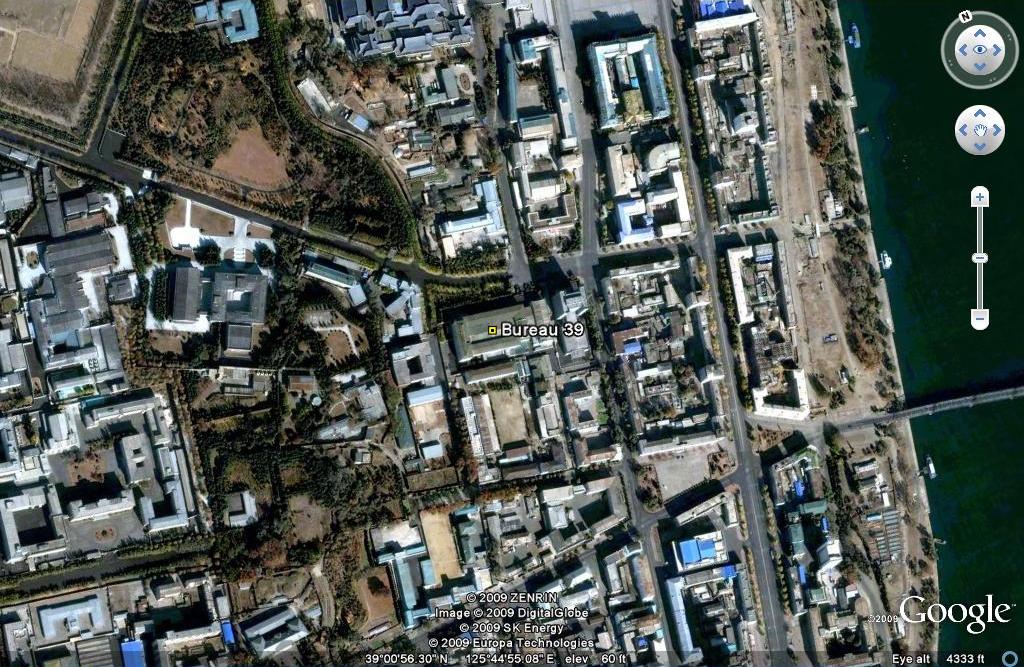
Vanity Fair has published a lengthy article about the DPRK’s mysterious Bureau 39 which is allegedly behind a number of illicit activities such as counterfeiting US currency and cigarettes, smuggling drugs and bilking western insurance companies with fraudulent claims. The full article is worth reading here.  (h/t DPRK Studies)

Of immediate interest, here is the supposed location of Bureau 39 just south of the Grand People’s Study House:

bureau39.JPG

Click image to enlarge

Here is a short excerpt:

Hamer’s three-year investigation—code-named Operation Smoking Dragon—began not with supernotes but with counterfeit cigarettes, which were being shipped by freight container from China into California ports by the millions. These, too, says Asher, originated in North Korea, and were the subject of a report by the Coalition of Tobacco Companies, one of whose investigators made an undercover visit, posing as a buyer, to North Korean factories in Pyongyang and the northeastern city of Rajin. These turn out fake Western brands, such as Marlboros, in such quantities that they generate as much as $720 million in gross revenue each year. Hamer set up a number of front operations to get inside the cigarette-smuggling business, and soon had many contacts who dealt with him as if he were a smuggler, too. In the spring of 2004, Hamer and his colleagues were asked by F.B.I. headquarters to see if they could acquire North Korean supernotes. One of Hamer’s best customers, Chao Tung “John” Wu, who eventually pleaded guilty to smuggling counterfeit currency, cigarettes, and narcotics, as well as conspiring to broker a deal for Chinese-made, shoulder-fired missiles, but died before he was sentenced, promised he could supply them with the help of a man who was a frequent visitor to North Korea—Wilson Liu. The notes were so good, Wu said at a secretly recorded meeting, “you can even go to Las Vegas and slide them into the machines—they take them right away.”

Share

US Treasury sanctions another DPRK financial organization

Tuesday, August 11th, 2009

According to the Dow Jones Newswire:

The U.S. Treasury Department Tuesday announced sanctions on the Korea Kwangson Banking Corp., a bank the department says is tied to North Korea’s nuclear and weapons trade.

Treasury alleges that North Korea used the Korea Kwangson Banking Corp., or KKBC, to hide nuclear proliferation activities.

The department accuses the bank of providing financial support to Tanchon Commercial Bank and a unit of the Korea Ryonbong General Corp., both of which have already been identified by the U.S. government as weapons of mass destruction proliferators.

“North Korea’s use of a little-known bank, KKBC, to mask the international financial business of sanctioned proliferators demonstrates the lengths to which the regime will go to continue its proliferation activities and the high risk that any business with North Korea may well be illicit,” Treasury Under Secretary for Terrorism and Financial Intelligence Stuart Levey said in a statement.

According to the Associated Press:

The sanctions mean bank accounts or other financial assets found in the United States that belong to the firm are blocked. Americans also are prohibited from doing business with the bank. It is based in North Korea and has operated at least one overseas branch in Dandong, China.

Further information:
1. Here is an earlier post that contains information on other sanctions imposed this year.

2. Aside from the US and UN, China has also “sanctioned” the DPRK this year.  See here and here.  No doubt they will react to the Dandong branch of KKBC as well. 

3. Stephan Haggard Marcus Noland call these kinds of actions “Whac-a-Mole.” Read their analysis here

4. Joshua notes that this company was one of the North Korean banks listed in Treasury/OFAC’s June 18th advisory about North Korean financial institutions engaging in money laundering activities.

Share

US sanctions Hyoksin Trading Corporation

Thursday, July 30th, 2009

Nearly two weeks ago, the UN Security Council sanctioned five North Korean organizations. One of them was the Hyoksin Trading Corporation.  I believe they even have a web page here.

Today, the US imposed financial sanctions on this company.  According to the The Associated Press  (Via the Washington Post):

The Obama administration on Thursday imposed financial sanctions on a North Korean firm accused of involvement in the country’s missile programs.

The Treasury Department’s action covers Korea Hyoksin Trading Corp. It means any bank accounts or other financial assets found in the United States that belong to the company must be frozen. Americans also are prohibited from doing business with the firm.

It is the latest move by the United States to keep pressure on Pyongyang, whose nuclear ambitions have ratcheted up global tensions.

The department alleges that Korea Hyoksin Trading is owned or controlled by another North Korean firm, Korea Ryonbong General Corp., which the United States says is involved in the development of weapons of mass destruction. Korea Ryonbong supports Pyongyang’s sales of military-related items, the department said.

Read the full story here:
US tightens financial noose on North Korea
The Associated Press
Jeannine Aversa
7/30/2009

Share

China pulls out of DPRK mining deal

Thursday, July 30th, 2009

According to the Choson Ilbo:

A Chinese investment company developing a copper mine in North Korea with a North Korean company sanctioned by the UN Security Council has reportedly called an abrupt halt to the project.

An industry source in China said the investment firm sent a letter to NHI Shenyang Mining Machinery, the company it had commissioned to build facilities for the mine in Hyesan, North Korea, telling it to stop construction. An estimated 400,000 tons of copper are deposited there.

The Chinese firm had signed an agreement with (North) Korea Mining Development Trading Corporation (KOMID) [NKeconWatch: a.k.a. Korea Mining Development Corporation) to develop the mine in November 2006. But the North Korean partner was blacklisted by the UN Security Council after North Korea carried out its latest nuclear test.

The industry source said, “When Chinese Vice President Xi Jinping visited Pyongyang in June last year, he pledged full support for the development of the Hyesan copper mine so that it could become a model for investment by Chinese business in North Korea. This prompted NHI to hurry construction so that production could start in September this year.”

But he added the Chinese government apparently persuaded the investment firm to stop the project as Beijing takes part in the UN sanctions. “Otherwise, it’s unusual for a project to be stopped at this late stage,” he said. The investment firm reportedly gave NHI no reason for the cancellation.

Looking at Hyesan on Google Earth, this appears to be the only large-scale minig operation in Hyesan.

Read the full article below:
N.Korea Mining Project Buckles Under UN Sanctions
Choson Ilbo
7/31/2009

Share