Archive for the ‘DPRK organizations’ Category

North Korea: It’s the Economy, Stupid

Thursday, March 4th, 2010

Nautilus Institute Policy Forum Online 10-015A
Aiden Foster-Carter
3/4/2010

Too many Kim Yong-ils

Korean names can set traps for the unwary. Amid a multitude of Kims, almost all unrelated, North Korea adds an extra twist. German speakers, and some others, tend to mispronounce the J in Kim Jong-il as a Y. Not only is this incorrect, but currently it can confuse; for North Korea’s Premier – head of the civilian Cabinet, as distinct from the Dear Leader who chairs the more powerful National Defence Commission (NDC) – is named Kim Yong-il.

To add to the confusion, another Kim Yong-il was until recently vice foreign minister (one of several), but in January became director of the ruling Workers’ Party of Korea (WPK)’s international department: a post apparently vacant since 2007. As such, this Kim Yong-il met his Chinese counterpart Wang Jiarui, head of the Chinese Communist Party (CCP)’s international liaison department, when Wang visited Pyongyang in early February. Since his promotion, Kim Yong-il 2 (as it may be best to call him) has been reported as frequently at Kim Jong-il’s side. This suggests he may see far more of the Dear Leader than does anyone else involved in DPRK foreign policy, including the man hitherto thought to be the eminence grise on that front: first vice foreign minister Kang Sok-ju, who negotiated the 1994 Agreed Framework with the US. It was Kang whom the current US special envoy on North Korea, Stephen Bosworth, demanded to meet when he visited Pyongyang in December, rather than the North’s main nuclear negotiator Kim Kye-gwan: a more junior deputy foreign minister.

Or is Washington behind the curve? That Kim Yong-il 2 is the DPRK’s new foreign affairs head honcho seemed confirmed on February 23, when he turned up in Beijing and went right to the top: going straight into talks with President Hu Jintao and separately with Wang Jiarui. This flurry of activity suggests two possibilities. Either Kim Jong-il will soon visit China, as he is overdue to do; or North Korea may return to the nuclear Six Party Talks (6PT), which have not met in over a year. Or perhaps both, if we are especially fortunate.

If both Kim Yong-ils are now leading players, perhaps one of them could change his name? That is not a frivolous suggestion. Some DPRK officials do this, for no clear reason. Often the change is small, so this is not a case of deception. Thus Paek Nam-sun, DPRK foreign minister – meaning chief meeter and greeter rather than top negotiator – from 1998 until his death in 2007, was originally Paek Nam-jun. Ri Jong-hyok, who as vice-chairman of the Asia-Pacific Peace Committee (APPC) now handles relations with the South, was Ri Dong-hyok in the 1980s when this writer knew him as head of North Korea’s mission in Paris.

(For completeness, yet another Kim Yong-il was Kim Jong-il’s late half-brother. He died of liver cirrhosis in 2000 aged only 45 in Berlin, where he had a diplomatic posting tantamount to exile – as his elder brother Kim Pyong-il, the DPRK ambassador to Poland, still does.)

Jong and Yong both say sorry

The past month saw both Chairman and Premier Kim doing something almost unheard of in Pyongyang. Apparently they both said sorry, although some reports got the two muddled up.

On February 1 Rodong Sinmun, daily paper of the ruling Workers’ Party of Korea (WPK), reported Kim Jong-il as lamenting his failure to fulfil his late father Kim Il-sung’s pledge, to which he had also alluded shortly before on January 9, that all North Koreans would eat rice and meat soup (everyday fare for even the poorest South Korean, be it noted). This time Kim said: “What I should do now is feed the world’s greatest people with rice and let them eat their fill of bread and noodles. Let us all honour the oath we made before the Leader and help our people feed themselves without having to know broken rice [an inferior version]”.

Given Kim Jong-il’s own notoriety as gourmet and gourmand, his professed “compassion” for his less fortunate subjects’ deprivation may induce queasiness. Yet even this not-quite-apology glosses over the truth. Broken rice? They should be so lucky. As readers of Barbara Demick’s excellent and heartbreaking new book Nothing to Envy will know, rice of any kind – whole or broken – is a rare luxury for most North Koreans. In the late 1990s a million or so starved to death; even today most remain malnourished. One refugee who fled to China saw her first rice in years in the first house she came to – in a dog’s bowl. That is the true reality.

Worse, all this was and is avoidable: the result of stupid and vicious policies, not the natural disasters that the regime blames. The real cause was the government’s failure to adapt in the 1990s after Moscow abruptly pulled the plug on aid. This hurt other ex-Soviet client states too. Cuba went for tourism; Vietnam tried cautious reform; Mongolia sold minerals. North Korea, bizarrely, did nothing – except watch its old system break down and growth plunge.

In a speech at Kim Il-sung University in December 1996, when famine was seriously biting, Kim Jong-il lashed out at the WPK and uttered this petulant but very revealing whinge:

In this complex situation, I cannot solve all the problems while I have the duty of being in charge of practical economic projects as well as the overall economy, since I have to control important sectors such as the military and the party as well. If I concentrated only on the economy there would be irrecoverable damage to the revolution. The great leader told me when he was alive never to be involved in economic projects, just concentrate on the military and the party and leave economics to party functionaries. If I do delve into economics then I cannot run the party and the military effectively.

Evidently Bill Clinton’s famously apt watchword, which helped him win the presidency in 1992, had not breached North Korea’s thick walls and heads. It’s the economy, stupid! The paternal advice was dead wrong. (The full speech can be read on the much-missed Kimsoft website. Unsurprisingly it is not part of the DPRK’s official canon of the dear leader’s works, but the scholarly consensus is that it is genuine. A slightly different version appears here.)

Redenomination disaster

Mass starvation, you might hope, would prompt some soul-searching and fresh thinking. From mid-2002 North Korea did essay cautious market reforms, but recently it has tried to squash Pandora back in her box. The latest such crass effort, a currency redenomination that deliberately wiped out most people’s meagre savings, was discussed in December’s Update.

By all accounts this has backfired badly, sparking runaway inflation (which it was supposed to stanch) and even riots. Forced on the defensive, the regime has issued an unprecedented apology. This being North Korea, it has not done so publicly; there are limits. Nor, in 2010 as in 1996, is Kim Jong-il about to take the rap, despite some newswires confusing J with Y.

But reliable intelligence claims that on February 5 Premier Kim Yong-il called all leaders of neigbourhood groups (inminban) to Pyongyang. The lowest unit in the DPRK’s still tight system of socio-political control, each comprises 20-40 households. This suggests that over 10,000 people heard the premier say what no leader had ever said to them before: sorry. In his words: “I offer a sincere apology about the currency reform, as we pushed ahead with it without sufficient preparation and it caused a great pain to the people… We will do our best to stabilize people’s lives.” The audience’s reaction is not recorded.

The situation on the ground remains confused, but markets appear to be functioning again unhindered. Good Friends, a seemingly well-informed South Korean Buddhist NGO, said on February 18 that after examining a report on food shortages and conditions nationwide by the Office of Economic Policy Review, the WPK Central Committee issued an ‘Order for Absolutely No Regulation Regarding Foodstuffs’. All markets are to reopen as they were before recent government crackdowns, and under no circumstances must local authorities try to regulate food sales – “until central distribution is running smoothly.” There may be a sting in that tail, but for now this is a complete, humiliating government U-turn and climbdown.

This is an astonishing episode, which history may record as pivotal. If the leadership learns its lesson and finally accepts that the market economy is as ineluctable as gravity, then the DPRK might conceivably survive on a reconstituted economic base and social contract, like today’s China or Vietnam. But if Kim Jong-il (or whoever) keeps trying to square the circle, under the delusion that correct politics is a substitute for sound economics, there is no hope.

Sea shells

Relations with South Korea remain an odd blend of sabre-rattling and dialogue. Four times in the past month, starting on January 25 and most recently on February 19, the North has declared a series of no-sail zones for varied time periods. Some of these adjoin two ROK-held islands close to the Northern coast, Baengnyong and Daechong. For three days (January 27-29) the Korean People’s Army (KPA) fired volleys of artillery shells near the Northern Limit Line (NLL): the de facto western sea border since 1953, which the North rejects.

Though no shells actually crossed the NLL, on the first day the South called this provocative and fired back – but again only within its own waters south of the line. By late February, a Southern defence spokesman called the latest shelling “a routine situation that is part of the North’s winter military exercise”, adding that this may go on till the end of March. Routine or not, a report submitted to the ROK National Assembly’s Defence Committee on February 19 said Pyongyang has reinforced its military along the west coast of the peninsula and has strengthened military drills.

Kaesong and Kumgang remain unsettled

The shelling did not stop the Koreas talking about their two joint venture zones just north of the Demilitarised Zone (DMZ). But they got nowhere, beiing far apart on the agenda, format and venue for talks. On the Kaesong Industrial Complex (KIC) – see last month’s Update for more details – the North suggested that the South’s issues – it wants smoother cross-border passage – were best left to military-level talks, which in the past have handled issues relating to the border and security. The South agreed, proposing February 23 at the border village of Panmunjom: the venue for all military meetings hitherto. The North then counter-proposed March 2, at Kaesong; but on February 22 the South said it will insist on Panmunjom, rather than set the precedent of holding a military meeting inside North Korea. With both venue and agenda still in dispute, the chances of progress on the substantive issues looks remote.

Mount Kumgang tours remain suspended

Separately, South Korea with some misgivings accepted the North’s request for talks on resuming tours to the Mount Kumgang resort, suspended since a Southern tourist was shot dead there in July 2008. At the talks held in Kaesong on February 8, North Korea asked for tours to restart from April 1. It breezily declared that the South’s three conditions – a probe into the shooting, efforts to ensure no repetition, and a cast-iron safety guarantee – had been met. But as the North well knows, the South’s key demand is to send in its own investigating team – which the North resolutely refuses. The Northern side proposed continuing the talks on February 12, but the South declined unless the North accepts their three conditions first.

More arms are interdicted

UN sanctions imposed last June after North Korea’s second nuclear test seem to be biting. In February South Africa told the Security Council that in November it inspected a ship headed for the Congo Republic (Congo-Brazzaville). The French owners reported suspicions about cargo they took on in Malaysia from a Chinese vessel. Seizing the containers, South Africa found that what the manifest called “spare parts of bulldozer” were in fact tank components. The shipping agent, and likely origin, is North Korean. China said it will investigate its own vessel’s role in the affair. UN resolution 1874 bans almost all DPRK weapons exports.

More ambiguously, on February 11 Thailand dropped charges against the crew of a plane seized in December and found to contain 35 tonnes of weapons from North Korea, including five crates of Manpads (man-portable air defence systems) which terrorists can use to shoot down aircraft. Next day all five were put on a flight to Almaty. Four are Kazakhs, and their government had asked that they be sent home to be tried. It will be dismaying if they are not.

Share

DPRK government delivering rice to high risk areas

Tuesday, February 23rd, 2010

Daily NK
Jung Kwon Ho
2/22/2010

In late January, Kim Jong Il held a meeting of his highest officials, including Jang Sung Taek, Director of the Ministry of Administration of the Party, aiming to find ways to alleviate the negative side effects of November’s currency redenomination. In the meeting, the group apparently agreed to release emergency supplies of rice to those on the brink of starvation.

According to a Daily NK source, “Following the meeting, which he chaired, Kim Jong Il handed down a handwritten decree to the chief secretaries of all provinces on January 20 in which it was stated, ‘Preventing anyone from starving to death is your obligation.’”

Chief Secretaries of Provincial Committees of the Party, the recipients of the decree, handed on the threat to their subordinates, warning provincial cadres, “You will resign if anyone starves to death, because this was a direct instruction from the General.”

In the decree, the three most vulnerable provinces were named as Yangkang, South Hamkyung, and Kangwon Provinces, so the officials governing those provinces are understandably nervous. They are the provinces where most casualties occurred during the March of Tribulation, and they remain the most food insecure.

Under the decree, the Ministry of Procurement and Food Policy makes daily deliveries of 5kg of relief rice to each people’s unit and 5-15kg to each factory and enterprise. Chairpersons of people’s units and managers of factories are required to observe the circumstances of the people under their control and provide those in the greatest danger of starvation with relief rice first.

In late January, quite a number of households were reportedly facing starvation due to the aftermath of the currency redenomination; notably sky high prices coupled to strict market regulations. However, there have been no reports of starvation since relief rice deliveries began on February 1.

Alongside the chairpersons of People’s Units, cadres working for local government offices are required to cross-check whether or not starvation is occurring. In theory, they are reprimanded if they do not report the situation truthfully.

Upon hearing the news, a defector in Seoul commented, “It seems that the people will not lie still and suffer that dire situation. Kim Jong Il may have done this because he senses a crisis situation this time.”

Share

China to send $10 billion investment to DPRK

Tuesday, February 16th, 2010

UPDATE: According to the Daily NK, South Korea’s National Intelligence Service (NIS) claims $10 billion transfer is not likely:

The director of the NIS, Won Sei Hoon passed on the confirmation to a closed-door meeting of the Intelligence Committee of the National Assembly on Tuesday, after which members Chung Jin Suk of the Grand National Party and Park Young Sun of the Democratic Party revealed it to the press.

According to the two lawmakers, Won told the Committee, “Although North Korea is likely going around trying to invite 10 billion dollars of foreign investment, it seems that they have not attracted that much capital,” before predicting, “Unless the North solves the nuclear problem, it will be almost impossible to attract that much capital.”

He did add, however, “The Cabinet, Workers’ Party, military authorities and National Defense Commission have all seemingly been moving to try and obtain foreign capital. The appeasement attitude shown to the international community may be a part of their efforts to solve the problem of a lack of foreign currency.”

During the closed-doors meeting, Won also gave his opinion on a wide range of other issues pertaining to North Korea, including the inter-Korean dialogue and the truth of Kim Jong Il’s health status.

“It is not a deadlock situation because there is still dialogue,” Won said of the inter-Korean relationship. However, “Since North Korea’s attitude has not changed yet; it will take more time to resume the tours of Mt. Geumgang and Kaesong.”

Commenting on Kim Jong Il’s probable health condition, Won revealed that Kim has been making an effort to appear healthy, for example by removing age spots on his face, but, “While he has been visiting industrial sites, he has expressed nervousness about current issues and economic problems, and has a sharpened temper. His tendency of relying on old acquaintances and family members has been increasing.”

However, “I believe there is zero possibility of a coup. For the time being, it seems that the North Korean leadership can control its domestic society.”

ORIGINAL POST: According to Yonhap:

During his four-day visit to Pyongyang, the source said [Wang Jiarui, head of the international department of the Communist Party of China] held in-depth discussions about investments by Chinese companies via Daepung Group, an investment company that works to attract overseas capital to the communist state.

Total investments are expected to exceed the $10 billion mark, with a signing ceremony planned by North Korea’s State Development Bank in mid-March that is to be attended by foreign investors from involved nations, the source said.

“Over 60 percent of total investments, which will be announced next month, will come from China,” the source added, suggesting the Chinese government’s close involvement in building railways, ports and houses in North Korea.

China is North Korea’s biggest trading partner and an important provider of food and fuel. North Korea remains isolated from most of the world and has received virtually no foreign investment. The North’s GDP was estimated at around $26.2 billion in 2008 compared with $1.3 trillion for the South, according to the U.S. State Department.

Read more about the Korea Taepung International Investment Group and the DPRK State Development Bank here.

Read the full story below:
N. Korea draws US$10 billion in foreign investments: source
Yonhap
2/15/2010

Share

Thai authorities halt shipment of DPRK-made weapons

Thursday, February 11th, 2010

UPDATE 13:  According to the Times of London, the weapons were headed for Hamas and Hezbollah:

An aircraft full of weapons seized in Bangkok last year was heading from North Korea to Hezbollah, the Lebanese militia, and Hamas, the Palestinian group, Avigdor Lieberman, the Israeli Foreign Minister, said yesterday.

The Thai authorities said that the aircraft was carrying 35 tonnes of weapons, including rockets and rocket-propelled grenades. The Thai Government informed the UN that the haul had been bound for Iran, which is believed to ship weapons to its ally Syria, which distributes them to Hezbollah or Hamas.

North Korea had the “intention to smuggle these weapons to Hamas and to Hezbollah”, Mr Lieberman said in Japan, where he was on an official visit. “This co-operation between North Korea and Syria [does not] improve the economic situation in their countries,” he added.

UPDATE 12: Thailand to release pilots.  According to the AP (via the Washington Post):

Thai prosecutors dropped charges against the five-man crew of an aircraft accused of smuggling weapons from North Korea, saying Thursday the men would be deported to preserve good relations with their home countries.

The Attorney General’s Office said the decision was made after the governments of Belarus and Kazakhstan contacted the Thai Foreign Ministry and requested the crew’s release to face prosecution at home.

“To charge them in Thailand could effect the good relationship between the countries,” said Thanaphit Mollaphruek, a spokesman for the Attorney General’s Office. “We have decided to drop all the charges and deport them to their home countries.”

“To charge them in this case would not be a benefit to Thailand,” he added.

The crew – four Kazakhs and a Belarusian – were expected to be released later in the day, said their lawyer Somsak Saithong.

Thailand’s Foreign Minister Kasit Piromya indicated earlier this month the men would be released, telling reporters in Geneva the government had “suggested to the office of the attorney general to release them because the U.N. resolution does not oblige Thailand to … bring up charges on the pilots and the crew.”

Thursday’s decision was likely to spark international criticism. The weapons’ ultimate destination remains a mystery, though Thailand has said the plane’s final destination appears to have been Iran. Experts have also voiced concerns that authorities in the former Soviet republics have turned a blind eye to illicit activities of air freight companies that use Soviet-era planes to fly anything anywhere for a price.

A Thai government report to the U.N. Security Council, leaked to reporters in late January said the aircraft was bound for Tehran’s Mahrabad Airport.

But Thai government spokesman Panitan Wattanayarkorn said subsequently that “to say that the weapons are going to Iran, that might be inexact.”

“The report only says where the plane was going to according to its flight plan, but it doesn’t say where the weapons were going to,” he said. “It’s still under investigation, and the suspects are under our legal system.”

Investigations by The Associated Press in several countries showed the flight was facilitated by a web of holding companies and fake addresses from New Zealand to Barcelona designed to disguise the movement of the weapons.

Read previous posts on this topic below:
(more…)

Share

State Prices Finally Unveiled

Sunday, February 7th, 2010

Daily NK
Jung Kwon Ho
2/5/2010

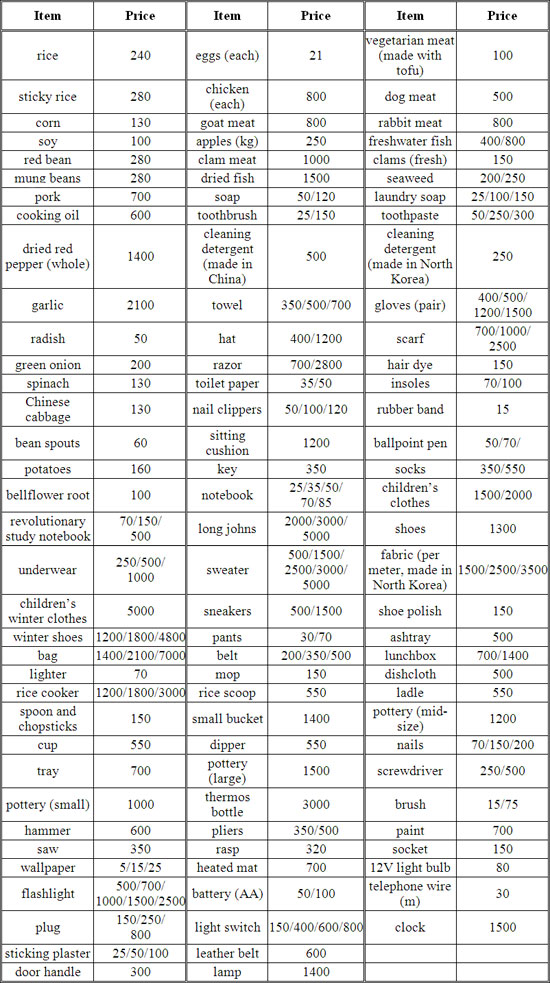
The North Korean authorities finally released fixed prices for 100 items across the country at 3 P.M. on Thursday.

A Daily NK source inside North Korea revealed the news today in a telephone conversation, saying, “The authorities announced state-designated prices for 100 items in a notice posted at the entrance to markets on Thursday afternoon.

Alongside the message came a warning, “If traders fail to sell goods at the stated prices, goods will be confiscated.”

The price list includes those for rice and corn. By implication, the selling of food has now been officially sanctioned in the market.

If the listed prices are enforced, however, confusion and anger are absolutely inevitable, because the gap between the newly-posted prices and real jangmadang prices is enormous.

For example, the latest real rice price in the jangmadang is 350 won per kilo, while corn is selling for 180 won; however the state-designated prices are 240 won and 130 won respectively. The jangmadang price of pork is around 300 won more expensive than its state-designated price.

Inevitably, therefore, traders’ increasingly wily attempts to circumvent the unrealistic demands of the state are continuing apace, “For now,” the source explained, “traders are pretending to sell for the released prices, but in reality they are selling for the existing jangmadang prices.”

According to the state price list, rice is 240 won per kilo; corn is 130 won; pork is 700 won; soy beans are 160 won; oil is 600 won; a kilogram of apples is 250 won; and a single egg is 21 won.

Meanwhile, a toothbrush is 25 won; bars of soap, tubes of toothpaste and laundry soap are all 50 won; sneakers are 500 won; toilet paper is 50 won; a notebook comes in various sizes between 25 and 55 won; lighters are 70 won; shoes are 1,300 won; a flashlight is 500 won and a single battery 100 won.

Children’s clothes are 1,500 won; children’s winter clothes are 5,000 won; and finally socks are listed as 350 won a pair.

UPDATE: Below is a table of prices from the Daily NK:

dprk-prices-feb-2010.jpg

Click image for larger version

Share

Head of Office 39 replaced

Thursday, February 4th, 2010

According to the Guardian:

It is the nerve centre of North Korea’s money-making operations, the department dedicated to raising hard currency for Kim Jong-il while his country teeters on the brink of collapse.

Room 39 is responsible for some legal ventures, such as the country’s limited exports of ginseng and other items. But according to defectors, most of its energy goes into drug-trafficking, sales of weapons and missile technology, and the production of counterfeit US dollar bills.

Today, it was reported the department’s head – Kim Jong-il’s personal finance manager – has been sacked, possibly in response to international action against the alleged illegal moneymaking. South Korea’s Yonhap news agency said Kim Dong-un was dismissed because he had been blacklisted by so many foreign governments, including the EU in December, leaving him unable to travel on behalf of Room 39’s legal companies. He has been replaced by his deputy, Jon Il-chun, Yonhap said, citing an unidentified source.

Housed in an unremarkable government compound in Pyongyang, Room 39 oversees 120 companies and mines, accounting for a quarter of all North Korean trade and employing 50,000 people, according to Lim Soo-ho, a research fellow at the Samsung Economic Research Institute. He said Kim’s dismissal may be part of attempts to get around international sanctions.

While its inner workings remain a mystery to all but its occupants and the family they serve, Room 39’s role in enabling the regime to survive even in times of widespread famine and international pressure, has come under greater scrutiny since the imposition last year of tough UN sanctions over its nuclear programme.

Some of the money generated by Room 39 is used to buy the loyalty of senior party officials, a role that may take on greater prominence as Kim Jong-il, who suffered a stroke in 2008, prepares to hand over power to his third son, Kim Jong-un. Analysts have estimated that illegal activities account for up to 40% of all North Korean trade and an even higher share of total cash earnings.

Additional information: 

1. More on the EU travel ban is here.

2. Office 39 is reportedly located here.  Kim Jong Il’s office is reportedly nearby here.

3. This week the KWP’s finance director, Pak Nam-gi, was also let go.

4. Mike Madden notes the new director’s  appearance with KJI at an “On the Spot Guidance” visit this week.  Mike also points to a possible appearance the Korea Taepung International Investment Group meeting.

Share

Koryolink reaches 100,000 subscribers

Wednesday, February 3rd, 2010

According to the Financial Times:

Orascom Telecom, the Egypt-based mobile network operator, says its subsidiary in North Korea, Koryolink, has acquired 100,000 subscribers in its first year and expects to add millions more in the next five years.

The expansion plans come as the isolated country of 24m, which says it wants to be considered a “mighty and prosperous nation” by 2012, steps up efforts to attract foreign investment.

Pyongyang’s economic ambitions come in the face of tough international sanctions on its nuclear arms programme.

“We see that there is a very big plan for an economic boom,” said Khaled Bichara, chief executive of Orascom. “They are really looking to have, by 2012, a much stronger economy. We believe that mobiles and eventually international communication will definitely be part of this.”

Koryolink, a pre-pay system, has been available in Pyongyang and Nampo, the capital’s port, since December 2008. To help expand the network from there, Mr Bichara said North Korea was laying fibre-optic cables in the provinces.

Orascom was installing its most technologically advanced 3G network in North Korea, he said. The 2010 target for user numbers was ambitious but Mr Bichara declined to put a figure on it.

“I think if we achieve the target of this year, that will be a big milestone,” he said. “The number will be big enough to make Koryolink look like a significant company for us because the revenues per customer are interesting and we believe that this business will have customers in the millions within the next four or five years.”

Mr Bichara said the subscription figures showed that mobile phones were not limited to elite members of the military and communist party, as many observers had speculated.

However, the handset price of €140 ($195) put a mobile phone out of most people’s grasp.

So far, Koryolink offers only a basic voice and text messaging service. International calls and roaming services are not provided but Mr Bichara said starting them would be simple given the sophistication of the network being installed.

Koryolink is a joint venture in which Orascom has a 75 per cent stake. The rest is owned by Korea Post & Telecommunications Corp, the state fixed-line provider.

Thanks to a reader for sending this to me. 

Read the full article here:
N Korea operator looks to millions of 3G users
Financial Times
Christian Oliver and Heba Saleh
2/3/2010

Share

DPRK finance chief sacked over currency revaluation

Wednesday, February 3rd, 2010

According to the Choson Ilbo:

The North Korean regime apparently sacked the Workers’ Party’s Finance Director Pak Nam-gi, letting him take the fall for the failed currency reform late last year. Pak was appointed finance director in July 2007 to oversee North Korea’s economic policies and has spent the past few years trying to root out a nascent market economy.

“Right now, North Korean officials are busy blaming each other for the failed currency reform and Pak, who spearheaded the revaluation, is believed to have been sacked,” said a diplomatic source in Beijing. “Markets have come to a grinding halt following the currency revaluation and prices have soared,” the source said. It seems North Korea hoped to stabilize prices through the currency reform and then credit the achievement to Kim Jong-il’s third son and heir apparent Jong-un to consolidate his grip on power, but this flopped, the source added.

Some North Korea watchers in China predict that the regime may perform a U-turn back to timid market reforms now that Pak, who led the crusade against capitalism, has been fired. One North Korea expert in Beijing said, “There is a strong possibility that high-ranking North Korean officials who led the drive to crush market forces since 2004 will be removed from office, while policies will shift toward market reforms starting in the second half of this year.”

Meanwhile, the new North Korean won is still plummeting against the U.S. dollar. North Korea valued the new currency to 98 won per dollar after the old won weakened to 3,500. But the new won has plunged since last month and is now being traded at between 300 and 500 won per dollar, according to people who trade goods with North Koreans.

According to the Daily NK:

In the tradition of dictatorial regimes worldwide, scapegoats have apparently also been chosen. South Korea’s Chosun Ilbo today claimed that Park Nam Ki, Director of the Planning and Financial Department of the Central Committee, has taken responsibility for the failed redenomination, which initiated a period of hyper-inflation, and been dismissed.

According to the report, Park was appointed to the top economic position in the North Korean government in July, 2005, where he began to pull up the green shoots of spontaneous market economy.

If the news is confirmed, Park will be following in the undesirable footsteps of Ministry of Agriculture head Seo Gwan Hee and Premier Park Bong Ju.

Seo was executed for his role in the 1990s famine. According to defector testimony, Kim Jong Il shifted responsibility for the famine onto him and had him publicly executed in 1997.

Meanwhile, Park Bong Ju became the Premier of the North Korean Cabinet in 2003, the year after the adoption of the July 1st Economic Management Reform Measure, and was responsible for introducing revised market economic elements according to the July 1st Measure. However, results were not sufficient and he was sent to manage the Suncheon Vinylon Complex in South Pyongan Province. 

Lets hope that the jangmadang come back with a vengeance. 

Read the full articles here:
N.Korean Finance Chief Sacked Over Currency Debacle
Choson Ilbo
2/3/2010

Read the full story here:
Ban on Markets lifted
Daily NK
Jung Kwon Ho
2/3/2010

Share

Fighting in the Streets

Tuesday, February 2nd, 2010

Daily NK
Park Sung Kook
2/2/2010

There has been an explosion in the number of casualties resulting from popular resentment at harsh regulation of market activities by the security apparatus across North Korea, according to various Daily NK sources.

For instance, in Pyongsung, North Pyongan Province, normally one of the key distribution centers in North Korea, there have been several incidents of agents from the People’s Safety Agency (PSA), the organization charged with cracking down on the smuggling of food and other officially “immoral” acts, being attacked by unidentified assailants.

A Daily NK source reported on Monday, “A group of agents who had just finished doing the rounds of the jangmadang and alley markets in Naengcheon-dong, Haksu-dong, and Cheongok-ri in Pyongsung were attacked by a number of people, who assaulted them and immediately ran away. As a result, PSA officials are feeling very tense these days.”

Commenting privately on these incidents, some people savor them as acts of revenge, but others are worried about the situation, according to The Daily NK’s sources.

There have been more examples unearthed in recent days, too. For instance, North Korea Intellectuals Solidarity (NKIS), a Seoul-based defector group, recently received news that “a fight broke out between agents of the PSA, who monitor the Hyesan jangmadang, and some residents. As the fight turned serious, one resident snatched an agent’s gun and fired randomly into the crowd. One agent, Choe, is in a critical condition.”

According to NKIS, the fight began after the PSA agents beat up a trader who was trying to avoid the crackdown, and that made other residents angry, so they attacked the agents in return. As the fight grew more serious, agents threatened residents, but this only added fuel to the flames.

Finally, a Daily NK source from North Hamkyung Province released one other incident: Cho, who used to work for the Prosecutions Department of the National Security Agency in the region, was apparently killed by a Chongjin Steel Mill worker called Jeung Hyun Deuk.

The source explained, “Jeung’s father, the chief of a foreign currency-generating company, was interrogated last July on suspicion of embezzling enormous amounts of property and foreign currency, and in January was sentenced to life in prison. However, a few days after being imprisoned, he died. Thereafter, Jeung held a grudge against his father’s interrogator, Cho, and eventually killed him.”

The source concluded, “Traders and residents have lost their property due to the redenomination and are pretty much being treated as criminals as a result of the NSA and PSA’s ‘50-Day Battle.’ Therefore, people are taking revenge on agents, since they feel so desperate that, regardless of their actions, they will die. As a result, social unrest is becoming more serious.”

On January 2, the National Defense Commission released an order entitled “On completely sweeping away hostile factions who attempt to demolish our Republic from the inside,” initiating the “50-Day Battle” crackdown by the PSA and NSA in every city, county, and province which was referred to by the North Hamkyung Province source.

Share

Friday Fun Smörgåsbord

Thursday, January 21st, 2010

Item 1: Koryo Credit Development Bank. This bank is located in the Yangakdo Hotel and is accessible to foreign visitors.  Here are the marketing materials they provide to “encourage” foreigners to set up hard currency accounts: Folder (PDF), Inserts (PDF).

Item 2: DPRK Customs Form (PDF)

Item 3: The Ryugyong Hotel is looking more like a spaceship (Source here. Date: 12/2009)

py-winter10.jpg
Click for larger version

Too bad it will never take off

Item 4: DPRK Transportation. Last September I linked to a collection of vehicles manufactured in the DPRK.  See them here.  This month Kernbeisser posted a great collection of photos he has taken of vehicles on the DPRK’s roads.  Seem them here

Share