Archive for the ‘DPRK organizations’ Category

DPRK to distribute light industrial goods to the people by April 2012

Sunday, February 13th, 2011

Institute for Far Eastern Studies (IFES)
NK Brief No. 11-02-08
2011-02-08

In last month’s New Year’s Joint Editorial, North Korean authorities reaffirmed the national drive to strongly develop the country’s light industrial sector by 2012, the 100th anniversary of the birth of Kim Il Sung. On February 2, the Choson Sinbo, the newspaper of the pro-North Korean residents’ league in Japan, proclaimed that all efforts were being focused on delivering high-quality light industrial goods by April of next year.

North Korea’s minister of light industry, forty-seven year old Hu Chul San, was interviewed by the paper’s Kook Jang Eun. Hu stated that light industrial zones already in operation would be further bolstered and the provision of raw materials would be prioritized for celebrations surrounding the 100-year birthday of the country’s founder.

The North Korean regime has set 2012 as the year in which it will “open the doors to a great and prosperous nation,” and Kim Il Sung’s April 15 birthdate has been set as the first target for economic revival. Just as in 2010, this year’s Joint Editorial called for light industrial growth and improvements in the lives of the North Korean people as the ‘strong and prosperous nation’ goal is pursued.

Minister Hu gave one example of the expected boost in production, stating that all students, from elementary school to university, would receive new school uniforms by next April. “Originally, school uniforms were issued to all students once every three years, but as the nation’s economic situation grew more difficult, [the regime] was unable to meet the demand.” He promised that for the 100-year anniversary, “Rationing would take place as it did when the Great Leader was here.”

The minister also explained that all preparations for distributing light industrial goods to the people next April needed to be completed by the end of this year, since Kim Il Sung’s birthday fell so early in the spring. He stated that a strong base had already been established for the production of high-quality goods, and that many organizations had already mass-produced high-quality goods for the celebration of the 65th anniversary of the Korean Workers’ Party founding last year, offering the Pyongyang Sock Factory, the Sinuiju Textile Mill, the Botong River Shoe Factory, and the Pyongyang Textile Mill as examples.

When asked how North Korea would resolve raw material shortages, the minister explained that since the February 8 Vinalon Complex began operations last year, Vinalon and several other types of synthetic materials were available. The Sunchon Chemical Complex and other industries were also providing synthetic materials to light industrial factories throughout the country, strongly supporting indigenous efforts to increase production. He added, “Raw rubber, fuel and other materials absent from our country must be imported,” but that “national policies were being implemented” to ensure steady supply.

Minister Hu admitted that there was no shortage of difficulties, but that every worker was aware of the importance of meeting the April deadline, and that because raw material shortages were being resolved, light industries were now able to press ahead with full-speed production.

Share

Research round-up: DPRK minerals, military, and agriculture

Wednesday, February 9th, 2011

Three items popped up on my radar this afternoon so in the interest of time I thought I would post them all together.  All three are worth checking out:

Status and Future of the North Korean Minerals Sector
The DPRK Energy and Minerals Experts Working Group Project  at the Nautilus Institute
Edward Yoon
Download paper here (PDF)

The minerals industry is of great importance to the economy of the Democratic People’s  Republic of Korea (DPRK), accounting for about 15.2% of its exports in 2005. (Chung, Woo Jin 2007, p. 3). In particular, the iron and coal mining industries have been priority industries for DPRK economic development since the 1970s (Korea Mining Promotional Corporation report, 2005). Minerals industries in the DPRK have been played prominent roles in North Korean National exports as shown in Table 1, below.  The DPRK holds the great bulk of the total known minerals deposits on the Korean peninsula. It is estimated that some 200 of the minerals found in the DPRK have economic values. The value of North Korea’s known minerals deposits was estimated to be nearly thirty times of that of South Korea’s as of 2005.

Mining industries are very important to the DPRK. The mining subsector of the DPRK’s industry accounted 8.3% of the North Korean GDP and about 15.9% of total export revenues in 2005. The minerals production sector in North Korea has, however, been struggling because of poor central planning and a lack of modern technology and equipment, as well as a shortage of electricity. For these reasons, North Korea needs to rebuild its production lines by obtaining proper equipment and technology (ibid, p.14).  As a result of the problems noted, minerals production in the DPRK has declined sharply in the past two decades.  It is estimated that production in 2002 was between one third and one half in comparison with output data obtained during 1989 (ibid, p. 12, and private source, 2010). In the decade from 1997 to 2007, DPRK  authorities have allowed foreign investors to participate in selected mining projects.  The  Government plans to continue its effort to consolidate heavy industries, and at the same time to develop light industries.

KPA Journal Vol.2, No. 1
Joseph Bermudez, military analyst for Jane’s Intelligence Review and author of The Armed Forces of North Korea, has published the next issue of his very fascinating KPA Journal.  Topics include: Wartime underwater bridges, KPA involvement in Burundi, Kim Ok Biography (Michael Madden), Type-63 107mm MRL.

The full issue can be downloaded here (PDF) and past issues can be downloaded at the journal’s home page.

CIA Assesses Flooding in the DPRK
CIA analysts studied data on major floods due to rainfall in North Korea since 1996 in order to devise a framework for evaluating the significance of such floods and their likely consequences for North Korean agriculture.  The analysts identified four principal variables:  the intensity of the rainfall, the location of the rainfall, the time of year, and damage to non-agricultural infrastructure.

“Rainfall intensity and geography of flooding appear to be key variables with the most impact,” their report (pdf) said. “Critical periods in the agricultural growth cycle — for sowing, growing, and harvesting — and the scope and severity of infrastructure damage are compounding variables that can magnify the impact of major floods in key food producing areas.”

All four elements were present in 1996 and 2007, when flooding produced the most severe agricultural impact.  But using the methodology described, analysts judge that the cumulative impact of two instances of heavy rain in 2010 “has been relatively low.”

FAS has posted a copy of the paper here (PDF)

Share

KPA in charge of fulfilling 2012 Pyongyang construction

Wednesday, February 9th, 2011

According to the Joongang Daily:

North Korea’s leadership wants “renovations” of its capital city of Pyongyang, a South Korean government source said yesterday, and much of the so-called renovations will reflect the rising power of the military.

The source said that leader Kim Jong-il and heir-apparent Kim Jong-un had given orders to hand the Ministry of Capital City Construction Development over to the military.

The source also said military men took over key positions in the ministry.

The modernization of the capital is a long-term project that began in 2001. The Ministry of Capital City Construction Development was included in the cabinet in that year.

In 2006, Kim Jong-il’s brother-in-law Jang Song-thaek, often called the second-most powerful man in North Korea, took charge of the ministry.

It is unclear, however, whether Jang will continue to head the ministry after the military takes over.

The change is being seen as part of North Korea’s often stated goal of becoming a “strong and prosperous country” by 2012.

That will also include improving Pyongyang and the economy as a whole, with the military controlling much of the activity.

Temporary youth brigades were mobilized last September to help with construction throughout the country. They were assigned to military brigades as regular soldiers.

North Korea analysts have said that the change in the ministry was for “mobilization and stronger control.”

“North Korea has recently stopped calling laborers and farmers the ‘leaders of the revolution,’ and said the soldiers are,” said Jung Chang-hyun, a professor of North Korean studies at Kookmin University in Seoul.

“Assigning civilian groups to the military means that the leadership aims to mobilize the people and gain effective control to create a strong and prosperous country by next year,” Jung added.

Kim Jong-il said in October 1996, during a speech honoring the 50th anniversary of Kim Il Sung University: “Only the military can be trusted.”

Kim’s reliance on the military and the mobilization of civilians into the military reflects his songun, or “military-first,” ideology.

The moves also aim to solidify Kim Jong-un as the next leader of North Korea, with his name on the orders along with his father’s. If the projects improve people’s lives, the positive results can be attributed to Kim Jong-un, said Lee Jo-won, professor of political science at Chung-Ang University in Seoul.

The number of facilities in Pyongyang that have been renovated over the past 10 years are too numerous to mention here.  Most showcase factories, schools, theaters and restaurants have been renovated.  Some more than once.

Additionally, the North Korean government has sought to boost the quantity of housing in the city.  A high-profile project near the Potonggang Gate has already been completed, and labor units are busy trying to complete 100,000 new housing units by next February.

Here are previous posts on: Real estate and Construction.

Read the full story below:
Kims want to ‘renovate’ Pyongyang for people
Joongang Daily
Jeong Yong-soo
2/9/2011

Share

DPRK special forces beefed up

Wednesday, February 9th, 2011

According to the Choson Ilbo:

Pundits were intrigued Tuesday by claims from the commander of the U.S. Forces Korea that North Korean special forces troops consist of 60,000 specialized troops and 140,000 light infantry soldiers. The South Korean government’s 2010 Defense White Paper mentions that North Korea beefed up its special forces from 180,000 to 200,000 but does not elaborate on their makeup.

More Light Infantry

The 140,000 troops described by Gen. Walter Sharp as being light infantry soldiers are lightly armed and are trained to infiltrate deep behind enemy lines to destroy key installations and engage in black ops. North Korea beefed up special forces troops by 80,000 over the last four years, and most of them are apparently with the light infantry.

According to the 2010 Defense White Paper, North Korea formed these light infantry units throughout the military and continues to bolster their numbers.

“North Korea probably learned from watching the wars in Afghanistan and Iraq that guerrilla operations using light infantry soldiers could deliver major blows to South Korean and U.S. troops,” a South Korean military source speculated. “The U.S. military perceives the strengthened North Korean special operations capability as a serious threat.”

Crack Squads

The 60,000-strong crack squads are apparently made up of its main special forces units, the 11th or so-called “Storm” Corps, air force and naval commandos who would be parachuted into enemy territory, and reconnaissance units. They reportedly undergo rigorous training that tests the limits of human endurance. Lee Kwang-soo, a North Korean spy who was captured during a botched submarine infiltration operation back in 1996, said, “One special forces soldier trains more than three hours a day to take on and defeat three to 15 enemies and practices target shooting more than 3,000 times before infiltration.”

Special troops who could infiltrate South Korea on land may either walk or use underground tunnels, while naval units have 130 hovercraft or 260 landing vessels at their disposal. The airborne units are expected to be deployed by mobilizing 170 aging but low-flying AN-2 transport planes that are difficult to detect by radar and 130 helicopters.

There are 10,000 naval special troops capable of infiltrating across the border and 5,000 airborne special forces soldiers, according to South Korean intelligence estimates.

Highly trained North Korean crack squads could deliver a considerable blow to South Korea if they infiltrate deep behind the front lines. During the botched submarine infiltration in 1996, a total of 1.5 million South Korean soldiers and police had to be mobilized to search for a mere 26 North Korean operatives and 26 submarine crewmembers who fled into the mountains of Gangwon Province.

Experts say South Korea faces considerable hurdles to dealing with a full-blown infiltration by North Korean special forces using transport planes and hovercrafts. South Korea has only 20,000 elite special troops — 10,000 in the Army, plus Navy Seals and Air Force and Marine units. That means the South Korea is outnumbered 10 to one.

Read the full sotry here:
What Kind of Threat Do N.Korea’s Special Forces Pose?
Choson Ilbo
2/9/2011

Share

North Korea increasing coal production – seeking to ease power shortages and boost exports

Wednesday, February 2nd, 2011

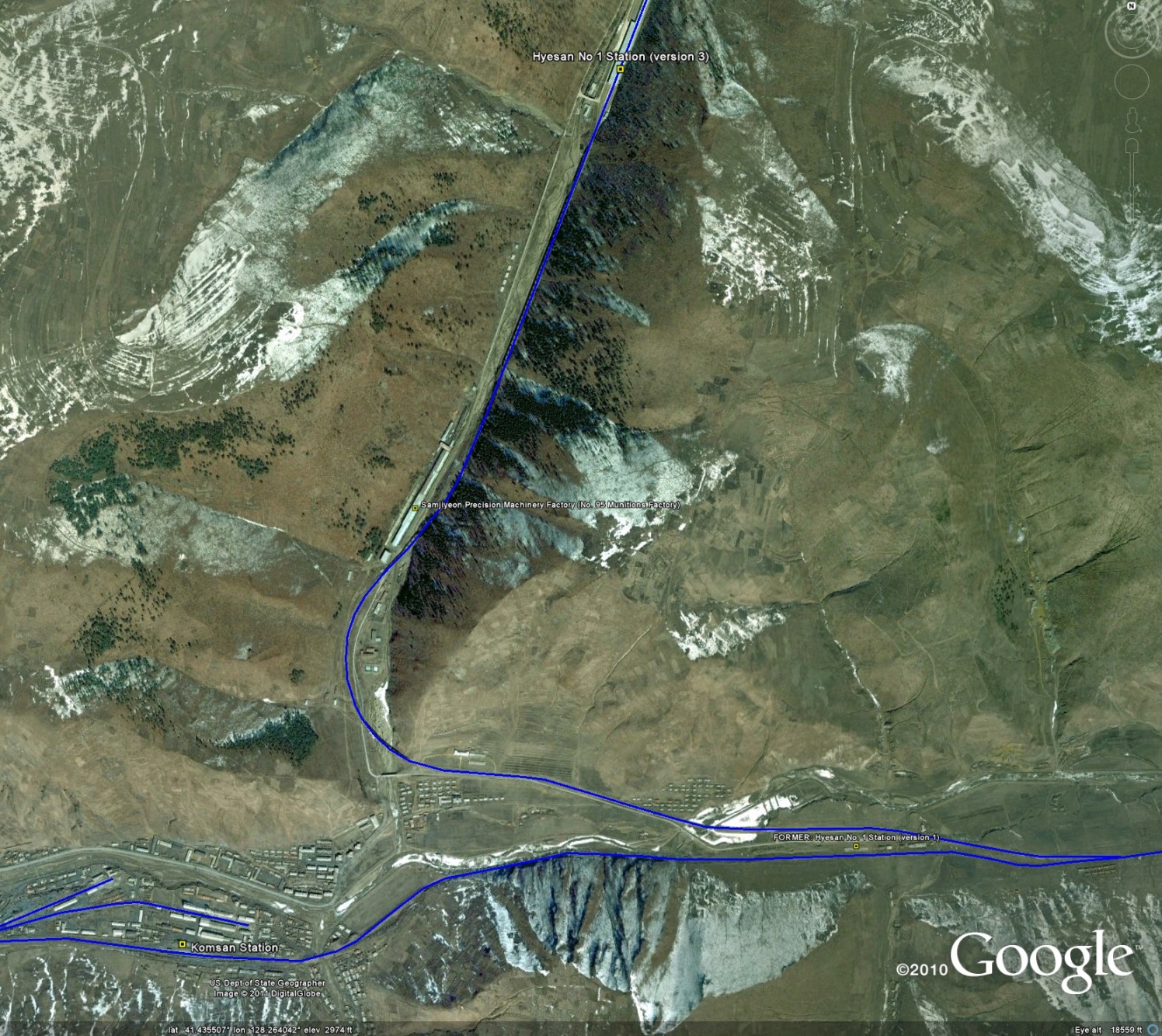
Pictured Above: Pongchon Coal Mine (Google Earth)

Institute for Far Eastern Studies (IFES)
NK Brief No. 11-01-18
1/28/2011

The DPRK Workers’ Party’s newspaper, the Rodong Sinmun, recently featured a front-page editorial urging the North Korean people to increase coal production. On January 26, the KCNA reiterated the call, reporting that the newspaper editorial highlighted fertilizer, cotton, electricity, and steel as products suffering from a lack of coal, and that “coal production must be quickly increased in the Jik-dong Youth Mine, the Chongsong Youth Mine, the Ryongdeung Mine, the Jaenam Mine, Bongchon Mine [Pongchon Mine] and other mines with good conditions and large deposits.”

The editorial also emphasized that “priority must be placed on the equipment and materials necessary for coal production,” and, “the Cabinet, national planning committee, government ministries and central organizations need to draft plans for guaranteeing equipment and materials and must unconditionally and strongly push to provide,” ensuring that the mines have everything they need. It also called on all people of North Korea to assist in mining endeavors and to support the miners, adding that those responsible for providing safety equipment for the mines and miners step up efforts to ensure that all necessary safety gear is available.

In the recent New Year’s Joint Editorial, coal, power, steel and railways were named as the four ‘vanguard industries’ of the people’s economy. Of the four, coal took the top spot, and all of North Korea’s other media outlets followed up the editorial with articles focusing on the coal industry. On January 15, Voice of America radio quoted some recent Chinese customs statistics, revealing that “North Korea exported almost 41 million tons of coal to China between January and November of last year, surpassing the 36 million tons exported [to China] in 2009.” It was notable that only 15.1 tons were exported between January and August, but that 25.5 tons were sent across the border between August and November.

North Korea’s coal exports to China earned it 340 million USD last year, making the coal industry a favorite of Pyongyang’s economic and political elites. Increasing coal production is boosting output from some of the North’s electrical power plants, while exports to China provide much-needed foreign capital. However, even in Pyongyang, where the electrical supply is relatively good, many houses lack heating and experience long black-outs. Open North Korea Radio, a shortwave radio station based in the South, reported on January 24, “As electrical conditions in Pyongyang worsen, now no heating is available.” Farming villages can find nearby timber to use as firewood, but because prices are so high in Pyongyang, even heating has become difficult. Some in the city even wish for rural lifestyles, just for the access to food and heat.

Share

North Korean art stirs Muscovites

Wednesday, February 2nd, 2011

Leonid Petrov writes in the Asia Times:

After two months, an exhibition in Moscow of North Korean graphics, mosaics and embroidery is coming to a close. Oddly entitled “And Water Flows Beneath the Ice”, the exhibition was a major project initiated and hosted by Russian entrepreneurs at the trendy Winzavod Gallery, a revamped wine factory in central-eastern Moscow.

All the pictures came from the Mansudae Art Studio in Pyongyang, a government-run enterprise that employs more than 1,000 artists to create art for export.

The late (and eternal) North Korean president, Kim Il-sung, is known to have once said, “Abstraction in art is death,” leaving no choice for North Korean artists but to embrace socialist realism as their method.

Russians, who still remember when this artistic trend was the only one permitted by the Communist Party, were given a chance to refresh their memory exactly 20 years after the collapse of the Soviet Union. It is no surprise that many felt a sense of familiarity and at times nostalgia for while visiting the unusual exhibition.

During a short trip to Moscow last month, I met with colleagues, Russian scholars and researchers of Korean studies at the exhibition. They came along with their students, and we had a lively discussion about the hidden messages and artistic value of each picture. It was good to share opinions on a contentious topic such as North Korean art, and our feeling converged on many things regarding the commonalities and differences between North Korean and Soviet propaganda art.

First of all, socialist realism in art is a misnomer, since it depicts life as it should be, not as it really is. For instance, in this exhibition, there was an image of chubby children in Pyongyang Zoo feeding monkeys with ice-cream. The abundance of rice, vegetables and rabbits on show in other pictures also seemed a disservice to aid agencies diligently dispatching food and other humanitarian relief to starving North Koreans. In the artwork, life in the Democratic People’s Republic of Korea was consistently depicted as affluent and pleasant.

In fact, North Korea is a revolutionary state, struggling to achieve economic success and advance its military power. This can be viewed and sensed through the canvases dedicated to the heroism of builders working on the Taegyedo Tideland Reclamation Project or soldiers engaged in constructing the Huicheon Dam.

Heroism at war and in peaceful reconstruction is venerated and equated to the revolutionary course of juche (national self-reliance) and songun (military-first) politics. Thus, every picture, embroidery and poster carries a condensed revolutionary message that must convince the viewer that the people of North Korea are determined and invincible. Some may call it propaganda, but in North Korea this genre is known as Chosunhwa (Korean painting).

In fact, there is very little of Korean tradition in Chosunhwa. Although most pictures are created with watercolors and ink, the characters, actions and settings are Stalinist Soviet or Maoist Chinese. Even where the North Korean artists try to be experimental and use such materials as gouache or mosaic, the results resemble the typical posters and murals once omnipresent in the streets of Moscow and Beijing.

Only the embroidery works were genuinely traditional, and most viewers were stunned by their elaborate composition and vibrant range of colors.

After discussing the merit of each exhibit, my expert friends and I agreed that totalitarian societies do produce impressive pieces of art, which inspire awe and overwhelm the target audience.

While the value of such art is transient and more akin to propaganda, the technical side of it is so unquestionably powerful that it deserves recognition and research, if not admiration.

Unfortunately for the North Korean artists and Mansudae Art Studio entrepreneurs, the value of this art is restricted by the willingness of the purchaser to help the juche and songun revolution. Otherwise, mainstream North Korean art, which is dutifully devoid of abstraction, has very limited export value.

That explains the usual commercial difficulties encountered by the North Korean art exhibitions brought overseas by the North Korean Committee for Cultural Relations with Foreign Countries. Among the rare buyers of the socialist kitsch are maverick revolutionary zealots and some rich sympathizers from South Korea.

In Russia and China, former communist patrons of North Korea, the appetite for hackneyed images and themes is dwindling. What leaves the strongest impression from “The Water Flows Beneath the Ice” is not the contrived propaganda on the walls but the artistic installation placed in the middle of the gallery.

Dozens of green combat helmets hanging from the ceiling form perfect lampshades over the scarlet-red carpet hosting a lonely short-legged Korean traditional table. A bowl of white rice on the table symbolizes the prosperity that songun was designed to create and protect. The soft pink light gleaming from each helmet resembles the cherished hope of the Korean people for peace, love and harmony.

The bouquets of colorful firework shots projected on the screen at the end of the gallery hall surmount the composition and instill a sense of triumphant fulfillment. The aim is seemingly to capture the unbending spirit of Koreans (in both the North and South), as well as their hardworking and peace-loving character.

Overall, the “And Water Flows Beneath the Ice” was a bright and memorable phenomenon for the cultural life of the Russian capital. Neither the awkwardness of the premises (conditions in the old liquor factory demanded that all visitors wore clumsy overshoes) nor the overpriced pamphlet (more than US$30) spoiled the positive and inspiring atmosphere.

Although it is commercially and morally questionable as well as kitsch, the unusual initiative has awakened in hardened Russian art-lovers a long-lost belief in fairness and altruism: ideals that are highly valued by Koreans.

Read the full story here:
North Korean art stirs Muscovites
Asia Times
Leonid Petrov
2/2/2011

Share

Security agents raise money from defector families

Thursday, January 27th, 2011

Pictured above: Ontan Worker’s District, Onsong (Google Earth)

According ot the Daily NK:

In advance of next week’s lunar New Year’s Day holiday, National Security Agency agents are concentrating on getting together things for the holiday from households of those whose family members have crossed into China or South Korea.

Exploitation by the NSA or other powerful state apparatus is exceedingly common, of course, and the obtainment of necessities for holidays such as Kim Il Sung and Kim Jong Il’s birthdays, the Korean thanksgiving day (Chuseok) and lunar New Year’s Day are often covered via exploitation of the people. The difference this time, however, is that the specific targets are the families of defectors.

A source from North Hamkyung Province told The Daily NK today, “NSA agents in charge of northern border regions including Onsung have been engrossed in preparations for the holidays and generating private benefits, targeting smugglers and households with family members who have crossed into China or South Korea.”

The source explained, “Modes of exploitation by agents of the NSA and People’s Safety Ministry and cadres of the Party or prosecutors have been varied of late. They win houses which have problems over to their side and then get them to give certain things.”

The source said that as the lunar New Year’s Day comes closer, these moves have become more active and transparent. “NSA agents visit all of these houses and force them, or sometimes beg for things. They are no different from thieves, just without a knife.”

According to the source, the Conspiracy Research Office of the NSC in Onsung, North Hamkyung Province, which employs 25 agents, has allotted each agent items to get from their district.

There are two sets of items: one set is ten bottles of liquor, 5kg of pork, 20 packs of expensive cigarettes called “Yeomyung,” and the other set contains 20kg of gasoline, a certain amount of fruit and candy, and bottles of oil. Each agent has to select one set.

According to Onsung Jangmadang standards, a bottle of liquor can be bought for 4,000 won, 1kg of pork for 5,000 won, a pack of “Yeomyung” for 6,000 won, 1kg of gasoline 3,000 won, and a bottle of oil for 5,000 won.

In Ontan workers-district within Onsung, there are three agents. The goods assigned to them are also unaffordable, but only defector families have to provide them, the source said.

The source explained, “When an agent visits one’s home, they won’t leave until the host has set up a table of drinks for him. After drinking some, the agent coaxes them, ‘Have you got some news from the South?’ ‘Are you getting money well?’ or ‘When you get a call next time, you should grumble that the situation is hard, so that they will send more money.’”

Sometimes, agents call for bribes for their own family events, too. The source said, “While talking, agents hint furtively that there will be a family event and call for something for that, saying, ‘There will be nothing bad for you if you help out.’”

“Agents say openly that, ‘If more money is delivered, we can live well; it’s is a good thing, and a way to maintain socialism.’ They only need so much as to smell money and they come running,” the source complained.

Due to possible revenge from agents, people cannot complain about the situation and have to provide them with the things they demand, according to the source, who added, “However, the effect works only at that moment when they get the goods. When a problem occurs for these defector families, they are nowhere to be seen.”

Read the full story here:
Defector Families Are Moneybags for NSA Agents
Daily NK
Im Jeong Jin
1/27/2011

Share

Worker’s Party revises charter

Saturday, January 22nd, 2011

According to Voice of America:

North Korea has revised the charter of its only political party, apparently to ensure a smooth transition of power from father to son in the reclusive communist state.

VOA correspondent Steve Herman has obtained a copy of the document, which has not been made public in or outside North Korea.

It is worth pointing out that although the Worker’s Party is the only one that matters, technically it is not the only political party in North Korea. There is also the Korean Social Democratic Party and the Chondoist Party.

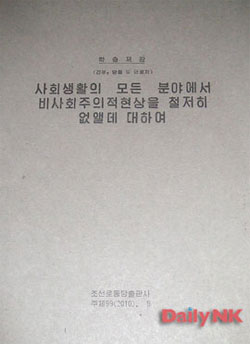
Here is a PDF of the new charter.  I am afraid th my Korean is not that good and I do not have a copy of the former charter. If anyone can do or find a comparison, I would like to see it.

Share

DPRK, NGO to film Paek Son Haeng film

Monday, January 17th, 2011

Pictured above: Paek Son Haeng Memorial Hall, Pyongyang (Google Earth)

According to the Daily NK:

North Korea has apparently agreed to accept foreign funding to produce a movie which shows Christians in a positive light. It will be the first movie made in North Korea to show the life story of a Christian.

An activist working in New Zealand for “Team and Team International”, a South Korean NGO working on international disaster relief, reported today, “A North Korean movie import-export company (Chosun Movie Company) has decided to produce a movie, ‘Paek Sun Haeng’, with the support of an organization from New Zealand,” and added, “They are at the last stage of working on the scenario and plan to start filming this coming September.” A budget production, it will cost a reported $1.5 million.

The activist said that the two sides have agreed to show the movie in movie theaters across the country and on Chosun Central TV. The purpose behind the investment is apparently to depict the positive side of Christianity and Christians to the North Korean people.

He explained, “Based on the idea that the figure, Baek Sun Haeng, has been defined as a good capitalist in North Korea, the organization has been negotiating production of a movie about her with North Korea since 2008.” Additionally, he said “They will describe fully the image of Baek as a philanthropist as well as a Christian in the movie.”

The scenario was reportedly written by the head of Chosun Movie Company, Choi Hyuk Woo, but there has been conflict over the degree of Christian content.

The source explained, “Problems when the North Koreans tried to change one line or scene have not been small.” However, “They were able to persuade the North Korean staff by sticking stubbornly to the fact that it would have been impossible to invest in the movie without Christian content.”

North Korea’s bad situation vis a vis foreign currency may have influenced the North’s decision-making, the source agreed, saying, “I am aware that North Korea’s internal capital situation is rather difficult. That economic difficulty may have influenced this contract somewhat.”

Chosun Movie Company oversees the export and import of movies under the Culture and Art Department of the Propaganda and Agitation Department, which is within the Central Committee of the Party.

The activist emphasized, “Aid activities for North Korea should give dreams and hope for new things to the North Korean people through diverse cultural approaches beyond food or essential aid.”

The movie’s main character, Baek Sun Haeng (1848-1933) is a well-known philanthropist in North Korea who has been mentioned in North Korean textbooks, in Kim Il Sung’s memoirs and elsewhere.

After her husband died when she was 16 years old, she is said to have accumulated wealth relentlessly. After that, she built both “Baek Sun Bridge” across the Daedong River and a three-story public meeting hall in Pyongyang. She also donated real-estate for Pyongyang Gwangsun School and Changdeok School.

Baek, as the deaconess of a church, also contributed to the education of Korean Christians by donating capital and land for Pyongyang Presbyterian Church School, which was built by Rev. Samuel Austin Moffett, the then-reverend at the First Church of Pyongyang, and Soongsil School, the forerunner to Soongsil University in Seoul, which was established by Dr. W. M. Baird, an American missionary, in Pyongyang on October 10th, 1887.

Additionally, she dedicated all of her property to an organization dedicated to the relief of poverty in 1925, so the Japanese government general tried to present her with a commendation, but she refused it. Therefore, she has been praised highly as a “people’s capitalist” in North Korea.

In 2006, the North Korea media reported that an existing monument to Baek had been restored and moved into “Baek Sun Haeng Memorial Hall” in Pyongyang on the instructions of Kim Jong Il.

Read the full story here:
Christian Movie Being Shot inside North Korea
Daily NK
1/17/2011

Share

DPRK establishes State General Bureau for Economic Development

Sunday, January 16th, 2011

According to KCNA:

The DPRK Cabinet adopted its decision on “10-Year State Strategy Plan for Economic Development” and decided to establish the State General Bureau for Economic Development.

This governmental body will handle all issues arising in implementing state strategy projects for economic development.

This step was taken at a time when miracles and innovations are being performed in the socialist economic construction everyday on the basis of a solid springboard laid for building a thriving socialist nation under the outstanding and tested Songun leadership of Kim Jong Il.

The above-said plan set a state strategic goal for economic development. It puts main emphasis on building infrastructure and developing agriculture and basic industries including electric power, coal, oil and metal industries and regional development. It, at the same time, helps lay a foundation for the country to emerge a thriving nation in 2012 and opens a bright prospect for the country to proudly rank itself among the advanced countries in 2020.

When the above-said strategy plan is fulfilled, the DPRK will emerge not only a full-fledged thriving nation but take a strategic position in Northeast Asia and international economic relations.

The DPRK Cabinet entrusted the Korea Taepung International Investment Group with the task to fully implement major projects under the strategic plan.

The historic Conference of the Workers′ Party of Korea and events to mark the 65th anniversary of the founding of the WPK successfully held in the DPRK fully demonstrated the might of the single-mindedly united country in the aspects of politics and ideology and in military technique. All the people are dynamically advancing to fling open the gate of a thriving nation in 2012.

According to Yonhap:

Cho Bong-hyun, a Seoul-based analyst with IBK Bank, said North Korea had been working on the 10-year plan since late 2009 and that it covers 12 areas worth US$100 billion.

According to Cho, the dozen categories include agricultural development, the building of five logistics districts, an airport and a port, and urban development.

“Setting up this 10-year plan is to help find breakthroughs for the North Korean economy through foreign investments, since the North has reached a point where it can’t solve economic problems on its own,” Cho observed.

The analyst also said the North’s current regime appears to be trying to build economic achievements credited to Kim Jong-un, the heir apparent to Kim Jong-il, and smooth the impending hereditary power succession.

I am unsure of the relationship between this new organization and the Korea Taepung International Investment Group and the State Development Bank (previous posts here).  I have a major exam next weekend so I will take a closer look after then.

Here also are some quick country rankings by per capital GDP: IMF, CIA.

Share

An affiliate of 38 North