Archive for the ‘USA’ Category

NK Nuclear Envoy to Visit US for Diplomatic Normalization Talks

Tuesday, February 27th, 2007

Korea Times
2/27/2007

The U.S. State Department confirmed Monday that a North Korean nuclear negotiator would visit the United States soon to start working group talks on bilateral diplomatic normalization, Yonhap News Agency reported.

Kim Kye-gwan, Pyongyang’s top envoy to the six-party nuclear talks, will go to San Francisco then travel to New York, where he will meet his Washington counterpart, Christopher Hill, Yonhap quoted the department as saying.

Department spokesman Sean McCormack said the Kim-Hill talks will be to both establish and hold the first round of the working group talks that address issues to be resolved for an eventual normalization of ties between the two countries.

A well-informed source told Yonhap, South Korea’s semi-official news service, last week that Kim will arrive in San Francisco on Thursday.

“I think that he (Kim) has meetings, potentially with some NGOs (nongovernmental organizations) out there in San Francisco,’’ McCormack was quoted as telling reporters.

“We are still working through the logistics of a meeting between him and Chris Hill. We expect the venue will be New York.’’

South and North Korea, the U.S., China, Russia and Japan, members of the so-called six-party process, struck a deal in Beijing on Feb. 13 under which Pyongyang would shut down its primary nuclear facilities in phases. In return, the North would receive heavy fuel oil as energy assistance.

The agreement establishes five working groups, including those to deal with diplomatic normalization between North Korea and the United States and between North Korea and Japan. The groups would meet within 30 days of the agreement.

Most of the contacts between Pyongyang and Washington are made in New York, where North Korea has a mission to the United Nations.

Share

North Korea’s Gold Mines

Wednesday, February 21st, 2007

Oh My News
Robert Neff
2/21/2007

(Check out the original post for photos)
Many people’s impression of North Korea is that of a poor country unable to feed its own people and desperate for cash. Other than selling weapons, printing counterfeit money, and engaging in the production of illegal drugs, it is thought that it has very little means of obtaining hard currency. Yet, recently, it has received a great deal of the media’s attention for its sale of gold to Thailand. Many people forget that North Korea has always had an abundance of mineral wealth — including gold.

Korea’s wealth had long been known not only in the Far East, but also in the Middle East. Ibn Khordadzbeh (844-848), an Arab, wrote that “there is a mountainous country named Silla and divided into numerous principalities. Gold abounds there.” Another Arab, Ibn Rosteh, repeated this claim in the 10th century when he pronounced Silla was very rich with gold. Arab merchants traveled from their own countries, along with the Chinese, and traded with Korean merchants along the Yesong River during the Koryo period. Most of Korea’s trade with these merchants was mainly gold and silver utensils, copper, ginseng, paper, fans and swords.

Eventually, as Korean foreign policy changed and it began to avoid most intercourse with foreign nations, this trade died, but the legends of Korea’s wealth didn’t. In 1867, Ernest Oppert, a Prussian trader from Shanghai, China, may have used Korea’s reputation for being abundant with gold, and the common belief amongst the Westerners that Korean kings were buried in coffins of solid gold, to hire a band of mercenaries to assist him in his infamous failed attempt to exhume the Korean regent’s father’s tomb and hold his remains as ransom.

Although gold is found throughout the Korean peninsula, it was, for the most, primarily mined and panned for in the mountainous regions of the northern provinces of Korea and along the eastern coast using primitive methods. This mining has gone on for literally centuries, but it wasn’t until the 1880s when several attempts, Korean and Western, were made to mine gold using “modern” methods. These efforts failed primarily because of the lack of finances, skilled labor, infrastructure and the resolve of the Korean government.

It wasn’t until 1896 when the first large mining concession was granted to a couple of American businessmen that “modern” gold mining in Korea began. This was the origin of the Oriental Consolidated Mining Company [OCMC], the first, longest running, and the richest of the Western mining concessions in Korea, and one of the richest in the world. It was soon followed by British, German, French, Italian, and of course, Japanese concessions, but none of them could compare to the wealth and size of the OCMC.

Although these mining concessions have been condemned by many modern Korean scholars as tools of exploitation by the Japanese and the West; it is also important to remember that they brought employment, education, and even higher living standards to thousands of Korean miners and their families.

The pictures accompanying this article are of the Seoul Mining Company located at Su’an (in present day North Korea) in 1915. The Seoul Mining Company was established in 1907 when two American businessmen, H. Collbran and H.R. Bostwick, leased Su’an mine from a British mining syndicate. The British had grown disenchanted with the mine and were convinced that it was not very profitable — they were wrong. Within the first six years of its operation it had produced nearly $3,000,000 worth of gold. Although the Seoul Mining Co., at first appeared to be one of, if not, the richest gold mining operations in Korea, by the early 1920s it was apparent that the gold was nearly depleted and in 1924 the mine was closed.

One of the chief problems for the early mining companies was transportation. Most of these gold mining sites had few, if any, crude roads or paths to them. It was often easier to transport supplies and equipment by flat-bottomed boats up the river to the landing nearest the mines. Then, depending on what was being transported, Korean ponies or bulls were used to manhandle the equipment and supplies to the mines.

The Korean bull was a slow moving powerful animal that was extremely docile and easily handled by its mapoo (handler), the ponies on the other hand were described as “swell-made spirited little beasts [but] generally vicious.” One early Westerner described his first encounter with his pony:

“As soon as the creature saw me approaching to mount, it reared and kicked furiously, and opened its mouth and flew at me like a tiger.”

So violent were these little ponies that a missionary remarked: “I love to see the pony shod, see him pinioned teeth and nail, in one hard knot, lying on his back under the spreading chestnut tree, with the village smithy putting tacks into him that brings tears to his eyes.”

In addition to transportation problems there was the lack of timber. Timber was essential to mining operations. In the beginning it was used as fuel to run the stamps (grinding equipment), to construct the buildings and to support the mine shafts, but timber was not always readily available in large quantities. Without timber the mines were doomed. By about 1910, most of the mines participated in reforestation programs, but for most of them they would not be around long enough to profit from these actions.

Most of the mines were in remote places, far from civilization. Obtaining enough miners to work the mines was usually not a problem, as they were generally paid better than the average Korean. However, these remote sites were home to large populations of big predatory animals — chiefly, tigers, leopards, and wolves.

Occasionally, tigers, especially ones that were too old to hunt the fleet-footed deer, would attack a lone Korean miner returning to his home at night. Often very little of the victim was found in the morning save a few pieces of ripped clothing and scuffle and blood marks on the ground. Surprisingly the animal that caused the most fatalities and was arguably the most feared was the wolf.

Sometimes wolves would creep into the small mining settlements at night and snatch children on their way to and from the outhouses. There are even accounts of wolves forcing their way into the flimsier hovels and dragging away children from the safety of their beds.

By 1939 all of the large Western gold mining concessions had been sold to the Japanese, and only a few very small mines were still operated and owned by Westerners, and even these were eventually taken over by the Japanese when Japan entered World War II. During World War II many of the mines fell into disrepair due to the negligence of their Japanese managers, and their failure to pay their Korean miners. During the Korean War, American soldiers reported that the OCMC mines were flooded and unworkable.

It has been more than 50 years since the Korean War has ended. During this time, North Korea has made great effort and progress in reopening some of these mines from the past and developing new ones. Today Western financing and expertise are still being used to aid the extraction of gold from the mountains of the north.

Share

Outside Pressures Broke Korean Deadlock

Wednesday, February 14th, 2007

NY Times
David E. Sanger

It is hard to imagine that either George W. Bush or Kim Jong-il would have agreed even a year ago to the kind of deal they have now approved. The pact, announced Tuesday, would stop, seal and ultimately disable North Korea’s nuclear facilities, as part of a grand bargain that the administration has previously shunned as overly generous to a repressive country — especially one that has not yet said when or if it will give up its nuclear arsenal.

But in the past few months, the world has changed for both Mr. Bush and Mr. Kim, two men who have made clear how deeply they detest each other. Both are beset by huge problems, and both needed some kind of breakthrough.

For Mr. Bush, bogged down in Iraq, his authority undercut by the November elections, any chance to show progress in peacefully disarming a country that detonated a nuclear test just four months ago could no longer be passed up. As one senior administration official said over the weekend, the prospect that Mr. Bush might leave Iraq, Iran, Afghanistan and North Korea more dangerous places than he found them “can’t be very appealing.”

Still, the accord came under fast criticism from right and left that it was both too little and too late.

For years, Mr. Bush’s administration has been paralyzed by an ideological war, between those who wanted to bring down North Korea and those who thought it was worth one more try to lure the country out of isolation. In embracing this deal, Mr. Bush sided with those who have counseled engagement, notably his secretary of state, Condoleezza Rice, and her chief negotiator, Christopher R. Hill. Mr. Bush took the leap in the hope that in a few months, he will be able to declare that North Korea can no longer produce fuel for new nuclear weapons, even if it has not yet turned over its old ones.

For Mr. Kim, the nuclear explosion — more of a fizzle — that he set off in the mountains not far from the Chinese border in October turned out to be a strategic mistake. The Chinese, who spent six decades protecting the Kim family dynasty, responded by cutting off his military aid, and helping Washington crack down on the banks that financed the Cognac-and-Mercedes lifestyle of the North Korean leadership.

“As a political statement, their test was a red flare for everyone,” said Robert Gallucci, who under President Clinton was the chief negotiator of the 1994 agreement with North Korea, which collapsed four years ago. “It gave President Bush and the Chinese some leverage.”

Mr. Gallucci and other nuclear experts agree that the hardest bargaining with world’s most reclusive, often paranoid, government remains ahead.

Over the next year, under the pact, the North must not only disable its nuclear reactors and reprocessing facilities, it must lead inspectors to its weapons and a suspected second nuclear weapons program. And to get to the next phase of the agreement, the one that gives “disarmament” meaning, North Korea will have to be persuaded to give away the country’s crown jewels: the weapons that make the world pay attention to it.

But before the administration faces off against Mr. Kim in Pyongyang, it will have to confront the many critics of the deal here at home. As the White House took credit on Tuesday for what it called a “first step,” it found itself pilloried by conservatives who attacked the administration for folding in negotiations with a charter member of what Mr. Bush called the “axis of evil,” and for replicating key elements of Mr. Clinton’s agreement with North Korea.

At the same time, Mr. Bush’s advisers were being confronted by barbs from veterans of the Clinton administration, who argued that the same deal struck Tuesday had been within reach several years and a half-dozen weapons ago, had only Mr. Bush chosen to negotiate with the North rather than fixate on upending its government.

In fact, elements of the new decision closely resemble the Clinton deal, called the Agreed Framework. As it did in that accord, the North agrees to “freeze” its operations at Yongbyon, its main nuclear facility, and to allow inspections there. And like that agreement, the new one envisions the North’s ultimately giving up all of its nuclear material.

In two respects, however, the new accord is different: North Korea does not receive the incentives the West has offered — in this case, about a year’s supply of heavy fuel oil and other aid — until it “disables” its equipment at Yongbyon and declares where it has hidden its bombs, nuclear fuel and other nuclear facilities. And the deal is not only with Washington, but with Beijing, Moscow, Seoul and Tokyo.

“We’re building a set of relationships,” Ms. Rice argued Tuesday, saying that the deal would not have been possible if she and President Bush had not been able to swing the Chinese over to their side. Mr. Bush has told colleagues that he believes the turning point came in his own blunt conversations with President Hu Jintao of China, in which, the American president has said, he explained in stark terms that a nuclear North Korea was more China’s problem than America’s.

But the administration was clearly taken aback on Tuesday by the harshness of the critique from the right, led by its recently departed United Nations ambassador, John R. Bolton, who charged that the deal “undercuts the sanctions resolution” against the North that he pushed through the Security Council four months ago.

Democrats, in contrast, were caught between enjoying watching Mr. Bush change course and declaring that the agreement amounted to disarmament-lite. “It gives the illusion of moving more rapidly to disarmament, but it doesn’t really require anything to happen in the second phase,” said Joel Wit, who was the coordinator of the 1994 agreement.

The Bush administration is counting on the lure of future benefits to the North — fuel oil, the peace treaty ending the Korean War it has long craved, an end to other sanctions — to force Mr. Kim to disclose where his nuclear weapons and fuel are stored.

Mr. Bush’s big worry now is that Mr. Kim is playing the administration for time. Many experts think he is betting that by the time the first big deliveries of oil and aid are depleted, America will be distracted by a presidential election.

But Mr. Bush could also end up with a diplomatic triumph, one he needs desperately. To get there, he appears to have changed course. Asked in 2004 about North Korea, he said, “I don’t think you give timelines to dictators and tyrants.”

Now he appears to have concluded that sometimes the United States has to negotiate with dictators and odious rulers, because the other options — military force, sanctions or watching an unpredictable nation gain a nuclear arsenal — seem even worse.

Share

Seoul Wants 6 Nations to Shoulder Burden for Energy Aid to NK

Sunday, February 11th, 2007

Korea Times
Park Song-wu
2/11/2007

South Korea is thinking of chairing a working group for energy aid to North Korea as the United States is trying to differentiate this round of the six-party talks from a 1994 process, a Seoul official said on Sunday.

But Seoul has a firm position that all parties should jointly pay the “tax” for peace, he said.

“Denuclearization will benefit all parties, so the burdens should be shared jointly,” he said. “But we are thinking of taking the lead in the working group for energy aid, considering the circumstances of the other parties.”

He did not elaborate. But Tokyo is not expected to raise its hand to chair the working group, considering the Japanese anger over the North’s abduction of its nationals in the past.

Russia prefers forgiving the North’s debts instead of providing it with energy.

China, host of the multilateral dialogue, is already playing the most important role of chairing the six-party meeting.

What the United States apparently has in mind, and consented to by all parties, is the necessity to differentiate the result of these on-going negotiations from the 1994 Agreed Framework.

Since it was signed by Robert Gallucci and Kang Sok-ju in Geneva on October 21, 1994, Washington provided 500,000 tons of heavy oil annually to Pyongyang over the following seven years.

But the North’s promise to freeze its graphite-moderated reactors in return for two light-water reactors was not obeyed, causing the Bush administration to criticize the deal as a diplomatic failure of his predecessor, Bill Clinton. After that, U.S. diplomats even avoided meeting their North Korean counterparts bilaterally.

The U.S. policy, however, has recently reached a turning point.

“The Bush administration may have been driven to greater negotiating flexibility by a need to achieve a foreign policy victory to compensate for declining public support for the Iraq war and the loss of the Republican leadership of Congress,” Bruce Klingner, a senior research fellow for the Heritage Foundation said in a recent article.

But one thing that has not changed is the U.S. hope of not repeating the “mistake” it made with the Geneva agreement.

From 1994 to 2002, Pyongyang received 3.56 million tons of heavy oil, equivalent to $500 million, from the now-defunct Korean Peninsula Energy Development Organization (KEDO), and the United States shouldered the largest share of $347 million.

To shake off that bad memory, Washington wants to use the term “shut down” instead of “freezing” and even wants to avoid providing fuel oil to the North, reportedly citing the possibility that it can be used for military purposes.

So the talks have dragged on. And, to make things worse, the North Koreans are demanding a lot.

Japan’s Kyodo news agency reported that North Korea had demanded 2 million tons of heavy oil or 2 million kilowatts of electricity in exchange for taking the initial steps towards denuclearization.

Christopher Hill, the top U.S. envoy, expressed hope on Sunday that such technical issues could be discussed at working group meetings. On the same day, the Seoul official hinted that South Korea will chair the working group.

Share

U.S. budgets money to pressure North in 2008

Wednesday, February 7th, 2007

Joong Ang Daily
Kang Chan-ho
2/7/2007

Budget allocations by the Bush administration show that the United States plans to continue to pressure North Korea about human rights violations and illicit financial transactions, despite the ongoing North Korean nuclear talks.

In its fiscal plan for the year 2008 released Monday, the U.S. State Department said $20 million had been set aside to support refugees in the East Asian region, including North Korean defectors, while $2 million had been earmarked to support activities promoting democracy in North Korea.

In addition, $668 million will be set aside for radio propaganda broadcasts: The Voice of America and Radio Free Asia will increase their combined broadcast hours targeted to the North by up to 10 hours each day. The State Department is focusing its broadcasts on North Korea, the Middle East, Somalia and Cuba.

In addition, the Treasury Department has budgeted $385,000 to hire two more officials to deal with illicit North Korean financial activities and act in an advisory role to bring more pressure on the communist country.

The budget plan by the State Department also outlined a timeline for the ongoing nuclear negotiations. It projects that should the nuclear talks be concluded, the actual process of dismantling the North’s nuclear weapons should start by early 2008. The plan states that negotiations to dismantle the North’s mid- to long-range missiles would begin next year as well.

Meanwhile, with nations involved in the six-party talks getting ready to convene in Beijing on Thursday to resume nuclear negotiations, Japanese Prime Minister Shinzo Abe said on Monday that without sincere measures taken by Pyongyang regarding Japanese abductees, Tokyo will not come up with the energy aid measures needed to compensate the North.

Officials involved in the nuclear talks have said they intended to take some initial steps toward implementing an international accord reached in September 2005. The Yomiuri Shimbun reported earlier that Pyongyang was looking to get 500,000 tons of heavy fuel per year in exchange for agreeing to stop operations at its Yongbyon nuclear reactor and allowing inspectors from the International Atomic Energy Agency back into the country.

Share

U.S. might consider Kaesong goods to be South Korean: Vershbow

Monday, February 5th, 2007

Yonhap
2/5/2007

The United States may recognize goods produced at a joint industrial complex just north of the border as South Korean if there is a change in circumstances, the top U.S. diplomat here said Monday.

In a one-hour meeting with Unification Minister Lee Jae-joung, U.S. Ambassador Alexander Vershbow said that while it is unrealistic to recognize the goods made in the border city of Kaesong as South Korean, there is room left to negotiate within the proposed free trade agreement (FTA) between the two countries, Unification Ministry officials said.

“Lee stressed that U.S. recognition of the goods produced in Kaesong as South Korean will contribute to bringing about a lasting peace on the Korean Peninsula. Vershbow said ‘if,’ but he did not elaborate on what kind of change under what kind of circumstances,” said a ministry official who was present at the meeting, but who asked to remain anonymous.

So far, the U.S. has avoided placing the issue on the official agenda of the FTA negotiations, so Vershbow’s remarks could be construed as a slight change in U.S. strategy toward forging a free trade deal with South Korea.

In spite of United Nations sanctions on the North following its nuclear weapon test in October, South Korea has kept two major cross-border joint projects afloat: an industrial complex in Kaesong just north of the border, and a tourism program at the North’s scenic Mount Geumgang.

In the industrial complex, South Korean businesses use cheap North Korean labor to produce goods. Twenty-one South Korean factories employ about 11,160 North Korean workers in Kaesong.

The six-party talks aimed at ending North Korea’s nuclear weapons program, involving the two Koreas, the U.S., China, Japan and Russia, will reconvene in Beijing on Thursday.

US May Accept Kaesong Goods
Korea Times

Ryu Jin
2/5/2007

The United States might recognize goods made at a joint industrial complex in the North Korean border city of Kaesong as South Korean products in a proposed free trade agreement (FTA) if there is a change in circumstances, the top U.S. diplomat in Seoul said Monday.

U.S. Ambassador to Seoul Alexander Vershbow said in a meeting with Unification Minister Lee Jae-joung that, although it seems unrealistic at the moment to recognize the Kaesong products as South Korean, there is room left to negotiate within the proposed FTA.

“Lee stressed that U.S. recognition of the goods produced in Kaesong as South Korean will contribute to bringing about a lasting peace on the Korean Peninsula,” a ministry official said after the meeting. “Ambassador Vershbow said `if,’ but he did not elaborate on what kind of change under what kind of circumstances.”

Vershbow’s remarks could be interpreted as a sign of change in U.S. strategy since Washington has so far refused to deal with the issue as an official agenda item in the ongoing negotiations for a South Korea-U.S. FTA.

Inter-Korean ties have soured in recent years in tandem with the deteriorating North Korea nuclear standoff. But the six-party talks aimed at ending North Korea’s nuclear program is expected to see a substantial progress in the coming round of negotiations.

South Korea has kept afloat its major cross-border projects with North Korea, including the joint industrial park in Kaesong and a tourism program at the North’s scenic Mt. Kumgang, even after Pyongyang’s nuclear test in October.

South Korea has exerted much effort to have its counterparts in FTAs, such as Southeast Asian countries, recognize the Kaesong products as “made in Korea” because it has a significance to further promote the joint industrial project.

A total of 21 South Korean factories are operating in the Kaesong industrial park at present, employing over 10,000 North Korean workers.

Share

U.S., N.K. open talks on BDA

Tuesday, January 30th, 2007

Korea Herald
Lee Joo-Hee
1/30/2007

Officials from Washington and Pyongyang are in Beijing today for their second round of talks on U.S. financial sanctions against North Korea.

The discussions are likely to set the tone for the upcoming round of six-party talks scheduled to resume early next month.

The agenda is thought to include North Korea’s acknowledgement of illicit financial activity, a pledge to prevent any reoccurrence, and the lifting of a U.S. embargo on North Korean accounts at a Macau bank.

Washington imposed financial restrictions against Banco Delta Asia after charging the bank with helping North Korea launder counterfeit dollars and funds raised from smuggling restricted goods. The move prompted Pyongyang to boycott the six-party talks process in 2005.

Upon returning to the six-party process in December last year, North Korea demanded it must first solve the financial issue before discussing the nuclear question.

The United States remains adamant that the financial measures were separate from the nuclear issue but has offered to discuss it on the sidelines of the nuclear talks.

The U.S. side is led by Daniel Glaser, the Treasury Department’s deputy assistant secretary for terrorist financing and financial crimes.

The North Korean team is led by Oh Gwang-chul, president of the Foreign Trade Bank of Korea, the reclusive regime’s window for foreign banking.

The two delegations are likely to discuss the technical aspects of the issue, which North Korea claims was a political gesture by the United States as part of its hostile policy.

On Sept. 15, 2005 the U.S. Treasury Department banned all American banks from dealing with Banco Delta Asia for allegedly helping North Korean companies launder money from smuggled cigarettes and counterfeit $100 bills.

Washington and Pyongyang have been exchanging questions and information regarding the measures since their first discussion in Beijing on the sidelines of the six-party talks last month.

N. Korean financial officials arrive in Beijing for talks on U.S. sanctions
Yonhap
1/30/2007

A group of North Korean financial experts arrived in Beijing Tuesday for talks with their U.S. counterparts on removing U.S. financial sanctions on the North, a major hurdle to six-way negotiations on the communist nation’s nuclear weapons program.

The U.S.-North Korea financial talks come ahead of a new round of six-nation negotiations next week aimed at persuading North Korea to give up its nuclear weapons program.

The Chinese Foreign Ministry said Tuesday the new round of the nuclear disarmament talks will start Feb. 8.

The North Koreans, headed by O Kwang-chol, president of the North’s Foreign Trade Bank, arrived in the Chinese capital at 9:30 a.m. The North Koreans were expected to hold talks with a U.S. financial team led by Daniel Glaser, a deputy assistant secretary at the U.S. Treasury Department.

Upon arriving from Pyongyang, the head North Korean delegate said the sides would hold talks at their countries’ embassies here.

The two last met here on the sidelines of a December round of the nuclear talks, also held in Beijing. The working-group financial meeting seeks to remove U.S. sanctions imposed in September 2005 on a Macau bank suspected of laundering money for the North, which Pyongyang used as an excuse to stay away from the nuclear talks for 13 months.

Expectations of progress from the financial discussions, as well as the nuclear talks, have been significantly raised following a three-day meeting of top U.S. and North Korean nuclear negotiators in Berlin earlier in the month, at which the two agreed “on a number of issues,” according to Christopher Hill, the top U.S. nuclear envoy.

Hill said Monday (Washington time) that the next round of the nuclear talks could produce an agreement similar to a 1994 pact in which North Korea agreed to freeze its nuclear activities in return for economic and energy assistance. The 1994 Agreed Framework became defunct when the ongoing dispute over the North’s nuclear ambitions erupted in late 2002.

However, Hill made it clear that the goal of the six-party negotiations is to carry out a 2005 agreement in which Pyongyang agreed in principle to completely and verifiably dismantle its nuclear program in return for economic and diplomatic benefits.

“Whatever emerges in the next round, our job will not be finished until the full joint statement is finally realized and implemented,” Hill told Reuters in Washington.

“I am not too worried whether something might look like the Agreed Framework because we’re only looking at part of what we’re aiming at,” Hill added.

The top U.S. envoy to the financial talks Tuesday also expressed hope for progress.

“We are prepared to go through these talks as long as it takes for us to get through our agenda,” Glaser was quoted as telling reporters in Beijing. “I am hopeful we’ll make progress.”

Treasury officials have so far refused to confirm it, but recent reports said the United States may unfreeze part of North Korea’s assets at the Macau bank to help move the nuclear negotiations forward.

Pyongyang has about US$24 million in 50 accounts at the Macau bank, Banco Delta Asia, and as much as $13 million is believed to belong to legitimate accounts.

Share

Last US defector in North Korea

Tuesday, January 30th, 2007

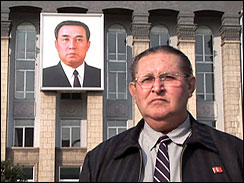
dresnok.jpgThe folks who brought us “The Game of their Lives” and “A State of Mind”  have delivered their third DPRK-based documentary, “Crossing the Line” about four American soldiers that defected to the DPRK.  It was shown at the Sundance Film Festival this week, and sorry to Simon, Nick and Dan that you did not win.

A section of the interview with the last remaining defector, James Dresnok, was aired on CBS this week.  It was very interesting, not only because we get a glimpse into the life of Dresnok, but also his children.  Click here to see the video clip.

The story below was also published in the BBC.

BBC
1/23/2007

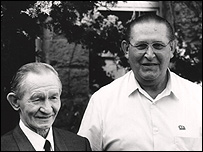
dresnokjenkins.jpgIn the 1960s four US soldiers separately defected to North Korea, and were little heard from again.

Now one – the last known former American GI left in the country – has spoken for the first time to British documentary-makers.

James Dresnok is something of a celebrity around the North Korean capital Pyongyang, his home for the last 44 years.

Unmissable thanks to his 6ft 5in height and bulky frame, the 64-year-old has appeared in North Korean films, taught English at university and been a propaganda hero for the Communist nation.

“I have never regretted coming to [North Korea]. I feel at home,” he says, in the documentary Crossing the Line, which premiered at the US Sundance Film Festival on Monday.

James Dresnok was a 21-year-old army private when he decided to leave his post in South Korea one August afternoon in 1962 to cross into the North.

Three months earlier, Private Larry Abshier had become the first known US soldier to defect to the North, while patrolling the demilitarised zone between the two Koreas.

In the three years that followed, Specialist Jerry Parrish and Sergeant Charles Jenkins would follow Abshier and Dresnok across the border.

The four, who initially lived in the same house, found their new life tough in the early years. Mr Dresnok admits he did not want to stay. “I didn’t think I could adapt”.

A joint bid for asylum at the Soviet embassy in 1966 was rejected and the four were forced to undergo intense re-education, which included learning North Korea’s official Juche ideology.

It was at that point, Mr Dresnok says, that he decided he would try to fit in. “Man is the master of his life, and little by little I came to understand the Korean people,” he said.

All four married, were granted North Korean citizenship and – apart from starring as evil capitalists in a propaganda film called Nameless Heroes in 1978 – appeared to drop off the face of the earth.

In fact, so little was known about them that Larry Abshier had been dead for 13 years when the US defence department said, in 1996, it believed all four men were still alive. Jerry Parrish had in fact died in 1996.

Persistence

UK documentary-maker Daniel Gordon and his Beijing-based co-producer Nick Bonner were already familiar to North Korea’s film-making authorities when they asked them about the rumours of the four defectors.

Their 2002 film, The Game of Their Lives – about the North Korean football team that beat Italy in the 1966 World Cup and qualified for the quarter finals – had been a huge hit in the country.

They were working on their second film, A State of Mind – following two North Korean schoolgirls preparing for the mass games – when they asked for permission to make a film about Mr Dresnok and the others.

“We were initially told it was absolutely impossible,” Mr Gordon explained, “but we took that to mean it was possible.”

In June 2004, at a meeting they thought would be with the North Korean authorities, the filmmakers were brought face-to-face with James Dresnok and Charles Jenkins for the first time.

“The two men weren’t wholeheartedly keen on making the film. It had the potential to blow up in their faces. But at the end of the two-and-a-half hour meeting, they had come round,” Mr Gordon said.

Within five weeks of the meeting, however, Charles Jenkins’ story became known to the whole world when he left North Korea to be reunited with his wife in Japan.

Privileged

While the documentary is about all four defectors, the focus is undoubtedly on James Dresnok who is filmed fishing, going to a restaurant, the opera and having a medical check-up.

“I found him a fascinating guy,” Daniel Gordon says. “He has had such a unique experience of life.

“It is hard to understand from our perspective why an American soldier would choose to make his life in arguably the biggest US-hating nation on earth.”

James Dresnok describes how an unstable childhood and his first wife’s infidelity left him with a sense of hopelessness before he crossed the line into the North.

Since his defection, he has been married twice and has three children.

He taught languages and carried out translating work even though he, like the other three, had dropped out of school by the age of 15.

And he also appeared in several other films, apart from Nameless Heroes, and is still referred to as Arthur after a character he once played.

Mr Dresnok admits he lives a privileged life by North Korean standards, confessing that he got rice rations during the deadly famines of the late 1990s while others were starving.

“The government is going to take care of me until my dying day,” he tells the documentary team.

Share

US regulations codify UN sanctions

Monday, January 29th, 2007

U.S. Federal Register (Hat Tip OneFree Korea)

Here are the highlights:

DEPARTMENT OF COMMERCE
Bureau of Industry and Security
15 CFR Parts 732, 738, 740, 742, 746, 772 and 774

[Docket No. 070111012-7017-01]
RIN 0694-AD97

North Korea: Imposition of New Foreign Policy Controls
AGENCY: Bureau of Industry and Security, Commerce.
ACTION: Final rule.
———————————————————————–

SUMMARY: In accordance with recent United Nations (UN) Security Council resolutions and the foreign policy interests of the United States, the United States Government is imposing restrictions on exports and reexports of luxury goods to the Democratic People’s Republic of Korea (North Korea), and is continuing to restrict exports and reexports of nuclear or missile-related items and other items included on the Commerce Control List (CCL). To this end, the Bureau of Industry and Security (BIS) is amending the Export Administration Regulations (EAR) to impose license requirements for the export and reexport of virtually all items subject to the EAR to North Korea, except food and medicines not listed on the CCL.
    BIS will generally deny applications to export and reexport luxury goods, e.g., luxury automobiles; yachts; gems; jewelry; other fashion accessories; cosmetics; perfumes; furs; designer clothing; luxury watches; rugs and tapestries; electronic entertainment software and equipment; recreational sports equipment; tobacco; wine and other
alcoholic beverages; musical instruments; art; and antiques and collectible items including but not limited to rare coins and stamps.
    BIS will continue to generally deny applications to export and reexport arms and related materiel controlled on the CCL and items controlled under the multilateral export control regimes (the Missile Technology Control Regime, the Nuclear Suppliers Group, the Australia Group, and the Wassenaar Arrangement). This includes items specified in UN documents S/2006/814, S/2006/815 and S/2006/853. BIS will also generally deny applications to export and reexport other items that the UN determines could contribute to North Korea’s nuclear-related, ballistic missile-related, or other weapons of mass destruction-related programs.
    BIS will also generally approve applications to export or reexport: non-food, non-medical humanitarian items (e.g., blankets, basic footwear, heating oil, and other items meeting subsistence needs) intended for the benefit of the North Korean people; items in support of United Nations humanitarian efforts; and agricultural commodities and medical devices that are determined not to be luxury goods.
    BIS will review on a case-by-case basis applications to export and reexport all other items subject to the EAR.

DATES: This rule is effective January 26, 2007.

The following further amplifies the illustrative of list luxury goods set forth in Sec.  746.4(c):
    (a) Tobacco and tobacco products
    (b) Luxury watches: Wrist, pocket, and others with a case of precious metal or of metal clad with precious metal
    (c) Apparel and fashion items, as follows:
    (1) Leather articles
    (2) Silk articles
    (3) Fur skins and artificial furs
    (4) Fashion accessories: Leather travel goods, vanity cases, binocular and camera cases, handbags, wallets, designer fountain pens, silk scarves
    (5) Cosmetics, including beauty and make-up
    (6) Perfumes and toilet waters
    (7) Designer clothing: Leather apparel and clothing accessories
    (d) Decorative items, as follows:
    (1) Rugs and tapestries
    (2) Tableware of porcelain or bone china
    (3) Items of lead crystal
    (4) Works of art (including paintings, original sculptures and statuary), antiques (more than 100 years old), and collectible items, including rare coins and stamps
    (e) Jewelry: Jewelry with pearls, gems, precious and semi-precious stones (including diamonds, sapphires, rubies, and emeralds), jewelry of precious metal or of metal clad with precious metal
    (f) Electronic items, as follows:
    (1) Flat-screen, plasma, or LCD panel televisions or other video monitors or receivers (including high-definition televisions), and any television larger than 29 inches; DVD players
    (2) Personal digital assistants (PDAs)
    (3) Personal digital music players
    (4) Computer laptops
    (g) Transportation items, as follows:
    (1) Yachts and other aquatic recreational vehicles (such as personal watercraft)
    (2) Luxury automobiles (and motor vehicles): Automobiles and other motor vehicles to transport people (other than public transport), including station wagons
    (3) Racing cars, snowmobiles, and motorcycles
    (4) Personal transportation devices (stand-up motorized scooters)
    (h) Recreational items, as follows:
    (1) Musical instruments
    (2) Recreational sports equipment
    (i) Alcoholic beverages: wine, beer, ales, and liquor

Share

U.S. to defer contributions pending UNDP audit

Saturday, January 27th, 2007

Joong Ang Ilbo
1/27/2007

Washington said Thursday it will withhold all contributions to the United Nations Development Program (UNDP), an agency accused of mismanaging its North Korea activities that led to a large, steady influx of cash into a regime suspected of seeking nuclear weapons.

The United States would also consider proposing that the UN stop all programs in the North except those for humanitarian assistance, said Ambassador Alejandro Wolff, acting U.S. envoy to the United Nations. He said the U.S. was satisfied with UNDP’s announcement of steps to remedy the situation, including an audit and readjustment of its 2007-2009 North Korea program.

“In the meantime, until we get the results of that audit and the program is reviewed, we would defer approval of the new program for the DPRK.,” the envoy said. “The U.S. also withholds its contribution in part to UNDP to the DPRK program,” he said. DPRK stands for Democratic People’s Republic of Korea, North Korea’s official name.

Japan went further, its envoy suggesting the UN stop all programs in North Korea except for direct humanitarian aid. Mr. Wolff said the Japanese argument “is quite compelling” and added the U.S. will consider the proposal.

At the State Department, spokesman Sean McCormack denied that the UNDP probe is targeted at Pyongyang. “This is not a U.S.-North Korea issue,” Mr. McCormack told reporters. “This is not directed at North Korea. This is simply an issue of management and oversight of UN programs. The secretary-general and executive director of UNDP understand it as such.”

The UNDP has been accused by Washington of mismanaging its aid in North Korea, resulting in a massive cash flow into the Pyongyang regime through hard currency payments to the North Korean government and local employees and vendors.

Ban Ki-moon, the new UN leader, asked for an overall audit of all UN funds and programs, starting with the first report on North Korea to be completed within 90 days.

Pyongyang in a statement claimed strict conformity with UN regulations.

Share

An affiliate of 38 North