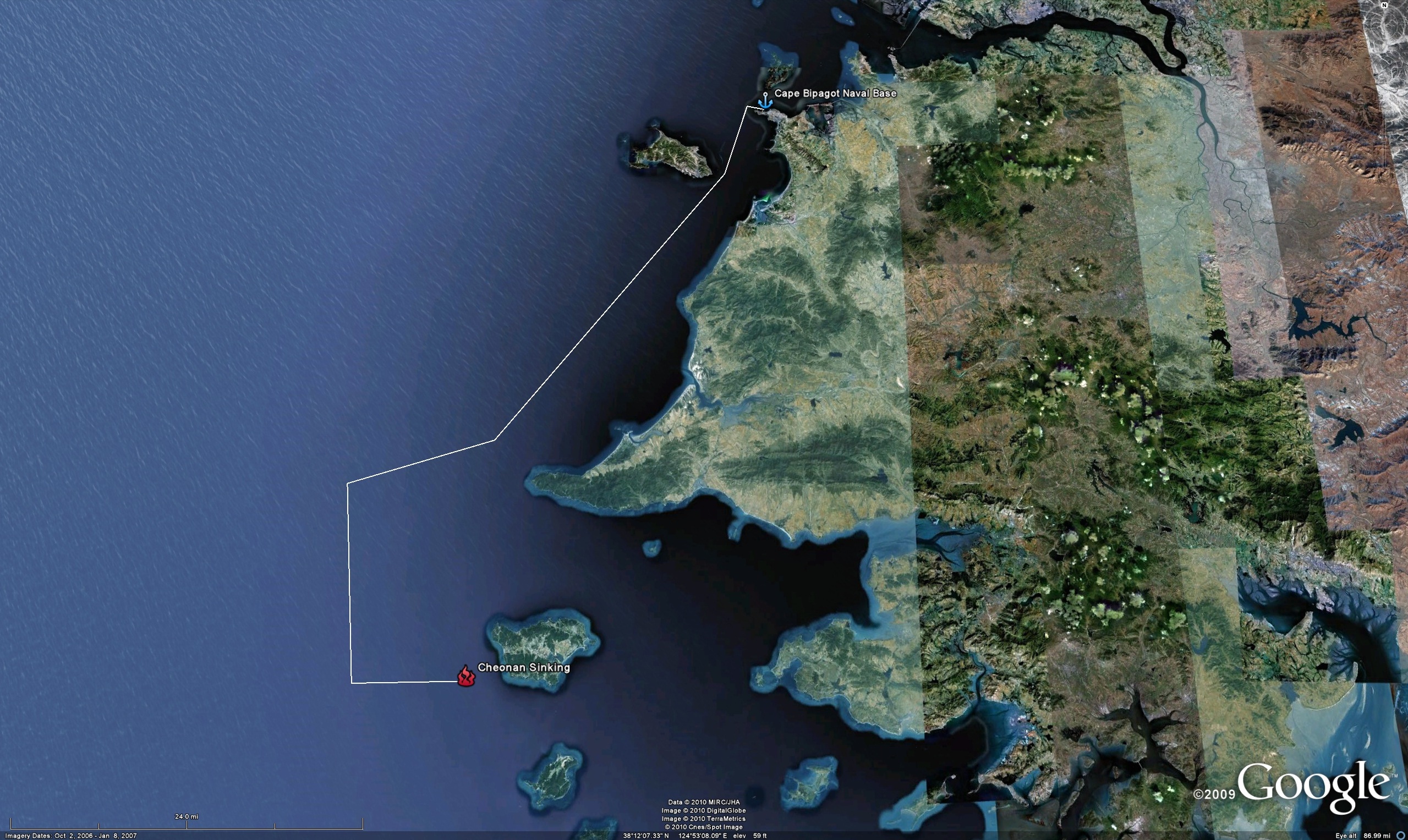
UPDATE 68 (2012-8-27): The Hankyoreh reports on a new study (order the study here) that asserts that the Cheonan could have been sunk by an abandoned South Korean mine. According to the article:
An article has been published in an international academic journal arguing that the explosion that sank the South Korean Cheonan warship in March 2010 may not have been from a North Korean torpedo, but from a mine discarded by the South Korean navy.
This is the second scientific study on the Cheonan sinking published in an academic journal, the first being a seismic analysis published last year by Yonsei University Department of Earth System Sciences professor Hong Tae-kyung. That study supported the findings of the government’s joint investigation team.
In the study published in the international academic journal “Pure and Applied Geophysics,” Korea Seismological Institute director Kim So-gu and the Geophysical Institute of Israel’s Yefim Gitterman wrote that analysis of the seismic waves, acoustic waves and bubble frequency made it clear an underwater explosion took place.
They said the seismic magnitude of the explosion was 2.04, that of 136kg of TNT and equivalent to the individual yield of the large number of land control mines abandoned by the Korean navy after they were first installed in the 1970s.
The findings are noteworthy in that they differ greatly from those of the Civilian-Military Joint Investigation Group (MCNJIG), which found the cause of the sinking to be a North Korean CHT-02D torpedo with a yield of 250kg of TNT exploding at a depth of six to nine meters, producing a seismic yield of 1.5.
Read the full Hankyoreh story here.
UPDATE 67 (4/1/2011): A group of US lawmakers are working to add the DPRK back to the US list of state sponsors of terror. According to Yonhap:
A bipartisan group of congressmen will soon submit legislation to re-designate North Korea as a state sponsor of terrorism for its torpedoing of a South Korean warship and shelling of a South Korean border island that killed 50 people last year, sources said Friday.
“I understand Rep. Ileana Ros-Lehtinen has almost completed drafting the legislation, and she is likely to submit the legislation as soon as possible,” a congressional source said, adding several other Republican and Democratic congressmen are expected to sponsor the legislation.
Ros-Lehtinen (R-FL), chairwoman of the House Foreign Affairs Committee, introduced similar legislation in May last year but it didn’t pass.
In June, she had wreaths laid at the tombs of the 46 South Korean sailors killed in the sinking of the warship Cheonan in waters near the western sea border with North Korea.
UPDATE 66 (3/31/2011): A member of North Korea’s National Defense Commission has now issued a statement about the Cheonan sinking, as well as a subsequent artillery shelling of Yeonpyeong Island by North Korean forces eight months later. According to KCNA:
A spokesman for the inspection group of the DPRK National Defence Commission issued the following statement on Thursday:
One year has passed since warship “Cheonan” sank in the waters off Paekryong Island in the West Sea of Korea.
But the south Korean authorities and military warmongers, hell-bent on the inter-Korean stand-off and steeped in distrust in compatriots, are still linking the warship “Cheonan” sinking case with the DPRK and passing the buck for the Yonphyong Island shelling on it, escalating confrontation with it.
The inspection group of the NDC of the DPRK has already opened to the public the truth of the two cases twice.
At the outset of the occurrence of the “Cheonan” warship sinking case, the DPRK expressed regret at those who suffered the disaster from the viewpoint that they are members of the Korean nation though they were soldiers of the south Korean army who leveled guns at the DPRK.
Nevertheless, the south Korean authorities and military warmongers floated investigation results without any scientific ground and objective nature in a bid to deliberately lay obstacles in the way of achieving national reconciliation and unity and block the way of achieving peace and prosperity desired by all the fellow countrymen.
They have become evermore sinister and brazenfaced in their reckless anti-DPRK confrontation rackets with the first anniversary of the occurrence of the case as a momentum, in particular, only to touch off burning resentment of all the Koreans.
This situation compelled the inspection group of the NDC of the DPRK to re-clarify its principled stand internally and externally.
1. The south Korean authorities and military warmongers should no longer perpetrate such reckless act as linking the “Cheonan” warship sinking case with the DPRK.
Explicitly speaking once again, the DPRK has nothing to do with the case. This means something irrelevant to it can never be anything in which it is allegedly involved no matter how much water may flow under the bridge.
Any attempt to deliberately link the DPRK with the case while shunning this stark reality would only serve as a living testimony that they are only seeking to escalate confrontation with fellow countrymen and deteriorate inter-Korean relations.
The south Korean side walked out of the venue of the preliminary contact for opening the north-south high-level military talks without any patience. But it falsified the fact, claiming that the north was the first to walk out of the venue. They should stop such folly at an early date and no longer link the DPRK with the above-said case.
The further they bedevil inter-Korean relations while spreading the “story about the north’s involvement” full of lies and fabrications, the deeper pitfall of history they will find themselves.
The inspection group of the NDC will probe the truth about the “farce” by issuing the third and fourth statements till the above-said story has disappeared.
2. They should no longer work hard to pass the buck for the Yonphyong Island shelling on the DPRK.
Explicitly speaking, the above-said shelling incident was an unsavory case which occurred as they preempted a provocation against the DPRK.
Had they not preempted firing shells into the inviolable territorial waters of the DPRK, there would not have occurred the shelling on the island.
Various forms of firing exercises and drills targeted against the DPRK have frequently taken place in the areas of south Korea and waters around it for more than six decades since the division of the country. But the army of the DPRK has not taken any physical counteraction against them even once.
Any attempt to conceal the criminal preemptive shelling and shift the responsibility for it onto the other is an act of deceiving not only themselves but all the fellow countrymen and an anti-peace act little short of pulling the wool over the eyes of the whole world.
If they do not want to suffer the same disgrace as they did through the Yonphyong Island shelling incident, they should broad-mindedly halt such shameless act as shifting their blame onto the other and have a proper attitude to settle the issue.
Their oft-repeated talk about someone’s responsibility for the Yonphyong Island shelling would only harden the DPRK’s determination to protect the fair and aboveboard extension of the Military Demarcation Line in the West Sea.
3. The present south Korean authorities and military warmongers should stop the reckless anti-DPRK hysteria under the pretence of the two cases.
They are resorting to anti-DPRK confrontation rackets and reckless psychological warfare, anxiously waiting for “contingency” of someone to occur, and staging various forms of military exercises and drills, stoking a war atmosphere. But they should bear in mind that their much anticipated “contingency” is bound to take place in the south, not in the north.
Their anti-DPRK confrontation hysteria kicked up by them under the pretexts of the two cases is as foolish an act as shaking fist in the back lane after being hit hard in a street.
This is nothing but a thoughtless and traitorous action to calm down the distrust in the two cases shown by different circles of south Korea, settle the ever-growing “discord” in the south, adhere to the nonsensical “theory of principle” in dealing with the inter-Korean relations and stick to the wrong hard-line policy towards the north.
The inspection group of the National Defence Commission regards their anti-DPRK confrontation campaign being staged on the lapse of one year since the occurrence of the warship “Cheonan” sinking case as no more than a farce of “counting the age of a dead child”.
The DPRK wishes more ardently than anyone else to see the tension defused on the Korean Peninsula and achieve peace through the improved relations between the north and the south and this process leading to peace and prosperity of Northeast Asia and the rest of the world.
Precisely for this reason the DPRK proposed on its own initiative comprehensive dialogue and negotiations and has made every possible effort of goodwill to put them into practice.
The reality indicates that the nation is standing at the crossroads of detente and increased tension and peace and prosperity and war.
It is the stand of the Korean People’s Army to have bold dialogue or fight a real war.
The present south Korean authorities and puppet military warmongers should properly understand that they are standing on the crossroads of dialogue and war.
UPDATE 65: Production value at the Kaesong Industrial Zone returns to pre-Cheonan levels.
UPDATE 64: South Korea Abandons Demand for Apology Over Ship’s Sinking
UPDATE 63: DPRK offers samples to refute claims it sank the Cheonan. According to Reuters:
North Korea offered on Tuesday to provide samples of its torpedoes to refute an international investigation that blamed Pyongyang for the sinking of a South Korean warship earlier this year.
UPDATE 62: Russia will not release its Cheonan report. Read more in the Korea Times.
UPDATE 61: South Korea has issued another report claiming the DPRK is responsible. Read about it here, here and here.
UPDATE 60: DPRK torpedo catalog includes name of torpedo exporter.
UPDATE 59: DPRK asked to hold summit before Cheonan incident.
UPDATE 58: Russian team casts doubt on Cheonan findings.
UPDATE 57: The Daily NK reports that the alleged North Korean propeller came from Kagam, Kaechon county. 39°32’37.77″N, 125°50’47.24″E.
UPDATE 56: Barbara Demick writes about South Koreans skeptical of the government’s claims.
UPDATE 55: Nautilus Institute publishes inconsistencies in RoK Cheonan report.
UPDATE 54: North Korean officials postpone warship talks with US (Washington Post)
UPDATE 53: UNSC condemns sinking but does not blame DPRK.
UPDATE 52: UNSC reaches deadlock.
UPDATE 51: North and South Korean ambassadors to South Africa exchange words at World Cup event
UPDATE 50: South Korea Rejects North on Joint Sinking Probe Idea
UPDATE 49: Cheonan Investigators Presented Wrong Torpedo Diagram
UPDATE 48: John McGlynn brings a skeptical eye to the Cheonan findings.
UPDATE 47: Gomes has been threatened over the political fallout resulting from the sinking of the Cheonan.
UPDATE 46: EU Condemns N.Korea Over Cheonan Sinking
UPDATE 45: UNSC raises no objections to RoK assessment of sinking.
UPDATE 44: 11 DPRK ships turned away from ROK waters 20 times.
UPDATE 43: South Korea adds regulatory barrier to inter-Korean trade.
UPDATE 42: Hankyoreh: Wide-ranging incompetence and cover-ups took place night of Cheonan sinking, audit reveals
UPDATE 41: South Korea has installed speakers along the DMZ (previously removed under the Sunshine Policy). There seems to be some dispute about how many. Korea Times says 2. Yonhap says 11.
UPDATE 40: DPRK sends letter to UNSC.
UPDATE 39: Lankov was right. The Russians are unconvinced. See here and here.
UPDATE 38: Russian experts complete investigation of Cheonan in Seoul but do not release findings. Lankov believes that the Russian government will come to know what actually happened, though their public comments will remain neutral.
UPDATE 37: The Cheonan incident may have brought down the PM of Japan.
UPDATE 36: South Korea asks UN Security Council to act.
UPDATE 35: South Korea wants UN to send symbolic message, not increase sanctions.
UPDATE 34: China aims to be impartial.
UPDATE 33: Seoul still waiting for China to send an investigation team to examine the evidence.
UPDATE 32: Japan tightens sanctions.
UPDATE 31: South Korea refutes the DPRK’s counter-claims. Read more here and here.
UPDATE 30: The South Korean govenrment delays propaganda broadcasts. Private groups continue to send propaganda. baloons.
UPDATE 29: The EU has cancelled a parliamentary delegation to the DPRK.
UPDATE 28: The Military Armistice Commission, under the United Nations Command (UNC), has completed its own investigation into the sinking of the “Cheonan” naval vessel.
UPDATE 27: The Russians have sent a team to Seoul to examine the ROK’s claims.
UPDATE 26: DPRK rejects ROK evidence. According to the AFP:
North Korea has flatly rejected evidence showing it torpedoed a South Korean warship with the loss of 46 lives, saying it does not even own a midget submarine allegedly used for the March attack.
The North’s powerful National Defence Commission (NDC), chaired by leader Kim Jong-Il, held a rare press conference on Friday and denied Pyongyang’s involvement, according to official North Korean media.
Major General Pak Rim Su, director of the policy department of the NDC, said the North does not have a 130-tonne “Yeono (salmon)-class” submarine, which the South says torpedoed its 1,200-ton corvette, the Cheonan, in the Yellow Sea.
“We don’t have anything like a 130-tonne Yeono-class submersible,” Pak was quoted by Pyongyang’s Chungang TV as telling reporters.
A multinational investigation led by Seoul concluded earlier this month that the March 26 sinking was caused by a torpedo attack from the North.
South Korean investigators said a Yeono class midget submarine had intruded into South Korean waters via international waters.
But Pak said: “It does not make any sense militarily that a 130-tonne submersible carrying a heavy 1.7-tonne torpedo travelled through the open sea into the South, sank the ship and returned home.”
But South Korea’s Yonhap news agency quoted South Korean officials as saying the North’s submarine fleet includes around 10 Yeono class submarines.
Pak also rebutted Seoul’s allegation that salvaged fragments of the torpedo matched design specifications that appeared on brochures the North allegedly sent to an unidentified potential buyer of North Korean torpedoes.
“Who in the world would hand over torpedo designs while selling torpedoes?” he said.
But Yonhap quoted an unidentified senior government official as saying that the South got hold of brochures sent by a North Korean state-run trading company to a potential weapons buyer that contain design specifications of three types of torpedoes.
Senior Colonel Ri Son Gwon dismissed as a “fabrication” a serial number hand-written on a torpedo fragment reading “1 bun” or number one.
South Korea said the serial number handwritten in Korean was strong evidence of Pyongyang’s involvement in the sinking.
“When we put serial numbers on weapons, we engrave them with machines,” Ri said. “We use ‘bun’ only for football or basketball players,” he said.
But South Korean investigators said the North also uses “bun” for numbering things to be assembled, attributing the information to defectors from North Korea.
Pak said the Seoul-led multinational team was not in a position to conduct an objective probe and attacked Seoul for rejecting Pyongyang’s demand to allow its own experts to investigate the cause of the sinking.
Voice of America has more.
UPDATE 25: Daily NK reports that DPRK is not on war footing.
UPDATE 24: China put in awkward position vis a vis South Korea, Japan. See here, here, and here.
According to the New York Times:
Japan, which already bans trade with the North, said Friday that it would lower the limit on the amount of undeclared cash that could be carried to North Korea to 100,000 yen, or about $1,100, from the current 300,000 yen, or $3,300.
The maximum amount that can be sent to North Korea without being reported to the Japanese government was lowered to $33,000 from $110,000.
According to Washington Post:
A visit last week to Beijing and Seoul by Secretary of State Hillary Rodham Clinton served, at least, to put China on the spot. Ms. Clinton rightly pressed the Chinese leadership to consider the commission’s 400-page report. She spoke publicly about the need for “a strong but measured response” to the incident as well as cooperation on the future direction of North Korea, which some experts believe may be unraveling.
China’s best response came Friday when Premier Wen Jiabao, on a visit to Seoul, reportedly told President Lee Myun-bak in a closed meeting that Beijing would not protect the North if it concluded that the North was responsible. South Korean officials took that as a hint that China might not oppose Mr. Lee’s plan to seek a U.N. Security Council resolution condemning the Kim regime. Yet China has offered no sign that it will take any action of its own to pressure the North, though it has far more leverage than any other country. Indeed, President Hu Jintao hosted Mr. Kim this month — and probably committed to supply him with more aid — even after the naval attack.
In the short term China’s behavior has benefited the United States. Watching Beijing defend the indefensible probably helped the Japanese government settle a dispute with the Obama administration over a U.S. base on Okinawa. It has shown South Koreans as well as people throughout Asia why the United States remains an indispensable guarantor of security in the region.
According to the LA Times:
South Korea and China are projected to do up to $200 billion in trade annually by 2012, according to Wen’s remarks Friday in Seoul; trade between China and North Korea is estimated at $1.5 billion.
UPDATE 23: The Financial Times puts together a list of scenarios which might explain the Cheonan’s sinking. I have paraphrased them below:
Revenge: North Korea wanted revenge for a sea battle in November, when one of its ships was badly damaged.
Succession: Some defectors have said he is trying to associate Jong-eun’s name with major successes in domestic propaganda.
Internal power struggle: Some analysts believe the attack could have been the work of a single rogue commander, possibly vying for patronage as the succession gathers pace. North Korea this month made the highly unusual announcement that it was removing Kim Il-chol, a senior admiral on the National Defence Commission, prompting speculation the navy could have exceeded its authority.
Reversion to hardline ideology: Some scholars say Kim Jong-il had, until last year, been increasingly open to advice from a more liberal faction, advocating market and currency reform. When this backfired, he had no choice but to listen more to Cold War-era ideologues.
Breakdown of command: Perhaps the most worrying of the possibilities is that Kim Jong-il is no longer in full command, possibly because of a stroke the North Korean leader suffered in 2008. This could mean the sinking was either the result of jostling commanders or poor judgment from Mr Kim himself. Andrei Lankov, a North Korea expert at Kookmin University in Seoul, believes the country has become a “rudderless ship” and that logical decision-making has fallen to pieces, as seen when Pyongyang revalued its currency to disastrous effect late last year.
Distract from economic woes: South Korea’s military intelligence argues the sinking of one of its warships by Pyongyang could distract from hunger and economic failure in the north.
Bitterness about G20 meeting in Seoul: Seoul has been turning its presidency of the G20 group of leading economies this year into domestic propaganda, parading how well it has developed economically since the Korean War of 1950-1953.
UPDATE 22: KCNA posts links to all of the DPRK’s official coments.
UPDATE 21: Lankov explains the inconsistent behavior of the South Korean government.
UPDATE 20: South Korea halts all trade with the DPRK over the Cheonan incident.
UPDATE 19:(h/t Aidan Foster-Carter) DPRK military spokesman may be the same individual who led the capture of the USS Pueblo. According to the Associated Press:
Evidence presented Thursday to prove North Korea fired a torpedo that sank a South Korean ship was fabricated by Seoul, North Korean naval spokesman Col. Pak In Ho told broadcaster APTN in an exclusive interview in Pyongyang.
He warned that any move to sanction or strike North Korea would be met with force.
“If (South Korea) tries to deal any retaliation or punishment, or if they try sanctions or a strike on us …. we will answer to this with all-out war,” he told APTN.
And according to KCNA (2003):
Pak In Ho, an officer and hero of the republic who was the head of the seven-member death-defying corps that captured the ship, briefs visitors on what the ship did, the combat for capturing it and the brazen-faced and crafty nature of the U.S. imperialists.
UPDATE 18: According to Reuters, the United Nations Command (UNC) has launched an investigation into whether North Korea violated the Korean War armistice. On Monday, South Korea will bring the case before the UNSC.
UPDATE 17: According to Voice of America, the DPRK is demanding access to the ROK’s investigation of the Cheonan sinking. Part of me wonders if the North Koreans even remember Park Wang-ja.
UPDATE 16: According to the Choson Ilbo:
…the submarine and support vessel left the base on Cape Bipagot, around 80 km from Baeknyeong Island on March 23 and maneuvered out of the sight of South Korean and U.S. intelligence. The ship apparently accompanied the submarine to provide support and offer aid in case the sub encountered difficulties. The submarine took a detour out into open seas and arrived in waters to the west of Baeknyeong Island on March 25. There it is believed to have awaited its prey 10 m under the surface for about a day.
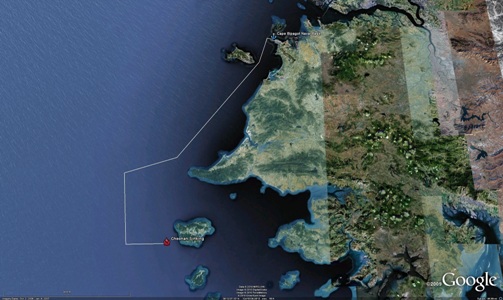
Click image for larger version
You can click here to see satellite imagrey of all the DPRK’s south-western naval facilities, including Bipagot.
Also according to the same story in the Choson Ilbo:
The submarine class was unknown until now. The 130-ton sub ranks between the shark (325 tons) and a Yugo class (85 tons). Air Force Lt. Gen. Hwang Won-dong, the chief of the intelligence analysis team, said, the sub “is similar to the shark-class submarine and was built recently for export, equipped with night-vision equipment and other high-tech gadgets, as well as a unique structure to enhance its stealth capabilities.” Intelligence experts say the sub is the same as the three “Ghadir” class midget submarines the North exported to Iran.
Planeman has some terrific information on the sub type. Check out these pictures from Bluffer’s Guide to Iranian Naval Power: Sub outside, Sub interior.
According to his web page:
Dimensions: L 29m, W 2.75m
Displacement : 120 tons dived
Crew: ?
Endurance: ?
Speed (est): 11kts surfaced, 8kts submerged
Powerplant: Diesel-electric
Armament: 2 x 533mm (21”) torpedo tubes with 2 torpedoes, Skhval rocket torpedoes or ~4 mines. Possibly submarine launched anti-ship missiles but unsubstantiated.
Of North Korean design, the IS-120 Ghadir (Qadir) submarine closely resembles the North Korean “P-4 Class”.
Some models of the Ghadir appear to have conventional cruciform tail fins with conventional propeller instead of the North Korean sub’s unconventional control plane arrangement and co-axel twin propeller. Photos of a production boat however show the unusual under-tail hydroplane position as per the North Korean boats. The coaxil twin props of the P-4 is replaced by a single skewed skrew in the usual place, plus a small ducted skrew mounted above, possible steerable. The exact reasoning for the two propellers is not clear but it is likely that the smaller one is intended for slow/quite running and counter-drift. Its mast and unusual snorkel (which folds backwards into the hull -casing when not in use) is almost identical however. It is possible that there are several iterations of boat with varying tail arrangements and snort-mast stowage (some appear to remain above the deck when folded).
Another charactristic which has yet to be explained is a small container mounted externally on the forward deck just ahead of the sail. This resembles an oil drum. One guess might be compressed gas.
Estimates of the size of this submarine vary greatly but video evidence confirms that there’s barely enough room to stand up in the hull.
UPDATE 15: More media (H/T NKnews.org)
North Korea threatens war in English-language radio broadcast: Audio clip on YouTube.
Clinton Condemns Attack on South Korean Ship
New York Times
Mark Landler
5/21/2010
U.N. Command to probe whether N. Korea violated armistice
Yonhap
Kim Deok-hyun
5/21/2010
Int’l Experts Agree on Cheonan Findings
Choson Ilbo
5/21/2010
How Did N.Korea Sink the Cheonan?
Choson Ilbo
5/21/2010
UPDATE 14: (5/20/2010) Today the South Korean government officially accused the DPRK of intentionally sinking the Cheonan with a torpedo from a submarine. Here are a number of stories and documents:
Seoul vows retaliation after confirming N.K. torpedo sank warship
Yonhap
Kim Deok-hyun
5/20/2010
Irrefutable Evidence Implicates N.Korea, Says Lee
Choson Ilbo
5/20/2010
Cheonan Sinking: Photographic Evidence
Daily NK
5/20/2010
Pentagon won’t say ship sinking is an act of war
AP via Washington Post
Anne Flaherty and Matthew Lee
5/20/2010
The BBC offers a PDF of the findings of the investigatory panel. It is available in PDF here.
What’s going on in Pyongyang
Korea Times
Andrei Lankov
5/20/2010
UPDATE 13: South Korea to formally accuse the DPRK. According to the Washington Post:
South Korea concluded that North Korea was responsible for the attack after investigators from Australia, Britain, Sweden and the United States pieced together portions of the ship at the port of Pyeongtaek, 40 miles southwest of Seoul. The Cheonan sank on March 26 after an explosion rocked the 1,200-ton vessel as it sailed on the Yellow Sea off South Korea’s west coast.
The officials, who spoke on the condition of anonymity because South Korea has yet to disclose the findings of the investigation, said subsequent analysis determined that the torpedo was identical to a North Korean torpedo that South Korea had obtained.
Of the countries aiding South Korea in its inquiry, officials said that Sweden had been the most reluctant to go along with the findings but that when the evidence was amassed, it too agreed that North Korea was to blame. A spokesman for the Swedish Embassy declined to comment.
…
China has called on both parties to remain calm, but its fence-sitting risks damaging its ties with South Korea, East Asian officials said. “China wants to be a wise giant treating all parties the same,” said a senior diplomat. “But somebody committed murder here. This is ridiculous. This is a barometer for China. We are watching how they respond.”
To that end, South Korea will request that the U.N. Security Council take up the issue in an effort to tighten sanctions on North Korea, the officials said. The United States has indicated it would support such an action, U.S. officials said. President Obama and Lee spoke via telephone on Monday, according to the White House. Lee briefed Obama on the probe, the White House said, and the two “committed to follow the facts of the investigation wherever they lead.”
The Obama administration is also leaning toward relisting North Korea as a sponsor of terrorism, a move that would open the door for even more sanctions that could strike at the heart of North Korea’s economy.
…
Japanese Foreign Minister Katsuya Okada told his South Korean counterpart on Monday that Japan would also support taking the issue to the Security Council, the Japanese news media reported Tuesday.
It is unclear whether Beijing would support taking the issue to the Security Council; a senior Chinese official said China would first need proof that North Korea launched the attack.
Analysts said China would be reluctant to take strong measures against North Korea because its main interest is to keep the country intact. North Korea’s collapse would create hundreds of thousands of refugees and probably lead to the emergence of a Western-leaning united Korea on China’s border.
Also of interest….North-East Asia Matters translates a Choson ilbo piece which reports on the importance of some recovered torpedo fragments. According to the report, ” the joint investigation team reportedly was able to retrieve a pair of torpedo propellers in relatively good shape last week in the mud near the location where the Cheonan went down. After comparing the serial number imprinted on the retrieved propellers to a known North Korean sample, the investigation team reportedly found the font and the imprinting style used in the serial number of the retrieved propeller to be a match to the North Korean sample. Read more here.
More updates via NKnews.org:
1. Choson Ilbo on the torpedo serial numbers.
2. S. Korea briefs envoys of China, Russia, Japan on warship sinking
Read the full article here:
South Korea to officially blame North Korea for March torpedo attack on warship
Washington Post
John Pomfret and Blaine Harden
5/19/2010
UPDATE 12: South Korean Ministries asked to stop DPRK aid.
UPDATE 11: South Korea freezes spending on the DPRK.
UPDATE 10: Bermudez speculates on the DPRK’s submarines.
UPDATE 9: South Korea is examining DPRK trade and investment.
UPDATE 8: Here are the DPRK’s naval bases in the area where the Cheonan sank.
UPDATE 7: Seoul considers how it can respond should the DPRK be behind the sinking of the Cheonan. It considers resuming broadcasts across the DMZ, reducing imports from the DPRK, and refraining from giving the DPRK a free feed of the World Cup.
UPDATE 6: According to the New York Times explosive residue has been detected on the Cheonan:
“It is true that traces of RDX, a chemical substance used in making torpedoes, have been found,” Defense Minister Kim Tae-young said Monday, referring to a component common to many military explosives. He said that there was “a high possibility” that a torpedo was the cause of the explosion, but that it was also too soon to conclude definitively that it was the cause.
The material was found on the ship’s smokestack and in samples of sand from the site of the sinking, said Rear Adm. Moon Byung-ok, a spokesman for the investigation team. He noted that RDX is also used in making mines.
UPDATE 5: Evan Ramstad writes in the Wall Street Journal how this event could influence the South Korean elections:
As South Korea gets closer to understanding what happened to a naval ship that sank near the maritime border with North Korea last month, the incident is shaping up to be a major influence on a legislative election in June that will be the political event of the year here.
The sinking of the Cheonan patrol ship on March 26 is already the most difficult challenge President Lee Myung-bak has faced since he took office in early 2008. It led to the death of 46 South Korean sailors—the most in a military incident here since the 1980s. And it raised suspicions of North Korean involvement, because it occurred near the inter-Korean maritime border where the South’s navy sent a North Korean vessel back in flames after a skirmish last November.
It also happened as South Korea nears the biennial legislative election on June 2, a vote that comes near the halfway point of Mr. Lee’s five-year tenure and, until the Cheonan incident, appeared likely to be a referendum on his policies and handling of the economic crisis.
“Generally speaking, people have a fairly high level of satisfaction with Lee government, especially over the economy,” says Kang Won-taek, a political scientist at Soongsil University in Seoul. “But people tend to use this election, like the U.S. mid-term election, to send a warning signal against the incumbent government.”
Now, the Cheonan sinking has added a new element. Politicians from Mr. Lee’s ruling conservative Grand National Party and a related faction are staking out a hard line in case North Korea is involved. The leader of a minority conservative party has already called for a military strike.
Meanwhile, opposition politicians, in progressive and nationalist parties, are using the incident to criticize Mr. Lee’s administration, with some seeking the resignation of top military officials.
North Korea stepped into the fray this weekend when its state-run news agency on Saturday relayed a commentary from an unidentified military source that blamed South Korea for the sinking and said Mr. Lee’s government was trying to use it against the North. However, the statement did not explicitly deny North Korean involvement in the sinking.
Last week, a salvage crew raised the stern of the ship from 37 metersof water and investigators found the bodies of 36 sailors inside. The stern sank first, while the bow floated for several hours as 58 sailors clung to it and were rescued.
Mr. Lee and top defense officials have said they won’t be able to determine what caused the sinking until the ship is fully recovered. Another salvage crew will begin lifting the bow, which settled in about 21 meters of water, as soon as Monday.
Survivors say the Cheonan was rocked by an external explosion. A preliminary examination of the stern confirmed that assessment, the military’s chief investigator said Friday, but he added that it will take more time to know whether it was struck by a torpedo or a mine.
If North Korea is found to be involved, Mr. Lee and his party may get a boost in what Mr. Kang called a “rally around the flag effect.” The political scientist added, “At the same time, the Cheonan case shows some poor performance of the incumbent government in military affairs and will lead to some discussion of political accountability.”
If North Korea is found to have caused the sinking, Mr. Lee will face a difficult decision over how to respond. Mr. Lee hasn’t publicly discussed his options, but analysts say they include economic penalties like cutting off more trade with Pyongyang, a return to the use of radio broadcasts to send messages to North Koreans and a variety of military strikes.
On Sunday, South Korean foreign minister Yu Myung-hwan told KBS, a South Korean TV network, that the country will likely first ask the United Nations Security Council to become involved in imposing a penalty if North Korea caused the sinking.
Much of the North Korean commentary released Saturday on the sinking was devoted to its effect on South Korean politics. North Korea’s authoritarian government has for years favored nationalist politicians in the South and has heaped criticism on Mr. Lee since shortly after he took office.
“If public opinion is built to claim that the accident occurred due to ‘an internal factor’ and its cause is not properly clarified, the group of traitors will be held directly responsible for it and, accordingly, will not be able to escape a heavy defeat in the forthcoming ‘June 2 local elections’,” the commentary said.
The language bore the assumption—which is standard in North Korea—that South Korea is actually a wayward part of a country that Pyongyang should run, is governed by traitors to its regime and conducts unfair elections. The commentary went on: “This will lead to the split of the conservative camp including the ‘Grand National Party’ and the weakening of its ruling power, throwing the group into an inescapable predicament.”
UPDATE 4: The Cheonan has been recovered and signs point to an external explosion (torpedo or mine). According to Reuters (via MSNBC):
The likelihood North Korea sank a South Korean naval ship near their disputed border rose when Seoul said on Friday an external explosion probably caused the ship to split in two, killing dozens.
South Korea’s defense minister said this month the 1,200-tonne Cheonan may have been hit by a torpedo, immediately putting suspicion on North Korea and stoking concerns that the incident could start a conflict on the long divided peninsula.
“Conclusively, after a visual inspection, there is a higher chance of an outer explosion than an internal one,” Yoon Duk-yong, a top investigation official, told a news conference.
UPDATE 3: Aidan Foster-Carter provides context for the sinking. Read his piece in the Asia Times here.
UPDATE 2: Andrei Lankov offers a rationale for the South Korean government’s handling of the situation. According to the Herald Tribune (via the New York Times):
On the evening of March 26, Cheonan, a 1,200-ton South Korean corvette, was on patrol in coastal waters near the disputed border with North Korea when its stern was suddenly torn away by a powerful explosion.
The warship sank within a few minutes, taking the lives of 46 sailors. The South Korean government initially assumed the warship was attacked by a North Korean submarine and put its military on high alert.
However, the next morning the South Korean government began to work hard to dismiss or at least downplay the probability of a North Korean attack. President Lee Myung-bak and his officials warned against “premature conclusions” and emphasized that there was no definite evidence linking the Cheonan disaster to North Korea.
They might be right: despite occasional bouts of bellicose rhetoric, North Korea is currently in a negotiating mood (that is, seeking to squeeze more money from the outside world). But the evidence points to an external explosion roughly equivalent to that of 180 kilograms of TNT, so a mine or torpedo are the most plausible explanations.
If so, why is the Seoul government dismissing such an option? There are good reasons for this. If North Korean involvement was established, the Seoul government would face a hard choice: it would have to retaliate or be seen as spineless. This is a lose-lose situation for South Korea, since it has no way of “punishing” the North.
Full-scale war is out of the question. The military balance leaves almost no doubt that a war would be won by the South (with some American involvement), but the price of victory would be unacceptably high.
The Seoul metropolitan area, home to half of South Korea’s population, lies within range of a heavy concentration of North Korean artillery. A massive artillery barrage would leave many thousands dead and devastate vital parts of the country. Any advance north across difficult and heavily fortified mountainous terrain would also be very costly — not to mention the costs of postwar reconstruction.
So nothing short of a massive North Korean attack on major population centers in the South would likely be seen by Seoul as sufficient cause for a large-scale military operation.
Limited actions, such as raids against the North Korean naval and military installations, would make the Seoul government look strong in the eyes of voters, but would create many problems for which the same voters would soon start blaming the government.
Plus, such raids are useless. Kim Jong Il and his henchmen would not lose sleep if they learned that a few dozen North Korean sailors or soldiers were killed in a South Korean attack. In the North, even the death of many thousands is politically irrelevant so long as they are not members of Kim’s inner circle. At the same time, such raids would scare investors away from South Korea and damage its financial rating.
Financial sanctions, such as closing the Kaesong industrial park, a joint South-North economic development, or freezing the few remaining exchange projects, might seem attractive at first glance, but in the long run could be counterproductive. Contrary to some assumptions, the Kaesong park and other exchange projects are damaging for Kim Jong Il, since they represent a potentially dangerous contact with the outside world.
Without any means of retaliating, Lee Myung-bak’s administration may have decided to play down the likelihood of North Korea’s involvement or at least portray it as one of several possible explanations.
Whether North Korea was involved or not, the Cheonan affair is a sober reminder that if North Korea did choose to become aggressive again, not much could be done to counter it. Partial operations might be impressive but are inefficient, and large-scale retaliation would likely be quietly blocked by the South Koreans. This is understandable — they’re the ones who live on the front line.
(more…)