Archive for the ‘International Governments’ Category

Chinese trade undermining DPRK information blockade

Thursday, December 16th, 2010

According to the Korea Herald:

Although not so explicitly, the communist North Korea appears to be becoming more aware of capitalist cultures and trends, a change the Kim Jong-il regime has feared the most and tried to prevent for decades.

Not only the social upper crust, but the majority of the general public has seen popular South Korean TV series through copies that flow in from China and is aware of the financial gap between the two divided states, North Korean defectors said during a recent forum in Seoul.

According to the defectors ― among hundreds of others who attempt to abandon their impoverished state and escape to the wealthier South each year ― such changes are causing a headache for the North Korean leader trying to secure internal unity before handing over the regime to his youngest son.

“It is difficult to fend off South Korean products and TV shows from entering the country so as long as China remains to be its main trade partner and financial donor,” said Ju Seong-ha, a North Korean defector who graduated from the North’s top Kim Il-sung University.

“The recent phenomena may result in North Koreans choosing South Korea over their own country when the time comes for them to decide.”

North Korea, which is one of the world’s last remaining totalitarian states and also one of the most secretive nations, keeps its people largely isolated from outside news and strictly forbids them from possessing goods that are not distributed by the ruling Workers’ Party.

But the impoverished state’s heavy dependence on Beijing for food and other commodities is inevitably opening up its people to goods and cultures from capitalist nations, particularly South Korea.

China has emerged as the world’s second largest economy after abandoning Stalinist policies and is one of the largest markets for South Korean pop culture, also widely known as “hallyu.”

Most copies of popular South Korean TV series and news that flow into North Korea are produced in China, which is notorious for illegally making cheap, low-quality copies of copyrighted materials.

A 20-something North Korean who escaped to Seoul last year said he had been “shocked” at the sight of South Korea the first time he saw a soap opera starring the country’s top celebrities.

“We had been told South Korea was an underdeveloped country full of beggars,” the defector said, requesting not to be named for safety reasons. “What I saw were beautiful, trendy people living in a glamorous city.”

“I say 90 percent of North Koreans have seen a South Korean TV series at least once,” he said.

Even security and judiciary officials watch popular South Korean soap operas in secret, another unnamed defector told the Dec. 10 forum in Seoul.

“Because the DVD players are sold at a relatively cheap price in North Korea, many households possess them and share CDs among themselves,” the defector said. “Seeing for themselves how well-off and happy people in the South seem, many people build up admiration for the country.”

The apparent popularity of South Korean culture in North Korea coincides with President Lee Myung-bak’s recently made remarks during his trip to Malaysia.

“No one can possibly stop the changes brewing among the general North Korean public,” the South Korean president had said.

Read the full story here:
Changes brewing in ‘not so isolated’ North
The Korea Herald
Shin Hae-in
12/15/2010

Share

ROK church to light Christmas tree for DPRK near Kaesong

Wednesday, December 15th, 2010


UPDATE: The “tree” was lit December 21.

ORIGINAL POST: South Korea plans to construct a “Christmas tree” on a hilltop tower across the river from Jogang-ri, in Kaesong (37.752445°, 126.593120°).

According to Bloomberg:

South Korea will allow a local church to turn a 30 meter (100 foot) tower at its border with North Korea into a brightly lit Christmas tree as part of “psychological warfare” between the two countries, the JoongAng Ilbo reported.

The tower hasn’t been lit up since 2004, according to the Korean-language newspaper report. North Korea, which suffers from energy shortages and relies on outside handouts to feed its 24 million people, had demanded the tower be demolished, JoongAng said.

Here is a link to the original story in the Joong Ang Ilbo (Korean).

Read the full Bloomberg story here:
South Korean Christmas Tree to Provoke North, JoongAng Says
Bloomberg
Bomi Lim
12/14/2010

Share

DPRK claims waters around Yonphyong Island

Wednesday, December 8th, 2010

Pictured above (Google Earth): The NLL and the DPRK’s alternative maritime border in the West Sea

Evan Ramstad writes in the Wall Street Journal:

North Korea state media on Thursday issued a statement that claimed possession of all waters around South Korea-controlled Yeonpyeong Island, clarifying for the first time that its Nov. 23 attack of the island was motivated by a different view of the inter-Korean maritime boundary in the Yellow Sea than is widely held.

North Korea has said since the attack that it was motivated because shells from an artillery test South Korea conducted on the island that day fell into its waters.

Military officials in South Korea have said that its test-firing that day was routine and was directed into South Korean waters south of the island. South Korea has long understood the maritime boundary to be in several miles north of the island and, as a result, directs its tests southward.

But officials and analysts who have watched North Korea’s evolving statements since Nov. 23 have noticed that Pyongyang didn’t claim that South Korea fired northward, raising questions about just what territory North Korea was claiming.

The new statement carried by Korea Central News Agency wiped out the ambiguity.

“The above-said island is located deep inside the territorial waters of the DPRK side from the maritime demarcation line,” the statement said, using an acronym for North Korea’s full name, the Democratic People’s Republic of Korea.

“If any live shell firing is conducted from there, shells are bound to drop inside the territorial waters of the DPRK side no matter in which direction they are fired because of these geographical features of the island,” the statement added.

North Korea has long disputed the inter-Korean maritime border in the Yellow Sea, or West Sea, which was drawn up by the United Nations when hostilities in the Korean War ended with a ceasefire in 1953.

In recent years, North Korea has grown more vocal and belligerent in its claim of a different maritime border, one that runs many miles to the south of the one drawn by the U.N. and known in South Korea as the Northern Limit Line, or NLL.

In North Korea’s claim, five islands that have long been controlled by South Korea lie within its waters. However, North Korea has not claimed possession of the islands.

As it exists, the U.N.-drawn border forces military and fishing vessels from the North Korean city of Haeju and other points along its southern coast to make a coastline-hugging journey westward for 30 miles or more before they can reach open water.

Here is the DPRK’s statement in full from the new KCNA page (for those who do not want to visit the new page):

Pyongyang, December 9 (KCNA) — The Secretariat of the Committee for the Peaceful Reunification of Korea released a detailed report on Wednesday laying bare the truth and nature of the Yonphyong Island shelling incident in the West Sea of Korea. It clarified internally and externally who was the provocateur and who was to wholly blame for it.

The report said:

The Yonphyong Island covers just 6.8 square km and it has nearly 18 km in circumference. But this small island has been fortified as such core military stronghold that the puppet forces call it “area for top class guard.” A brigade of the puppet marine corps and “K-9” self-propelled artillery pieces of more than one company are deployed on the island and it has a dense network of detection means and intelligence-gathering and communication facilities.

It was waters not far from Yonphyong archipelago that patrol ship of the puppet forces “Cheonan” sank in March this year. The puppet warmongers have persistently escalated the tension in this area, crying out for seeking “revenge,” and at last went the lengths of perpetrating direct shelling under the pretext of a military exercise.

The motive of the incident and the background against which it occurred make it clearer that it was a deliberate provocation of the puppet forces.

The above-said island is located deep inside the territorial waters of the DPRK side from the maritime demarcation line. If any live shell firing is conducted from there, shells are bound to drop inside the territorial waters of the DPRK side no matter in which direction they are fired because of these geographical features of the island.

The puppet warmongers fired as many as thousands of shells into the territorial waters of the DPRK side after deliberately fixing those waters as a target of sighting firing. This reckless act was obviously a deliberate provocation to prompt the DPRK to take a military counter-action.

No matter what rhetoric the south Korean conservative group may use in a bid to shift the responsibility for the incident onto the DPRK like a thief crying “Stop the thief!” it cannot hide the truth.

The above-said incident was an inevitable product of the puppet conservative group′s vicious moves to escalate the confrontation with fellow countrymen and ignite a war.

The inter-Korean dialogues and visits which had been brisk since the adoption of the June 15 joint declaration were totally suspended and an atmosphere of reconciliation, unity and reunification rapidly got cool due to the puppet group.

The conservative authorities of south Korea have persistently mocked at the DPRK′s sincere efforts to improve the inter-Korean relations and turned away their faces from them.

Since the puppet warmongers′ seizure of power, they have staged an increasing number of exercises for a war of aggression against the DPRK and they assumed more dangerous nature.

They have staged more frequent military exercises in waters off Yonphyong Island, in particular.

When the puppet group′s all policies to escalate the confrontation with the DPRK and war moves against it proved totally bankrupt in face of the domestic and foreign public′s rebuff and condemnation, it orchestrated such hideous shocking incident as the Yonphyong Island shelling incident as its last-ditch effort.

While the conservative group of south Korea was the direct provocateur of the said incident, the U.S. was a wire-puller and chieftain of the incident as it egged the puppet warmongers onto the military provocation.

The above-said incident was triggered off because of the illegal “northern limit line” fixed by the U.S. in the West Sea of Korea.

Military clashes and disputes have not ceased in waters of the West Sea of Korea since the cease-fire due to this bogus line having no ground in the light of international law as it was unilaterally drawn by Clark, the then UN forces commander on August 30, 1953.

The U.S. sidestepped the DPRK′s fair and aboveboard proposal for fixing a military boundary line in the West Sea. And it instigated the puppet conservative group to totally scrap the June 15 joint declaration and the October 4 declaration, claiming that the setting up of a special zone for peace and cooperation in the West Sea would bring the “northern limit line” to naught.

The U.S. in league with the puppet warmongers have run the whole gamut of schemes to make the “northern limit line” an established fact at any cost.

Not only the warship “Cheonan” case in March but the recent Yonphyong Island shelling incident were cooked up according to this sinister scenario of the U.S. and under its backstage manipulation.

Since the above-said shelling incident the U.S. has massively supplied the latest weapons to the puppet group while zealously egging it onto carry out what it called “retaliation plan.” This fact goes to clearly prove that the U.S. was the arch criminal who orchestrated and wire-pulled the incident behind the scene.

Additional Information:
1. I have been keeping up with the Yonpyong shelling saga here.

2. Google Earth/Maps now has high resolution imagery of Yongpyong and the DPRK peninsula where the attack originated.  Check it out at 37°39’44.04″N, 125°42’9.71″E and 37°46’21.28″N, 125°36’16.97″E

3. Sorry, Josh, no “Brigandish” this time.  Josh Stanton (One Free Korea) gets credit for inventing the KCNA drinking game.  Every time KCNA mentions “Brandish” behavior, you take a drink.  For those who like to imbibe more frequently, here is a link to every single KCNA story that mentions “Briganish”–all 738 of them. This is courtesy of the indispensable STALIN search engine.

Read the full Wall Street Journal story here:
North Korea Claims Waters Around Shelled Island
Wall Street Journal
Evan Ramstad
12/8/2010

Share

Iranian defector ‘saw North Korean technicians’ in Tehran

Tuesday, December 7th, 2010

Image via Arms Control Wonk

According to AFP (via Zawya):

A former Iranian diplomat who defected to the West said on Tuesday that he had regularly seen North Korean technicians at Tehran airport between 2002 and 2007.

Western intelligence agencies suspect North Korea may be helping Iran to develop long-range ballistic missiles and nuclear weapons technology. Tehran insists it simply wants to develop civilian nuclear power.

Mohammed Reza Heydari, Iran’s former consul in Norway, sought political asylum in December amid protests in his homeland in the aftermath of Iranian President Mahmoud Ahmadinejad’s disputed re-election.

On Tuesday he told reporters at a meeting organised by the Paris-based think tank the Centre of Political and Foreign Affairs that he had seen North Koreans when he had been a foreign ministry official at Tehran airport.

“I saw them with my own eyes,” he said. “They were treated in a very discreet manner, in order to pass through without being seen.”

Heydari said he was “100 percent certain” that these contacts continue and alleged he had spoken to members of Iran’s hardline Revolutionary Guards Corps who confirmed that Iran plans to build a bomb.

“I was able to confirm that Iran has two goals — to develop the range of its ground-to-ground missiles and to obtain a nuclear weapon with the help of North Korea,” he said.

Since defecting, Heydari has sought to convince more Iranian diplomats to abandon the regime and form an opposition movement in exile.

Describing his view of the political scene back in Tehran, Heydari said a group of conservatives around the speaker of parliament Ali Larijani were increasingly opposed to a more religious faction backing Ahmadinejad.

According to the defector, while Larijani’s group wants to govern Iran, Ahmadinejad’s supporters have a more “global agenda” and are awaiting the return of the “hidden imam”.

Some Shiite Muslims believe that the 12th Imam, known as the Mahdi, who disappeared in the year 874, will return to bring justice to the world.

Heydari said Ahmadinejad’s faction is pushing Iran’s nuclear agenda. “According to our information, this inner circle believes that with only two bombs they can ensure the survival of the country and of Islam,” he said.

The usual defector caveats apply.  According to Bob Baer, Iran’s nuclear program has been an intelligence black hole.  Of course so was the DPRK’s—and they managed to surprise everyone by bulding a LEU facility right in the middle of Yongbyon.  There is no shortage of evidence that the two countries are working together on a number of political, economic, and military initiatives, however, so it is entirely possible that this Iranian defector is telling the truth.

As an aside, many Americans are nervous about visiting both Iran and the DPRK, but having visited nearly 45 countries, I can tell you that Iran and the DPRK are in the top three for me.  Of course, I live on the beach and prefer to “rough it” on vacation.

Read the full story here:
Iranian defector ‘saw North Korean technicians’ in Tehran
AFP (via Zawya)
12/7/2010

Share

No yachts for you (UPDATE)

Tuesday, December 7th, 2010

UPDATE (12/7/2010): Austrian convicted for yacht sale to DPRK.  According to Reuters:

A Vienna court has fined an Austrian man 3.3 million euros ($4.4 million) over the sale of luxury goods, including yachts, believed destined for North Korean leader Kim Jong-Il, a court official said Tuesday.

The businessman, who was not named, was also handed a nine-month suspended sentence late Monday for the dealings which violate an international trade embargo against Kim’s impoverished state, court official Christian Gneist said.

“The amount was 3.3 million euros because this was the amount he received as payment,” Gneist said. The trade violated U.N. sanctions against North Korea imposed over its nuclear bomb tests.

Working with a North Korean intermediary close to Kim, the Viennese man tried to procure two yachts and received payment for them, Gneist said.

Prosecutors also accused him of lining up eight top-end Mercedes-Benz S-Class cars and musical instruments including a Steinway grand piano for Pyongyang, Austrian daily Kurier reported.

The Austrian man pleaded guilty and told the court he had not realized what he was getting into, Kurier said.

“It doesn’t have anything to do with atomic bombs. I am not interested in politics. I am a businessman,” the paper quoted him as telling the court.

Italian financial police helped to break up the sale of the yachts last year, which prosecutors believed to be a birthday present for Kim. The Austrian bought them from the Azimut-Benetti boatyard, one of the world’s leading yachtmakers. Azimut-Benetti was not accused of wrongdoing and had cooperated fully in the investigation, Italian police have said.

The sale of luxury goods to North Korea is banned under a U.N. resolution in retaliation for the country’s nuclear testing program. The U.N. Security Council unanimously voted to widen its sanctions after North Korea’s nuclear test in May last year.

ORIGINAL POST (7/23/2009): According to Reuters (via Washington Post), UN sanctions have prevented the sale of two Italian yachts to the DPRK.  To top it off, the DPRK purchaser lost the deposit!  According to the article:

Financial police in the city of Lucca in central Italy said the vessels were worth nearly 13 million euros ($18 million) and had been purchased by an Austrian intermediary from the Azimut-Benetti boatyard, one of the world’s leading yachtmakers.

The Austrian intermediary then ceded the contract to a Chinese company, which in turn paid a Hong Kong business to take delivery of the vessels, police said.

“The difficulty was tracing it back to a violation of the sanctions,” said Colonel Antonio Leone, the Finance Police’s commander in Lucca. Asked if Kim was the intended final recipient of the vessels, he said: “It is an irrefutable fact.”

“There has been a thorough investigation, partly in Austria, backed up by confessions and investigative breakthroughs.”

The yachts were initially confiscated by Italy’s Economic Development Ministry but have since been returned to the boatyard, which has been allowed to keep the deposit.

Azimut-Benetti is not accused of wrongdoing and has cooperated fully in the investigation, police said.

The sale of luxury goods to North Korea is banned under a U.N. resolution in retaliation for the country’s nuclear testing program. The U.N. Security Council unanimously voted to widen its sanctions after North Korea’s May 25 nuclear test.

Given the complex chain of front companies involved in carrying out this transaction, the application of the UNSC resolution is a great illustration of what Haggard and Noland call “whac a mole“.  The North Koreans will now attempt to reconstitute their trade and proliferation networks using new front companies.  According to Haggard and Noland:

As a small country dependent on foreign trade and investment, North Korea should be highly vulnerable to external economic pressure. In June 2009, following North Korea’s second nuclear test, the UN Security Council passed Resolution 1874, broadening existing economic sanctions and tightening their enforcement. However, an unintended consequence of the nuclear crisis has been to push North Korea into closer economic relations with China and other trading partners that show little interest in cooperating with international efforts to pressure North Korea, let alone in supporting sanctions. North Korea appears to have rearranged its external economic relations to reduce any impact that traditional sanctions could have.

Given the extremely high priority the North Korean regime places on its military capacity, it is unlikely that the pressure the world can bring to bear on North Korea will be sufficient to induce the country to surrender its nuclear weapons. The promise of lifting existing sanctions may provide one incentive for a successor government to reassess the country’s military and diplomatic positions, but sanctions alone are unlikely to have a strong effect in the short run. Yet the United States and other countries can still exercise some leverage if they aggressively pursue North Korea’s international financial intermediaries as they have done at times in the past.

Read Haggard’s and Noland’s complete analysis here.

Read the full stories here:
Italy blocks sale of yachts to North Korea’s Kim
Reuters (via Washington Post)
7/23/2009

Sanctioning North Korea: The Political Economy of Denuclearization and Proliferation
Peterson Institute Working Paper 09-4
Stephan Haggard and Marcus Noland

Share

Pyongyang Information Center (PIC)

Monday, December 6th, 2010

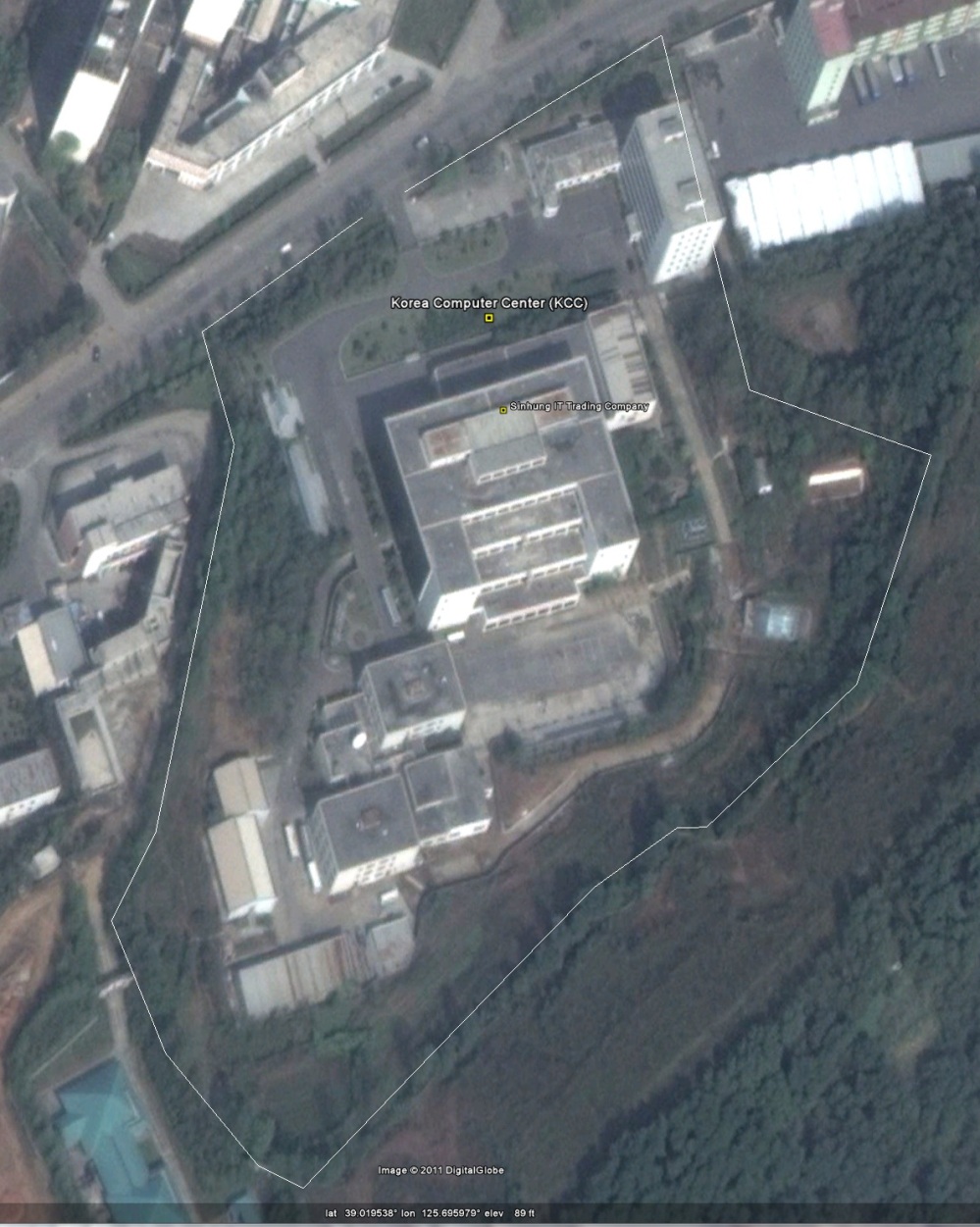
Pictured Above (Google Earth): Pyongyang Information Center and Annex

* AKA Pyongyang Informatics Center

Choi Sung, Professor of computer science at Namseoul University, writes in the IT Times:

I have been writing about North Korea’s IT industry since the start of this year. In this installment, I would like to introduce North Korea’s major information and communications institution. If the Choson Computer Centre (KCC) is called the centerpiece of North Korea’s IT R&D, Pyongyang Information Centre (PIC) is the mecca of their software development. The PIC, founded on July 15, 1986, was jointly funded by the United Nations Development Programme (UNDP) and Jochongnyeon (the pro-Pyongyang federation of Korean residents in Japan). It is situated in Kyong-Heung dong near the Botong River in Pyongyang.

The PIC was created as the Pyongyang Program Development Company and changed its name to Pyongyang Electronic Calculator Operator in October of 1988 and then again to Pyongyang Information Centre (PIC) in July of 1991. As of now, the best and the brightest of North Korea’s IT talent is developing various kinds of programs and devices at the PIC: nearly 300 IT professionals, who graduated from the North’s most prestigious universities such as Kim Il-sung University, Kim Chaek University of Technology and Pyongyang University of Science and Technology (PUST), are on the payroll of the PIC.

On the overseas front, the PIC has its branches in China, Japan and Singapore, where PIC IT experts are working on software development, and has teamed up with foreign companies to jointly develop software programs and expedite technology transfers. The PIC, North Korea’s major software developer, has been at the vanguard of these following areas: language information processing, machinery translation, document editing, global IMEs (Input Message Editor), computer-aided design (CAD), networks, database systems, fonts, multimedia, dynamic images, etc. For instance, the PIC’s database development taskforce consists of about 40 IT experts, who are all working on the development of information management systems for production lines, companies and other institutions. The PIC’s publishing group has been engaged in various R&D projects from the development of Chang-Deok, a PC word processor, to DTP (desk top publishing) systems for Mac computers. Last but not least, the PIC’s application software group is keen on CAD, virtual reality and the development of project management devices. The PIC has been developing a plethora of software products: embedded software, CAD, image processing, Korean-language information processing and systems, network management systems, multimedia dynamic images, etc. The PIC’s 3D CAD has been widely employed by North Korean and foreign architectural design companies and more sophisticated versions of it are coming out. What’s more, the PIC is ramping up its joint R&D efforts with overseas IT developers with a focus on the development of diverse image processing programs. Korean-language information processing and systems are about developing the technologies for character recognition, voice recognition, natural language processing and primary retrieval while the development of network management systems includes fire walls, security solutions, encryption, e-commerce, IC cards, instant messenger programs, mobile game programs, etc. They are also working on the development of multimedia and dynamic images: technologies for producing 3D materials, 2D cartoon production and the technology for adding accompaniments to images are being developed. The PIC’s font development team has developed 300 Korean fonts and a myriad of calligraphic styles for imported mobile phones and dot fonts for PDAs.

The PIC has thus far scaled up its IT exchanges with overseas information and technology companies as well as R&D institutions. A case in point is the North-South joint venture, HANA Program Center, which is located in Dandong-si in Liaoning, China and was jointly invested in May of 2001 by the PIC and North-South HANA Biz, a subsidiary of South Korea’s Dasan Network. Another showpiece of the PIC’s effort for joint R&D is the software development for fonts and Chinese character recognition in collaboration with Soltworks (an e-publishing software developer). On top of that, the PIC’s IT exchanges with overseas institutions have been on the rise.

As such, inter-Korean cooperation projects will serve as the driving force behind the PIC’s IT exchanges with South Korea. To that end, non-military sanctions imposed on Pyongyang should be eased, such as the Wassenaar Arrangement (a multilateral export control regime (MECR) with 40 participating states) should be eased to move US – North Korea relations forward and the US’s EAR (Export Administration Regulation) on the North should be scaled back. Above all, IT-initiated unification of the two Koreas should be preceded by pragmatic dialogues with the North and North Korea’s efforts for reaching out to other nations. As of now, the North needs to draw up a future blueprint to embark on phased cooperation with the S. Korean government and companies in a bid to open its doors to the international community.

UPDATE from a reader who has spent some time there:

[T]hey are an interesting institution that not everyone has a chance to see from the inside. What was interesting is that they really work on software for foreign markets (i.e. mobile software for well known international cell network providers). In addition to that they have an impressive library of books on all topics of software development which was up-to-date at the time I visited.

In contrast to the other institutions they immediately showed commercial accomplishments instead of where the leaders have walked. Employees have access to a gym too. A place out of place in Pyongyang. What I found interesting in the article is that the mentioned developments match some of those the KCC presents in their building. The PIC made much more an impression of a service unit for foreign customers than for the country itself. However, they are training hardware specialists for the infrastructure there.

Read the full story here:
North Korea’s IT Application Software Development Center – Pyongyang Information Centre (PIC)
IT Times
Choi Sung
12/6/2010

Share

DPRK comments at the International Conference of Asian Political Parties in Phnom Penh

Monday, December 6th, 2010

According to the Daily NK:

In yet another hint as to Kim Jong Eun’s true status, Secretary of the International Department of the Chosun Workers’ Party Kim Young Il pointed to the beginning of the leadership of the successor at a recent conference in Cambodia.

Alongside politicians from 31 Asian states including South Korea, Kim was attending the 6th International Conference of Asian Political Parties in Phnom Penh on December 2nd as the head of the Chosun Workers’ Party delegation. There, according to Rodong Shinmun, Kim used his speech to explain, “At the Workers’ Party Delegates Conference, we appointed respected Comrade General Kim Jong Eun to Vice Chairman of the Central Military Commission of the Party.”

Kim also made several further mentions of the results of the Delegates’ Conference. Speaking of Kim Jong Il, he said “Our great leader, Comrade Kim Jong Il continues as General Secretary of the Chosun Workers’ Party…”, but by using the most honorary of terms like “respected”, he appeared also to emphasize the fact that the era of Kim Jong Eun has begun.

Chosun Central News Agency also reported the details of Kim’s speech on December 4th, emphasizing the words, “Every member of the Party and the people, with the great pride and self-respect of having a man of unsurpassed greatness at the highest level of the revolution, celebrated the 65th anniversary of the founding of the Chosun Workers’ Party splendidly last October; a great political festival to be spoken of as a special event in our people’s history.”

Given the context of the Korean used, it appears that the “man of unsurpassed greatness” refers to Kim Jong Eun.

Also, Kim reportedly added, “The nation’s economic power is being strengthened by the creation of Chosun-style iron, textiles and fertilizer, while we have seized control of the foundations of CNC technology; the most advanced CNC-equipped factories are being built constantly.”

Synthesizing these reports coming from Rodong Shinmun and Chosun Central News Agency and based on the fact that a major Party figure participating in an international conference should talk of Kim Jong Il and Kim Jong Eun in the same breath suggests the formalization of the Kim Jong Eun succession to power

Especially, Kim Young Il mentioning CNC, which the North Korean authorities are promoting as an amorphous “achievement” of the successor is seen in some quarters as tantamount to an announcement that Kim Jong Eun’s leadership has began. Recently, North Korea has allegedly been encouraging the expansion of CNC technology into most industrial fields.

Kim Yeon Su, a professor at National Defense University in Seoul, explained to The Daily NK, “This is to proclaim to the outside world that Kim Jong Eun has advanced to the successor’s position and that he has begun to lead.”

Professor Kim commented, “During the South Korea-U.S. joint military exercises in the West Sea (November 30th~December 1st), Kim Jong Il went on an on-site inspection without Kim Jong Eun. This is a very exceptional incident and an expression of trust in Kim Jong Eun and confidence, suggesting that the Kim Jong Eun succession leadership system is ready.”

Meanwhile, also during his speech, Kim Young Il repeated existing arguments that the shelling of Yeonpyeong Island was based on the right to self-defense, and asserted that responsibility for it lies with South Korea.

Read the full story here:
“A Man of Unsurpassed Greatness”
Daily NK
Kim So Yeol
12/6/2010

Share

Arduous March continues to take toll on DPRK population

Monday, December 6th, 2010

According to the Choson Ilbo:

The demographic graph of a normal country has a pyramid or bell shape. But that of North Korea reportedly has an abnormal gourd-shaped curve. The narrow part in the middle of the curve accounts for the key age group between 20 and 34 of the economically active population in the North. It is believed that is because many of those born in the 1990s in the midst of economic difficulties and food shortages died of malnutrition or diseases when they grow up.

This was revealed on Monday by Hwang Na-mi, a researcher at the Korea Institute for Health and Social Affairs, in the outcome of her analysis of a 2008 census report the North’s Central Statistics Bureau submitted to the UN Population Fund (UNFPA). The North’s demographic graph shows that the “population between 20 and 34 years of age remarkably dwindled compared to teens or those in their 40s,” she said.

Lee Ae-ran, a professor of food, nutrition and cuisine at Kyungin Women’s College, said, “As economic problems worsened in the 1990s, many young North Koreans avoided marriage and childbirth and illegal abortions were rampant. Especially in the late 90s, many children and youths starved to death in urban areas, as well as in rural regions.” She is the first female North Korean defector to obtain a doctoral degree in the South.

The North’s 2008 census was conducted according to international standards with the help of the UNFPA, and thus it is regarded as reliable statistics on the status of North Korean population.

The North conducted its first-ever census in December 1993. But the categories did not conform to international standards, nor were the results consistent.

The North’s infant mortality rate, which is considered a yardstick for gauging a country’s socio-economic level and health, was 19.3 per 1,000 infants younger than 1 year, up 5.2 from 14.1 in 1993. However, some experts speculate that such a rate in the North is not as serious as it has been known so far.

According to the “2010 World Population Report” published by the UNFPA last month, the North’s infant mortality rate is 47 per 1,000, pushing the country to 51st place among 181 countries.

The North’s maternal mortality rate, the rate of mothers who die during pregnancy or childbirth, was 77.2 per 100,000, far up from 54 in 1993. The Stalinist country’s average life expectancy was 69.3 years in 2008, down from 72.7 years in 1993.

Past stories about the DPRK’s 2008 census can be found here, here, here, and here.

The officially published data can be found here.  Summaries can be found here.

Read the full story here:
N.Korea’s Youth Population Dwindles Due to Food Shortage
Choson Ilbo
12/6/2010

Share

KCNA re-launched on DPRK-owned IP address

Monday, December 6th, 2010

UPDATE 4 (12/6/2010): Martyn Williams informs us that the new KCNA web page has undergone a second round of changes:

Also new is the addition of Korean-language articles to the previously-available English and Spanish news.

The front page includes an image, the day’s headlines and links to seven category menus. I had problems with some of the links and the menus when accessed via Firefox, but they function with Internet Explorer.

It still has to be accessed via an ugly all-numeric address but new is a copyright line that states:

Copyright © 2000-2010 by www.star.edu.kp all rights reserved.

This is the first time I’ve seen the name “www.star.edu.kp.” The Star could refer to “Star JV,” the DPRK-Thai joint venture that runs the North Korean IP address space. That company is planning to use “www.star.net.kp” for it’s own homepage. But the “edu” typically signifies an educational domain.

At present all KP domain names remain offline. The German server that was responsible for serving the dot-kp top-level domain has been offline for several months.

Because this is the second of an unknown number of versions, I will call this “new KCNA v2.”

Below is a screen shot of the original version:

Photo from Martyn Williams

UPDATE 3 (10/21/2010): Martyn Williams reports that the South Korean government is now blocking the new North Korean web pages.

Internet users in South Korea had been able to access the website earlier this week, but as of Thursday attempts to connect are redirected to a National Police Agency page that warns the site’s content is prohibited in South Korea.

The blocking isn’t a surprise. About 30 Web sites with North Korean connections have been blocked for several years by the South Korean government. They include a similar site operated from Tokyo that, like the new site, carries news in English and Spanish from the official Korea Central News Agency (KCNA).

UPDATE 2: More in the comments.

UPDATE 1: You can see the new KCNA here (hat tip to “PR”).

ORIGINAL POST: Martyn Williams writes in Computer World:

North Korea appears to have made its first full connection to the Internet. The connection, planning for which has been going on for at least nine months, came as the reclusive country prepares to mark the 65th anniversary of the founding of the ruling Workers’ Party of Korea with a massive celebration and military parade.

A Web site for the country’s official news agency [KCNA] was the first to appear from among a group of 1,024 Internet addresses that had been reserved for North Korea but never used. The Korea Central News Agency’s new Web site is different from one operated by a group in Tokyo and carries news and photos a day ahead of the Japanese site.

Other North Korea-linked Web sites and a recently launched Twitter feed operate from locations outside the country or via direct connections to China’s national Internet.

The site appeared as Pyongyang welcomed foreign journalists to the city to observe Sunday’s parade. A press room for the journalists was set up at the Koryo Hotel and reporters were given full access to the Internet. Typically visitors to Pyongyang are only able to make telephone calls or send e-mails through designated computers.

“The North Korean IT guys at the press room really know their stuff. We’re logged on,” wrote Melissa Chan, a correspondent for Al Jazeera, in a Twitter message.

She later appeared live on the channel via a Skype link.

“We have access to Facebook, Twitter and here I am able to Skype with you,” she said.

The access is extraordinary for a country that keeps such tight control on how its citizens communicate.

While Internet access is believed to be available to small group of elite members of the ruling party, the rest of the country is not permitted access to outside sources of news.

Radios are pre-tuned to state broadcasts, magazines and newspapers from other countries are banned and the only Web access available is to a nationwide intranet that doesn’t link to sites outside of the country. As PCs are unusual at home, most access is via terminals in libraries.

The first signs of a greater interest in the Internet came late last year when a batch of Internet addresses, long reserved for North Korea, were assigned to a North Korean-Thai joint venture.

The numeric IP addresses lie at the heart of communication on the Internet. Every computer connected to the network needs its own address so that data can be sent and received by the correct servers and computers. Without them, communication would be impossible.

Frequent monitoring of the addresses by IDG News Service repeatedly failed to turn up any use of them until now.

An analysis of the connection to the news agency Web site shows it is connected to the wider Internet via China Netcom.

It’s impossible to tell if the access given to journalists in Pyongyang marks a turning point in the way the country regulates access to communications, or if it’s simply a courtesy made available to create a good impression among journalists.

The founding anniversary of the Workers’ Party of Korea is a big deal for the country every year, but this year is especially important. Kim Jong Eun, son of leader Kim Jong Il, has just taken his first position within the party, which rules North Korea. His appointment to the party’s Central Committee and the Central Military Commission are first steps towards a likely future position as leader of the country.

I have had a hard time locating the new web page (Google has not scraped it), but I will post it here soon.

The KCNA site run by the Chongryon in Japan is here.  The new version also seems to offer both English and Spanish versions.

Read more here:
North Korea opens up Internet for national anniversary
Computer World
Martyn Williams
10/9/2010

…and Martyn’s personal web page: http://www.northkoreatech.org/

Share

DPRK-PRC trade up 26.7 percent

Friday, December 3rd, 2010

Institute for Far Eastern Studies (IFES)
NK Brief No.10-12-3-2
12/3/2010

North Korean trade with China has jumped 26.7 percent during the first eight months of the year, with the bulk of its imports made up of crude oil, and its largest export being coal. Despite the increasingly severe food shortages in the North, food imports from China were actually down 7.5 percent, while on the other hand, fertilizer imports shot up by 162 percent.

The Korea Trade-Investment Promotion Agency (KOTRA) looked into the Chinese government’s import and export figures and determined that North Korean exports to China during the first eight months of the year were worth 650,000 USD, 20.6% more than during the same period last year, while DPRK imported 1.345 billion USD-worth of goods (30% increase), for trade worth a total of 1.995 billion USD, 26.7 percent more than 2009.

“Mineral fuel and mineral oil” topped the list of North Korean imports (321,000 USD), with crude oil (229,000 USD) and oil (63,000 USD) making up 90.7 percent of imported goods. However, while crude imports were 53 percent more expensive, the amount of oil imported only rose by 2.3 percent; the sharp increase in expenditure was due to climbing international oil prices. The second- and third-largest imports were listed as “nuclear reactor, boiler, and machinery” (127,000 USD) and “electromagnetic machinery, sound and video equipment” (106,000 USD). Other imports included cars and car parts, steel and steel goods, plastic and plastic goods, artificial filament, fertilizer, and grain. A KOTRA official stated that while “nuclear reactor” was listed among the goods imported by the North, there is no way to verify the Chinese statistics.

North Korea’s grain import expenditures increased by five percent, to 34,000 USD, but overall grain imports fell 7.5 percent, to 102,000 tons, due to increased costs. More specifically, rice import expenditures were up 8.4 percent to 16.6 million USD, but the amount of rice imported fell by six percent, to 38,400 tons. Corn expenditures dropped by one percent to 16.3 million USD while the amount imported fell by ten percent, to 62,000 tons. The cost of barley imports grew 190 percent, to 353,000 USD, with the amount of barley brought into the country up 89 percent to 1,011 tons. 277,000 tons of fertilizer were imported, 162 percent more than last year, at a cost of 40 million USD, 85 percent more than 2009. Almost all of the fertilizer was nitrogenous.

North Korea’s exports to China were made up largely of mining and fisheries. Coal topped the list (191,000 USD), although the amount sent across the border was 31 percent less than last year. Iron ore was second, and was not only down by 34 percent, it brought in 134 percent less than 2009, as it was worth only 111 million USD. Textiles and accessories worth 81 million USD, steel worth 64 million USD, and mollusks worth 32 million USD were also sent to China.

Share

An affiliate of 38 North