Archive for the ‘International Governments’ Category

Dennis Rodman’s third trip to DPRK

Thursday, December 19th, 2013

UPDATE 2 (2013-12-26): A couple of the individuals involved in getting Rodman into the DPRK for his second trip (post-Vice) have written an op-ed explaining their motivation. According to the article:

Sometimes private citizens can ease tensions between governments when public officials cannot.

Since we met NBA Hall of Famer Dennis Rodman in May, we have been helping to coordinate his visits to the Democratic People’s Republic of Korea and organize an international basketball tournament sponsored by Irish bookmaker Paddy Power. Seeing as our government has branded the DPRK a “critical” national security threat, we find it reflects badly on Foggy Bottom that the three Americans best acquainted with its supreme leader are a retired NBA star, a mixed martial arts fighter and a tuba-playing human geneticist.

Mr. Rodman constantly reminds those around him to “just do one thing: Do your job.” Now it seems he is picking up some of the slack for the U.S. State Department.

Despite decades-old antagonisms, it was ultimately not confrontation but détente between the capitalist and communist blocs that brought the threat of global nuclear war to an end. Perhaps the most memorable episode of this process was President Richard M. Nixon’s visit to the People’s Republic of China and the period of Ping-Pong Diplomacy that laid the groundwork for it; USA/PRC relations were theretofore nonexistent. As Klaus Mehnert put it, the country “had been closed off so completely that there seemed to be about as many astronauts going to the moon as there were foreign observers getting into China.”

In 1967, presidential candidate Richard Nixon expressed his hope for détente with Peking, writing, “There is no place on this small planet for a billion of its potentially most able people to live in angry isolation.” On Christmas 1970, People’s Daily ran a front-page story with a photograph of Chairman Mao Tsetung and American journalist Edgar Snow standing side by side atop the Tien An Men rostrum; at the top of the page, the day’s Mao quote: “All the peoples of the world, including the American people, are our friends.” While Washington dismissed this gesture given Snow’s sympathy for Mao, in retrospect it seems it was intended as a subtle olive branch.

With spring came a chance meeting between American and Chinese ping-pong players concluding with an exchange of gifts. This simple act of humanity touched off a string of cultural and, later, diplomatic interactions.

Days later, the American team was invited to Peking. President Nixon took the opportunity to announce an easing of sanctions and his hope for normalized bilateral relations and “the ending of the isolation of Mainland China from the world community.”

Henry Kissinger’s secret visit to Peking that summer paved the way for “the Week that Changed the World.” Although Nixon and Mao certainly did not see eye to eye, their shared view that diplomacy is preferable to both isolation and war made normal relations between Washington and Peking possible.

The value of cultural exchanges consists in their power to erode misconceptions. For instance, Dr. Terwilliger spent a month this summer in Pyongyang teaching human evolutionary genetics to a class of very talented Korean undergraduates.

Aside from teaching scientific critical thinking, he took care to present his students with the best side of the American people, to demonstrate that we are a generous and friendly people rather than the “brigandish aggressors” of the familiar caricature. He was both surprised and encouraged by their interest in Mr. Rodman’s February visit.

They noted that hearing Mr. Rodman say nice things about their country made them rethink their stereotypes about Americans, for they had now seen one embracing their leader. Many had even read Mr. Rodman’s autobiography and remarked that they admired his frankness in describing the difficulties he faced in his early life.

Such reactions can only bode well. Hostility is inevitable when the common man on each side sees highlighted only the worst aspects of the other. Mutual understanding is where rapprochement starts.

While the first few timid steps may proceed slowly as trust is built, the example of Ping-Pong Diplomacy demonstrates that if the momentum is sustained it can offer governments new options with which to pursue peace and may even be developed into a full gallop (what the Koreans call “Chollima speed”) toward rapprochement. At the very least, track-two diplomacy can present unique opportunities for engagement between private citizens whose governments remain at odds.

Mr. Rodman would be the first to recognize that he is neither a politician nor a diplomat — and yet, that is precisely what makes him such a promising agent of reconciliation. As a cultural icon, Mr. Rodman has the power to project a relatable human face in a way a government functionary simply cannot: by doing down-to-earth things all people can enjoy.

Our government has repeatedly missed the basket, but at least this time Mr. Rodman is there to pick up the rebound. As he has said, “[Kim Jong Un] loves basketball. … Obama loves basketball. Let’s start there.”

An associate professor at Columbia University in New York City, Joseph D. Terwilliger was a member of Dennis Rodman’s September and December delegations to Pyongyang. John Doldo IV, a Watertown native who has also spent time in North Korea, has been working behind the scenes helping to coordinate many aspects of the project. Both authors worked on a strictly voluntary basis in order to avoid any financial conflict of interest.

UPDATE 1 (2013-12-24): According to NK News, the Irish gambling company Paddy Power has decided to end its sponsorship of Rodman’s trips to the DPRK. According to the article:

Irish betting company Paddy Power has ended its partnership with Dennis Rodman and his “basketball diplomacy” initiative.

“We have been reviewing the partnership on an ongoing basis, and with the benefit of hindsight, we probably got this one wrong,” company spokesman Paddy Power (and son of Paddy Power’s founder, Paddy Power) tells NK News.

“Circumstances have changed quite a lot in North Korea; there has been worldwide scrutiny of the North Korean regime, probably more in the past month than in the past couple of years.

“There has been almost total condemnation of North Korea worldwide, and we’re really responding to that.”

Though they won’t be involved, Rodman’s plan to bring 11 other former NBA players to Pyongyang is still a go, according to Power.

“We have spoken to Rodman’s people,” he says. “The event is apparently still happening, but we just won’t be a part of it.”

“Dennis is very appreciative of Paddy Power’s support up to this point for this historic game of basketball diplomacy taking place on Jan. 8th,” Rodman’s agent Darren Prince told the Associated Press.

Here is an article on the history of Rodman and Paddy Power.

ORIGINAL POST (2013-12-21): Dennis Rodman has made his third trip to the DPRK. Trip one post here. Trip two post here.

The organizer, Michael Spavor, has been tweeting the trip here. Based on his pics, here is the appx itinerary:

1. Arrive at night and drive to hotel (motorcade). 2013-12-19

2. Meeting with sports minister. Poto with sports minister. Meeting room. 2012-12-20

3. Dennis Rodman “leads” training for DPRK team. Game scheduled against an American team in January. Pic 1, Pic 2, Pic 3, Pic 4, Pic 5. 2012-12-20. Here is AP video of the training. Rodman is smoking a cigar.

4. Travel to Koryo Hotel for lunch. 2012-12-20

5. Travel to Korea Federation for the Protection of the Disabled. Pic 1, Pic 2, Pic 3. 2012-12-21

6. Travel to the Recuperation Center and pools at the newly renovated Munsu Water Park. Pic 1, Pic 2, Pic 3, Pic 4, Pic 5, Pic 6, Pic 7, Pic 7, Pic 8, Pic 9. 2012-12-21

7. Travel to Mirim Riding Club. Pic 1, Pic 2, Pic 3, Pic 4, Pic 5, Pic 6. 2012-12-21

Rodman and the group left the DPRK without meeting Kim Jong-un, however, I suspect that he will get together in the upcoming fourth trip slated to take place in January.

Journalists have asked Rodman about current events (Jang song-thaek, Kenneth Bae and human rights) in the DPRK, and he has responded. According to the Telegraph:

“It has nothing to do with me. I mean, whatever his uncle has done, and whoever’s done anything in North Korea, I have no control over that,” Rodman said in Beijing. “I mean, these things have been going on for years and years and years.

“I’m just going over there to do a basketball game and have some fun,” he said.

Ahead of the trip, Seoul-based North Korean human rights activist Shin Dong-hyuk said in an open letter in the Washington Post that Rodman should talk to Kim about human rights abuses in North Korea.

Rodman said it was not his place to talk about such issues.

“People have been saying these things here and there. It doesn’t really matter to me. I’m not a politician. I’m not an ambassador,” he said.

“I’m just going over there to try and do something really cool for a lot of people, play some games and try to get the Korean kids to play,” he said.

“Everything else I have nothing to do with. If it happens that he wants to talk about it then great. If it doesn’t happen I just can’t bring it up because I don’t (want) him to think that I’m over here trying to be an ambassador and trying to use him as being his friend and all of a sudden I’m talking about politics. That’s not going to be that way,” Rodman said.

Rodman is expected to provide North Korea’s national basketball team with four days of training during the trip.

Here is a video interview with Rodman at the Koryo Hotel. Here is much of what he said in the video printed in an article.

He also intends to return to Pyongyang in January with a team of fellow former National Basketball Association stars to hold basketball games on Kim’s birthday.

Share

DPRK insists Jang purge will not lead to economic policy change

Sunday, December 15th, 2013

Following Jang’s purge, there has been speculation about what exactly will happen to economic relations between China and the DPRK and with ongoing efforts to introduce economic reform measures in the DPRK. According to the People’s Daily (China):

The execution of the uncle of Pyongyang’s top leader may temporarily affect some cooperation projects with China, but economic ties between the neighbors will remain stable in the long run, analysts say.

The Democratic People’s Republic of Korea’s official news agency KCNA reported on Friday that Jang Song-thaek, uncle of supreme leader Kim Jong-un, was executed on Thursday for being a traitor.

Jang was in charge of economic affairs and cooperation with China.

“Following Jang’s execution, the DPRK is likely to review cooperation projects with China,” said Gao Haorong, an expert on DPRK studies at the Xinhua Center for World Affairs Studies, a think tank under Xinhua News Agency.

Jang led delegations to China for negotiations on economic projects, including Hwanggumpyong Island, a special economic zone near Dandong in Liaoning province.

Chen Qi, a professor in international affairs at Tsinghua University, said that after Jang’s execution, China and the DPRK may need some time to rebuild connections to continue cooperation on such projects and to further their economic cooperation.

But Wang Junsheng, a researcher in East Asian studies at the Chinese Academy of Social Sciences, said the impact will be short-term and limited.

“Pyongyang needs China to support its economic development, and this offers opportunities for Chinese companies, so both sides want to advance ties,” Wang said.

“Both countries have the will to consolidate their relations, given frequent high-level visits,” he said.

The latest such exchange saw Chinese Assistant Foreign Minister Zhang Kunsheng meet a visiting delegate from the DPRK’s Foreign Ministry on Friday.

At a news briefing on Friday, Chinese Foreign Ministry spokesman Hong Lei said China hopes and believes that economic relations between the two countries will continue to advance.

Hong said it is in line with the interests of both to develop economic ties. China will further promote economic cooperation with the DPRK.

He described Jang’s execution as “an internal affair” of the DPRK.

In response, the DPRK has started sending signals that Jang’s purge will not lead to any surprises. Eric Talmadge writes for the Associated Press:

The execution Friday of Jang, considered to be North Korea’s second most powerful man and a key architect of the country’s economic policies, should not be taken as a sign that the North will change its economic course or its efforts to lure foreign investment, Yun Yong Sok, a senior official in the State Economic Development Committee, said in an interview with The Associated Press in Pyongyang.

“Even though Jang Song Thaek’s group caused great harm to our economy, there will be no change at all in the economic policy of the Democratic People’s Republic of Korea,” Yun said. “It’s just the same as before.”

Jang’s sudden purge and execution for allegedly trying to overthrow the government has raised questions about how solid the North Korean regime is and whether it will be able to stay the course on policies aimed at raising the country’s standard of living.

The North has shown no willingness to abandon its nuclear weapons program to get out from under international trade sanctions. That makes investment or financing from major international organizations difficult if not impossible.

It also means the success of the zones hinges on China, North Korea’s only major ally, and Jang was seen as a crucial conduit between Pyongyang and Beijing, along with being a supporter of China-backed reforms, such as the zones, to revive the North’s moribund economy.

Jang met with top Chinese officials during their visits to Pyongyang, and in 2012 traveled to China as the head of one of the largest North Korean delegations ever to visit the Chinese capital to discuss construction of the special economic zones, which Beijing hopes will ensure North Korea’s stability.

Yun, however, downplayed Jang’s importance in policymaking and said his removal would instead speed progress on the economic front because he was a threat to the unity of the nation. He said Jang’s execution should not scare away Chinese investment, which is crucial to the success of the zones.

“By eliminating the Jang Song Thaek group, the unity and solidarity of our party and people with our respected marshal at the center has become much stronger, our party has become more determined and the will of our soldiers and people to build a prosperous socialist country has been strengthened,” Yun said. “Our State Economic Development Committee welcomes investment and business from any country to take part in the work of developing our new economic zones.”

Yun said local officials have been tasked with drawing up the plans for the zones in their jurisdictions and are likely to formally submit them for approval to his commission within the next few months.

At the same time, rumors from the South Korean media indicate that North Korean businessmen in China are returning home in large numbers. According to Yonhap (2013-12-14):

North Korean businessmen in China have been summoned back to their country in large numbers in connection with the execution of North Korea’s No. 2 man two days ago, sources familiar with the issue said Saturday.

The businessmen worked out of the northeastern Chinese cities of Shenyang and Dandong to facilitate trade between the two countries and attract Chinese investment in North Korea, according to the sources.

The top North Korean official in charge of promoting economic ties with China is believed to have been Jang Song-thaek, the once-powerful uncle of North Korean leader Kim Jong-un.

With Jang’s execution on Thursday, however, North Korea appears to be cracking down on those loyal to him by summoning them back to their country, the sources said.

Jang was executed immediately after a special military tribunal found him guilty of treason, according to the North’s state media.

“Large numbers of North Korean businessmen in Shenyang and Dandong have gone home in a hurry this week,” said one source, who declined to be identified.

“Judging from their numbers and the fact that it was so sudden, it doesn’t appear to be related to the second anniversary of (the death of former North Korean leader) Kim Jong-il on Dec. 17,” the source said, referring to the late father of the current leader.

According to another source, Norea Korea plans to summon all of its officials and staff from China in stages.

“The ostensible reason will be to educate them on the government’s policies, but (in fact), those classified as having connections to Jang Song-thaek will never be able to go abroad again and will be purged,” the source said, also requesting anonymity.

On Chinese report insinuated that Jang’s ouster could affect Chinese investment in the Hyesan Youth Copper Mine. According to Shanghai Metals Market:

 North Korea’s Zhang Chengze [Jang Song-thaek]  event might undermine Wanxiang Group’s 500-million-yuan ($81.6 million) investment in Huishan copper mine [Hyesan Youth Copper Mine], according to a report by the business magazine China Entrepreneur.

Back in 2004, Wanxiang Group’s chairman Lu Guanqiu started investing in Huishan copper mine with a joint venture company Sino-Mining International Investment Co. and added up total investments to 560 million yuan over the years, according to the report.

The mine, said to have a copper reserve largest in Asia and located just 10 kilometers from the China-North Korea border, was put into production in 2011. Yet daily operations met with many political hurdles since, the report said.

Zhang Chengze, North Korea’s young leader Kim Jeong-eun’s uncle and close aid with a pro-China view, was executed by Kim earlier this month.

Both the Rason and Hwanggumphyong Special Economic Zones have been brought to a standstill following Jang’s purge. Leaders from both projects have been called back to Pyongyang.

You can read posts related to Jang’s purge here.

Click to read posts on the Economic Development Zones and the new Law on Economic Development Zones.

Read the full story here:
N Korean Official: Purge Won’t Hurt Economic Policy
Associated Press
Eric Talmadge
2013-12-15

Share

Contract signed for Onsong Economic Development Zone

Friday, December 13th, 2013

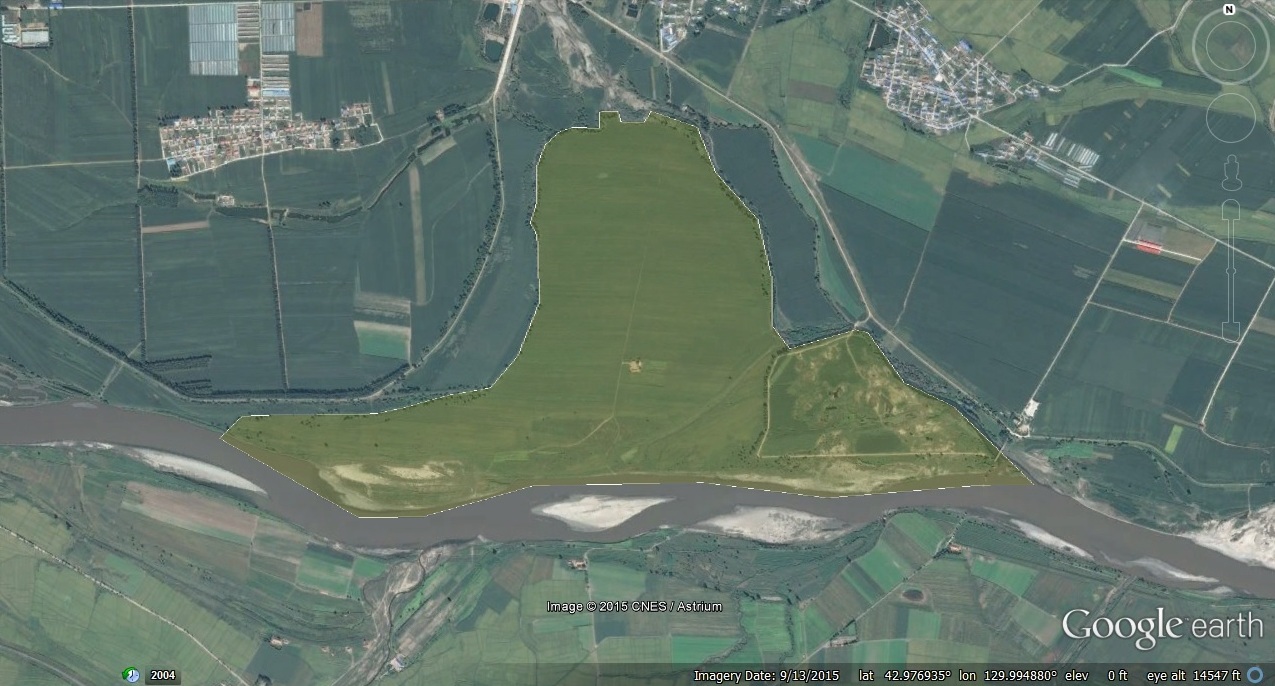
Onsong-SEZ-2015-9-13-web

Pictured above (Google Earth): The approximate location for the North Hamgyong Provincial Onsong Island Tourist Development Zone

According to China’s Global Times:

A contract has been signed between North Korea and a Chinese border city to develop a special economic zone in North Hamkyung Province, one day after North Korea removed Kim Jong-un’s once all-powerful uncle from his post.

North Korea on Monday signed the contract for Onsong Economic Development Zone with Tumen, a Chinese city under the administration of Yanbian Korean Autonomous Prefecture in Northeast China’s Jilin Province, South Korea’s JoongAng Daily reported Thursday.

On Sunday, North Korea dismissed Jang Song-thaek, widely considered the second-most powerful figure in the country, and expelled him from the Workers’ Party of Korea. Jang was accused of “anti-party, counter-revolutionary factional acts” and womanizing.

Considered an economic reformist, Jang led a delegation to China in August last year to discuss the development of two economic zones in Rason City and the Hwanggumpyong and Wihwa islands near the Chinese border.

An official from Tumen said the city government expressed concerns regarding possible postponement of the contract signing due to Jang’s ouster, but North Korea requested they sign the contract as scheduled, according to the daily.

“Jang’s involvement in economic projects had been diminished significantly this year, so his purge would not have much impact on the speed of economic reform in North Korea,” Kim Kyu-chol, head of non-government Forum for Inter-Korean Relations, a Seoul-based group monitoring inter-Korean business relations, told the Global Times on Thursday. “Actually  economic reform will speed up next year as North Korea will focus on the economy next year, the third of Kim Jong-un’s rule.”

North Korea was in the process of forming the new National Committee for Economic Development earlier this year, which technocrats who had prior experience with the nation’s former economic development bureau, will have joined, Kim Kyu-chol said.

North Korea also reached an agreement with China on Sunday over a 380-kilometer high-speed railway to connect Sinuiju, the city across the border from Dandong in Liaoning Province, through to Pyongyang and Kaesong, South Korean Democratic Party lawmaker Hong Ik-pyo told a seminar at the National Assembly.

Pyongyang’s insistence on inking the contract sends a signal that its economic ties with China will not be affected by Jang’s dismissal and that North Korea wants to strengthen cooperation with China, said Jiang Longfan, a North Korea expert at Yanbian University.

“Kim wants to consolidate his absolute authority through purging Jang, but in the meantime the commitment to economic development has to be maintained to win people’s support,” Jiang said.

Sinuiju Special Zone located at the estuary of the Yalu River is expected to see the ground-breaking of a major project in February next year, with backing from Hong Kong. North Korea also signed a contract with investors from Singapore, Hong Kong, and the Chinese mainland to invest in the Kangryong Green Development Zone in South Hwanghae Province in mid-November, Tongil News reported on Tuesday.

The Onsong Economic Development Zone is one of the 14 special economic zones North Korea has designated this year to attract foreign investment.

North Korea planned to develop the zone into a tourism resort that includes a golf course, swimming pool, horse racing, and restaurants to attract foreigners, said Jin Hualin, an expert on North Korea economy at Yanbian University.

“But the exact development agenda hasn’t been set as Tumen will invite investors to make their decisions,” he said.

He is optimistic about the economic prospects for the zone, which, located in mysterious North Korea, will be attractive to foreigners, he said.

Next year, North Korea aims to host 1 million foreign tourists and thus further tourism projects are expected to be announced, Kim Kyu-chol said.

Some 250,000 foreign tourists, more than 90 percent of whom were Chinese, visited North Korea last year, Kim said.

Read the full story here:
N.Korea inks border town economic deal
Global Times
Sun Xiaobo and Park Gayoung
2013-12-13

Share

Jang’s purge to affect HGP and Rason economic Zones

Friday, December 6th, 2013

The Asahi Shimbun reports on the Hwanggumphyong SEZ (2013-12-19):

The execution last week of Jang Song Thaek, North Korea’s de facto No. 2 leader, has taken its toll on a joint project with China to develop Hwanggumphyong island across the border from this city in Liaoning province.

Jang, uncle of North Korean leader Kim Jong Un, was believed to be in charge of relations with China and overall economic affairs. His purge could continue to have further ramifications on economic cooperation with and investment from China.

Hwanggumphyong island is an 11-square-kilometer swath of North Korean territory in the Yalu river that defines the border with China. A bilateral joint development venture there, kicked off by a ground-breaking ceremony in June 2011, was halted temporarily after North Korea insisted on having its troops stationed on the island.

But both sides agreed to rejuvenate the project and set up a joint steering committee when Jang visited China in August 2012. Beijing committed to investing 80 million yuan (1.4 billion yen, or $13 million) and has since been laying the groundwork on the island.

The North Korean official in charge of the venture, however, was recalled immediately following Jang’s purge, and construction work was also halted around the same time, sources in the steering committee said. A Chinese member of the steering committee reported to the central government in Beijing that quick changes in North Korea made it difficult to achieve the initial goal for attracting firms to Hwanggumphyong island.

The steering committee has touted the advantages of being able to rely on cheap North Korean labor in a bid to attract 30 firms from China, Taiwan and elsewhere before the year is out, but only a handful of companies have come forward with decisions to set up shop on the island amid widespread concern about investments associated with North Korea.

The purge of Jang, who was the main contact for joint China-North Korea ventures, has probably alienated most decent investors, said an embittered Chinese official in the steering committee.

North Korea has also been calling for Chinese investment in the Rason Economic and Trade Zone in the country’s northeast. But Pyongyang sent investors into panic when it accused Jang of an “act of treachery” in “selling off the land of the Rason Economic and Trade Zone to a foreign country” during his trial. He was also accused of attempting “subversion of the state.”

North Korea has sought to rehabilitate its moribund economy by attracting foreign capital to specially designated economic zones. It released an ordinance in late November, for example, to designate “economic development zones” in its various provinces.

It is believed there will be no change to that policy line, which has received Kim Jong Un’s endorsement.

Many observers believe Premier Pak Pong Ju, who has been engaged in practical aspects of economic management under Jang’s supervision, will take charge of overall economic affairs.

“Pyongyang will probably expand the role of Pak, who is believed to be an economic reformist, so as to reassure investors,” said one diplomatic source.

But investor confidence is expected to remain weak in the short term, because Jang’s execution was undoubtedly perceived as an “investment risk” in the eyes of Chinese and other foreign investors.

“It is by no means easy to regain the confidence of private-sector capitalists who were shaken up by the purge,” said one Chinese investment adviser who visits Rason frequently. “It will take time before concerns are quelled.”

The JoongAng Daily reports on the Rason SEZ (2013-12-6):

The Rason Special Economic Zone, which was headed by Jang Song-thaek, the once-powerful uncle of North Korean leader Kim Jong-un, has been left as a ghost town after Jang’s purge, and several North Korean officials who worked in the zone are under questioning, a source in China said.

“On Nov. 3 to 4, I visited the Rason economic district,” the source exclusively told the JoongAng Ilbo, “but I couldn’t meet with the two main officials in charge of the zone’s development because they were both sent to Pyongyang.

“The two officials were in the inner circle of Jang Song-thaek and they were in charge of developing economic zones of North Korea,” the source said.

The Rason Special Economic Zone is one of the most ambitious attempts by North Korea at limited economic reforms. The district has been developed since Jang visited China in August 2012.

In August 2012, North Korea and China’s [Jilin] provincial government launched a DPRK-China Rajin-Sonbong management committee for full-fledged development of the zone, according to the source. The [Jilin] government dispatched about 50 Chinese officials, while Pyongyang sent about 30 to the committee.

With the purge of Jang, most of the Chinese officials have left the zone, and the North Korean officials are scheduled to return to Pyongyang soon. All activities at three piers in Rason’s port have stopped with the downfall of Jang. The first pier, run by a Dalian-based Chinese company, suspended its transportation of coal, and the construction of a second pier has been halted. The construction of a third pier by a Russian builder was also suspended.

“Last year, the development of the Rason district seemed very dynamic,” said another source knowledgeable about North Korea.

“But most Chinese businessmen did not trust North Korea’s polices, and the Chinese government did not offer guarantees on investment in the district so, in fact, there wasn’t much progress.

“Despite the fact that development was slow, Jang’s aides invited some girls to the district and held a big soiree at a floating restaurant, which could be one of the reasons for Jang’s purge,” the source said.

Read the full story here:
Jang’s execution halts China-N. Korea joint venture, alienates investors
Asahi Shimbun
Koichiro Ishida
2013-12-19

With purge, Rason zone is ghost town
JoongAng Daily
Hoi Hyung-Kyu, Kim Hee-jin
2013-12-6

Share

Largest known rare earth deposit discovered in DPRK

Thursday, December 5th, 2013

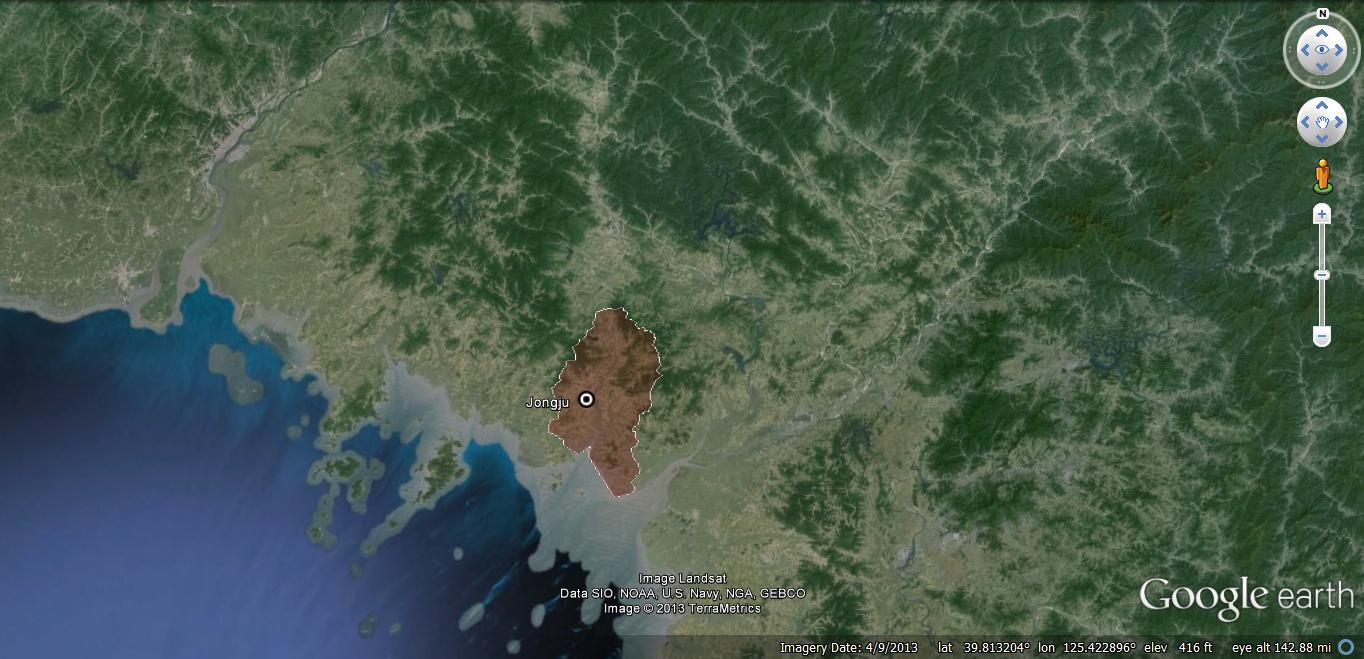
2013-12-Jongju

Pictured above (Google Earth): Jongju County

According to Mining.com:

Privately-held SRE Minerals on Wednesday announced the discovery in North Korea of what is believed to be the largest deposit of rare earth elements anywhere in the world.

SRE also signed a joint venture agreement with the Korea Natural Resources Trading Corporation for rights to develop REE deposits at Jongju in the Democratic People’s Republic of Korea for the next 25 years with a further renewal period of 25 years.

The joint venture company known as Pacific Century Rare Earth Mineral Limited, based in the British Virgin Islands, has also been granted permission for a processing plant on site at Jongju, situated approximately 150 km north-northwest of the capital of Pyongyang.

The initial assessment of the Jongju target indicates a total mineralisation potential of 6 billion tonnes with total 216.2 million tonnes rare-earth-oxides including light REEs such as lanthanum, cerium and praseodymium; mainly britholite and associated rare earth minerals. Approximately 2.66% of the 216.2 million tonnes consists of more valuable heavy rare-earth-elements.

According Dr Louis Schurmann, Fellow of the Australasian Institute of Mining and Metallurgy and lead scientist on the project, the Jongju deposit is the world’s largest known REE occurrence.

The 216 million tonne Jongju deposit, theoretically worth trillions of dollars, would more than double the current global known resource of REE oxides which according to the US Geological Survey is pegged at 110 million tonnes.

Minerals like fluorite, apatite, zircon, nepheline, feldspar, and ilmenite are seen as potential by-products to the mining and recovery of REE at Jongju.

Further exploration is planned for March 2014, which will includes 96,000m (Phase 1) and 120,000m (Phase 2) of core drilling, with results reported according to the Australia’s JORC Code, a standard for mineral disclosure similar to Canada’s widely used National Instrument 43-101.

Also from Mining Weekly:

SRE Minerals Limited announces the results of exploration and studies in collaboration with the Korea Natural Resources Trading Corporation of the Democratic People’s Republic of Korea

SRE Minerals Limited (“SRE” or “the company”) announced today their joint venture agreement with the Korea Natural Resources Trading Corporation for rights to develop all rare-earth-element deposits at Jongju, North Pyongan Province.

The joint venture company known as Pacific Century Rare Earth Mineral Limited has the rights under the joint venture agreement which includes the exploration, mining, beneficiation and marketing of all REE deposits in the Jongju area for the next 25 years with a further renewal period of 25 years.

Under the terms of the JV agreement SRE has also been granted permission for a National Rare Earth Mineral Processing Plant on site at Jongju, which is situated approximately 150 km north-northwest of the capital city of Pyongyang, within the North Pyongan Province, Democratic People’s Republic of Korea.

Leading Australian mining and geological consultancy, HDR Salva Resources Pty Ltd, has been SRE’s technical representative for the project and has been commissioned to access the mineralised potential of the Jongju REE target* with special reference to detailed mapping, extensive trenching and limited drilling.

HDR Salva Resources (Pty) Ltd.’s initial assessment of the Jongju REE Exploration Target* indicates a total mineralisation potential of 6.0 Bt (216.2 Mt total rare-earth-oxides including light rare-earth- elements such as lanthanum, cerium and praseodymium (mainly britholite and associated rare earth minerals). Approximately 2.66% of the 216.2 Mt TREO consists of heavy rare-earth-elements. A detailed classification of mineralised potential present in the Jongju REE Target* is presumed to be:

• 664.8 Mt @ >10.00% TREO,
• 1.1 Bt @ 4.72% TREO,
• 579.4 Mt @ 3.97% TREO, and
• 3.63 Bt @ 1.35% TREO.

Dr Louis Schurmann said: “The Jongju Target* would appear to be the World’s largest known REE occurrence.”

Technical information in this announcement has been compiled by Dr Louis W. Schurmann, who is a Fellow of the Australasian Institute of Mining and Metallurgy and a Professional Natural Scientist with over 18 years of experience relevant to the styles and types of rare earth mineral deposits under consideration, and to the activities which has been undertaken to qualify as a Competent Person as defined by the Australasian Code for Reporting of Minerals Resources and Reserves (JORC) 2004. Dr Schurmann consents to the inclusion of information in this publication.

Further exploration is planned to recommence in March 2014, which will include 96,000m (Phase 1) and 120,000m (Phase 2) of core drilling. Results from the exploration program will be reported according to the Joint Ore Reserves Committee of The Australasian Institute of Mining and Metallurgy, Australian Institute of Geoscientists and Mineral Council of Australia (JORC Code (2004 / 2012)).

Investigations by the DPRK’s Academy of Science geologists have also identified several HREE targets*. There are also seven newly discovered carbonatite complexes which have been identified as green-field exploration targets. Exploration programs have been planned to assess their potential in 2014, together with the evaluation of known bastnasite and monazite deposits.

According to the mentioned HDR Salva Resources’ assessment, the Jongju REE Target* also contains economical quantities of rare and critical metals associated with fluorite, apatite, zircon, magnetite, ilmenite, nepheline and feldspar. These commodities will also be addressed during future exploration and further studies.
“This joint venture agreement reinforces the strong and constructive relationship SRE has developed with the DPRK over that time,” he said.

“The REE resource potential of the DPRK, while estimated to be massive has only been lightly explored to date. Given the major economic significance of the effective utilisation of these important minerals to the DPRK, we look forward to working in close co-operation with our partner to progress the development of this excellent opportunity.”

In terms of back ground, the majority of rare earth elements were sourced from placer deposits in India and Brazil in 1948. During the 1950’s, supply came mainly from South Africa, mined from large veins of rare earth-bearing monazite. Then from the 1960’s to 1980’s, rare earths were supplied primarily from the U.S., predominantly from Mountain Pass in California. Competition from China and environmental concerns eventually saw the U.S. operations shut down, and for the last 15 years China has dominated global supply. China today supplies an estimated 90-95% of the global market.

China has recently set quotas to restrict its rare earth exports, and global suppliers have made considerable headway in reducing dependence on Chinese supply. Based on this, several major rare earth companies have been taking advantage of this situation while many junior exploration companies have embarked on exploration programs to add value to small and relatively low-grade REE occurrences.

References to Exploration Target(s)* or Target(s)* in this document are in accordance with the guidelines of the JORC Code (2004). As such it is important to note that in relation to reported Exploration Targets or Target any reference to quality and quantity are conceptual in nature. Exploration carried out to date is insufficient to be able to estimate and report rare-earth mineral resources in accordance with the JORC Code (2004). It is uncertain if further exploration will result in the determination of a rare earth mineral Resource.

Further information will be available at www.pcreml.com and www.sreminerals.com

Here is coverage in Voice of America,  Time, The Diplomat.

Read the full story here:
Largest known rare earth deposit discovered in North Korea
Mining.com
Frik Els
2013-12-5

Share

DPRK – PRC trade up 6.2% in Jan – Oct 2013

Wednesday, December 4th, 2013

According to Yonhap:

Trade between North Korea and its major trading partner China rose 6.2 percent on year in the first 10 months of this year to total US$4.72 billion, data showed Wednesday, despite international sanctions against Pyongyang over its defiant nuclear and missile tests.

The rise suggested that North Korea is becoming increasingly reliant on China, although Beijing is not supportive of Pyongyang’s nuclear ambition.

In the 10-month period, North Korea’s exports to China jumped 12.3 percent on year to account for $2.36 billion, according to data by the China Customs Information Center. The North’s imports gained 1.8 percent to $2.36 billion.

Remarkably this data shows a perfect balance of trade between the DPRK and China (exports=imports). This is a reversal from earlier in the year when it was reported that DPRK – PRC trade volumes had fallen from the previous year. See previous posts on DPRK trade statistics here.

Read the full story here:
Trade between N. Korea, China rise 6.2 pct in Jan-Oct despite sanctions
Yonhap
2013-12-4

Share

DPRK harvest up 5% for third year, but chronic malnutrition persists

Thursday, November 28th, 2013

“Speical Report: FAO/WFP crop and food security assessment mission to the Democratic People’s Republic of Korean”
Read the full report here (PDF)Previous reports here.

According to the UN WFP/FAO Press Release (on Thanksgiving day!):

ROME/PYONGYANG – A nationwide assessment by two United Nations agencies shows an increase in staple food production in the Democratic People’s Republic of Korea (DPRK) for the third year running.

The report, however, notes that although rates of child malnutrition have steadily declined over the past 10 years, rates of stunting caused by malnutrition during the first 1,000 days of a child’s life remain high and micronutrient deficiencies are of particular concern.

The joint Crop and Food Security Assessment Mission to the DPRK by the Food and Agriculture Organization (FAO) and World Food Programme (WFP) visited all nine agricultural provinces in late September and early October around the main annual cereal harvest.

Total food production is estimated at about 5.03 million metric tons (including milled rice) in 2013, which is about a 5 percent increase over the previous year. Despite the improved harvest, the food security situation is still unsatisfactory with 84 percent of households having borderline or poor food consumption.

The mission observed immense logistical challenges for the public food distribution system and expressed concerns about the timeliness and consistency of distributions. Markets and informal mechanisms of bartering and other forms of exchange are believed to be of increasing importance for access to food by families, particularly in urban areas.

“Despite continued improvement in agricultural production, the food system in the DPRK remains highly vulnerable to shocks and serious shortages exist particularly in the production of protein-rich foods,” said Kisan Gunjal, FAO economist and co-leader of the mission. “In the interest of increased protein consumption and to reverse the downward trend of soybean production, the price paid to farmers for soybean should be increased.”

Since 1998, WFP in partnership with the government has produced blended fortified foods and nutritious biscuits for children and pregnant or nursing women. WFP has recommended a shift to a new product – Rice Soya Milk Blend – for children in nurseries to reduce stunting and wasting.

“Improving the diversity and quality of food provided through the child institution system is essential to improving children’s nutrition,” said WFP DPRK Country Director Dierk Stegen. “We want to produce Rice Soya Milk Blend but can only do so if we receive sufficient donor support.”

Despite a small reduction in the area planted, overall crop production in 2013/14 is estimated to increase due to generally favourable weather conditions that resulted in a higher rice crop.

The aggregate production from cooperative farms, plots on sloping land and household gardens estimated by the mission includes the 2013 main season harvest and the forecast for 2014 early season crops. Unusually early and heavy rains in July and early August compromised maize and soybean yields but had little effect on paddy.

The report estimated cereal import requirements at 340,000 metric tons for the 2013/14 marketing year (November/October). Assuming the official import target of 300,000 metric tons of cereals is met, there remains an uncovered food deficit of 40,000 metric tons for the current marketing year.

While this food gap is the narrowest in many years, it needs to be bridged either through additional purchases by the government and/or international support to avoid increased undernourishment during the current marketing year.

To improve food security and nutrition, the report recommends national and international support for sustainable farming practices, better price and market incentives for farmers and improvements in farm mechanization.

In nutrition, the report recommends that efforts should go toward improving dietary diversity and feeding practices for young children and women through strategies such as behavioural change, market reform and encouraging livestock and fish production; strengthening treatment of severe and moderate acute malnutrition; and better hygiene and sanitation practices.

ADDITIONAL INFORATION:

1. Here is a follow up report in 38 North by Randall Ireson.

2. Here is coverage in the Wall Street Journal and Assocaited Press.

3. High-Resolution photographs from DPRK can be downloaded here.


Share

Skilled North Koreans in Russia

Tuesday, November 26th, 2013

According to Yonhap:

The number of skilled North Korean workers in Russia has jumped 2.8-fold in the first nine months of this year compared to 2012, a report showed Tuesday.

The report by Radio Free Asia that used data provided by Amur Oblast showed 762 cases of work permits being issued to skilled North Koreans in the cited period. Of these, 34 involved permits for specialized workers with considerable technical expertise.

The Washington-based media outlet said the sharp on-year increase is in contrast to the incremental rise in the number of work visas issued for menial laborers, which grew by just 2.2 percent to around 1,700 cases.

Pyongyang has been sending workers to Russia to help the country earn hard currency, with most being hired by Russian logging companies.

The North and Russia held government-level talks on Nov. 12 to facilitate the movement and employment of North Korean workers.

Read the full story here:
Number of skilled N. Korean workers in Russia surge this year: report
Yonhap
2013-11-26

Share

Inter-Korean trade begins to recover in Q4 2013

Sunday, November 24th, 2013

According to Yonhap:

Inter-Korean trade has gradually been returning to normal levels following the reopening of a joint industrial park in North Korea’s border city of Kaesong in September, government data showed Sunday.

According to data from the Ministry of Unification and the Korea Customs Service, two-way trade between South and North Korea amounted to US$152.15 million last month. The amount is equivalent to 80.9 percent of total bilateral trade in the same month last year.

“Exports have grown with the entry of large amounts of raw materials, production facilities and food supplies as (the Kaesong complex) prepares to resume operations in earnest,” a ministry official said, speaking on condition of anonymity.

The complex, which ground to a halt in April amid high security tensions on the Korean Peninsula, reopened in September. Inter-Korean trade is limited to the joint factory park because all other economic exchanges have been banned since May 2010 due to North Korea’s sinking of a South Korean warship in March of that year.

“The Kaesong Industrial Complex is gradually recovering to previous levels,” the official said.

The complex, a key outcome of the first-ever inter-Korean summit in 2000, combines South Korean capital and technology with cheap North Korean labor to produce clothes, utensils, watches and other labor-intensive goods.

The project serves as a key source of cash for the impoverished country.

My compendium of stories related to the closure and reopening of the Kaesong Zone can be found here.

Read the full story here:
Inter-Korean trade recovers following reopening of Kaesong complex
Yonhap
2013-11-24

Share

Recent developments in Rason

Wednesday, November 20th, 2013

A new article in Forbes updates us on some of the changes in Rason:

Tomas Novotny has been in North Korea two days, and he looks frazzled. It was a long journey from Prague, and standing on the street in downtown Rajin, his government minder by his side, he can already see that doing business in the DPRK’s remote northeast will present an unusual set of challenges.

Novotny is here because of that railway line. A brewing technologist with the Czech firm Zvu Potez, he has come to set up a brewery. All the equipment and materials were transported by train–from Prague to Moscow, through Siberia and onto the branch line of the Trans-Korean main line.

“We’re still building the brewery. Come and see it,” says Novotny. The two containers that brought the Zvu Potez equipment from Prague lie 50 meters from the brewery. It’s a great location by the sea in Rajin’s main park. The business is a joint venture between the Czech firm and the Rason regional government, says Novotny, and will target tourists and foreigners. There are about 300 Western tourists–including Russians–a year and about 20,000 Chinese visitors to the country’s northeast.

“When they’ve finished building,” he says, shouting over the drilling, “I’m going to teach three or four locals how to brew. I hope they can speak English. If they can’t it will be interesting.”

He expects to be in Rason for six months establishing the business, but already he misses home and his young son. “I won’t get to speak to them until I go home at Christmas,” he says.

North Korea’s telecommunications challenges are a headache for business, too. Foreigners are able to get 3G on their phones, but it is expensive. International calls are possible but equally pricey.

“When telecommunications become a little more open that will indicate the seriousness of purpose,” says Andray Abrahamian, who directs Choson Exchange, a Singaporean nonprofit that focuses on business and legal training for young North Koreans in the DPRK.

Abrahamian has been watching North Korea for a decade and visited Rason several times. He says things are finally moving, a result of legal changes made in 2010 that helped make Rason more autonomous. Further legal changes two years ago were intended to harmonize Rason’s economic laws with those of China, he says.

“The degree to which [Pyongyang] will allow autonomy to the regional decision makers or local planners has yet to be seen. That’s a key issue for Rason–how autonomous are these places really?” asks Abrahamian, 36.

“Chinese small and medium-size enterprises, from Jilin Province but also Heilongjiang Province, are continuing to come in–Rason is experiencing growth,” says Abrahamian.

Not all the factories are new. The Rajin Garment Factory was built in 1958, long before talk of special economic zones. In the early days it produced school uniforms for North Korean students. After 1991 it took orders from China and today employs 180 staff.

The factory manager stands on the front steps. It’s early evening, and he’s watching a staff volleyball game in the car park. Has business improved since Rason was made a special economic zone?

He shrugs and says: “It’s hard to say. It’s different. For every school uniform we used to get paid 800 won and a 1,200-won government subsidy. Now there is no government subsidy.”

The workers, nearly all women, are given housing and paid 600? to 700 won a month, plus overtime, he says. Inside the factory, on the first floor, close to 100 women are clocking overtime. Wearing blue uniforms and matching head scarves, they are sewing puffer jackets, hurrying to complete a big order. The final step of the process is to sew in the label: “Made in China.”

The tag is written in English, and the woman packing the jackets doesn’t understand the visitors’ raised eyebrows. Apparently this is a common practice.

It’s noisy on the factory floor. The popular all-girl band Moranbong blasts out of speakers, drowning out the whir of sewing machines. It’s impossible to hear the drone of the generator, switched on after yet another power failure, a regular feature of life in the DPRK.

There is a deal in place to bring power from Jilin Province, but the Chinese have been holding it up using the pretext of an environmental impact study.

More Chinese power can’t hurt, says researcher Melvin, “but there are many more substantive problems the North Korean must overcome before serious large-scale investment can move into the country. The DPRK cannot currently credibly commit to any policy–no policy stability, rule of law–and has a poor record of honoring its agreements and impartially enforcing contracts. No independent company will risk serious capital in this environment.”

Another matter is fuel. Joseph Naemi is director of HBOil, an oil trading and refining company based in Ulaanbaatar, Mongolia. HBOil grabbed a few headlines in June when it was reported the firm had acquired a 20% stake in Sungri oil refinery in Rason. That was premature, says Naemi: HBOil has 20% of a state-dominated joint venture called Korean Oil Exploration Corp. International, and a formal commitment with Sungri has yet to be made. Another option is to invest in a refinery on the west coast of the DPRK.

“The easy option is Sungri oil refinery because it’s based on Russian technology and because of its location in terms of the dynamic state of affairs in Rason Special Economic Zone. We are conducting engineering assessment of the refinery to determine the various phases of upgrading and expanding–it’s a work in progress,” says Naemi.

Describing Rason officials as well educated and smart, he says they understand issues of foreign investment protection, taxation and the need to not only be fiscally transparent but also to offer attractive terms to investors.

“I know a number of Mongolian companies, all privately owned, that are at various stages of either investing in North Korea or finalizing their joint ventures so that they can invest. There is a robust relationship between Mongolia and North Korea,” says Naemi.

For anyone doing business, there will be surprises. Standing on the terrace of the new brewery, Novotny looks out at the recently planted lawn. The seeds have been planted in rows, five centimeters apart, all the way down to the sea. Come summer and the warmer weather, the grass should have taken. It stands to be a great spot for a bar.

“Yeah, if we’re still open,” says Novotny and laughs. He drops his voice and out of earshot of his minder adds: “Look at the grass, see how it grows in such straight lines. Things are different here.”

Read the full story here:
Things are Brewing in North Korea’s Rason Zone
Forbes
Kate Whitehead
2013-11-20

Share